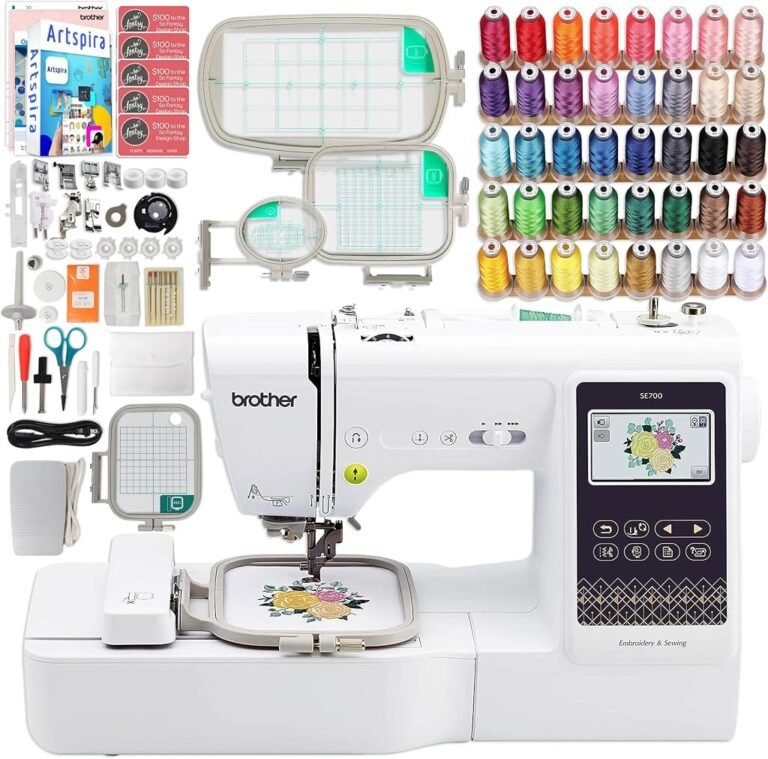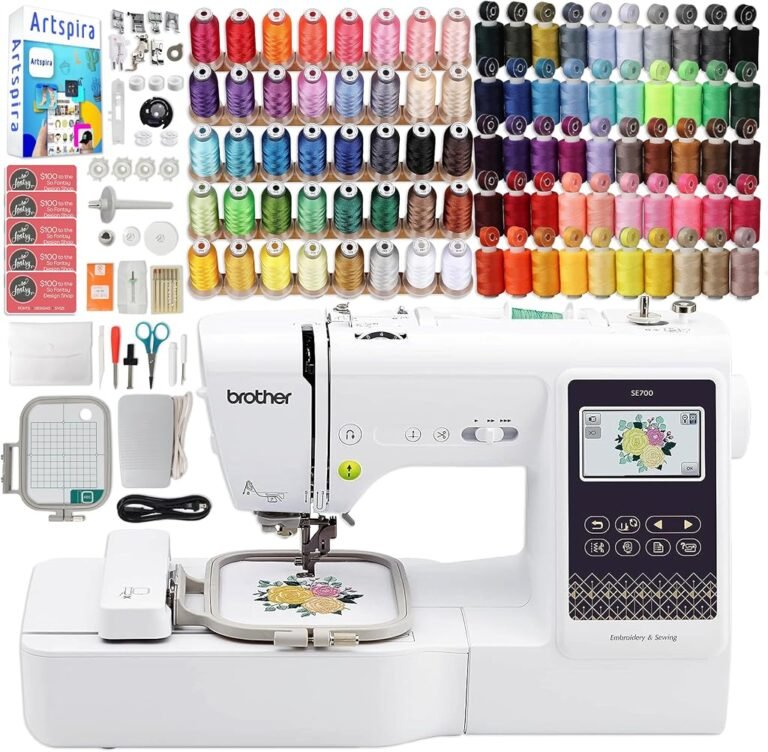
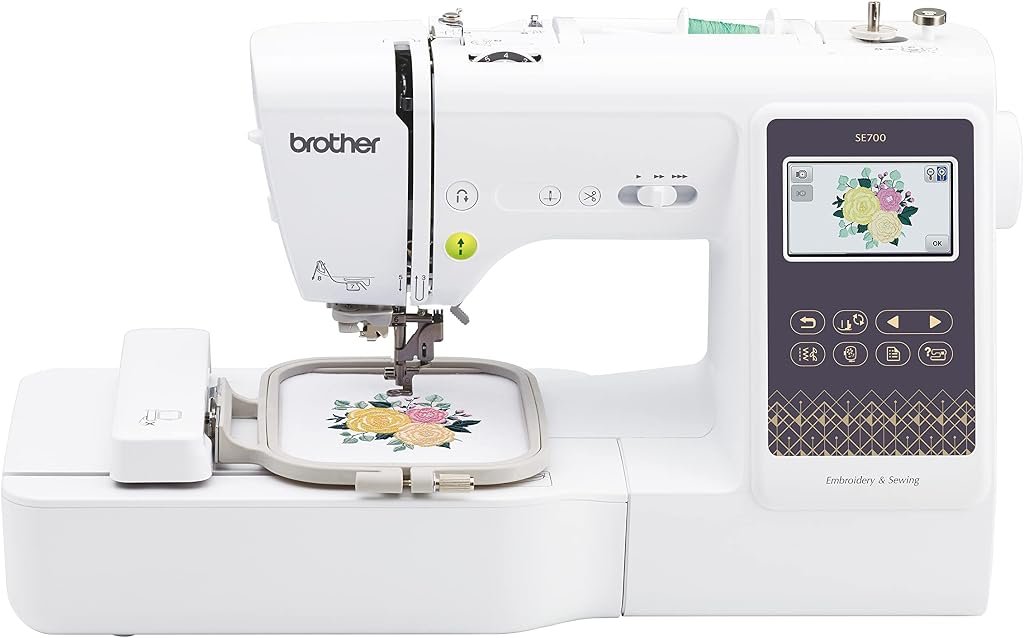
The Brother SE700 sits at an interesting point in the sewing-machine market: sophisticated enough to introduce genuine computerized embroidery, yet restrained enough that a new owner does not need a dedicated studio or production-business workload to justify it. It combines conventional sewing with a 4 × 4-inch embroidery platform, wireless connectivity, on-screen editing, automatic thread cutting, and access to Brother’s expanding digital design ecosystem.
That combination earns the SE700 an Our Score of 8.71/10. Customer Sentiment stands at 8.5, Buyer Confidence at a particularly strong 9.8, and Value at 8.28. Those figures describe a machine with a coherent purpose rather than an absence of compromises.
The central compromise is the 4 × 4-inch embroidery field.
For monograms, small decorative motifs, children’s garments, patches, compact logos, personalized towels, and similar projects, that field can be perfectly workable. Larger embroidery ambitions expose its boundary quickly. The buyer deciding whether the SE700 belongs among the best sewing and embroidery machines for a particular household should therefore spend less time counting built-in designs and more time thinking about the physical dimensions of future projects.
That is where this machine becomes easier to understand.
What the Brother SE700 Actually Is
The SE700 is a computerized combination sewing and embroidery machine rather than an embroidery-only model.
According to Brother’s official SE700 specifications, the machine provides 135 built-in embroidery designs, 10 embroidery lettering fonts, more than 103 built-in sewing stitches, 10 one-step auto-size buttonhole styles, wireless LAN connectivity, a 3.2 × 1.8-inch LCD display, automatic thread cutting, and sewing speeds up to 710 stitches per minute. Its maximum embroidery area is 4 × 4 inches.
Those specifications establish its position quite clearly. The SE700 is not trying to replace a large-field embroidery machine or a multi-needle commercial system. It is designed to give one machine two distinct personalities.
In sewing mode, it handles conventional construction and decorative stitching. In embroidery mode, an embroidery unit controls the hoop so digital designs can be stitched automatically.
That distinction matters because decorative sewing stitches and machine embroidery are sometimes treated as though they were interchangeable. They are not. Decorative stitches still follow the normal sewing process, with fabric moving through the feed system. Embroidery places stabilized fabric in a hoop and moves that hoop according to digital stitch coordinates.
The SE700 provides both methods.
The 4 × 4-Inch Embroidery Field Defines the Experience
A review of the SE700 that relegates hoop size to a specification table misses the machine’s defining limitation.
Four inches by four inches means a design must fit within an embroidery field approximately 100 × 100 mm when using the machine’s maximum standard embroidery area. Brother itself describes the SE700 as a 4 × 4-inch machine.
For small designs, this is not inherently restrictive. Initials on a towel do not require a jacket-back-sized embroidery field. Neither do many children’s motifs, compact decorative elements, names, small logos, or patches.
Problems emerge when the buyer’s ambitions expand.
A design larger than the available field cannot simply be stitched because there appears to be enough fabric around the hoop. It must be resized, divided, repositioned, or otherwise adapted. Multi-position techniques can extend what an experienced user accomplishes, but they also introduce more setup and alignment work.
This is the dividing line in the SE700 buying decision.
A beginner who expects to explore embroidery through compact projects has room to learn without purchasing substantially larger equipment. A buyer already collecting large embroidery files, planning sweatshirt fronts, large decorative panels, or expansive compositions should examine larger-field machines before buying.
The SE700’s embroidery field is not a hidden defect. It is a visible engineering boundary that needs to match the work.
Sewing Capability Makes the Machine More Than an Embroidery Starter
The combination architecture becomes particularly persuasive when the buyer does not already own a capable sewing machine.
Brother specifies more than 103 built-in sewing stitches and 10 one-step auto-size buttonhole styles. The machine also includes an advanced needle-threading system and automatic thread cutter, while its listed sewing speed reaches 710 stitches per minute.
That makes the SE700 relevant for ordinary construction and repair work rather than limiting it to decorative personalization.
A user can sew a project and subsequently embroider it on the same machine. For households with limited table or storage space, that arrangement has obvious practical merit.
There is also an operational drawback.
The machine cannot perform both jobs simultaneously. During an extended embroidery design, it is effectively unavailable for sewing. That barely matters when embroidery is occasional. It becomes more irritating as output rises.
This is one reason experienced users sometimes migrate toward separate sewing and embroidery machines. The embroidery machine can stitch while garment construction proceeds elsewhere.
For an entry-level or space-conscious setup, however, combination equipment avoids buying and storing two machines before there is evidence that two are necessary.
Wireless LAN Is More Useful Than It First Appears
The SE700’s wireless capability is one of the features that separates it from older entry-level workflows.
Brother states that its Design Database Transfer software can send embroidery data wirelessly from a Windows PC to compatible wireless LAN machines. The software also provides thumbnail-based management of embroidery files.
That removes one repetitive physical step from design transfer.
Embroidery users often accumulate substantial digital libraries. A project may begin with a purchased design, a personally created file, or something edited elsewhere. Historically, moving files between computer and machine commonly involved removable media. Wireless transfer does not alter stitch quality, but it can reduce friction around file management.
The distinction between convenience and capability matters here.
Wi-Fi does not make a 4 × 4 machine stitch a 5 × 7 design. It does not improve stabilization. It does not correct poor digitizing. It does not choose suitable thread tension. It simply makes one part of the workflow less cumbersome.
That is still meaningful because repetitive minor inconveniences become disproportionately irritating over years of ownership.
Artspira Gives the SE700 a Mobile Workflow
The SE700 is compatible with Brother’s Artspira platform, adding another layer to its connected-machine identity.
Brother says Artspira can transfer designs to compatible embroidery machines after the app and machine are connected. The user selects and edits a design, chooses the receiving machine, and transfers it to the machine’s temporary data area.
Brother also documents support for importing external embroidery files into Artspira in PES, PHC, PHX, and DST formats.
That is more significant than simply having another library of pictures.
Machine embroidery increasingly exists as a software-and-hardware workflow. Designs have to come from somewhere, and the easier it is to move them between devices, the less the embroidery machine feels isolated from the user’s broader creative process.
There are boundaries. Brother’s support documentation states that Artspira transfers only one pattern at a time; previously transferred server data can be overwritten if it has not first been retrieved.
The workflow is therefore convenient rather than unlimited.
On-Screen Editing Reduces Trips Back to the Computer
The SE700’s color LCD provides on-machine design interaction rather than forcing every adjustment back through external software.
Brother specifies a 3.2 × 1.8-inch LCD and on-screen editing capability.
A display of this scale should be judged according to the machine’s class. It is not intended to imitate the expansive interface of a high-end embroidery system. Its purpose is to make routine design selection and adjustment accessible at the machine.
That distinction has practical consequences.
Embroidery frequently involves small positional decisions: orientation, placement, lettering arrangement, and similar adjustments. A usable machine interface reduces the number of interruptions between preparation and stitching.
The SE700’s screen therefore belongs in the convenience column rather than the large-format design-workstation column.
Built-In Designs Are Useful, but They Should Not Drive the Purchase
The SE700 includes 135 embroidery patterns and 10 embroidery fonts.
These numbers are easy to market because they are easy to compare. They are much less decisive than they appear.
Embroidery machines are rarely confined to their factory libraries. Wireless transfer, imported files, and platforms such as Artspira mean the design catalog can expand far beyond what was installed at the factory.
The buyer should therefore prioritize embroidery field, transfer methods, usability, sewing functionality, service support, and project requirements ahead of the raw number of included motifs.
Built-in designs are convenient on the first day. Hoop dimensions remain relevant for the life of the machine.
Our Score: Why the SE700 Earns 8.71/10
Our Score of 8.71/10 reflects a machine whose strengths are unusually coherent for its intended audience.
The combination of sewing and embroidery reduces the need for separate equipment. Wireless LAN modernizes design transfer. Artspira creates a mobile route into the embroidery workflow. Automatic thread cutting and needle-threading assistance address repetitive machine interaction. The 135 included designs and 10 embroidery fonts provide enough internal material to begin working without immediately building an external design library.
The score stops short of the highest tier primarily because the SE700’s long-term flexibility is constrained by the 4 × 4-inch embroidery field.
That limitation matters more as skill grows.
A novice can learn stabilizer selection, hooping, thread management, placement, lettering, design transfer, and machine operation on a 4 × 4 platform. Once those skills are established, the natural desire is often to make larger projects. At that point, the physical field rather than the user’s knowledge can become the bottleneck.
An 8.71 score therefore describes a highly convincing entry-level combination machine, not a universal embroidery endpoint.
Customer Sentiment: 8.5
Our Customer Sentiment score of 8.5 reinforces the broader assessment that the SE700’s proposition works well when expectations align with its size and category.
That distinction deserves emphasis because sewing machines are unusually sensitive to expectation mismatch.
A buyer expecting commercial embroidery throughput from a compact single-needle combo machine is likely to find limitations quickly. A user seeking small-format personalization alongside general sewing encounters a much more coherent machine.
The score therefore fits a product with broad appeal but a clearly defined ceiling.
Buyer Confidence: 9.8
Buyer Confidence is the SE700’s strongest editorial signal at 9.8.
Part of that confidence comes from clarity. The machine’s core capabilities are straightforward and well documented by Brother. Its embroidery area, built-in design count, fonts, sewing stitches, wireless connectivity, screen dimensions, sewing speed, automatic thread cutter, Artspira compatibility, and warranty structure are explicitly documented by the manufacturer.
Support infrastructure also matters with computerized equipment. Brother’s SE700 support portal provides access to manuals, downloads, warranty information, compatible supplies, frequently asked questions, and contact channels.
A computerized sewing and embroidery machine is not merely a motor, needle bar, and feed mechanism. Software, design transfer, file compatibility, documentation, and troubleshooting increasingly affect ownership.
That makes manufacturer support more relevant than it might be for a purely mechanical sewing machine.
Value: 8.28
Our Value score is 8.28.
The SE700’s value comes from consolidation. It performs both sewing and embroidery, which can remove the immediate need to purchase two machines. Its digital connectivity also means the buyer is not paying for an embroidery platform isolated from contemporary file-transfer workflows.
Yet value depends heavily on intended use.
Someone interested exclusively in sewing would be paying for an embroidery system that may sit unused. Someone interested exclusively in serious embroidery might be better served by directing the budget toward a dedicated machine with a larger field.
The SE700’s strongest value case lies between those extremes: a buyer who genuinely intends to sew and embroider and considers 4 × 4 inches sufficient for the foreseeable project list.
The Most Meaningful Strengths
The SE700’s strengths can be reduced to several practical advantages:
- Sewing and embroidery are combined in one chassis.
- The 4 × 4 format provides an accessible introduction to machine embroidery.
- Wireless LAN reduces reliance on physical file-transfer routines.
- Artspira integration extends design selection and creation into a mobile workflow.
- The machine includes 135 embroidery patterns and 10 embroidery fonts.
- More than 103 sewing stitches and 10 one-step buttonhole styles give the sewing side genuine breadth.
- Automatic thread cutting reduces a repetitive part of both sewing and embroidery work.
- The LCD allows design interaction directly at the machine.
- Brother maintains dedicated support resources for the model.
None of these individually transforms the SE700 into a production machine. Together, however, they create a balanced home platform.
The Drawbacks That Matter
The 4 × 4-inch embroidery area is the principal drawback and should dominate the pre-purchase evaluation.
A second limitation is inherent to all single-machine combination setups: sewing and embroidery cannot occur simultaneously.
The machine is also single-needle equipment. Multicolor embroidery therefore requires more operator involvement than multi-needle commercial systems that can keep numerous thread colors loaded at once.
Its screen, while functional, is relatively compact. Users accustomed to tablets and large touch interfaces should calibrate expectations accordingly.
Wireless functionality also introduces a software component into ownership. That is beneficial when the ecosystem works as intended, but buyers who prefer entirely offline, mechanically simple equipment may place less value on connectivity than the specification sheet suggests.
These are not minor footnotes. They define who should and should not buy the machine.
Who Should Buy the Brother SE700?
The SE700 makes the strongest case for beginners who want to learn both sewing and machine embroidery without buying separate systems immediately.
It also suits established sewers who want to experiment with embroidery but do not yet require large-format designs.
Small-space users have another reason to consider it. One combination machine consumes less permanent workspace than maintaining separate sewing and embroidery stations.
The model is particularly logical for projects such as:
- Monograms and names
- Small logos
- Children’s clothing embellishment
- Towels and linens
- Compact decorative motifs
- Small patches
- Personalized gifts
- General garment sewing and repairs
- Decorative sewing
- Early embroidery experimentation
A buyer whose project list resembles that group is operating inside the machine’s natural range.
Who Should Look Elsewhere?
Anyone already planning designs larger than 4 × 4 inches should investigate larger embroidery fields before purchasing.
The same applies to users intending to build a serious embroidery business. Commercial work does not automatically require commercial machinery, particularly at very low order volumes, but repeated multicolor production quickly exposes the labor requirements of a single-needle setup.
Dedicated garment sewers who have no interest in machine embroidery can also find better allocation elsewhere. Their money can be directed toward sewing-specific features rather than an embroidery module.
Similarly, embroidery-focused buyers who already own a satisfactory sewing machine should compare dedicated embroidery models. Paying twice for sewing functionality offers little benefit unless redundancy itself has value.
How It Fits Among the Best Sewing and Embroidery Machines
The phrase best sewing and embroidery machines can encourage an overly simplistic ranking mentality. Sewing equipment does not work particularly well that way.
A 4 × 4 combination machine, a 5 × 7 embroidery machine, a computerized sewing machine, a serger, and a 10-needle commercial embroidery system are not direct substitutes.
The SE700 deserves attention because its feature set aligns closely with a specific buyer: someone entering computerized embroidery who still needs a capable conventional sewing machine.
Within that role, the 8.71/10 score is justified.
Outside that role, larger or more specialized equipment can make more sense even when it costs considerably more.
Final Considerations
The Brother SE700 is best understood as a bridge between conventional home sewing and connected digital embroidery.
Its 135 built-in embroidery designs, 10 embroidery fonts, more than 103 sewing stitches, 10 one-step buttonhole styles, wireless LAN, Artspira compatibility, LCD interface, automatic thread cutting, and up-to-710-stitches-per-minute sewing speed create a substantial feature set for a compact combination machine.
Our Score of 8.71/10 reflects that balance. Customer Sentiment at 8.5 suggests a broadly convincing ownership proposition. Buyer Confidence of 9.8 is especially persuasive because the machine’s purpose, capabilities, manufacturer documentation, and support structure are unusually clear. Value at 8.28 acknowledges that the combination format delivers meaningful utility while still facing competition from specialized machines.
The decision ultimately turns on four inches.
If the intended embroidery work fits comfortably inside a 4 × 4-inch field, the SE700 combines sewing, embroidery, wireless transfer, and mobile-connected design tools in a coherent package. If larger designs are already part of the plan, that same 4 × 4 boundary is likely to become the reason for an eventual upgrade.
That is the SE700’s defining trade-off. It lowers the threshold for learning computerized embroidery without pretending to be a large-format production platform. For the buyer whose projects match that scale, its limitations are manageable. For the buyer whose ambitions already exceed it, the wiser decision is to start with a larger field rather than pay twice for the same lesson.