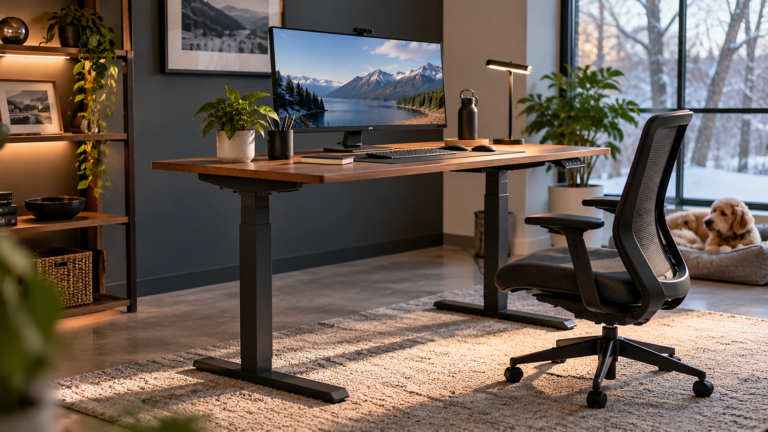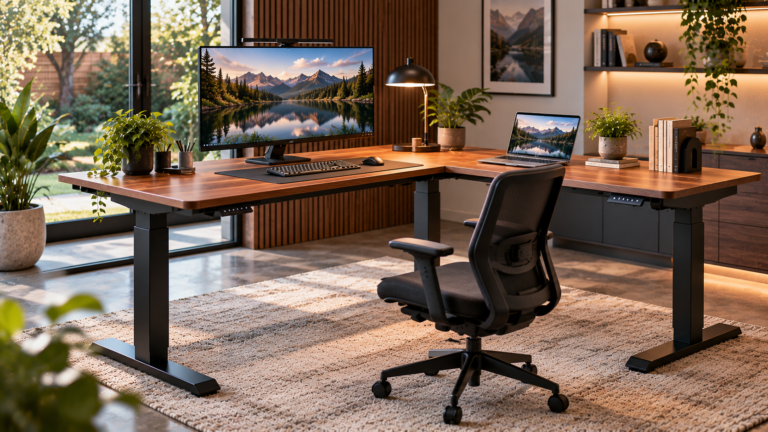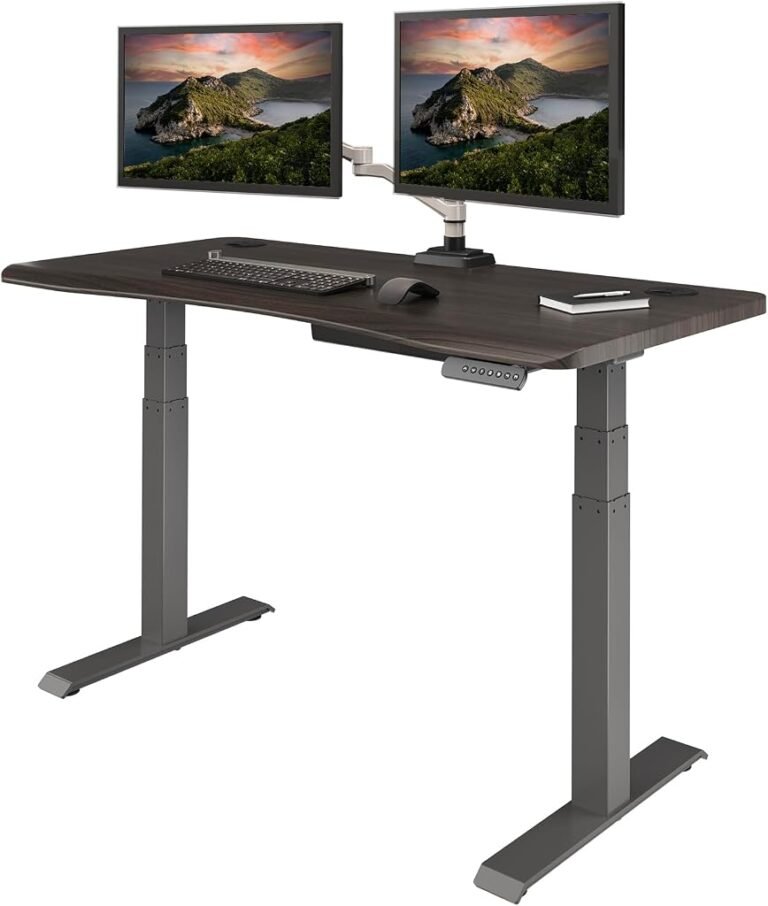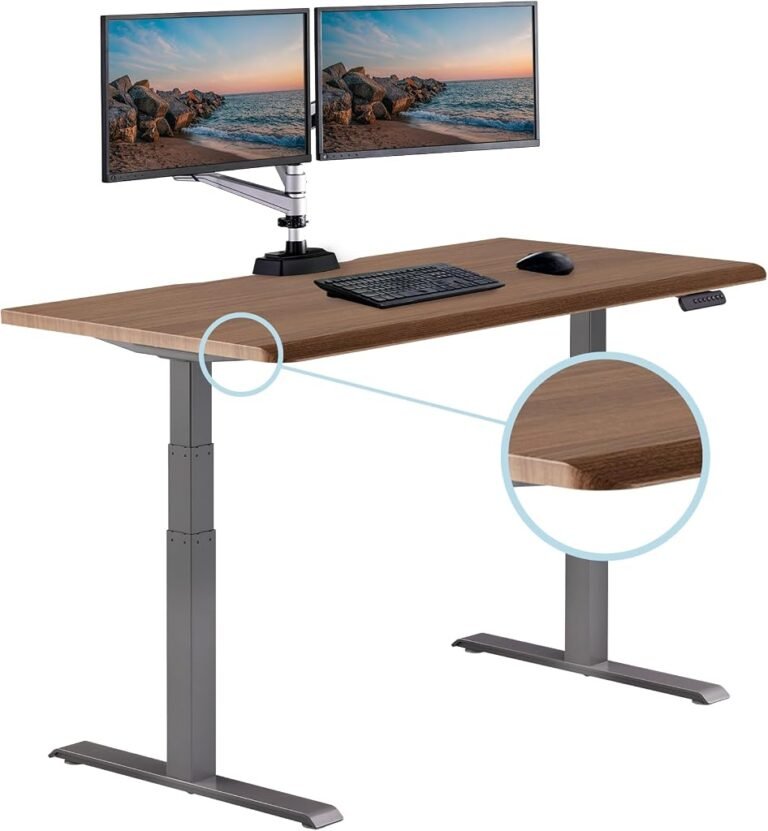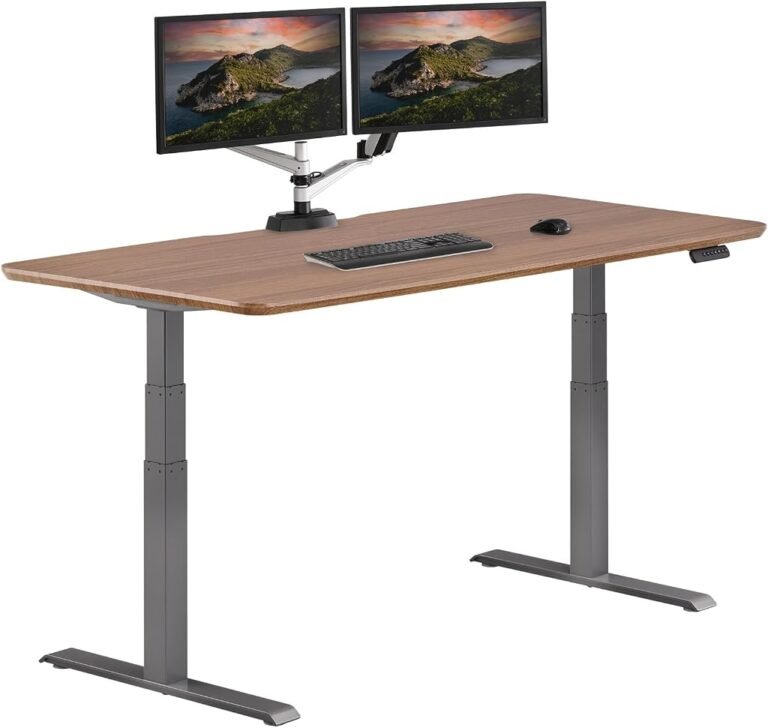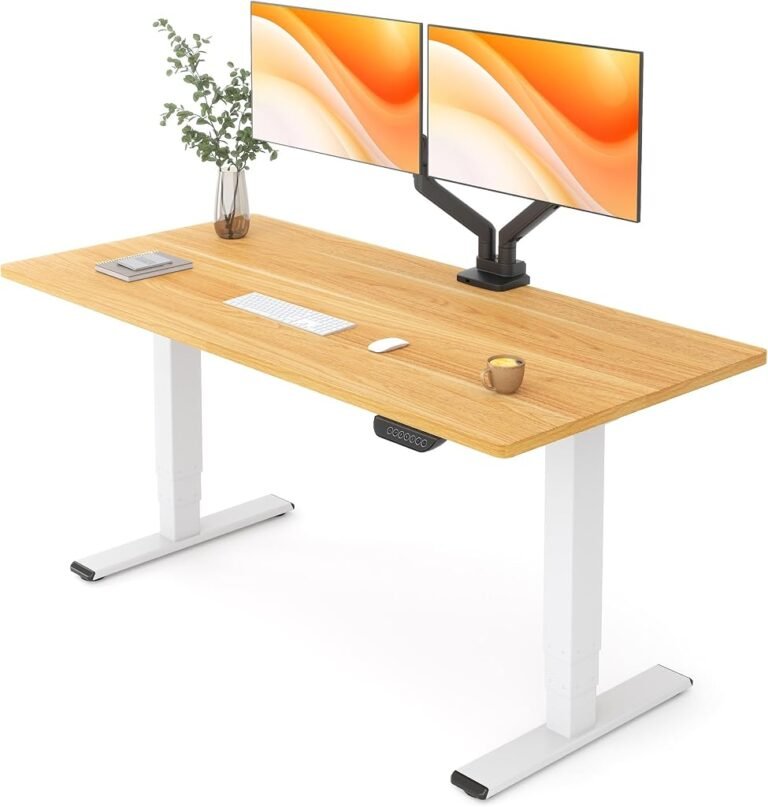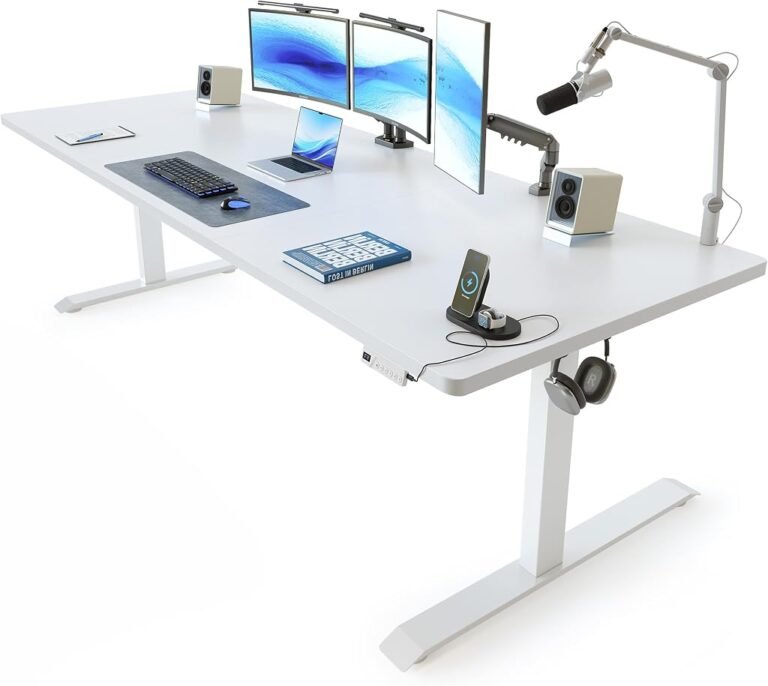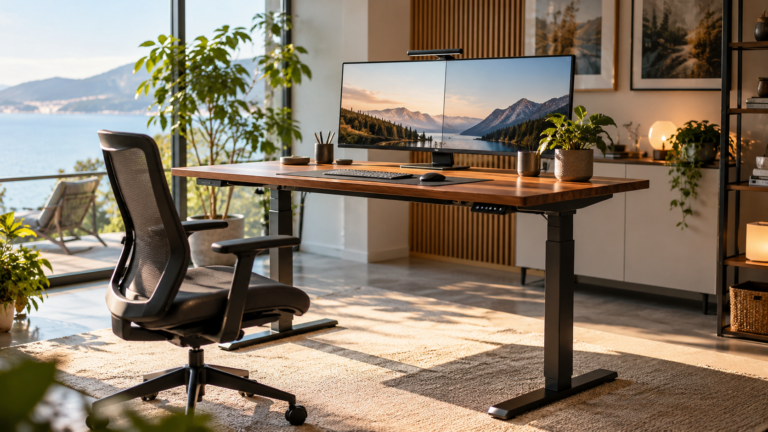
The difference between an electric standing desk and a manual standing desk appears straightforward. One changes height through a motorized mechanism. The other relies on human effort, usually through a hand crank or another mechanical adjustment system.

That distinction, however, has consequences extending well beyond convenience.
The adjustment mechanism influences purchase price, maintenance, noise, operating effort, equipment compatibility, reliability, and the likelihood that a worker will actually change positions throughout the day.
Electric desks offer push-button adjustment and, on some models, programmable height presets. Manual desks eliminate dependence on electricity for height changes and generally use less complicated mechanical systems.
Neither design automatically produces a healthier workstation.
A motor cannot correct poor monitor positioning, and a hand crank cannot compensate for an unsuitable height range. Both systems must accommodate the user’s body, equipment, room, and working habits.
The central purchasing question is therefore not simply whether electric adjustment is worth paying for. It is whether the method of adjustment supports the way the desk will be used over several years.
How Electric and Manual Standing Desks Actually Differ
Electric standing desks use powered lifting mechanisms to raise and lower the working surface.
Depending on the design, the lifting system may incorporate one or more motors, telescoping legs, a control panel, and electronic components that coordinate movement.
Some models provide programmable memory positions, allowing users to return to preferred seated and standing heights without repeatedly adjusting the desk manually.
Manual standing desks operate differently.
Crank-adjustable models use a mechanical drive system to translate turning force into vertical movement. Other manually adjustable designs may use counterbalance mechanisms or mechanical locking arrangements.
These distinctions matter because not all manual desks require the same effort.
A well-designed counterbalanced workstation can be relatively easy to reposition, while a crank-operated desk may require numerous rotations to travel between seated and standing heights.
Similarly, electric desks differ in motor configuration, lifting capacity, operating speed, noise, and control features.
The correct comparison must therefore examine actual mechanisms rather than assuming every electric or manual desk performs identically.
Purchase Price: Manual Desks Have a Simplicity Advantage
Manual standing desks can offer a lower entry price because they do not require an electric motor, electronic controller, or powered adjustment system.
That potential saving is one of their main attractions.
However, a manual mechanism does not guarantee a cheaper finished desk.
Desktop dimensions, frame construction, materials, lifting capacity, storage, and manufacturing quality can influence price as much as the adjustment method.
A substantial manual workstation may cost more than a compact electric model.
The electric market also includes desks with extensive surfaces and integrated storage, making simple price comparisons unreliable.
For perspective, several large electric standing desks illustrate how widely configurations can vary:
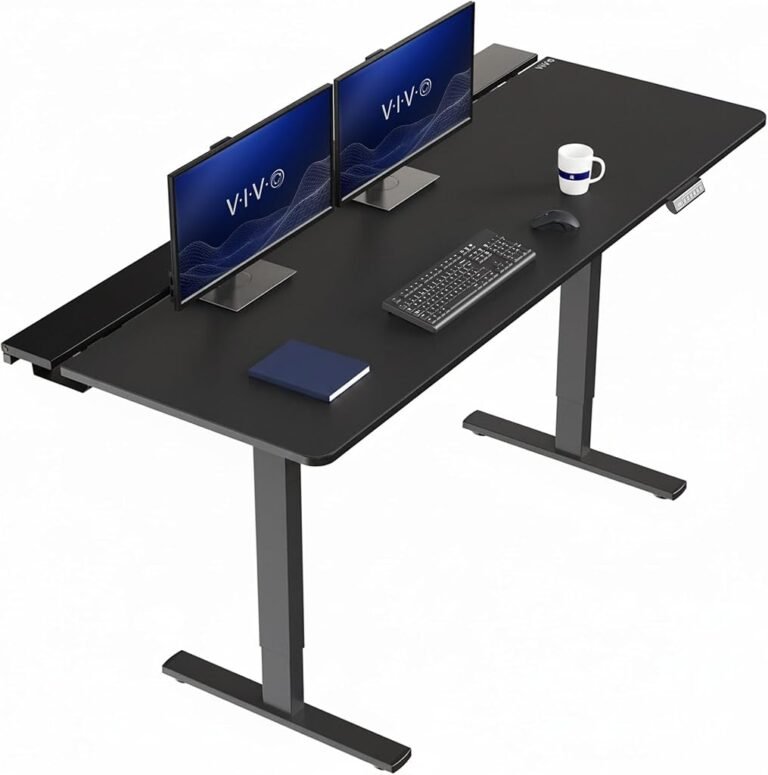
- A 71-by-30-inch VIVO standing desk is priced at $359.99.
- An 83-by-37-inch FEZIBO electric desk with a 1-inch-thick desktop costs $399.99.
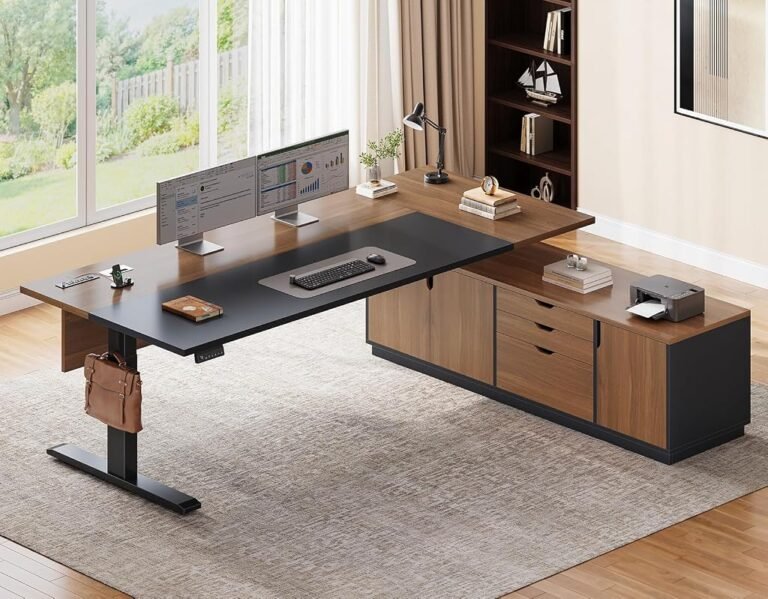
- A 71-inch SEDETA Executive L-shaped electric desk costs $329.99.
- A SEDETA Fluted L-shaped electric desk with four drawers costs $389.99.
- A 63-by-63-inch MOUMON electric desk with drawers and shelves costs $379.99.
These prices demonstrate that electric adjustment is available across several desk formats within a relatively narrow price band.
They do not establish a universal premium over manual desks. A meaningful comparison requires a manual alternative with similar dimensions, materials, adjustment range, and equipment capacity.
The Real Cost Is the Complete Workstation
A desk’s advertised price is only one component of ownership cost.
A more useful calculation includes the furniture and accessories necessary to create a functioning workstation.
Potential expenses include:
- The desk and its lifting mechanism.
- Monitor arms or monitor stands.
- Cable-management accessories.
- Additional storage.
- Replacement components.
- Assembly or installation.
- Delivery and relocation.
- Repairs after warranty coverage ends.
The balance changes according to the buyer’s existing equipment.
Someone who already owns suitable storage may prefer a simple desk frame and desktop.
Another buyer may find an integrated electric desk with drawers and shelves more economical than purchasing separate furniture.
Electric adjustment should therefore be evaluated as one component of the complete office setup rather than an isolated feature.
Adjustment Effort Is the Most Important Everyday Difference
The greatest practical distinction between electric and manual desks appears during ordinary use.
An electric desk generally changes height after the user presses a button.
A crank-operated manual desk requires physical interaction throughout the adjustment process.
That difference may seem minor when a desk is adjusted once.
It becomes more consequential when the worker changes positions several times during the day.
Consider a hypothetical routine involving four complete seated-to-standing or standing-to-seated adjustments daily.
Across 220 working days, that represents 880 height changes annually.
The calculation does not establish how often any particular person should adjust a desk. It illustrates how a small difference in effort can accumulate through repeated use.
With an electric desk, those changes may require only brief interaction with the controller.
With a crank-operated desk, each adjustment involves turning the mechanism until the desired height is reached.
The distinction becomes particularly relevant for workers who alternate between tasks requiring different working positions.
Convenience Can Influence Whether Adjustment Happens
The central purpose of a height-adjustable desk is to make different working positions available.
That benefit becomes less meaningful if changing height is sufficiently inconvenient that the user rarely does it.
An electric mechanism reduces the physical effort associated with adjustment.
For someone working through meetings, writing assignments, computer tasks, and document review, that convenience may encourage more frequent position changes.
Manual adjustment introduces a deliberate interruption.
That is not necessarily undesirable. Some users prefer a simpler mechanical routine and change desk height only occasionally.
However, the amount of effort required should be considered before purchase.
The Occupational Safety and Health Administration’s guidance on computer-working positions recommends varying posture rather than remaining stationary for prolonged periods.
The practical value of an adjustable desk therefore depends partly on how readily its owner can use the adjustment mechanism.
Electric Desks Are Better Suited to Frequent Height Changes
Electric adjustment becomes particularly useful when the desk is expected to move repeatedly.
This includes shared workstations, offices with alternating seated and standing tasks, and environments where different people use the same desk.
Programmable presets, where available, can simplify transitions between preferred heights.
A worker can establish one position for seated keyboard work and another for standing.
Shared desks may benefit from additional presets if the controller supports them.
However, memory functions should not be assumed to exist on every electric model.
Buyers should verify the controller’s capabilities before treating presets as part of the purchasing decision.
For manual desks, repeated adjustments may require greater effort and more time, especially when the height difference is substantial.
The advantage therefore shifts toward electric operation as adjustment frequency increases.
Manual Desks Make a Stronger Case for Occasional Adjustment
Manual standing desks remain sensible when height changes are infrequent.
A worker who prefers to stand during one portion of the day and sit during another may find a crank mechanism entirely manageable.
The same applies to workstations where the desk height is adjusted primarily to accommodate a new user or a changed seating arrangement.
Manual adjustment also removes the need for an electrical connection dedicated to the lifting mechanism.
That can be useful in rooms with limited outlet access or where cable simplicity is a priority.
A mechanical system may also appeal to buyers who prefer furniture with fewer electronic components.
The important distinction is between simplicity and suitability.
A manual desk is not automatically more reliable, and an electric desk is not automatically fragile.
Actual durability depends on component quality, construction, operating conditions, and maintenance.
Reliability: Fewer Electronics Do Not Eliminate Mechanical Risk
Electric standing desks contain components that manual desks generally do not require.
These can include motors, controllers, wiring, power supplies, sensors, and electronic switches.
Each component introduces a possible failure point.
If a motor or controller fails, the desk may become difficult or impossible to adjust until the problem is corrected.
Manual desks avoid several of those electrical failure possibilities.
However, they still depend on mechanical parts.
Crank handles, drive shafts, gears, lifting columns, and connecting components can wear or become misaligned.
The absence of electronics therefore reduces one category of complexity without eliminating maintenance concerns.
What Buyers Should Examine
Reliability assessments should focus on specific purchasing protections:
- Warranty coverage for the lifting mechanism.
- Coverage for motors and electronic controls on electric models.
- Availability of replacement components.
- Accessibility of repair instructions.
- Manufacturer support arrangements.
- Conditions that might invalidate warranty protection.
- Whether the desk can be serviced without replacing the entire frame.
These considerations become increasingly important for buyers expecting many years of daily use.
A lower initial price can lose its advantage if a failed component requires replacing the entire workstation.
Electricity Costs Are Usually a Secondary Consideration
Electric desks consume electricity while their motors operate. Some also draw power while idle, depending on their electronics and standby design.
Manual desks require no electrical power for height adjustment.
That difference is real, but its financial importance should not be exaggerated.
An electric desk’s operating cost depends on motor power, adjustment duration, standby consumption, and the local electricity rate.
Consider a purely illustrative calculation.
If a desk’s motor draws 200 watts while operating and runs for two minutes daily, its adjustment energy use would be approximately 0.0067 kilowatt-hours per day.
Across 220 working days, that would equal approximately 1.47 kilowatt-hours.
At an illustrative electricity rate of $0.20 per kilowatt-hour, the movement itself would cost about $0.29 annually.
This is not a measured figure for any specific desk. It excludes standby consumption and assumes the stated operating power and duration.
The example demonstrates why electricity expense is unlikely to dominate the financial comparison for many users.
Purchase price, repairs, accessories, and replacement costs generally deserve more attention.
Height Range Matters More Than Motor Type
A desk can have effortless electric adjustment and still be ergonomically unsuitable.
The same is true of a manual workstation.
The minimum and maximum heights determine whether the working surface can accommodate the user comfortably.
The OSHA guidance on keyboard positioning emphasizes relaxed shoulders, appropriate elbow positioning, and straight wrists.
Those principles apply regardless of how the desk moves.
A user should be able to reach a comfortable seated keyboard height without raising the shoulders or placing the wrists in awkward positions.
The standing position should also support natural arm alignment.
One electric example, the MOUMON L-shaped desk, has a stated height range of 28.9 to 45.3 inches.
That provides 16.4 inches of adjustment.
The range can be compared with an individual’s seated and standing requirements before purchase.
Manual desks require the same scrutiny.
A crank mechanism is not inherently more or less ergonomic than a motor. The usable adjustment range and the resulting working position matter more.
Lifting Capacity: The Desk Must Support Its Equipment
The weight of equipment influences the suitability of both electric and manual standing desks.
A simple laptop setup creates different demands from a workstation carrying several monitors, desktop computers, speakers, books, and specialized equipment.
Electric desks have rated lifting capacities determined by their frame and lifting systems.
Manual desks also have structural and mechanical load limits.
Neither category should be assumed to support heavier equipment without checking the manufacturer’s specifications.
Weight distribution matters as well.
A desk loaded heavily on one side may behave differently from one carrying evenly distributed equipment.
Monitor arms can introduce concentrated loads near mounting points.
Storage-equipped desks may also carry substantial additional material.
Before purchasing, buyers should calculate the approximate combined weight of the desktop equipment and compare it with the desk’s published capacity.
The goal is not merely to avoid exceeding the maximum rating. It is to establish a sensible operating margin for normal use.
Stability Is a Separate Question From Lifting Power
Lifting capacity and stability are related but different characteristics.
A desk may support a specified load while still allowing noticeable movement at greater heights.
As the working surface rises, structural movement can become more apparent.
This matters particularly for users with large monitors or equipment mounted above the desktop.
Small frame movements can become visible as screen vibration.
Neither electric nor manual adjustment guarantees superior stability.
Frame geometry, lifting-column construction, cross-supports, desktop dimensions, and assembly quality all influence the result.
Buyers should therefore distinguish between claims about maximum supported weight and evidence concerning stability at working height.
A powerful motor does not automatically create a rigid frame.
Likewise, a manual mechanism does not guarantee that the desk will remain motionless when fully raised.
Noise: Electric Motors vs Manual Mechanisms
Noise can matter in shared offices, bedrooms, and recording environments.
Electric desks produce sound when their motors operate.
The character and volume of that sound vary between designs.
Manual crank systems may also generate mechanical noise through gears, shafts, and moving components.
Neither category is universally silent.
An electric desk may produce a brief motor sound during adjustment but require little user effort.
A manual desk may avoid motor noise while producing mechanical sounds over a longer adjustment period.
For users working in noise-sensitive environments, the relevant information is the actual operating sound level of the specific model.
Published noise measurements, when available, are more useful than broad claims about one mechanism being quieter.
Cable Management Favors Simplicity, but Not Always Manual Desks
Manual standing desks eliminate the power cable required by an electric lifting mechanism.
That simplifies one part of the workstation.
However, most modern desks still support electrically powered equipment.
Monitors, computers, speakers, chargers, and networking devices require cable management regardless of how the desk changes height.
Both electric and manual desks must accommodate moving cables throughout their adjustment range.
A power cord or monitor cable that works at seated height may become taut when the desk rises.
Loose cables can also interfere with moving components or create hazards beneath the workstation.
The National Institute for Occupational Safety and Health’s office-environment guidance identifies workplace hazards associated with poorly managed cords and unsuitable equipment arrangements.
Cable planning should therefore consider the complete workstation rather than only the lifting mechanism.
Ergonomics Requires More Than Standing
The popularity of standing desks can create an overly simple assumption: standing is beneficial, so standing longer must be better.
Occupational health research does not support such a simplistic interpretation.
In a NIOSH review of prolonged standing at work, researchers examined evidence connecting extended standing with discomfort, fatigue, and other health concerns.
The review emphasized the importance of movement and opportunities to change posture.
This is the central ergonomic argument for adjustable furniture.
The goal is not to replace prolonged sitting with prolonged standing.
It is to create a workstation that allows users to vary their positions and interrupt static work.
Electric desks can make those transitions easier.
Manual desks can support the same changes when their mechanisms are convenient enough to use.
Neither removes the need for walking, stretching, and periodic movement away from the workstation.
The Hidden Trade-Off: Convenience vs Mechanical Independence
Electric and manual desks represent different approaches to everyday control.
Electric adjustment prioritizes convenience.
The user presses a button, and the mechanism performs the work.
Manual adjustment prioritizes mechanical independence.
The user supplies the effort, and the mechanism operates without electricity.
Neither philosophy is inherently superior.
The more frequently a desk moves, the more valuable electric convenience becomes.
The less frequently it moves, the less significant that advantage may be.
For users with limited ability or comfort when operating a crank, electric adjustment may also be particularly useful.
Conversely, someone who values simpler mechanisms and does not need frequent changes may prefer manual operation.
The most revealing question is not whether the desk can change height.
It is how readily the user will change it on an ordinary working day.
A Standing Desk Buying Guide Should Compare Actual Use
A standing desk buying guide should begin with work habits rather than motor specifications.
The following questions provide a practical framework:
- How frequently will the desk change height? Frequent adjustment strengthens the case for electric operation.
- How much equipment will it support? Both categories require suitable lifting and structural capacity.
- Does the height range fit the user? Minimum and maximum heights matter more than the adjustment mechanism.
- Will several people share the workstation? Electric presets can be useful when supported by the controller.
- Is electrical access convenient? Manual desks avoid the need for power dedicated to adjustment.
- How important is maintenance simplicity? Compare actual mechanical and electronic components.
- What does the warranty cover? Repairability and replacement-part availability influence ownership costs.
- How sensitive is the room to noise? Check model-specific operating characteristics.
- Will the desk carry multiple monitors or heavy equipment? Evaluate stability and load distribution.
- Does the complete workstation fit the budget? Include accessories, storage, installation, and potential repairs.
These questions move the purchasing decision away from the assumption that electric always means better or manual always means cheaper.
Which Buyers Benefit Most From Electric Desks?
Electric standing desks are particularly well suited to workers who expect frequent height changes.
They also make sense for shared workstations where users have different preferred working heights.
Computer-heavy offices can benefit from quick adjustment without requiring the user to manipulate a crank while working around monitors and accessories.
Electric operation may also be more practical for people who find repetitive cranking uncomfortable.
The strongest argument is behavioral.
If a desk is easy to adjust, users have fewer practical reasons to remain in one position simply because changing height is inconvenient.
That does not guarantee healthier habits, but it removes a barrier to using the desk’s adjustable function.
Which Buyers Benefit Most From Manual Desks?
Manual standing desks make a stronger case when adjustment is occasional.
They can suit individual workstations where the preferred height changes only a few times daily or less.
They also appeal to buyers who want height adjustment without relying on an electrical connection.
For simple setups, a mechanical lifting system may provide all the functionality required.
The critical condition is that the mechanism must remain practical under the intended equipment load.
A crank-operated desk that requires substantial effort to move may become frustrating if it supports a large workstation.
Buyers should examine the adjustment method, travel distance, and load rating rather than relying on the manual label alone.
Final Considerations
Electric and manual standing desks solve the same basic problem through different mechanisms.
Electric desks reduce the effort required to change height. They are particularly useful for frequent adjustments, shared workstations, and users who value push-button operation.
Manual desks eliminate the need for powered height adjustment and can provide a simpler mechanical alternative. Their appeal is strongest when height changes are occasional and the adjustment mechanism remains comfortable to operate.
The financial comparison is less straightforward than the categories suggest.
Manual desks may offer lower initial costs, but desktop size, frame construction, equipment capacity, and manufacturing quality can alter the price relationship.
Electric desks introduce motors and electronics that may require repair or replacement, while manual desks retain their own mechanical maintenance requirements.
Electricity expense is generally a secondary consideration compared with purchase price, durability, and the cost of maintaining a complete workstation.
Ergonomically, neither category holds an automatic advantage.
The correct height range, suitable equipment positioning, adequate legroom, stable construction, and opportunities for movement matter more than whether adjustment is powered.
For workers who change position frequently, electric operation offers a practical advantage that can justify a higher price.
For workers who rarely adjust their desks, a well-designed manual mechanism may provide the necessary flexibility without additional electronics.
The decision should therefore begin with three questions: How often will the desk move? How much equipment must it support? Can it reach comfortable working heights?
Once those answers are established, the remaining trade-offs become easier to evaluate.
The better standing desk is not necessarily the one with the more sophisticated lifting mechanism. It is the one whose adjustment system, dimensions, reliability, and cost fit the way the workstation will actually be used.