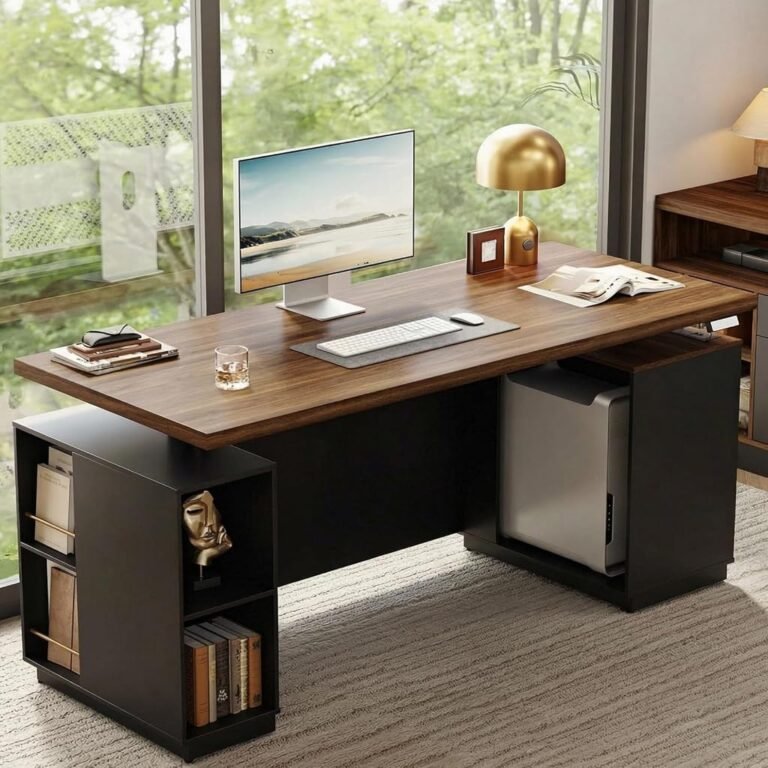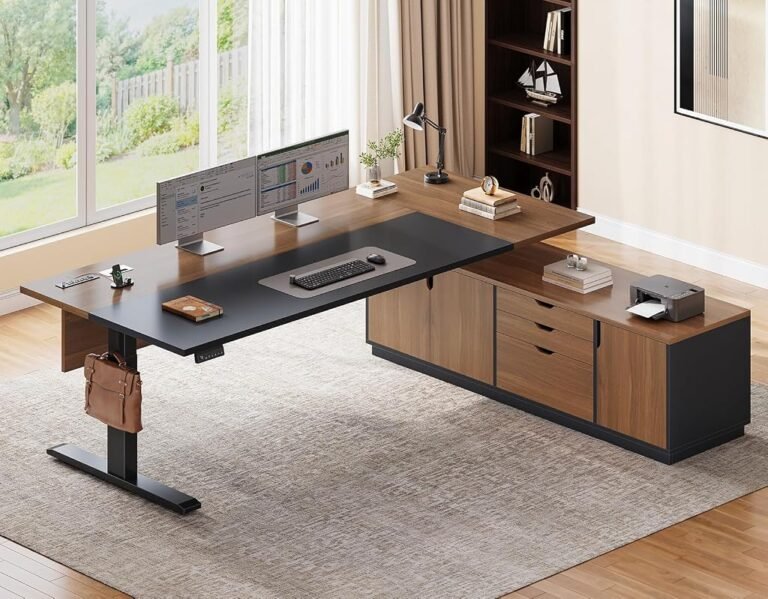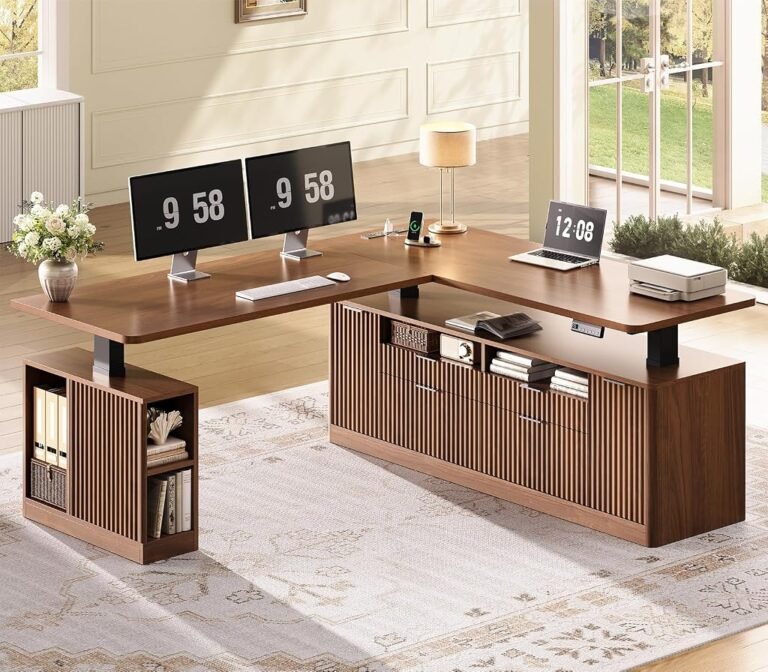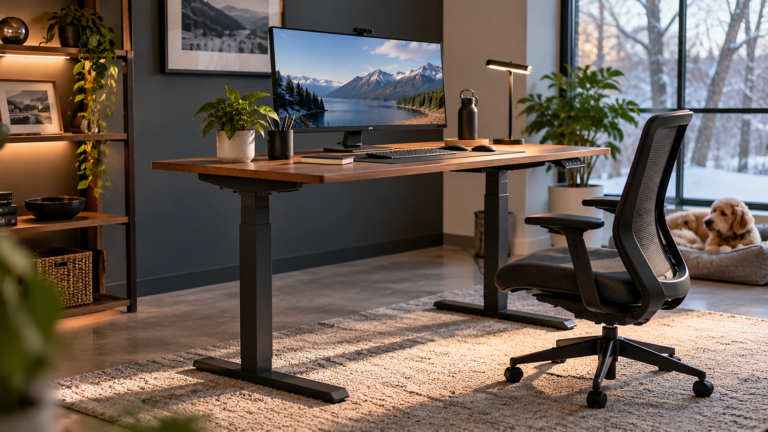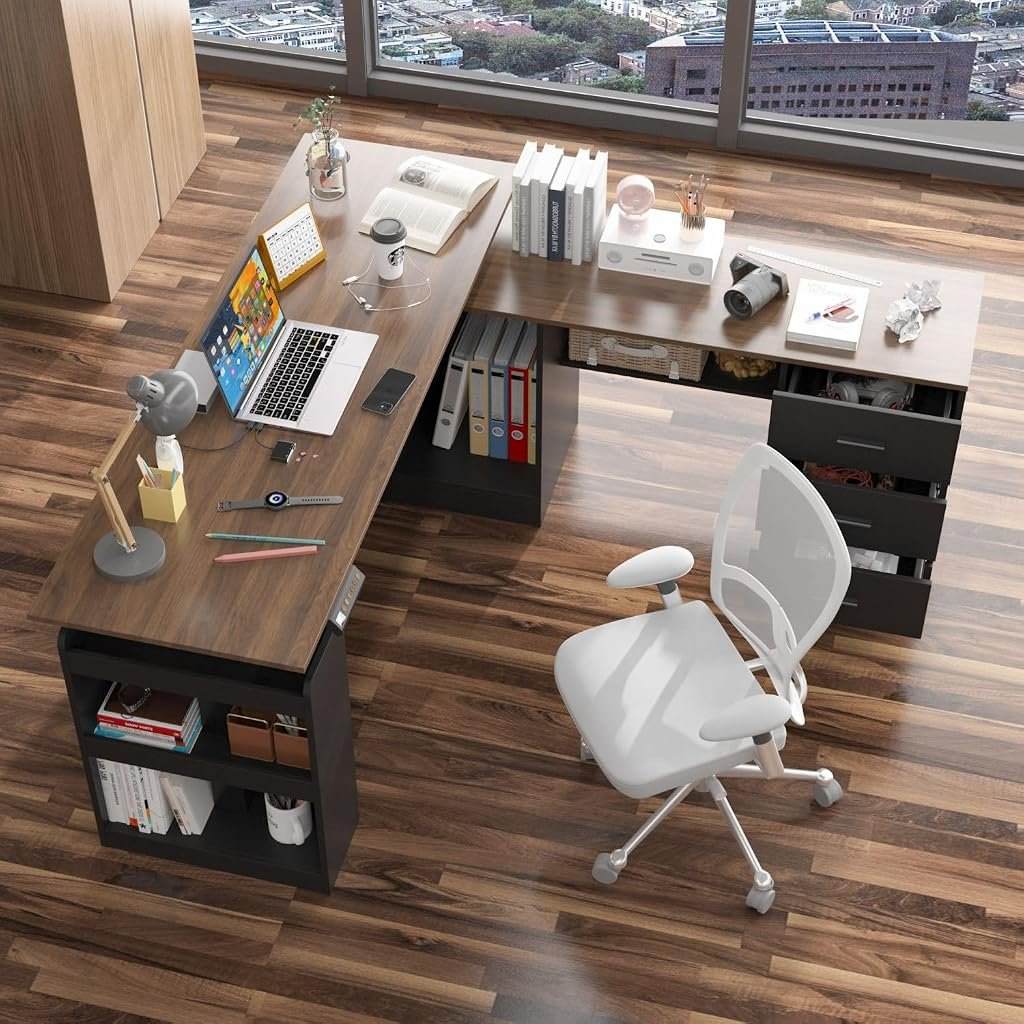
The MOUMON Executive L-Shaped Electric Standing Desk combines several furniture ideas that are often sold separately: an electrically adjustable workstation, a 63-inch L-shaped surface, drawers, and shelving. Its deep brown and black finish pushes the design toward traditional executive furniture rather than the stripped-down appearance common among basic sit-stand desks.
At $379.99, the MOUMON is not trying to compete solely on the presence of an electric lifting mechanism. Its case rests on integration. The desk measures 63 inches wide by 63 inches deep and adjusts from 28.9 to 45.3 inches high, giving buyers concrete dimensions to assess before making room for what is, physically, a substantial piece of office furniture.
Our editorial score is 8.17/10. Customer Sentiment stands at 8.06, Buyer Confidence at 8.64, and Value at 8.03. The relatively narrow spread between these ratings reflects a workstation with a coherent identity: it combines storage, surface area, and adjustable height without asking the buyer to assemble those functions from several separate pieces of furniture.
That combination also creates the desk’s main challenge. More functionality requires more space, more deliberate organization, and greater attention to ergonomic positioning. The MOUMON makes the strongest case for itself when its drawers, shelves, L-shaped layout, and electric adjustment all have specific jobs to perform.
The MOUMON’s Design Starts With Its 63-by-63-Inch Footprint
The first fact that should influence a purchasing decision is not the color, storage, or electric adjustment. It is the footprint.
At 63 inches wide and 63 inches deep, the MOUMON demands considerably more planning than a compact rectangular workstation. An L-shaped desk extends across two axes, affecting how a chair moves, where nearby furniture can sit, and how easily a worker can reach doors, cabinets, outlets, and shelves.
This is not necessarily a disadvantage.
For a dedicated home office, an L-shaped configuration can create two distinct work areas without requiring two separate desks. One side can accommodate the primary computer setup while the other remains available for documents, reading, project materials, or secondary equipment.
The arrangement is particularly relevant for workers whose jobs cannot be reduced to a laptop and a coffee cup.
Accountants, designers, administrators, managers, researchers, consultants, and other professionals may regularly move between screens and physical material. For those workflows, a second connected surface can be more useful than simply making a rectangular desktop wider.
The practical question is whether the room can support the arrangement without becoming cramped.
L-Shaped Geometry Can Improve Organization — or Magnify Clutter
Large desks have a peculiar weakness: empty space tends not to remain empty.
An L-shaped workstation can create excellent separation between activities, but it can just as easily become a holding area for cables, unopened mail, notebooks, peripherals, and objects that have no defined location.
The MOUMON counters part of that problem with integrated drawers and shelving.
That gives the desk an organizational advantage over minimalist standing desks, where virtually every object must remain on the desktop or be stored in separate furniture.
Creating Distinct Working Zones
A practical MOUMON arrangement can divide the workstation into several zones:
- Primary computer area: monitor, keyboard, mouse, and equipment used continuously.
- Secondary work area: documents, notebooks, reference material, or project-specific items.
- Drawer storage: smaller objects that should remain accessible but do not need permanent desktop space.
- Shelf storage: materials suited to open storage and less frequent interaction.
This approach gives each part of the desk a reason to exist.
The Occupational Safety and Health Administration’s computer workstation evaluation checklist provides a useful framework for thinking about equipment placement, emphasizing workstation arrangements that avoid awkward postures and excessive reaching.
The MOUMON’s additional surface area is therefore most useful when it reduces clutter around the primary working position rather than pushing frequently used equipment farther away.
The 28.9-to-45.3-Inch Adjustment Range Deserves Careful Attention
The MOUMON has a stated height range of 28.9 to 45.3 inches.
Unlike many standing-desk evaluations where the height specifications remain abstract, these measurements allow prospective buyers to make a more informed assessment.
The difference between the minimum and maximum stated heights is 16.4 inches.
That adjustment span provides the mechanism through which the desk changes from lower to higher working positions, but whether those positions suit a particular person must be evaluated individually.
Why the Minimum Height Matters
Standing-desk marketing naturally focuses attention on how high a desk can rise.
For everyday ergonomics, the minimum height can be equally consequential.
A seated worker should be able to position the keyboard and mouse without unnecessarily raising the shoulders or bending the wrists.
If a desktop remains too high at its lowest setting, a user may compensate by raising the chair. That can create another problem if the feet no longer rest comfortably on the floor.
The OSHA guidance on computer workstation positions describes neutral working arrangements involving relaxed shoulders, supported feet, and comfortable alignment of the arms and wrists.
The MOUMON’s 28.9-inch minimum should therefore be compared with the buyer’s seated requirements rather than judged in isolation.
Why the Maximum Height Matters
The same reasoning applies at the opposite end of the range.
A 45.3-inch maximum does not automatically establish suitability for every standing user.
Body dimensions vary, and footwear, keyboard thickness, and preferred working posture can affect the required surface height.
A buyer should ideally determine a comfortable standing keyboard height before ordering and compare that measurement with the desk’s stated range.
This simple measurement is more useful than assuming that any product described as a standing desk will accommodate every person.
Drawers and Shelves Give the MOUMON a Different Identity
Integrated storage separates the MOUMON from the conventional adjustable desk.
Drawers are useful for objects that should remain nearby but out of sight. Shelves are better suited to items that benefit from visibility or quick access.
Combining the two provides more organizational flexibility than relying on either alone.
A worker might use drawers for stationery, chargers, notebooks, and smaller accessories while reserving shelves for books, document trays, or other frequently referenced materials.
The distinction can reduce desktop congestion.
However, storage should be evaluated by placement rather than quantity alone.
Storage Must Not Compete With the User
Drawers and shelves consume physical space.
If storage components extend into areas required for knees, legs, or chair movement, their organizational advantage can become an ergonomic disadvantage.
OSHA’s guidance on keyboard workstation components specifically addresses situations where under-desk components interfere with comfortable positioning.
That principle applies directly to storage-heavy furniture.
Prospective MOUMON buyers should examine where the drawers and shelves sit relative to the intended primary working position.
The goal is straightforward: storage should hold office materials, not force the worker’s body into an awkward position.
Deep Brown and Black Styling Gives It an Executive Character
The MOUMON’s deep brown and black finish creates a different visual effect from white, light wood, or monochrome standing desks.
The combination leans toward traditional executive-office furniture while retaining the visible functionality of an adjustable workstation.
For dedicated home offices, this may be an advantage.
A desk is a large visual object. At 63 by 63 inches, the MOUMON will contribute substantially to the character of a room.
Deep brown can coordinate with conventional bookshelves and storage furniture, while black components can visually connect the desk with monitors, computer hardware, and office chairs.
Styling remains subjective, however.
The color combination may appear heavy in a small or dimly lit room. Buyers favoring Scandinavian, minimalist, or very light interiors may prefer a less visually substantial design.
The furniture’s size amplifies these aesthetic considerations. A finish that looks restrained on a small desk can become visually dominant across a larger L-shaped surface.
Monitor Placement Requires Discipline
The additional surface provided by an L-shaped desk can encourage users to spread equipment widely.
That is not always beneficial.
A primary monitor positioned well to one side may require repeated neck rotation. A mouse placed too far from the keyboard can encourage reaching. Documents positioned at the far end of the secondary surface may require frequent twisting.
The OSHA monitor guidance addresses factors including viewing distance, screen height, glare, and positioning relative to the user.
The safest organizational principle for a large workstation is to build outward from the primary working position.
The monitor, keyboard, and mouse should establish the center of the computer workstation. Secondary equipment should then be arranged according to frequency of access.
The L-shaped extension is best treated as supplementary working space rather than an invitation to distribute essential equipment across the entire 63-by-63-inch footprint.
Electric Adjustment Changes the Cable Problem
Every electrically adjustable workstation must manage two systems simultaneously: furniture movement and connected electronics.
The MOUMON adds another variable because its L-shaped surface can support equipment across a relatively broad area.
Computer cables, power adapters, monitor connections, chargers, and peripheral wiring must accommodate changes in desk height.
A cable that works perfectly at 28.9 inches may become taut as the desk approaches 45.3 inches if insufficient slack has been provided.
Conversely, excessive loose cable can hang below the workstation or interfere with moving components.
Cable routing should therefore be planned at both the minimum and maximum heights.
This is especially relevant when power strips or hubs are mounted to the desk. Components that move with the workstation can simplify cable management, provided their connections to wall outlets have sufficient travel.
A standing desk is not static furniture. Cable planning should reflect that reality.
Stability Matters More as the Desk Rises
Adjustable desks face different structural demands at different heights.
As the working surface rises, movement that is barely noticeable while seated can become more apparent.
The effect can matter to users working with large displays or monitor arms because small movements at the desk can become visible as screen vibration.
An L-shaped configuration also distributes equipment differently from a simple rectangular surface.
Computers, monitors, books, stored materials, and accessories can create varying loads across the structure.
Buyers should verify the MOUMON’s published lifting capacity before deciding how much equipment to install.
No assumptions should be made from the desk’s visual size.
A substantial-looking workstation does not automatically establish a particular weight rating.
The same applies to motor configuration, adjustment speed, and operating noise. Those technical characteristics should be checked against current manufacturer specifications when they affect the purchase decision.
Our Score: 8.17/10
We rate the MOUMON Executive L-Shaped Electric Standing Desk 8.17/10.
The score reflects a workstation that combines several useful functions without losing a coherent purpose.
Its strongest qualities are the 63-inch L-shaped format, integrated drawers and shelves, electric height adjustment, and clearly stated 28.9-to-45.3-inch height range.
The desk does more than provide a platform that moves vertically.
It attempts to function as a complete office workstation.
That broader ambition earns credit, but it also creates the conditions that prevent the score from moving substantially higher.
A 63-by-63-inch desk requires meaningful floor space. Storage components must coexist with legroom. A broad surface requires disciplined equipment placement. The stated height range must suit the individual user.
An 8.17 rating therefore reflects a very good overall proposition rather than universal suitability.
Customer Sentiment: 8.06
Our Customer Sentiment score is 8.06.
The figure sits relatively close to the overall rating, supporting the view that the desk’s feature combination translates into a credible ownership proposition.
The score also reflects the practical reality of large multifunctional furniture.
A buyer has more to manage than with a simple rectangular standing desk: room placement, storage organization, two connected surfaces, cables, and height adjustment.
For users who need those functions, the complexity has purpose.
For users who do not, the same furniture can feel excessive.
The 8.06 score reflects that balance without undermining the desk’s overall appeal.
Buyer Confidence: 8.64
Buyer Confidence is the strongest editorial rating at 8.64.
That difference is meaningful.
The MOUMON presents buyers with unusually concrete physical information. Its 63-inch tabletop format, 63-by-63-inch footprint, 28.9-to-45.3-inch height range, L-shaped design, drawers, and shelves establish a relatively clear picture of the workstation before purchase.
This makes suitability easier to assess.
A buyer can measure the room. The minimum and maximum working heights can be compared against personal requirements. Storage needs can be considered in advance.
That clarity supports a high Buyer Confidence rating.
The product’s intended audience is also relatively easy to identify: users seeking a substantial adjustable workstation with integrated organization rather than a minimalist lifting desk.
Value: 8.03
Our Value rating is 8.03.
At $379.99, the MOUMON must justify its price through more than electric adjustment.
The integrated drawers, shelves, L-shaped surface, and executive styling provide that broader argument.
The value is strongest when those features replace furniture that would otherwise need to be purchased separately.
A worker who requires an adjustable desk, drawer storage, shelving, and multiple working zones may find the integrated format economically sensible.
A worker requiring only a laptop platform may reach a different assessment.
This explains why Value sits below Buyer Confidence.
The MOUMON has a clearly defined proposition, but the financial logic depends on whether the buyer actually needs the features included in that proposition.
How the MOUMON Fits Into a Standing Desk Buying Guide
A practical standing desk buying guide should start with physical compatibility rather than aesthetics.
The MOUMON makes this especially straightforward because several relevant measurements are known.
Prospective buyers should work through the following questions:
- Does 28.9 inches provide a suitable seated working height?
- Does 45.3 inches provide a suitable standing working height?
- Can the room accommodate a 63-by-63-inch L-shaped footprint?
- Is there enough space for a chair and normal movement around the desk?
- Can drawers and shelves be accessed without interfering with the user’s legs or nearby furniture?
- Does the published lifting capacity support the intended computer equipment and stored materials?
- Can cables move safely through the full 16.4-inch adjustment span?
- Do warranty and replacement-part provisions suit the expected ownership period?
These questions reduce the risk of selecting a desk because its feature list appears impressive while overlooking basic physical compatibility.
Who Is the MOUMON Best Suited For?
The MOUMON is particularly well aligned with several types of users.
Remote Professionals With Dedicated Offices
A 63-by-63-inch workstation is easier to justify in a dedicated office than in a shared bedroom or compact living area.
Remote professionals who work for extended periods at one location can make productive use of the additional surface and storage.
Workers Managing Digital and Physical Material
The L-shaped configuration is especially useful when computer work occurs alongside documents, notebooks, reference material, or other physical resources.
One side can remain computer-focused while the second supports temporary projects.
Users Who Need Storage
Drawers and shelves are meaningful additions for anyone who wants office supplies and reference material close to the workstation without leaving everything on the desktop.
Buyers Seeking Traditional Office Styling
The deep brown and black finish provides an alternative to the light-colored and minimalist aesthetic common among adjustable desks.
It can suit offices furnished around darker wood tones and conventional executive furniture.
Who Should Consider a Simpler Desk?
The MOUMON is not the logical choice for every user.
A person working primarily from a laptop may not need 63 inches of width and depth.
Small apartments and shared rooms can also make the L-shaped footprint difficult to accommodate.
Very tall or very short users should pay particular attention to the stated 28.9-to-45.3-inch adjustment range.
If either endpoint falls outside a comfortable personal working position, the desk’s other features cannot correct that mismatch.
Buyers who frequently move house or rearrange rooms should also consider the practical burden associated with larger furniture.
A substantial L-shaped workstation with storage is inherently less flexible to relocate than a compact rectangular desk.
Strengths and Drawbacks
The MOUMON’s strongest qualities come from combining several office functions within one workstation.
Strengths
- 63-inch L-shaped design creates distinct working areas.
- 63-by-63-inch footprint provides substantial surface space.
- Electric adjustment covers a stated 28.9-to-45.3-inch range.
- Drawers provide enclosed storage.
- Shelves add accessible open storage.
- Deep brown and black styling suits traditional office environments.
- Buyer Confidence reaches 8.64.
- Overall editorial score is 8.17/10.
Drawbacks and Limitations
- The 63-by-63-inch footprint requires substantial room.
- A 28.9-inch minimum height may not suit every seated user.
- A 45.3-inch maximum height may not suit every standing user.
- Storage placement must remain compatible with legroom.
- Large surfaces can encourage inefficient equipment placement.
- Cable management requires planning across the adjustment range.
- Buyers should verify lifting capacity and other mechanical specifications before loading the workstation heavily.
- The dark executive aesthetic may feel visually heavy in smaller rooms.
These are not minor details. They determine whether the MOUMON functions as an integrated workstation or simply becomes too much furniture for the available space.
Making Better Use of the Drawers and Shelves
Storage works best when each compartment has a defined purpose.
Frequently used items should remain closest to the primary working position. Objects used less often can move into lower drawers or more distant shelving.
A simple hierarchy can prevent the desk from becoming overloaded:
- Immediate access: notebook, pens, headphones, frequently used charging accessories.
- Regular access: current documents, reference books, spare peripherals.
- Occasional access: replacement supplies and project materials.
- Long-term storage elsewhere: archived documents and rarely used equipment.
Open shelving should be treated differently from drawers.
Shelves make their contents visible. This is useful for frequently referenced material but less effective for objects that create visual clutter.
Drawers are better suited to smaller items and supplies that do not need constant visibility.
The combination gives the MOUMON more organizational flexibility than a desk relying exclusively on one storage method.
Movement Should Remain Part of the Workday
An electric standing desk is a tool for changing position, not a mandate to stand indefinitely.
The National Institute for Occupational Safety and Health’s office-environment guidance addresses office ergonomics, awkward postures, and prolonged static positioning.
The practical lesson for MOUMON users is straightforward.
The desk should move.
A user can alternate between seated and standing positions according to comfort and task requirements while also taking opportunities to walk away from the workstation.
The electric mechanism is most useful when it enables variation rather than creating a new static posture.
The MOUMON’s adjustable range therefore matters not merely as a specification but as part of how the workstation is used throughout the day.
Final Considerations
The MOUMON Executive L-Shaped Electric Standing Desk is an ambitious piece of office furniture.
At $379.99, it combines a 63-inch L-shaped working format, drawers, shelves, deep brown and black styling, and electric adjustment from 28.9 to 45.3 inches.
Our overall score of 8.17/10 reflects a very good balance between these functions.
Buyer Confidence leads the ratings at 8.64, supported by a clearly defined configuration and useful published dimensions. Customer Sentiment reaches 8.06, while Value stands at 8.03. The narrow separation among these scores indicates a workstation whose overall proposition remains consistent across buyer fit, expected ownership appeal, and price.
Its greatest advantage is integration.
The MOUMON can provide working surface, enclosed storage, open shelving, and adjustable height within a single workstation. For users who genuinely need each of those functions, that combination can reduce dependence on additional office furniture.
Its limitations are equally physical.
A 63-by-63-inch footprint requires room. The 28.9-to-45.3-inch adjustment range must fit the individual user. Drawers and shelves must coexist with comfortable movement. Computer equipment needs to remain within the desk’s rated capacity, and cables must accommodate the 16.4-inch height change.
For minimalist workers or confined rooms, a simpler rectangular adjustable desk is likely to make more sense.
For a dedicated office where computer equipment, documents, storage, and changing working positions all need to coexist, the MOUMON presents a more compelling argument.
The desk earns its 8.17/10 rating not because it contains more features than a basic standing desk, but because those features can work as a coherent system when matched to the right room, equipment, and working routine.