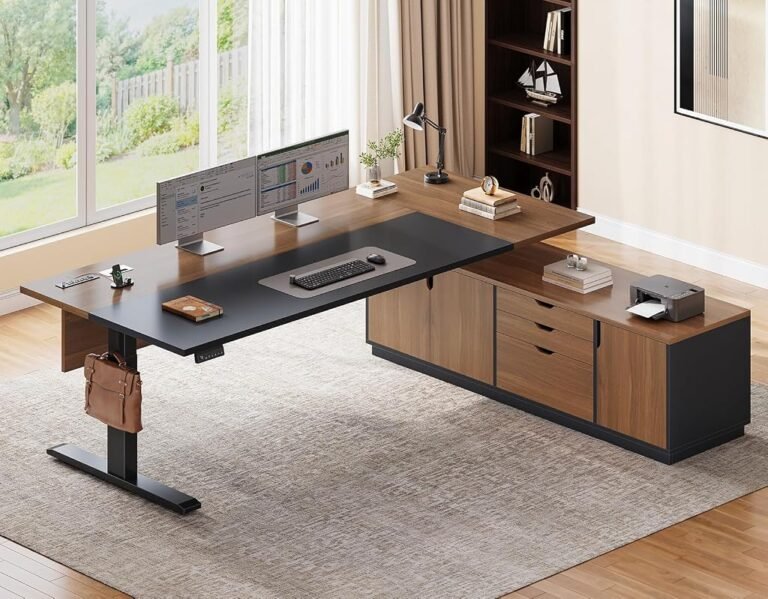
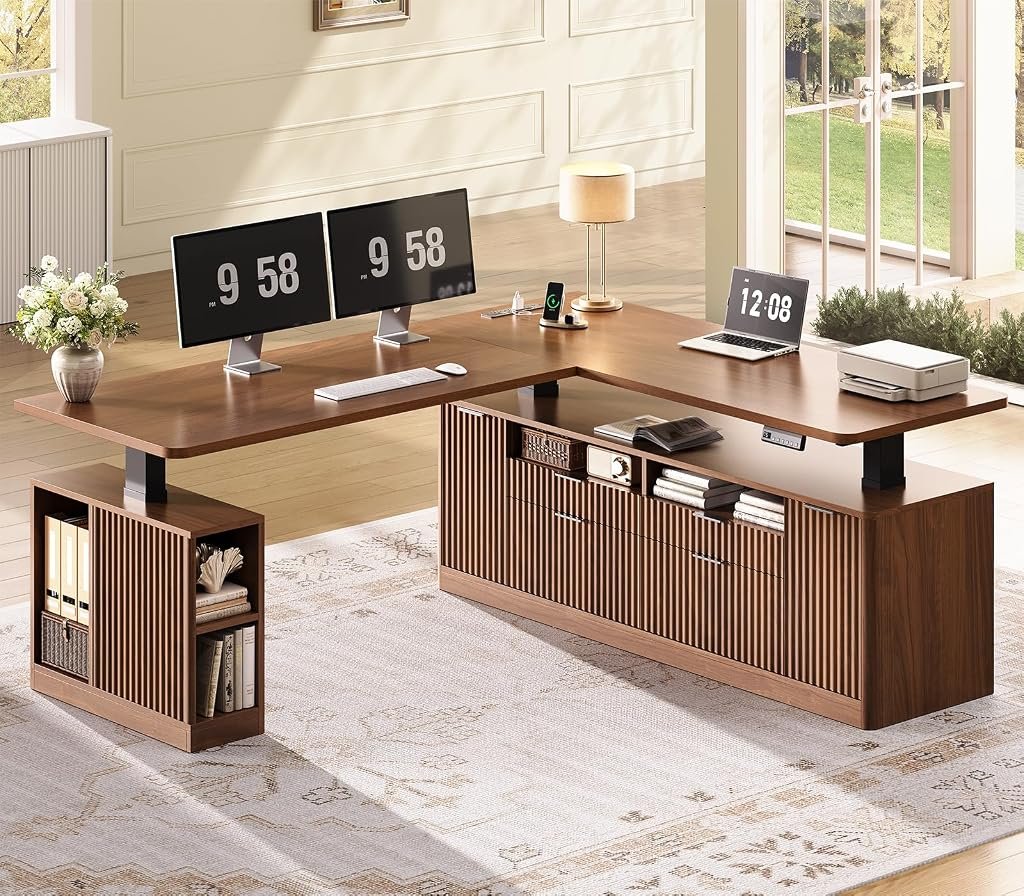
The SEDETA Fluted L-Shaped Executive Electric Standing Desk with four drawers sits at the intersection of three office-furniture priorities that do not always coexist comfortably: adjustable working height, substantial storage, and residential styling. At $389.99, it is positioned above simpler electric standing desks, but it also attempts to replace some of the organizational furniture that might otherwise surround them.
That distinction matters. A standing desk can be evaluated as a lifting platform, but an executive workstation has a broader assignment. It must provide enough surface area for real work, accommodate equipment without creating disorder, and fit into a room without looking like laboratory furniture. Add four drawers and an L-shaped configuration, and the evaluation becomes less about a single feature than about how several features interact.
Our score is 8/10, placing the SEDETA in the very good category. Buyer Confidence reaches 8.57, while Customer Sentiment is 7.84 and Value is 7.91. Those figures describe a desk with a clearly defined audience and a credible feature combination, though not one that suits every room or every working style.
The SEDETA makes the most sense for someone who needs storage and multiple working zones as much as height adjustment. For a minimalist laptop setup, much of its physical complexity could go unused.
A Standing Desk That Behaves More Like Office Furniture
Many electric standing desks follow a deliberately simple formula: a rectangular top, an adjustable frame, a controller, and little else. That approach has practical advantages. Fewer components generally mean fewer decisions about drawer clearance, storage placement, and how furniture elements interact with the lifting structure.
The SEDETA takes another route.
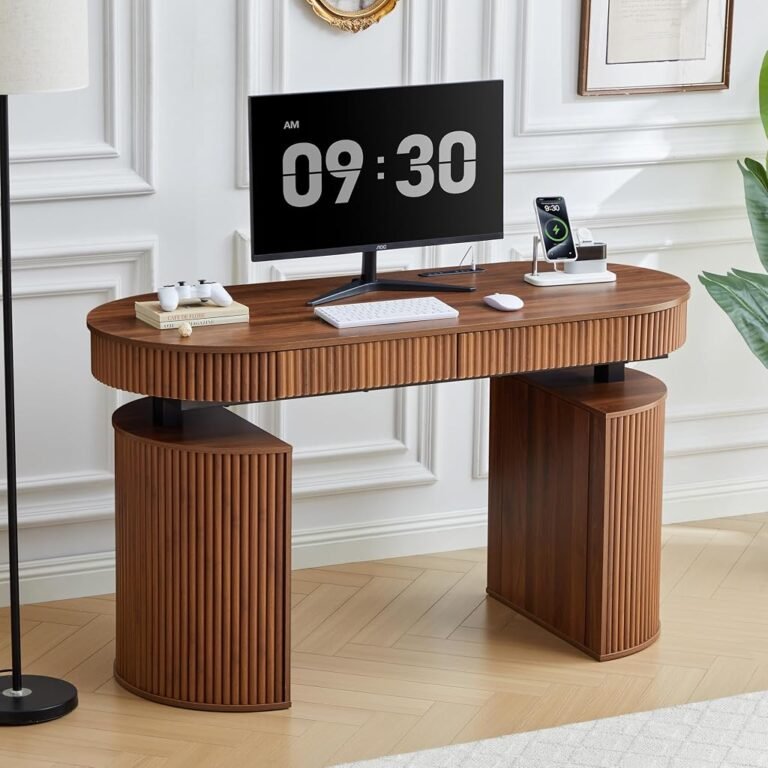
Its L-shaped executive format and four drawers move it closer to conventional office furniture. The fluted styling further separates it visually from the utilitarian appearance associated with basic adjustable desks.
That makes the product particularly relevant to dedicated home offices.
A workstation in a spare bedroom or study is still furniture after the computer is switched off. Visual character can therefore matter alongside ergonomics. Fluting adds texture and architectural detail, helping distinguish the desk from flat-panel office designs.
The aesthetic treatment should still be judged separately from construction quality. Decorative fluting says little by itself about structural materials, surface durability, scratch resistance, or long-term mechanical performance.
Those characteristics should be verified independently when they affect the purchasing decision.
Why the L-Shaped Configuration Matters
An L-shaped desk changes the geometry of work.
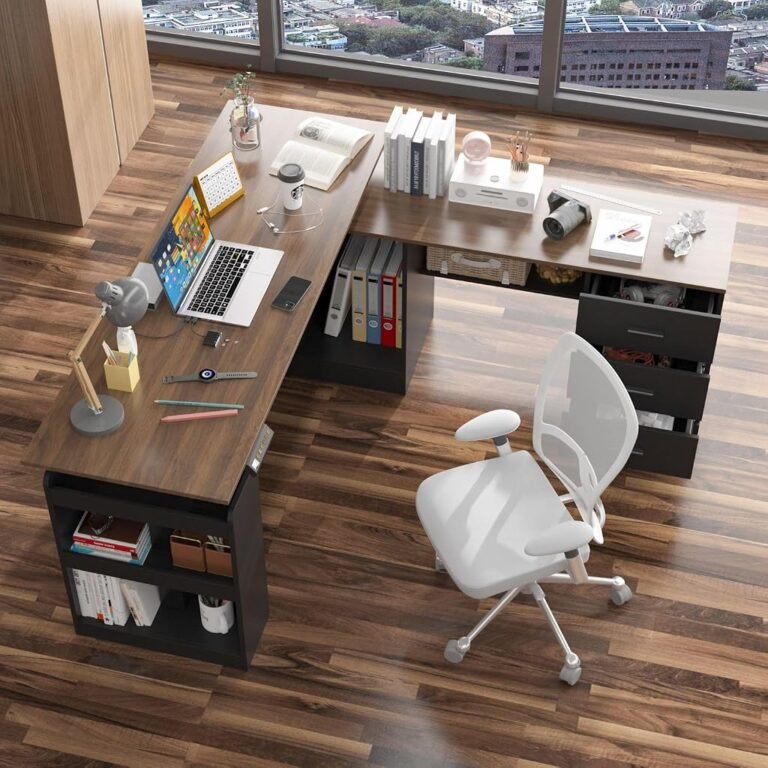
Rather than placing every activity along one horizontal line, it creates two connected work surfaces. This can allow computer equipment to remain in one area while documents, notebooks, communications equipment, or project materials remain on the other.
The benefit is not merely more surface.
It is the possibility of assigning different functions to different areas.
For someone who works almost entirely from one laptop, that separation may be unnecessary. For someone who alternates between computer work, paperwork, reading, and administrative tasks, the additional zone can reduce repeated rearrangement.
There is also a behavioral effect. Large surfaces invite accumulation. A poorly organized L-shaped desk can become a larger platform for clutter rather than a more efficient workstation.
The layout therefore rewards deliberate organization.
A Practical Three-Zone Arrangement
A sensible setup could divide the SEDETA into three areas:
- Primary working zone: monitor, keyboard, mouse, and frequently accessed computer equipment.
- Secondary working zone: documents, notebooks, reading material, or temporary project items.
- Storage zone: supplies and objects that can remain inside the four drawers until needed.
This approach keeps the most frequently used equipment close to the body while moving less frequently accessed objects away from the immediate working area.
That distinction is consistent with the Occupational Safety and Health Administration’s workstation evaluation guidance, which addresses workstation arrangement, posture, and the positioning of frequently used components.
The existence of extra surface area should not encourage users to place frequently accessed objects beyond comfortable reach.
Four Drawers Change the Value Proposition
The four drawers are one of the SEDETA’s defining characteristics.
Storage is often treated as a secondary furniture feature, yet it can materially change how a workstation functions. A basic adjustable desk may require separate drawers, filing furniture, or desktop organizers. Integrated storage can reduce that dependence.
For workers who routinely use notebooks, stationery, chargers, documents, and other accessories, four drawers create designated places for objects that would otherwise compete for desktop space.
The result can be a cleaner working surface.
However, drawer quantity is only part of the equation.
Useful storage depends on accessibility, dimensions, placement, and its relationship with the user’s seated position.
Storage Versus Legroom
Under-desk storage creates a recurring ergonomic trade-off.
Drawers require physical space. If they extend into the area needed by the user’s thighs or knees, they can restrict seated positioning.
OSHA’s keyboard workstation guidance specifically discusses how under-desk components such as center drawers can interfere with suitable keyboard and leg positioning.
That issue deserves attention with any storage-heavy adjustable desk.
The SEDETA’s four drawers are attractive from an organizational perspective, but buyers should examine where those drawers sit relative to the intended chair and keyboard position.
Storage that forces the desk higher than necessary during seated work can undermine comfortable posture.
The best storage arrangement is therefore not necessarily the one with the greatest capacity. It is the one that keeps useful items accessible without competing with the body for space.
Electric Height Adjustment and the Case for Movement
Electric height adjustment gives the SEDETA its second major identity.
The desk can function as both a seated and standing workstation, distinguishing it from fixed-height executive desks with similar storage-oriented layouts.
This flexibility is useful because ergonomic guidance does not support the idea that one posture should dominate an entire working day.
The OSHA guidance on neutral computer-working positions describes several acceptable postures and emphasizes arranging the workstation so the body can remain in comfortable alignment.
An adjustable desk provides a mechanical means of changing working position.
That does not make standing inherently preferable to sitting.
A productive use of electric adjustment involves changing posture when appropriate, maintaining comfortable equipment positioning, and incorporating movement away from the desk.
Height Range Still Matters
The existence of an electric lifting mechanism does not establish ergonomic suitability for every user.
A standing desk must descend far enough for comfortable seated keyboard use and rise sufficiently for standing work.
Individual requirements vary with body dimensions, chair height, footwear, keyboard thickness, and other factors.
Buyers should therefore confirm the SEDETA’s published adjustment range against their own requirements before purchase.
The same applies to lifting capacity, adjustment speed, and operating noise. These characteristics should be evaluated from current manufacturer specifications rather than inferred from the desk’s size or price.
The Fluted Executive Design Is More Than Decoration
Fluted furniture has a distinctive visual language. Repeated vertical grooves introduce shadow and texture, allowing a broad furniture surface to appear more detailed than a plain panel.
In the SEDETA, this treatment supports the executive character of the workstation.
That matters because standing desks historically have tended toward visible frames, simple tops, and mechanical aesthetics. The SEDETA attempts to integrate powered adjustment into furniture that looks more deliberate within a furnished room.
This is particularly relevant in home offices used for video meetings.
The visual environment surrounding a worker increasingly forms part of the professional setting. A desk does not need to disappear aesthetically, but neither should appearance interfere with practical use.
Fluting should therefore be regarded as a design preference rather than an ergonomic feature.
Buyers who prefer restrained, minimalist furniture may find the detailing unnecessary. Those furnishing a traditional or transitional office may see greater value in it.
Monitor Placement on an L-Shaped Surface
Large desks create freedom, but freedom can produce poor equipment placement.
The primary monitor should generally remain aligned with the user’s principal working position rather than being pushed toward one side merely because additional surface is available.
The OSHA monitor guidance addresses viewing distance, screen position, glare, and head alignment.
These principles become especially relevant on an L-shaped workstation.
If the primary monitor sits near the corner while the keyboard remains on one wing, the user may spend hours rotating the head or torso. The desk would technically provide abundant space while creating an inefficient working position.
A better arrangement places the primary display, keyboard, and pointing device around one central seated and standing position.
The secondary surface can then accommodate equipment requiring less frequent interaction.
Multiple-monitor users should also account for monitor stands or arms, cable paths, and the weight those accessories contribute to the lifting system.
Space Requirements Deserve Serious Attention
The most obvious limitation of an L-shaped executive desk is physical.
It requires room.
A conventional rectangular desk can often be placed against one wall. An L-shaped workstation extends in another direction, affecting chair movement, doors, cabinets, shelving, and circulation through the room.
The four-drawer configuration adds another spatial consideration: drawers need clearance to open.
A desk can fit within a room’s measured dimensions and still function poorly if the user cannot comfortably access its storage or move a chair around it.
Measure More Than the Wall
Before purchasing, buyers should measure:
- The complete floor area available for both sections of the desk.
- Chair clearance in seated and standing configurations.
- Space required for opening all drawers.
- Distance from doors and nearby cabinets.
- Access to electrical outlets.
- Vertical clearance beneath shelves or wall-mounted objects.
- Cable routes between the desk and power sources.
This exercise is especially important for adjustable furniture.
The workstation changes height, so the environment must accommodate it throughout its usable adjustment range.
A shelf positioned safely above the desktop while seated may become an obstacle when the desk rises.
Cable Management Becomes More Complicated
Electric desks require power for the lifting mechanism. Computer workstations add monitor cables, chargers, power adapters, network connections, and peripheral wiring.
An L-shaped desk can spread these connections across a broader area.
Cable management therefore deserves more attention than it would on a small fixed desk.
Wires must have sufficient slack to accommodate height changes without becoming taut. At the same time, excessive loose cable can become visually distracting or interfere with moving components.
Power strips and adapters should also be positioned so that they move safely with the desk when appropriate.
The objective is not merely neatness.
Poor cable routing can limit the desk’s usable height range or create unwanted tension on connected devices.
The SEDETA’s larger format makes planning particularly useful before equipment is permanently arranged.
Our Score: 8/10
We rate the SEDETA Fluted L-Shaped Executive Electric Standing Desk 8/10.
The score reflects a coherent combination of adjustable height, an L-shaped working arrangement, four integrated drawers, and executive styling at $389.99.
The desk addresses a more demanding use case than a simple height-adjustable platform.
Its strongest proposition is integration.
Instead of asking the buyer to combine an electric desk with separate storage furniture, the SEDETA brings multiple functions into one workstation.
That integration also produces its main trade-offs.
More furniture functionality means greater spatial demands. Drawers must coexist with comfortable seated positioning. A large L-shaped surface requires disciplined equipment placement. Decorative design does not remove the need to verify technical specifications.
An 8/10 score reflects that balance: a well-defined product with meaningful practical advantages, but one whose benefits depend on the right room and working habits.
Customer Sentiment: 7.84
Our Customer Sentiment score is 7.84.
That figure supports a favorable assessment while leaving room between the desk’s conceptual appeal and the realities of owning a large, multifunctional workstation.
Products with several integrated functions create more points of interaction than simpler furniture.
The user must manage the lifting mechanism, two-part working layout, storage, equipment placement, and room fit.
For the right buyer, these features can work together effectively.
For someone seeking a simple adjustable platform, they may represent unnecessary complexity.
The Customer Sentiment score therefore sits below Buyer Confidence, reflecting the difference between a strong purchasing proposition and the more varied realities of individual workspace preferences.
Buyer Confidence: 8.57
Buyer Confidence is the strongest of our editorial ratings at 8.57.
The reason is straightforward: the SEDETA has a clearly identifiable purpose.
It is not attempting to be the smallest standing desk or the most stripped-down adjustable workstation.
It combines electric adjustment with an L-shaped executive layout and four drawers.
That feature set makes the target user comparatively easy to identify.
A buyer who needs substantial surface area, integrated storage, and posture flexibility can assess the desk against concrete requirements.
That clarity supports confidence.
The 8.57 rating does not imply universal suitability. Instead, it reflects how clearly the product addresses a specific working environment.
Value: 7.91
Our Value rating is 7.91.
At $389.99, the desk must justify a meaningful premium over basic adjustable desks.
Its argument rests on the additional functionality supplied by the L-shaped format, four drawers, and executive styling.
For a buyer who would otherwise purchase a standing desk plus separate storage, the integrated design may make financial and spatial sense.
For a laptop user requiring little storage, the same features may provide limited additional utility.
This is why the Value score remains below Buyer Confidence.
The SEDETA’s proposition is clear, but value depends on whether its major features replace furniture or functionality the buyer would otherwise need.
How It Fits Into a Standing Desk Buying Guide
A useful standing desk buying guide should resist evaluating products by feature count alone.
Four drawers are not automatically better than two. An L-shaped surface is not automatically better than a rectangle. Electric adjustment is not automatically ergonomic.
Each feature must solve a specific working problem.
For the SEDETA, prospective buyers should evaluate seven areas:
- Height compatibility: Confirm that the adjustment range suits seated and standing positions.
- Floor space: Measure the complete L-shaped footprint and surrounding circulation area.
- Drawer clearance: Confirm that storage can be accessed without interfering with the chair or nearby furniture.
- Equipment weight: Verify the desk’s rated capacity against monitors, computers, accessories, and stored items.
- Primary working position: Plan where the monitor, keyboard, and mouse will sit before filling the secondary surface.
- Cable routing: Ensure wiring can move safely throughout height adjustment.
- Warranty and support: Examine coverage for electrical, mechanical, and structural components.
These questions provide a more useful purchasing framework than comparing decorative features in isolation.
Who Is the SEDETA Best Suited For?
The SEDETA has several identifiable buyer profiles.
Remote Professionals With Mixed Workloads
Professionals who alternate between computer work, reading, paperwork, and administrative tasks can make productive use of separate working zones.
The L-shaped surface provides room to keep those activities organized without repeatedly clearing the primary computer area.
Users Who Need Integrated Storage
The four drawers are particularly relevant to people who keep stationery, notebooks, documents, charging accessories, and other supplies near the workstation.
Integrated storage can reduce dependence on separate drawer units or cabinets.
Dedicated Home Offices
The desk makes more sense in a dedicated room than in a cramped multipurpose space.
Its executive styling and fluted detailing also suit buyers who want office furniture with a stronger residential character.
Multi-Equipment Workstations
Users with monitors, speakers, peripherals, document holders, and other equipment may benefit from the additional surface.
They should still verify lifting capacity and arrange equipment to avoid excessive reaching.
Who Should Look Elsewhere?
The SEDETA is less convincing for minimalist users.
Someone working primarily from a laptop may not need an L-shaped surface or four drawers.
Small rooms are another concern.
A large workstation can dominate limited floor space and reduce flexibility when furniture needs to be rearranged.
Buyers who frequently relocate should also consider the practical consequences of larger furniture. More components generally mean more effort when assembling, disassembling, or moving a workstation.
Users requiring specific technical characteristics should verify them before purchase.
These include adjustment range, load rating, lifting speed, noise level, construction materials, and warranty provisions.
Those factors can be more consequential than styling when the desk is expected to support demanding daily use.
Strengths and Drawbacks
The SEDETA’s strengths arise from the integration of functions that often require separate furniture.
Strengths
- L-shaped configuration creates multiple working zones.
- Four drawers provide integrated organization.
- Electric adjustment supports seated and standing positions.
- Fluted executive styling offers an alternative to utilitarian standing-desk designs.
- $389.99 price combines several furniture functions within one workstation.
- Strong Buyer Confidence rating of 8.57.
- Overall editorial score of 8/10.
Drawbacks and Limitations
- Large configuration requires careful room measurement.
- Four drawers may provide more storage than minimalist users require.
- Drawer positioning must remain compatible with comfortable legroom.
- L-shaped surfaces can encourage excessive reaching when poorly organized.
- Cable management requires planning across a larger moving workstation.
- Buyers should independently verify technical specifications such as height range and lifting capacity.
- Decorative styling will not appeal equally to minimalist interiors.
The desk is therefore strongest when its complexity is useful rather than merely tolerated.
A Better Way to Use Four Drawers
Four drawers can easily become four places to hide disorder.
A more disciplined approach assigns storage according to frequency of access.
The upper or most accessible storage should contain objects used regularly.
Less accessible compartments can hold occasional supplies.
Documents requiring long-term retention may belong elsewhere rather than consuming prime workstation storage.
A simple hierarchy could look like this:
- Daily access: pens, notebook, charging accessories, headphones.
- Weekly access: reference documents, spare peripherals, office supplies.
- Occasional access: replacement accessories or project materials.
- Archive elsewhere: records and objects rarely required during normal work.
This prevents integrated storage from becoming permanent clutter.
It also keeps frequently accessed objects closer to the user, reducing unnecessary reaching and searching.
Ergonomics Still Outranks Furniture Styling
The fluted finish, executive profile, L-shaped design, and four drawers give the SEDETA a distinctive identity.
None of these features should outrank comfortable working posture.
The National Institute for Occupational Safety and Health’s office-environment guidance addresses ergonomic risks associated with office work, including prolonged static positions and awkward postures.
For a SEDETA owner, practical application means using the adjustable mechanism rather than treating the desk as a fixed-height piece of furniture.
It also means positioning the monitor, keyboard, chair, and frequently accessed equipment around the body rather than around the decorative symmetry of the desk.
Furniture should adapt to the worker.
The reverse arrangement usually produces unnecessary physical compromises.
Final Considerations
The SEDETA Fluted L-Shaped Executive Electric Standing Desk with four drawers is a notably different proposition from the basic rectangular standing desk.
At $389.99, it combines powered height adjustment with an L-shaped working area, integrated storage, and fluted executive styling.
Our overall score of 8/10 reflects the coherence of that combination.
Buyer Confidence is particularly strong at 8.57 because the desk’s intended audience is easy to identify. Customer Sentiment at 7.84 and Value at 7.91 are slightly more measured, reflecting the practical realities of fitting and organizing a large multifunctional workstation.
The four drawers are a meaningful advantage for workers who genuinely require nearby storage. The L-shaped surface can separate computer work from paperwork or secondary tasks. Electric adjustment allows the workstation to support different working positions.
Those same features create the principal limitations.
The desk requires adequate floor space. Drawers must coexist with seated legroom. Equipment needs deliberate placement. Cables must accommodate movement. Technical characteristics such as adjustment range and lifting capacity should be checked against individual requirements before purchase.
For a small room or minimalist laptop setup, a simpler adjustable desk may be more rational.
For a dedicated home office where storage, working area, and adjustable height are all genuine requirements, the SEDETA presents a more convincing proposition.
Its value is ultimately tied to integration. Rather than treating storage, surface area, styling, and height adjustment as separate purchases, the desk brings them together within one piece of office furniture.
That approach earns its 8/10 editorial score, provided the buyer has enough room—and enough work—to make use of what the SEDETA actually offers.