The modern home office has created an unusual challenge for furniture manufacturers. A desk must accommodate computers, monitors, documents, and the physical demands of prolonged work while remaining compatible with the appearance of a residential interior. For many professionals, a conventional rectangular desk no longer provides the flexibility required for an increasingly varied workload.
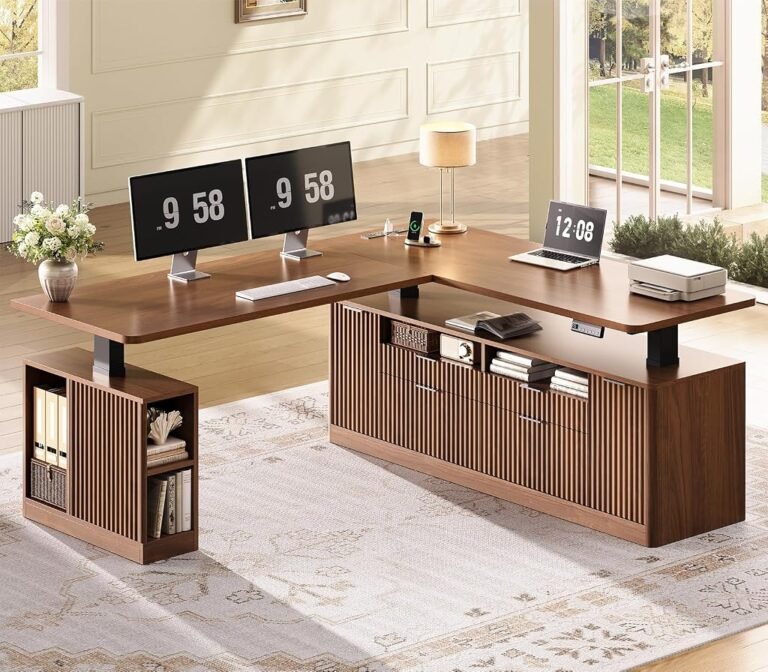
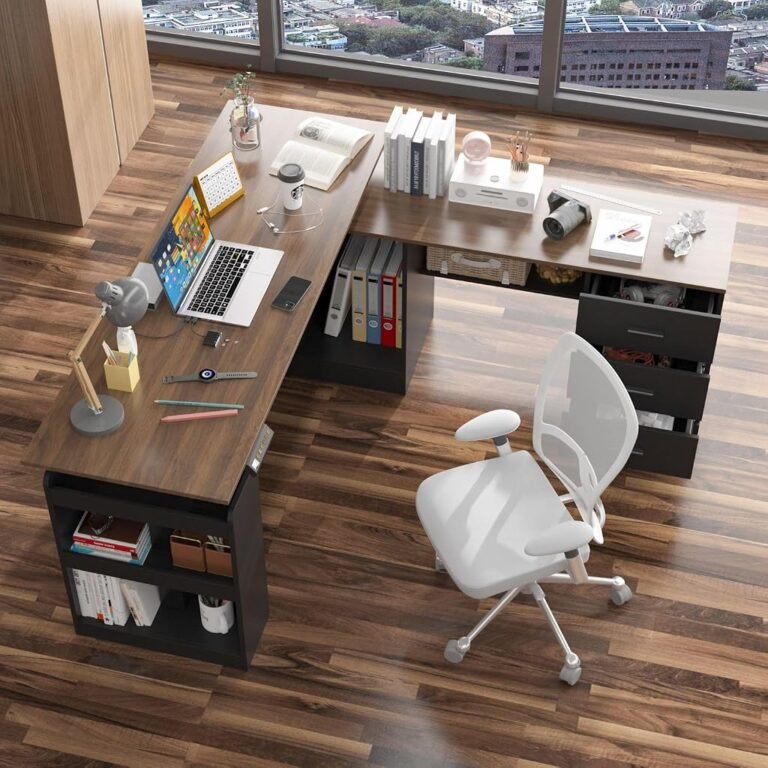
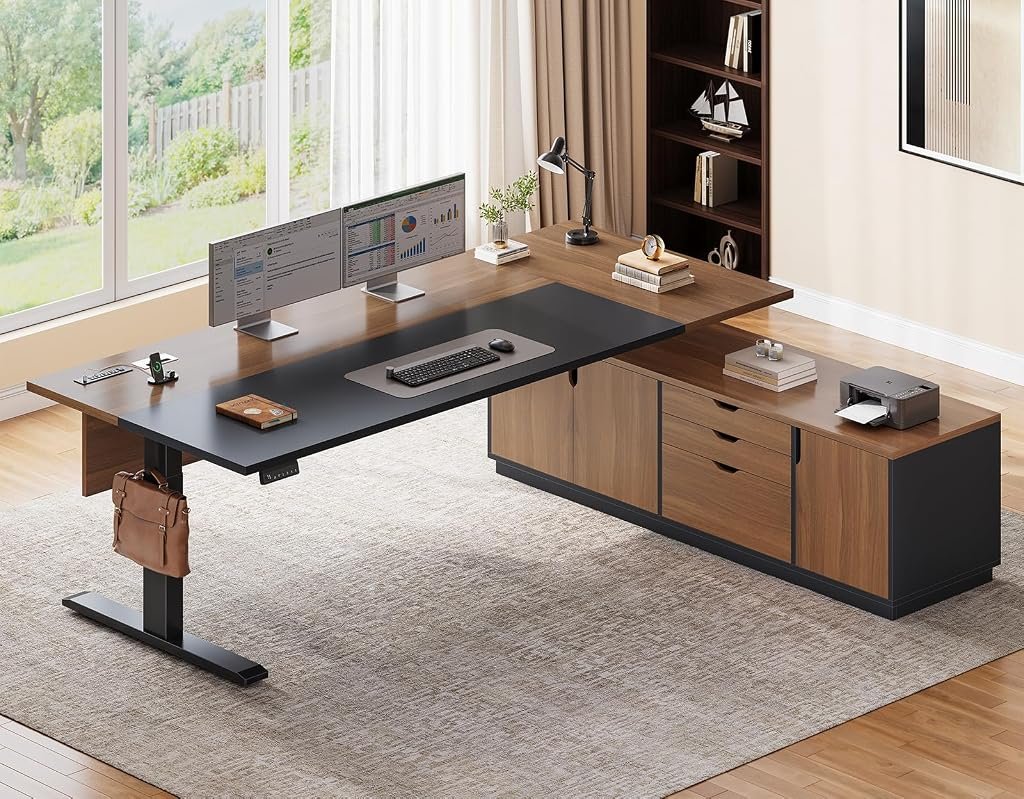
The SEDETA 71-Inch Executive L-Shaped Electric Standing Desk addresses this challenge through a combination of an extended L-shaped configuration, electric height adjustment, and traditional executive styling.
Finished in brown and priced at $329.99, the desk targets buyers who want a substantial workstation without abandoning the flexibility associated with adjustable office furniture.
Its defining feature is the combination of a 71-inch format and an L-shaped layout. This arrangement offers a different approach to organizing computer equipment, paperwork, and frequently used accessories compared with a conventional straight desk.
Our editorial assessment gives the SEDETA Executive L-Shaped Electric Standing Desk an overall score of 8/10, placing it in the very good category.
The rating reflects a favorable balance between its functional design, price, and suitability for home-office environments.
However, the desk’s appeal is not universal. Its larger configuration requires careful consideration of available floor space, working habits, and equipment requirements.
The central purchasing question is whether the additional working area and adjustable height provide enough practical benefit to justify choosing this configuration over a simpler workstation.
Design and Appearance: Executive Styling Meets Modern Functionality
The SEDETA desk combines two furniture concepts that have traditionally developed along different paths.
Executive desks generally emphasize a substantial physical presence, broad working surfaces, and a formal appearance.
Electric standing desks, by contrast, are often designed around mechanical simplicity and adjustable functionality.
The SEDETA brings these approaches together.
Its brown finish introduces a conventional furniture aesthetic, while the L-shaped configuration creates a workstation with a more substantial visual footprint than a typical rectangular desk.
This design direction is particularly relevant to home offices where furniture must serve both professional and residential purposes.
A desk that looks appropriate in a dedicated office may appear excessively industrial in a bedroom or shared living space.
The SEDETA’s executive styling offers an alternative for buyers who prefer a more traditional appearance.
The Appeal of a Brown Finish
Brown office furniture remains relevant because it can complement a wide range of interior arrangements.
Wood-toned colors often work alongside neutral walls, upholstered chairs, bookshelves, and conventional storage furniture.
The SEDETA’s brown finish supports this type of coordination.
However, appearance should not be confused with construction.
A brown finish does not establish whether the desktop uses solid wood, engineered wood, laminate, or another material.
These distinctions influence resistance to scratches, moisture, edge damage, and long-term wear.
Buyers concerned with durability should verify the construction materials and surface specifications before purchasing.
The desk’s appearance is an advantage for buyers seeking executive styling, but its long-term performance depends on more than color.
The 71-Inch L-Shaped Configuration: Why Layout Matters
The SEDETA’s 71-inch format is central to its identity.
Unlike a conventional straight desk, an L-shaped workstation creates two connected working areas.
This arrangement can support different activities without requiring users to clear the entire surface whenever they change tasks.
For example, one section can accommodate a computer and monitor, while the adjoining section can hold documents, notebooks, or reference materials.
The practical advantage is separation.
Computer work and paperwork do not necessarily require the same arrangement of equipment.
An L-shaped desk can provide designated areas for both.
Separating Computer Work From Administrative Tasks
A conventional rectangular desk often forces multiple activities into a single working zone.
A keyboard, monitor, notebook, telephone, and documents may compete for the same surface.
An L-shaped arrangement offers an alternative.
The primary section can support computer-based work, while the secondary section can accommodate tasks requiring additional surface space.
This may be particularly useful for professionals who regularly alternate between digital and physical materials.
Administrative workers, consultants, accountants, and remote employees frequently handle several categories of information throughout the day.
A workstation that separates these activities can reduce repeated rearrangement of equipment.
However, the benefits depend on how the desk is positioned and how frequently the secondary working area is used.
An L-shaped configuration is most useful when both sections support identifiable tasks.
Otherwise, the additional surface may become an area where unnecessary objects accumulate.
Electric Height Adjustment: The Functional Centerpiece
The SEDETA is an electric standing desk, meaning its working height can be adjusted through a powered lifting mechanism.
This distinguishes it from conventional fixed-height executive furniture.
Height adjustment allows users to change between seated and standing working positions.
The flexibility is relevant to people who spend substantial portions of the day using computers.
However, the ergonomic benefit depends on whether the desk can reach suitable working heights for the individual.
Understanding Neutral Working Postures
The Occupational Safety and Health Administration’s guidance on computer workstation positioning explains the importance of maintaining neutral body alignment during computer work.
The agency identifies several relevant characteristics, including relaxed shoulders, appropriately positioned forearms, and comfortable alignment of the head and torso.
OSHA also recommends changing working positions throughout the day rather than remaining stationary for extended periods.
This distinction is central to understanding the purpose of an electric standing desk.
The objective is not to replace prolonged sitting with prolonged standing.
Instead, adjustable furniture allows workers to vary their posture according to comfort and task requirements.
The SEDETA supports this approach through its electric height-adjustment capability.
Nevertheless, buyers should confirm the desk’s minimum and maximum height settings before purchasing.
The presence of electric adjustment alone does not establish whether the available range suits every user.
Does an L-Shaped Standing Desk Improve Ergonomics?
An L-shaped workstation can support comfortable working arrangements, but the shape itself does not guarantee ergonomic benefits.
The relationship between the user’s chair, keyboard, monitor, and frequently accessed equipment remains more important than the overall size of the desktop.
A poorly arranged L-shaped desk can encourage excessive reaching or repeated twisting.
For example, positioning the primary monitor on one section while placing the keyboard on another may require uncomfortable neck rotation.
Similarly, frequently used accessories placed near the far end of the secondary surface may encourage unnecessary reaching.
The most effective arrangement keeps primary equipment directly in front of the user.
Monitor Placement
The OSHA recommendations for monitor positioning emphasize arranging displays to support comfortable head and neck alignment.
For SEDETA users, the primary monitor should generally remain aligned with the main working position.
Secondary equipment can be arranged around that central setup.
The desk’s L-shaped design provides additional flexibility, but users should avoid treating every available surface as equally suitable for frequently accessed equipment.
The additional area is most beneficial when it reduces clutter without introducing awkward movement.
Keyboard and Mouse Positioning
Keyboard placement is another important consideration.
The keyboard should remain at a height that allows relaxed shoulders and relatively straight wrists.
The mouse should be positioned close enough to avoid excessive reaching.
These requirements apply regardless of whether the desk is seated or standing.
The SEDETA’s adjustable design can help users establish different working heights, but equipment placement remains essential.
Workspace Organization: The Advantage of Two Connected Surfaces
One of the SEDETA’s most practical characteristics is the ability to organize different activities across an L-shaped working area.
A larger desk can provide greater flexibility when arranging equipment.
However, usable workspace should not be measured exclusively by total surface area.
Accessibility matters.
A distant section of the desk may be suitable for occasional tasks but inconvenient for equipment that requires constant interaction.
Creating Separate Working Zones
A practical SEDETA arrangement could divide the workstation into three functional areas:
- Primary computer zone: Monitor, keyboard, mouse, and essential computer accessories.
- Secondary work zone: Documents, notebooks, reference materials, or temporary project equipment.
- Peripheral zone: Items used occasionally, such as charging accessories or office supplies.
This organization can reduce competition for the primary working surface.
It also encourages deliberate placement of equipment according to frequency of use.
The OSHA workstation evaluation checklist recommends keeping frequently accessed items within comfortable reach.
That principle is particularly relevant to larger desks.
More surface area is useful only when the arrangement supports efficient movement and comfortable working positions.
Stability and Structural Considerations
Stability is one of the most consequential characteristics of an electric standing desk.
A workstation may appear substantial while still allowing movement under certain conditions.
Adjustable desks face particular mechanical demands because their supporting structures change position as the working surface rises.
At greater heights, lateral movement and uneven loading can become more noticeable.
For users working with monitors, excessive movement may create distracting screen vibration.
The SEDETA’s L-shaped configuration introduces additional considerations because equipment can be distributed across two connected sections.
Equipment Distribution
A workstation supporting multiple monitors, computers, and accessories must remain within its rated lifting capacity.
The placement of equipment also matters.
Concentrating substantial weight near one section can create different loading conditions from distributing equipment more evenly.
Buyers should verify the desk’s published weight capacity before purchasing.
The lifting system must accommodate the intended equipment alongside the weight of the desktop structure.
Motor performance, adjustment speed, operating noise, and resistance to movement are separate technical considerations.
The SEDETA’s electric adjustment establishes its core functionality, but buyers should examine the manufacturer’s technical specifications when these characteristics are purchasing priorities.
The Practical Challenges of an L-Shaped Desk
The SEDETA’s configuration creates opportunities for organization, but it also introduces spatial demands.
An L-shaped workstation requires a different room arrangement from a conventional rectangular desk.
Its secondary section extends into the surrounding space, potentially affecting access to doors, cabinets, windows, and other furniture.
This makes room planning particularly important.
Measuring the Available Space
Before purchasing, buyers should examine the intended desk location.
The measurement process should account for more than the desk’s nominal 71-inch format.
The full footprint, including the secondary section, must fit comfortably within the room.
Additional clearance is required for the office chair and normal movement around the workstation.
The desk must also have sufficient vertical clearance throughout its height-adjustment range.
Nearby shelves, wall-mounted equipment, and window fittings can interfere with upward movement.
A large desk that restricts access to surrounding furniture may reduce the practical usefulness of the room.
Corner Placement Versus Open-Room Placement
L-shaped desks are frequently associated with corner arrangements.
A corner location can make use of space that might otherwise remain underutilized.
However, not every room benefits from this configuration.
A desk placed against two walls may limit access to electrical outlets or make cable routing more complicated.
An open-room arrangement can improve access to the workstation but requires more floor space.
The SEDETA’s suitability therefore depends partly on the intended room layout.
Price Analysis: What Does $329.99 Represent?
At $329.99, the SEDETA Executive L-Shaped Electric Standing Desk combines a substantial working format with powered height adjustment.
Its value proposition rests on the integration of these two features.
A conventional fixed-height desk may provide ample surface area without allowing users to change working posture.
A basic electric standing desk may offer adjustment while providing a smaller or simpler working surface.
The SEDETA combines an executive-style L-shaped layout with electric functionality.
For buyers who require both, the arrangement presents a practical proposition.
However, price should be evaluated against actual working requirements.
A large desk provides little additional value when the user requires only a laptop and a small number of accessories.
Similarly, electric adjustment has limited practical benefit if the user rarely changes working positions.
The desk’s strongest value emerges when both features are used regularly.
Evaluating Long-Term Ownership Costs
The initial purchase price represents only one part of the financial assessment.
Electric standing desks contain mechanical and electrical components that require dependable operation.
Potential ownership considerations include the lifting mechanism, electronic controls, electrical connections, and structural hardware.
These are general considerations for adjustable furniture rather than established problems with the SEDETA.
Buyers should examine warranty coverage, replacement-part availability, return conditions, and assembly requirements.
A desk intended for daily professional use should remain functional beyond its initial installation.
Long-term value depends on sustained usefulness rather than appearance alone.
Understanding Our Editorial Ratings
Our overall score for the SEDETA Executive L-Shaped Electric Standing Desk is 8/10.
This places it in the very good category.
The rating reflects the desk’s coherent combination of an L-shaped working format, electric adjustment, executive styling, and a $329.99 price.
Its design is particularly relevant to users seeking a substantial workstation that accommodates several types of office activity.
However, the overall score also recognizes that the desk’s usefulness depends on available space and working habits.
Customer Sentiment: 7.84/10
Our Customer Sentiment rating is 7.84/10.
This supports a favorable but measured assessment of the ownership proposition.
The desk’s larger configuration introduces considerations that may not affect simpler rectangular models.
Room dimensions, equipment arrangement, and assembly requirements can influence how comfortably the workstation integrates into everyday use.
The rating reflects a product with meaningful appeal but a more specific audience than a compact adjustable desk.
Buyer Confidence: 8.53/10
Buyer Confidence receives 8.53/10, the highest of our four editorial ratings.
This reflects the clarity of the SEDETA’s intended purpose.
The combination of electric adjustment and an L-shaped executive format addresses identifiable workplace requirements.
The desk is particularly relevant to buyers who need additional working area without sacrificing the ability to alternate between seated and standing positions.
The difference between Buyer Confidence and Customer Sentiment is significant.
The SEDETA presents a coherent purchasing proposition, but its practical success depends on matching the configuration to the intended environment.
Value: 7.91/10
Our Value rating is 7.91/10.
At $329.99, the SEDETA offers a favorable balance for buyers who will use both its L-shaped layout and adjustable height.
The value becomes less compelling when the additional working area is unnecessary.
The distinction matters because furniture value is not determined by dimensions alone.
A smaller desk that accommodates all required equipment may provide better utility in a confined room.
Conversely, a larger workstation can justify its footprint when it supports multiple activities without requiring additional furniture.
The SEDETA’s 7.91 Value rating reflects that balance.
Who Is the SEDETA Executive Standing Desk Best Suited For?
The SEDETA is most relevant to users whose work requires more than a single compact surface.
Its combination of electric adjustment and an L-shaped arrangement supports several identifiable working environments.
Remote Professionals
Remote workers frequently combine computer-based tasks with administrative activities.
A larger workstation can accommodate a monitor, keyboard, documents, and other equipment without requiring constant rearrangement.
The SEDETA’s electric adjustment also supports changes in working posture throughout the day.
This makes it relevant to professionals spending substantial time at a home workstation.
Administrative and Document-Heavy Workers
Employees handling paperwork, reports, reference materials, and computer applications may benefit from separate working areas.
An L-shaped arrangement allows documents to remain accessible without necessarily interfering with the primary computer setup.
This can be useful for tasks requiring frequent movement between digital and physical materials.
Users With Multiple Computer Accessories
Workers using external monitors, speakers, document holders, and other accessories may appreciate the flexibility of a larger surface.
However, equipment placement should remain ergonomically appropriate.
The availability of additional space should not encourage awkward reaching or unnecessary neck rotation.
Buyers Seeking Executive Styling
The SEDETA’s brown finish and substantial configuration may appeal to buyers who prefer traditional office furniture aesthetics.
Its appearance is more closely associated with an executive workstation than a minimalist adjustable desk.
This can make it suitable for dedicated home offices where furniture design contributes to the room’s overall character.
Who Should Consider a Different Desk?
The SEDETA is less suitable for certain working environments.
Buyers with limited floor space should prioritize compact configurations that preserve comfortable movement around the workstation.
An L-shaped desk can become inconvenient when its secondary section obstructs furniture, doorways, or circulation routes.
Users relying primarily on a laptop may also find the additional surface unnecessary.
For these buyers, a simpler rectangular electric desk may provide sufficient functionality with a smaller footprint.
People requiring highly specific lifting performance should prioritize verified technical specifications.
The desk’s motor configuration, adjustment range, operating noise, and load capacity should be checked against the intended equipment requirements.
Finally, buyers seeking extensive integrated storage should evaluate whether the desk’s configuration meets their organizational needs.
An L-shaped working surface and enclosed storage are different features.
Additional desktop area does not automatically replace drawers, cabinets, or shelving.
How the SEDETA Fits Into a Standing Desk Buying Guide
A useful standing desk buying guide should evaluate ergonomic suitability before decorative design or overall size.
The SEDETA illustrates why this approach matters.
Its 71-inch format may be attractive to buyers seeking a substantial workstation, but the available surface must support comfortable equipment placement.
Its electric adjustment provides flexibility, but the height range must accommodate the individual user.
Its executive styling contributes to visual appeal, but construction quality and structural stability remain separate considerations.
A practical purchasing assessment should address the following questions:
- Height compatibility: Does the desk reach suitable seated and standing positions?
- Room dimensions: Can the complete L-shaped configuration fit without restricting movement?
- Equipment capacity: Is the lifting system rated for the intended monitors, computers, and accessories?
- Workstation organization: Will both sections support regular tasks?
- Ergonomic positioning: Can the monitor, keyboard, and mouse remain comfortably aligned?
- Electrical access: Can power cables remain safely arranged throughout height adjustment?
- Long-term support: Are warranty coverage and replacement components appropriate for the intended ownership period?
These considerations help distinguish a genuinely useful workstation from one selected primarily for appearance.
Making the Most of the SEDETA Desk
The SEDETA’s practical value can be improved through deliberate workstation organization.
Its L-shaped layout creates opportunities to separate tasks, but effective use requires attention to ergonomics and accessibility.
Establish a Primary Working Position
The first priority should be identifying the location where most computer work will occur.
The primary monitor and keyboard should remain directly in front of the user.
Frequently used accessories should be positioned within comfortable reach.
The secondary section can then support tasks requiring occasional access.
This arrangement reduces unnecessary reaching and repeated body rotation.
Alternate Working Positions
Electric adjustment should support regular changes in posture.
The National Institute for Occupational Safety and Health’s office safety guidance recommends avoiding prolonged sitting or standing and reducing awkward working positions.
For SEDETA users, this means adjusting the desk according to comfort rather than maintaining one position throughout the day.
Standing can be useful for selected activities, while seated work may remain preferable for others.
Movement breaks should remain part of the working routine.
Organize Cables Carefully
An adjustable L-shaped workstation may require cables to travel across a relatively broad working area.
Power connections, monitor cables, and peripheral wiring should remain clear of moving components.
Sufficient cable length is necessary to accommodate height changes.
Excess cable length should also be managed to reduce clutter and prevent accidental contact with surrounding objects.
Keep the Secondary Surface Purposeful
The additional working area should support identifiable tasks.
A section used for paperwork, reading, or temporary project materials can improve organization.
However, allowing the secondary surface to accumulate unused equipment may reduce its practical benefit.
Regular organization helps preserve the desk’s functional flexibility.
Strengths and Drawbacks at a Glance
The SEDETA’s strongest characteristics are connected to its working format and adjustable functionality.
Strengths
- Substantial 71-inch executive-style format.
- L-shaped configuration supporting separate working areas.
- Electric height adjustment for seated and standing use.
- Brown finish suited to traditional office interiors.
- $329.99 price for a multifunctional workstation.
- Practical appeal for remote workers and document-heavy tasks.
- Favorable overall editorial score of 8/10.
Drawbacks and Limitations
- L-shaped configuration requires more careful room planning than a compact desk.
- Additional surface area may be unnecessary for minimalist computer setups.
- Buyers must verify the complete footprint and available clearance.
- Height range and lifting capacity require confirmation against individual needs.
- Larger working surfaces can encourage excessive reaching when poorly organized.
- Electrical and mechanical components introduce long-term maintenance considerations.
- Executive styling may not suit buyers seeking minimalist furniture.
These trade-offs establish the SEDETA as a workstation designed for a particular combination of space, equipment, and working habits.
Its strongest appeal lies in the integration of adjustable height with an expanded working arrangement.
Final Considerations
The SEDETA 71-Inch Executive L-Shaped Electric Standing Desk offers a coherent combination of traditional executive styling and modern adjustable functionality.
Its brown finish supports a conventional office appearance, while the L-shaped configuration provides flexibility for organizing computer equipment, paperwork, and other working materials.
Electric height adjustment adds an important functional dimension by allowing users to change between seated and standing positions.
At $329.99, the desk presents a favorable proposition for buyers who need both an expanded working surface and powered adjustment.
Our overall score of 8/10 reflects its very good positioning within that category.
Buyer Confidence at 8.53 indicates a favorable assessment of the desk’s clearly defined purpose. Customer Sentiment at 7.84 and Value at 7.91 introduce a more measured perspective, recognizing that its larger configuration and price must align with actual working requirements.
The difference between these ratings reinforces the importance of buyer fit.
The SEDETA is particularly suitable for remote professionals, administrative workers, and users who regularly manage several types of office activity.
It is less compelling for buyers with limited space or minimal equipment requirements.
Its L-shaped design should be treated as a functional arrangement rather than an automatic improvement over rectangular alternatives.
The most effective workstation is one that accommodates the user’s body, equipment, available space, and daily tasks without introducing unnecessary complexity.
For buyers seeking a substantial executive-style desk with electric height adjustment, the SEDETA represents a well-positioned option at its stated price.
Its strongest advantage is the combination of a flexible working layout and adjustable functionality. Its principal limitation is the need for sufficient space and deliberate equipment organization.
When those conditions are satisfied, the SEDETA offers a practical foundation for a comfortable, organized, and adaptable home-office environment.