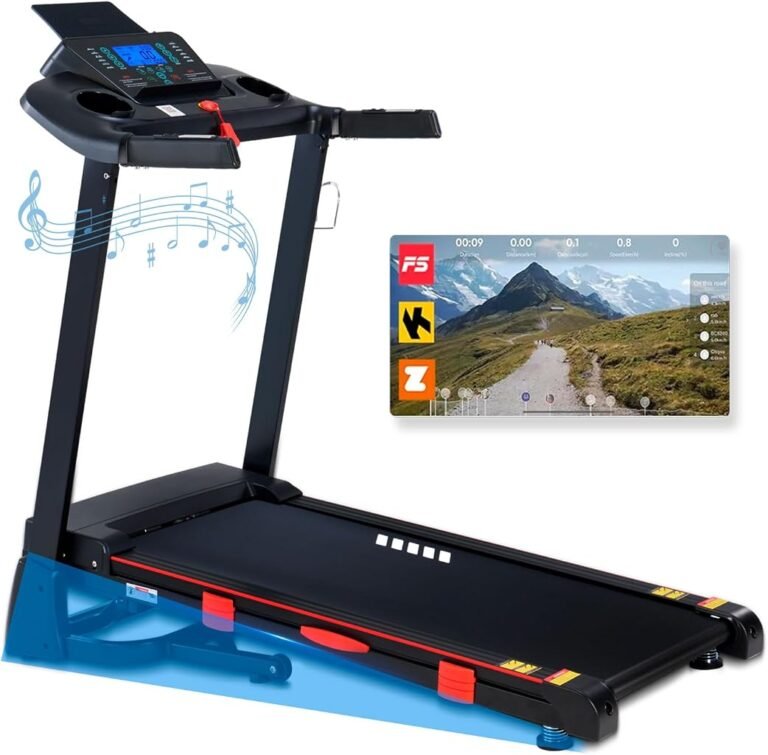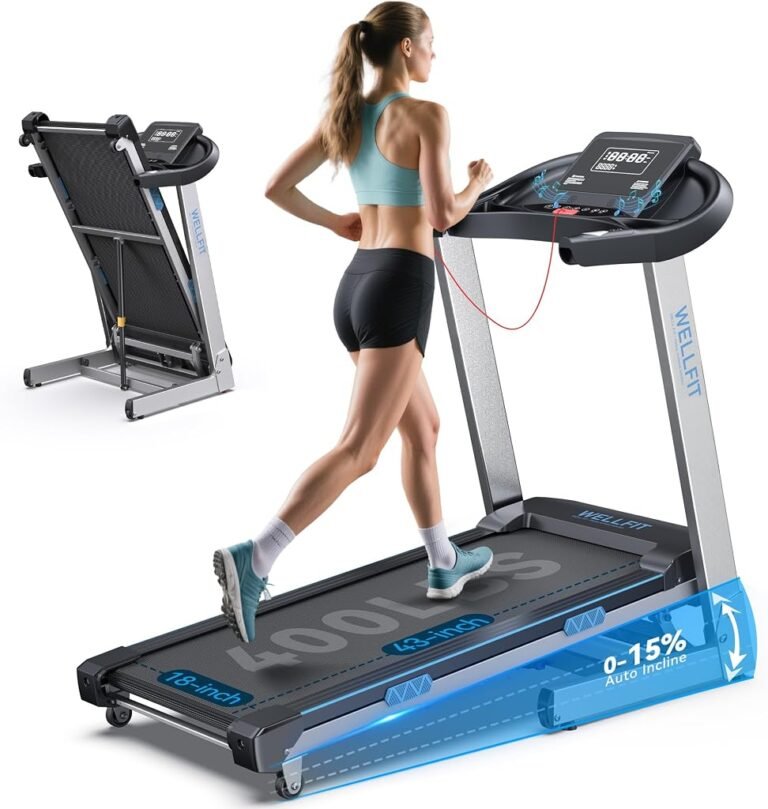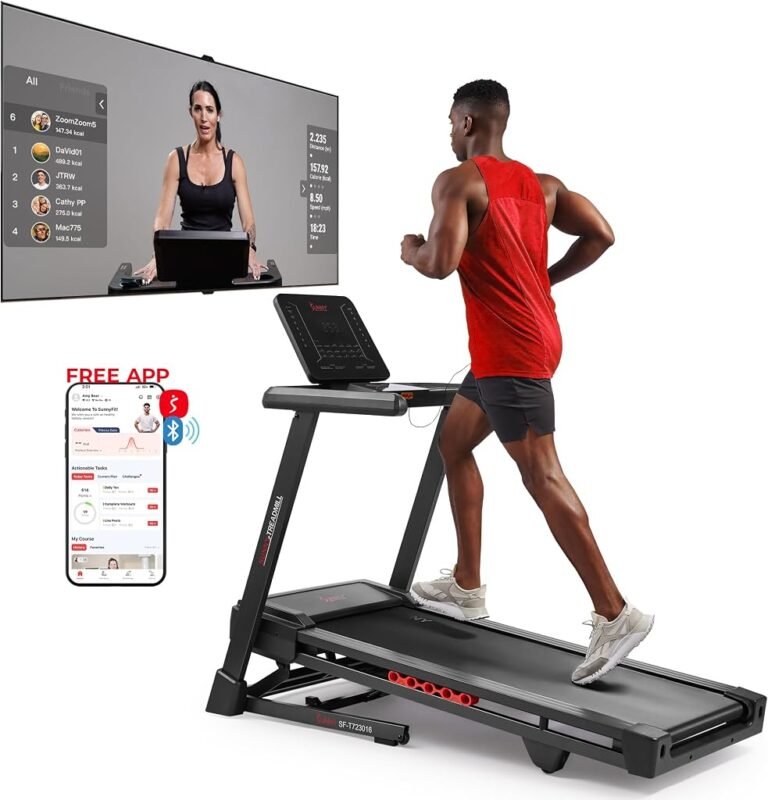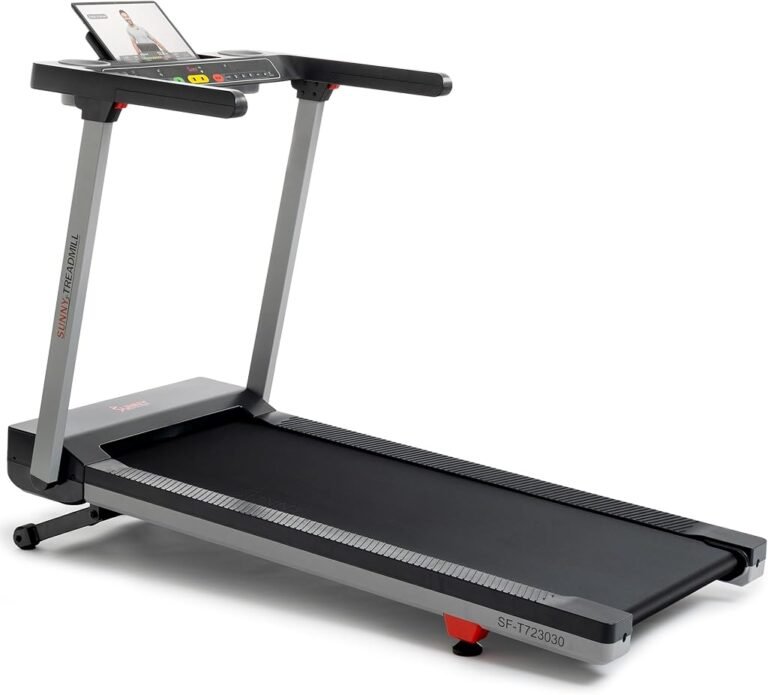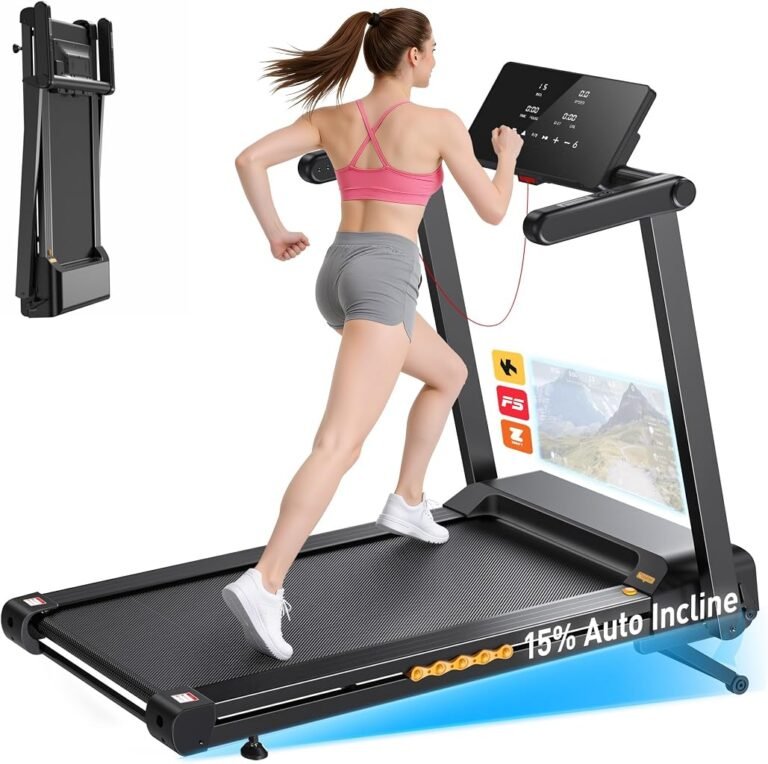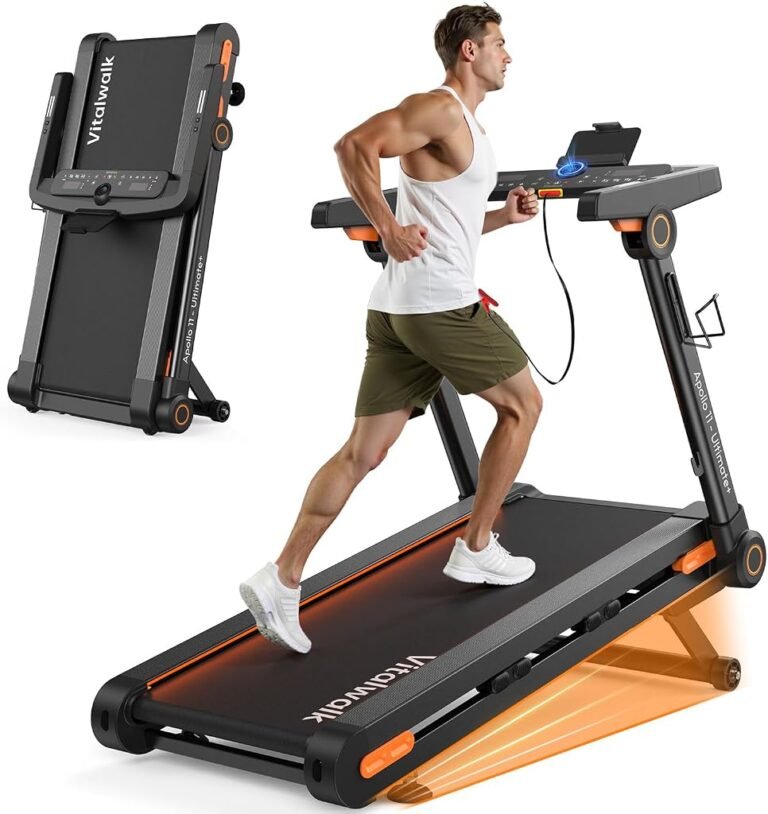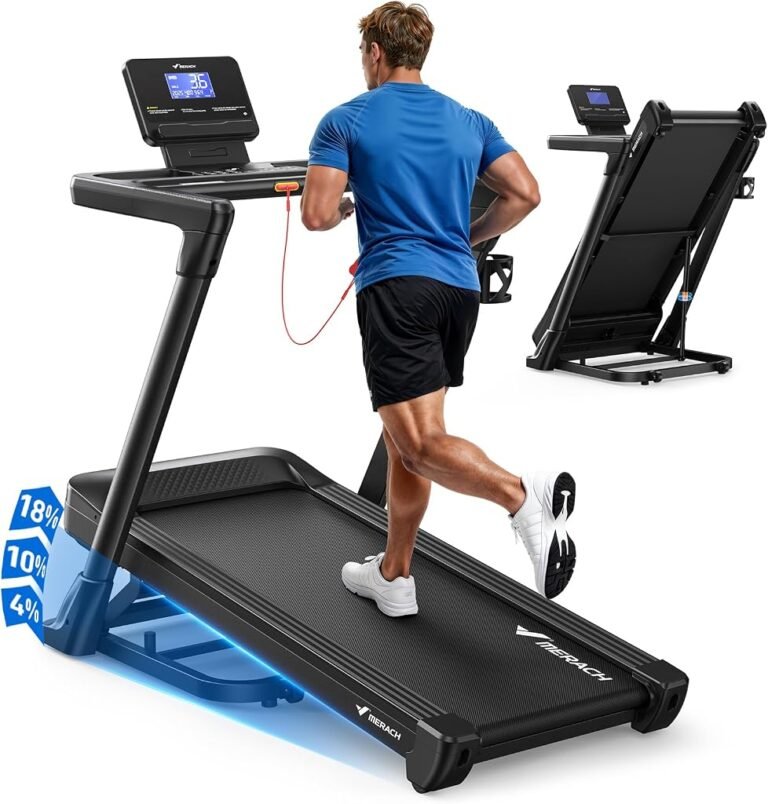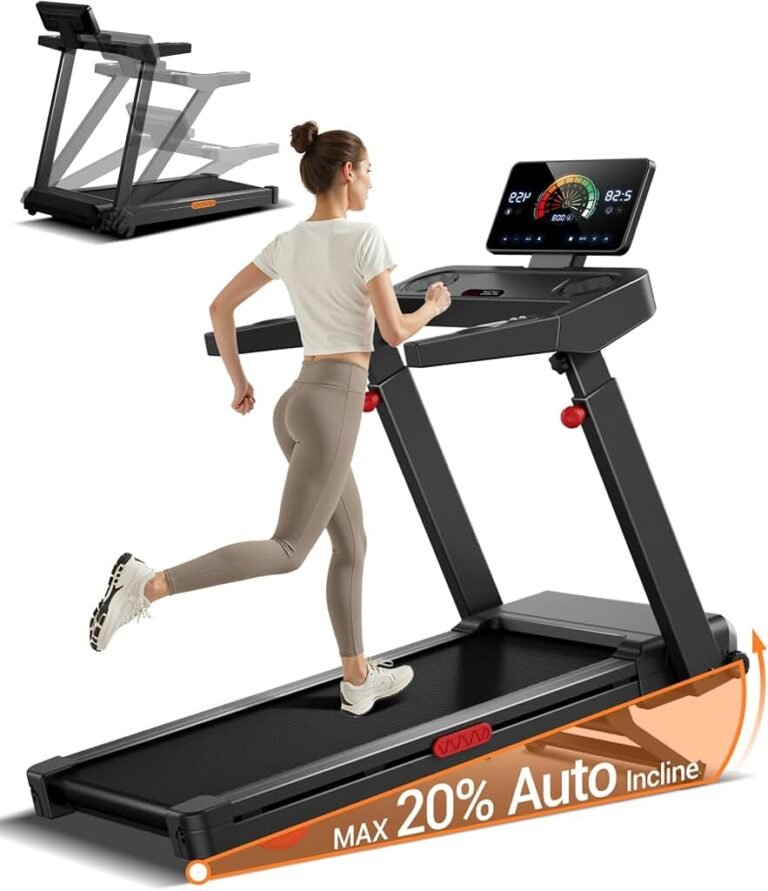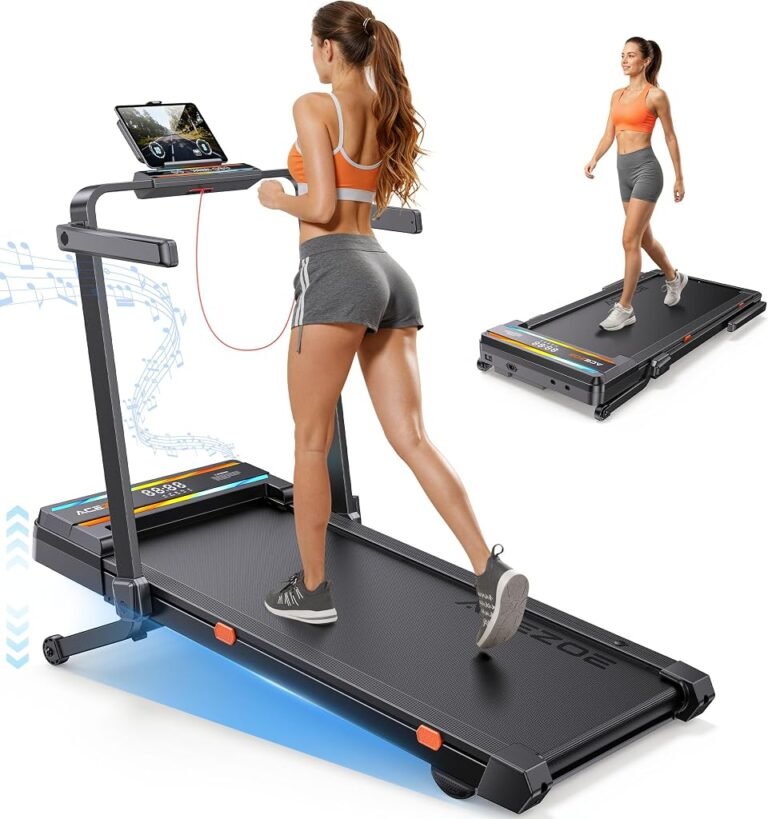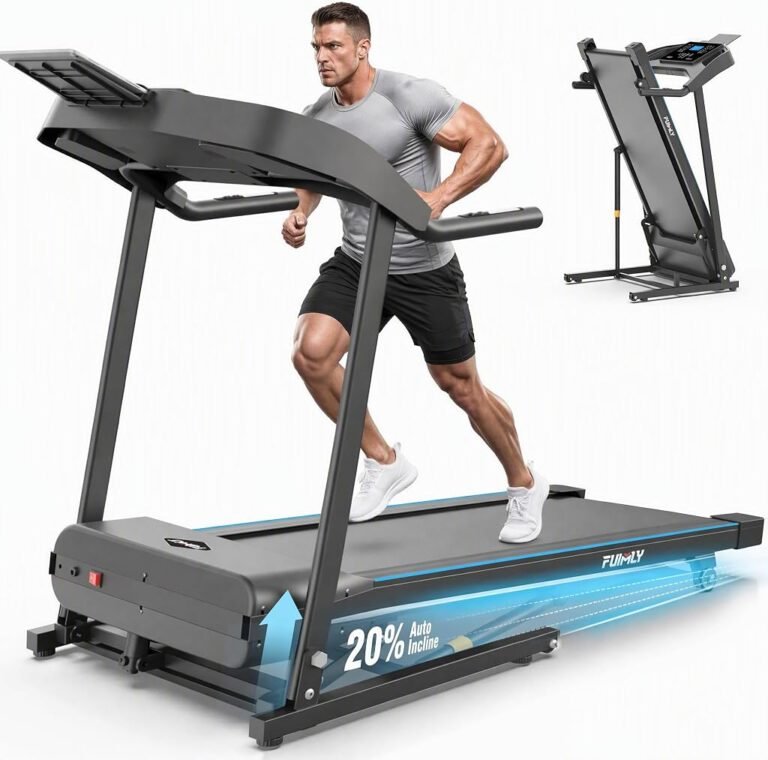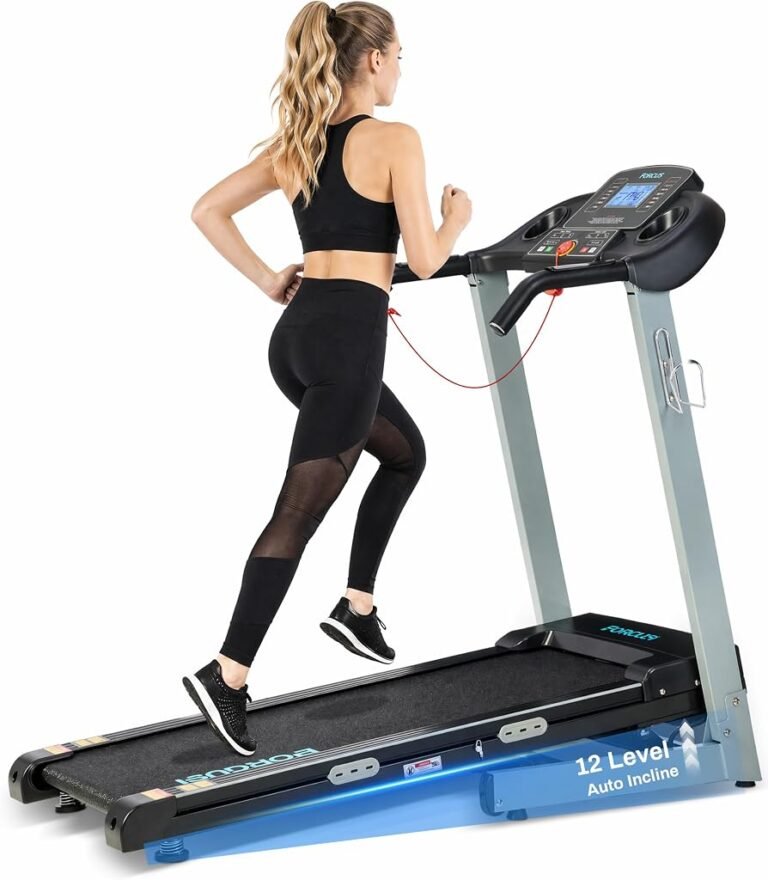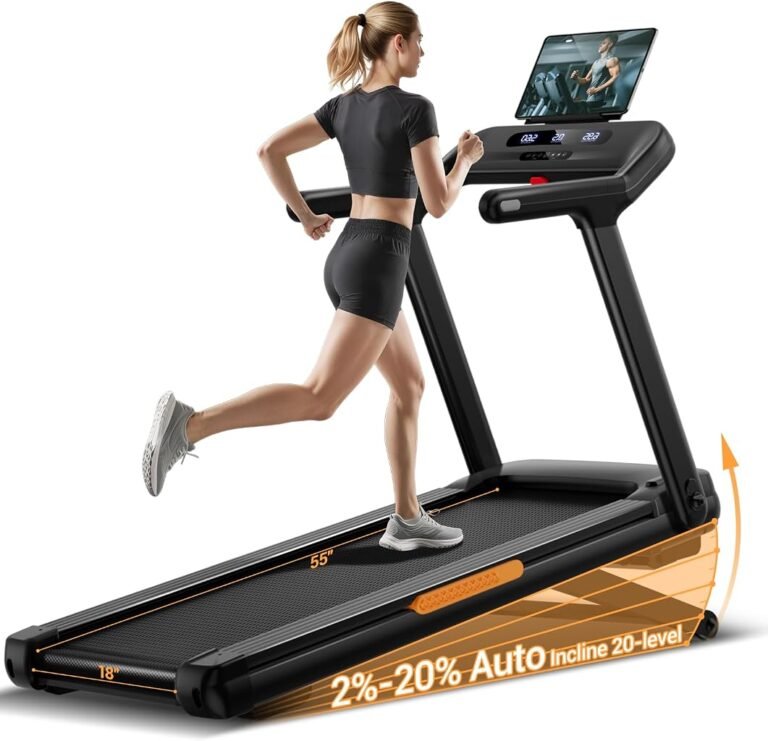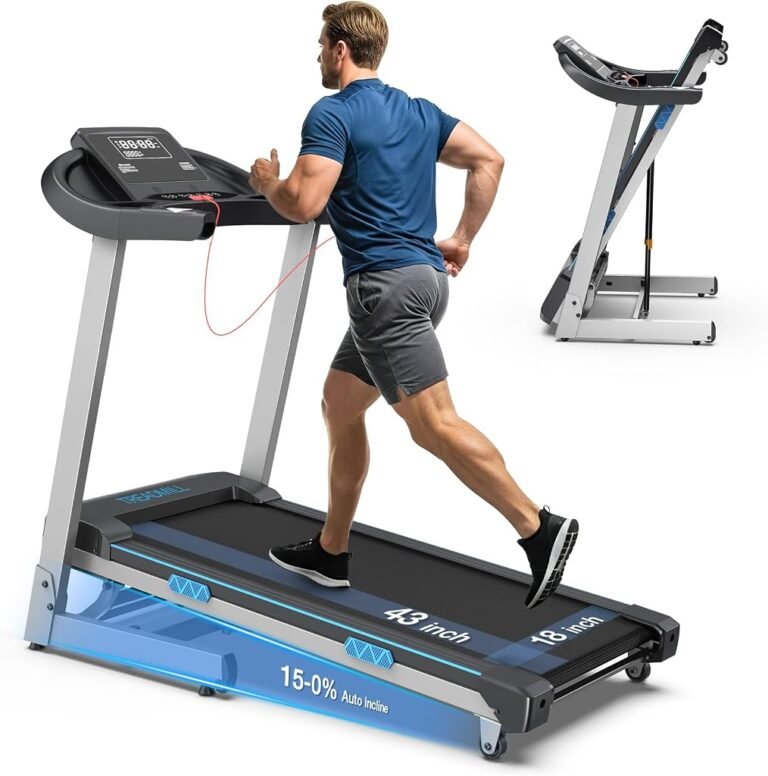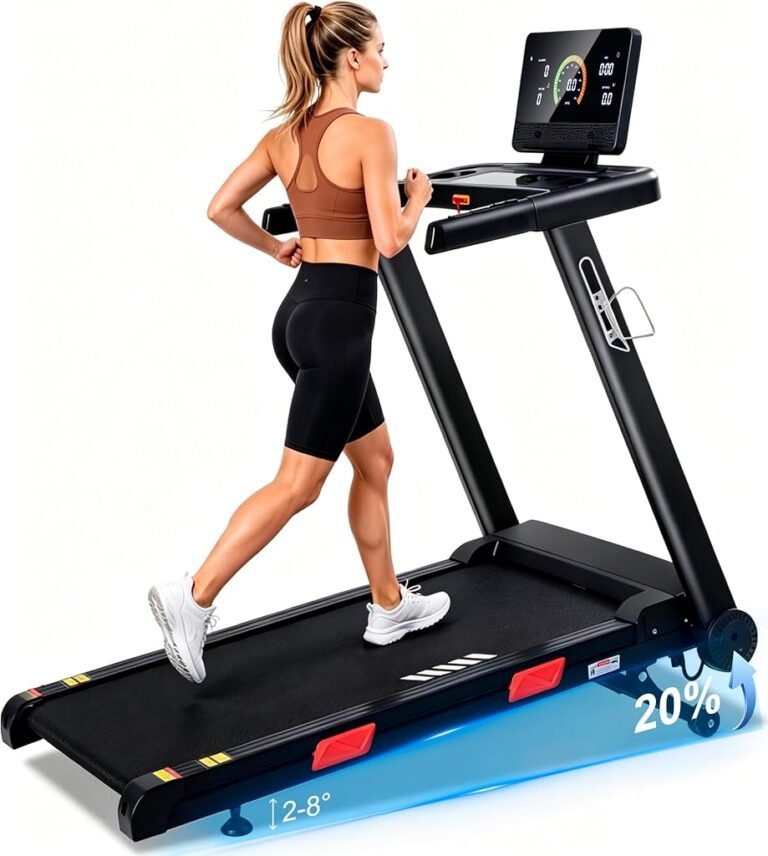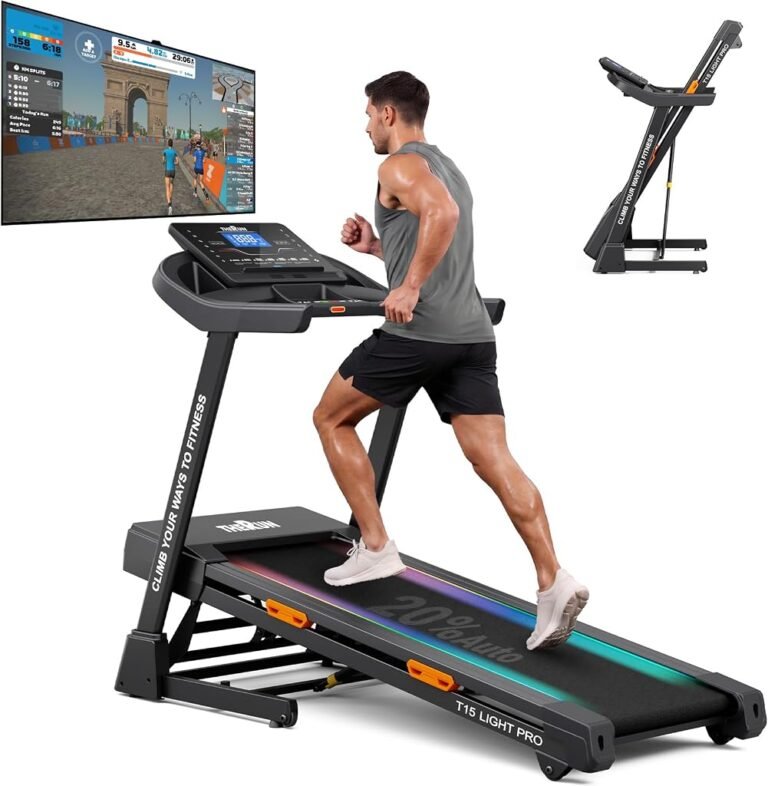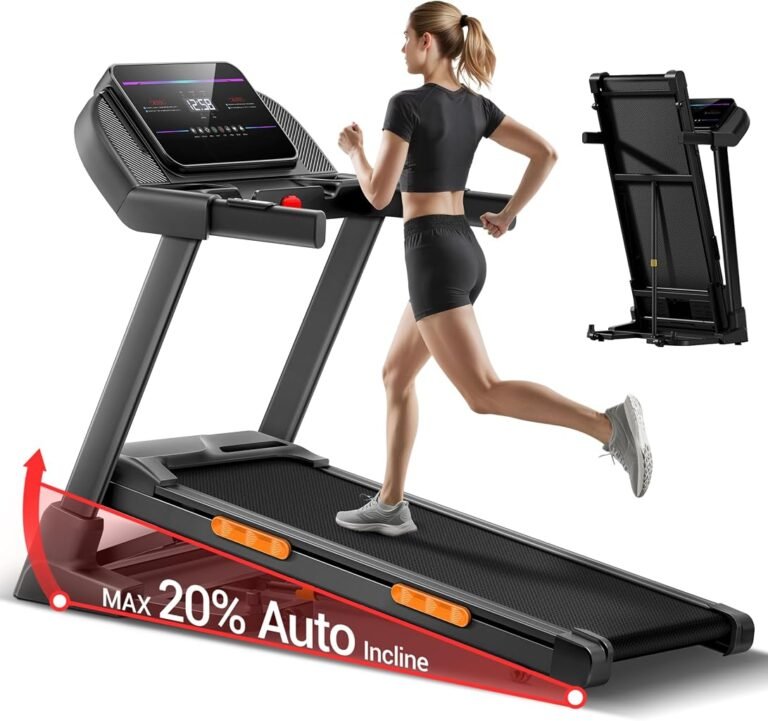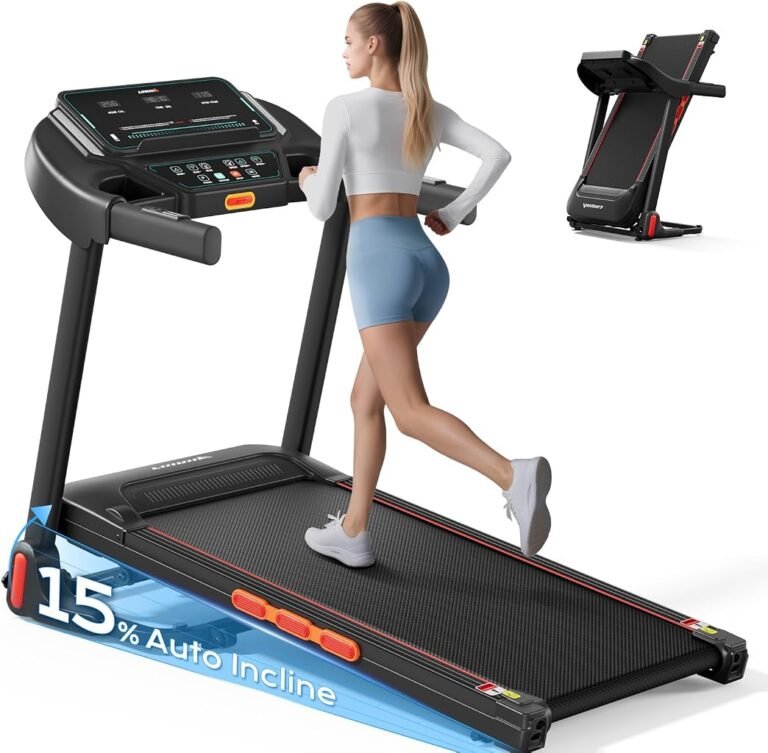
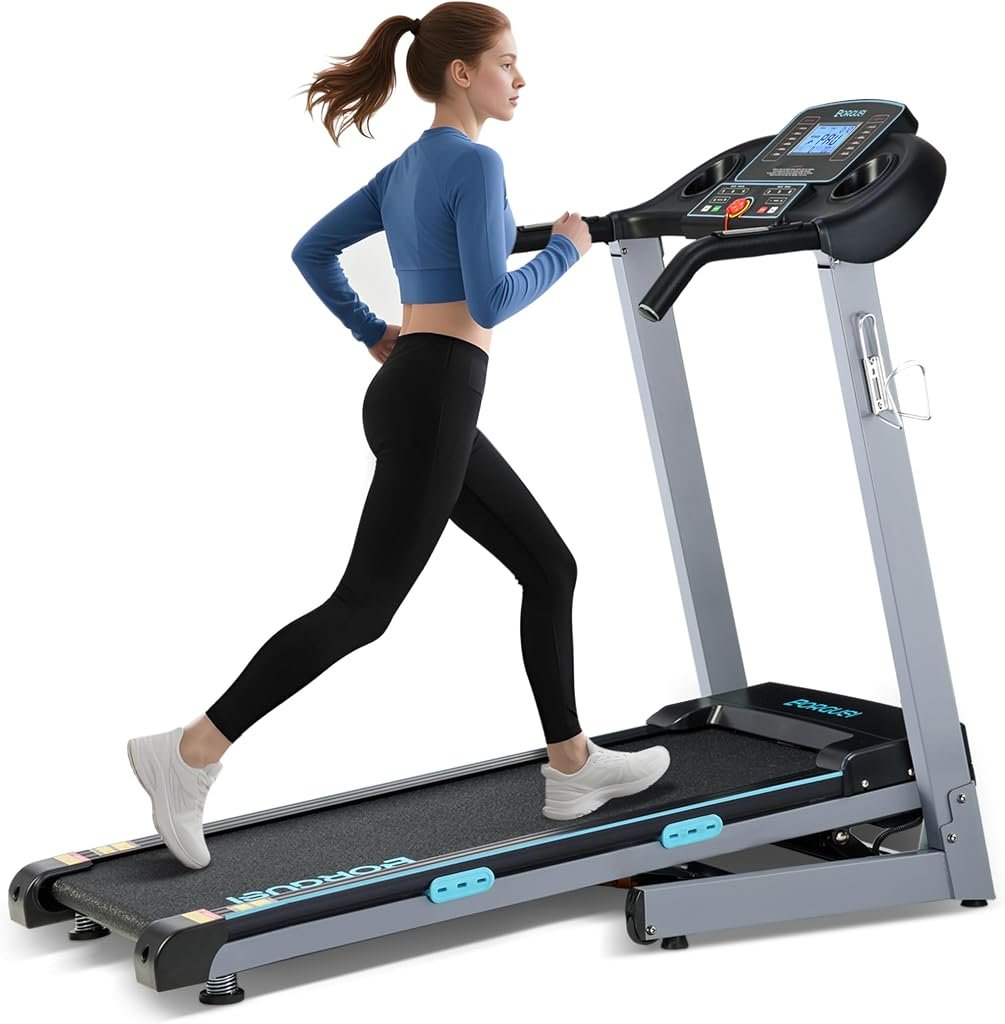
The BORGUSI Auto Incline Folding Treadmill enters the home-cardio market at $389.99 with a proposition that is easy to understand: combine powered incline with a folding treadmill format so that meaningful indoor exercise does not automatically require a permanent home gym.
That sounds straightforward. Building a convincing machine around the idea is harder.
Folding treadmills operate under competing demands. They need enough physical substance to feel appropriate during exercise, yet compactness matters once the workout ends. Incline adds mechanical complexity but can substantially broaden the usefulness of walking. Price adds another constraint: at nearly $400, buyers reasonably expect more than a basic motorized walking belt.
Our Score is 8.55/10. Customer Sentiment is 8.28, Value is 8.15, and Buyer Confidence reaches an unusually strong 9.8. The spread between those figures tells much of the story.
This is a treadmill our assessment regards with considerable confidence, but confidence does not erase trade-offs. Customer Sentiment trails Buyer Confidence by 1.52 points, while Value sits 1.65 points below it. That gap suggests a product whose underlying proposition is easier to endorse than its suitability for every household.
The distinction is useful. A treadmill can be a credible product without being the correct treadmill for every body, room, budget, or exercise style.
For BORGUSI, automatic incline and foldability make the central case. The buyer’s task is determining whether those capabilities match how the machine will actually be used.
The BORGUSI Proposition Is Broader Than Basic Walking
The phrase “folding treadmill” can describe remarkably different equipment.
At one extreme are low-profile walking pads built for modest speeds and easy storage. At the other are conventional running treadmills with folding decks, substantial handrails, larger frames, and training features closer to gym equipment.
BORGUSI operates between those categories.
The manufacturer’s current auto-incline model uses a conventional treadmill structure rather than the stripped-down architecture of an under-desk walking pad. BORGUSI’s 47.3-inch smart treadmill with automatic incline, for example, lists a 47.3-by-17.5-inch belt, automatic electric incline, folding construction, and a 300-pound stated capacity. Specifications should always be matched to the exact model being purchased, but the company’s design philosophy is apparent: these are home treadmills intended for structured exercise rather than passive step accumulation.
That distinction affects how the BORGUSI should be judged.
Its natural comparison is not merely with inexpensive walking pads. It also competes with other compact folding treadmills intended to handle deliberate cardio sessions.
At $389.99, that is where the scrutiny should begin.
Our Score: 8.55/10
An 8.55/10 overall rating places the BORGUSI firmly in excellent territory within our scoring framework.
The score reflects a coherent combination of functions rather than one spectacular specification.
Automatic incline has legitimate exercise value. Folding addresses a real household constraint. The treadmill format provides a more conventional exercise environment than an ultra-thin walking pad. The price remains below the level associated with many large home-running systems.
The overall score does not rise as high as Buyer Confidence because the purchasing equation still contains meaningful compromises.
Space remains one. A folding treadmill does not cease to have dimensions or weight when folded.
Value is another. A buyer who needs only low-speed flat walking can satisfy that narrower requirement with simpler equipment.
Physical fit is the third. Compactness can improve storage while simultaneously making belt dimensions more consequential for taller users or people expecting substantial running.
Our 8.55 score recognizes those tensions without allowing them to obscure the strength of the underlying concept.
Buyer Confidence: 9.8
Buyer Confidence is the standout score at 9.8.
That is exceptionally high relative to the other editorial ratings and deserves interpretation rather than repetition.
The product category itself is mature. Motorized home treadmills are established equipment, powered incline has a clear function, and folding mechanisms address an obvious domestic problem. BORGUSI also maintains its own treadmill catalog and publishes product specifications, providing buyers with a manufacturer-level reference point for current models.
Confidence also benefits from the product’s relatively focused purpose.
This is not a treadmill attempting to justify itself through an assortment of loosely related novelty features. Its central proposition-incline exercise in a folding home format-is understandable and useful.
Yet a 9.8 Buyer Confidence score does not mean purchasing should be automatic.
Before ordering, the buyer should confirm:
- Exact incline range and adjustment controls
- Maximum belt speed
- Running-surface length and width
- Maximum supported user weight
- Overall operating dimensions
- Folded dimensions
- Machine weight
- Safety-stop arrangement
- Electrical requirements
- Assembly requirements
- Warranty coverage
- Recommended maintenance
- Clearance requirements around the treadmill
Those details decide whether a credible treadmill becomes a sensible individual purchase.
Customer Sentiment: 8.28
Customer Sentiment is 8.28, substantially below the 9.8 Buyer Confidence score.
The 1.52-point difference is the most interesting feature of the score profile.
It indicates greater confidence in the BORGUSI as a purchasing proposition than uniform enthusiasm about how a product of this type fits every owner.
Compact treadmills naturally produce this tension.
A person who primarily walks may find a moderately sized running surface entirely comfortable. A taller user attempting faster running can experience the same geometry differently. An apartment resident may prize folding above nearly every secondary feature, while someone with a dedicated gym room may barely use the mechanism.
Expectations surrounding incline can vary as well.
One owner may use powered grade adjustment repeatedly during structured walking sessions. Another may leave the treadmill flat most of the time, reducing the practical value of one of its defining functions.
Customer Sentiment at 8.28 remains favorable. It simply argues for careful matching between machine and user rather than assuming the high Buyer Confidence score makes the product universal.
Value: 8.15
Value receives an 8.15 rating.
At $389.99, the BORGUSI does not need to be the cheapest treadmill to represent sound value. It does, however, need its additional functionality to earn the difference between this machine and simpler walking equipment.
Automatic incline carries much of that burden.
If the owner regularly changes grade, the treadmill offers a meaningful training variable that flat walking pads cannot reproduce. If the incline mechanism goes largely unused, the economic case becomes weaker.
Frequency of use matters just as much.
At $389.99, the initial equipment cost corresponds to approximately $3.90 per session after 100 workouts. After 250 sessions, that falls to about $1.56. At 500 workouts, the initial purchase price works out to roughly $0.78 per workout.
Those calculations exclude electricity, maintenance, repairs, financing, and accessories. They are useful because they expose the relationship between utilization and value.
Exercise equipment does not become economical simply because its sticker price is low. Equipment becomes easier to justify when it is used repeatedly.
Automatic Incline Is More Than a Catalog Feature
Incline changes treadmill walking in measurable ways.
A controlled study involving 24 healthy older adults compared treadmill walking at 0%, 10%, and 16% grades. Researchers reported that, relative to level walking, net cardiopulmonary metabolic energy cost increased 22.9% at 10% incline and 44.2% at 16% incline. The experiment also found changes in lower-limb muscle activity as grade increased.
Those results should not be interpreted as a direct prediction of what every BORGUSI user will experience. The study population, walking speed, individual conditioning, and treadmill settings matter.
The broader principle is useful: grade materially changes the physiological demand of walking.
That gives automatic incline a legitimate place in home training.
Instead of making every harder session a faster session, the user can alter slope. Walking can remain walking while becoming substantially more demanding.
For people who prefer not to run, that distinction can be especially useful.
Incline Walking Creates Another Route to Moderate Exercise
The attraction of incline becomes clearer when considered alongside public-health recommendations.
The Centers for Disease Control and Prevention recommends at least 150 minutes of moderate-intensity activity each week for adults, with brisk walking given as an example. Adults are also advised to perform muscle-strengthening activity on at least two days each week.
A treadmill does not need to support extreme athletic training to contribute meaningfully to that target.
Thirty minutes of brisk walking on five days totals 150 minutes. Roughly 22 minutes each day also reaches the weekly figure.
Incline adds another way to manipulate how demanding those minutes become.
A user might perform a predominantly flat recovery session one day, moderate hill intervals another day, and sustained brisk walking later in the week.
The practical advantage is variability without dependence on weather, daylight, traffic, or route availability.
Slower Uphill Walking Can Be a Legitimate Training Strategy
Faster is not automatically better.
Research involving adults with obesity compared level and uphill treadmill walking across different combinations of speed and grade. The researchers found that slower uphill walking could provide moderate cardiovascular stimulus while reducing several lower-extremity loading measures compared with faster level walking.
That finding should not be converted into a universal exercise prescription. Individual biomechanics, health status, balance, orthopedic history, and conditioning differ.
It does illustrate why incline matters.
A treadmill with powered grade adjustment gives users another route for modifying workload besides increasing belt speed. That flexibility can make walking more adaptable across different fitness levels.
It also challenges a common assumption that progression on a treadmill must eventually mean running.
For many people, progression can mean longer duration, brisker walking, greater incline, structured intervals, or some combination of those variables.
Maximum Incline Should Not Become the Objective
Incline percentages are easy to market because larger numbers appear more capable.
Exercise does not work quite so neatly.
The maximum grade is merely the upper boundary of adjustment. It is not the setting users should automatically seek.
Research examining walking at 0%, 5%, 10%, 15%, and 20% grades found substantial relationships between slope, walking speed, oxygen consumption, and energetic cost. The study of incline walking energetics reinforces the broader point that grade meaningfully alters locomotion.
The appropriate incline is the one compatible with controlled movement.
If a user has to hang heavily from the rails, dramatically alter posture, or struggle to maintain position on the belt, reducing grade or speed is a more rational response than treating the maximum incline as a target.
Progress can be gradual.
A moderate incline used consistently may have far more practical value than a dramatic maximum setting used rarely.
Folding Design Addresses the Unromantic Problem of Floor Space
Fitness equipment is bought for exercise but lives as furniture most of the day.
That reality deserves more attention.
A treadmill used for 30 minutes daily remains unused for the other 23.5 hours. In a dedicated home gym, that may not matter. In an apartment, bedroom, office, or shared living area, it matters considerably.
Folding construction attempts to reduce that conflict.
The value of the mechanism depends on how easily the machine can transition between operating and storage positions. A treadmill that technically folds but is rarely moved because doing so is inconvenient provides less practical benefit than its specification suggests.
Buyers should measure both configurations.
Operating dimensions determine whether exercise is comfortable and safe. Folded dimensions determine whether the machine actually fits the intended storage area.
Furniture, door swings, cabinets, desks, radiators, electrical outlets, and normal routes through the room should all be considered.
The exercise space and storage space are separate problems. Both need solving.
Belt Dimensions Deserve More Attention Than Screens
Digital features are visually appealing in product photographs. Belt dimensions are less glamorous and more consequential.
The walking or running surface determines how much room the user has for each stride.
BORGUSI’s current 47.3-inch auto-incline model, for example, lists a 47.3-by-17.5-inch belt. That specification should not be assumed for every BORGUSI treadmill, but it illustrates the kind of measurement buyers should prioritize.
Walking places different spatial demands on a treadmill than faster running.
As speed rises, stride characteristics change and available deck space can feel more consequential. Taller runners may be particularly sensitive to usable belt length.
This is why a treadmill should fit two spaces simultaneously: the room and the person.
A compact machine that fits beautifully between a desk and a wall is not a successful purchase if the intended user feels constrained while exercising.
Folding Does Not Automatically Mean Portable
Foldability and portability are related but distinct.
A treadmill can fold while remaining heavy enough that frequent movement is inconvenient. Transport wheels can help, but machine weight, floor type, storage orientation, and the physical ability of the user all affect the experience.
Anyone planning to unfold and store the treadmill after every workout should pay particular attention to machine weight and movement requirements.
Someone planning to fold it only occasionally can treat those factors differently.
This is an area where realistic household behavior matters more than imagined routines.
A buyer might envision storing a treadmill neatly after every morning walk. If doing so requires moving furniture, navigating a narrow doorway, or repeatedly handling a cumbersome frame, the machine may soon remain open.
Measurements should therefore include the route to storage, not merely the destination.
The Home-Treadmill Advantage Is Largely About Friction
Outdoor walking remains one of the simplest forms of exercise. It requires little equipment and can provide changing scenery, sunlight, and social contact.
A home treadmill offers a different benefit: logistical predictability.
Rain becomes irrelevant. Darkness stops determining the available walking window. Traffic does not affect the route. There is no commute to a gym.
The CDC notes that moderate physical activity can be divided across the week rather than completed in a few large sessions. That matters because a treadmill can make short periods of available time usable.
Twenty-five free minutes can become nearly 25 minutes of movement.
For many households, that reduction in friction is the strongest argument for owning cardio equipment.
The machine does not create motivation. It shortens the distance between deciding to exercise and beginning.
Who Is the BORGUSI Best Suited To?
The strongest fit is a home exerciser who wants more capability than a basic walking pad but does not want a large treadmill permanently dominating a room.
Powered incline is especially relevant for people who prefer walking and want a way to adjust exercise demand without relying entirely on speed.
The folding format favors shared domestic spaces.
Households with users at different fitness levels may also find the concept useful. One person can focus on level walking while another incorporates incline into more demanding sessions.
The fit becomes less convincing at the extremes.
Someone who wants only slow under-desk walking may be paying for structure and features that are unnecessary.
A dedicated runner expecting substantial weekly mileage should approach the decision differently. Running-surface dimensions, speed range, motor characteristics, stability, warranty coverage, and long-session suitability should take priority over foldability.
The BORGUSI’s strongest identity lies between those use cases.
How It Fits Among the Best Treadmills for Home Use
The best treadmills for home use are not necessarily the machines with the largest motors, screens, decks, or maximum incline figures.
Home equipment operates under constraints commercial gym machines rarely face.
It has to coexist with furniture. Noise matters. Storage matters. Household electrical arrangements matter. Multiple users may have different goals. Price comes directly from a household budget rather than a commercial equipment allocation.
That changes what “better” means.
For one buyer, a large treadmill with a long deck may be preferable. For another, a machine that can be folded after a 30-minute incline walk is far more useful.
The BORGUSI’s 8.55 overall score reflects this domestic perspective.
It offers enough capability to move beyond minimalist walking while preserving a format intended to make home ownership more manageable.
What Buyers Should Verify Before Ordering
A treadmill should be measured and specified before it is purchased, not after delivery.
The buyer should confirm:
- Exact automatic-incline range
- Number and size of incline adjustments
- Maximum speed
- Belt length and width
- Maximum supported user weight
- Overall dimensions when operating
- Dimensions when folded
- Total machine weight
- Electrical requirements
- Safety-stop mechanism
- Handrail and control layout
- Assembly requirements
- Warranty coverage
- Maintenance instructions
- Recommended operating clearance
The intended room should then be measured physically.
Using masking tape to mark the footprint on the floor can reveal conflicts that dimensions on a screen do not make obvious. A door may strike the treadmill. A desk chair may lose its movement range. The folded machine may obstruct a cabinet.
These are mundane problems until they happen every day.
Preventing them is part of intelligent treadmill selection.
Where the BORGUSI Gives Ground
An 8.55/10 product still involves compromise.
The first is economic. At $389.99, the BORGUSI costs more than many straightforward walking pads. Its incline and treadmill structure need to be genuinely useful to justify that difference.
The second is physical. Folding reduces storage demands but cannot make the machine disappear.
The third is user fit. A compact treadmill format may be excellent for walking while requiring closer scrutiny from taller users or dedicated runners.
The fourth appears directly in the scores.
Customer Sentiment at 8.28 and Value at 8.15 are both meaningfully below Buyer Confidence at 9.8. Our assessment therefore views the product proposition with greater confidence than it views universal owner fit or outright price advantage.
That is not contradictory. It is a realistic description of specialized home equipment.
Final Considerations
The BORGUSI Auto Incline Folding Treadmill earns an 8.55/10 overall score by combining two features that make practical sense together: powered incline for greater training flexibility and folding construction for domestic space management.
Buyer Confidence is exceptionally strong at 9.8. Customer Sentiment reaches 8.28, while Value receives 8.15. Those differences sharpen rather than weaken the assessment.
The treadmill is easy to understand as a credible purchase. Whether it becomes a particularly satisfying or economical purchase depends more heavily on the user.
At $389.99, someone seeking only gentle flat walking can find simpler alternatives. A high-mileage runner should place considerable weight on verified deck dimensions, speed, motor characteristics, stability, and warranty coverage.
The strongest audience lies between those groups: people who want deliberate indoor walking, powered incline, a conventional treadmill format, and the ability to recover some household space after exercise.
Incline is particularly meaningful because it allows progression without turning every harder session into a faster one. Published research confirms that increasing treadmill grade materially changes metabolic demand, while public-health guidance recognizes brisk walking as legitimate moderate-intensity activity.
That makes the BORGUSI more interesting than a treadmill judged only by maximum speed.
Its real purpose is adjustable walking and home cardio in an environment where floor space has competing uses.
The 9.8 Buyer Confidence score expresses substantial editorial confidence in that proposition. The lower Customer Sentiment and Value ratings impose the necessary discipline: measure the room, verify the exact specifications, consider the intended user, and decide whether automatic incline will actually become part of the exercise routine.
When those pieces align, the BORGUSI’s 8.55/10 overall score is well earned. Its strongest argument is not spectacle. It is the possibility of making useful indoor exercise easier to start, varied enough to sustain, and practical enough to coexist with the rest of the home.