A foldable treadmill solves one household problem by creating a mechanical one: the machine must perform as exercise equipment while also functioning as a large moving structure.
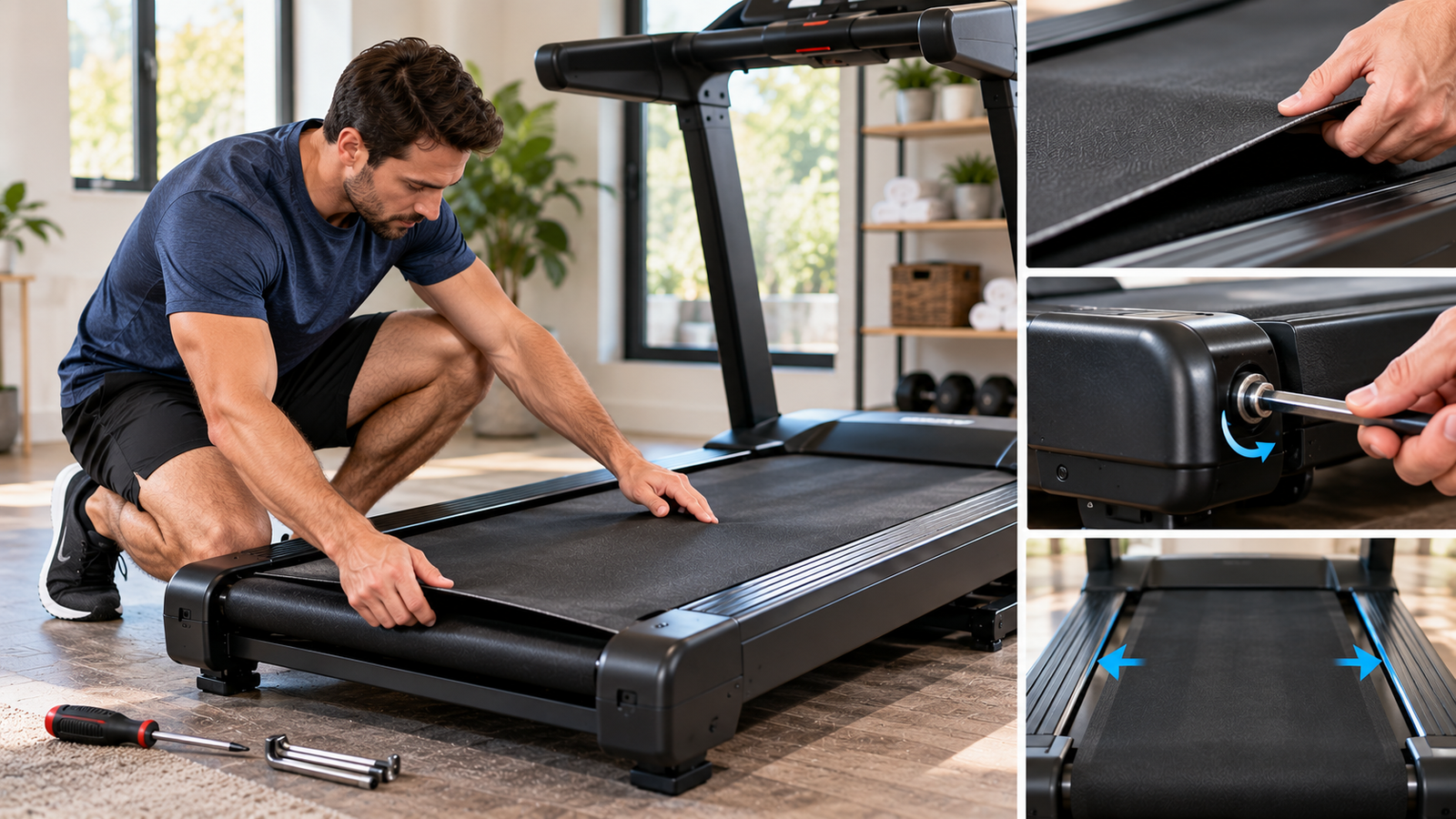
That distinction changes maintenance. A conventional treadmill already combines a motor, control electronics, rollers, bearings, a running belt, a deck, incline hardware, fasteners, and electrical connections. A folding model adds a lift mechanism, locking hardware, hinges or pivots, transport wheels, and often a gas-assisted shock. Every time the deck rises for storage and returns to the floor, those components are asked to move, align, lock, and support considerable weight.
Smooth operation therefore requires more than occasionally adding lubricant beneath the walking belt. Cleaning, belt alignment, lubrication, hardware inspection, folding-mechanism care, correct placement, electrical safety, and early diagnosis all matter.
Manufacturer instructions differ, sometimes substantially. Some running surfaces require silicone lubrication. Others use waxed systems that are specifically intended to receive no added lubricant. A sensible maintenance plan starts with the owner’s manual for the exact treadmill rather than borrowing a routine from another machine.
The following step-by-step method provides a framework for keeping a foldable home treadmill clean, stable, correctly aligned, and mechanically predictable.
Step 1: Start With the Owner’s Manual, Not a Bottle of Lubricant
Lubrication is one of the most misunderstood treadmill-maintenance tasks because there is no universal lubricant rule.
Horizon Fitness, for example, distinguishes between silicone and waxed running surfaces. Its current running-deck and belt guidance states that waxed decks and belts should not have additional substances applied, while compatible silicone surfaces require periodic lubrication.
For its applicable silicone systems, Horizon recommends lubrication every 150 miles, or 241 kilometers, or every three months. Another current Horizon procedure specifies 100% silicone oil for the models covered by that instruction.
Those figures should not be transferred automatically to every treadmill brand.
Before applying anything beneath a running belt, the owner should identify:
- The exact model number.
- The specified lubricant, if any.
- The recommended maintenance interval.
- Whether lubrication is based on calendar time, mileage, operating hours, or inspection.
- Whether the deck is pre-waxed or otherwise designed to run without user-applied lubricant.
- Whether lubrication procedures affect warranty coverage.
Using the wrong material can be worse than delaying maintenance. Household oils, penetrating sprays, grease, and generic lubricants are not interchangeable with a treadmill manufacturer’s specified product.
The first maintenance tool, in other words, is documentation.
Step 2: Disconnect Power Before Maintenance
A treadmill that appears inactive can still contain energized electrical components.
Routine maintenance should begin by stopping the machine, switching it off where applicable, and unplugging it from the wall. Horizon’s maintenance schedule states directly: “To remove power from the treadmill, the power cord must be disconnected from the wall outlet.”
That principle matters when cleaning around the belt, reaching underneath the deck, inspecting a folding mechanism, removing a motor cover, or making belt adjustments.
The safety key is not a substitute for unplugging the machine during mechanical maintenance.
After unplugging, the power cord itself should be examined. Look for:
- Cuts or flattened sections.
- Exposed insulation.
- Damage near the plug.
- Crushing caused by the treadmill frame.
- A cable trapped beneath a wheel or folding deck.
- Unusual heat discoloration around the plug or receptacle.
Foldable machines create a particular cable-management problem because their geometry changes between use and storage. A cord that is safely positioned when the treadmill is flat can become pinched when the machine is folded or moved.
Current Horizon maintenance instructions explicitly call for checking that the cord is not beneath the treadmill or positioned where storage or use could pinch or cut it.
A damaged power cord warrants repair or replacement according to manufacturer instructions rather than tape, improvised splicing, or continued operation.
Step 3: Wipe Down the Treadmill After Use
Sweat looks harmless compared with a motor or roller, but routine contamination is one of the easiest maintenance problems to prevent.
Perspiration contains water and salts. Dust accumulates wherever airflow, static electricity, and moving surfaces permit it. Hair, lint, pet fur, textile fibers, and small debris can migrate toward vents and underneath the treadmill.
After use, a basic cleaning routine should cover the console housing, handrails, side rails, exposed frame, motor cover, and accessible running-belt surface.
Horizon recommends wiping the belt, deck area, motor cover, and console casing with a damp cloth after use and specifically warns against solvents.
The word “damp” matters.
A treadmill is electrical equipment. It should not be saturated during cleaning. Life Fitness likewise advises that a treadmill running belt can be cleaned with a dry microfiber cloth and vacuuming, or with a damp cloth, while warning against using a wet mop because water may reach electronic components or enter the space between the belt and deck. Its running-belt cleaning guidance describes those precautions in detail.
The practical method is simple:
- Disconnect power.
- Use a soft cloth that is damp rather than dripping.
- Wipe sweat from surfaces before it dries.
- Remove visible debris from the belt and side rails.
- Keep liquids away from openings, electronics, control buttons, and motor ventilation.
- Allow cleaned areas to dry before reconnecting power.
Aggressive household chemicals are rarely necessary. Unless the manual specifically approves a cleaner, mild methods are safer than improvisation.
Step 4: Clean Underneath the Treadmill Every Week or Two
The floor under a treadmill is an invisible collection tray.
Shoes carry dust onto the belt. The moving belt transports particles toward the rear. Air movement around the motor draws in lint. Carpet fibers, pet hair, and ordinary household debris gather underneath the deck and frame.
A folding treadmill offers an advantage here: the deck can often be raised so the floor beneath it becomes accessible.
Horizon recommends cleaning underneath its treadmills weekly. Its procedure calls for shutting down and unplugging the machine, folding it upright, confirming that the lock latch is secure, moving the treadmill, and then wiping or vacuuming the accumulated debris.
Weekly cleaning is a manufacturer-specific schedule rather than a universal mandate, but the underlying logic applies broadly.
Homes with pets, carpet, heavy treadmill use, or substantial dust may require more frequent cleaning. A lightly used treadmill in a clean room may accumulate debris more slowly.
The floor itself also deserves inspection. Look for objects that could contact the belt or wheels, moisture, uneven flooring, or deformation of a protective mat.
A treadmill that rocks slightly can produce noises that sound like an internal mechanical defect.
Step 5: Inspect the Running Belt Before Adjusting It
A running belt communicates problems early.
Warning signs include:
- Belt movement toward one side.
- Rubbing against a side rail.
- Slipping when the foot lands.
- Sudden hesitations or surges.
- Frayed edges.
- Unusual squeaking.
- Visible creases or deformation.
- A burning smell.
- Black residue appearing rapidly around the machine.
Not every symptom means the belt needs tightening.
A belt can be too loose, too tight, misaligned, inadequately lubricated, worn, or affected by another component. Tightening every problematic belt is comparable to tightening a screw whenever a door sticks: sometimes it solves the issue, and sometimes it creates another one.
Horizon includes belt tension and alignment among its routine inspection points and warns that a misaligned belt can contact and damage other components.
The owner’s manual should govern the actual adjustment procedure because roller-bolt direction, acceptable belt lift, adjustment increments, and test speeds can differ.
When adjustment is required, small changes are preferable. Both sides should not be altered casually, because changing rear-roller geometry affects tracking.
Step 6: Understand Why Belt Tension Matters
The walking belt has to satisfy two competing requirements.
It must grip the roller system well enough not to slip under load, yet it must not be pulled so tightly that unnecessary tension is placed on the belt, rollers, bearings, motor, and related components.
An over-tightened belt can feel reassuring because it seems firm. Mechanically, excessive tightness can increase resistance.
An under-tightened belt creates a different problem. During walking or running, the user’s foot can momentarily slow the belt while the rollers continue moving. That produces the familiar sensation of a belt “catching” or slipping.
The correct setting is neither maximally tight nor maximally loose. It is the manufacturer’s specified tension.
If slippage persists after correct adjustment, repeated tightening should stop. Lubrication, belt wear, drive-belt condition, roller condition, or another mechanical issue may require investigation.
Step 7: Lubricate Only When the Machine Requires It
Where lubrication is specified, its purpose is friction management between the running belt and deck.
That interface carries the user’s weight while the belt slides continuously across the deck. Excess friction increases resistance and can make the drive system work harder.
Horizon states that inadequate lubrication on its applicable systems can contribute to premature belt, deck, motor, or electronics failure.
The correct procedure is model-specific, but a typical compatible-silicone process involves disconnecting the treadmill, accessing the underside of the belt, applying the specified lubricant to the deck area rather than the walking surface, restoring the correct belt tension, and running the machine slowly to distribute lubricant.
Horizon’s current lubrication instructions for covered models call for 100% silicone oil and specify spreading it beneath the belt. The treadmill is then run at 3 mph for three minutes, followed by walking for another three minutes to complete distribution and check belt tension and alignment.
That procedure illustrates why indiscriminately pouring lubricant beneath a belt is poor maintenance.
Too little may fail to address friction. Too much can migrate toward the edges, floor, rollers, or other components. The wrong lubricant can create an entirely different problem.
The machine’s own manual remains the authority.
Step 8: Inspect the Folding Lock Every Time the Deck Is Raised
A foldable treadmill introduces a component that fixed-frame models do not need: a mechanism that must securely hold the raised deck.
That lock deserves routine attention because storage safety depends on it.
Horizon instructs users of its folding treadmills to raise the rear of the deck until the lock latch engages and to verify that the deck is securely latched before releasing it.
That inspection should become automatic.
When folding, the user should observe whether:
- The latch engages fully.
- The deck reaches its intended storage position.
- Nothing obstructs the mechanism.
- The machine remains stable once folded.
- The deck unexpectedly drops or drifts.
- The release mechanism operates smoothly.
- Hardware around the latch appears loose or damaged.
A folding deck that no longer locks positively should not be treated as a minor inconvenience.
Nor should a deck be forced into position when the locking mechanism resists. Resistance can result from misalignment, obstruction, damaged hardware, or a problem with the lift mechanism.
Step 9: Treat the Gas Shock as a Mechanical Component
Many folding treadmills use a gas-assisted shock or similar mechanism to make a heavy running deck easier to raise and control during lowering.
That assembly is easy to ignore because it often sits beneath the treadmill, outside the user’s normal field of view.
Yet manufacturers sometimes specify maintenance for it. Horizon’s current treadmill-care schedule instructs owners of applicable folding models to clean and grease the gas shock and support tube as part of quarterly maintenance.
A separate Horizon lubrication procedure specifies a Teflon-based spray for the silver tube on applicable air-shock systems.
That does not make Teflon spray universally appropriate for all folding treadmills. It demonstrates why the lift mechanism deserves its own entry in the maintenance schedule.
Changes in folding behavior can be diagnostic. A deck that suddenly falls faster, becomes unusually difficult to raise, sticks midway, or behaves inconsistently should be inspected rather than repeatedly forced.
Step 10: Check Bolts and Structural Hardware Periodically
A treadmill repeatedly absorbs impact from walking or running. A folding treadmill also experiences movement when its deck is raised, lowered, tilted, and transported.
Fasteners deserve periodic inspection.
Horizon recommends inspecting assembly bolts monthly on the treadmills covered by its current routine-maintenance guidance.
Inspection does not mean tightening every visible bolt as hard as possible.
The aim is to identify hardware that has visibly loosened or moved and then follow the manufacturer’s torque or assembly guidance. Over-tightening can damage threads, crush components, or distort assemblies.
Pay particular attention to areas where movement occurs:
- Upright-to-frame connections.
- Console supports.
- Handrails.
- Folding pivots.
- Locking hardware.
- Transport-wheel assemblies.
- Rear roller hardware.
- Incline-frame connections where accessible.
Persistent clicking or knocking often deserves investigation before it becomes louder.
Step 11: Keep the Motor Area Free of Dust
The motor compartment is one area where cleanliness can affect more than appearance.
Treadmills rely on electronics and drive components operating under load. Dust and lint accumulating around cooling paths, circuitry, or motor components are undesirable.
Horizon recommends monthly cleaning of the motor and lower-board area on models covered by its maintenance schedule, after the machine has been powered off, unplugged, and allowed time for the displays to extinguish.
Its broader care schedule also recommends quarterly vacuuming under the motor cover with a soft-bristled attachment and cautions users not to hit wiring or electronic connectors.
Motor-cover removal is not appropriate on every machine or for every owner. Some designs, warranties, or service procedures may restrict access.
Where owner access is permitted, care is required. Vacuuming should be gentle. Wires should not be pulled aside casually. Electronics should not be sprayed with household cleaners.
If the manual directs motor-compartment servicing to a technician, that instruction should prevail.
Step 12: Give the Treadmill Enough Breathing Room
Maintenance starts before a screwdriver or cloth is used.
Placement affects cooling, stability, electrical safety, cleaning access, and emergency clearance.
Horizon currently recommends placing its treadmills on a level, stable surface and keeping ventilation openings unobstructed. Its location guidance specifies one foot of clearance at the front for the power cord, an unobstructed area behind the treadmill at least as wide as the machine and 79 inches, or 2 meters, long, plus preferably 2 feet, or 0.6 meters, of accessible space on each side.
Those dimensions are manufacturer guidance for the covered machines, not universal measurements for every treadmill. The important lesson is broader: a treadmill should not be squeezed into a space simply because its folded dimensions fit there.
The usable footprint includes the safety zone around it.
Ventilation also matters. Blocking air openings with a wall, fabric, boxes, curtains, or stored household items can interfere with heat dissipation.
Step 13: Move a Folding Treadmill Correctly
Transport wheels make a treadmill movable. They do not make it weightless.
Before moving a folding machine, the running deck should be secured in accordance with the manual and the power cord positioned safely.
Horizon instructs owners to remove the cord from the wall and frame before moving applicable treadmills so the cord cannot be damaged. For folding two-wheel models, the machine should be folded and securely latched before it is tilted and rolled.
Dragging a treadmill sideways, lifting from an unsuitable frame member, or moving it with the deck unsecured can place forces on components that were not designed to take them.
A second person may be appropriate when the machine is heavy, the route includes thresholds, or control is uncertain.
Once relocated, the treadmill should be checked for rocking and returned to a level, stable operating position.
Step 14: Listen for Changes Rather Than Waiting for Failure
Mechanical equipment develops patterns. A healthy treadmill has a familiar sound, vibration, startup behavior, and belt feel.
Changes are often more informative than absolute noise level.
The owner should investigate when the machine develops:
- A new rhythmic thump.
- Squeaking linked to each belt revolution.
- Grinding.
- Belt hesitation.
- Excessive vibration.
- A repeated click during folding.
- Increased motor noise.
- A hot or burning odor.
- Unexpected shutdowns.
- Erratic incline movement.
- A deck that no longer lowers predictably.
Some sounds are harmless, but a new noise should not be dismissed merely because the treadmill still operates.
A useful diagnostic method is to note whether the symptom appears with no person on the belt, only under body weight, only at certain speeds, during incline changes, or during folding. That information can help distinguish belt, roller, deck, frame, incline, and drive-system problems.
Step 15: Know When Maintenance Has Become Repair
Routine care should not drift into uncontrolled mechanical experimentation.
Loose cosmetic hardware and normal cleaning are different from motor-control faults, damaged electrical wiring, cracked frames, failed lift systems, worn decks, abnormal roller bearings, or a locking mechanism that no longer secures the machine.
Horizon states in its maintenance schedule that defective components should be replaced and improperly functioning equipment should remain out of use until repaired.
That is a sensible threshold.
The treadmill should be taken out of service when:
- The power cord is damaged.
- The folded deck will not lock reliably.
- The belt cannot be centered through the approved procedure.
- Slippage remains after correct adjustment.
- Electrical smells or visible arcing occur.
- The machine repeatedly trips electrical protection.
- Structural components are cracked or bent.
- The lift mechanism behaves unpredictably.
- The treadmill starts, stops, or changes speed unexpectedly.
Continuing to exercise on a malfunctioning treadmill converts a maintenance problem into a safety problem.
Step 16: Build a Maintenance Schedule That Is Easy to Follow
Maintenance routines fail when they are complicated enough to postpone.
A simple schedule is more useful than an ambitious one that exists only on paper.
After Each Workout
- Wipe perspiration from the console, rails, and frame.
- Inspect the belt briefly for obvious tracking problems or debris.
- Check that nothing has fallen near the running surface.
- Allow moisture to dry before folding if necessary.
Weekly
- Disconnect power.
- Clean the running-belt surface according to the manual.
- Fold the treadmill securely and clean underneath it.
- Inspect the power cord for pinching or damage.
- Look at the deck latch and folding mechanism.
Monthly
- Inspect accessible assembly hardware.
- Check belt tracking and tension.
- Look for unusual belt wear or fraying.
- Clean ventilation areas.
- Inspect transport wheels and leveling points.
- Follow any model-specific motor-area cleaning instructions.
Every Few Months or at the Manufacturer’s Mileage Interval
- Lubricate the belt and deck only if the model requires it.
- Inspect the folding shock or lift mechanism.
- Perform manufacturer-specified lubrication on folding hardware where required.
- Review the machine for developing noises, looseness, or uneven operation.
Keeping a short maintenance record can help. Date, mileage or operating hours, lubrication, belt adjustments, and repairs are enough.
Patterns then become visible. If a belt suddenly requires repeated tracking corrections after years of stability, the repeated adjustment itself becomes diagnostic information.
Choosing a Home Treadmill With Maintenance in Mind
Maintenance is also a purchasing issue.
People comparing the best treadmills for home often focus on motor ratings, maximum speed, incline range, screens, programs, and folded dimensions. Serviceability deserves equal attention.
A useful home treadmill should have accessible documentation explaining:
- Belt lubrication requirements.
- Belt tension and tracking procedures.
- Folding and unfolding.
- Lock-latch inspection.
- Cleaning.
- Power requirements.
- Replacement parts.
- Error messages.
- Service contacts.
A treadmill that folds compactly but makes routine cleaning or adjustment difficult may become less convenient over years of ownership.
The strongest maintenance design is not necessarily the machine with the fewest visible parts. It is the one whose required care is clear, realistic, and compatible with how the household will actually use and store it.
Final Considerations
Smooth treadmill operation is rarely the result of one dramatic maintenance session. It is produced by small interventions made before friction, contamination, looseness, misalignment, or wear become major problems.
For a foldable treadmill, that responsibility extends beyond the running belt. The locking mechanism has to engage securely. The folding shock has to behave predictably. Transport wheels and structural fasteners endure repeated movement. The power cord must remain clear of a frame whose geometry changes. Dust has to be controlled around a machine that moves air through a motor compartment while operating.
The most effective routine is therefore layered.
The machine is wiped after use. The floor beneath it is cleaned regularly. The belt is watched for drift and slippage. Lubrication follows the exact manufacturer’s specification rather than a generic schedule. Bolts and folding hardware receive periodic inspection. Changes in sound, heat, movement, or belt behavior are investigated early.
Just as importantly, restraint is part of maintenance. A belt should not be tightened simply because it slips once. Oil should not be added merely because a treadmill has a moving belt. A motor cover should not be opened if the manufacturer directs that work to service personnel. A faulty folding latch should not be tolerated because the treadmill still runs.
A well-maintained foldable treadmill should feel uneventful. The belt tracks where it should. The deck rises and locks without drama. The machine starts without hesitation, runs without unexpected surges, and returns to storage without cables, debris, or hardware getting in the way.
That uneventfulness is not accidental. It is the result of regular inspection, correct lubrication where required, careful cleaning, and attention to small mechanical changes before they become expensive ones.