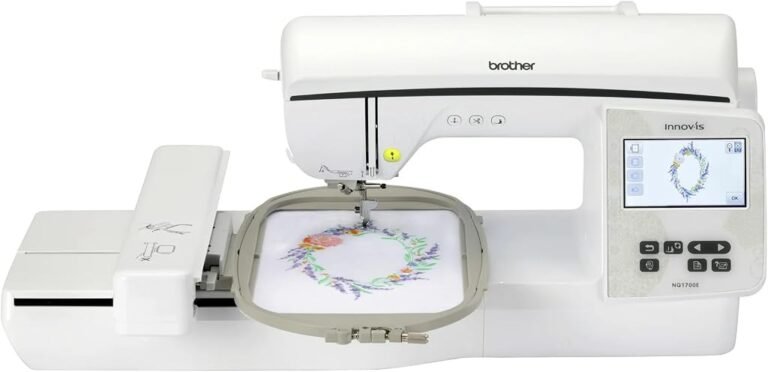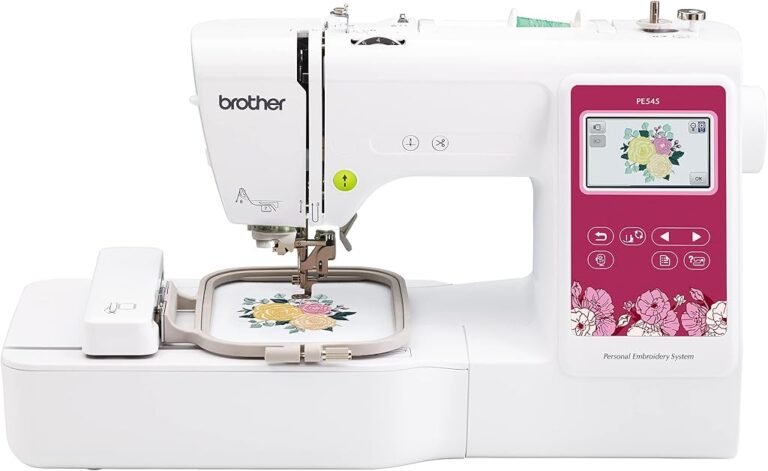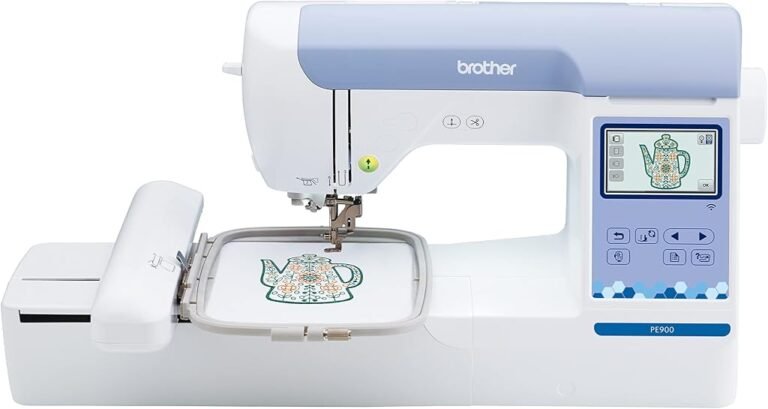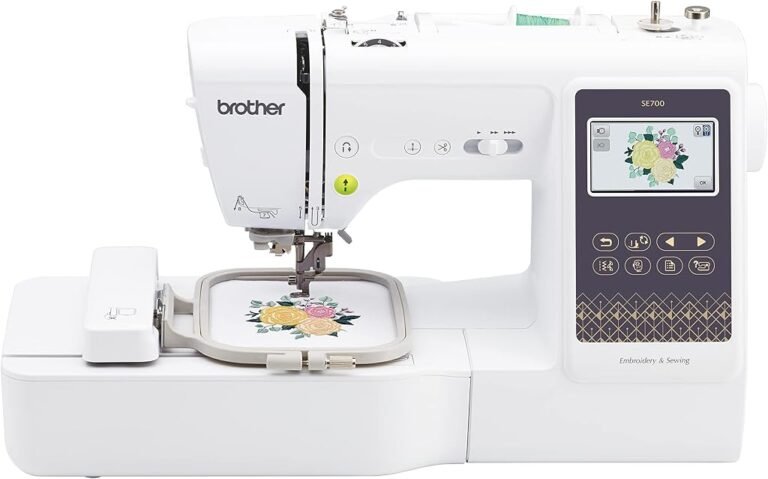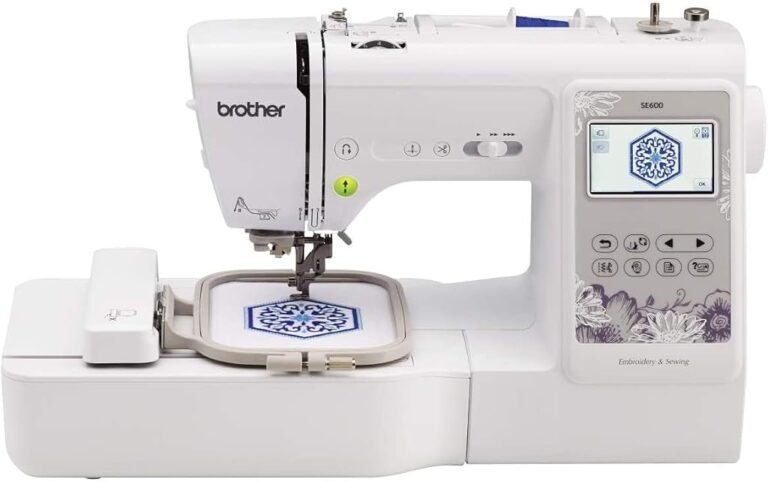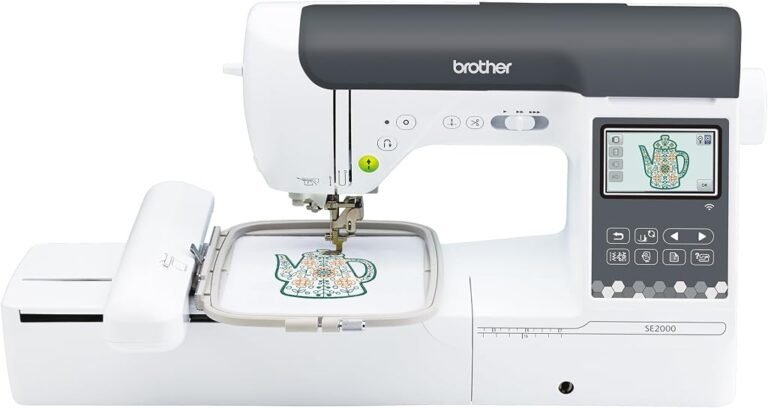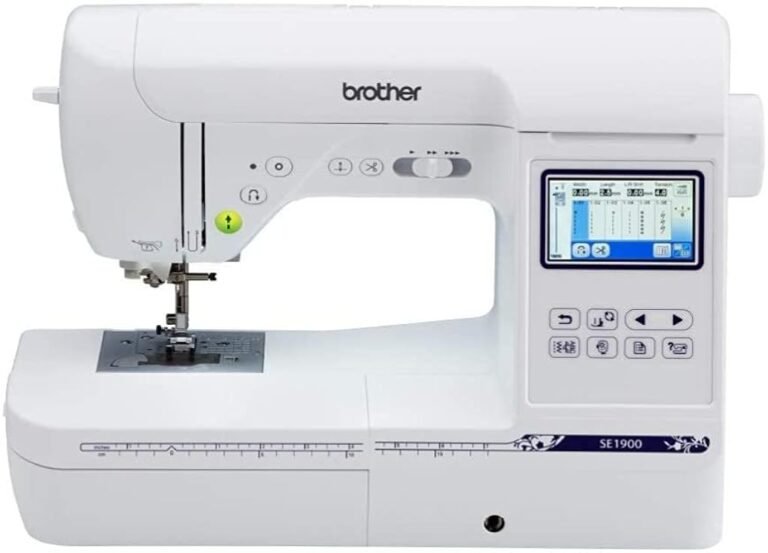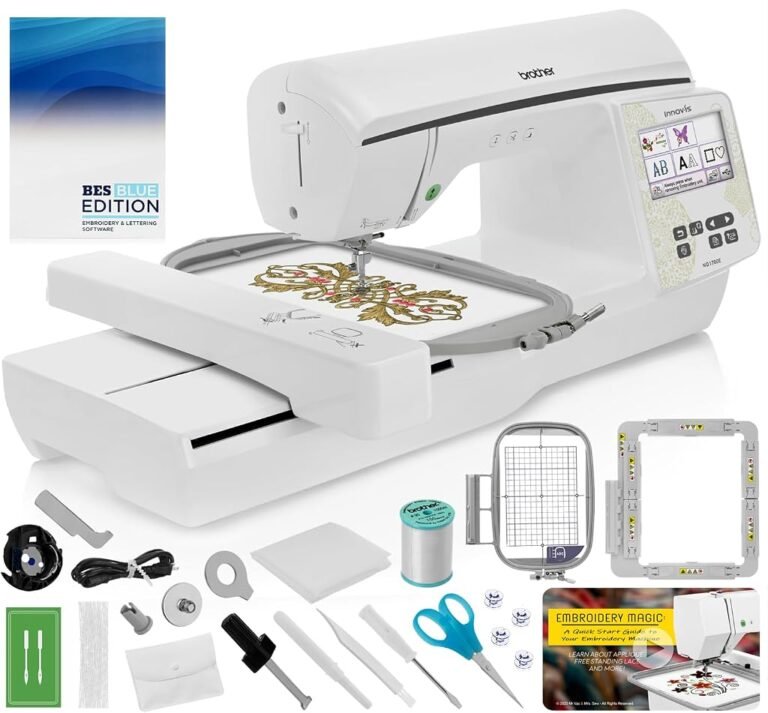
The Brother PE545 and PE900 share enough technology to look like variations on the same idea. Both are dedicated embroidery machines rather than sewing-and-embroidery combinations. Both provide 3.7-inch color LCD displays, wireless LAN, USB connectivity, built-in memory, automatic thread cutting, upper- and bobbin-thread sensors, and compatibility with Brother’s wireless design ecosystem. Yet the similarities conceal a much larger divide in physical capability.
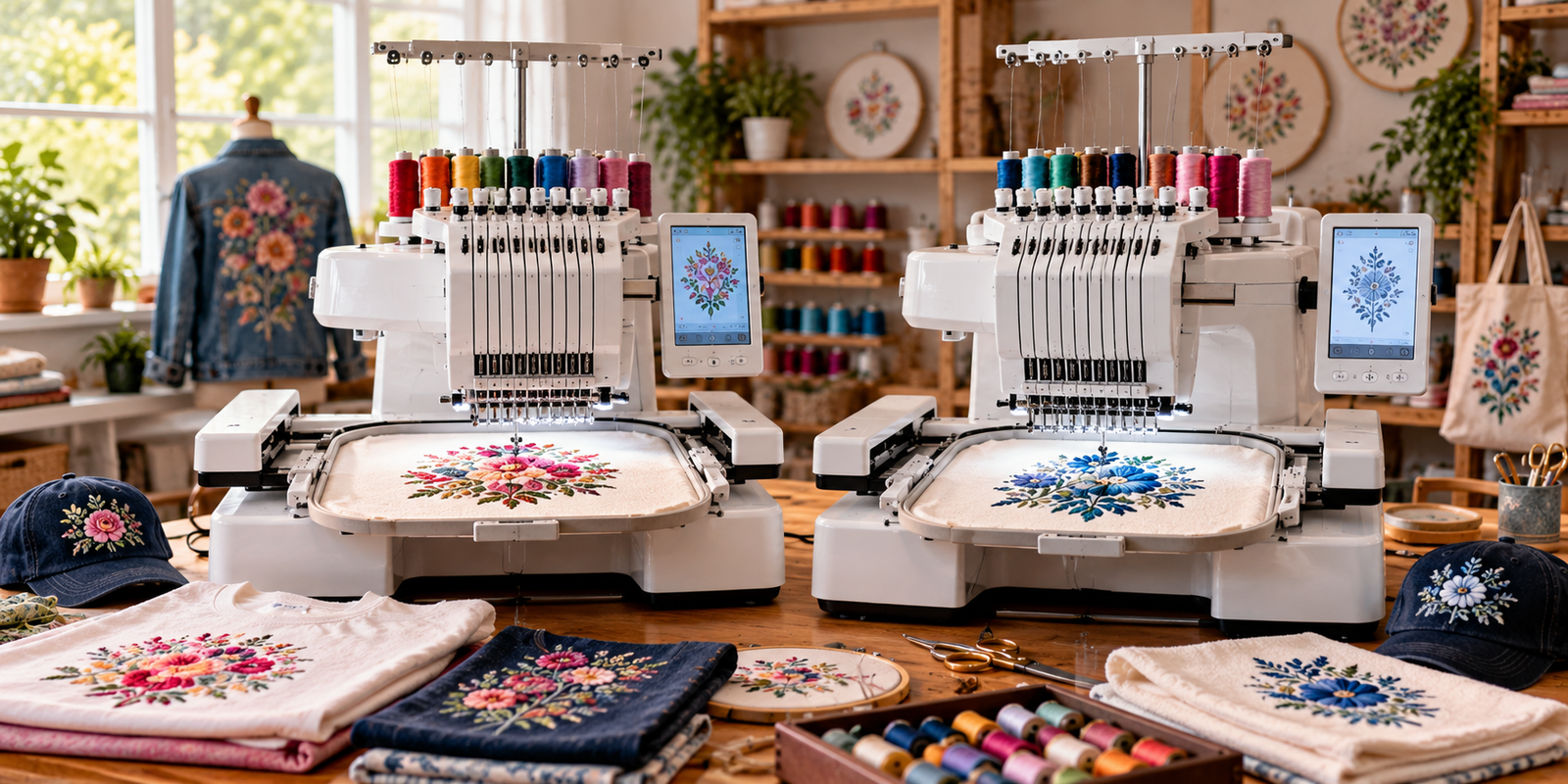
The PE545 has a maximum embroidery area of 4 by 4 inches and operates at speeds up to 400 stitches per minute. The PE900 expands the embroidery field to 5 by 7 inches and reaches 650 stitches per minute. Brother also gives the PE900 193 built-in embroidery designs, 13 lettering fonts, Color Sort and automatic jump-stitch trimming. The PE545 provides 135 designs and 10 lettering fonts.
That distinction makes this comparison fundamentally different from choosing between two machines separated mostly by software.
The PE900 can physically embroider larger designs in one hooping, and its maximum embroidery speed is 62.5% higher. The PE545 counters with a far lower reference price: $479.99 versus $1,179.99. That is a $700 difference, or roughly 146% of the PE545’s reference price.
Our scores are almost identical despite that large difference in cost and capability. The PE545 earns 8.58/10, with Customer Sentiment at 8.5, Buyer Confidence at 9.15 and Value at 8.28. The PE900 receives 8.59/10, with Customer Sentiment at 8.5, Buyer Confidence at 9.22 and Value at 8.28.
A difference of 0.01 points is effectively irrelevant to the buying decision. The real question is whether the larger embroidery field, higher speed and additional workflow automation of the PE900 are worth paying substantially more.
For many beginners, they are not. For frequent embroiderers already anticipating larger designs and more complicated multicolor projects, they can be.
Both Machines Are Embroidery-Only Models
The first distinction buyers need to make has nothing to do with the PE545-versus-PE900 debate.
Neither machine is designed for conventional sewing.
Brother classifies both as dedicated embroidery machines. They are intended to place programmed embroidery designs onto fabric rather than function as general-purpose sewing machines for garment seams, buttonholes, zipper insertion or routine alterations.
This matters for anyone researching the best sewing and embroidery machines because an embroidery-only model answers a different need from a combination machine.
A combination machine can generally switch between conventional sewing and embroidery. A dedicated embroidery machine concentrates its hardware and interface around embroidery.
That specialization can make sense in two circumstances.
The first is a buyer who already owns a satisfactory sewing machine and does not need another one. The second is a more active embroidery user who wants to leave an embroidery machine configured for embroidery while another machine handles ordinary sewing.
For a household buying its first and only machine, however, either PE model can create an equipment gap. Neither substitutes for a conventional sewing machine.
The Embroidery Field Is the Most Important Difference
The PE545’s official Brother specifications state a maximum embroidery area of 4 by 4 inches. The PE900 increases that to 5 by 7 inches.
Those dimensions deserve more attention than they usually receive.
A 4-by-4-inch field represents 16 square inches of rectangular area. A 5-by-7-inch field represents 35 square inches.
Pure area does not translate perfectly into embroidery capability because a design’s dimensions, shape, stitch count and orientation also matter. Still, the arithmetic demonstrates the scale of the difference: the PE900’s nominal rectangular embroidery field is more than twice the area of the PE545’s.
That changes project planning.
Four-by-four embroidery is well suited to small monograms, compact decorative motifs, patches, children’s clothing, napkins, pockets and similarly restrained designs.
Five-by-seven creates substantially more room for larger lettering arrangements, bigger decorative compositions and designs that would exceed one of the PE545’s dimensions.
The difference is not merely that the PE900 includes a larger hoop. Its embroidery mechanism supports the larger maximum field.
That is the PE900’s strongest argument.
Why Hoop Size Can Matter More Than Design Count
Built-in design numbers are easy to compare because 193 is plainly larger than 135.
Hoop capacity is more consequential.
The PE545 contains 135 built-in embroidery designs and 10 lettering fonts. Brother breaks those designs into 75 motif designs plus 60 alphabet and frame designs. The PE900 provides 193 built-in embroidery designs and 13 embroidery fonts.
The PE900 therefore adds 58 built-in designs and three fonts.
That is useful, particularly for someone who prefers working from the machine’s internal library. Yet both machines can import designs. Once external embroidery files become part of the workflow, the significance of the original design count decreases.
The embroidery field does not become less significant in the same way.
A downloaded design that exceeds 4 by 4 inches cannot simply be made compatible with the PE545 by transferring it wirelessly. It must be resized appropriately, split where technically feasible or replaced with a design fitting the available field.
The PE900 therefore provides more freedom before software intervention becomes necessary.
For a buyer who expects embroidery to become a sustained hobby rather than an occasional personalization tool, that physical capacity deserves priority.
The PE900 Is Considerably Faster
Speed creates the second major hardware separation.
Brother rates the PE545 at embroidery speeds up to 400 stitches per minute. The PE900 reaches 650 stitches per minute.
The difference is 250 stitches per minute.
Expressed proportionally, the PE900’s stated maximum is 62.5% higher.
That does not mean every design will finish 62.5% sooner. Embroidery involves acceleration, deceleration, color changes, thread trimming and other interruptions. Stitch density and design geometry can also affect machine behavior.
Still, maximum speed becomes more relevant as designs grow larger.
A small monogram containing relatively few stitches will not expose the same productivity difference as a dense design containing tens of thousands of stitches. As project complexity increases, additional machine speed has more opportunity to affect total working time.
This reinforces a pattern already established by hoop size.
The PE545 is configured for smaller-scale embroidery at a lower acquisition cost. The PE900 is configured for more ambitious work and higher throughput.
Both Have Wireless LAN
Connectivity does not separate these machines nearly as much as their prices might suggest.
Both models are wireless LAN enabled.
Brother allows PE545 owners to transmit embroidery files from a computer using its Design Database Transfer software. The PE900 supports the same wireless system. Brother describes Design Database Transfer as a Windows application that can send embroidery data wirelessly to compatible Brother machines while displaying designs through a thumbnail-based management interface.
This parity matters.
A buyer does not need to spend PE900 money simply to eliminate routine USB transfer.
The PE545 already participates in Brother’s current wireless workflow, which sharply reduces the technological distance between the two models.
Both also retain USB capability and built-in memory. Wireless transfer is therefore an additional route rather than the only route available.
For buyers who organize designs on a computer, either machine can support a modern file-management process.
Artspira Works With Both Machines
The same pattern appears with mobile design transfer.
Brother’s Artspira transfer instructions explicitly list both the PE545 and PE900 among supported embroidery machines. A compatible design can be selected or edited in Artspira, sent to the chosen machine and retrieved from the machine’s temporary data area.
That means Artspira is not a PE900-exclusive reason to upgrade.
Both machines can participate in Brother’s mobile embroidery environment.
This is significant because connected features often age more quickly than mechanical ones. Here, the lower-cost PE545 is not isolated from Brother’s contemporary software direction.
There are limits to the convenience. Brother states in its Artspira guidance on multiple design transfers that Artspira transfers one pattern at a time; transferring another pattern before retrieving the first overwrites the previously transferred server data.
That restriction applies to workflow rather than embroidery quality, but it illustrates why wireless connectivity should not be treated as frictionless automation.
The PE900’s justification must therefore come from elsewhere: field size, speed, design capacity and automation features.
The 3.7-Inch Display Is Shared Territory
Both machines use a 3.7-inch color LCD display.
On the PE545, Brother provides on-screen editing and a drag-and-drop function that allows a design to be moved with a finger. The PE900 likewise uses a 3.7-inch display and adds editing functions including letter editing, zooming, resizing, rotating, repositioning and combining designs.
A touchscreen matters because machine embroidery is partly a positioning problem.
A design must be placed within the available embroidery field, oriented correctly and evaluated before stitching begins. On-screen controls reduce reliance on external calculations for ordinary adjustments.
Neither display is tablet-sized. A 3.7-inch screen necessarily imposes limits on how much detail can be viewed at once.
Yet the shared screen dimension creates another useful buying insight: the PE900’s higher price is not buying a dramatically larger display.
The extra money is concentrated more heavily in embroidery capacity and workflow features.
Color Sort Gives the PE900 a Genuine Workflow Advantage
One of the PE900’s more consequential differences is Color Sort.
Brother describes the function as rearranging the stitching order in multicolor designs to reduce color changes.
The concept matters because a single-needle embroidery machine still requires human involvement when thread colors change.
If a design contains multiple separated elements using the same color, an optimized stitching sequence can reduce unnecessary returns to that color. Fewer color changes mean fewer interruptions for the operator.
The value grows with design complexity.
Someone embroidering simple one- or two-color names may rarely extract much benefit. Someone routinely stitching elaborate multicolor patterns has more opportunity to save manual intervention.
Color Sort does not make the PE900 a multi-needle production machine. It cannot keep several thread colors loaded simultaneously and select between them automatically.
It does, however, make better use of the single-needle architecture.
The PE545 does not offer the same advertised Color Sort function.
Jump-Stitch Trimming Further Separates the PE900
The PE900 also includes automatic jump-stitch trimming.
Jump stitches are connecting threads created when the embroidery path moves between separated sections without stitching the fabric continuously between them. They can leave visible thread spans requiring cleanup.
Brother states that the PE900’s Jump Stitch Trimming function automatically trims excess thread jumps within a color.
Again, this is a workflow feature rather than a larger embroidery field.
Its usefulness becomes more apparent with complex designs containing multiple separated elements. Reducing manual trimming after embroidery can make finishing less tedious.
Combined with Color Sort, it gives the PE900 a more automated relationship with complicated multicolor designs.
That distinction is more meaningful than simply having another decorative motif in the built-in library.
The PE545 still includes an automatic thread cutter, so basic automated cutting is present on the less expensive machine. What it lacks is the PE900’s more specialized jump-stitch management.
Weight Reveals the Hardware Difference
The PE545 weighs 14.07 pounds, according to Brother, and measures 7.76 by 16.50 by 12.09 inches.
Brother lists the PE900 at 17.64 pounds.
The PE900 is therefore roughly 3.6 pounds heavier.
That difference is unsurprising given the larger embroidery mechanism and working capacity, but it matters for storage.
An embroidery machine often spends long periods on a dedicated surface because embroidery projects involve hoops, stabilizers, thread and other materials around the chassis. If the machine must be packed away after every session, lower weight can become meaningful.
The PE545 has an advantage here.
Its smaller embroidery field limits project scale, but the same compactness can suit a smaller workspace or a user who routinely moves the machine.
The PE900 asks for more physical accommodation in exchange for its larger working envelope.
The Price Difference Is Impossible to Ignore
The reference prices are $479.99 for the PE545 and $1,179.99 for the PE900.
That produces a $700 gap.
A buyer paying the difference receives a larger embroidery field, 58 additional built-in designs, three additional lettering fonts, a 250-stitch-per-minute increase in maximum embroidery speed, Color Sort, jump-stitch trimming and the broader physical workspace associated with the larger machine.
What the buyer does not receive is equally revealing.
Both machines already have wireless LAN.
Both work with Artspira.
Both have 3.7-inch color displays.
Both provide USB connectivity.
Both include automatic thread cutters.
Both provide upper- and bobbin-thread sensors.
Both have built-in memory.
The PE900 premium is therefore paying primarily for embroidery scale, speed and workflow refinement rather than entry into an entirely different digital ecosystem.
That distinction should govern the buying decision.
Why Both Receive the Same Value Score
Our Value rating is 8.28 for both machines, despite the large price difference.
That may initially seem contradictory.
Value is not synonymous with low price.
The PE545 costs substantially less, but it also has a smaller embroidery field and lower maximum speed. Its value proposition rests on providing current wireless features and capable small-format embroidery without requiring a four-figure investment.
The PE900 costs much more, but its 5-by-7-inch field can prevent an owner from reaching the 4-by-4-inch ceiling as quickly. Its higher speed and automation also become more useful as project volume rises.
The machines therefore earn value differently.
For a casual embroiderer, the PE545 can provide much of the desired experience for hundreds of dollars less.
For a frequent embroiderer, buying a 4-by-4-inch machine and replacing it after discovering that the field is too restrictive can prove less economical than purchasing the PE900 initially.
Value is tied to use, not merely the receipt total.
Built-In Designs Favor the PE900, but Not Decisively
The PE900’s 193 designs exceed the PE545’s 135 by roughly 43%.
That is a measurable advantage.
Yet built-in design counts deserve skepticism when evaluating modern wireless embroidery machines.
Both products can accept external designs. Both have USB ports. Both have built-in memory. Both can receive compatible designs through Brother’s connected ecosystem.
The internal library is therefore a starting collection rather than a permanent creative boundary.
Lettering fonts can have greater practical persistence because monogramming and personalization are common embroidery applications. Here the PE900 provides 13 fonts versus the PE545’s 10.
Even then, hoop dimensions remain the stronger differentiator. A larger font collection cannot compensate when the intended composition physically exceeds the embroidery field.
Neither Machine Is a Multi-Needle Production System
The PE900’s higher price and faster operation should not cause it to be mistaken for commercial multi-needle equipment.
Both models use a single-needle home-embroidery format.
When a multicolor design calls for another thread color, the operator must change thread accordingly. Color Sort can reduce the number of changes on the PE900, but it cannot load and select several thread colors independently.
This distinction matters for anyone planning a substantial personalization business.
A single-needle machine can produce sophisticated embroidery, but production workflow differs substantially from a multi-needle machine designed to keep several colors threaded at once.
The PE900 sits above the PE545 in Brother’s single-needle home-embroidery hierarchy represented by these two products. It does not eliminate the operational characteristics of that category.
Which Machine Is Better for Beginners?
The PE545 is the stronger entry point for many beginners.
Its 4-by-4-inch field keeps initial projects relatively contained, while its 3.7-inch touchscreen, automatic thread cutter, wireless transfer, USB port, built-in memory and Artspira compatibility prevent it from feeling digitally obsolete.
The lower reference price also reduces the financial commitment required to discover whether machine embroidery becomes a lasting interest.
There is a counterargument.
A beginner already committed to larger designs may outgrow 4 by 4 inches quickly. In that situation, buying the PE545 solely because it appears more beginner-oriented can create an unnecessary intermediate purchase.
Skill level and project ambition are different questions.
A beginner can reasonably choose the PE900 when the intended designs already require its larger field.
Which Machine Is Better for Frequent Embroidery?
The PE900 has the stronger case.
Its 5-by-7-inch field allows larger single-hooping designs. Its 650-stitch-per-minute maximum is substantially higher. Color Sort can reduce thread-color changes, and jump-stitch trimming can reduce manual cleanup.
Those differences accumulate when embroidery is repeated frequently.
Saving a small amount of manual work on one design may be trivial. Saving it across dozens of multicolor projects becomes more meaningful.
The larger field also broadens the pool of designs that can be used without splitting or resizing.
The PE900 is therefore not simply a PE545 with additional patterns. Its hardware and automation better suit higher embroidery ambition.
Interpreting the Editorial Scores
Our overall ratings are extraordinarily close.
The PE545 receives 8.58/10. The PE900 receives 8.59/10.
Both have Customer Sentiment scores of 8.5 and Value ratings of 8.28.
Buyer Confidence provides the slightly larger separation: 9.15 for the PE545 versus 9.22 for the PE900.
The PE900’s small advantage reflects its broader embroidery capacity and additional automation. Yet a 0.01-point difference in overall score should never be mistaken for a universal recommendation.
The PE545 can be the superior purchase for a buyer whose projects fit comfortably inside 4 by 4 inches. Paying another $700 for unused capacity would not improve that person’s embroidery merely because the PE900 carries the marginally higher rating.
Likewise, the PE900 is the better machine for a buyer who repeatedly encounters designs larger than the PE545 can accommodate.
The ratings are close because each product makes sense within a distinct level of embroidery ambition.
Who Should Choose the PE545?
The PE545 is better suited to:
- Beginners exploring dedicated machine embroidery.
- Users whose designs routinely fit within a 4-by-4-inch field.
- Buyers prioritizing lower initial cost.
- Owners who already have a conventional sewing machine and want a separate embroidery station.
- Users who still want wireless LAN and Artspira compatibility without moving to the PE900.
- People with more restricted storage or workspace.
- Monogramming and small-personalization users who do not require higher-volume workflow features.
The main reason to avoid it is equally simple: 4 by 4 inches is a hard physical limit for a single embroidery field.
Who Should Choose the PE900?
The PE900 is better suited to:
- Users who already know that 4-by-4-inch embroidery is too restrictive.
- Embroiderers who want a 5-by-7-inch maximum field.
- People working frequently with larger or more complicated designs.
- Users who can benefit from a 650-stitch-per-minute maximum.
- Multicolor embroidery users who value Color Sort.
- Buyers who want automatic jump-stitch trimming.
- Users prepared to pay substantially more for additional physical capacity and workflow automation.
The PE900’s strongest justification is not its larger built-in design library. It is the combination of hoop capacity, speed and automated handling.
Final Considerations
The Brother PE545 and PE900 illustrate two different approaches to dedicated home embroidery without forcing the buyer to choose between old and new connectivity.
Both are wireless. Both support Brother’s contemporary transfer environment. Both work with Artspira. Both provide 3.7-inch color displays, USB connectivity, automatic thread cutting, thread sensors and built-in memory.
The decisive differences are more tangible.
The PE545 offers a 4-by-4-inch embroidery area, 400-stitch-per-minute maximum, 135 built-in designs and 10 lettering fonts. At the $479.99 reference price, it creates a relatively accessible path into dedicated embroidery while retaining wireless design transfer.
Its 8.58/10 overall score, 8.5 Customer Sentiment, 9.15 Buyer Confidence and 8.28 Value rating reflect that balance. The machine is limited by its embroidery dimensions, but it avoids stripping away modern connectivity merely to reach a lower price.
The PE900 raises the maximum embroidery field to 5 by 7 inches, increases maximum speed to 650 stitches per minute, supplies 193 designs and 13 fonts, and adds Color Sort and jump-stitch trimming. Its 8.59/10 overall score, 8.5 Customer Sentiment, 9.22 Buyer Confidence and 8.28 Value rating recognize a more capable machine whose higher price requires a more demanding use case.
At a $700 reference-price difference, the PE900 should not be chosen merely because it has the higher model number or 58 more built-in designs. The additional expenditure makes the strongest sense when 5-by-7 embroidery, faster operation and reduced manual intervention solve identifiable problems.
For small monograms, patches, children’s garments, compact motifs and occasional personalization, the PE545 is likely to be the more rational allocation of money.
For users expecting larger designs, repeated multicolor embroidery and enough project volume to benefit from higher speed and automatic cleanup, the PE900 has the stronger hardware.
And for buyers already worried that even 5 by 7 inches may be restrictive, the comparison itself points toward a different answer: neither machine should be selected simply because it is the larger of these two. Embroidery field is one of the few specifications that cannot be expanded later through an app, firmware update or larger design library.
The PE545 is therefore the better value-oriented entry into dedicated wireless embroidery. The PE900 is the better choice for users who can identify, before purchase, why 4 by 4 inches and 400 stitches per minute would constrain their work. That distinction is more useful than declaring one machine universally superior, because these two Brother models are separated primarily by the scale of the projects they are built to handle.