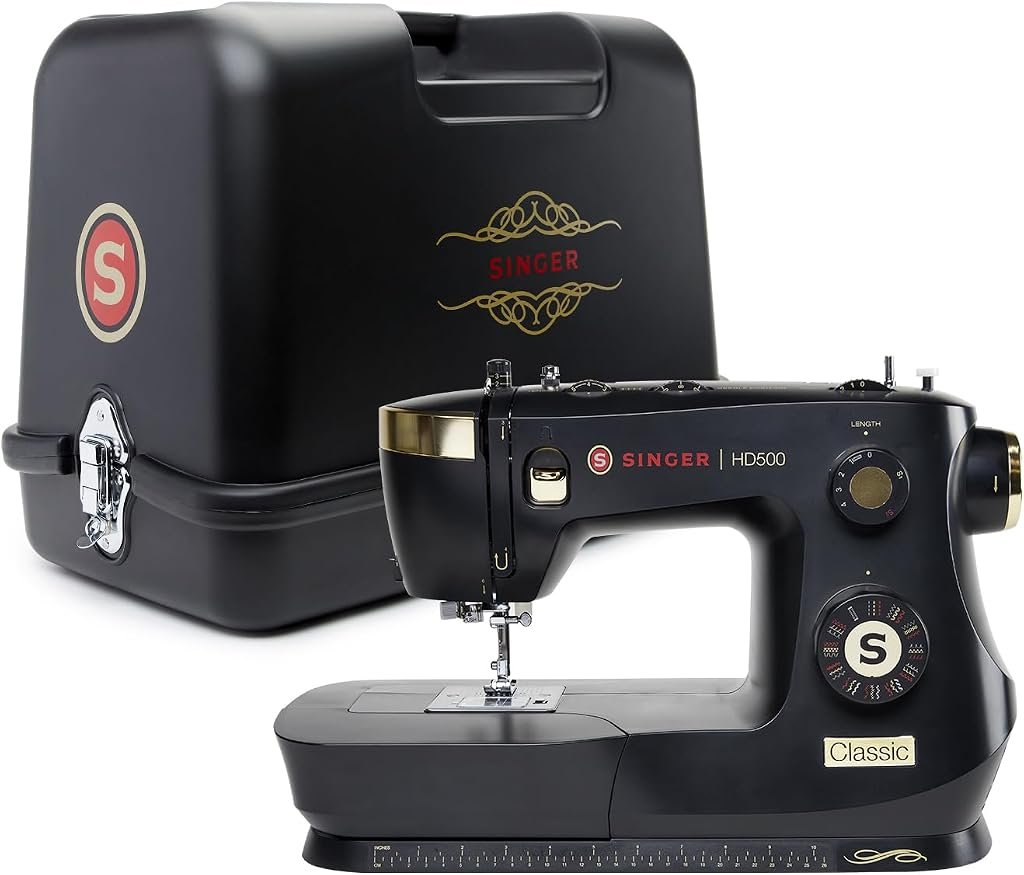
The SINGER Heavy Duty 500 occupies an unusual place in the domestic sewing market. Beneath its black-and-gold, vintage-inspired exterior sits a mechanical sewing machine built around 23 stitches, a metal internal frame, adjustable presser-foot pressure, drop feed, a one-step buttonhole, a top drop-in bobbin and a maximum sewing speed of 1,000 stitches per minute. In the Super Bundle configuration, the machine is paired with a rigid carrying case intended for storage and transport.
The styling deliberately recalls an earlier period of domestic sewing, but the useful questions are mechanical rather than nostalgic. Can it manage thicker assemblies without abandoning ordinary garment work? Are 23 stitches sufficient? Does a carrying case materially improve the package? And, perhaps most importantly, what does “Heavy Duty” mean when attached to a modern domestic machine?
Our editorial score is 8.36/10, with Customer Sentiment at 8.28, Buyer Confidence at 8.85 and Value at 8.15. Those numbers place the machine in favorable territory while leaving measurable distance between it and a nearly unconditional recommendation. The HD500 has a coherent feature set, but the bundle makes most sense when its combination of mechanical controls, enhanced piercing capability and protected portability corresponds to actual sewing habits.
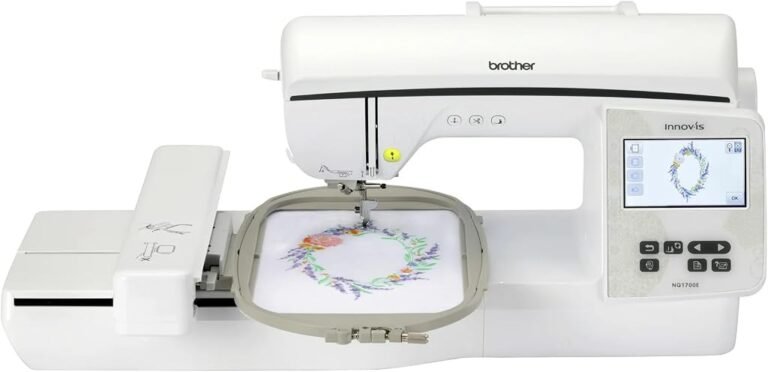
It is also a conventional sewing machine, not an embroidery system. Anyone comparing the best sewing and embroidery machines should make that distinction immediately. The HD500 can create decorative stitches and handle free-motion techniques with the feed dogs lowered, but it cannot import embroidery files, operate an embroidery hoop or reproduce the programmed design functions of a dedicated embroidery machine.
Understanding What the HD500 Actually Is
The official SINGER HD500 Classic specifications identify 23 built-in stitches spanning utility, stretch and decorative work. SINGER also specifies enhanced piercing power for thicker fabric layers, a metal frame, automatic needle threading, adjustable stitch length and width, drop feed and an automatic one-step buttonhole.
That specification set tells a more useful story than the machine’s retro appearance.
This is fundamentally a mechanical domestic sewing machine. Stitch selection and adjustment take place through physical controls rather than a computerized screen. The operator retains direct authority over variables including stitch dimensions and presser-foot pressure.
Maximum stitch width is 6 mm, while maximum stitch length is 4 mm. SINGER specifies sewing speeds of up to 1,000 stitches per minute and more than six inches of sewing space to the right of the needle.
Those are practical rather than extravagant numbers.
Twenty-three stitches will appear modest beside computerized machines advertising hundreds of patterns. Yet raw stitch count often says little about how effectively a machine handles garment construction, alterations, bags, home décor or quilting.
Straight stitches, zigzag variants, stretch stitches, decorative choices and buttonhole capability cover a substantial portion of domestic work. A sewer who needs lettering, extensive decorative libraries or programmable motifs belongs in a different machine category.
The Phrase “Heavy Duty” Needs Careful Interpretation
Few sewing-machine descriptions create more confusion than “heavy duty.”
A domestic machine carrying that language should not automatically be treated as equivalent to industrial equipment. Industrial sewing machines are commonly engineered around highly specialized, sustained production work and may be mounted into dedicated tables with motors and mechanisms selected for a narrow operation.
The HD500 remains a portable household sewing machine.
SINGER describes the model as having enhanced piercing power that permits projects such as hemming jeans, sewing multiple fabric layers for garments and home décor, and quilting. The manufacturer also specifies a heavy-duty metal frame intended to support durability and stability during sewing.
That is the appropriate framework for assessing its capability.
The machine is intended to provide more authority when encountering thicker fabric assemblies than a minimal entry-level machine. That does not mean material thickness becomes irrelevant. Needle selection, thread, seam construction, fabric density, presser-foot pressure and the number of layers all affect whether a particular operation is sensible.
“Heavy duty” is therefore more useful as a description of the HD500’s domestic positioning than as permission to feed any material under the presser foot.
Piercing Power Is Only Part of Thick-Fabric Sewing
Marketing often reduces difficult sewing to motor strength. Actual fabric handling is more complicated.
A machine must penetrate the fabric, certainly, but it must also feed the layers evenly enough to preserve stitch length and seam alignment. The needle must be appropriate for the material. Thread must move through the system without creating excessive tension. The presser foot must exert enough pressure to maintain control without unnecessarily restricting movement.
The HD500 addresses some of these variables directly.
Its adjustable presser-foot pressure allows the operator to change the downward force exerted on the fabric. That becomes useful when moving between significantly different material weights. SINGER specifically describes this adjustment as a means of improving feeding with thinner or heavier fabrics.
The machine also provides adjustable needle position.
Needle-position adjustment becomes useful for edge stitching, topstitching, piping and zipper installation because seam placement can be changed without relying entirely on physically repositioning the project.
These controls are not visually dramatic, but they are more relevant to real construction work than a large collection of decorative stitches that may rarely leave the selector dial.
1,000 Stitches per Minute: Fast, but Not a Race
The HD500’s maximum speed of 1,000 stitches per minute places considerable mechanical capacity beneath the foot controller.
That speed is useful during long straight seams, quilting operations and repetitive construction. It should not be interpreted as the correct operating speed for every task.
Precision sewing often rewards slower movement.
Approaching a zipper stop, turning a tight corner, navigating several intersecting seams or topstitching near a visible edge demands control more than outright speed. Thick assemblies can also require deliberate handling as the presser foot transitions over changes in height.
The value of a high maximum speed is therefore capacity. An experienced operator can work quickly when the project permits it without forcing the machine to crawl through long uncomplicated seams.
Beginners should resist equating speed with proficiency. A straight seam completed at half the machine’s maximum rate is more useful than a crooked seam produced at full throttle.
Twenty-Three Stitches Are More Useful Than They Sound
Modern sewing-machine comparison pages encourage a peculiar numerical competition. One machine has 50 stitches, another 100, another several hundred.
The HD500 largely refuses that contest.
Its 23 built-in stitches include utility, stretch and decorative options. The number is comparatively restrained, yet it covers the types of stitching likely to appear repeatedly in general home sewing.
The practical distinction is between a stitch and a stitch application.
A stitch can often be altered through width, length or needle-position settings and then applied to multiple techniques. Manufacturers sometimes describe the resulting possibilities as stitch applications, but those should not be confused with individually distinct built-in stitch patterns.
For garment construction, utility stitches generally carry more weight than decorative abundance. Straight stitching alone accounts for an enormous amount of sewing. Zigzag stitching handles several finishing and stretch-related tasks. Dedicated stretch options extend the machine’s usefulness with knit fabrics.
The one-step buttonhole is especially relevant because it automates an operation where consistency matters visually.
The One-Step Buttonhole Is a Meaningful Convenience
SINGER’s automatic one-step buttonhole system uses the button itself to help establish buttonhole size. The button is placed in the buttonhole-foot holder, after which the machine produces the corresponding buttonhole.
That arrangement reduces the manual sequencing required by older multi-stage buttonhole systems.
For anyone making shirts, dresses, children’s clothing, pillow closures or other projects involving repeated buttons, consistency matters. A row of buttonholes exposes small differences quickly.
Automation here therefore solves a genuine construction problem rather than simply adding another specification.
The HD500 does not need a computerized interface to automate this operation. That illustrates a broader theme in its design: mechanical controls coexist with selected conveniences where automation materially reduces repetitive setup.
Top Drop-In Bobbin and Thread Visibility
The HD500 uses transparent SINGER Class 15 bobbins in a top drop-in configuration. SINGER describes the system as resistant to jamming and emphasizes that the transparent bobbin and cover allow the operator to monitor remaining thread.
Visibility is a deceptively useful feature.
Running out of bobbin thread halfway through a long seam is not catastrophic, but it interrupts the workflow and can leave a section apparently sewn from above while no lower thread is actually forming stitches.
Being able to inspect the bobbin supply before beginning a long operation reduces that problem.
Top-loading access also removes the need to reach into a front-loading compartment whenever the bobbin needs replacement.
The built-in needle threader addresses the opposite end of the thread path. It reduces the fine-motor work required to pass thread through the needle eye, particularly useful when changing thread frequently or working under less-than-perfect lighting.
Drop Feed Expands the Machine’s Range
The HD500 allows its feed dogs to be disengaged.
During ordinary sewing, feed dogs advance fabric beneath the presser foot at a controlled rate. Lowering them transfers movement control to the operator, which enables techniques including free-motion quilting, free-motion monogramming, thread painting, darning and button sewing.
That capability broadens the machine beyond conventional forward-feed construction.
Free-motion work still requires technique. Removing the feed dogs from the equation does not make the machine automatically produce smooth quilting curves or balanced decorative movement. The operator becomes responsible for moving the fabric relative to needle speed.
The useful point is that the HD500 does not mechanically prevent those techniques.
For a sewer developing from garment construction into occasional quilting or decorative free-motion work, drop feed creates room for progression without requiring another machine immediately.
Free Arm and Everyday Garment Construction
Removing the HD500’s accessory-storage compartment exposes its free arm. SINGER specifically identifies cylindrical areas such as trouser hems and sleeve cuffs as applications for this configuration.
The free arm is a mature sewing-machine feature precisely because the geometry makes sense.
Trying to sew a narrow sleeve or trouser leg flat against a full sewing bed can require awkward bunching of the surrounding material. A narrow free arm allows the tubular piece to pass around the machine bed while the seam remains accessible to the needle.
For alterations, this can matter more frequently than decorative stitching.
The removable accessory area also provides storage, keeping smaller items near the machine rather than scattered through a separate sewing box.
The Metal Frame Matters, but It Is Not the Entire Machine
SINGER emphasizes the HD500’s internal metal frame. The manufacturer describes this rigid internal support as a means of maintaining mechanism alignment and promoting stability during sewing.
The distinction between internal frame and exterior housing deserves attention.
A metal frame does not mean every visible part of a modern domestic sewing machine is made from metal. The structural chassis and external casing perform different jobs. What matters mechanically is whether the internal structure holds the needle, feed and drive mechanisms in stable alignment under normal operating loads.
For thick-material work, stability is particularly relevant because needle penetration creates reaction forces through the machine.
Still, metal construction should not be treated as a universal proxy for performance. Feed geometry, motor behavior, needle system, tolerances, maintenance and user setup also affect sewing quality.
The frame is a meaningful feature. It is not magic.
The Super Bundle Changes the Value Equation
The reviewed configuration pairs the HD500 with a matching hard carrying case. The internal reference price for this package is $339.99.
A carrying case does not alter stitch quality, piercing power or feed behavior. Its value therefore depends almost entirely on how the machine is stored and transported.
For someone who leaves the HD500 permanently installed on a sewing desk, the case may spend most of its life unused.
For someone attending sewing classes, quilting groups or workshops—or simply storing the machine in a closet between projects—a rigid case becomes more relevant. It protects the machine from dust and incidental contact while making transport more orderly.
This difference helps explain our 8.15 Value score.
The package can represent sensible value for a mobile sewer because the buyer receives both the machine and dedicated transport protection. A stationary user should compare the bundle price carefully with the cost of purchasing the underlying machine configuration without a case.
Bundle value is not the same as machine value.
Included Accessories Cover the Basic Work
SINGER lists an all-purpose foot, zipper foot, buttonhole foot, blind-hem foot and satin-stitch foot among the HD500’s standard accessories. The package also includes four transparent Class 15 bobbins, spool holders, an auxiliary spool pin, needles, a screwdriver and a combined brush/seam ripper, along with a soft cover.
That collection covers the ordinary requirements of garment and household sewing reasonably well.
The zipper foot addresses close stitching beside zipper teeth and piping. The blind-hem foot supports controlled blind hemming. The satin-stitch foot provides clearance and visibility appropriate to dense decorative stitching.
The accessory set is therefore functional rather than excessive.
More specialized work may eventually justify additional presser feet, needles or attachments, but a new owner is not forced to acquire a zipper or buttonhole foot before completing basic clothing projects.
Vintage Styling Hides a Modern Domestic Machine
The HD500’s black body and gold detailing are deliberately historical in appearance. SINGER describes the design as a reference to its vintage machines.
There is genuine history behind that aesthetic.
According to SINGER’s corporate history, Isaac Singer received a patent for the first SINGER-brand sewing machine on August 12, 1851. The company records the introduction of its lightweight Grasshopper domestic machine in 1858 and what it describes as the first practical electric sewing machine in 1889.
The HD500 borrows visually from that heritage without attempting to reproduce nineteenth- or early-twentieth-century machinery.
That distinction matters because appearance can create misleading expectations. A vintage-looking housing does not imply cast-iron construction throughout, nor does it mean the machine operates like an antique straight-stitch model.
Underneath the styling is a modern multi-stitch domestic machine with a drop-in bobbin, automatic needle threader and one-step buttonhole system.
Nostalgia is aesthetic. The useful features are contemporary.
Where the SINGER Heavy Duty 500 Is Limited
The HD500’s limitations become clearer when its intended role is properly defined.
First, 23 stitches are enough for broad domestic construction but modest for decorative specialists. Anyone who regularly uses large decorative libraries, alphabets or programmable patterns will find computerized alternatives substantially broader.
Second, this is a mechanical machine. There is no LCD interface, electronic stitch selection or extensive computerized control.
Third, it is not an embroidery machine. Decorative stitches should not be confused with hoop embroidery.
Fourth, the machine’s heavy-duty positioning does not transform it into industrial equipment. Users routinely sewing exceptionally dense assemblies, specialized leatherwork or production quantities should evaluate machinery built specifically for those tasks rather than assuming a domestic model can substitute indefinitely.
Fifth, the Super Bundle’s hard case only creates value when storage or transportation protection matters. Buyers paying extra for an accessory they never use dilute the package’s economic appeal.
These trade-offs are reflected in our overall score rather than hidden beneath the machine’s attractive styling.
Who Should Buy the HD500?
The machine fits several kinds of users particularly well:
- Garment sewers who regularly move between ordinary fabrics and thicker seam intersections.
- Home-décor makers working with multiple fabric weights.
- Beginners who prefer physical dials and mechanical controls over menu-driven operation.
- Alteration work where free-arm access, adjustable needle position and stronger piercing capability are useful.
- Occasional quilters who can benefit from drop feed and a metal internal frame.
- Sewers who transport or regularly store their machine and can therefore make genuine use of the hard carrying case.
- Users who want a restrained stitch library rather than hundreds of decorative patterns.
It is less convincing for embroidery-focused users, highly decorative computerized sewing, specialized industrial work or buyers who primarily value large stitch libraries.
Interpreting Our Editorial Scores
Our 8.36/10 overall score reflects a capable domestic mechanical machine whose feature set is broad enough for garment sewing, household projects, alterations and some quilting without becoming unnecessarily complicated.
The 8.28 Customer Sentiment score is slightly lower. That fits a product whose appeal depends partly on preferences that cannot be universal: mechanical controls, vintage styling, a relatively modest stitch library and a bundle centered partly on portability.
Buyer Confidence reaches 8.85, the strongest component of our assessment. The HD500’s core specifications are clearly documented by SINGER, its operation relies on established mechanical sewing architecture, and manufacturer manuals remain accessible through SINGER’s product-manual library.
The 8.15 Value score requires more discrimination. The machine itself provides a useful collection of construction features, but the economics of the Super Bundle depend partly on whether the hard case has practical value to its owner.
The difference between 8.85 Buyer Confidence and 8.15 Value is therefore meaningful. There is more confidence in what the machine is than certainty that this particular bundle is the right allocation of money for every sewer.
A Better Way to Think About Heavy-Duty Sewing
The HD500 is most persuasive when the “heavy duty” label is translated into individual capabilities.
It has enhanced piercing power.
It has adjustable presser-foot pressure.
It uses a metal internal frame.
It provides adjustable stitch dimensions and needle position.
It reaches 1,000 stitches per minute.
Those facts are more informative than the label by itself.
They also encourage better sewing habits. A heavy seam should still receive an appropriate needle. Fabric should still be tested. Presser-foot pressure should still match the material. Thick seam intersections should still be approached with control.
No domestic machine abolishes textile physics.
The HD500 instead gives the operator a broader mechanical envelope in which to work.
Final Considerations
The SINGER Heavy Duty 500 succeeds primarily by combining traditional mechanical operation with a sensible set of modern conveniences.
Its 23 built-in stitches will not impress buyers counting decorative patterns, yet stitch quantity is not its central argument. The stronger case lies in adjustable presser-foot pressure, enhanced piercing capability, 1,000-stitch-per-minute maximum speed, adjustable needle position, drop feed, a 6 mm maximum stitch width, one-step buttonholing, free-arm access and the metal internal frame.
The Super Bundle adds another dimension through its rigid carrying case. For a machine that travels or is stored frequently, that protection can justify part of the package cost. For a machine permanently stationed on a desk, the same accessory becomes much less consequential.
Our 8.36/10 score therefore represents a favorable but selective assessment. Customer Sentiment at 8.28 reflects a machine with a defined personality rather than universal appeal. Buyer Confidence at 8.85 benefits from clear specifications, established mechanical design and manufacturer documentation. Value at 8.15 recognizes that the bundle earns its strongest economic argument only when its machine and case are both useful.
The HD500 also illustrates why buyers should look beyond labels. “Heavy duty” sounds absolute; sewing rarely is. Material, needle, thread, seam thickness, presser-foot pressure and feeding conditions remain part of the equation.
What the HD500 offers is not unlimited material capacity but a practical domestic machine configured to deal with demanding everyday sewing while retaining the flexibility required for lighter garments, buttonholes, decorative work and free-motion techniques.
That balance is its strongest argument. The vintage appearance may attract the first glance, but the more durable reason to consider the SINGER Heavy Duty 500 lies underneath it: a mechanical feature set built around control, useful power and relatively uncomplicated sewing.