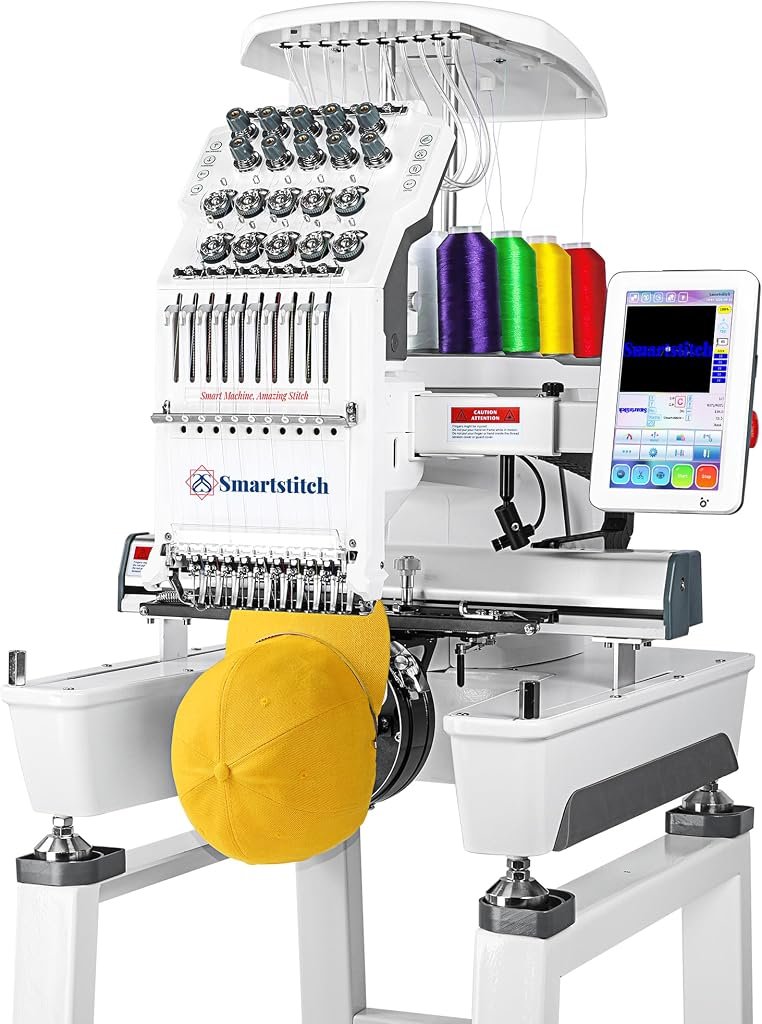
The Smartstitch S-1001 sits in a category that changes the arithmetic of home embroidery. Instead of asking how comfortably a single-needle machine handles occasional personalization, the S-1001 asks a harder question: how much manual intervention can be removed before embroidery starts to resemble small-scale production?
Its answer begins with ten needles.
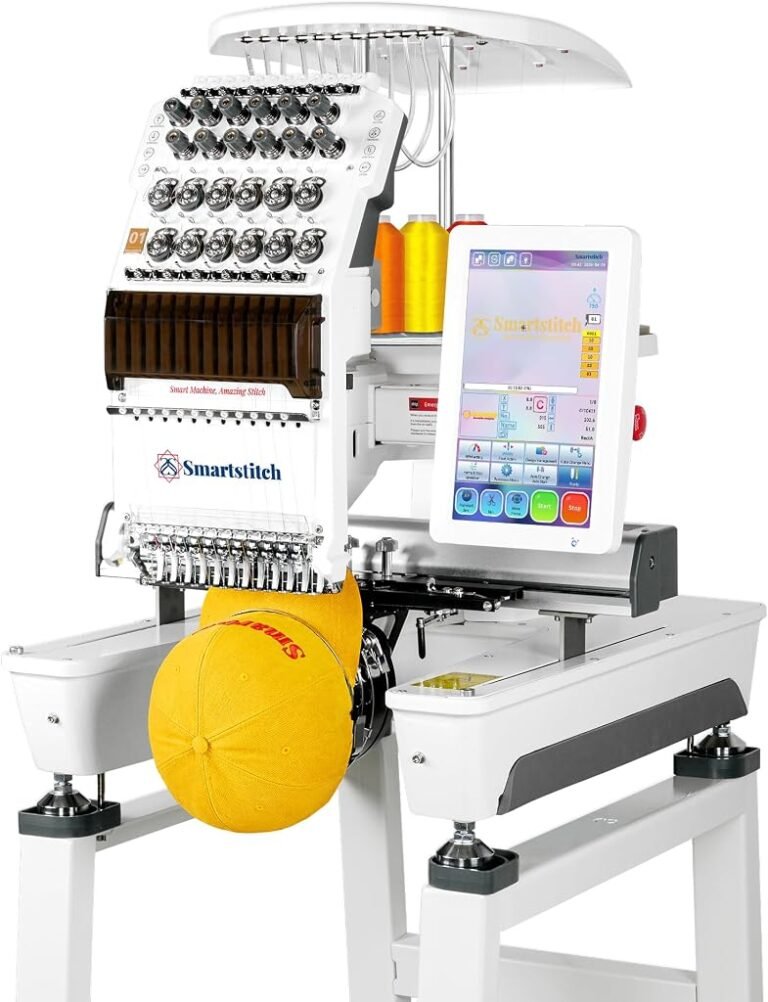
That architecture allows multiple thread colors to remain loaded at the same time, reducing the repeated thread changes that define ordinary single-needle embroidery. Smartstitch pairs those ten needles with a maximum flat embroidery area of 240 × 360 mm, or roughly 9.5 × 14.2 inches, a rated maximum speed of 1,200 stitches per minute, a 7-inch touchscreen, automatic color changing, automatic thread trimming, thread-break detection, USB and Wi-Fi transfer, laser positioning and cap embroidery support.
According to Smartstitch’s current S-1001 specifications, the machine weighs about 42 kg, or 92.4 pounds, supports DST and DSB files, reaches up to 850 stitches per minute on caps and uses a 270-degree cap driver. The manufacturer also lists operating noise at 65 dB and gives the flat embroidery field as 240 × 360 mm.
Our editorial rating is 8.97/10. Customer Sentiment is 9.16, Buyer Confidence is 8.84, and Value is 8.64.
Those figures place the S-1001 well above ordinary hobby territory without pretending that it eliminates the operational demands of commercial-style embroidery. Its strengths are measurable: ten threaded colors, a generous sewing field, high speed and support for flat goods and caps. Its limitations are equally concrete: a substantial physical footprint, a steeper setup burden, restricted native file formats and the maintenance expectations that accompany a faster multi-needle platform.
Ten Needles Change the Economics of Thread Changes
The central difference between the S-1001 and a conventional home embroidery machine is not screen size or Wi-Fi.
It is the needle count.
A single-needle machine running a design with eight colors can require the operator to stop repeatedly, remove one upper thread, load another and resume the job.
A ten-needle machine can keep ten colors threaded and ready.
That difference affects both convenience and labor.
Suppose a small business runs 20 identical eight-color logos. If a single-needle workflow requires seven manual color changes per item, the operator may intervene 140 times across the batch. With ten colors already loaded, many of those interventions disappear.
The machine still requires supervision. Bobbins run out. Thread can break. Garments still need hooping. Designs need loading and positioning.
Yet the fundamental rhythm changes.
Instead of acting as a constant thread-change attendant, the operator can spend more time preparing the next garment, checking completed work or handling another production task.
That is the S-1001’s strongest argument.
A 9.5 × 14.2-Inch Field Broadens the Project Range
The S-1001 provides a maximum flat embroidery field of 9.5 × 14.2 inches.
That equals nearly 135 square inches of nominal rectangular working area.
For comparison, a 5 × 7 field contains 35 square inches. A 6 × 10 field contains 60. A 7.9 × 11 field offers roughly 87.
The S-1001 therefore provides markedly more layout room than the fields found on many home embroidery machines.
That larger area can accommodate:
- Jacket-back designs
- Large sweatshirt graphics
- Tote-bag decoration
- Quilt blocks
- Large appliqués
- Broad chest designs
- Decorative panels
- Personalized blankets
- Workwear logos
- Repeated commercial-style garment layouts
Physical area matters because artwork exceeding the native field must usually be resized, divided or repositioned.
Multi-hooping can solve many size problems, but it introduces another registration task. Fabric must be repositioned accurately, and separate portions need to align convincingly.
A 9.5 × 14.2-inch field reduces how often that extra work is necessary.
For buyers comparing the best sewing and embroidery machines, field size should therefore be treated as a hard mechanical limit rather than another number buried in a feature list.
The S-1001 Is Not a Sewing Machine
Despite the broader phrase people often use when shopping for textile equipment, the S-1001 is a dedicated embroidery machine.
It is not intended for conventional garment construction, hemming, utility stitching or buttonholes.
That specialization carries both advantages and costs.
A business or serious hobbyist with a separate sewing machine can leave the S-1001 configured for embroidery instead of repeatedly converting one combination machine between two different jobs.
The two machines can also work at the same time.
For a first-time buyer who needs ordinary sewing as well, however, the S-1001 does not solve the entire equipment problem.
A separate sewing machine will still be required.
That makes buyer fit unusually important at this price level. The S-1001 makes sense when embroidery is already a defined activity rather than a secondary feature someone merely hopes to explore.
1,200 Stitches Per Minute Changes Throughput
Smartstitch rates the S-1001 at a maximum flat-embroidery speed of 1,200 stitches per minute.
That figure deserves translation.
At a theoretical uninterrupted 1,200 stitches per minute, a 12,000-stitch design represents ten minutes of needle movement:
12,000 ÷ 1,200 = 10 minutes.
A 24,000-stitch design represents 20 minutes.
A 36,000-stitch design represents 30 minutes.
Actual production time will be longer.
The machine accelerates and decelerates. Thread breaks happen. Bobbins need replacement. Color sequences introduce mechanical transitions. Garments require hooping, loading and unloading. Dense design areas may be run at lower speeds.
Still, the arithmetic illustrates why 1,200 SPM matters.
When production involves repeated designs, even modest reductions in run time accumulate.
A machine completing a job several minutes faster can return hours over a large batch.
The S-1001’s speed therefore matters most to people running repeat work, not someone stitching one personalized towel on a weekend.
Cap Embroidery Adds Another Production Category
The S-1001 is not limited to flat garments.
Smartstitch specifies a 270-degree cap driver, a cap embroidery area of 280 × 75 mm and a maximum cap speed of 850 stitches per minute.
This is a meaningful distinction because caps behave differently from flat fabric.
Their curved structure complicates hooping and places greater demands on registration and machine clearance. The seam running through the center of many caps can also affect needle behavior and design placement.
The dedicated S-1001 cap hoop system extends the machine beyond shirts, towels and bags into structured headwear.
For a small customization business, that matters because caps represent a distinct product category rather than merely another piece of fabric.
The lower 850-SPM cap ceiling also illustrates an important principle: maximum machine speed does not apply identically to every object.
Flat goods and curved headwear impose different mechanical demands.
The Seven-Inch Touchscreen Is a Control Surface, Not Decoration
The S-1001 includes a 7-inch touchscreen used for design management, color sequencing and machine control.
A screen of that size is especially useful on a ten-needle machine because there are more production variables to monitor.
The operator is not simply selecting a design.
Thread colors must be assigned to needles. Stitch order needs review. Positioning has to be verified. Speed settings may need adjustment. A design may need rotation or placement changes.
The screen becomes part of production management.
Smartstitch also includes eight direct-access physical buttons, according to its current specification table.
That combination is practical.
Touchscreens are useful for visual tasks. Physical buttons can be preferable for frequently repeated machine commands because they require less navigation through menus.
The two input methods complement each other.
Laser Positioning Addresses a Costly Error
The S-1001 includes pinpoint laser positioning.
This feature deserves more attention than it often receives because placement errors can destroy otherwise good embroidery.
A logo can be beautifully stitched and still be unusable if it sits too high, too low or too far from center.
On expensive garments, that is not merely an aesthetic mistake.
It is a material loss.
Laser positioning helps the operator align the machine’s sewing location with the intended placement on the garment before stitching begins.
It does not replace measurement.
A business still needs repeatable placement standards for left-chest logos, cap fronts, sleeve designs and other common jobs.
The laser simply gives the operator another reference point during setup.
In production work, repeatability often matters more than decorative sophistication.
DST and DSB Support Define the File Workflow
The S-1001 supports DST and DSB embroidery files.
That is appropriate for a machine oriented toward commercial-style work because DST remains widely used in embroidery production.
It also means buyers should understand the difference between artwork and embroidery files.
A PNG, JPEG, SVG or PDF logo is not automatically ready for stitching.
The image must be digitized into a stitch file containing information about needle movement, stitch sequence, color changes, density and pathing.
The S-1001 can execute a properly prepared embroidery file.
It does not remove the digitizing step.
Businesses have several choices: learn digitizing software, outsource digitizing, or use a combination of both.
That workflow decision can affect quality as much as the machine itself.
Poor digitizing can produce unnecessary thread breaks, excessive density, distortion and inefficient stitch sequences even on capable hardware.
Wi-Fi and USB Offer Useful Redundancy
Pattern transfer is available through both Wi-Fi and USB.
That dual approach matters because production equipment benefits from redundancy.
Wi-Fi can reduce repeated physical handling of files when artwork is prepared on another computer.
USB provides a straightforward fallback if the network is unavailable or inconvenient.
A shop that depends exclusively on wireless transfer can find itself unable to work normally when router settings change or local connectivity fails.
A USB path avoids that dependency.
The ability to choose between the two methods is therefore more meaningful than wireless capability alone.
Thread-Break Detection Reduces Silent Failure
Thread-break detection is one of the S-1001’s more practical automatic functions.
When upper thread breaks, continued needle movement without thread can leave an unstitched section while the machine appears to be progressing through the design.
Detection allows the machine to pause so the operator can repair the issue and resume.
That matters more at high speeds.
At 1,200 stitches per minute, even a short unnoticed interruption can translate into a significant number of missed stitches.
The S-1001 operating documentation also describes automatic thread trimming and automatic color changing as part of the machine’s multi-needle workflow.
Together, these systems reduce several repetitive forms of intervention.
They do not make the machine unattended equipment.
They make supervision less constant.
Ninety-Three Pounds Is Portable Only by Commercial Standards
Smartstitch lists the machine at approximately 42 kg, or 92.4 pounds.
That is lighter than many larger commercial embroidery systems.
It is not light in household terms.
The assembled dimensions are listed at approximately 18.9 × 25.9 × 59.8 inches.
Those numbers have practical consequences.
A temporary folding table is not an appropriate home for a machine producing rapid reciprocating movement at up to 1,200 stitches per minute.
The stand or work surface needs stability.
There must also be adequate space around the embroidery arm and hoops.
Large jackets, bags and other garments require room for excess fabric to move without catching.
The machine may fit inside a home studio, but buyers should treat workspace planning as part of the purchase rather than something to solve after delivery.
The S-1001 Occupies a Middle Ground Between Home and Industrial Equipment
The S-1001 is marketed as a commercial embroidery machine, but it is more useful to view it through workflow rather than labels.
It is far more production-oriented than a single-needle home machine.
Ten needles reduce thread changes.
The 1,200-SPM ceiling shortens long runs.
Cap capability broadens product offerings.
The large embroidery field handles projects that would challenge smaller home units.
Yet the machine remains a single-head system.
One garment is embroidered at a time.
That distinguishes it from multi-head equipment built for factories producing several identical garments simultaneously.
A two-head machine can stitch the same logo on two pieces during one cycle. A six-head system can handle six.
The S-1001 cannot create that type of parallel production.
Its role is therefore most convincing in a home business, small shop, startup operation or custom studio where order variety matters more than mass duplication.
Production Bottlenecks Move Away From Thread Changes
A ten-needle machine does not eliminate bottlenecks.
It relocates them.
Once manual thread swapping decreases, hooping can become the next major source of lost time.
Garments still need accurate placement.
Backing needs preparation.
Finished pieces need removal.
New pieces need loading.
Files have to be checked.
Bobbins need replacing.
This shift explains why experienced embroidery operations pay so much attention to hooping systems, workstations and repeatable placement methods.
The machine may be capable of 1,200 stitches per minute, but that figure means little if it sits idle for ten minutes between garments while the next piece is prepared.
The productivity value of the S-1001 therefore depends partly on workflow around the machine.
Training Matters More on a Multi-Needle Platform
A machine with ten needles, automatic color sequencing, cap attachments, tension adjustments and high-speed operation asks more of a beginner than a compact home embroidery machine.
Smartstitch addresses that learning burden through setup videos, support groups and one-on-one virtual training.
Its current training and technical support program covers setup, threading, tension adjustment and basic embroidery operation, while model-specific support videos are also available.
This support structure is directly relevant to our Buyer Confidence rating.
Multi-needle embroidery can be learned.
It should not be mistaken for plug-and-play printing.
Thread paths need to be understood. Tension requires observation. Hooping technique matters. Cap embroidery introduces another set of variables.
The owner who expects a learning period is far better positioned than someone expecting finished commercial work immediately after unpacking.
Warranty Coverage Is Useful but Limited
Smartstitch currently states a one-year limited warranty for new machines.
Its published warranty policy lists one year for parts and labor, electronic components and drivetrain, while standard accessories receive 90 days of coverage.
The policy excludes consumable components and identifies several circumstances that can invalidate or fall outside coverage, including unauthorized modification, misuse, installation problems, ordinary wear and certain maintenance failures.
That structure should be read carefully before purchase.
Commercial-style embroidery machines are mechanical systems exposed to repeated motion, vibration, thread debris and wear.
Warranty length matters, but owner maintenance and access to replacement parts matter as well.
Customer Sentiment at 9.16 Reflects the Appeal of Ten Needles
Our Customer Sentiment score of 9.16 is the highest of the four ratings.
That result makes sense when the S-1001 is evaluated against the frustrations it is designed to remove.
Users moving from single-needle machines immediately gain a different color-management workflow.
Ten loaded colors can transform multicolor embroidery from a sequence of manual thread changes into a largely automated run.
The large field also removes many size compromises.
Caps broaden the range of products.
Speed reduces waiting.
Those are immediately understandable gains.
The machine still requires skill, but its advantages become visible in ordinary use rather than existing primarily on paper.
Buyer Confidence at 8.84 Reflects Greater Mechanical Commitment
Our Buyer Confidence score is 8.84.
That is strong, but lower than Customer Sentiment.
The difference reflects the seriousness of the purchase.
A 93-pound, ten-needle, high-speed embroidery machine demands more planning than a desktop hobby unit.
Delivery logistics matter.
Workspace matters.
Training matters.
Maintenance matters.
File preparation matters.
Replacement parts and service access matter.
Smartstitch provides training materials, warranty coverage, local parts support and service information, which reduces uncertainty.
Still, the machine asks buyers to commit to a more demanding equipment category.
That is why Buyer Confidence does not rise quite as high as enthusiasm for the machine’s capabilities.
Value at 8.64 Depends on Production Intent
Our Value score of 8.64 reflects a straightforward reality: ten needles are valuable when they save repeated labor.
A person embroidering two monograms a month may gain little from this architecture.
A small business running multicolor logos across shirts, hats and jackets can benefit much more.
The value equation therefore depends on volume, color count and project variety.
The S-1001 makes particular sense when an owner regularly encounters one or more of these conditions:
- Frequent multicolor designs
- Repeated customer orders
- Cap embroidery
- Large garment graphics
- Jacket backs
- Small production batches
- Multiple jobs per day
- A need to reduce manual thread changing
- A need for faster stitch throughput
Without those pressures, a simpler machine may be financially easier to justify.
With them, the S-1001 begins to look less like expensive hobby equipment and more like labor-saving production machinery.
Understanding the 8.97/10 Overall Score
Our 8.97/10 overall score reflects a machine whose individual features reinforce one another.
Ten needles reduce manual color changes.
The 9.5 × 14.2-inch field supports larger designs.
The 1,200-SPM ceiling shortens long embroidery runs.
Cap hardware extends the project range.
Wi-Fi and USB provide two file-transfer routes.
Laser positioning assists repeatable placement.
Thread-break detection reduces silent stitching failures.
The 7-inch touchscreen gives the operator a practical interface for controlling these systems.
The restrictions are equally clear.
The S-1001 is large and heavy compared with ordinary home machines. DST and DSB support place real importance on digitizing workflow. Ten needles still cannot accommodate designs calling for more than ten simultaneous thread colors without intervention. A single head cannot match the parallel output of multi-head equipment.
Those limits do not contradict the design.
They define its intended scale.
Final Considerations
The Smartstitch S-1001 represents a decisive shift away from casual single-needle embroidery.
Its ten-needle architecture is the defining feature because it changes the operator’s relationship with multicolor work. Instead of repeatedly stopping to replace upper thread, multiple colors can remain loaded and ready for automatic sequencing.
That change becomes more meaningful when paired with the machine’s other specifications.
The 9.5 × 14.2-inch embroidery area accommodates large garment designs. A maximum speed of 1,200 stitches per minute supports meaningful throughput. The 270-degree cap system adds structured headwear. Laser positioning helps with placement. USB and Wi-Fi provide alternative transfer methods. Thread-break detection, automatic trimming and automatic color changing reduce repetitive intervention.
Our 8.97/10 overall rating reflects the coherence of that package.
Customer Sentiment at 9.16 is the highest score because the practical gains are easy to understand. Ten needles, more speed and a larger field directly address recurring frustrations faced by users moving beyond single-needle machines.
Buyer Confidence at 8.84 remains strong while recognizing the greater commitment involved in a 93-pound commercial-style machine. Training, maintenance, delivery and workspace deserve planning.
Value at 8.64 depends heavily on production intent. A buyer running frequent multicolor work can convert the ten-needle system into saved labor. An occasional hobby user may never generate enough volume to justify the machinery.
The S-1001 therefore makes its strongest case for a specific type of owner: someone whose embroidery has already grown beyond occasional personalization and begun behaving like production.
That might be a home business making company shirts, a custom apparel studio handling local orders, a creator selling embroidered hats, or an established hobbyist whose single-needle machine now spends too much time waiting for human intervention.
For those users, the next upgrade is not simply a larger screen or another inch of hoop space.
It is fewer interruptions.
That is what the Smartstitch S-1001 sells most convincingly: not embroidery without labor, but a machine architecture that lets human effort move away from repeated thread changes and toward the parts of production that still require judgment.