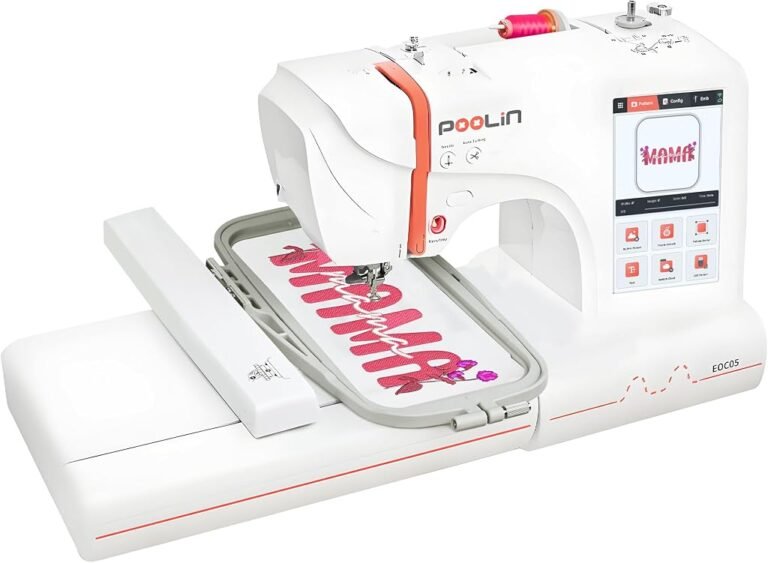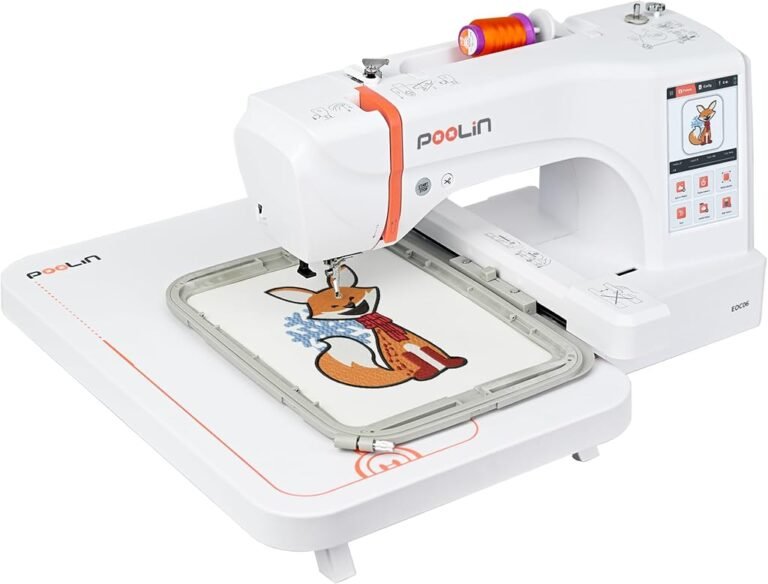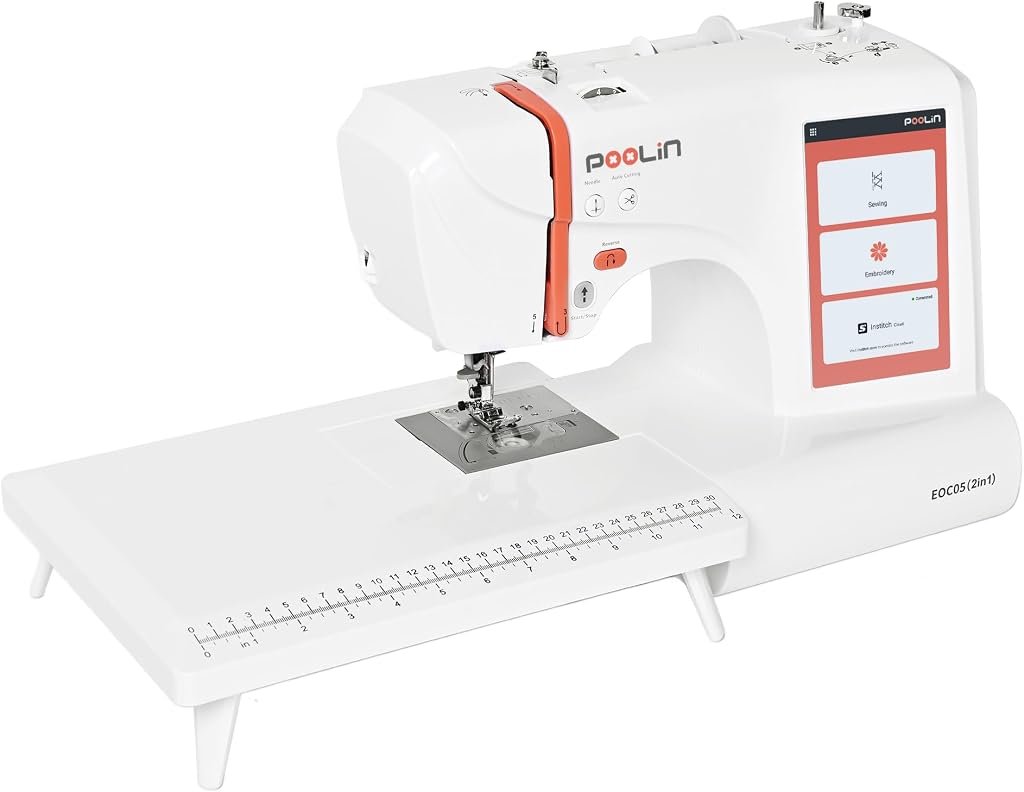
The POOLIN EOC05 enters home embroidery from a different direction than many established sewing-machine brands. Its proposition is centered on computerized embroidery: a large 7-inch touchscreen, two included hoop sizes, 130 built-in patterns, eight lettering fonts, automatic functions, and a maximum embroidery speed of 650 stitches per minute.
That makes the EOC05 interesting, but also easy to misunderstand.
Its most consequential specifications are not the size of the touchscreen or the number of patterns stored in memory. They are the dimensions of the embroidery areas the machine can physically handle. POOLIN supplies a 100 × 100 mm hoop and a 100 × 235 mm hoop, giving the machine a relatively long working format for names, vertical compositions, borders, and other designs that fit its approximately 4-inch-wide geometry.
Our Score for the POOLIN EOC05 is 8.61/10. Customer Sentiment is 8.5, Buyer Confidence is 9.32, and Value is 8.28. Those ratings describe a capable computerized embroidery platform with an approachable visual interface and useful automation, while acknowledging that its dimensions, single-needle workflow, and broader ownership ecosystem should be examined carefully before purchase.
The EOC05 is therefore most persuasive when evaluated according to actual embroidery projects rather than specification volume.
The Embroidery Area Deserves First Attention
The EOC05 comes with two hoop sizes: 100 × 100 mm and 100 × 235 mm.
Converted approximately into inches, those dimensions are about 3.9 × 3.9 inches and 3.9 × 9.3 inches.
That second format is significant.
A buyer looking only at familiar categories such as 4 × 4 and 5 × 7 embroidery could miss the EOC05’s unusual geometry. Its longer hoop gives it considerably more length than a conventional 4 × 4 format while keeping the design width relatively narrow.
That creates a specific kind of flexibility.
Long names, vertically arranged motifs, certain border-like designs, sleeve-oriented graphics, elongated decorative elements, and narrow compositions can make good use of the available length.
Wider designs present a different problem.
A design measuring six inches across does not become compatible simply because its total area is smaller than the area of the long hoop. Width and height constraints apply independently.
Embroidery-machine capacity is geometry, not merely area.
That principle should guide the entire buying decision.
The 100 × 235 mm Hoop Has a Distinct Project Profile
The long hoop changes what the EOC05 can reasonably attempt without immediately moving into a much larger machine category.
A 235 mm length gives nearly 9.3 inches of physical reach in one direction. That can be useful for lettering because names and phrases frequently need more horizontal or vertical distance than a square 100 mm frame permits.
Yet the 100 mm dimension remains.
This creates a long, narrow canvas rather than a broadly expanded one.
For buyers, that distinction is more useful than a generic claim that the machine has a “large” embroidery area.
A machine with a 5 × 7-inch field provides roughly five inches in its narrower dimension. A machine with a 100 × 235 mm field provides only about 3.9 inches in its narrower dimension but considerably more length.
Neither geometry is automatically better.
The correct format depends on the designs being stitched.
This is why prospective owners should inspect the dimensions of actual embroidery files before choosing a machine. A collection dominated by long names and narrow motifs presents a different requirement from one built around square jacket graphics or wide decorative compositions.
A 7-Inch Touchscreen Changes the Interface Experience
POOLIN equips the EOC05 with a 7-inch touchscreen.
That is one of the machine’s most immediately distinctive characteristics.
Embroidery is unusually dependent on visual interaction. The operator selects designs, examines dimensions, positions graphics, works with lettering, manages color sequences, and prepares the machine for stitching.
A larger display gives those controls more physical room.
The benefit should be understood as interface space rather than embroidery performance.
A 7-inch screen does not enlarge the hoop. It does not improve poor digitizing. It cannot compensate for unsuitable stabilizer, incorrect tension, or inadequate hooping.
What it can do is make machine-side interaction less compressed.
For beginners, that can matter. Computerized embroidery already asks the operator to think in terms of digital files, physical dimensions, thread colors, fabric behavior, and stitch sequencing. A larger visual interface can reduce some of the friction involved in navigating those controls.
The EOC05 Includes 130 Built-In Patterns
The machine provides 130 built-in embroidery patterns.
That gives a new owner a substantial starting library without requiring immediate acquisition of external designs.
Factory patterns can be useful for learning because they allow the operator to concentrate on the physical process of embroidery rather than file sourcing.
The user can practice stabilizing fabric, hooping accurately, selecting thread, managing bobbins, changing colors, and understanding how embroidery density affects materials.
Over time, however, built-in design counts become less decisive.
Embroidery preferences are personal. Someone interested in children’s designs, another focused on monograms, and another decorating bags may have almost no overlap in the files they actually use.
A machine’s ability to accommodate the dimensions and formats required by the owner therefore matters more over long ownership than the sheer number of designs installed at the factory.
The 130 patterns are useful.
They should not overshadow hoop geometry.
Eight Lettering Fonts Support Personalization
POOLIN lists eight built-in lettering fonts for the EOC05.
Lettering is particularly relevant given the machine’s elongated hoop.
Names, initials, short phrases, dates, labels, and personalized gift projects can benefit from the additional length available in the 100 × 235 mm format.
This pairing makes more practical sense than examining font count alone.
A lettering system becomes more useful when the machine has enough physical space to arrange the intended text.
The approximately 100 mm width still matters, especially for large letter heights or designs combining text with wide decorative graphics.
The buyer should therefore consider both character style and final composition dimensions.
A machine can contain attractive fonts while still being physically unable to stitch a desired arrangement at the intended size.
Maximum Embroidery Speed Is 650 Stitches per Minute
The EOC05 has a stated maximum embroidery speed of 650 stitches per minute.
Speed figures are easy to overvalue.
An embroidery design containing 10,000 stitches would theoretically require about 15.4 minutes to execute at a constant 650 stitches per minute. Real project time will be longer because embroidery involves acceleration, deceleration, color changes, thread management, machine movements, and other interruptions.
The simple calculation nevertheless provides useful scale.
Stitch count is only one part of production time.
A dense multicolor design with frequent thread changes can take substantially more operator time than a simpler design with the same nominal stitch count.
This is particularly relevant because the EOC05 uses a single-needle workflow. Each color change requires intervention rather than automatic switching among several pre-threaded needles.
Maximum speed therefore describes machine movement, not total project productivity.
Single-Needle Embroidery Is a Different Workflow From Production Equipment
The EOC05 belongs to the single-needle home embroidery category.
This has important implications.
Suppose a design uses six thread colors. A multi-needle machine may be able to keep those colors threaded simultaneously, depending on its needle configuration. A single-needle machine requires the operator to change thread as the design progresses.
For one personalized towel, that may be entirely reasonable.
For dozens of identical garments, the repeated intervention changes the labor equation.
This does not prevent the EOC05 from being used for paid projects. It means production planning should account for operator time rather than looking only at embroidery speed.
A machine capable of stitching a design once is not automatically optimized for stitching it repeatedly at commercial volume.
That distinction is central when comparing home embroidery equipment with business-oriented multi-needle systems.
Automatic Thread Trimming Reduces Repetitive Intervention
The EOC05 includes automatic thread trimming.
This feature addresses one of embroidery’s recurring mechanical chores.
As a design progresses, thread must be managed between operations and at appropriate stopping points. Automated trimming can reduce some manual cutting and make the process more orderly.
It should not be interpreted as eliminating every finishing task.
Embroidery projects may still require manual trimming or cleanup depending on how a design is digitized and how its stitch sequence is constructed.
Automatic trimming is therefore a workflow aid.
Its value increases with frequency. A small action saved once has little consequence. The same action removed repeatedly across many designs becomes more meaningful.
Needle Threading and Bobbin Winding Address Setup
POOLIN also includes needle-threading and bobbin-winding functions.
These features do not affect embroidery-field dimensions or design capacity, but they address tasks repeated throughout ownership.
Threading becomes particularly relevant in single-needle multicolor embroidery because color changes occur at the same needle position.
Bobbin preparation is equally fundamental.
Embroidery consumes substantial amounts of bobbin thread, often invisibly beneath the fabric. An owner focused only on decorative top thread can quickly discover that bobbin management is a routine part of machine embroidery.
Automation around these steps reduces friction.
It does not eliminate the need to understand correct threading, bobbin installation, thread compatibility, or tension.
The Thread-Break Alarm Addresses a Common Interruption
The EOC05 includes a thread-break warning function.
This is more consequential than it may initially sound.
An embroidery machine follows digital instructions regardless of whether the operator is staring continuously at the needle. A broken thread can interrupt the intended stitch formation and, without detection, create missing sections that must later be repaired.
A warning system helps bring the interruption to the operator’s attention.
The feature does not prevent thread breaks.
Prevention depends on factors including thread quality, needle condition, threading, tension, design density, fabric, stabilizer, and machine setup.
Detection and prevention are different functions.
The EOC05 addresses the first through its alarm system. The owner remains responsible for the second.
Stabilizer Selection Still Determines Much of the Physical Result
A touchscreen can make embroidery look primarily digital.
The finished object is not.
Fabric stretches, shifts, compresses, puckers, and responds differently to dense stitching. Stabilizer is used to control that behavior during embroidery.
A lightweight woven cotton, stretchy knit, towel, fleece, and dense bag material do not necessarily demand the same preparation.
The operator therefore has to match stabilizer strategy to fabric and design.
This is where beginners often discover the distance between selecting a graphic and producing clean embroidery.
The machine can place thousands of stitches accurately according to a file while the fabric still behaves poorly because it was inadequately supported.
Technology automates needle movement.
It does not repeal textile physics.
Hoop Technique Matters as Much as Hoop Size
The EOC05’s two hoops provide different project dimensions, but proper hooping remains fundamental.
Fabric and stabilizer need enough support to remain stable while avoiding unnecessary distortion.
Poor hooping can allow material to shift during embroidery. Overly aggressive stretching can distort the fabric before the first stitch is made, causing problems when the project is removed from the hoop and the material relaxes.
Placement also matters.
A perfectly stitched design can still be disappointing if it sits too high, too low, off-center, or rotated relative to the garment or object.
This is why successful machine embroidery involves measurement before automation.
The EOC05 can control the needle path.
The operator controls where that path begins on the physical object.
The Large Screen Does Not Replace Digitizing Software
A 7-inch touchscreen can create expectations that the machine itself functions as a complete design workstation.
That would be the wrong standard.
Machine-side editing and embroidery digitizing are different activities.
Editing generally involves working with an existing embroidery design: positioning it, resizing within supported limits, arranging lettering, changing colors, or making other permitted adjustments.
Digitizing creates the stitch instructions themselves.
That process can involve stitch type, density, direction, underlay, sequencing, pull compensation, and decisions about how artwork should translate into thread.
A larger touchscreen makes machine-side interaction more comfortable.
It does not make specialized design knowledge unnecessary.
Design Transfer Should Be Considered Part of the Buying Decision
POOLIN’s EOC05 ecosystem should be evaluated not only by what appears on the machine but by how external designs enter the workflow.
POOLIN’s official EOC05 product information describes the model’s embroidery capabilities and associated design workflow.
For a buyer intending to rely heavily on downloaded or self-created embroidery files, transfer procedure deserves close examination before purchase.
This is especially important for users moving from another embroidery ecosystem.
File organization habits can become deeply embedded. A workflow that feels minor during the first week can become significant after hundreds of projects.
The question is not simply whether external designs can be used.
It is how many steps separate the design library from the needle.
The EOC05 Is Better Viewed as an Embroidery Platform Than a Sewing Replacement
The phrase best sewing and embroidery machines can encourage shoppers to place every computerized needle machine into the same category.
That approach obscures meaningful differences.
The EOC05’s documented strengths center on embroidery: hoops, patterns, fonts, touchscreen controls, thread management, design handling, and automated embroidery movement.
A buyer who needs extensive conventional garment sewing should compare the EOC05’s exact sewing capabilities against a dedicated sewing machine or a clearly documented sewing-and-embroidery combination model.
This distinction is not semantic.
Ordinary sewing requires a different set of capabilities: feed control, utility stitches, buttonholes, presser-foot options, stitch-width and stitch-length adjustment, garment construction functions, and ergonomic controls intended for fabric guidance by hand.
Embroidery automates fabric movement inside a hoop.
The two workflows overlap at the needle but differ substantially in use.
Our Score: 8.61/10
We rate the POOLIN EOC05 at 8.61/10.
The score reflects an embroidery machine with a distinctive hardware proposition.
The 100 × 235 mm long-format hoop gives it useful reach for narrow, elongated designs. The 100 × 100 mm hoop handles smaller work. A 7-inch touchscreen provides generous interface space. The machine also includes 130 patterns, eight lettering fonts, automatic thread trimming, needle threading, bobbin winding, a thread-break alarm, and a maximum embroidery speed of 650 stitches per minute.
Those features form a coherent package for home embroidery.
The score remains measured because the machine’s geometry is specialized rather than universally expansive.
Approximately 9.3 inches of length sounds generous, but the approximately 3.9-inch narrower dimension still governs what can fit.
The EOC05 should therefore be purchased according to design shape as well as design size.
Customer Sentiment: 8.5
Our Customer Sentiment score is 8.5.
That figure reflects a product whose strengths are easy to appreciate but whose fit depends strongly on expectations.
The 7-inch touchscreen can make interaction approachable. Two hoop formats give users meaningful project flexibility. Automatic functions reduce repeated manual tasks. The 130-pattern library provides immediate material for experimentation.
The narrower hoop dimension remains the defining qualification.
Someone focused on names, long narrow graphics, small motifs, monograms, and personalized household projects can make much better use of the architecture than someone expecting broadly proportioned large-format embroidery.
Customer satisfaction in this category is often a function of whether the machine’s geometry was understood before purchase.
The EOC05 rewards buyers who plan projects in millimeters rather than marketing categories.
Buyer Confidence: 9.32
Buyer Confidence is 9.32, the strongest of our four editorial ratings.
The score reflects the fact that the EOC05’s core proposition can be defined clearly.
Its hoop dimensions are known. Its maximum embroidery speed is known. Its pattern and font counts are defined. Its 7-inch interface is a tangible feature rather than an abstract software promise. Automatic trimming, needle threading, bobbin winding, and thread-break detection address recognizable embroidery tasks.
The remaining buying work is largely about fit.
Will the intended designs fit inside the hoop geometry?
Does a single-needle workflow suit the expected volume?
Does the file-transfer process match the user’s design habits?
Are replacement supplies, compatible accessories, documentation, and support suitable for long ownership?
Those are answerable questions, which supports a high confidence rating.
Value: 8.28
Our Value score is 8.28.
That figure is deliberately lower than Buyer Confidence.
The EOC05 provides useful hardware, but value cannot be separated from project fit and ecosystem considerations.
A large touchscreen has little financial significance if the buyer repeatedly encounters designs too wide for the available field.
A long hoop can have substantial value for lettering if the buyer regularly creates names and elongated compositions.
Automatic functions have greater value for frequent embroidery than for occasional experimentation.
The same machine can therefore produce very different economic outcomes for different owners.
Value is strongest when the EOC05’s long-format geometry eliminates the need for repeated repositioning on the projects the buyer actually intends to make.
The Strengths That Matter Most
The POOLIN EOC05’s most meaningful advantages include:
- A 100 × 235 mm long-format embroidery hoop
- A 100 × 100 mm hoop for smaller projects
- A 7-inch touchscreen interface
- 130 built-in embroidery patterns
- Eight built-in lettering fonts
- Maximum embroidery speed of 650 stitches per minute
- Automatic thread trimming
- Needle-threading assistance
- Bobbin-winding functionality
- Thread-break warning
- A design format suited to names and other elongated compositions
These strengths are most coherent when treated as parts of one embroidery workflow rather than isolated specifications.
The Limitations Buyers Should Examine
The approximately 100 mm narrower dimension of the embroidery field is the first limitation to examine.
A long hoop does not automatically accommodate wide designs.
The single-needle architecture is another consideration. Multicolor work requires operator intervention during thread changes.
Production throughput is therefore limited not merely by the machine’s maximum stitch speed but by the amount of human interaction required during a project.
The broader ecosystem also deserves attention.
Buyers should investigate file transfer, software compatibility, replacement hoops, bobbins, needles, service options, documentation, and support before treating the purchase price as the complete cost of ownership.
An embroidery machine is rarely an isolated purchase.
Thread, stabilizer, needles, bobbin supplies, designs, and other consumables become recurring expenses.
Who Should Consider the POOLIN EOC05?
The EOC05 makes the strongest case for users interested in:
- Names and lettering
- Monograms
- Long narrow embroidery designs
- Small decorative motifs
- Personalized towels and linens
- Children’s projects
- Bags and narrow panels
- Gift personalization
- Home embroidery
- A large touchscreen interface
- Automatic thread-management features
- Learning computerized embroidery on a single-needle platform
Its 100 × 235 mm hoop is especially relevant when project length matters more than width.
Who Should Look Elsewhere?
Buyers planning broad jacket graphics, large square compositions, or designs regularly wider than approximately 100 mm should investigate machines with wider native embroidery fields.
Users expecting high-volume multicolor production should examine multi-needle equipment.
Someone whose primary requirement is conventional garment sewing should compare dedicated sewing machines and documented combination machines rather than assuming embroidery capability automatically provides equivalent sewing functionality.
The correct alternative depends on the work being produced.
That is more useful than comparing machines solely by touchscreen size or design count.
Final Considerations
The POOLIN EOC05 earns an Our Score of 8.61/10 because its design combines a generous visual interface with an unusual and potentially useful long-format embroidery area.
The 100 × 235 mm hoop is the central feature. It provides nearly 9.3 inches of reach in one direction while retaining a narrower dimension of approximately 3.9 inches. That geometry can work particularly well for names, lettering, narrow decorative compositions, and other elongated projects.
The supporting features strengthen the proposition: a second 100 × 100 mm hoop, 130 built-in patterns, eight fonts, a 7-inch touchscreen, automatic thread trimming, needle threading, bobbin winding, thread-break detection, and embroidery speeds up to 650 stitches per minute.
Customer Sentiment at 8.5 reflects a machine whose appeal depends heavily on matching expectations to its geometry. Buyer Confidence at 9.32 reflects clearly identifiable core capabilities and a straightforward single-needle embroidery proposition. Value at 8.28 recognizes that useful hardware does not automatically produce good economics when project dimensions or workflow requirements fall outside the machine’s strengths.
The EOC05’s most interesting characteristic is also the one most likely to be oversimplified.
Its embroidery area is long.
It is not equally wide.
That distinction should shape the purchase.
A buyer working primarily with names, narrow motifs, small personalization projects, and elongated designs may find the 100 × 235 mm format more useful than a smaller square field. A buyer expecting broadly proportioned large graphics may encounter the 100 mm width as a recurring restriction.
The 7-inch touchscreen makes the digital side of embroidery more approachable, but the physical side still decides whether a project succeeds. Fabric must be stabilized correctly. The hoop must be positioned accurately. Thread and needle choices must suit the material. Designs must fit within the machine’s movement envelope.
Those realities make the EOC05 easier to judge.
It should not be purchased because 130 patterns sound plentiful or because a 7-inch screen looks modern. It should be purchased when its specific embroidery geometry and single-needle workflow align with the projects the owner actually intends to produce.
When that alignment exists, the EOC05 presents a capable route into computerized home embroidery with unusually generous screen space and useful long-format reach. When the intended work demands greater width, simultaneous thread colors, or a broader conventional sewing platform, a different machine architecture is the more rational choice.