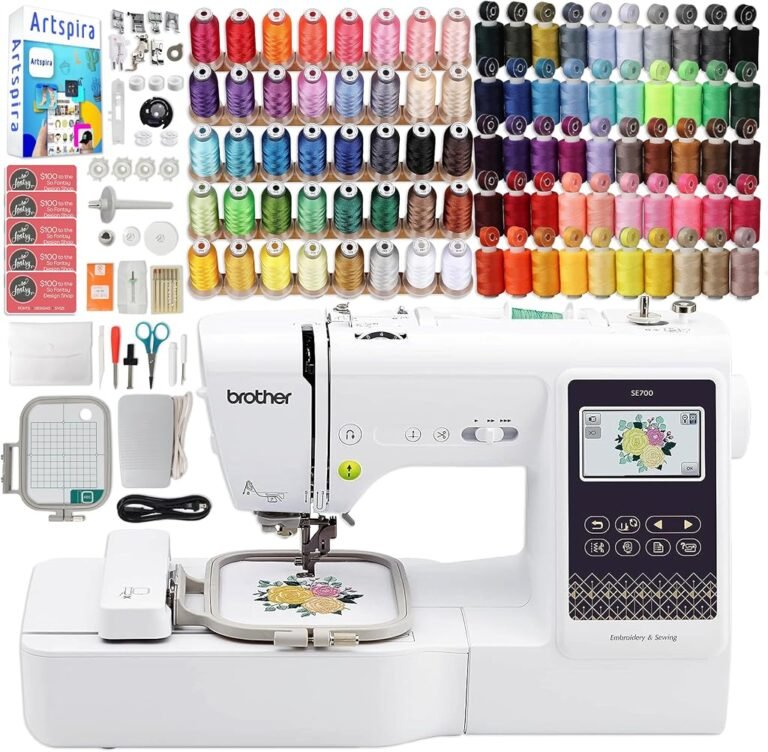
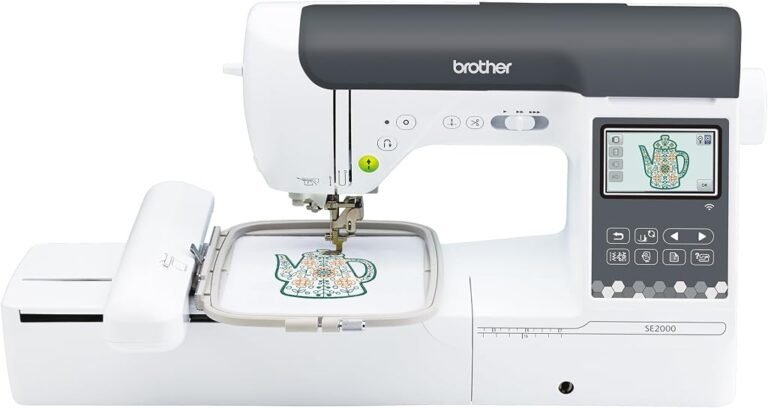
Machine embroidery has an unusual equipment problem: two machines can create visually similar lettering on a polo shirt while belonging to very different classes of machinery.
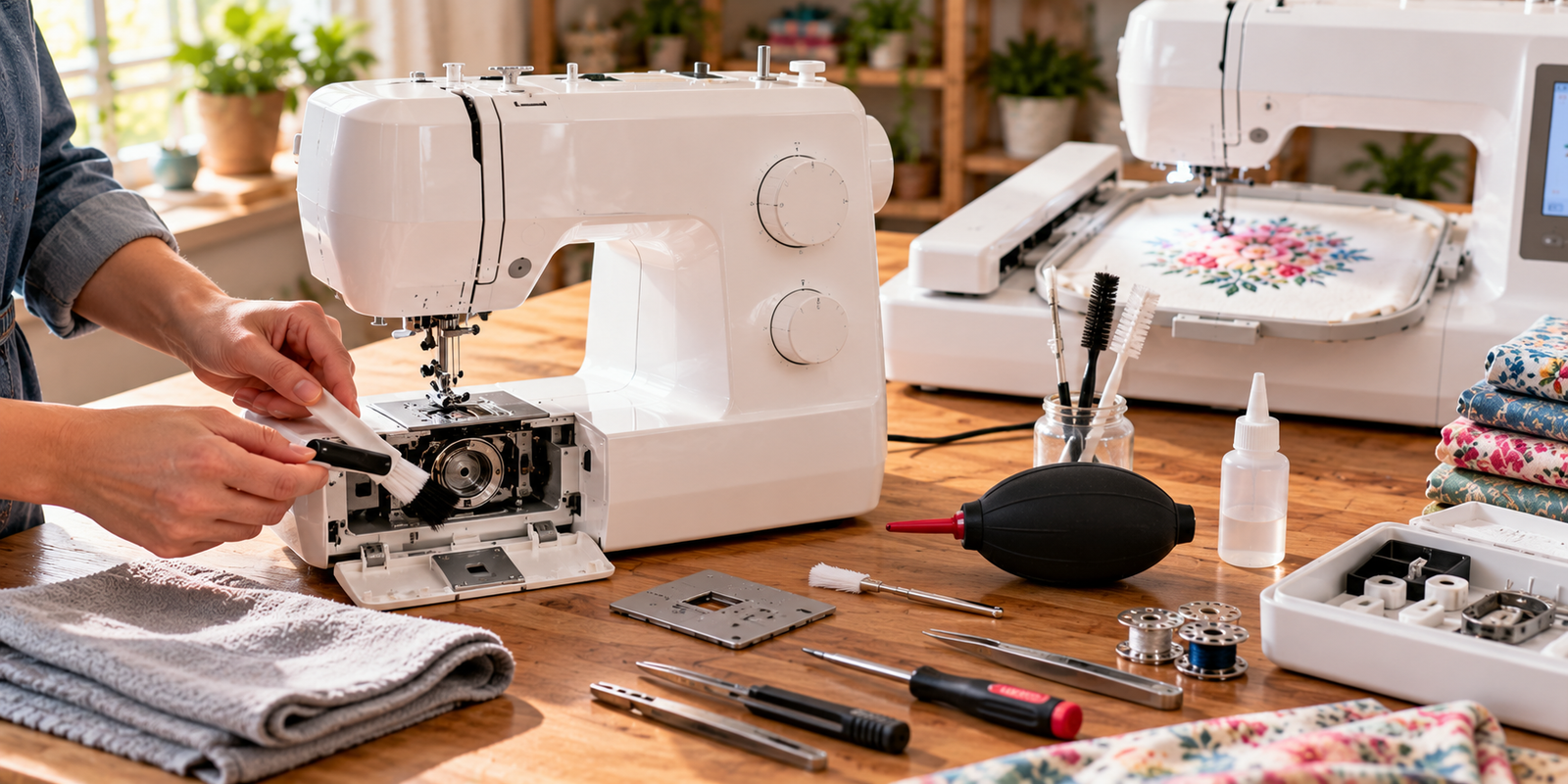
A home embroidery machine may produce detailed monograms, appliqué, quilt blocks, decorative motifs, and personalized gifts with impressive precision. A commercial embroidery machine can produce many of those same designs. Yet the resemblance largely ends at the finished stitch. Their architecture, workflow, needle systems, production expectations, physical footprints, and tolerance for repeated operation can differ substantially.
The useful dividing line is workload.
A person producing occasional birthday gifts does not have the same equipment requirements as a business sewing 60 embroidered uniforms before Friday. Nor does a growing home business automatically need a large multihead industrial installation. Between those extremes sits a broad category of single-head multineedle machines that blurs the old division between domestic and commercial equipment.
Choosing well therefore requires examining what happens during an actual working day: how often thread colors change, how frequently garments are rehooped, how long the machine runs, what objects must fit around the needle, and how costly operator interruptions become.
That analysis reveals why stitch count alone says remarkably little about whether a machine can handle a workload.
The Difference Starts With Machine Architecture
Most conventional home embroidery machines are single-needle systems. One needle carries one upper thread at a time. When a design calls for another color, the machine stops and the operator changes the thread.
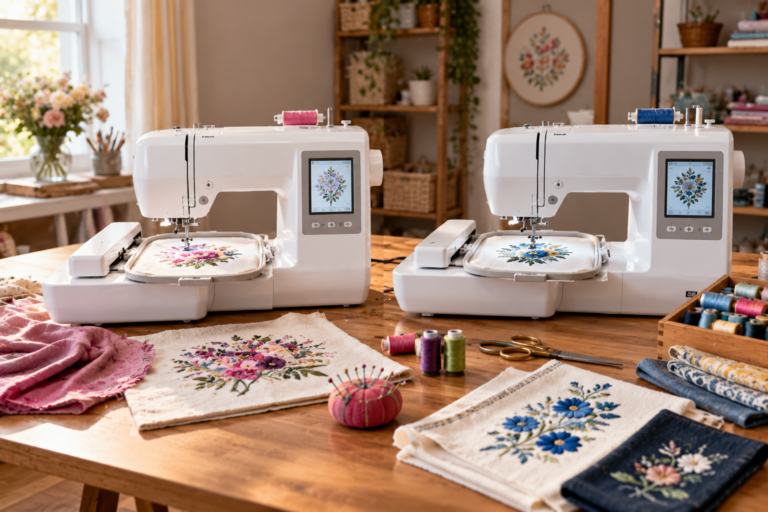
That arrangement is practical for hobby embroidery because it keeps the machine relatively compact and straightforward. A project containing six colors may require several manual changes, but a person producing one decorative piece at home might reasonably accept those interruptions.
Commercial production changes the value of every interruption.
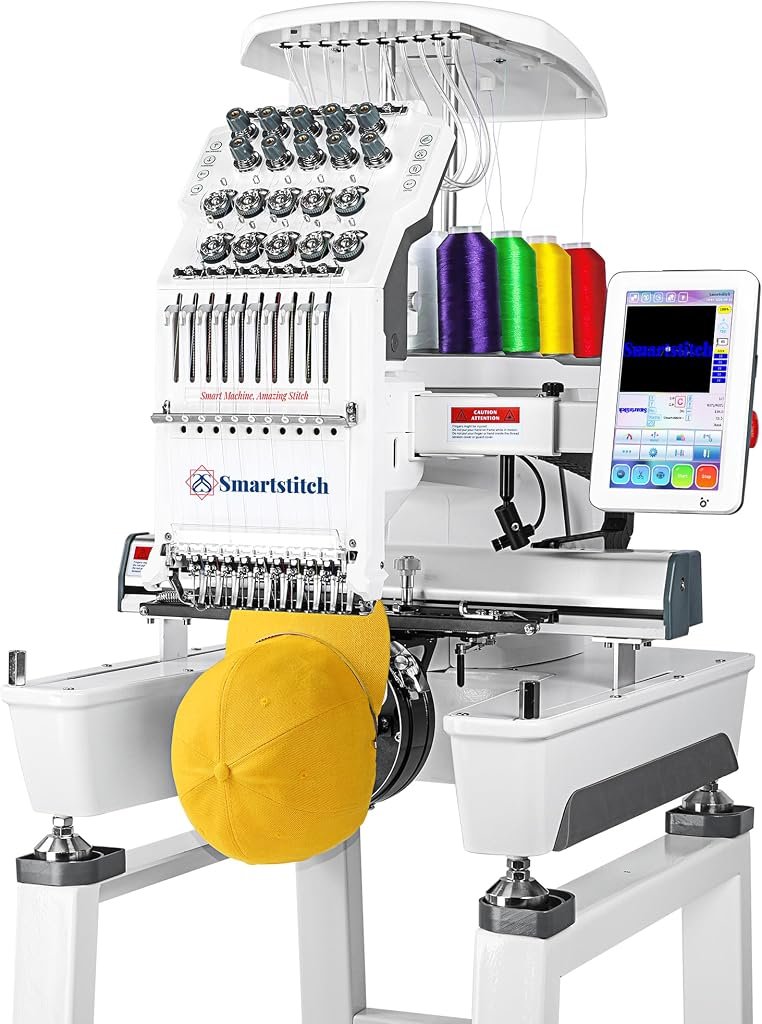
A multineedle machine keeps several colors threaded simultaneously. Instead of replacing the thread spool at each programmed color change, the machine selects another needle. Operator involvement decreases, particularly on designs using a recurring palette.
The difference can be seen even before reaching heavy industrial equipment. Janome describes its seven-needle MB-7 embroidery machine as a home-use multineedle model. It reaches a specified maximum embroidery speed of 800 stitches per minute and uses seven needles, illustrating how equipment categories increasingly overlap.
Brother’s six-needle PR680W moves further toward business-oriented operation. The machine is specified for up to 1,000 stitches per minute, and its six needles allow designs containing as many as six threaded colors to proceed without a manual rethread between those colors. Brother’s PR680W specifications also describe machine-linking capability for installations using multiple units.
A full commercial single-head machine can go further. Tajima’s TMEZ-SC is available with 9, 12, or 15 needles and has a specified maximum revolution rate of 1,200 rpm. Its configuration, 95-kilogram machine weight, and broad selection of frame systems place it firmly in commercial production. Tajima’s technical specifications show how substantially the machine architecture changes once sustained production becomes the design priority.
The real distinction is therefore not simply “home machine versus expensive machine.” It is the degree to which the machine is engineered to reduce human intervention while repeating embroidery work.
Speed Matters Less Than It First Appears
Embroidery-machine marketing often emphasizes stitches per minute. The number is easy to compare and easy to misunderstand.
Consider three machines.
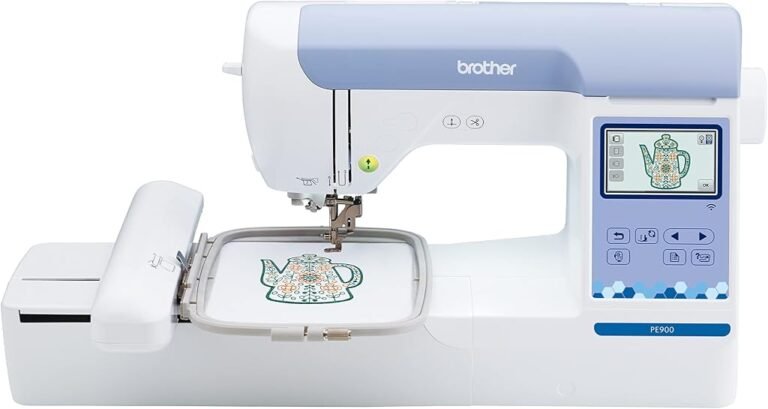
A home-oriented Brother PE900 is rated for embroidery speeds up to 650 stitches per minute and offers a 5-by-7-inch embroidery area. Brother’s PE900 specifications describe a machine clearly configured around personal embroidery and relatively compact projects.
Janome’s home-oriented Memory Craft 550E reaches a stated 860 stitches per minute and increases the maximum embroidery area to 7.9 by 14.2 inches. Janome’s MC550E specifications therefore show that a domestic machine can approach the nominal stitch rates associated with some business-oriented systems.
At the industrial end, Barudan lists 1,300 stitches per minute on flat embroidery for its 15-needle BEKT-S1501CII, with cap work rated at up to 1,000 stitches per minute. The Barudan machine specifications also identify a 450-by-520-millimeter sewing field.
Those numbers appear to create a straightforward ladder: 650, 860, 1,300.
Actual production is less tidy.
A 10,000-stitch design does not automatically require 15.4 minutes on a 650-stitch-per-minute machine or 7.7 minutes on a 1,300-stitch-per-minute machine. Machines accelerate and decelerate. Designs contain trims, jumps, short stitches, direction changes, color changes, and other operations that prevent continuous running at maximum rated speed.
More critically, embroidery production includes time when no stitches are being formed at all.
Garments must be hooped. Stabilizer must be cut and positioned. Bobbins must be changed. Thread breaks require intervention. Finished items have to be removed. The next item must be loaded. Orders must be sorted. Files have to be transferred and verified.
A machine can therefore be faster on paper yet save surprisingly little time if the surrounding workflow remains inefficient.
Commercial equipment earns its advantage through more than motor speed. It is designed around reducing interruptions and handling repetition.
Needle Count Can Matter More Than Maximum Speed
Imagine a company logo using eight thread colors.
On a single-needle machine, almost every color transition requires operator involvement. The machine pauses, the old thread is removed, a new thread is installed, and sewing resumes.
If the design takes only 12 minutes to stitch but requires repeated manual thread changes, the operator may remain tied to the machine throughout most of the job.
A 15-needle machine changes the labor equation. Each required color can remain threaded. When the design calls for a new color, the machine moves to the assigned needle.
This distinction grows with order quantity.
One manually threaded sample may be trivial. Twenty-five identical shirts are different. One hundred are different again.
For repetitive production, the relevant metric is not merely stitches per minute. It is operator minutes per finished piece.
That is why multineedle capacity often becomes the first major step toward commercial embroidery. It does not necessarily make an individual stitch prettier. It removes repetitive labor surrounding the stitch.
Embroidery Field Determines What Can Be Produced
The machine’s physical embroidery area sets another hard boundary.
A small home embroidery field can handle monograms, patches, names, children’s designs, chest logos, and many decorative motifs. Larger jacket backs, quilt sections, banners, and elaborate compositions require more movement across the fabric.
The Janome Memory Craft 550E, for example, offers a maximum embroidery size of 7.9 by 14.2 inches. That is generous by domestic-machine standards and suitable for many larger decorative projects.
Commercial single-head machines can provide substantially more working area. Tajima lists a border-frame field of 360 by 500 millimeters-approximately 14.1 by 19.6 inches-on the TMEZ-SC.
Barudan lists a 450-by-520-millimeter field on its BEKT-S1501CII, equivalent to roughly 17.7 by 20.5 inches.
Field size should not be treated as a contest for the largest number. Larger embroidery fields bring value only when projects use them.
A person primarily sewing 3-inch chest logos receives little economic benefit from a huge flat-work field. A shop regularly embroidering jacket backs, blankets, or large panels may find a small field restrictive almost immediately.
The buying question is therefore concrete: what is the largest recurring design, not the largest hypothetical project someone might attempt one day?
Free-Arm Construction Changes What Can Be Hooped
Flat embroidery is mechanically simple compared with finished garments.
A towel, fabric panel, or unassembled quilt block can often lie relatively flat around a domestic embroidery arm. Finished clothing is less cooperative.
Polo shirts contain neck openings and seams. Sweatshirts have sleeves and cuffs. Bags create enclosed spaces. Caps curve. Children’s garments may provide very little room around the embroidery site.
Commercial-style multineedle machines often use a free-arm or cylinder architecture that allows a tubular garment to surround the embroidery area rather than forcing excess material under a large flat machine bed.
That design can fundamentally change production.
A shirt can be loaded so only one layer is stitched. Pockets, sleeves, bags, socks, and other finished goods become easier to position with suitable frames or fixtures. Tajima, for example, lists tubular, cap, pocket, sock, border, and other frame options for its commercial system.
This is one reason a buyer comparing the best sewing and embroidery machines should distinguish between decorative capability and garment-production capability. A large color screen and extensive built-in design library can be useful at home, while a business may derive more operational value from free-arm access and specialized hoop support.
The machine should be judged by the objects that must physically move around its needle.
Commercial Machines Are Built Around Repetition
The difference between making embroidery and manufacturing embroidered goods is repetition.
A domestic machine may spend substantial portions of its life turned off. A commercial system may be expected to complete one item, receive another, and start again through an extended working period.
This changes engineering priorities.
Controls must be positioned for repeated use. Thread paths need to support numerous colors. Stands accommodate large cones. Frames and fixtures must be exchanged repeatedly. Motors, drive systems, and chassis are selected with a production environment in mind.
Physical mass illustrates the difference. Tajima lists the single-head TMEZ-SC at 95 kilograms, or roughly 209 pounds.
By contrast, Janome lists its seven-needle MB-7 at 50 pounds.
Neither figure alone predicts stitch quality. Weight does, however, hint at different mechanical assumptions. High-speed frame movement repeatedly accelerates fabric in opposing directions. A commercial chassis must control those forces while preserving registration.
The commercial machine is therefore not simply a domestic unit with additional needles attached. Its operating environment has influenced the entire design.
Machine Embroidery Has Industrial Roots
The distinction between personal decoration and production is older than computerized embroidery.
The Smithsonian’s National Museum of American History holds an 1868 patent model created by Antoine Bonnaz of Paris. The museum describes the invention as a machine for embroidering fabric and states that it “made possible the mass production of embroidered garments and trimmings.” The Smithsonian record of Bonnaz’s embroidery machine dates the patent to November 10, 1868.
That historical detail puts the modern home-versus-commercial question into perspective.
Mechanized embroidery was connected to production economics long before USB design transfers, touchscreens, or digitally controlled frames. Machines allowed repetitive decorative stitching to move away from exclusively manual labor.
Computer control later changed what could be automated. A digital embroidery file now tells the machine where stitches should fall, how the frame should move, when threads should be trimmed, and when colors should change.
Yet the production problem remains recognizable: how can repeated decoration be produced accurately with less direct manual labor?
Commercial embroidery machinery answers that question aggressively.
Home machinery answers a different question: how much automated embroidery capability can be made practical for a personal sewing space?
The Single-Needle Home Machine Still Has Major Advantages
Commercial machinery is not automatically the better purchase.
A home machine can be smaller, easier to move, quieter in many settings, and better suited to a room that must remain a living space rather than become a production floor.
Home units also tend to place substantial emphasis on graphical interfaces, built-in decorative designs, lettering, automatic layout tools, and straightforward editing.
For someone making personalized towels, baby gifts, quilt labels, monograms, holiday decorations, or occasional clothing, these priorities make sense.
A single needle may not create a serious obstacle because production volume is low.
There is also a difference between machine embroidery as a creative activity and embroidery as order fulfillment.
A hobby user may enjoy selecting thread for every color stop. That interruption is part of making the piece. In production, the same activity can represent paid labor that contributes nothing visible to the finished design.
The identical action changes meaning when the workload changes.
A Home Business Creates the Hardest Buying Decision
The difficult category is neither hobby sewing nor established manufacturing. It is the home embroidery business producing enough work to feel constrained by consumer equipment but not enough to justify a multihead production floor.
This is where the single-head multineedle machine becomes attractive.
It can offer:
- multiple colors threaded simultaneously;
- free-arm access for finished garments;
- automatic color changes;
- larger thread-cone support;
- cap or specialty-frame compatibility;
- higher sustained production potential;
- less operator involvement per design.
Yet such machines still require space, maintenance, supplies, hoop inventory, and workflow discipline.
The buyer should therefore avoid using revenue alone as the trigger for an upgrade.
Workload composition matters more.
A home business selling one-off personalized baby blankets may produce substantial revenue while changing designs constantly. Another business selling uniform chest logos may repeat the same six-color design hundreds of times.
The second business benefits much more directly from multineedle automation even if its machine produces less revenue per individual item.
Multihead Machines Change the Economics Again
Commercial embroidery reaches another threshold when a machine contains multiple sewing heads.
Instead of embroidering one garment at a time, several heads can sew the same design simultaneously.
That changes production arithmetic dramatically.
Suppose an order contains 48 identical shirts. A single-head machine requires 48 embroidery cycles. A six-head system can theoretically reduce the number of batches to eight, assuming all six heads are used, all garments can be loaded appropriately, and no production interruption changes the schedule.
The practical gain is not exactly sixfold because operators still load garments, manage thread, change bobbins, inspect output, and respond to faults. Even so, parallel production changes the cost structure of repeated orders.
This is also where buying too much machine becomes financially dangerous.
A multihead system earns its floor space when orders regularly contain enough identical or similar items to keep several heads working. A personalized-gift business dominated by unique names may gain far less from parallel heads than a uniform supplier stitching the same corporate logo across hundreds of garments.
Production equipment should follow order structure rather than aspiration.
Hoop Time Is Often the Hidden Bottleneck
Many first-time business buyers focus on embroidery speed while overlooking hooping.
That can be a serious calculation error.
If a design stitches in eight minutes but the operator requires four minutes to prepare, align, hoop, and load each garment, improving stitch speed cannot eliminate that four-minute preparation period.
Production may then depend more heavily on:
- hoop selection;
- alignment systems;
- magnetic frames;
- templates;
- garment fixtures;
- prepared stabilizer;
- staging procedures;
- operator experience.
A machine sitting idle while the next shirt is prepared produces nothing, regardless of its maximum stitch rate.
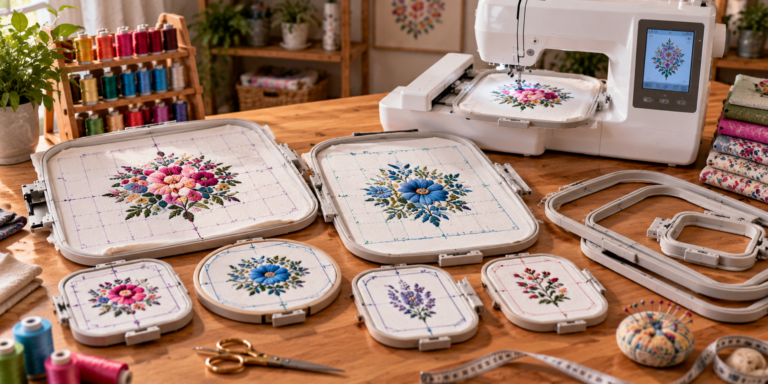
Efficient shops often address this by preparing one item while another is being embroidered. Extra hoops or compatible frames can help separate preparation from machine occupancy.
This is one of the strongest reasons to calculate workflow rather than compare specification sheets.
Downtime Becomes More Expensive as Volume Increases
A hobby machine that needs service can be frustrating.
A business machine that needs service can stop revenue-generating production.
That changes how maintenance, parts availability, dealer support, and technician access should be evaluated.
Commercial equipment may justify greater attention to lubrication schedules, cleaning procedures, needle replacement, hook timing, tension systems, drive components, and preventive servicing because its usage level is fundamentally different.
The cost of maintenance is only one side of the calculation. The cost of unavailable equipment is the other.
A shop with one machine has a single point of failure. Two smaller machines may offer redundancy even when one larger machine appears more productive on paper.
This produces an interesting purchasing dilemma. The machine with the highest nominal output is not always the safest business configuration.
Production resilience has economic value.
Design Digitizing Matters More Than Machine Class
No machine can compensate fully for badly prepared embroidery data.
Digitizing determines stitch direction, density, underlay, sequencing, trims, color changes, and many other characteristics that affect how a design sews.
A poorly digitized logo can cause thread breaks, distortion, puckering, unnecessary trims, excessive density, and long run times on expensive industrial machinery just as readily as on a home machine.
This is another reason hardware comparisons can become misleading.
A business upgrading from a domestic machine to a commercial machine may expect an immediate improvement in every finished design. If poor digitizing remains unchanged, the new machine may simply reproduce the same problems faster.
Machine capability and design quality are separate variables.
A Practical Workload Test
The purchase decision becomes clearer when actual production is measured for several weeks.
The operator can record:
- how many embroidery jobs are completed per week;
- average stitch count per item;
- average number of thread colors;
- number of manual thread changes;
- hooping time per item;
- machine sewing time;
- operator intervention time;
- percentage of jobs using finished garments;
- frequency of cap, sleeve, pocket, or bag embroidery;
- largest recurring embroidery field;
- number of identical items in a typical order;
- hours per week the machine is actively sewing.
Those figures expose bottlenecks.
If manual thread changes dominate operator time, multineedle equipment becomes easier to justify.
If hooping dominates, another machine may do little unless framing workflow also improves.
If the embroidery field is constantly too small, field size becomes a priority.
If orders frequently contain dozens of identical garments, higher duty capability-or eventually multiple heads-deserves closer examination.
If the machine spends most days idle, commercial capacity may simply become expensive furniture.
When a Home Machine Fits the Workload
A home embroidery machine remains a rational choice when production is intermittent and projects vary widely.
It generally fits users who:
- embroider primarily for personal use;
- make gifts or occasional custom pieces;
- work mainly with flat items;
- rarely process large batches;
- can tolerate manual thread changes;
- need a machine that can be stored or moved;
- prioritize creative editing over production throughput;
- work within a domestic sewing space;
- do not need commercial cap or tubular-garment systems.
For these users, a commercial platform can impose costs without solving an actual problem.
More needles, greater mass, specialized frames, and higher speed do not generate value merely by existing.
When Commercial Equipment Starts Making Sense
Commercial-style equipment becomes more rational when machine limitations begin affecting delivery time or labor cost.
Warning signals include:
- repeated orders with many identical items;
- frequent multicolor designs;
- substantial time spent manually changing thread;
- near-daily machine use;
- regular embroidery on finished garments;
- increasing cap, bag, sleeve, or pocket work;
- lost orders because the embroidery field is too small;
- production schedules extending unnecessarily because one item must finish before another starts;
- orders large enough that machine downtime threatens deadlines;
- labor cost becoming a larger issue than equipment acquisition cost.
The transition does not have to jump directly from a single-needle hobby unit to a large multihead installation.
A single-head six-, seven-, twelve-, or fifteen-needle machine may remove the dominant bottlenecks while retaining a footprint compatible with a small studio.
That middle category deserves careful examination because it matches the way many embroidery businesses actually grow.
Final Considerations
The difference between home and commercial embroidery equipment cannot be reduced to stitch quality, price, or motor speed.
A well-configured home machine can create highly detailed work. A commercial machine can sew the same basic decorative stitches. What changes is the infrastructure surrounding those stitches.
Home embroidery machines emphasize accessibility, creative flexibility, manageable size, and occasional production. Commercial machines emphasize repetition, thread readiness, garment access, sustained operation, specialized framing, and lower operator involvement per piece.
The correct purchase therefore emerges from observing the workload.
A user completing a handful of unique projects each month may gain little from fifteen threaded needles. A uniform business changing thread manually dozens of times each day may be paying for a commercial machine already-only the cost is appearing as labor instead of equipment.
Maximum speed deserves similar skepticism. A machine rated at 1,300 stitches per minute cannot recover time lost to slow hooping, poor digitizing, thread failures, disorganized garment staging, or constant manual intervention.
The deeper question is not how fast the needle can move.
It is how smoothly work can move through the entire embroidery process.
Once embroidery shifts from occasional creation to repeated production, the machine’s job changes. It must no longer merely stitch accurately. It must reduce interruption, accept difficult garments, repeat designs predictably, and remain productive often enough to justify the space and capital committed to it.
That is the point at which commercial architecture begins to make economic sense.
Until then, a capable home embroidery machine may be exactly what the workload requires.