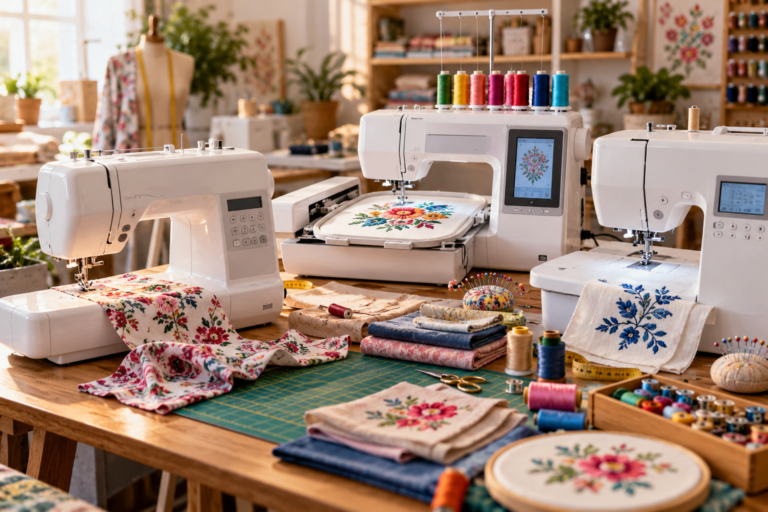
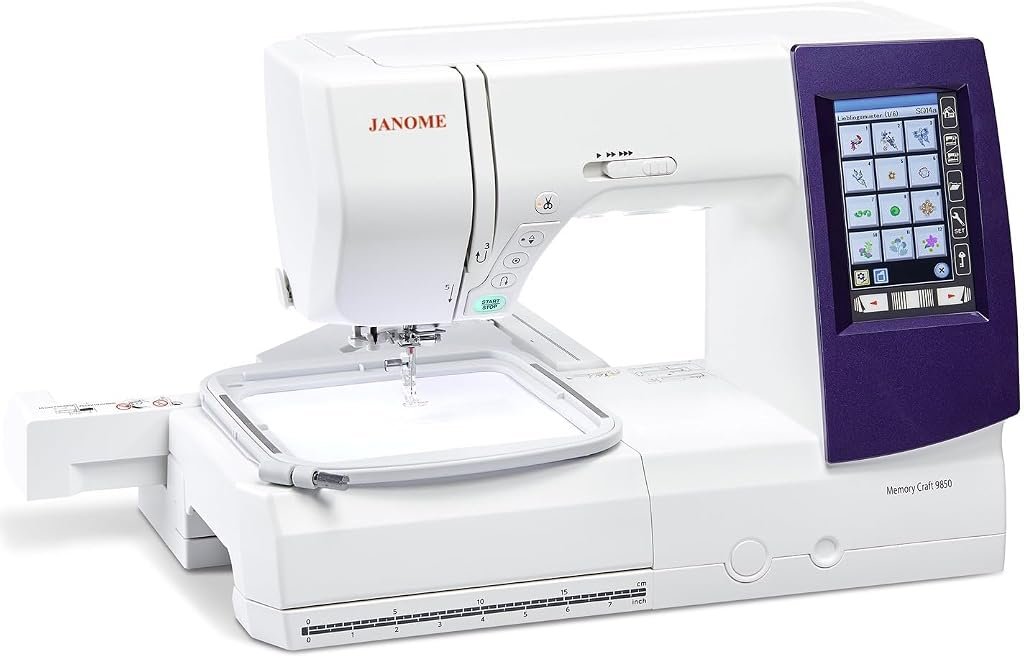
The Janome Horizon Memory Craft 9850 approaches the sewing-and-embroidery combination from a decidedly machine-centered perspective. Its specifications emphasize physical capacity and integrated controls: 200 built-in sewing stitches, 175 embroidery designs, a maximum embroidery field of 6.7 × 7.9 inches, sewing speeds up to 1,000 stitches per minute, embroidery speeds up to 800 stitches per minute, automatic thread tension, USB design transfer, and a color touchscreen.
That collection of features places the MC9850 well beyond introductory 4 × 4 embroidery machines in physical working area. Yet the machine also illustrates an increasingly important distinction in computerized sewing: mechanical capability and digital connectivity do not advance at the same pace.
The MC9850 has substantial physical capabilities. Its embroidery field is larger than the common 4 × 4 and 5 × 7 formats. Its sewing system is extensive enough to stand independently rather than functioning as an afterthought attached to an embroidery unit. Its USB port allows external embroidery files to move into the machine.
What it does not center is the mobile-first, wireless design workflow increasingly associated with newer connected models.
Our Score for the Janome Horizon Memory Craft 9850 is 8.2/10. Customer Sentiment is 8.06, Buyer Confidence is 8.81, and Value is 8.03. Those ratings reflect a machine with substantial sewing and embroidery hardware whose appeal depends on whether a buyer values physical capability more heavily than contemporary connectivity.
The MC9850 is therefore best judged at the needle, inside the hoop, and across the sewing bed.
The 6.7 × 7.9-Inch Embroidery Field Is the Central Specification
The MC9850’s maximum embroidery size is 6.7 × 7.9 inches.
According to Janome’s official Memory Craft 9850 specifications, the machine supports a maximum embroidery field of 6.7 × 7.9 inches and includes multiple embroidery hoops.
This is the specification that most clearly separates the machine from entry-level combination models.
A 4 × 4-inch field has a theoretical rectangular area of 16 square inches. A 5 × 7 field provides 35 square inches. A 6.7 × 7.9 rectangle provides approximately 52.9 square inches.
Actual embroidery designs do not necessarily consume the complete rectangular field, but the comparison demonstrates the scale difference.
The MC9850 gives designs room.
That affects names, decorative arrangements, garment graphics, home-textile motifs, quilt labels, monograms, and compositions containing several design elements.
More importantly, additional field size reduces the frequency with which users must split designs, reposition fabric, or reorganize a composition solely because the machine cannot reach far enough.
Embroidery Field Size Is a Long-Term Hardware Decision
Built-in designs can be supplemented.
Embroidery files can be purchased, created, organized, and replaced.
A machine’s native embroidery field is different.
It is governed by physical movement.
That makes hoop capacity one of the more durable buying considerations in computerized embroidery. Someone who purchases a machine because its factory designs are appealing may eventually outgrow those designs. Someone who purchases a machine whose physical field is too small encounters a harder limit.
The MC9850’s 6.7 × 7.9-inch capacity therefore deserves more weight than its design count.
This field is not unlimited. Large jacket-back graphics, expansive quilt blocks, oversized home-decor designs, and other broad compositions can still exceed it.
Yet compared with 4 × 4 and 5 × 7 formats, the machine gives the user substantially more native working room before workarounds become necessary.
That is a meaningful distinction.
The Machine Includes 175 Embroidery Designs
Janome provides 175 built-in embroidery designs.
That is a substantial starting collection.
Factory designs are useful during early ownership because they allow users to explore the embroidery system without first building an external file library. They also provide immediate material for learning thread changes, stabilizer selection, hoop placement, editing controls, and design sizing.
Over time, however, design count tends to become less important than design access.
The MC9850 includes USB connectivity for importing compatible embroidery files.
That means the 175 designs are not a closed creative library.
External files can expand the machine’s usable collection according to the owner’s actual interests. A user focused on floral designs may build one library. Someone producing children’s projects may build another. A monogram-focused owner may rely heavily on lettering and custom files.
The machine’s physical field remains constant while its digital library can evolve.
The Sewing System Is Substantial in Its Own Right
The MC9850 includes 200 built-in sewing stitches.
That number matters because combination machines can sometimes be evaluated almost entirely through their embroidery specifications.
Doing so would misrepresent this Janome.
The sewing side includes utility and decorative stitch options alongside six one-step buttonholes. Janome also specifies automatic thread tension, adjustable foot pressure, an automatic thread cutter, memorized needle up/down, a start/stop button, and a speed-control slider.
These are not merely decorative additions.
They influence routine sewing.
Automatic thread tension reduces one manual adjustment during ordinary work. Needle up/down can make pivoting and controlled stopping easier. Speed adjustment allows the operator to slow the machine for detail work and increase pace on longer, straightforward seams.
The MC9850 therefore makes more sense when conventional sewing is a genuine requirement rather than an occasional secondary task.
Sewing Speed Reaches 1,000 Stitches per Minute
Janome specifies a maximum sewing speed of 1,000 stitches per minute.
That is substantial for a home-oriented computerized combination machine.
Maximum speed should still be treated as available capacity rather than a universal operating target.
A long straight seam on stable fabric can tolerate a much faster pace than tight curves, small garment components, applique work, or precision topstitching.
Speed without control is not useful.
The MC9850’s speed-control slider allows the operator to limit the machine according to the project. This makes the 1,000-stitch-per-minute ceiling more practical because it exists alongside the ability to work deliberately at lower speeds.
For a buyer who spends substantial time sewing as well as embroidering, this specification can matter more over years of ownership than the number of built-in embroidery designs.
Embroidery Speed Reaches 800 Stitches per Minute
Janome lists a maximum embroidery speed of 800 stitches per minute.
The number provides a useful reference point, but it does not translate directly into total project time.
Consider a hypothetical 12,000-stitch design. At a perfectly constant 800 stitches per minute, the stitching itself would require 15 minutes.
Actual embroidery takes longer.
The machine may change speed during different parts of the design. Multicolor work requires thread changes. Thread breaks, bobbin replacement, trimming, setup, hooping, stabilizing, and design positioning add time outside the nominal stitch count.
A maximum embroidery-speed specification therefore measures one component of productivity.
For home use, that distinction may be modest.
For repeated paid work, it becomes far more important because operator time accumulates across every copy of a design.
Single-Needle Embroidery Still Requires Color Management
The MC9850 is a single-needle embroidery system.
That means multicolor designs require the operator to change thread colors during the embroidery sequence.
The machine automates hoop movement and stitch placement.
It does not keep numerous colors threaded simultaneously.
For individual projects, this workflow is entirely normal. A personalized towel, garment, bag, or quilt label can contain several colors without creating an unreasonable burden.
Production changes the equation.
If a design requiring six thread colors is embroidered repeatedly across dozens of items, the operator repeats those thread changes for every piece.
A multi-needle machine addresses that problem differently by keeping several colors threaded and available.
The MC9850 should therefore be viewed as a sophisticated home combination machine rather than as a substitute for multi-needle production equipment.
Automatic Thread Tension Reduces One Variable
Janome includes automatic thread tension.
Thread tension determines how upper and bobbin threads interact to form stitches. Incorrect tension can produce visible loops, poor stitch formation, thread showing where it should not, or other undesirable results.
Automation reduces the amount of routine manual intervention required.
It does not make tension irrelevant.
Thread type, fabric, needle selection, embroidery density, and unusual materials can still create situations requiring judgment.
The more useful interpretation is that automatic tension gives the machine a managed starting point.
That fits the MC9850’s broader design philosophy.
Several routine actions are automated so the user can concentrate more heavily on project control.
Adjustable Foot Pressure Expands Sewing Control
Janome also provides adjustable foot pressure.
This is a sewing specification rather than an embroidery feature.
The presser foot applies pressure to fabric as the feed system moves material through the machine. Different fabrics can behave differently under the same pressure.
Fine or slippery materials may respond differently from thicker layers. Stretch fabrics create another set of handling challenges.
Adjustability gives the operator another way to adapt machine behavior to the material.
This feature is easy to overlook beside a color touchscreen or large embroidery field.
Yet conventional sewing is full of small mechanical relationships between fabric, feed dogs, presser foot, needle, and thread.
Control over those relationships can matter more than decorative stitch quantity.
The Color Touchscreen Supports Machine-Side Editing
The MC9850 includes a full-color touchscreen.
Embroidery places unusually high demands on the machine interface because the operator is not merely choosing a stitch.
A design must be selected, positioned, examined, edited, and prepared for execution.
Janome provides on-screen editing functions that allow users to work with designs directly at the machine.
This can reduce dependence on a computer for routine adjustments.
The touchscreen should not be confused with dedicated embroidery-digitizing software.
Machine-side editing modifies designs within the functions Janome provides. Digitizing creates or substantially reconstructs the stitch instructions that tell an embroidery machine how artwork should become thread.
Those are different jobs.
The touchscreen makes the first more accessible.
USB Transfer Keeps the Design Library Open
The MC9850 uses USB connectivity for design transfer.
This allows compatible external embroidery files to move from a computer or storage device into the machine.
USB transfer is less seamless than a modern wireless workflow.
A file must be organized, placed on compatible media, physically carried to the machine, and opened there.
For occasional transfers, this process is straightforward.
For someone managing a large library and sending new files to the machine constantly, the repeated steps become more noticeable.
The distinction is procedural rather than mechanical.
A design transferred by USB does not stitch worse merely because it arrived on physical media.
Wireless connectivity changes convenience.
The embroidery mechanism determines execution.
Connectivity Is the MC9850’s Most Obvious Generational Trade-Off
This is where the MC9850’s buying proposition becomes particularly interesting.
The machine has substantial mechanical and embroidery capability, but its digital workflow reflects a USB-centered generation.
Newer connected machines can provide wireless file transfer, mobile applications, cloud-linked design libraries, or other network-based conveniences.
Those functions can remove small steps from everyday use.
They cannot enlarge an embroidery field.
They cannot turn a slower sewing mechanism into a faster one.
They cannot substitute for adjustable sewing controls.
The buyer therefore has to decide which kind of capability matters more.
A user who transfers one new design every few weeks may barely care about USB.
A user who downloads and organizes designs constantly may care a great deal.
The MC9850 Includes Multiple Hoop Sizes
Janome supplies multiple embroidery hoops with the MC9850, including formats suited to smaller and larger designs.
Different hoop sizes matter because the largest hoop is not always the best choice.
A small design can often be stabilized and positioned more efficiently in a smaller hoop. Using a hoop closer to the dimensions of the design can reduce unnecessary material handling.
Larger hoops become useful when the composition actually requires the space.
This creates a more flexible embroidery workflow than relying on one frame for every project.
The principle is straightforward: hoop selection should follow design dimensions rather than an assumption that larger is always preferable.
Stabilizer Remains Part of the Machine System
Computerized embroidery can appear highly automated, but the fabric remains an uncontrolled physical material until the operator prepares it correctly.
Embroidery adds dense concentrations of thread.
Those stitches can pull, compress, stretch, or distort fabric.
Stabilizer helps resist those forces.
The correct approach varies according to the project. A stretchy knit does not behave like stable woven cotton. A towel presents different challenges from a thin shirt. Dense embroidery places different demands on material than a light open design.
The MC9850 can execute a digital stitch path accurately while the fabric still puckers because the project was poorly stabilized.
That is not a contradiction.
Machine precision and material preparation are separate variables.
Hoop Placement Can Matter More Than Design Editing
A design can be technically flawless and still look wrong if it is positioned poorly on the finished object.
Placement is therefore one of the less glamorous but more consequential embroidery skills.
Before hooping, the operator should identify the intended center, orientation, and relationship between the design and garment or object.
A name placed slightly too high on a towel can look awkward.
A chest design rotated a few degrees can appear visibly incorrect even if every stitch is perfect.
The MC9850 automates the embroidery path.
The operator determines where that path sits in relation to the object.
This is why measurement remains indispensable even on highly computerized machines.
Combination Machines Trade Parallel Productivity for Consolidation
The MC9850 performs both conventional sewing and embroidery.
That saves space and avoids purchasing two separate machines.
It also creates a workflow limitation.
The machine cannot embroider one project while simultaneously sewing another.
For most home users, that is entirely reasonable.
For heavier workloads, it can become restrictive.
Someone producing embroidered products may eventually want an embroidery machine running while a separate sewing machine handles construction work.
The combination format is therefore most efficient when consolidation matters more than parallel production.
This distinction should be considered before assuming that one machine replacing two is automatically more efficient in every situation.
Where the MC9850 Fits Among the Best Sewing and Embroidery Machines
The best sewing and embroidery machines should be judged according to project requirements rather than model age or feature count alone.
The MC9850 illustrates why.
Its USB workflow is less connected than newer wireless systems.
Its physical specifications remain substantial.
A 6.7 × 7.9-inch embroidery field gives it more native space than common 4 × 4 and 5 × 7 platforms. Two hundred sewing stitches and a 1,000-stitch-per-minute maximum sewing speed give the conventional sewing side considerable depth. An 800-stitch-per-minute embroidery ceiling provides useful machine capacity.
The buyer therefore has to weigh connectivity against physical capability.
For some households, wireless transfer will matter every week.
For others, larger embroidery dimensions and stronger sewing specifications will matter every time the machine is switched on.
Our Score: 8.2/10
We rate the Janome Horizon Memory Craft 9850 at 8.2/10.
That score recognizes substantial physical capability without ignoring the machine’s generational trade-offs.
The 6.7 × 7.9-inch embroidery field is a meaningful asset. The machine also provides 175 embroidery designs, 200 sewing stitches, six one-step buttonholes, automatic thread tension, adjustable foot pressure, a full-color touchscreen, USB design transfer, sewing speeds up to 1,000 stitches per minute, and embroidery speeds up to 800 stitches per minute.
Those specifications form a serious home sewing and embroidery platform.
The score remains measured because current buying decisions also involve software ecosystems, transfer convenience, accessory availability, support, and the price of newer alternatives.
The MC9850 is strongest when evaluated as machinery first and connected technology second.
Customer Sentiment: 8.06
Our Customer Sentiment score is 8.06.
That rating reflects a machine with considerable capability but a narrower ideal audience than a simpler entry model.
The MC9850 asks its owner to make use of substantial sewing and embroidery functionality.
A casual embroiderer working only with small monograms may not benefit fully from its larger field. A sewing-only buyer would pay for an embroidery system that remains unused. A mobile-first user may find USB transfer less convenient than current connected workflows.
The best fit is someone who actually sews and embroiders, values a larger native embroidery area, and accepts USB as a reasonable file-transfer method.
When those conditions are met, the architecture becomes much easier to justify.
Buyer Confidence: 8.81
Buyer Confidence is 8.81.
The machine’s core specifications are clearly defined through Janome’s documentation.
Field size, stitch counts, embroidery designs, buttonhole count, maximum speeds, tension control, foot-pressure adjustment, touchscreen operation, and USB connectivity can all be evaluated before purchase.
Janome also maintains support resources for its sewing and embroidery products covering manuals, software and other ownership information.
Buyer Confidence does not rise as high as some simpler machines because the MC9850 represents a more substantial investment and a more complex ownership decision.
A buyer needs to consider not only whether the machine works for the intended projects, but whether its USB-centered digital workflow remains acceptable for the expected ownership period.
That is a reasonable question rather than a fatal weakness.
Value: 8.03
Our Value score is 8.03.
This is the lowest of the four editorial ratings, and the difference is deliberate.
The MC9850 offers substantial hardware.
Value, however, is relative.
A buyer must compare its 6.7 × 7.9-inch embroidery area, 200-stitch sewing system, 1,000-stitch-per-minute sewing speed, 800-stitch-per-minute embroidery speed, touchscreen controls, automatic functions, and USB workflow against newer alternatives available at a similar expenditure.
If the buyer places high value on field size and conventional sewing capability, the equation becomes more favorable.
If wireless connectivity and mobile integration carry greater weight, newer platforms can exert considerable pressure on the MC9850’s value proposition.
A capable machine can therefore earn a high functional assessment while receiving a more restrained value score.
The Strengths That Matter Most
The MC9850’s most meaningful strengths include:
- A maximum 6.7 × 7.9-inch embroidery field
- 175 built-in embroidery designs
- 200 built-in sewing stitches
- Six one-step buttonholes
- Sewing speeds up to 1,000 stitches per minute
- Embroidery speeds up to 800 stitches per minute
- Automatic thread tension
- Adjustable presser-foot pressure
- Automatic thread cutting
- Memorized needle up/down
- Start/stop operation
- Variable speed control
- A full-color touchscreen
- USB embroidery-design transfer
- Multiple embroidery hoop sizes
- Substantial sewing and embroidery capability in one machine
These features reinforce one another when both sewing and embroidery are regular activities.
The Limitations Buyers Should Examine
The first limitation is digital workflow.
USB transfer works, but it requires physical file movement rather than the wireless processes available on many newer machines.
The second is the combination-machine format itself. Sewing and embroidery share one machine, preventing simultaneous work.
The third is single-needle embroidery. Multicolor designs require operator involvement for thread changes.
The 6.7 × 7.9-inch embroidery field is also a boundary. It is considerably more generous than entry-level formats, but buyers planning designs beyond those dimensions should investigate larger-field equipment before purchase.
Price completes the analysis.
Older hardware becomes attractive when its physical capability is priced appropriately against newer alternatives. It becomes harder to justify when the financial gap is small.
Who Should Consider the Janome Horizon Memory Craft 9850?
The MC9850 makes the strongest case for buyers who want:
- Conventional sewing and machine embroidery in one platform
- An embroidery field larger than 5 × 7 inches
- 200 built-in sewing stitches
- 175 built-in embroidery designs
- Sewing speeds up to 1,000 stitches per minute
- Embroidery speeds up to 800 stitches per minute
- Automatic thread tension
- Adjustable foot pressure
- A color touchscreen
- USB design importing
- Multiple hoop sizes
- Automatic thread cutting
- A machine intended for substantial use in both sewing and embroidery
It is particularly relevant for users whose projects have begun to outgrow smaller embroidery fields.
Who Should Look Elsewhere?
A buyer focused almost entirely on conventional sewing may find better allocation in a dedicated sewing machine.
Someone already owning a capable sewing machine should compare dedicated embroidery systems before paying for overlapping functionality.
Users who prioritize wireless design transfer, mobile applications, and connected design management should examine newer platforms.
Production-focused embroiderers should investigate multi-needle machines if repeated multicolor orders form a significant part of the workload.
Finally, buyers whose designs routinely exceed 6.7 × 7.9 inches should begin with a larger native embroidery field rather than planning to rely constantly on workarounds.
Final Considerations
The Janome Horizon Memory Craft 9850 earns an Our Score of 8.2/10 because its physical sewing and embroidery capabilities remain substantial even as expectations around connectivity have moved forward.
The 6.7 × 7.9-inch maximum embroidery field is its defining advantage. With approximately 52.9 square inches of theoretical rectangular area, it gives users considerably more room than 4 × 4 and 5 × 7 platforms before design splitting or repositioning becomes necessary.
The sewing specifications are equally relevant.
Two hundred built-in stitches, six one-step buttonholes, automatic thread tension, adjustable foot pressure, automatic thread cutting, needle up/down control, variable speed adjustment, and sewing speeds up to 1,000 stitches per minute make the conventional sewing system far more than an accessory to the embroidery unit.
The embroidery side adds 175 designs, a full-color touchscreen, multiple hoop sizes, USB transfer, and speeds up to 800 stitches per minute.
Customer Sentiment at 8.06 reflects a machine that makes the most sense for a defined user: someone genuinely engaged in both sewing and embroidery. Buyer Confidence at 8.81 recognizes clearly documented hardware and an established manufacturer support structure. Value at 8.03 reflects the pressure created by newer machines offering more connected workflows.
That difference between hardware and connectivity defines the MC9850.
A USB-delivered embroidery file does not inherently produce inferior stitches to a wirelessly transferred file. Wireless transfer saves procedural steps; it does not enlarge the hoop or increase sewing speed.
For some users, those saved steps matter greatly.
For others, the larger question is whether a machine can accommodate the intended design without dividing it and whether it can handle conventional sewing with enough speed and control to avoid needing another machine.
The MC9850 answers those physical questions convincingly.
Its purchasing case therefore rests on priorities. A buyer who values a 6.7 × 7.9-inch embroidery field, substantial sewing capability, high stated sewing and embroidery speeds, automatic controls, and USB design importing can find a well-defined machine here. A buyer whose workflow begins on a phone and expects seamless wireless transfer may find newer equipment more aligned with everyday habits.
The Janome Horizon Memory Craft 9850 is ultimately a machine for buyers who place the work at the needle ahead of the convenience of getting the file to it. That distinction is increasingly meaningful, and it explains both the MC9850’s enduring strengths and the restraint in its overall rating.