Portable generators tend to advertise power first and operational compromises second. The Pulsar PG5250B deserves a more disciplined reading because its defining characteristic is not simply a 5,250-watt headline. It is a dual-fuel, 120/240V conventional generator designed to trade some acoustic refinement and low weight for fuel flexibility, useful electrical capacity and a broad outlet selection.
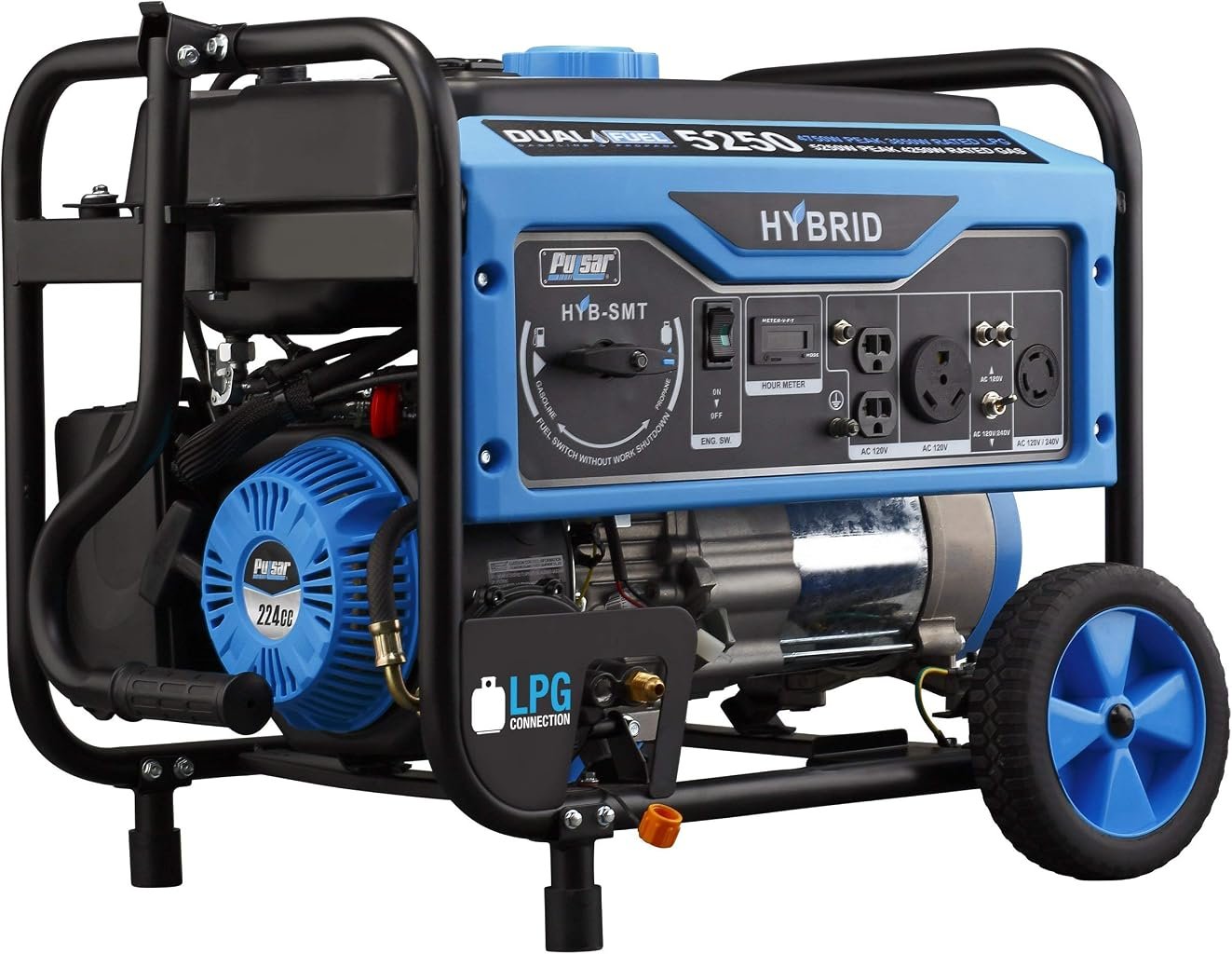
According to Pulsar’s current PG5250B specifications, the generator produces 5,250 peak watts and 4,250 running watts on gasoline. Propane reduces those figures to 4,750 peak watts and 3,850 running watts. A 224cc four-stroke OHV engine provides the mechanical power, while a four-gallon gasoline tank supports up to 12 hours of operation at 50% load under Pulsar’s current published specification.
That combination immediately distinguishes the PG5250B from lightweight inverter generators. This is not an inverter model. It weighs 107 pounds, produces a published 72 dB, uses recoil starting and rides on a mobility kit with never-flat wheels and a folding handle. In exchange, it provides both 120V and 240V output, an RV receptacle and dual-fuel operation.
Our score is 8.43/10. Customer Sentiment stands at 8.28, Buyer Confidence reaches 9.19 and Value is 8.15. At the approximately $549 review price, those ratings describe a generator whose appeal lies in functional breadth rather than refinement. Buyer Confidence leads because the PG5250B has a clearly documented electrical architecture and a well-defined use case. Value is lower because the design carries familiar conventional-generator compromises: weight, noise, recoil starting and the absence of inverter circuitry.
The central question is therefore not whether 5,250 watts sounds substantial. It is whether the generator’s actual sustained output, fuel options, connections and physical demands match the intended job.
The 5,250-Watt Figure Needs Translation
Pulsar rates the PG5250B at 5,250 peak watts and 4,250 running watts when operating on gasoline. On propane, capacity falls to 4,750 peak watts and 3,850 running watts.
Those four numbers are more informative than the product name alone.
Peak wattage represents temporary capacity available for short startup demands. Running wattage defines sustained rated output. Refrigerators, pumps, air conditioners and many power tools contain motors or compressors that can draw substantially more electricity during startup than during ordinary operation.
A buyer planning around gasoline should therefore treat 4,250 watts as the sustained electrical budget. A buyer planning around propane should use 3,850 watts.
The difference between fuels is meaningful.
Propane operation gives up 400 running watts compared with gasoline, a reduction of roughly 9.4%. That does not make propane ineffective. It means load planning needs to reflect the fuel actually being used.
This distinction belongs near the beginning of any useful portable generator buying guide. A generator is not a bucket containing an abstract quantity of watts. It is a power source with continuous limits, temporary limits, voltage requirements and loads that behave differently during startup.
The PG5250B offers substantial capacity for its class, but those limits still matter.
Dual Fuel Changes the Emergency-Power Equation
The PG5250B can operate on gasoline or propane, and Pulsar includes a propane hose with the generator.
Dual-fuel capability is more than a convenience feature during a long outage.
Gasoline has high energy density and is familiar to almost every small-engine owner. It also requires appropriate storage and fuel management. Propane offers a second energy source and avoids relying exclusively on the contents of the generator’s gasoline tank.
That redundancy can matter after storms, when local fuel availability may become unpredictable.
The PG5250B goes a step further through Pulsar’s Switch & Go system. Pulsar states that the system permits transition between LPG and gasoline while the generator is operating.
That feature addresses a practical nuisance of dual-fuel ownership. A conventional changeover procedure can require shutting down equipment, stopping the generator, changing the fuel supply and restarting. Switch & Go reduces that interruption.
The system does not change the output difference between fuels. A load that fits comfortably under gasoline’s 4,250-watt running rating may leave less margin under propane’s 3,850-watt rating.
Fuel switching therefore deserves the same discipline as initial load planning.
The 224cc Engine Powers a Conventional Generator, Not an Inverter
Pulsar uses a 224cc four-stroke OHV engine in the PG5250B. The company lists the engine at 8 horsepower and specifies recoil starting.
The generator’s architecture matters because the word “portable” covers several very different machine types.
The PG5250B does not contain a built-in inverter. Pulsar explicitly lists “Built-in Inverter: No.”
That distinction affects expectations around noise, engine behavior and sensitive electronics.
An inverter generator electronically conditions output and can commonly vary engine speed more aggressively according to demand. Conventional portable generators use a more traditional alternator arrangement and are often selected where raw utility, 120/240V capability and price-per-watt matter more than low acoustic output or compact dimensions.
An older PG5250B manual also warns about powering sensitive electronic equipment without an approved line conditioner.
That warning deserves attention from anyone expecting to run delicate electronics directly from the machine.
The PG5250B is better understood as a work-oriented dual-fuel generator than as a quiet electronics-first camping generator.
The 120/240V Architecture Broadens Its Use
One of the PG5250B’s more consequential advantages is voltage flexibility.
Pulsar specifies both 120V and 240V operation. The generator provides two 5-20R receptacles, one TT-30R RV receptacle and one L14-30R 120/240V twist-lock receptacle.
That outlet configuration significantly broadens the range of possible applications compared with a 120V-only inverter generator.
The ordinary receptacles support familiar household and jobsite equipment. The TT-30R connection addresses recreational vehicles. The L14-30R provides access to the generator’s 120/240V capability for suitable applications.
Pulsar specifies running current of 35.4 amps at 120V and 17.7 amps at 240V when using the gasoline running-watt rating.
Those figures follow directly from the generator’s 4,250-watt sustained output.
Voltage flexibility does not create additional wattage. Four thousand two hundred fifty watts remain 4,250 watts regardless of how the available output is distributed.
The benefit is compatibility.
A buyer who needs some 240V capability has options here that a 120V-only generator cannot provide natively. That makes the PG5250B more relevant for certain home-backup and jobsite applications.
The Four-Gallon Tank Favors Longer Gasoline Operation
Pulsar equips the generator with a four-gallon steel gasoline tank and currently publishes up to 12 hours of operation at half load.
At 50% of the 4,250-watt gasoline running rating, that corresponds to an electrical load of approximately 2,125 watts.
The load condition matters.
Twelve hours should not be interpreted as a universal runtime regardless of demand. A generator operating near its rated capacity will place greater demand on the engine than one carrying roughly half that load.
The four-gallon tank also illustrates the PG5250B’s priorities.
This machine is not chasing minimal dimensions or very low weight. A larger fuel reserve adds mass but reduces the frequency of gasoline refueling during sustained operation.
That can be particularly useful during overnight outages or extended jobsite use.
Refueling still requires care. The U.S. Consumer Product Safety Commission advises shutting a generator down and allowing it to cool before adding fuel. The same agency estimates that about 750 people died from generator-associated carbon-monoxide poisoning between 2012 and 2022.
Fuel capacity improves endurance. It does not reduce the need for safe operation.
Propane Creates a Different Runtime Calculation
Gasoline runtime is easy to discuss because the PG5250B carries its own four-gallon tank. Propane runtime depends on the external cylinder and the load placed on the generator.
That makes propane planning more variable.
The owner must consider cylinder size, ambient conditions and electrical demand rather than expecting the gasoline runtime specification to transfer directly across fuels.
Propane’s main attraction here is redundancy and storage flexibility, not identical performance.
The lower 3,850-watt running rating should be built into any propane-based emergency plan. Loads that approach 4,250 watts on gasoline cannot simply be carried over unchanged.
That difference becomes especially relevant when motor-starting loads are involved.
The generator’s 4,750-watt propane peak rating provides temporary headroom, but that is still 500 watts below the gasoline peak figure.
Dual fuel therefore expands options without making both fuels interchangeable in every electrical respect.
Switch & Go Is a Practical Feature With a Specific Purpose
Marketing names can sometimes obscure relatively simple engineering functions. Switch & Go is easier to understand.
Pulsar says the PG5250B can move between gasoline and propane while the generator remains running.
The practical benefit is continuity.
If the gasoline supply is becoming depleted, propane can become the next fuel source without requiring the same shutdown sequence associated with many generators. The reverse transition is also available.
That can be useful during an outage when refrigeration, pumps or other selected loads are being maintained.
The feature should not encourage careless fuel handling. Propane connections still need to be secure, fuel-selector procedures still need to be followed, and the generator still belongs outdoors.
Switch & Go makes the machine more flexible. It does not remove the operating rules surrounding either fuel.
One Hundred Seven Pounds Changes the Meaning of Portable
Pulsar lists the PG5250B at 107 pounds and 23.2 by 17.7 by 16.7 inches. A mobility kit is standard, with a folding handle and never-flat wheels.
That wheel kit is central to the generator’s claim to portability.
A 107-pound machine is movable, but it is not a casual one-handed carry. Loading it into a truck, raising it onto a platform or moving it across stairs can require considerably more effort than rolling it across a flat surface.
Fuel adds further mass.
A four-gallon tank filled with gasoline makes the operating package heavier than the dry specification suggests.
The PG5250B therefore fits the older, more literal definition of a portable generator: a machine that can be transported to where electricity is required, not necessarily one that is easy for a single person to lift repeatedly.
For jobsite and household use, that may be entirely acceptable.
For camping where the generator must frequently be lifted into an SUV or storage compartment, weight deserves much more scrutiny.
Seventy-Two Decibels Separates It From Quiet Inverter Models
Pulsar publishes a sound level of 72 dB for the PG5250B.
That number is consistent with the machine’s conventional-generator identity.
It should not be confused with the lower published sound figures associated with many enclosed inverter generators.
Noise matters differently according to application.
On a jobsite, a 72-dB generator may compete with tools and machinery already producing substantial sound. During an outage, neighbors and sleeping occupants may experience the same machine very differently. At a campsite, operating-hour and noise restrictions may affect whether the generator is appropriate at all.
Distance and surroundings alter perceived sound, so one published number cannot describe every listening condition.
What the figure does provide is a warning against assuming that dual fuel and portable automatically mean quiet.
The PG5250B is designed around utility first.
The Digital Meter Improves Operational Awareness
Pulsar equips the generator with a three-in-one digital meter. Its specification sheet also identifies a voltage meter, fuel gauge and hour meter.
Those instruments address different ownership needs.
Voltage information helps the operator monitor output. A fuel gauge provides a quick indication of the gasoline supply. The hour meter helps track engine use for maintenance planning.
Hours matter because small-engine service schedules are tied to operation.
A generator used during several multi-day outages can accumulate engine time quickly even if it spends most of the year stored.
Maintenance records are easier to manage when actual operating hours are visible rather than estimated.
The PG5250B also includes automatic low-oil shutdown and an automatic voltage regulator.
These systems reduce certain mechanical and electrical risks, though neither eliminates the need for maintenance or responsible load management.
The Absence of Automatic CO Shutdown Deserves Attention
One specification separates the PG5250B from many newer portable generators: Pulsar currently lists automatic carbon-monoxide shutdown as absent.
That makes correct placement especially significant.
The CPSC carbon-monoxide information center says one portable generator can produce as much carbon monoxide as hundreds of cars. More than 100 U.S. deaths each year are linked to portable generators.
CPSC says generators should be operated outdoors only, at least 20 feet from homes, with exhaust facing away.
An open garage does not satisfy that requirement. Neither does a basement, shed, crawlspace, porch or carport.
A CO sensor inside a home is also not permission to place the generator closer.
The PG5250B’s lack of automatic CO shutdown does not make safe use impossible. It places even greater responsibility on correct setup, working household CO alarms and disciplined adherence to outdoor-placement guidance.
Carbon Monoxide Risk Is Measured in Lives, Not Convenience
Generator safety can seem disconnected from product evaluation until the mortality figures are considered.
CPSC says portable generators are among the leading causes of post-storm carbon-monoxide deaths. Its May 2026 hurricane-season guidance warns that CO is colorless and odorless and can kill within minutes.
That hazard explains why the recommended 20-foot separation should be planned before an outage rather than improvised afterward.
The problem is behavioral as much as mechanical.
Bad weather encourages owners to move generators toward buildings. Long extension-cord runs are inconvenient. Noise can tempt users to place the machine where walls suppress sound. Theft concerns can encourage hidden or enclosed locations.
Each of those pressures can push a generator toward the very spaces where exhaust becomes dangerous.
The safe answer remains outside, well away from occupied structures, with exhaust directed away from openings.
For a 107-pound generator, planning that location matters because moving the machine after setup is less trivial than repositioning a 40-pound inverter model.
Home Backup Is One of the PG5250B’s Stronger Applications
The PG5250B’s combination of 4,250 gasoline running watts, 120/240V output and an L14-30R receptacle makes household backup a logical application.
The generator still requires load discipline.
Refrigerators, freezers, lights, communications equipment, furnace blowers and selected pumps may fit within an intelligently planned system, depending on their actual ratings and startup requirements.
Large resistance-heating appliances can consume the available capacity rapidly.
Electric water heaters, ranges, clothes dryers and space heaters should be evaluated carefully rather than treated as ordinary small loads.
The same applies to large air-conditioning equipment.
A generator with 4,250 running watts can keep meaningful household functions operating. It cannot reproduce the capacity of normal residential utility service.
The 240V capability broadens what can potentially be connected, but voltage compatibility should never be confused with sufficient wattage.
A Transfer Arrangement Matters for Household Circuits
The L14-30R outlet makes the PG5250B relevant to properly configured household backup systems, but the connection between a portable generator and residential wiring requires suitable equipment.
CPSC staff guidance on properly interfacing a portable generator with installed household wiring explains that a suitable transfer arrangement is needed to safely isolate generator and utility power when household wiring distributes backup electricity.
Improvised backfeeding is not an acceptable substitute.
In March 2026, CPSC again warned that male-to-male extension cords are sometimes used for generator backfeeding and can create electrocution and fire hazards.
A household planning to use the PG5250B through installed circuits should therefore include appropriate transfer equipment and qualified electrical installation in the budget.
The generator’s purchase price is only one part of a safe residential backup system.
Maintenance Is Simple Enough to Plan but Easy to Neglect
Pulsar specifies 10W-30 oil and a 20-ounce oil capacity on its current PG5250B product page. The generator includes automatic low-oil shutdown and carries a three-year limited warranty.
Those specifications make routine planning relatively straightforward.
The more difficult issue is inactivity.
Emergency generators can remain unused for long periods. Gasoline storage, carburetor condition, oil level, hoses, connections and starting behavior may receive little attention until an outage suddenly makes the machine necessary.
Periodic inspection and operation reduce that uncertainty.
Dual fuel provides another useful option because propane operation can reduce dependence on gasoline stored in the generator’s tank. It does not eliminate engine maintenance.
The hour meter is useful precisely because maintenance should follow actual use rather than vague recollection.
A generator that cannot start during an outage has an effective output of zero watts, regardless of what the specification sheet promises.
Understanding Our 8.43/10 Score
Our score of 8.43/10 reflects a capable conventional generator with unusually broad fuel and voltage flexibility for its output class.
Customer Sentiment is 8.28.
That rating recognizes a machine with practical strengths but obvious compromises. Dual fuel, 120/240V output, a four-gallon tank, RV connectivity and a mobility kit are useful. A 107-pound chassis, 72-dB published noise level, recoil starting and conventional rather than inverter architecture narrow the audience.
Buyer Confidence reaches 9.19, the highest of our four ratings.
The reason is documentation and clarity. Pulsar publishes distinct gasoline and propane outputs, engine displacement, runtime conditions, tank capacity, outlet types, voltage, weight, dimensions, oil requirements, noise, safety equipment and warranty coverage. The product’s capabilities and boundaries can therefore be identified before purchase.
Value stands at 8.15 at the approximately $549 review price.
That score is positive but more restrained because value depends heavily on whether dual fuel and 240V output are genuinely needed. A buyer seeking only light camping power may be better served by a smaller inverter generator. Someone requiring much higher sustained residential output will need a larger machine.
The PG5250B earns its value when its breadth is actually useful.
Who Is Most Likely to Appreciate the PG5250B?
The generator’s strongest buyer profiles follow directly from its engineering:
- Households seeking selective emergency backup with both 120V and 240V capability.
- RV owners who can make use of the TT-30R connection.
- Users who value gasoline and propane redundancy.
- Jobsites where conventional-generator noise is less problematic than at a campground.
- Buyers who need roughly 4,000 watts of sustained output rather than lightweight charging power.
- Owners who prefer a four-gallon gasoline tank for longer operating intervals.
- Users who can roll a 107-pound machine rather than repeatedly lifting it.
- Buyers who value fuel switching more than inverter architecture.
Poor matches are equally apparent.
The PG5250B is less attractive for buyers prioritizing very low noise, lightweight portability, electric starting, built-in USB charging, automatic CO shutdown or inverter-conditioned output.
Those are not minor distinctions. They define the machine.
The Drawbacks Reveal the Generator’s Age and Philosophy
The PG5250B is a conventional open-frame generator in a market where newer designs increasingly add electronic starting, enclosed acoustic housings, inverter circuitry and automatic CO shutdown.
Its 72-dB published sound level reflects that older utility-first philosophy.
So does recoil starting.
The absence of an inverter makes the machine less attractive for buyers focused primarily on sensitive electronics. The absence of automatic CO shutdown puts greater emphasis on correct placement and household CO alarms.
At 107 pounds, mobility depends on wheels and the folding handle.
Propane output is lower than gasoline output, reducing available headroom when the alternate fuel is used.
There are no built-in USB-A, USB-C or 12V automotive outputs listed on Pulsar’s current specification sheet.
Yet the same design choices produce advantages.
The PG5250B supplies 120/240V electricity, includes a 30A RV outlet and L14-30R connection, carries four gallons of gasoline and can switch between gasoline and propane. It is mechanically understandable and aimed at tasks where utility matters more than elegance.
That trade is coherent, even when newer machines offer more refinement.
Final Considerations
The Pulsar PG5250B 5250W Dual Fuel Portable Generator is best understood not as a 5,250-watt machine, but as two related power sources sharing one engine and alternator.
On gasoline, it provides 5,250 peak watts and 4,250 running watts. On propane, output falls to 4,750 peak watts and 3,850 running watts. Pulsar combines those ratings with a 224cc four-stroke OHV engine, four-gallon gasoline tank, 120/240V output, TT-30R RV receptacle, L14-30R twist-lock connection, Switch & Go fuel selection, digital instrumentation and a wheel-and-handle mobility system.
Our score is 8.43/10.
Customer Sentiment at 8.28 reflects a useful but deliberately utilitarian machine. Buyer Confidence at 9.19 recognizes unusually specific first-party documentation and an easily understood operating envelope. Value at 8.15 reflects the approximately $549 review price while acknowledging that weight, noise, recoil starting and conventional generator architecture reduce its appeal for some buyers.
The PG5250B makes the most sense when fuel redundancy and electrical flexibility matter more than low weight and quiet operation.
Its 120/240V capability gives it more household-backup range than many 120V-only recreational generators. Its TT-30R outlet gives RV owners a direct connection. Its four-gallon tank supports extended gasoline operation, while propane provides a second fuel path when circumstances change.
The costs are equally visible.
At 107 pounds, this is a rolling generator rather than an easily carried one. At a published 72 dB, it is not designed around acoustic discretion. Recoil starting demands physical input. There is no built-in inverter and no automatic CO shutdown listed by Pulsar.
Safety therefore deserves deliberate planning.
Current CPSC guidance says portable generators should operate outdoors only, at least 20 feet from homes and buildings, with exhaust directed away from windows, doors and vents. The agency also recommends looking for generators equipped with automatic CO shutoff, a feature the PG5250B does not list.
For household-circuit backup, proper transfer equipment is equally significant. The generator’s 240V capability and L14-30R outlet make such use possible in an appropriately designed system, but they do not make improvised backfeeding safe.
The final buying calculation should therefore begin with sustained demand rather than peak output. Buyers should calculate which loads must run together, include motor-starting requirements, determine whether gasoline’s 4,250 running watts or propane’s 3,850 running watts will govern the plan, and verify voltage requirements.
Once that arithmetic is complete, the PG5250B becomes easier to judge.
For users needing dual fuel, 120/240V output, an RV connection and around four kilowatts of sustained portable power, its design has a practical logic. For users prioritizing silence, low weight or electronics-focused inverter output, another generator architecture will fit more naturally.
The PG5250B’s central virtue is not sophistication. It is flexibility: two fuels, two voltage classes and enough sustained output to keep a carefully selected group of meaningful loads working when ordinary electricity is unavailable.