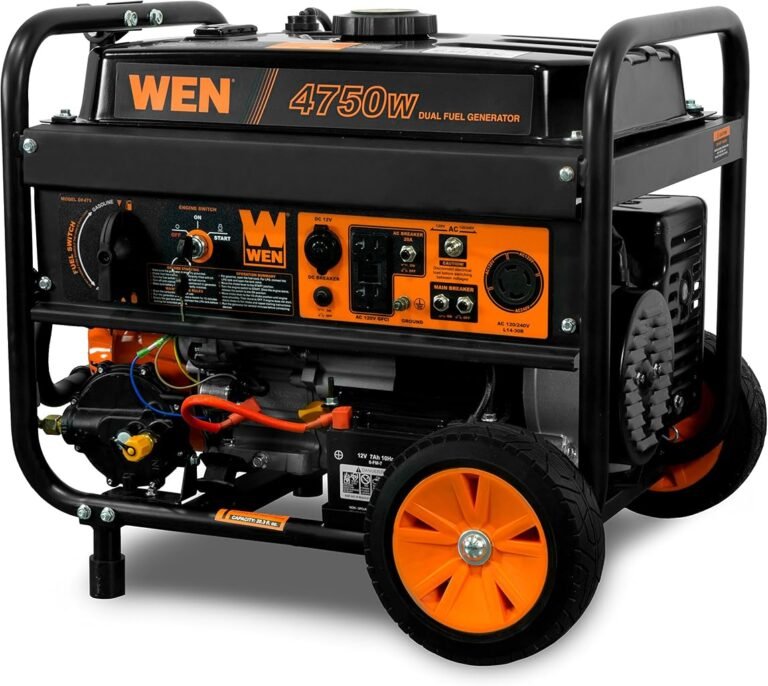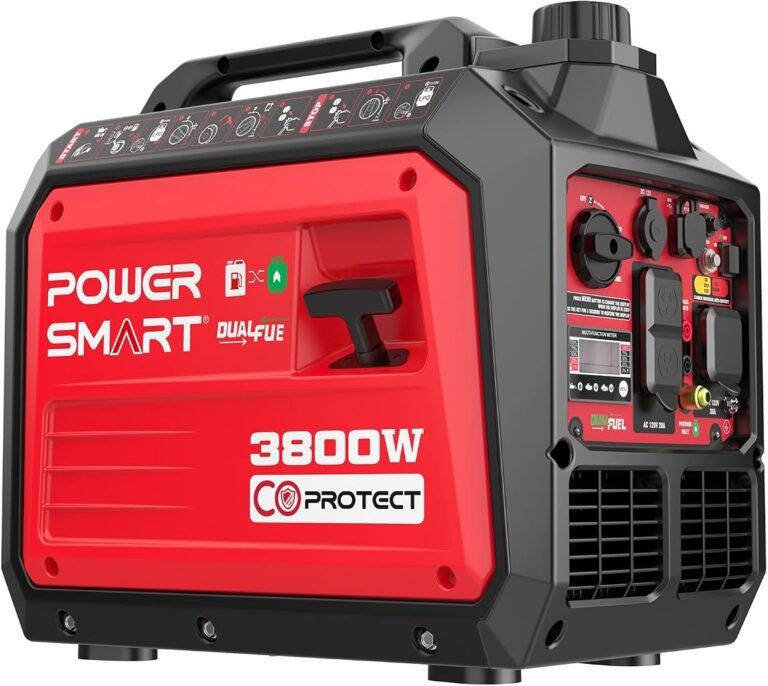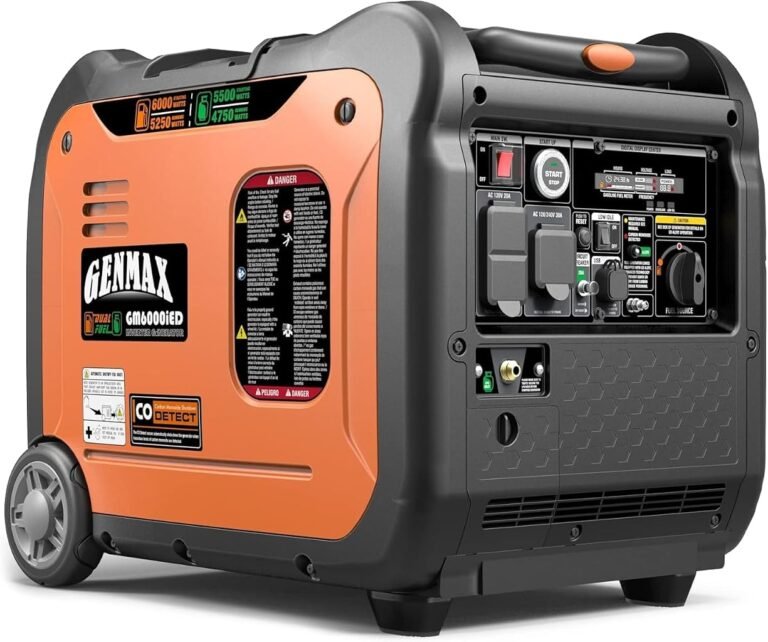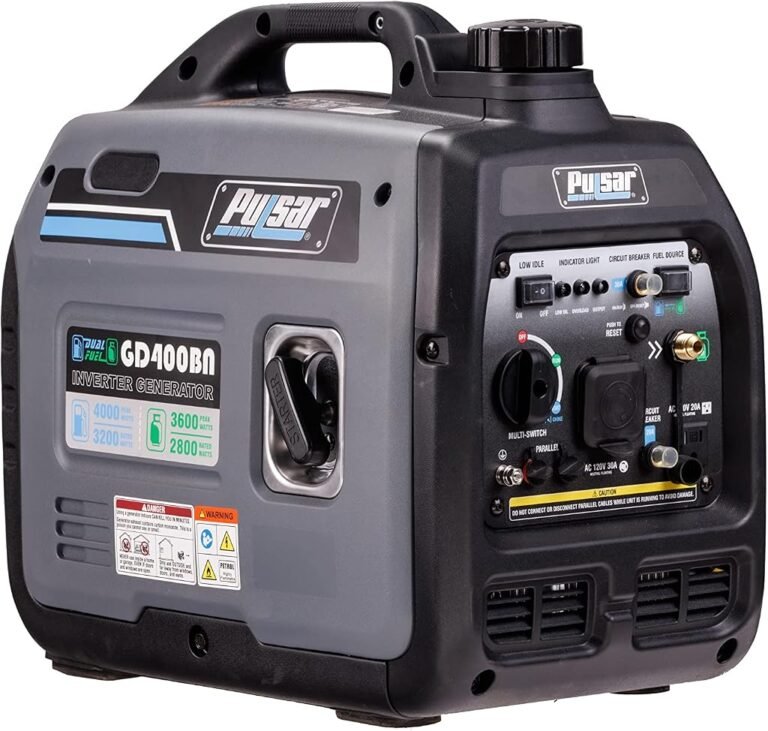
A 13,000-watt portable generator is not merely a larger version of the compact machines used to charge phones and keep a refrigerator cold at a campsite. At this output level, the equipment moves into a different category: substantial home-backup power, 120/240-volt capability, high-amperage connections, large fuel requirements, considerable weight, and electrical installation questions that deserve as much attention as the engine itself.
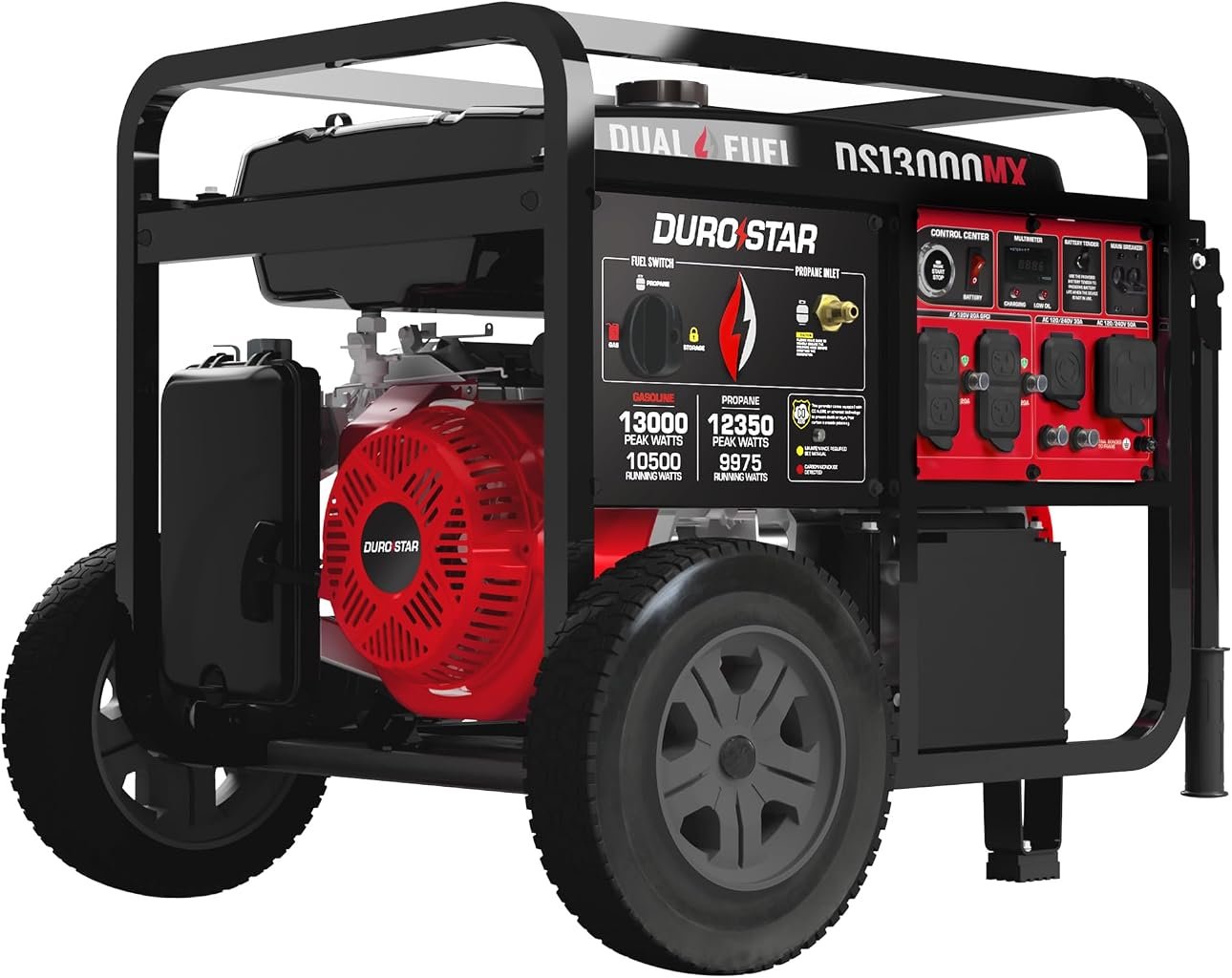
The DuroStar DS13000MX sits squarely in that category. It pairs a 500cc four-stroke engine with gasoline and propane operation, 120/240V output, remote and push-button starting, a 50-amp receptacle, carbon-monoxide shutdown, an 8.3-gallon gasoline tank, and a 209-pound dry weight. DuroStar currently lists the generator at $899.
Our score is 8.44/10. Customer Sentiment is 8.28, Buyer Confidence reaches 9.25, and Value is 8.15. The differences between those figures are revealing. Confidence is high because the DS13000MX has a clearly defined purpose and a substantial, documented hardware package. Value is more restrained because ownership involves more than buying watts: this is a heavy, loud, fuel-consuming conventional generator that requires deliberate installation and operation.
The result is a capable home-backup machine for buyers whose needs match its architecture, rather than a universal answer to residential power outages.
13,000 Watts Needs Context
The headline figure is 13,000 peak watts on gasoline. Continuous output is lower.
According to DuroStar’s DS13000MX specifications, gasoline operation provides 13,000 peak watts and 10,500 running watts. At 120 volts, DuroStar specifies 87.5 running amps; at 240 volts, the figure is 43.75 amps.
Those running figures matter far more than the largest number printed on the machine.
Peak capacity exists partly to accommodate short surges from equipment such as pumps, compressors, refrigerators, freezers, and air-conditioning systems. A generator that can briefly supply 13,000 watts should not be treated as a machine intended to sustain a 13,000-watt load indefinitely.
At 10,500 running watts on gasoline, however, the DS13000MX still provides substantial usable capacity. It can support a considerably broader collection of household loads than a 3,000- or 4,000-watt recreational generator, provided the individual circuits and startup requirements are calculated correctly.
DuroStar markets the model for whole-home backup and specifically mentions air conditioning among possible loads. That description requires sensible interpretation. “Whole home” does not mean every electrical appliance in every house can operate simultaneously without calculation. A large electric range, central air conditioner, electric water heater, well pump, clothes dryer, and numerous smaller loads can collectively exceed portable-generator capacity.
Household backup is therefore a load-management exercise even with 10,500 running watts available.
Dual Fuel Is More Than a Convenience Feature
Fuel flexibility is one of the DS13000MX’s stronger attributes.
The machine operates on gasoline or propane. This gives an owner two different fuel-storage and availability strategies during an extended outage. Gasoline provides the highest output, while propane sacrifices some electrical capacity in exchange for another fuel option.
DuroStar currently specifies propane output at 12,500 peak watts and 10,000 running watts. The manufacturer lists 83.13 running amps at 120V and 41.56 amps at 240V. Its suggested propane cylinder size is at least 40 pounds.
That reduction is modest but real. A load plan sitting comfortably below the generator’s capacity on gasoline may have less reserve when the generator is switched to propane.
The distinction is especially relevant with motor starting. Backup-power planning should therefore use the specifications for the fuel that will actually be burned, not the most favorable number from either fuel mode.
Fuel flexibility also has practical value during emergencies. A widespread outage can disrupt filling stations or create gasoline demand. Stored propane offers another option. Conversely, gasoline may be easier to replenish in other circumstances and delivers the machine’s maximum rated output.
Dual fuel does not eliminate fuel planning. It gives the owner two ways to solve it.
Runtime Shows the Cost of High Output
Large generators can produce large amounts of electricity because they consume meaningful quantities of fuel.
The DS13000MX carries an 8.3-gallon gasoline tank. DuroStar specifies 17 hours of runtime at 25% load and 8.5 hours at 50% load on gasoline. On propane, the published figures are 13 hours at 25% load and 6.5 hours at 50% load.
Those figures are useful because they expose a frequently overlooked part of generator ownership.
Half of the 10,500-watt gasoline running rating is 5,250 watts. If the machine is operated around that load, DuroStar’s 8.5-hour specification implies that a full gasoline tank is roughly an overnight interval rather than several days of autonomous operation.
A prolonged outage can therefore turn fuel logistics into a major part of household planning.
Load management helps. There is little reason to run unnecessary appliances merely because generator capacity exists. Refrigeration, pumps, selected lighting, communications equipment, heating-system controls, and other priority loads can be scheduled intelligently rather than operated indiscriminately.
The DS13000MX has enough capacity to encourage electrical abundance. Efficient ownership requires resisting that temptation when fuel availability matters.
The 500cc Engine Defines the Character
The engine is a 500cc, forced-air-cooled, four-stroke OHV design operating at 3,600 rpm. DuroStar specifies automatic low-oil shutdown, a cast-iron sleeve, splash oil cooling, and a 40.5-fluid-ounce oil capacity. The manufacturer recommends 10W-30 oil and lists conventional, blended, and synthetic types as acceptable.
These are the specifications of a substantial conventional portable generator, not an enclosed lightweight inverter.
That distinction affects almost every aspect of ownership.
The DS13000MX produces considerable power, but it also weighs 209 pounds dry. Its dimensions are 29.75 inches long, 27.5 inches wide, and 25.75 inches high. DuroStar includes a wheel-and-handle kit with 10-inch wheels, which makes movement across suitable surfaces considerably more realistic than the weight alone might suggest.
Yet “portable” is relative.
Two hundred and nine pounds is not luggage. Loading the generator into a pickup or trailer, moving it over steps, or negotiating soft ground can require planning and assistance. Buyers who expect to transport a generator frequently should treat weight as a primary specification rather than a minor inconvenience.
For stationary emergency use around a property, that weight is easier to accept. For repeated recreational transport, it becomes harder to ignore.
Noise Is Part of the Trade-Off
DuroStar specifies 74 dB at 50% load.
That figure should not be compared casually with noise specifications measured at different distances, loads, or under different procedures. Decibel ratings become meaningful only when measurement conditions are comparable.
Still, the broader point is straightforward: the DS13000MX is not built around the acoustic priorities of a small enclosed inverter generator.
A 500cc engine turning at 3,600 rpm while producing several kilowatts of electrical power will make itself known. For emergency home backup, that may be an acceptable compromise. At a quiet campsite or anywhere generators sit near neighboring properties, noise deserves considerably more weight in the buying decision.
Location matters for another reason: moving a generator farther from living areas cannot be approached solely as a noise-reduction tactic. Extension conductors, voltage drop, electrical protection, weather exposure, and carbon-monoxide safety all affect proper placement.
The Power Panel Is Built for Serious Loads
The electrical panel explains why the DS13000MX is substantially more useful for residential backup than many smaller portable generators.
DuroStar specifies two 5-20R receptacles, one L14-30R receptacle, and one 14-50R receptacle. The machine supplies 120/240V at 60Hz and includes GFCI outlets, a digital voltmeter, an hour meter, and automatic voltage regulation. The 50-amp connection is described by the manufacturer as transfer-switch ready.
That 120/240V capability is a major distinction.
Some smaller generators provide only 120V power, which limits their suitability for household systems containing 240V loads. The DS13000MX is designed with more substantial home-backup use in mind.
But a 50-amp outlet is not permission to improvise a connection to household wiring.
The Electrical Safety Foundation International’s portable-generator guidance warns against connecting a generator directly to household wiring without a transfer switch because backfeeding can expose utility workers to electrocution. ESFI recommends installation by a qualified electrician.
The U.S. Consumer Product Safety Commission is similarly explicit, warning consumers never to power house wiring by plugging a generator into a wall outlet.
The DS13000MX’s transfer-switch-ready hardware should therefore be viewed as an advantage precisely because it supports a proper installation-not because it makes electrical shortcuts acceptable.
Starting a 500cc Generator Should Not Be an Athletic Event
DuroStar equips the DS13000MX with push-button and remote-control starting, backed by recoil starting. A 12V sealed lead-acid battery is included.
This is a sensible combination for equipment of this size.
Electric starting reduces the effort required to bring a 500cc engine online, while recoil backup provides another starting method if battery circumstances demand it. Remote starting adds convenience when the installation and operating situation permit its appropriate use.
The battery introduces another maintenance item, however. A generator that spends months waiting for an outage still needs to be ready when that outage occurs. Fuel condition, oil level, battery condition, air filtration, spark-plug condition, and periodic inspection cannot be postponed indefinitely simply because the machine is not accumulating operating hours.
DuroStar provides a three-year warranty and lists nationwide service centers. Its generator manual library includes the DS13000MX manual, giving owners a first-party reference for setup, operation, service intervals, and troubleshooting.
Carbon Monoxide Is the Non-Negotiable Issue
The DS13000MX includes a CO sensor shutdown system. That is an appropriate safety feature, but it should never be interpreted as making unsafe placement acceptable.
Carbon monoxide cannot be seen or smelled. The danger from portable generators is severe enough that placement instructions deserve more attention than convenience.
The U.S. Consumer Product Safety Commission’s carbon-monoxide guidance states that a single portable generator can produce the same amount of carbon monoxide as hundreds of cars. The agency says generators should be operated outdoors only, at least 20 feet from homes, with exhaust directed away from the structure.
The mortality figures put that warning into perspective. CPSC estimates that about 750 people died from generator-associated carbon-monoxide poisoning between 2012 and 2022, according to its generator and winter-heating safety guidance.
A garage with its door open is not an acceptable generator location. Neither is a basement, crawlspace, shed, porch, or carport. CPSC states that opening doors or windows does not provide enough ventilation to prevent dangerous CO accumulation in enclosed spaces.
For a DS13000MX installation, the basic safety plan should include:
- operation outdoors, at least 20 feet from the home or other occupied building;
- exhaust directed away from buildings, doors, windows, and vents;
- working CO alarms inside the home;
- protection from unsafe wet-weather operation according to manufacturer guidance;
- cooling the engine before adding gasoline;
- safe fuel storage away from living spaces;
- professional electrical integration when household wiring is involved.
CO Alert is secondary protection. Safe placement is the primary control.
What the Editorial Scores Mean
Our overall score of 8.44/10 reflects a generator with substantial capability and identifiable compromises.
Buyer Confidence is the highest component at 9.25. That rating reflects a clearly specified machine with a defined home-backup purpose, a 500cc engine, dual-fuel operation, multiple starting methods, 120/240V output, a 50A receptacle, CO shutdown, published runtime data, a three-year warranty, and manufacturer documentation.
Customer Sentiment is 8.28. That score reflects the product’s broad utility while accounting for the realities attached to a generator of this scale. High output expands what can be powered, but 209 pounds and 74 dB at half load make this a different ownership experience from a compact inverter.
Value is 8.15, the lowest of the three supporting ratings. At $899, the DS13000MX provides substantial rated output and dual-fuel capability, but value cannot be measured as dollars per peak watt alone. A proper transfer arrangement can add installation expense. Fuel consumption matters during long outages. Maintenance remains necessary. The machine is also not compliant for sale in California according to DuroStar’s current specification page.
The score spread therefore makes sense: there is considerable confidence in what the DS13000MX is and what it can do, while the economics of owning and operating a large conventional generator are less simple.
Who the DS13000MX Fits
The strongest case for this generator is residential emergency backup where substantial 120/240V capacity is required but a permanently installed standby generator is not the chosen approach.
Its 10,500 gasoline running watts give a homeowner meaningful room to manage refrigeration, lighting, pumps, heating controls, selected kitchen loads, communications equipment, and potentially air-conditioning equipment, depending on actual startup and running requirements.
Dual fuel also makes sense for households that want more than one stored-energy option.
The DS13000MX is less compelling for buyers whose priority is minimal noise, low weight, highly portable recreational use, or inverter-style power architecture. A 209-pound open-frame generator is fundamentally oriented toward output and utility rather than discreet portability.
Nor should buyers automatically assume that 13,000 peak watts are necessary. Oversizing can mean purchasing, moving, maintaining, and fueling more engine than the household actually needs.
A Portable Generator Buying Guide for This Power Class
A disciplined portable generator buying guide starts with an electrical inventory rather than a wattage target.
Every appliance that must operate during an outage should be listed with its running requirement and, where applicable, starting demand. Loads should then be divided into essential, optional, and unnecessary categories.
For a generator in the DS13000MX class, buyers should examine:
- Running watts: 10,500 watts on gasoline is the primary sustained-output figure.
- Peak watts: 13,000 watts provides short-duration surge capacity rather than permanent output.
- Fuel-specific ratings: propane produces less rated power than gasoline.
- Voltage: 120/240V capability matters for many household applications.
- Connection hardware: the L14-30R and 14-50R outlets broaden installation possibilities.
- Transfer equipment: household integration requires a safe method that prevents backfeeding.
- Runtime: high electrical output creates significant fuel demand.
- Weight: 209 pounds affects storage, loading, and movement.
- Noise: 74 dB at 50% load is not inverter-generator quietness.
- Starting system: remote and electric starting improve usability, while recoil provides backup.
- Safety: CO shutdown is useful but does not change outdoor-placement requirements.
- Maintenance: batteries, gasoline, oil, filters, plugs, and periodic operation all require attention.
- Emissions eligibility: DuroStar currently states that the model is not for sale in California.
This approach prevents a common purchasing error: choosing a generator from the biggest wattage number and working backward.
The better method is to establish the load, connection method, fuel strategy, storage location, operating location, and transportation requirements first. The generator should then fit that plan.
The Real Cost Is Preparedness
A generator purchased for emergencies can spend hundreds of days doing nothing. Its success is determined on the relatively few days when the grid fails.
That creates an unusual ownership problem. Neglect may remain invisible until the exact moment reliability matters.
Gasoline storage requires care. The starting battery needs attention. Oil and filters need scheduled service. The generator should be periodically inspected according to the owner’s manual. Fuel and extension equipment need to be suitable for the intended load. A household transfer arrangement should be installed and understood before an outage, not improvised in darkness after the utility fails.
The same principle applies to load management. Owners should know in advance which circuits can operate simultaneously and which high-demand appliances need to be staggered.
Preparation turns 10,500 running watts into useful household capacity. Without preparation, 13,000 printed watts can create false confidence.
Final Considerations
The DuroStar DS13000MX earns an 8.44/10 overall score because its capabilities are substantial and its mission is clear. On gasoline it provides 13,000 peak watts and 10,500 running watts; propane provides slightly less output. A 500cc four-stroke engine, 120/240V capability, 50A connectivity, dual-fuel operation, an 8.3-gallon gasoline tank, electric and remote starting, CO shutdown, GFCI outlets, automatic voltage regulation, and an included wheel kit create a serious home-backup package.
The drawbacks are equally physical. At 209 pounds, this is portable equipment only in the broad sense. At a specified 74 dB under half load, silence is not part of the proposition. High output consumes meaningful fuel, and the generator requires the maintenance expected of a large carbureted gasoline engine.
The 9.25 Buyer Confidence score reflects a well-defined hardware proposition. Customer Sentiment at 8.28 and Value at 8.15 reflect the compromises that accompany that capability. The DS13000MX makes the strongest sense when a household genuinely needs high-output 120/240V backup, values gasoline/propane flexibility, and is prepared to install and operate the machine correctly.
The 13,000-watt number should therefore be the beginning of the buying decision rather than its end. The more revealing specifications are 10,500 running watts on gasoline, 120/240V output, 43.75 running amps at 240V, an 8.3-gallon tank, 209 pounds of dry weight, and the presence of a transfer-switch-ready 50A connection. Together, those figures describe what the machine actually is.
They also describe the responsibility attached to it. A generator capable of supplying a substantial portion of a home’s electrical demand deserves a planned electrical connection, disciplined fuel management, regular maintenance, and uncompromising carbon-monoxide precautions.
For the household prepared to provide those things, the DS13000MX offers substantial backup capability without requiring a permanently installed standby generator. For everyone else, the more useful question is not whether 13,000 watts sounds reassuring. It is how many watts the home genuinely needs, how those watts will safely reach the required circuits, and how the generator will be fueled and maintained when an outage lasts longer than expected.