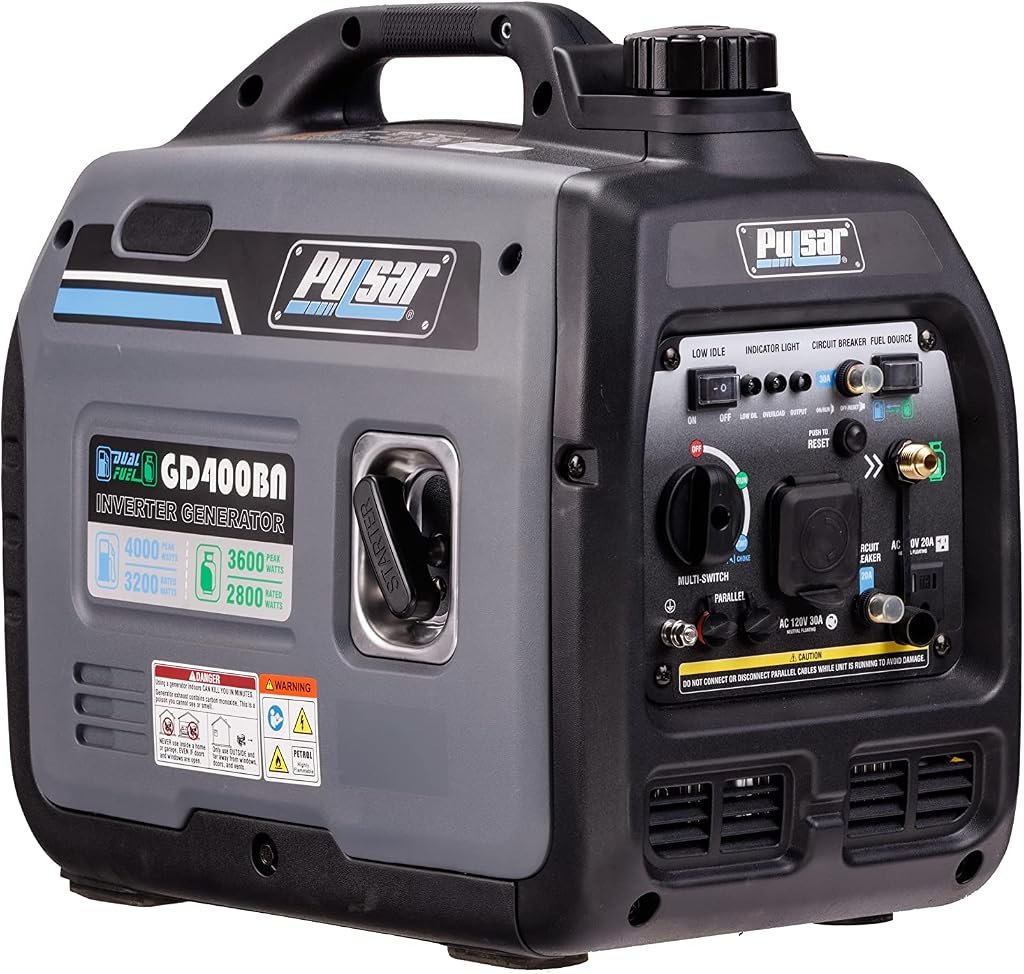
Portable generators are machines of compromise. More output usually means more engine, more fuel, more weight and more noise. Smaller units travel easily but can leave owners doing uncomfortable arithmetic when a refrigerator, air conditioner or other motor-driven appliance starts. The Pulsar Products GD400BN attempts to occupy the useful territory between those extremes: a compact dual-fuel inverter generator rated for 4,000 peak watts while weighing only 47 pounds.
That combination gives the GD400BN a distinct identity. This is not a whole-house generator disguised with a carrying handle, nor is it a minimalist power source intended merely for charging phones and running lights. It is a 120-volt portable inverter generator built around a 145cc four-stroke OHV engine, with gasoline and propane capability, parallel operation and enough output to address meaningful RV, camping and limited emergency-power loads.
Our score is 8.02/10, placing the GD400BN firmly in the very-good range. Customer Sentiment stands at 7.62, Buyer Confidence at 9.42, and Value at 7.79. Those numbers tell an unusually coherent story: the underlying design and specification package inspire considerably more confidence than the value proposition does at a $599 reference price.
There is also one safety omission that deserves far more attention than another hundred watts or an extra receptacle: the GD400BN’s current manufacturer specification lists no carbon-monoxide automatic shutdown system. For buyers comparing modern portable generators, that is a material limitation rather than a footnote.
What the GD400BN Actually Delivers
The headline number requires immediate translation. “4,000W” is peak output on gasoline, not the generator’s continuous rating. According to Pulsar Power Equipment’s GD400BN specifications, the machine produces 4,000 peak watts and 3,200 running watts on gasoline. On propane, Pulsar specifies 3,700 peak watts and 3,000 running watts.
That distinction matters.
Peak or starting capacity accommodates short surges, particularly when equipment containing a compressor or motor starts. Running wattage represents the more useful figure when planning sustained loads. A buyer should therefore treat this primarily as a 3,200-watt gasoline generator or 3,000-watt propane generator, with temporary surge capacity above those figures.
The engine is a 145cc, air-cooled, four-stroke OHV design with recoil starting. There is no starting battery to maintain. Pulsar specifies a one-gallon gasoline tank, 12-ounce oil capacity, 10W-30 recommended oil and up to 4.5 hours of operation at 50% load.
That relatively small fuel tank helps explain both the generator’s portability and one of its central compromises. Four and a half hours at half load is respectable for a compact machine, but extended outage duty on gasoline can involve repeated refueling. Buyers expecting overnight operation without intervention should factor runtime into their decision rather than focusing exclusively on wattage.
Propane changes that equation because runtime is no longer constrained by the onboard gasoline tank in the same way. It also brings the practical attraction of fuel diversification. During an outage, having two usable fuel types can matter more than a modest difference in maximum output.
Dual Fuel Is More Than a Convenience Feature
The GD400BN loses 200 running watts when moving from gasoline’s 3,200 watts to propane’s 3,000 watts, according to Pulsar. Peak capacity likewise falls from 4,000 to 3,700 watts.
That reduction is modest enough that propane remains genuinely useful rather than functioning as a secondary capability of questionable practicality.
For emergency planning, dual fuel creates options. Gasoline delivers the generator’s maximum rated output, while propane can simplify longer-term fuel storage and eliminate the need to keep gasoline sitting in the generator’s tank between uses. The GD400BN includes a propane hose, reducing the amount of additional equipment required to use its second fuel source.
There is still a capacity question. A generator should not be selected by adding only the printed running wattages of intended appliances. Motor-driven loads can demand substantially more power during startup. The sensible procedure is to identify the running requirements and starting requirements of the actual equipment that will be connected, then leave operating margin rather than planning around the generator’s absolute ceiling.
That arithmetic belongs in any responsible portable generator buying guide because a “4,000-watt generator” and a generator capable of continuously supplying 4,000 watts are not necessarily the same machine. The GD400BN illustrates the distinction perfectly.
Portability Is One of Its Stronger Arguments
At 47 pounds, the GD400BN is unusually manageable for a machine offering this level of output. Its published dimensions are approximately 19 by 11.4 by 17.3 inches, and Pulsar equips it with a carrying handle rather than a wheel kit.
That weight changes how the generator can realistically be used.
A machine approaching or exceeding 100 pounds might technically qualify as portable but practically become a garage-based appliance that moves only when necessary. At 47 pounds, the GD400BN can reasonably be transferred between storage, an RV, a campsite and an outdoor operating position by many adults without ramps or a dedicated wheeled frame.
The trade-off is equally straightforward: there are no wheels. Anyone who finds 47 pounds difficult to carry does not receive much mechanical assistance from the chassis.
For RV users, compact dimensions are particularly relevant because storage volume competes with water, tools, outdoor equipment and everything else carried on the road. The GD400BN also includes 120-volt 20-amp and 30-amp connections and is described by Pulsar as RV-ready. The manufacturer specifically states that it is suitable for air-conditioning units up to 13,500 BTU.
That air-conditioner statement should still be interpreted alongside the electrical specifications of the individual RV system. Air conditioners with different compressors, starting characteristics and other simultaneous loads can place very different demands on a generator.
Inverter Power Makes Sense at This Output Level
The “inverter” part of the name deserves attention because this machine will often share space with modern electronics.
Instead of positioning the GD400BN purely as a construction-site generator, Pulsar describes its inverter system as producing a stable sine wave suitable for most sensitive electronics. The practical appeal is easy to understand in an RV or outage setting where laptops, televisions, communications equipment and chargers can operate alongside conventional appliances.
Low-idle control is also included. The engine can reduce speed when electrical demand falls, rather than operating continuously as though maximum output were required. Pulsar associates this system with improved runtime.
The generator is parallel capable as well. Two compatible units can be connected for additional output, although that strategy naturally means buying, transporting, fueling and maintaining two engines. Parallel capability is therefore better viewed as expansion flexibility than as a substitute for selecting adequate capacity from the outset.
Noise: Quiet Needs Context
Generator manufacturers frequently use words such as “quiet” without providing enough context for meaningful comparison. Pulsar at least publishes figures.
Its current product information specifies 68 dB at full load and 50 dB in standby mode. Those are materially different operating conditions, so neither number should be treated as a universal noise level.
Load changes generator behavior. So do distance, surrounding structures, terrain and measurement methodology. A machine operating hard to support an RV air conditioner is not acoustically equivalent to the same machine idling under minimal demand.
The appropriate reading is therefore narrower: the GD400BN incorporates inverter architecture and low-idle control that allow engine behavior to respond to demand, but buyers concerned about campsite or residential noise should not interpret the lowest published figure as representative of heavy-load operation.
At full load, Pulsar’s own specification is 68 dB. That is the more revealing figure when judging what happens when much of the machine’s generating capacity is actually being used.
The Control Panel Is Functional Rather Than Elaborate
The GD400BN’s approach to controls is noticeably utilitarian. It includes a standard 120V 20-amp receptacle and a 120V 30-amp connection, along with circuit protection, an overload indicator and low-oil shutdown. Outlet covers are included.
What buyers do not get is equally informative.
Pulsar lists no fuel gauge, voltage meter or hour meter. There are also no USB-A or USB-C ports in the current manufacturer’s specification.
None of those omissions prevents the generator from performing its primary function, but they affect everyday usability. An hour meter is useful for maintenance scheduling. A fuel gauge reduces guesswork. Integrated USB ports can eliminate adapters when charging small electronics.
Their absence reflects the GD400BN’s design priorities: engine, inverter, dual-fuel operation, usable AC output and low weight take precedence over instrumentation.
That approach can appeal to owners who prefer fewer peripheral systems, but a $599 generator faces legitimate scrutiny when less expensive or similarly priced alternatives increasingly incorporate richer control panels.
The Carbon-Monoxide Issue Deserves Serious Weight
The largest reservation concerns carbon-monoxide protection.
Pulsar’s current specification explicitly identifies Carbon Monoxide Shutdown: No for the GD400BN. That distinction matters because portable-generator exhaust is not an abstract hazard.
The U.S. Consumer Product Safety Commission’s carbon-monoxide guidance reports that a gasoline-powered generator used during weather-related outages can produce as much carbon monoxide as hundreds of cars. The agency states that portable generators should never be operated inside a home, garage, basement, crawlspace, shed or other enclosed space and instructs consumers to operate them outdoors at least 20 feet from a house.
That guidance goes further. The agency advises consumers to look for generators with automatic CO shutoff and estimates that models certified to PGMA G300-2018 and UL 2201 can reduce CO-poisoning deaths by 87% and 100%, respectively.
That does not make a CO-shutdown system permission to operate a generator near a building. Proper outdoor placement remains mandatory. But automatic detection provides another defensive layer against a hazard that people cannot see or smell.
Pulsar itself now sells a different 4,000-watt dual-fuel inverter model, the GX400BN, with its “CO Sentry” automatic shutdown system. That makes the GD400BN’s omission harder to dismiss as merely something unavailable within the manufacturer’s product category.
For home emergency use, this should figure prominently in the buying decision.
Safety Requires More Than Choosing the Right Generator
No portable combustion generator should be operated inside a house, garage, basement, crawlspace or shed. Opening doors and windows does not make those locations safe.
The CPSC’s 2026 hurricane-season guidance states that portable generators should operate outdoors at least 20 feet from homes and buildings, with exhaust directed away from windows, doors and vents.
Refueling also deserves disciplined handling. Current federal safety guidance instructs users to shut generators down and allow them to cool before adding fuel.
These precautions are particularly relevant to a small, lightweight generator because portability can encourage improvised placement. Convenience cannot determine operating location. A covered porch, attached garage or carport might look sheltered and accessible during bad weather, but federal safety guidance warns against operating portable generators too close to a home.
Working carbon-monoxide alarms inside the residence remain part of sensible generator preparation regardless of whether the generator itself includes CO detection.
What the Scores Say About the GD400BN
Our 8.02/10 overall score reflects a machine with a convincing core specification and several identifiable compromises rather than a generator overloaded with secondary features.
The 9.42 Buyer Confidence score is the standout figure. There is little ambiguity about what the GD400BN fundamentally is: a lightweight 120V dual-fuel inverter generator with meaningful output, recoil starting and parallel capability. The model and its central specifications are documented directly by Pulsar.
Customer Sentiment at 7.62 is more restrained. That gap is useful. It suggests that confidence in the basic product proposition does not erase the compromises associated with runtime, instrumentation and feature selection.
The 7.79 Value score also deserves context at the $599 reference price. The GD400BN offers substantial power for its 47-pound weight, plus propane operation and inverter output. Yet value is not determined by wattage per dollar alone. No fuel gauge, no hour meter, no USB charging and, most significantly, no automatic CO shutdown create room for competing designs to offer a richer safety or convenience package.
Those differences explain why an otherwise capable generator does not push our overall rating higher.
Who Is the GD400BN Best Suited For?
The strongest fit is the buyer who prioritizes output-to-weight ratio and fuel flexibility.
That includes RV owners who need 120V portable power and appreciate a 30-amp connection, campers whose requirements exceed the capability of smaller inverter generators, and households looking for selective emergency backup rather than whole-home operation.
Its strongest attributes can be reduced to a practical set:
- 4,000 peak and 3,200 running watts on gasoline.
- 3,700 peak and 3,000 running watts on propane.
- 47-pound published weight.
- Compact approximately 19 × 11.4 × 17.3-inch footprint.
- Inverter output and low-idle operation.
- Dual-fuel capability with propane hose included.
- Parallel capability for future expansion.
- Low-oil shutdown, overload indication and circuit-breaker protection.
The weaker fit is the buyer seeking long unattended gasoline runtime, extensive digital instrumentation, electric starting, 240V output or integrated CO shutdown. Pulsar specifies this as a 120V generator; 240V output is not available.
Likewise, anyone planning a home-backup system should determine actual appliance loads and electrical connection requirements before buying. A 3,200-running-watt generator can support carefully selected essentials, but it is not interchangeable with a large standby system.
Final Considerations
The Pulsar Products GD400BN succeeds largely because it does not pretend to be bigger than it is. At 47 pounds, its 4,000-watt peak gasoline rating is paired with a genuinely portable chassis. Dual-fuel operation gives owners useful flexibility, while inverter technology, low-idle operation and parallel capability broaden its usefulness beyond basic emergency power.
Our 8.02/10 rating reflects that balance. Buyer Confidence of 9.42 is particularly strong because the generator’s fundamental proposition is clear and technically coherent. Customer Sentiment of 7.62 and Value of 7.79 temper the picture, particularly at a $599 reference price.
The compromises are not hidden in obscure technical details. Gasoline runtime is rated at 4.5 hours at half load. Starting is recoil-only. Instrumentation is sparse. There are no integrated USB ports. Output is 120V only. Most consequentially, the current GD400BN specification does not include automatic carbon-monoxide shutdown.
For buyers whose priorities are low weight, dual-fuel flexibility and roughly 3,000 watts of sustained inverter power, those trade-offs may be entirely rational. For buyers placing greater weight on modern CO protection, longer runtime or richer monitoring, they materially change the comparison.
The GD400BN is therefore most persuasive when evaluated for what portable generators actually demand: matching continuous and starting loads, deciding how fuel will be stored and replenished, accounting for transport weight, and planning a safe outdoor operating location before an outage occurs. The wattage printed on the housing is only the beginning of that decision.