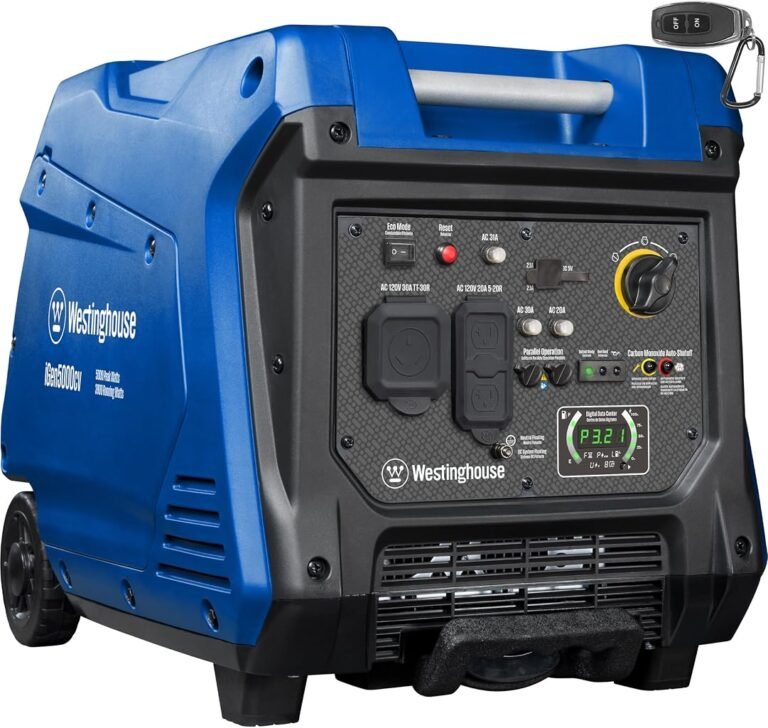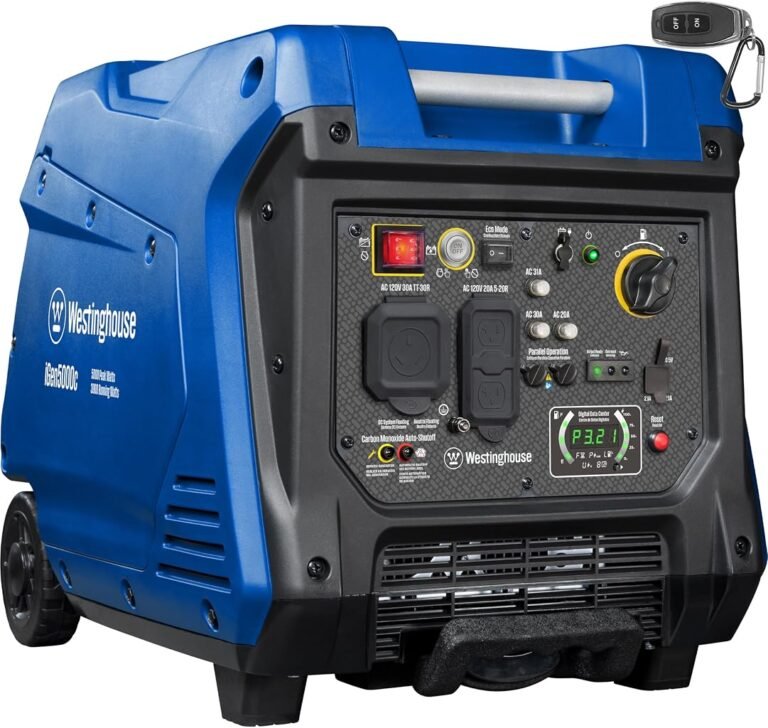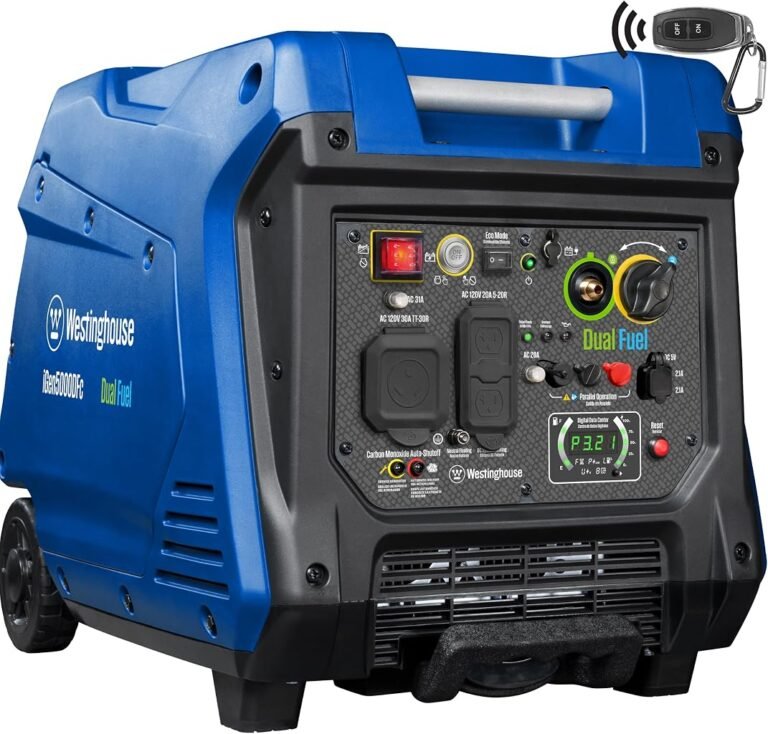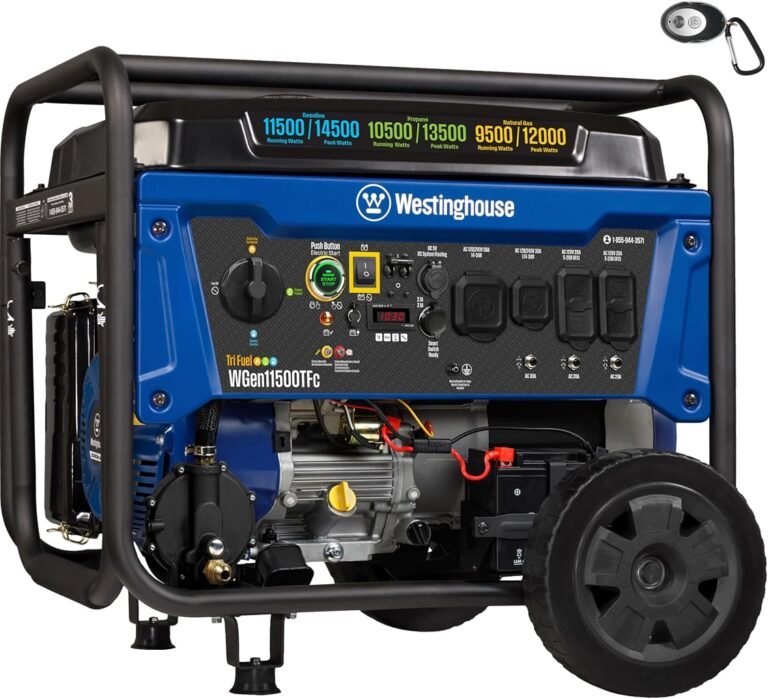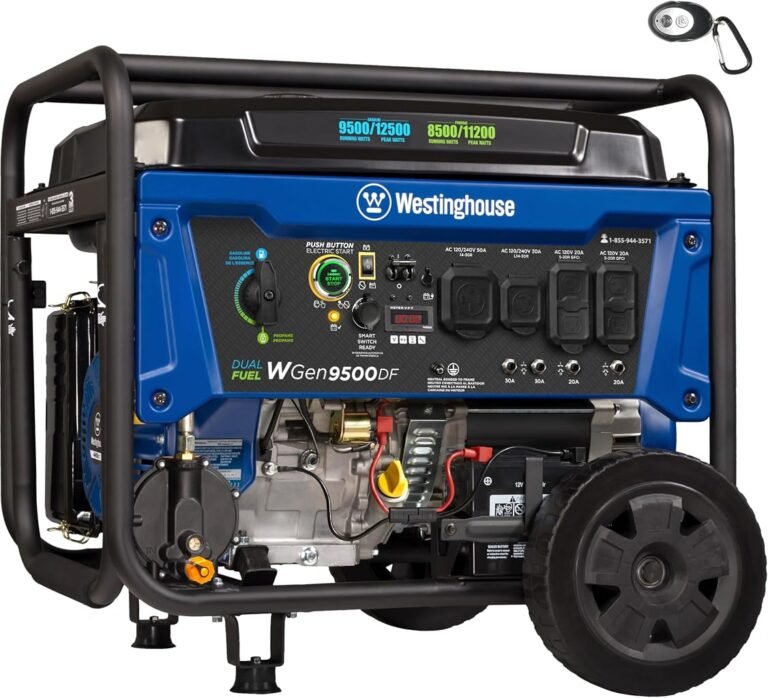
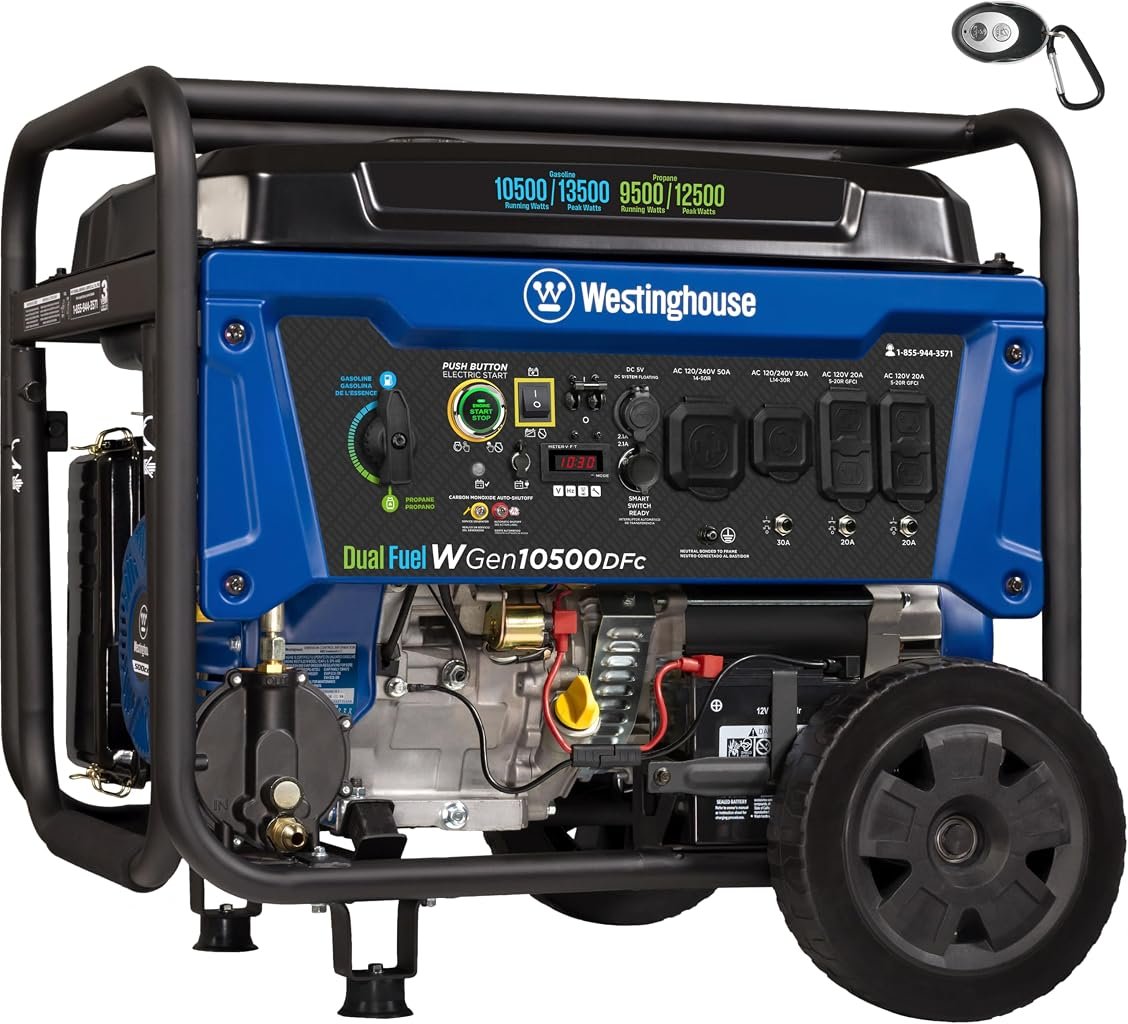
The Westinghouse 13500 Peak Watt Dual Fuel Portable Generator occupies an unusual position between conventional portable equipment and the larger backup systems homeowners normally associate with permanent installation. Its 13,500-watt headline figure attracts attention, but the number that matters more during an extended outage is 10,500 running watts on gasoline. On propane, output falls to 12,500 peak watts and 9,500 running watts.
Those figures identify the machine more precisely than the marketing shorthand does. This is the Westinghouse WGen10500DFc, a 500cc dual-fuel generator built for substantial home-backup loads, job-site use and other situations where a smaller 5,000W-class machine may impose too many compromises.
Our score is 9.01/10. Customer Sentiment stands at 9.16, Buyer Confidence at 9.05 and Value at 8.64. The relationship among those scores is revealing. The generator earns particularly high marks for its basic proposition—large sustained output, two fuel choices, remote and electric starting, 120/240V capability, transfer-switch readiness and long gasoline runtime—but value sits slightly lower because a machine of this size brings costs that extend beyond its purchase price.
At the $1,099 reference price used for this review, the WGen10500DFc is not inexpensive emergency equipment. Nor should it be evaluated like a compact generator intended to keep a refrigerator and several lights operating. Its specifications place it much closer to serious household backup.
The distinction changes almost everything about the buying decision.
The 13,500W Figure Needs Context
Any useful portable generator buying guide should separate peak wattage from running wattage immediately.
Westinghouse rates the WGen10500DFc at 13,500 peak watts and 10,500 running watts on gasoline. Switch to propane and the figures become 12,500 peak watts and 9,500 running watts. The official WGen10500DFc specifications also identify a 500cc four-stroke OHV engine and a 9.5-gallon gasoline tank.
Peak wattage describes short-duration electrical headroom. That matters because motor-driven equipment can demand significantly more electricity during startup than during normal operation. Refrigerators, pumps and air-conditioning equipment are familiar examples.
Running wattage is the sustained electrical budget.
For the WGen10500DFc, that means 10.5kW on gasoline or 9.5kW on propane.
That is a substantial difference from interpreting “13,500 watts” as continuously available power. A household whose simultaneous loads total 11,000W would already exceed the gasoline running rating despite remaining well below the generator’s peak figure.
Westinghouse’s ratings are nevertheless substantial enough to change the character of portable backup. A 10,500W continuous budget gives homeowners considerably more freedom to operate multiple circuits and appliances than a generator producing half that amount.
It still does not make electrical planning optional.
Dual Fuel Is More Than a Convenience Feature
The ability to operate on either gasoline or propane is one of the WGen10500DFc’s defining features.
Gasoline produces the higher electrical output: 10,500 running watts and 13,500 peak watts. Propane reduces those figures to 9,500 running and 12,500 peak watts. The difference amounts to 1,000W of continuous capacity.
That loss is meaningful but not necessarily decisive.
Propane offers a different storage proposition from gasoline. It does not require the same kind of fuel-management routine associated with gasoline stored for emergency use. Cylinders can also provide a separate energy reserve when filling stations are inaccessible or gasoline availability becomes difficult after a widespread outage.
Gasoline, meanwhile, extracts the generator’s full rated output and works with the large onboard tank.
Fuel flexibility is therefore less about identifying one universally superior fuel than about preserving options.
During a prolonged outage, options have practical value. Fuel shortages do not necessarily affect gasoline and bottled propane in identical ways or at identical times. A dual-fuel generator lets the owner plan around two supply chains rather than one.
The trade-off is straightforward: propane operation sacrifices some output.
A household already approaching 9,500W of sustained demand has little remaining capacity for startup surges. Owners intending to use propane routinely should therefore perform their load calculations using the propane ratings rather than the more flattering gasoline numbers.
A 500cc Engine Makes This a Serious Piece of Machinery
The WGen10500DFc uses a 500cc four-stroke OHV Westinghouse engine with a cast-iron sleeve.
That engine size helps explain both the machine’s electrical capability and its physical character.
This is not a compact generator that happens to produce unusually high wattage. The machine weighs roughly 230 pounds. Wheels and a handle make movement across suitable ground practical, but portability here means that the generator can be repositioned without permanent installation. It does not mean one-person lifting.
The distinction matters for storage planning.
A buyer should know where the generator will live, how it will reach its operating location and whether steps, gravel, mud, narrow gates or steep grades stand between those two points. Emergency equipment that cannot be moved safely when the power disappears has a logistical flaw regardless of its wattage.
The same applies to transport. Loading a roughly 230-pound generator into a truck or trailer is different from moving a 50-pound inverter generator.
Its mass is not surprising given the output class, but buyers should treat mobility as an engineering problem rather than a brochure adjective.
The 9.5-Gallon Tank Changes Outage Endurance
Westinghouse gives the WGen10500DFc a 9.5-gallon gasoline tank and specifies up to 19 hours of runtime at 25% load.
That sounds impressive because it is a large fuel reserve, but the load qualification cannot be separated from the runtime figure.
One-quarter of the 10,500W gasoline running rating is 2,625W.
A generator supplying approximately 2.6kW is operating under a very different workload from one delivering 8kW, 9kW or 10kW. Fuel consumption rises as the engine is asked to perform more work, so the 19-hour specification should not be interpreted as full-output endurance.
Even so, a 9.5-gallon tank reduces the frequency of refueling under moderate loads and gives the machine a credible overnight-backup profile when electrical demand is controlled.
The tank also creates a practical consideration: gasoline weighs roughly six pounds per U.S. gallon, meaning a full tank adds substantial mass to an already heavy generator. Owners should plan to move the machine before filling it rather than treating a fueled WGen10500DFc as casually mobile.
Fuel planning also extends beyond tank size. Stored gasoline requires appropriate containers, safe storage practices and attention to fuel condition. A generator that spends months waiting for an emergency still needs to be capable of starting when that emergency arrives.
10,500 Running Watts Can Change Household Backup Strategy
A smaller generator forces aggressive prioritization. At 10,500 running watts, the conversation becomes more flexible.
Refrigeration, lighting, communications equipment, televisions, computers, furnace blowers and selected pumps can represent only part of the available electrical budget, depending on their individual ratings. That leaves room for additional circuits that would be difficult to accommodate simultaneously on a 3,000W or 5,000W machine.
Yet the WGen10500DFc should not be described casually as capable of running every appliance in every home.
Household electrical demand varies enormously.
An all-electric property containing large resistance heaters, an electric water heater, an electric range, a clothes dryer and central air-conditioning can create loads far beyond what a 10.5kW portable generator can support simultaneously. Startup requirements complicate the calculation further.
A home with gas heating, gas water heating and carefully selected electrical loads presents a very different scenario.
That is why square footage is a poor proxy for generator sizing. A smaller electrically intensive house can demand more generator capacity than a larger property using gas for major heating loads.
The correct unit of analysis is watts, not bedrooms.
Transfer-Switch Readiness Is Central to the Home-Backup Case
The WGen10500DFc is configured for more than extension-cord operation.
Westinghouse equips it with household GFCI receptacles, a transfer-switch-ready L14-30R connection, a 120/240V 14-50R receptacle and USB connectivity. The combination gives the generator a credible route into a properly configured residential backup system.
The 120/240V capability is especially significant.
Some residential loads require 240V, and larger home-backup installations frequently benefit from feeding selected circuits through approved transfer equipment rather than running a collection of extension cords through doors and windows.
A properly configured transfer arrangement also addresses backfeeding.
Connecting a portable generator improperly to household wiring can energize circuits in ways that create serious hazards, including risks to utility personnel. Electrical work of this kind should follow applicable codes, generator documentation and the requirements of the specific transfer equipment.
A 10.5kW generator makes proper integration particularly worthwhile because there is enough power available to operate a meaningful selection of household circuits.
Its electrical capability deserves an installation strategy of comparable seriousness.
Remote Start Is Useful, but It Does Not Make the Generator Automatic
Westinghouse provides three starting methods: remote start through an included key fob, push-button electric start and recoil start.
That redundancy is well judged.
Electric starting removes the physical effort of pulling a recoil cord on a 500cc engine. Remote starting adds convenience once the machine has been safely positioned and prepared. Recoil starting provides a mechanical fallback if the starting battery or electric-start system becomes unavailable.
Yet remote start should not be confused with automatic standby operation.
A permanently installed standby generator can be configured to detect utility failure and start automatically as part of an integrated system. A portable WGen10500DFc remains equipment that requires deliberate setup, safe outdoor placement, fuel management and appropriate electrical connection.
The key fob reduces one step in that process.
It does not eliminate the process.
That difference matters for households in which occupants may be unable to move or prepare a 230-pound generator during an emergency.
Carbon Monoxide Is the Safety Issue That Overrides Everything Else
A generator producing more than 10kW can keep a great deal of household equipment operating. It can also produce dangerous carbon monoxide because its engine burns fuel.
Westinghouse incorporates a CO sensor with automatic shutdown into the WGen10500DFc. That is a meaningful secondary safety measure.
It is not permission to operate the generator in a garage.
The U.S. Consumer Product Safety Commission says portable generators should be used outside only, at least 20 feet from a home, with exhaust directed away from the building. Its current guidance reports that more than 100 people in the United States die each year from consumer-product-related carbon-monoxide poisoning linked to portable generators.
More recent CPSC reporting gives historical scale to the hazard: the agency estimates that about 750 people died from generator-associated carbon-monoxide poisoning between 2012 and 2022.
Those statistics turn generator placement from a matter of convenience into a life-safety requirement.
The generator should not be operated inside a house, basement, garage or shed. Opening doors and windows does not transform an enclosed space into a safe generator location. Exhaust should face away from structures, and operating CO alarms belong inside the home.
A CO shutdown sensor is an additional defense. Correct placement remains the primary one.
The Output Is Powerful, but It Is Not Inverter-Generator Power
High wattage does not automatically mean high electrical refinement.
The WGen10500DFc belongs to the conventional open-frame generator category rather than the large inverter-generator category. Westinghouse documentation for closely related 500cc WGen models specifies total harmonic distortion below 23%, rather than the very low THD figures associated with many inverter generators.
That distinction deserves attention when sensitive electronics form a major part of the intended load.
For refrigerators, pumps, many household circuits and general emergency equipment, the generator’s architecture is aimed squarely at practical high-output backup. Buyers whose primary objective is exceptionally clean power for sensitive electronic equipment should compare THD specifications directly rather than treating wattage as the only electrical metric.
This is one of the fundamental trade-offs behind the WGen10500DFc.
It provides a large amount of conventional generator capacity for the money. An inverter system offering comparable output can involve a different cost, weight and design equation.
Noise and Weight Are Part of the Price of High Output
A 500cc open-frame generator is not acoustically discreet.
Westinghouse lists related WGen10500 models at operating levels as low as approximately 74 dBA. Noise varies with operating conditions, load, distance and surroundings, but the broader point is simple: this machine will be heard.
That matters in dense neighborhoods, campgrounds and overnight use.
The same engineering reality explains the weight. Large engine, large alternator, steel frame, battery, wheels and a 9.5-gallon tank do not produce lightweight equipment.
For stationary home-backup duty, those disadvantages may be acceptable. The generator can be stored and rolled into a predetermined operating position when required.
For frequent transport, recreational use or worksites requiring repeated lifting, 230 pounds changes the calculation sharply.
A buyer who needs 10.5kW of portable output may accept that burden. Someone who merely wants emergency refrigeration and lights probably should not.
Our Score: 9.01/10
Our 9.01/10 rating reflects a generator whose design is unusually coherent for substantial portable home backup.
The WGen10500DFc combines 10,500 running watts on gasoline with 9,500W on propane, giving owners both high output and fuel flexibility. A 9.5-gallon gasoline tank supports long low-load runtime. The 120/240V architecture and transfer-switch-ready connections suit residential integration. Remote, electric and recoil starting provide useful redundancy, while automatic low-oil protection and CO shutdown address predictable operating risks.
The rating does not erase the machine’s physical realities.
At roughly 230 pounds, it requires planning to move. Its 500cc engine consumes fuel and demands maintenance. It produces exhaust and substantial sound. Conventional generator output may not suit every sensitive electronic application. Propane operation also reduces available wattage.
Those compromises are substantial, but they are largely the consequences of the generator’s central strength: delivering roughly 10kW of sustained portable backup power.
Customer Sentiment: 9.16
Our Customer Sentiment rating of 9.16 is the highest of the four editorial scores.
That figure reflects how directly the WGen10500DFc addresses the priorities that tend to matter in this category. High running wattage is paired with practical home-backup connections rather than existing merely as a specification. Dual-fuel operation provides flexibility. Remote and electric starting reduce friction. The large tank extends operating intervals under moderate demand.
There is also less ambiguity about the product’s intended role than with smaller multipurpose generators.
This is not principally a camping accessory. It is not an ultra-quiet recreational inverter generator. It is a large portable backup machine.
Buyers whose requirements align with that role are less likely to discover after purchase that they selected the wrong generator category.
Buyer Confidence: 9.05
Buyer Confidence stands at 9.05.
Westinghouse publishes detailed specifications and documentation for the WGen10500DFc, and its configuration relies on familiar portable-generator architecture rather than unusual proprietary operating concepts. The engine includes automatic low-oil shutdown, while the generator incorporates overload protection and carbon-monoxide monitoring.
The three starting methods add another layer of operational redundancy.
The company also advertises three-year limited service, labor and parts coverage for the model. Exact warranty eligibility should still be checked for the seller and purchaser’s circumstances.
The remaining uncertainty is not really about what the machine is. It is about whether a particular household has sized it correctly.
No generator rating can substitute for a load calculation.
Value: 8.64
Value is our lowest score at 8.64, although the rating remains favorable.
At the $1,099 reference price, the WGen10500DFc offers substantial output, but the generator itself is only part of the financial equation.
A serious home-backup installation may require a transfer switch or interlock arrangement where permitted, professional electrical work, suitably rated cords or inlet equipment, fuel containers, propane cylinders, engine oil, maintenance supplies and weather-conscious operating arrangements.
Fuel consumption also matters over a prolonged outage.
A 500cc engine generating several kilowatts for days is not an energy source without operating costs. Gasoline and propane prices can turn a long outage into a meaningful fuel expense.
The generator nevertheless delivers a great deal of electrical capacity for its reference purchase price. Value is strongest for households that can actually use its 120/240V capability and roughly 10kW running output.
Buying it to power a refrigerator, Wi-Fi router and several lamps would be an inefficient allocation of money, fuel and storage space.
Who Should Buy the WGen10500DFc?
The Westinghouse 13500 Peak Watt Dual Fuel Generator makes the most sense for households with substantial emergency-power requirements and enough outdoor space to operate it safely.
Good matches include:
- Homes requiring several simultaneous essential circuits during outages.
- Properties with well pumps, sump pumps or other motor-driven loads requiring meaningful startup headroom.
- Households seeking both gasoline and propane operation.
- Buyers planning a properly configured transfer-switch or approved home-inlet system.
- Users who need 120/240V capability rather than basic 120V portable power.
- Owners who can safely store and move a roughly 230-pound generator.
- Buyers who value remote and electric starting but also want recoil backup.
It is less convincing for apartments, lightweight recreational use, quiet campsites or homes needing only a few hundred watts of emergency electricity.
It is also not identical to a permanently installed standby generator. There is no substitute here for automatic outage detection, permanent fuel connection and automatic transfer when those are the requirements.
What to Calculate Before Buying
Generator sizing should begin with an inventory rather than a guess.
List the loads that genuinely need electricity during an outage. Record running wattage and startup requirements. Determine which appliances can overlap and which can be scheduled separately.
Then perform the calculation twice if both fuels will be used.
Gasoline provides 10,500 running watts. Propane provides 9,500. A backup plan that works only because it assumes the extra 1,000W available on gasoline is not automatically suitable for propane operation.
Next, consider runtime and fuel storage.
Westinghouse’s 19-hour figure is tied to 25% load. Higher demand means greater fuel consumption. Owners should estimate how many hours per day the generator will run and how much fuel can be stored safely and legally.
Finally, plan placement and connection before severe weather arrives.
The CPSC’s 20-foot outdoor-placement guidance may affect cord length, generator-inlet location and where the machine can realistically operate. Electrical integration should be established before an outage rather than improvised after the utility supply fails.
Preparation is what converts 13,500 peak watts on a specification sheet into useful emergency power.
Final Considerations
The Westinghouse WGen10500DFc earns its 9.01/10 overall score by pairing genuinely high portable-generator output with features that support serious household backup rather than merely decorating the specification list.
Its 13,500W gasoline peak rating is the attention-grabbing figure, but 10,500 running watts is the number around which an electrical plan should be built. Propane reduces output to 12,500 peak and 9,500 running watts while adding a second fuel option. That is a reasonable exchange for households that value fuel flexibility during extended outages.
The 500cc engine, 9.5-gallon tank and up-to-19-hour low-load runtime give the machine endurance appropriate to its output class. Transfer-switch readiness and 120/240V connectivity make its capacity easier to use intelligently. Remote, electric and recoil starting add redundancy, while CO and low-oil shutdown systems address two predictable hazards.
Customer Sentiment at 9.16 reflects a product whose purpose is unusually clear. Buyer Confidence at 9.05 recognizes the documented specifications, safety systems and established architecture. Value at 8.64 sits slightly lower because a 230-pound combustion generator carries expenses beyond the initial $1,099 reference price.
The compromises are substantial enough to matter. This generator is heavy. It is noisy compared with smaller inverter designs. It requires engine maintenance and fuel management. It must operate outdoors at a safe distance from occupied structures. Its conventional electrical output also warrants attention when particularly sensitive electronics are the primary load.
Yet those compromises need to be measured against what the WGen10500DFc actually provides: approximately 10kW of sustained, transportable, dual-fuel electrical capacity.
That makes it less a casual portable generator than a piece of movable household infrastructure. For the right property, that distinction is exactly the point.