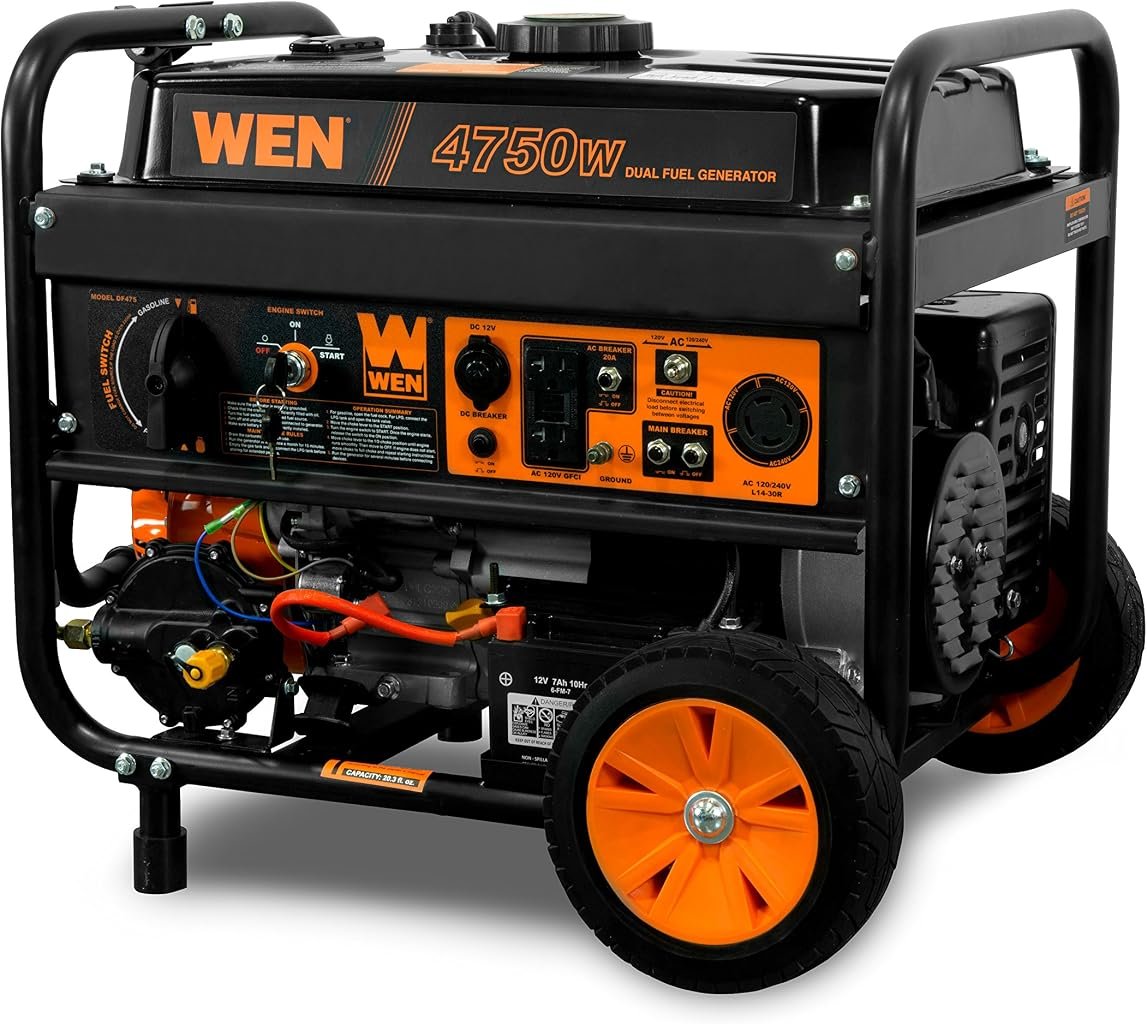
The WEN DF475T approaches portable backup power with an idea that is more consequential than another few hundred watts on a specification sheet: fuel choice. It can run on gasoline or propane, switches between 120V and 240V operation, includes electric starting, and carries its roughly four-kilowatt continuous gasoline output on a wheeled open-frame chassis.
That combination gives the DF475T a distinctive role. It is not an inverter generator built primarily around low noise and highly controlled harmonic distortion. Nor is it a large standby system intended to energize an entire property automatically. It is a conventional, dual-fuel portable generator designed for owners who need meaningful temporary electricity and want more flexibility over how that electricity is produced.
According to WEN’s specifications for the DF475T, gasoline operation provides 4,750 surge watts and 3,800 running watts, while propane produces 4,350 surge watts and 3,500 running watts. A 224cc four-stroke OHV engine supplies the mechanical power. The generator also has a four-gallon gasoline tank rated for up to 11 hours of operation at half load.
Our score is 8.55/10, with Customer Sentiment at 8.28, Buyer Confidence at 9.8, and Value at 8.15. Those ratings describe a generator whose main appeal lies in versatility and specification clarity. The unusually high Buyer Confidence score reflects how readily its capabilities can be matched against real electrical requirements. Value is more measured because the DF475T remains a conventional open-frame generator, bringing the noise, weight, maintenance, and fuel-management obligations associated with that architecture.
The machine is best judged not by its 4,750-watt headline but by the flexibility behind it.
Gasoline and Propane Produce Different Output
Dual-fuel capability does not mean identical performance on both fuels.
On gasoline, the DF475T delivers 4,750 surge watts and 3,800 running watts. Switching to propane reduces those figures to 4,350 surge watts and 3,500 running watts.
The difference is significant enough to affect load planning.
Gasoline provides 300 additional running watts and 400 additional surge watts. That additional capacity can matter when several appliances are operating simultaneously or when equipment with a motor or compressor starts.
Propane gives up some electrical output in exchange for a different storage and refueling proposition.
That trade deserves attention because fuel flexibility is often treated as a simple convenience feature. In an emergency, it can be much more than that. Gasoline supplies may become difficult to obtain after storms, extended outages, or evacuations. Propane offers another energy source that can be stored separately and connected when needed.
A dual-fuel generator therefore gives the owner two ways to solve the same problem.
The correct load calculation still changes with the selected fuel. A household configuration that fits comfortably within 3,800 running watts on gasoline may sit closer to the generator’s limit when the available continuous output falls to 3,500 watts on propane.
Any useful portable generator buying guide should make that distinction explicit. Fuel selection is part of electrical planning, not merely a question of which container happens to be available.
The 4,750W Figure Describes Surge Capacity
The largest number attached to the DF475T is its gasoline surge rating.
That does not make it a 4,750-watt continuous generator.
Its sustained gasoline rating is 3,800 watts, while propane reduces sustained capacity to 3,500 watts. The higher surge figures exist to accommodate short-duration increases in demand.
Motors and compressors are the familiar reason.
A refrigerator, freezer, sump pump, air conditioner, or power tool can draw considerably more electricity during startup than after reaching normal operating speed. If the generator were sized only to the steady consumption of every connected device, one compressor starting at the wrong moment could exceed the available capacity.
The DF475T’s gasoline configuration provides 950 watts of surge headroom above its continuous rating. On propane, the difference is 850 watts.
That does not mean every load combination below 3,800 watts will start successfully. Individual equipment has its own startup characteristics, and several motor-driven appliances can overlap.
A more disciplined strategy leaves breathing room below the continuous ceiling.
For emergency use, load rotation can be more effective than trying to operate every appliance simultaneously. Refrigeration can be powered for a period, followed by a pump or cooking appliance, rather than stacking every high-demand device onto the generator at once.
The DF475T rewards planning more than improvisation.
A 224cc Engine Provides the Mechanical Core
WEN uses a 224cc four-stroke OHV engine in the DF475T.
That displacement is paired with electric starting, making routine startup substantially easier than relying exclusively on a recoil cord. The electric-start system operates with a key, while the machine retains the physical architecture of a conventional portable generator.
Electric starting does not increase wattage or runtime, but it changes the experience of owning emergency equipment.
A generator may be operated by more than one member of a household. Some users have limited grip strength, shoulder mobility, or tolerance for repeated pull-start attempts. Key-operated starting lowers that physical barrier.
The trade is another component requiring attention: the starting battery.
Generators often spend long periods unused. Batteries do not benefit from neglect, and emergency equipment that starts electrically is only convenient if the electrical starting system remains ready.
The 224cc engine also means the DF475T carries ordinary combustion-engine obligations. Oil, fuel condition, air filtration, spark-plug condition, cooling airflow, and scheduled maintenance all matter.
Dual fuel does not remove those obligations. It changes what reaches the combustion chamber, not the fact that a combustion engine is doing the work.
The Four-Gallon Tank Supports Long Gasoline Operation
WEN specifies a four-gallon gasoline tank and rates the DF475T for up to 11 hours of runtime at half load.
The phrase “half load” gives the runtime figure its meaning.
Half of the generator’s 3,800-watt gasoline running capacity is approximately 1,900 watts. The 11-hour figure therefore describes operation around that level rather than continuous use at maximum output.
That is a relatively useful reference because 1,900 watts can support meaningful emergency loads when managed carefully.
Refrigeration, lighting, communications equipment, a television, chargers, and selected household devices can often be arranged within a moderate power budget. Pumps, electric heaters, air conditioners, cooking appliances, and other high-demand equipment change the arithmetic quickly.
Runtime falls as load rises.
A four-gallon tank also creates physical consequences. Gasoline adds substantial mass when the tank is filled, so a generator that is manageable on its wheel kit can become considerably less appealing to lift.
The sensible sequence is usually to position the generator safely before filling it rather than adding fuel in storage and then attempting to carry the machine.
Propane Changes the Preparedness Equation
Propane is the feature that most clearly distinguishes the DF475T from a comparable gasoline-only generator.
WEN includes a 47-inch LPG connection hose, allowing the generator to connect to an appropriate propane supply.
Propane offers practical storage advantages for emergency planning. Unlike gasoline stored in a small portable container, propane is held in a sealed pressurized cylinder. It also gives the household a second fuel pathway when gasoline availability becomes uncertain.
That flexibility has a price in output: 3,500 running watts rather than 3,800.
For many emergency loads, 300 watts will not fundamentally alter the plan. For a configuration already operating near the gasoline ceiling, however, it matters.
The owner therefore needs two electrical budgets.
The gasoline budget is 3,800 continuous watts with 4,750 watts available for surge demand. The propane budget is 3,500 continuous watts with 4,350 watts of surge capacity.
This is where dual-fuel ownership becomes more analytical than simply turning a selector.
Fuel flexibility works best when the owner already knows which loads can remain connected under each configuration.
The Fuel Selector Makes Switching Straightforward
WEN uses a selection dial to switch between gasoline and propane operation.
That interface reduces one source of confusion during an outage. The operator does not have to reconstruct a complicated fuel-routing procedure every time the available fuel changes.
Simple controls have disproportionate value on emergency equipment.
A generator may be started in darkness, poor weather, or after a long utility interruption. The person operating it may not be the person who purchased it. Controls that communicate their function directly reduce opportunities for error.
The DF475T’s broader control philosophy follows the same pattern. Electric starting, a dedicated voltage selector, conventional receptacles, and clearly separated fuel modes make the generator mechanically understandable.
The owner still needs to read and follow the manual. Straightforward controls are not permission to improvise with fuel or electrical connections.
120V and 240V Operation Expands Household Use
One of the DF475T’s more consequential capabilities is its ability to switch between 120V and 240V.
That separates it from many smaller portable generators designed exclusively around 120V loads.
WEN equips the machine with two 120V GFCI 5-20R outlets and a 120V/240V L14-30R 30A twist-lock receptacle, along with a 12V DC cigarette-lighter-style connection.
The L14-30R connection makes the generator relevant to properly designed transfer-switch arrangements and other compatible 120/240V applications.
Voltage capability should not be confused with unlimited capacity.
The generator still produces only 3,800 running watts on gasoline or 3,500 on propane. A 240V appliance can consume that capacity quickly, particularly if it contains a motor.
Yet access to 240V changes what kinds of backup plans are possible.
Certain well pumps, shop equipment, and household circuits require 240V. A generator restricted to 120V cannot power those loads merely because its wattage number appears adequate.
The DF475T removes that voltage barrier while retaining a relatively modest overall output rating.
For selective home backup, that can be more useful than adding another convenience outlet.
Transfer-Switch Capability Requires Proper Installation
WEN specifically identifies the L14-30R twist-lock connection as suitable for transfer-switch use.
That can make the DF475T useful for household emergency circuits, but the presence of the receptacle should not encourage improvised connections.
A generator should never be connected to household wiring through unsafe backfeeding methods.
A correctly configured transfer system isolates generator power from utility power and routes electricity through an installation intended for that purpose. Electrical codes, grounding arrangements, neutral configuration, generator documentation, and local requirements all affect installation.
For owners planning to connect the DF475T to building wiring, professional electrical work is a more serious consideration than the generator’s marketing features.
Portable power is straightforward when an extension cord connects a generator directly to a refrigerator.
It becomes a building-electrical-system issue when the generator energizes circuits through a panel.
The DF475T has the hardware to participate in that kind of setup. The rest of the installation needs equal discipline.
GFCI Household Outlets Add Practical Protection
The two conventional 120V receptacles are GFCI-protected 5-20R outlets.
Ground-fault circuit interrupters are designed to interrupt electrical power when current leakage indicates a potentially dangerous ground fault.
That protection is relevant because portable generators frequently operate outdoors, where moisture, extension cords, tools, and temporary connections create conditions very different from a permanent indoor receptacle.
GFCI protection does not make wet operation acceptable.
Generators and electrical connections still need to be protected according to manufacturer instructions, and extension cords should be correctly rated for the expected current and outdoor conditions.
The benefit is another defensive layer against a known electrical hazard.
For worksite and emergency applications, that is a meaningful inclusion rather than decorative specification-sheet material.
The Wheel Kit Addresses an Inherently Heavy Machine
The DF475T includes wheels and a folding handle.
That equipment matters because open-frame generators built around 224cc engines, steel frames, fuel tanks, alternators, batteries, mufflers, and control hardware are not carry-anywhere devices.
The wheel kit changes the generator from something that must routinely be lifted into something that can usually be rolled across suitable surfaces.
“Suitable” matters.
Concrete, asphalt, garage floors, and compact ground are relatively easy. Stairs, loose gravel, deep grass, mud, and vehicle loading expose the difference between wheeled mobility and genuinely low weight.
This is a recurring issue across portable-generator design.
Larger fuel tanks improve endurance. Electric starting adds a battery and starting hardware. Steel frames improve physical protection. 240V electrical hardware expands capability. Each useful addition carries some physical cost.
The DF475T resolves the problem conventionally: wheels and a handle rather than an aggressive effort to minimize mass.
Conventional Generation Brings a Different Noise Profile
The DF475T is not an enclosed inverter generator.
That distinction matters acoustically as well as electrically.
Open-frame conventional generators expose more of the engine, alternator, cooling system, and exhaust sound to the surrounding environment than heavily insulated inverter designs.
For emergency household operation, worksite use, or remote property maintenance, that may be acceptable. In a quiet campground or dense residential setting, it can become a more prominent issue.
Noise also changes with load and placement.
Hard walls can reflect sound. Greater distance reduces perceived noise. Heavy electrical demand can change engine behavior. Local campground rules may impose operating hours regardless of the machine’s capabilities.
The buyer therefore needs to evaluate acoustic expectations separately from wattage.
A generator can be electrically suitable and socially awkward.
Dual Fuel Does Not Remove Maintenance
Propane operation can reduce some gasoline-storage concerns, but it does not convert the DF475T into maintenance-free equipment.
The engine still requires lubrication. The air filter still handles combustion air. Spark ignition remains necessary. Cooling passages need airflow. Mechanical components age.
Gasoline operation adds another issue: stored fuel.
A generator purchased for emergencies may spend months waiting for an outage. That waiting period is precisely why storage practices matter.
The owner needs a repeatable maintenance routine rather than relying on memory after each storm season.
Electric starting adds the battery to that routine.
The machine’s value during an emergency is determined partly by what happens during the months when no emergency exists.
Carbon Monoxide Is the Dominant Safety Constraint
The DF475T burns fuel, which means its exhaust contains carbon monoxide.
That fact outranks convenience features, fuel flexibility, and wattage.
The U.S. Consumer Product Safety Commission says more than 100 U.S. deaths each year are linked to portable generators. The agency also states that one portable generator can produce the same amount of carbon monoxide as hundreds of cars.
CPSC’s current safety guidance instructs consumers to operate portable generators outdoors only, at least 20 feet from the home, with exhaust directed away from buildings. It warns against operating a generator inside a home, garage, basement, crawlspace, shed, or other enclosed area, even when doors or windows are open.
The historical scale is sobering. CPSC estimated that about 750 people died from carbon-monoxide poisoning associated with generators from 2012 through 2022.
Dual fuel does not alter the central safety rule. Propane combustion still produces carbon monoxide.
The generator needs a safe outdoor location planned before an outage, not improvised after one begins.
Working carbon-monoxide alarms inside the home provide another defensive layer. Fuel should never be added to a running or hot generator.
What the Editorial Scores Mean
Our 8.55/10 overall score reflects a generator with a broad range of practical capabilities but conventional-generator compromises that remain impossible to ignore.
The strongest figure is Buyer Confidence at 9.8.
That rating is driven by specification clarity. WEN identifies separate gasoline and propane outputs, running and surge ratings, engine displacement, fuel capacity, half-load runtime, voltage options, receptacle types, starting system, LPG hose, wheel kit, and warranty coverage.
The buyer can therefore answer several important questions before purchase.
Does the intended load fit within 3,800 gasoline running watts? Does it fit within 3,500 propane watts? Is 240V required? Is an L14-30R connection useful? Is electric start important? Does dual fuel solve a genuine preparedness problem?
Customer Sentiment at 8.28 is more restrained.
The DF475T asks its owner to accept the realities of a conventional open-frame machine: engine maintenance, outdoor operation, combustion exhaust, physical bulk, fuel management, and more acoustic presence than an enclosed inverter generator.
Those are meaningful compromises, even when the electrical capability is appropriate.
Value at 8.15 is the lowest editorial score.
That rating reflects a machine whose value depends heavily on whether its specific capabilities will actually be used. Dual fuel, 240V operation, electric start, the L14-30R connection, and the wheel kit create a flexible package. Buyers needing only a few 120V household outlets may be paying for capabilities that do little for their application.
For the right electrical plan, the feature set makes coherent sense.
Where the DF475T Fits Best
The WEN DF475T is particularly well aligned with users who value fuel flexibility and 120/240V capability more than minimum noise or low weight.
Likely applications include:
- selective household backup using gasoline or propane;
- properly configured transfer-switch applications using the L14-30R connection;
- powering compatible 240V equipment within the generator’s wattage limits;
- outage planning where access to two fuel types reduces dependence on gasoline alone;
- worksites requiring conventional 120V power and GFCI receptacles;
- users who prefer key-operated electric starting;
- properties where the generator can be rolled rather than repeatedly lifted.
It is less naturally suited to someone seeking extremely quiet campsite operation, highly portable hand-carry dimensions, or an inverter generator specifically selected for a documented low-THD electrical output.
Its design is aimed at flexible utility rather than acoustic refinement.
The Trade-Offs Are Mechanically Logical
The DF475T’s design choices fit together.
Dual fuel increases preparedness options but creates two different electrical output ratings. Electric start improves accessibility but adds a battery that needs attention. A four-gallon gasoline tank supports long half-load operation but adds mass when filled. 120/240V capability expands the range of compatible applications, while the 3,800-watt gasoline running ceiling still requires disciplined load selection.
The wheel kit makes the machine easier to move, but wheels do not turn an open-frame generator into lightweight equipment.
Its conventional engine-and-alternator architecture is familiar and functional, but buyers specifically prioritizing quiet operation and explicitly low harmonic distortion have reason to examine inverter alternatives.
These are not design contradictions.
They are the ordinary exchanges involved in building a generator that must balance cost, output, runtime, fuel flexibility, mobility, and electrical versatility.
Final Considerations
The WEN DF475T earns its 8.55/10 score because it gives the buyer several useful choices without making its electrical limits difficult to understand.
On gasoline, it produces 4,750 surge watts and 3,800 running watts. On propane, those figures fall to 4,350 surge watts and 3,500 running watts. Its 224cc four-stroke OHV engine can operate at 120V or 240V, while electric starting removes much of the physical effort associated with recoil-only generators.
The four-gallon gasoline tank supports up to 11 hours at half load. The outlet arrangement includes GFCI-protected household receptacles, a 120/240V L14-30R twist lock, and a 12V DC connection. The package also includes a wheel-and-handle kit and a 47-inch propane connection hose.
Its 9.8 Buyer Confidence score is the strongest editorial rating because the machine is relatively easy to match against a defined electrical plan. The difference between gasoline and propane output is explicit. The continuous ratings are explicit. The voltage options are explicit. The receptacles and runtime condition are explicit.
Customer Sentiment at 8.28 reflects a more tempered view of everyday ownership. The DF475T remains an open-frame combustion generator. It needs fuel, oil, maintenance, safe outdoor placement, electrical discipline, and realistic expectations about noise and mobility.
Value at 8.15 reflects the importance of using what the generator provides. A household that genuinely benefits from dual fuel, 240V capability, electric start, and an L14-30R connection receives a much broader tool than a basic gasoline-only 120V generator. A buyer who needs none of those features has less reason to accept the associated size and complexity.
The buying decision should therefore start with a written load plan.
List the equipment that must operate during an outage. Record its voltage. Separate continuous wattage from startup demand. Run the calculation once using the 3,800-watt gasoline ceiling and again using the 3,500-watt propane ceiling. Identify which loads require 240V. Decide whether circuits will be powered individually through extension cords or through a properly installed transfer arrangement.
Then build the fuel plan.
Determine how gasoline will be stored and rotated. Decide what propane supply will be available. Account for the lower output on propane before an emergency forces the switch. Keep the LPG hose and operating instructions with the generator rather than somewhere difficult to locate during an outage.
Finally, establish the operating location before the utility fails. CPSC guidance calls for outdoor operation at least 20 feet from the home with exhaust directed away from buildings. That distance needs to coexist with weather protection, correctly rated electrical connections, security, and a practical path for moving the generator.
Viewed that way, the DF475T’s identity becomes unusually straightforward. It is a medium-output, dual-fuel, 120/240V conventional generator built for buyers who would rather have two fuel choices and broader voltage capability than the quieter behavior of an enclosed inverter machine.
The 4,750-watt number attracts attention. The more meaningful story lies beneath it: 3,800 running watts on gasoline, 3,500 on propane, a four-gallon tank, electric starting, 240V capability, and an outlet arrangement capable of supporting a carefully planned backup system.
Those specifications do not remove the need for judgment. They give the owner enough information to exercise it.