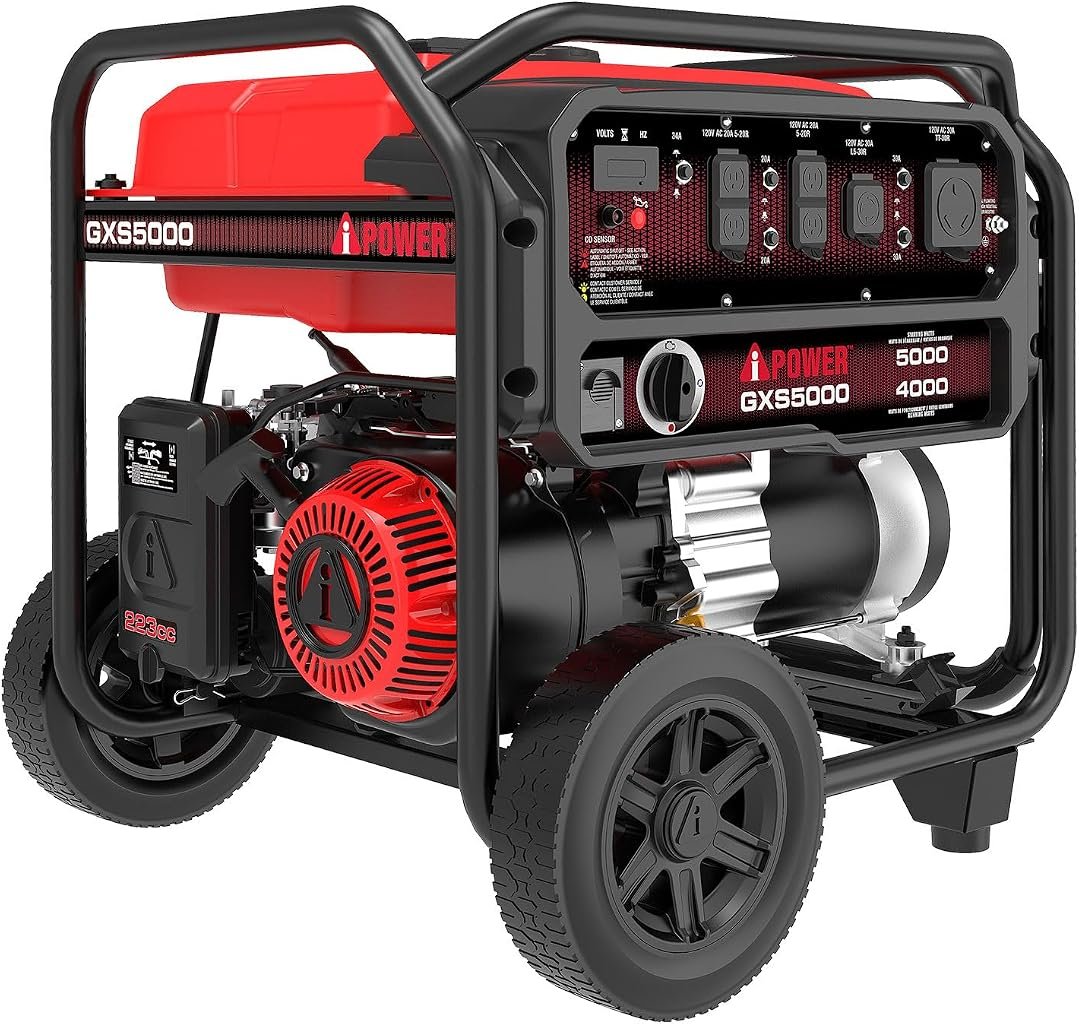
The A-iPower GXS5000 makes its priorities visible before the engine ever starts. This is an open-frame, gasoline-powered generator built around substantial fuel capacity, conventional 120V power, straightforward recoil starting, multiple 30A connections, and a steel-frame mobility system. It favors long-running utility over the quieter manners and electronic refinement associated with enclosed inverter generators.
The number in the name requires immediate qualification. According to A-iPower’s specifications for the GXS5000, the generator produces 5,000 starting watts and 4,000 running watts. A 223cc single-cylinder four-stroke OHV engine supplies that output. The machine carries 6.3 gallons of gasoline, provides up to 20 hours of runtime at 25% load, weighs 111.6 pounds, and includes 9-inch flat-free wheels with a folding handle.
Our score is 8.5/10. Customer Sentiment is 8.28, Buyer Confidence is 9.54, and Value is 8.15. Those ratings describe a generator with a well-defined job: deliver conventional portable power for outages, RVs, and work where long gasoline runtime and several useful outlets matter more than minimum noise, low weight, electric starting, or inverter-grade output.
Its strongest quality is not sophistication. It is clarity of purpose.
Five Thousand Watts Does Not Mean Five Thousand Running Watts
Portable-generator specifications become much easier to understand once peak output and sustained output are separated.
The GXS5000 can briefly supply 5,000 starting watts, but its continuous rating is 4,000 watts. The extra 1,000 watts exists primarily to accommodate temporary electrical surges.
Motors and compressors explain why that distinction matters. A refrigerator, pump, air conditioner, or power tool can require substantially more electricity while starting than after reaching normal operating speed. A generator therefore needs some temporary reserve above the ordinary combined load.
For the GXS5000, that reserve is 25% above its 4,000-watt continuous rating.
A buyer should not construct a load plan around 5,000 watts of continuous consumption. Instead, the ordinary connected load should remain within the 4,000-watt running capacity while leaving enough room for equipment with higher startup demand.
This arithmetic belongs near the beginning of any useful portable generator buying guide. Peak wattage attracts attention, but running wattage determines how many appliances can remain powered together.
Consider a hypothetical outage setup containing refrigeration, lights, communications equipment, a television, chargers, and a pump. Their steady consumption may fit comfortably within 4,000 watts. The pump or refrigerator can then introduce a short startup surge. The generator’s peak capacity provides room for that event.
Replace those modest loads with several electric heaters or large cooking appliances, and the electrical budget changes rapidly.
Four thousand running watts is substantial portable power. It is not unrestricted household power.
The 223cc Engine Is Conventional by Design
A-iPower uses a 223cc single-cylinder, four-stroke OHV, air-cooled engine with a cast-iron sleeve. The generator runs on gasoline and uses recoil starting. A low-oil shutdown system protects the engine if lubricant falls below an acceptable level.
The architecture is deliberately uncomplicated.
There is no starting battery to maintain because the GXS5000 uses a pull starter. That removes one component that can deteriorate during long storage. The trade-off is physical effort: recoil starting is inherently less convenient than turning a key or pressing a button.
For a worksite, occasional outage, or recreational application, that compromise may be acceptable. For an owner with limited mobility, shoulder problems, or an expectation of frequent starts and stops, electric starting can be considerably easier.
The engine uses 10W-30 oil with a 550 ml capacity, according to A-iPower. The presence of a cast-iron cylinder sleeve also reflects the machine’s traditional utility-generator architecture.
Nothing about this arrangement eliminates maintenance. Oil still needs monitoring and replacement. The air filter, spark plug, spark arrester, fuel system, and other engine components require periodic attention.
That is the bargain combustion generation makes with its owner: rapid refueling and extended operation in exchange for mechanical upkeep.
The GXS5000 Is Not an Inverter Generator
One of the most consequential distinctions in this review is what the GXS5000 is not.
A-iPower identifies the alternator as a brushed design with automatic voltage regulation, rather than an inverter system. The manufacturer’s specification page describes total harmonic distortion simply as “Standard.”
That separates the GXS5000 from A-iPower’s inverter products and from enclosed inverter generators designed around particularly low harmonic distortion.
A conventional generator operates differently from an inverter machine. Its engine runs at a speed tied closely to output frequency-in this case A-iPower specifies 3,600 rpm and 60Hz.
That architecture is established, relatively straightforward, and appropriate for many conventional loads.
It also helps explain why buyers primarily interested in sensitive electronics may prefer a generator with a manufacturer-specified low-THD inverter output.
The distinction should not be exaggerated into a claim that ordinary equipment cannot be powered by the GXS5000. The relevant point is narrower: buyers who specifically require low harmonic distortion should select equipment with an explicit specification matching that requirement.
The GXS5000’s priorities lie elsewhere-output, fuel capacity, outlet flexibility, durability, and long runtime.
A 6.3-Gallon Tank Is Central to the Product
Fuel capacity is one of the GXS5000’s defining characteristics.
The gasoline tank holds 6.3 gallons, or 23.8 liters, and A-iPower rates the machine for up to 20 hours at 25% load.
At a 4,000-watt running rating, 25% load equals approximately 1,000 watts.
The runtime figure therefore describes relatively light operation.
It should not be interpreted as 20 hours while continuously producing 4,000 watts. Fuel consumption rises as electrical demand rises, so sustained heavy loading will shorten runtime.
Yet the size of the tank still matters.
A generator carrying 6.3 gallons can spend long periods supplying modest emergency loads without requiring frequent refueling. During a nighttime outage, that can reduce interruptions and the number of fuel-handling events.
There is another side to the equation. Gasoline weighs roughly six pounds per U.S. gallon, depending on formulation and temperature. A full tank therefore adds a substantial amount of fuel mass to an already 111.6-pound generator.
Large fuel capacity improves endurance but makes a filled machine even less appealing to lift.
The GXS5000 should be positioned before filling whenever practical rather than treated as equipment that will be casually carried after six gallons of gasoline have been added.
Twenty Hours of Runtime Needs the Quarter-Load Context
Runtime claims deserve arithmetic rather than admiration.
At 25% of rated running output, the GXS5000 is supplying about 1,000 watts. A 1,000-watt average load can support a useful collection of lower-demand equipment, but it represents only one quarter of the generator’s continuous capacity.
That distinction has practical consequences.
During a utility outage, refrigeration cycles rather than running at maximum consumption continuously. LED lighting uses relatively little electricity. Communications equipment and chargers may create modest demand. A carefully managed household can therefore spend long stretches well below the generator’s maximum output.
Resistance heating changes that picture immediately.
Portable electric heaters commonly create large continuous loads. Electric cooking equipment, water heating, pumps, and air-conditioning equipment can also increase demand sharply.
A generator owner seeking long runtime should therefore think in terms of energy management, not merely outlet availability.
The fact that an appliance can be plugged in does not mean it should operate simultaneously with every other connected load.
The Outlet Configuration Is Unusually Practical
The GXS5000 has a control panel built for conventional 120V applications.
A-iPower specifies two 5-20R duplex 20A/120V receptacles, one L5-30R 30A/120V receptacle, and one TT-30R 30A/120V RV receptacle.
That gives the generator useful flexibility.
The conventional duplex outlets accommodate ordinary extension-cord loads. The locking L5-30R provides a 30A connection for compatible equipment, while the TT-30R directly addresses RV use.
The generator remains a 120V machine.
That is a meaningful limitation for households with equipment requiring 240V. A well pump, certain shop equipment, large appliances, or other 240V loads cannot simply be treated as ordinary 120V loads because enough total wattage exists.
Voltage compatibility comes before wattage.
For RV owners using 30A/120V service, the arrangement is much more natural. The TT-30R receptacle matches a familiar recreational-vehicle connection, although the generator’s 4,000-watt running ceiling still governs total power.
At 120V, 4,000 watts corresponds mathematically to about 33.3 amps. Actual operation must remain within the generator’s overall rating, individual receptacle limits, breakers, and connected equipment requirements.
A 68 dB Rating Defines the Acoustic Trade-Off
A-iPower specifies a 68 dB noise level for the GXS5000.
Sound figures require context because perceived generator noise changes with distance, load, terrain, surrounding structures, and measurement procedure. A single number cannot reproduce every operating environment.
What it can do is help identify the design category.
The GXS5000 is an open-frame conventional generator. It lacks the extensive acoustic enclosure used by many suitcase-style inverter generators.
That makes sense mechanically. The exposed frame permits straightforward cooling, servicing, and construction. It also leaves fewer barriers between engine noise and the surrounding environment.
For a worksite or emergency application, that may be a secondary concern. For a campground, dense neighborhood, or overnight use, noise deserves greater weight.
Generator selection is often presented as an electrical problem, but acoustic tolerance can become an equally practical constraint.
A machine can possess adequate wattage and still be a poor fit for an environment where generator noise is heavily restricted or disruptive.
The 111.6-Pound Weight Makes the Wheels Essential
The GXS5000 weighs 111.6 pounds, with A-iPower listing dimensions of 24.4 by 19.7 by 22 inches. It includes a folding U-shaped handle and 9-inch flat-free wheels.
At more than 100 pounds before gasoline is added, “portable” needs interpretation.
The generator can be rolled. That is very different from being comfortably carried.
Across pavement, garage floors, driveways, and reasonably firm ground, the wheel kit and folding handle make movement practical. Stairs, deep gravel, mud, vehicle loading, and uneven terrain expose the limits quickly.
The flat-free wheel design has a practical advantage: there is no pneumatic tire pressure to maintain.
The overall weight also reflects the machine’s priorities. A 6.3-gallon tank, 223cc engine, alternator, steel frame, wheels, muffler, electrical panel, and associated hardware create mass.
A-iPower has not pursued extreme portability here.
It has pursued transportable output and endurance.
The Digital Data Center Is Simple but Useful
The GXS5000 includes a digital data center that displays voltage, frequency, and total operating hours.
Those measurements address three different concerns.
Voltage provides a basic operating reference. Frequency helps confirm the generator is producing AC power at the expected 60Hz. Total operating hours provide a useful foundation for maintenance scheduling.
An hour meter can seem minor until a generator has been used intermittently across several outages, camping trips, or work projects.
Human memory is poor at accumulating scattered operating time. Maintenance intervals are easier to follow when the machine records usage itself.
The display does not provide every piece of information found on more elaborate inverter generators. There is no need to pretend otherwise.
Its usefulness lies in tracking the measurements most closely connected to basic operation and maintenance.
CO Watch-Guard Addresses the Generator’s Most Serious Hazard
The GXS5000 includes A-iPower’s CO Watch-Guard system, which monitors carbon-monoxide conditions and can shut the generator down automatically. The manufacturer also provides a CO indicator on the control panel.
That protection addresses a lethal hazard inherent to gasoline generation.
The U.S. Consumer Product Safety Commission reports that more than 100 U.S. deaths each year are linked to portable generators. CPSC also states that one portable generator can produce the same amount of carbon monoxide as hundreds of cars.
The agency instructs users never to operate portable generators inside homes or garages, even with doors and windows open. Its guidance calls for outdoor operation only, at least 20 feet from the home, with exhaust facing away.
That guidance should govern placement regardless of the presence of automatic CO shutdown.
A sensor is a secondary safeguard. It does not convert a garage, shed, basement, crawlspace, porch, or other enclosed location into a safe generator room.
The correct safety strategy begins with distance, ventilation, exhaust direction, and working CO alarms inside occupied buildings.
The GXS5000’s CO shutdown system adds another defensive layer if conditions around the machine become dangerous.
Low-Oil and Electrical Protection Matter Over Time
The GXS5000 also incorporates low-oil shutdown and circuit protection.
Low-oil shutdown is especially relevant because lubrication failure can damage an engine rapidly. The system does not remove the owner’s responsibility to check oil; it provides a defensive response when oil reaches an unsafe condition.
Circuit breakers address excessive electrical demand.
This matters because generator overload often develops incrementally. One appliance is connected, then another, then a compressor starts. The electrical total can cross the generator’s capability without a dramatic single decision.
The owner’s manual explicitly addresses avoiding overload and connecting electrical loads correctly.
Protection systems should therefore be viewed as backstops rather than ordinary operating controls.
A well-planned load should remain within rated output without relying on breakers to decide which appliance was one too many.
What the Editorial Scores Reveal
Our 8.5/10 score reflects a generator whose engineering is more functional than luxurious.
The strongest rating is Buyer Confidence at 9.54.
That score reflects unusually specific published information. A-iPower identifies the GXS5000’s starting and running wattage, engine displacement, fuel capacity, runtime condition, voltage, frequency, starting system, noise rating, outlets, weight, dimensions, alternator architecture, wheel size, oil specification, data-center functions, and CO protection.
Those details allow buyers to test the machine against real requirements before purchase.
Customer Sentiment at 8.28 sits below Buyer Confidence. That difference reflects a product built around traditional generator compromises. Recoil starting requires effort. The open frame produces more acoustic exposure than heavily enclosed inverter machines. At 111.6 pounds, the generator relies on its wheels for practical mobility.
Value at 8.15 is the lowest of the four scores.
That rating reflects the importance of buyer fit. The GXS5000 offers a large 6.3-gallon tank, up to 20 hours of quarter-load runtime, multiple 30A connections, CO shutdown, a digital data center, wheels, and 4,000 running watts. Those are useful assets.
It does not offer electric starting, dual-fuel capability, 240V output, or a low-THD inverter system.
A buyer who needs those absent capabilities should select a different architecture rather than treating them as minor omissions.
Where the GXS5000 Fits Best
The GXS5000 is most convincing when its traditional generator design aligns with the job.
Likely applications include:
- selective household backup for 120V appliances during outages;
- 30A RV power where a TT-30R connection is useful;
- worksites needing conventional 120V portable electricity;
- longer operating sessions where the 6.3-gallon tank reduces refueling frequency;
- users who prefer simple recoil starting without maintaining a starting battery;
- applications where a steel open frame and flat-free wheels are practical;
- situations where CO shutdown adds another safety layer to correct outdoor operation.
It is less well suited to buyers seeking quiet campsite power, frequent lifting, 240V equipment support, automatic or remote starting, or explicit low-THD inverter output.
Those are not obscure differences. They define the product category.
The Strengths and Drawbacks Come From the Same Design
The GXS5000’s strengths are closely connected to its limitations.
The 6.3-gallon tank supports long runtime but adds size and filled weight. The open frame simplifies construction and access but provides less sound isolation. Recoil starting eliminates starting-battery dependence but requires physical effort. Conventional generation supplies useful 120V power without inverter complexity but does not offer the same explicitly low-THD electrical profile as a dedicated inverter model.
The wheel kit compensates for the 111.6-pound dry weight, but only on surfaces where wheels work effectively.
Its 30A connections make the generator useful for RV and higher-current 120V applications, but the absence of 240V limits the range of household and shop equipment it can support.
This is why specification matching matters more than a large wattage number.
A generator is useful only when its voltage, outlets, running capacity, startup capacity, noise, fuel system, physical size, and operating requirements align with the intended job.
Final Considerations
The A-iPower GXS5000 earns its 8.5/10 overall score by delivering a straightforward version of portable gasoline power: 5,000 starting watts, 4,000 running watts, a 223cc OHV engine, 6.3 gallons of fuel capacity, multiple 30A outlets, a wheel kit, and automatic carbon-monoxide shutdown.
Its 9.54 Buyer Confidence score is the standout rating because the machine is relatively easy to assess before purchase. Its major specifications are explicit, and the design does not pretend to be something it is not.
Customer Sentiment at 8.28 reflects a positive but more measured assessment of the ownership experience. A conventional open-frame generator brings noise, recoil starting, maintenance, fuel handling, and substantial physical weight.
Value at 8.15 reflects the same balance. The generator concentrates its resources on runtime, conventional output, outlet flexibility, mobility hardware, and safety protection rather than premium starting systems or inverter electronics.
The buying process should begin with the electrical load. Continuous requirements need to fit below 4,000 watts. Equipment with motors or compressors requires startup allowance. Every intended appliance should operate at 120V. Buyers needing 240V should eliminate the GXS5000 from consideration before debating any other feature.
The physical plan matters next. A 111.6-pound generator with a 6.3-gallon tank needs a realistic route from storage to its outdoor operating location. Its wheels help considerably, but stairs and poor terrain remain obstacles. The 68 dB specification should be weighed against neighborhood or campground conditions.
Fuel planning matters just as much. The headline 20-hour runtime applies at 25% load, approximately 1,000 watts. Heavy continuous demand will shorten that figure. Owners expecting extended outage use should plan gasoline storage, refueling, maintenance, and load rotation accordingly.
Safety sits above all of those considerations. The CO Watch-Guard system is useful, but CPSC guidance still calls for outdoor generator operation at least 20 feet from the home with exhaust directed away. A carbon-monoxide sensor should never become an excuse for unsafe placement.
Seen through that framework, the GXS5000 is neither unusually complicated nor ambiguous. It is a heavy, long-running, gasoline-only 120V generator designed around conventional portable-power priorities.
Its strongest argument is endurance paired with useful output. Its 6.3-gallon tank is unusually consequential because it reduces the frequency with which the operator must interrupt light-load operation to refuel. Its 4,000 running watts provide enough capacity for meaningful backup, RV, and worksite loads when those loads are planned rather than improvised.
Its limitations are equally plain: no 240V, no electric start, no dual fuel, no enclosed acoustic shell, and no explicit low-THD inverter output.
For buyers whose requirements fit inside those boundaries, the GXS5000 presents a coherent package. The generator does not attempt to disguise the compromises of combustion power. It gives them wheels, a large fuel tank, several useful outlets, an hour meter, protective systems, and enough sustained wattage to make disciplined load management worthwhile.