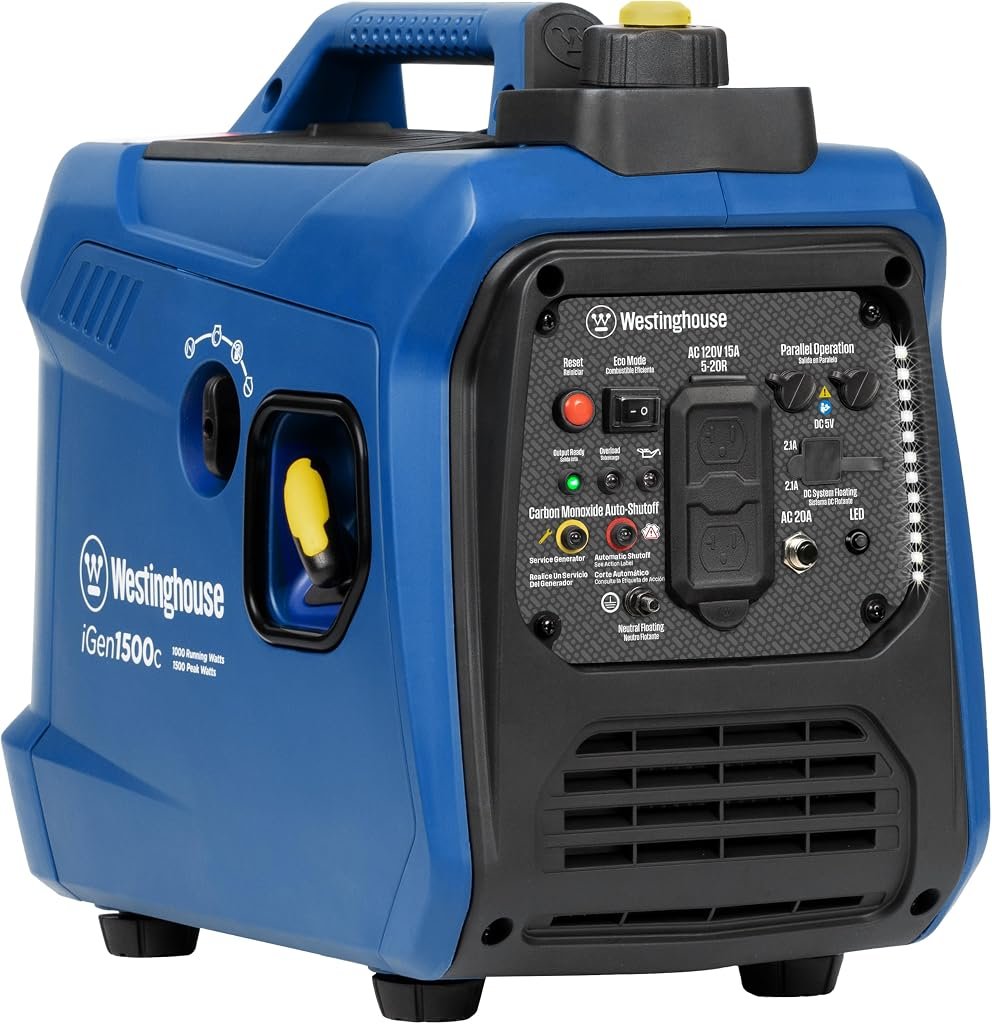
Small generators are easy to misunderstand. Their low weight and compact dimensions suggest simplicity, while the wattage printed prominently on the housing can imply considerably more electrical capacity than they actually provide continuously. The Westinghouse iGen1500c is a useful example of why those distinctions matter. It is rated for 1,500 peak watts, but its sustained gasoline output is 1,000 watts.
That specification defines the machine more accurately than its headline number. The iGen1500c is not intended to reproduce household electrical service during an outage, operate a conventional central air-conditioning system or become the electrical center of a large RV. Instead, it is a compact gasoline inverter generator aimed at modest loads where portability, fuel economy, relatively low acoustic output and clean inverter power carry substantial weight.
Our score is 8.38/10, a rating that reflects a particularly coherent small-generator design rather than exceptional raw output. Customer Sentiment stands at 8.28, Buyer Confidence at 8.96, and Value at 8.15. The scores sit relatively close together, suggesting fewer contradictions than are often found in portable generators: the iGen1500c largely does what its specification promises, provided the buyer genuinely needs only 1,000 running watts.
At a reference price of $349-a price also listed by a major retailer-the central question is therefore not whether the Westinghouse produces enough power in some abstract sense. It is whether 1,000 continuous watts are enough for the particular job.
The 1,500-Watt Label Needs Translation
The first entry in any responsible portable generator buying guide should explain the difference between peak and running output.
Westinghouse rates the iGen1500c at 1,500 peak watts and 1,000 running watts. Its gasoline engine is a 56cc four-stroke OHV design, producing 120V single-phase AC power at 60 Hz. The manufacturer specifies running current at 8.3 amps and peak current at 12.5 amps.
Peak wattage provides temporary capacity for short surges. Running wattage represents the sustained electrical load the generator is intended to carry. For actual purchasing decisions, 1,000 watts is therefore the more revealing figure.
That is not a criticism. It is simply the boundary around which the generator must be evaluated.
A collection of LED lighting, device chargers, networking equipment, a television, laptop or other relatively modest loads can fit comfortably within such an envelope when their actual power requirements are checked. Motor-driven appliances complicate the calculation because compressors and electric motors can require substantially more power while starting than during steady operation.
The safe method is arithmetic rather than intuition: identify the running wattage of every device expected to operate simultaneously, identify the largest relevant starting load, and compare those requirements with the generator’s ratings. Planning directly against the 1,000-watt ceiling leaves little room for unexpected demand.
The iGen1500c is consequently much easier to recommend for deliberately selected loads than for improvised emergency power.
Portability Is Central to the Design
Large portable generators sometimes stretch the definition of “portable.” A wheeled machine weighing well over 100 pounds can move across a garage floor, but loading it into a vehicle is another matter.
According to the Westinghouse iGen1500c specifications, the generator has a dry weight of 32 pounds and dimensions of 17 inches long, 10.5 inches wide and 16 inches high. A built-in carrying handle is integrated into the enclosure.
Those figures are not incidental. They define one of the generator’s strongest practical arguments.
A 32-pound generator can be moved between storage and an outdoor operating location without a wheel kit. It can fit into camping and tailgating arrangements where a larger open-frame generator would consume disproportionate space. It is also easier to reposition safely than a much heavier machine when the correct generator location is some distance from a house.
That last point matters because generator portability has a safety dimension. A unit that is easy to carry gives its owner fewer practical excuses for operating it too close to a building.
There is a corresponding compromise: the lightweight design is partly possible because this is a low-output machine with a small engine and modest fuel capacity. The iGen1500c cannot simultaneously deliver the portability of a 32-pound generator and the sustained electrical capacity of a much larger machine.
That trade is rational when low weight matters more than high output. It becomes restrictive when the buyer’s load calculation approaches or exceeds 1,000 watts.
Fuel Capacity and Runtime Tell a More Interesting Story
The iGen1500c has a 0.79-gallon, or 3-liter, gasoline tank. Westinghouse rates runtime at up to 12 hours at 25% load.
A quarter load corresponds to roughly 250 watts against the 1,000-watt running rating. That context is indispensable. Twelve hours should not be read as a universal runtime figure for every operating condition.
Fuel consumption rises as electrical demand increases. Someone operating near maximum sustained output should not expect the same runtime achieved under a light 25% load.
Even so, the published figure illustrates what inverter technology and economy control can accomplish with a relatively small fuel tank. Westinghouse equips the generator with an economy mode, allowing engine speed to respond to demand rather than maintaining unnecessarily high speed under light loads.
That arrangement makes particular sense in applications where loads fluctuate. A campsite might spend long periods powering only lights, chargers or communications equipment. During a power outage, a carefully managed set of modest electronics can likewise impose far less than the generator’s full rated load.
There is no fuel gauge, however. That omission becomes more noticeable during extended operation because remaining runtime cannot be assessed through a conventional gauge. Owners must develop a sense of fuel consumption from operating time and load rather than simply glancing at an instrument.
Inverter Output Is a Major Part of the Proposition
The iGen1500c is not merely a small engine attached to an alternator. Its inverter architecture is one reason the product makes sense for modern portable-power applications.
Westinghouse specifies total harmonic distortion of 3% or less and explicitly positions the generator for sensitive electronic equipment.
That is relevant because the loads placed on a small generator increasingly include laptops, phones, networking hardware, televisions and charging electronics rather than only incandescent lamps and simple resistive appliances.
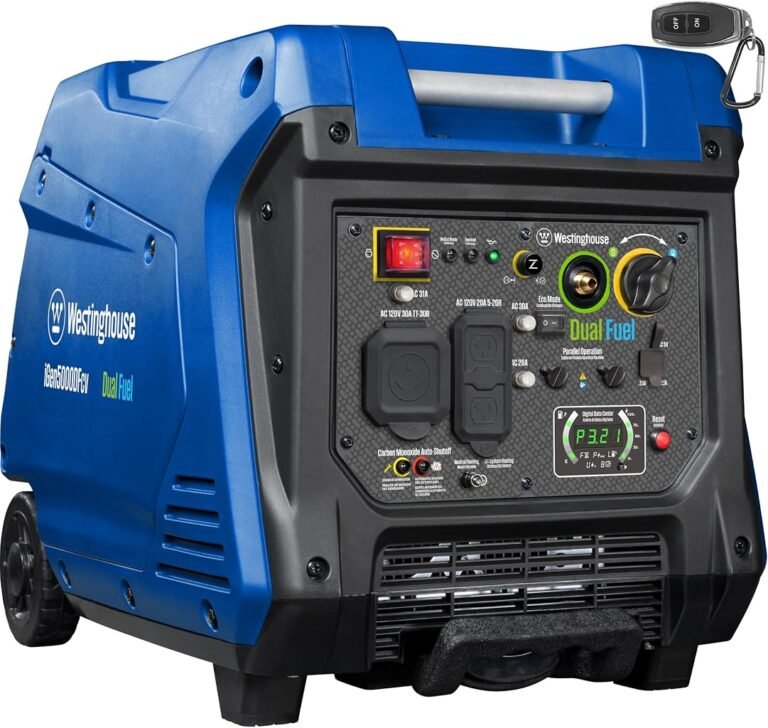
The control panel reflects that use case. The generator provides a duplex 120V 5-20R household receptacle and two USB ports, with outlet covers included.
Integrated USB connectivity is a modest feature, but on a 1,000-running-watt machine it is unusually appropriate. This generator’s natural workload includes small electronics, and direct USB connections reduce the number of AC adapters required.
The iGen1500c is also parallel capable. Westinghouse includes parallel cables, allowing connection to another compatible parallel-equipped Westinghouse inverter generator when additional capacity is required.
Parallel capability gives the machine an expansion path, but it should not distort the initial purchasing decision. Two generators mean two engines to maintain, store, transport and fuel. Anyone who routinely needs substantially more than 1,000 running watts should compare the economics and logistics of buying a larger generator from the outset.
Noise Is Low, but the Number Needs Context
Westinghouse publishes a noise figure of 52 dBA for the iGen1500c.
That figure helps distinguish the enclosed inverter design from many conventional open-frame generators, but generator noise specifications should never be interpreted without considering operating conditions and measurement procedures. Engine speed, electrical load, distance, surrounding surfaces and measurement position can all affect what a user actually hears.
Westinghouse’s economy mode is relevant here because the engine can reduce speed under lighter demand. The acoustic character of the machine therefore changes with its workload.
The practical point is not that 52 dBA guarantees silence. No gasoline engine becomes acoustically invisible. Rather, the iGen1500c has been designed around a use case in which lower noise matters: camping, residential backup of modest loads, tailgating and other settings where an open-frame generator running aggressively can become intrusive.
Its limited electrical output indirectly helps here. A 1,000-watt generator does not need the displacement required to produce several kilowatts continuously. The iGen1500c’s 56cc engine is correspondingly small.
For buyers whose requirements genuinely fit within its power envelope, that combination of compact engine, enclosure, inverter architecture and economy operation is more meaningful than chasing a much larger generator simply because higher wattage looks reassuring.
Recoil Starting Keeps the Machine Simple
Starting is entirely manual. The iGen1500c uses a recoil starter and manual choke. It does not include a starting battery.
That can be read in two ways.
Electric and remote starting are convenient, particularly on larger generators. Yet batteries introduce their own maintenance requirement. A generator that spends months in storage can greet an owner during an outage with a depleted starting battery unless that battery has been maintained.
Recoil starting avoids that particular failure point.
For a 32-pound generator built around a 56cc engine, manual starting is also proportionate to the machine. Adding an electric starter, battery and associated hardware would increase weight and mechanical complexity in a product whose strongest argument is compact simplicity.
Buyers with mobility or strength limitations may reasonably prefer electric starting. For everyone else, the recoil system fits the iGen1500c’s stripped-down approach.
The CO Sensor Is More Than a Specification-Line Feature
One of the iGen1500c’s more consequential features is its carbon-monoxide sensor with automatic shutdown. Westinghouse also specifies automatic low-oil shutdown and overload protection.
The CO feature deserves context because portable generators present a documented poisoning hazard.
According to the U.S. Consumer Product Safety Commission’s carbon-monoxide safety information, more than 100 people in the United States die each year from accidental non-fire carbon-monoxide poisoning linked to portable generators. The agency also states that a single portable generator can produce as much carbon monoxide as hundreds of cars.
Automatic shutdown therefore addresses a genuine risk rather than a hypothetical one.
It does not, however, make unsafe generator placement acceptable.
The CPSC instructs consumers to operate portable generators outside and at least 20 feet from the house, directing exhaust away from homes and other occupied buildings. The agency explicitly warns that opening windows or doors does not provide enough ventilation to prevent dangerous CO accumulation when a generator is improperly operated indoors.
The agency’s 2026 guidance points consumers toward models certified to current PGMA G300-2023 and UL 2201-2023 standards, which incorporate carbon-monoxide safety technologies.
The iGen1500c’s CO sensor should therefore be understood as an additional protective mechanism, not a substitute for outdoor operation and correct exhaust orientation.
Where 1,000 Running Watts Become Restrictive
The iGen1500c’s greatest advantage and greatest limitation come from the same design decision: it is small.
A buyer looking only at the 1,500-watt peak figure could easily overestimate what it can sustain. At 1,000 running watts and 120V only, this is not an all-purpose household backup generator.
Westinghouse does not describe it as RV-ready or transfer-switch-ready. That distinction helps frame appropriate expectations.
Its natural territory is selective portable power. Loads need to be managed rather than accumulated casually. A refrigerator or another appliance with a compressor requires attention to starting demand. High-wattage heating appliances can consume much or all of the available capacity by themselves. Large air conditioners belong in a different generator category.
This makes load planning unusually significant.
For emergency use, buyers should write down the exact equipment they intend to power before purchasing. Manufacturer nameplates or manuals provide a better basis for calculation than generic internet wattage charts because appliance consumption and startup behavior vary.
If those numbers fit comfortably within the iGen1500c’s 1,000-running-watt capacity, the machine becomes compelling. If they do not, portability cannot compensate for insufficient electrical capacity.
What the Scores Reveal
Our 8.38/10 overall score reflects a generator with a well-defined mission and relatively few mismatched features.
The 8.96 Buyer Confidence score is the highest of our four figures. That confidence comes from the coherence of the product itself. Westinghouse publishes detailed specifications, including output, runtime, engine displacement, tank capacity, THD, dimensions, weight, outlets and safety equipment. The manufacturer also provides three-year limited residential warranty coverage, with one-year limited coverage for commercial use.
Customer Sentiment at 8.28 sits close to the overall rating. It supports the view that the product’s strengths are practical rather than cosmetic: low weight, straightforward controls, inverter output and a manageable operating format.
The 8.15 Value rating is positive but slightly more restrained. At the $349 reference price, buyers receive a compact inverter generator with a CO sensor, USB connectivity and parallel capability. Yet $349 also buys only 1,000 running watts, and that limitation cannot be ignored merely because the machine is well executed.
Value therefore depends heavily on whether portability is being purchased intentionally.
Someone who needs 800 watts and values a 32-pound generator can reasonably see strong value here. Someone who needs 1,800 continuous watts is not receiving better value by buying a machine incapable of supplying the required load.
That distinction explains why Buyer Confidence exceeds Value.
Maintenance and Storage Still Matter
Compact dimensions do not eliminate combustion-engine maintenance.
Westinghouse specifies 10W-30 engine oil and an oil capacity of 9.28 ounces, or 0.29 quart. The generator uses unleaded gasoline and includes automatic low-oil shutdown.
The owner’s manual remains required reading because storage practices, oil changes, spark-plug inspection and fuel-system care determine whether a gasoline generator starts reliably after sitting unused.
This matters particularly for emergency equipment. A generator can spend far more time waiting than running. The first start after months of storage may occur during a storm or grid outage, precisely when troubleshooting stale fuel or neglected maintenance is least convenient.
The iGen1500c’s simplicity helps. There is no electric-start battery requiring periodic attention, and the small engine reduces the physical scale of routine service. Yet gasoline itself remains a storage consideration, and owners should follow the manufacturer’s current fuel and maintenance instructions rather than treating the machine as maintenance-free.
Who Should Buy the Westinghouse iGen1500c?
The iGen1500c is best understood as a personal-scale portable power source rather than a miniature whole-home generator.
Its most meaningful strengths include:
- 1,500 peak watts and 1,000 running watts.
- 32-pound published dry weight.
- Compact 17 × 10.5 × 16-inch dimensions.
- Up to 12 hours of runtime at 25% load.
- 0.79-gallon gasoline tank.
- 52 dBA published noise level.
- ≤3% total harmonic distortion.
- Duplex 120V household receptacle plus two USB ports.
- Economy mode.
- Parallel capability with cables included.
- Automatic low-oil shutdown.
- Carbon-monoxide sensor and shutdown.
- Overload protection.
- Three-year limited residential warranty.
The less suitable buyer is someone expecting to run several substantial appliances simultaneously, connect directly through a home transfer-switch arrangement, operate 240V equipment, use propane as an alternative fuel or rely on electric starting.
There is no dual-fuel capability here. There is no electric start, fuel gauge or 240V output. Westinghouse also identifies the model as neither transfer-switch-ready nor RV-ready.
Those are meaningful boundaries, not defects hidden behind marketing language.
A Small Generator That Benefits From Realistic Expectations
The portable-generator market encourages wattage escalation. Buyers understandably worry about purchasing too little capacity, so moving from 1,500 peak watts toward 2,500, 4,000 or 5,000 watts can feel safer.
But unused capacity carries costs of its own. Larger engines generally mean more weight, more storage volume and more fuel consumption. For a person whose actual load is a few hundred watts, buying several kilowatts of capability can turn a portable tool into an awkward piece of machinery that rarely moves.
The iGen1500c presents the opposite proposition.
It asks the buyer to calculate first.
If 1,000 running watts cover the intended loads with adequate margin, its 32-pound weight becomes highly attractive. If those loads require 1,500 watts continuously, the model should be rejected regardless of its portability, noise specification or inverter quality.
That clarity is part of why our 8.38/10 rating is relatively strong. The generator’s weaknesses are largely consequences of its category rather than inconsistencies in its design.
Final Considerations
The Westinghouse iGen1500c is a focused portable inverter generator. Its 1,500-watt peak rating attracts attention, but the 1,000-watt continuous rating is the number that should determine whether it belongs in a household, vehicle, campsite or emergency kit.
Within that electrical boundary, the design is persuasive. A 32-pound dry weight and compact enclosure make genuine portability possible. A 0.79-gallon tank paired with up to 12 hours of operation at 25% load addresses light-load endurance. Economy mode, ≤3% THD, USB connectivity and parallel capability give the generator a feature set appropriate to modern small-load applications. The integrated CO sensor also adds a meaningful safety layer, though CPSC guidance on outdoor placement remains non-negotiable.
Our 8.38/10 score captures that balance. Buyer Confidence at 8.96 reflects a clearly documented, logically configured product. Customer Sentiment at 8.28 reinforces the generally positive assessment. Value at 8.15 is slightly lower because the $349 reference price must be weighed against a firm 1,000-running-watt ceiling.
There is no reason to disguise that ceiling. The iGen1500c is not designed for heavy household backup, 240V equipment or broad appliance coverage. Its strengths emerge when the assignment is narrower: portable electricity for carefully selected loads, delivered by a machine light enough that “portable” retains its ordinary meaning.
For the right workload, that restraint is an advantage. The buyer who calculates electrical demand before shopping gets a compact generator with little wasted capacity. The buyer who shops from the 1,500-watt headline alone risks expecting a machine that does not exist.