Portable generators invite a deceptively simple comparison: wattage, price, weight, runtime. Yet those four figures rarely tell the whole story. A machine intended to spend most of its life stored in a garage, transported to campsites or waiting for a power failure has to reconcile conflicting demands. It needs enough electrical capacity to be useful without becoming difficult to carry, enough fuel capacity to run for meaningful periods without adding excessive bulk, and enough protective technology to make operation less hazardous.
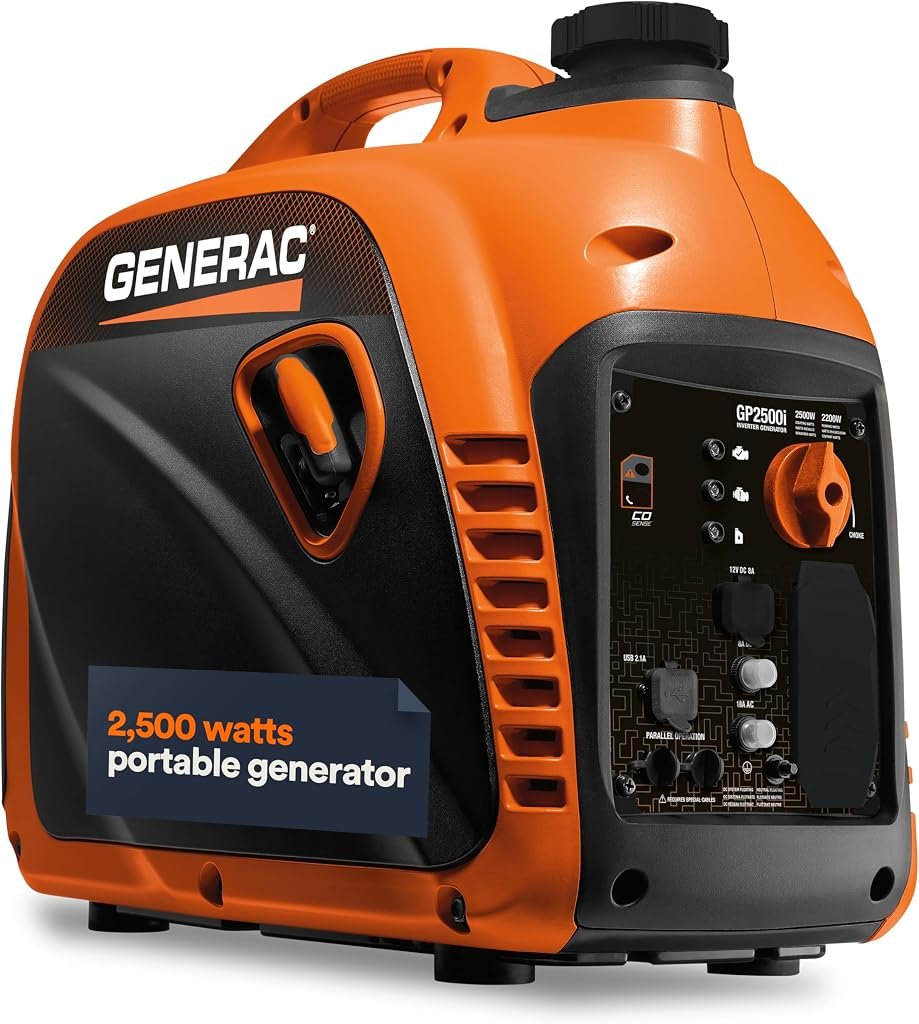
The Generac GP2500i approaches that equation with a relatively focused specification. It produces 2,500 starting watts and 2,200 running watts, weighs 48 pounds, carries one gallon of gasoline, uses a 98cc OHV engine, and incorporates inverter technology, Economy Mode, USB charging, parallel capability and Generac’s COsense carbon-monoxide detection system.
Those numbers place it well above ultralight generators intended mainly for electronics, but below the larger machines intended to support substantial portions of a household. It is a middle-sized portable power source in the literal sense: enough capacity to make load planning interesting, yet compact enough to remain genuinely movable.
Our score is 7.86/10. Customer Sentiment stands at 7.62, Buyer Confidence at 8.61, and Value at 7.79. The differences among those ratings matter. Buyer Confidence leads because the GP2500i has a clearly documented specification and a coherent design. Value is respectable rather than exceptional, while Customer Sentiment sits slightly lower. The overall picture is of a capable generator whose strongest argument is balance rather than dominance in any single specification.
The 2,500-Watt Number Requires Context
The first calculation in a portable generator buying guide should begin with running wattage rather than the largest number printed on the generator.
According to Generac’s GP2500i specifications, the generator produces 2,500 starting watts and 2,200 running watts. At 120 volts, its rated current is 18.3 amps.
That 300-watt difference between maximum starting output and sustained output is significant because appliances containing electric motors or compressors can draw additional power during startup. A refrigerator, pump or other motor-driven load cannot always be evaluated solely by its normal operating consumption.
The 2,200-watt continuous rating is therefore the more useful baseline for planning.
This amount of power opens considerably more possibilities than a 1,000-watt compact generator, but it remains far removed from whole-house capability. A carefully selected combination of refrigeration, lighting, communications equipment and small electronics may fit comfortably. High-resistance heating appliances, large air conditioners and multiple motor-driven loads can consume the available capacity quickly.
The right approach is to inventory actual equipment rather than work from generic assumptions. Appliance labels and manufacturer manuals should establish running demand, while starting requirements need separate attention where motors or compressors are involved.
Operating a generator permanently near its maximum rating also leaves little flexibility for an unexpected startup surge. Electrical capacity is better treated as a budget than a target to be exhausted.
That distinction makes the GP2500i a generator for selective power rather than indiscriminate power.
A 98cc Engine in a 48-Pound Package
Generac builds the GP2500i around a 98cc OHV engine with variable engine speed. Starting is by recoil, with an integrated Off/Run/Choke control arrangement on the control panel. The unit measures approximately 19.7 inches long, 11.4 inches wide and 17.9 inches high and weighs 48 pounds.
The weight deserves particular attention.
Forty-eight pounds is not featherweight, especially when the generator must be moved repeatedly or carried over uneven terrain. Yet it is light enough for the word “portable” to retain practical meaning. Many higher-output conventional generators require wheel kits and can become awkward two-person lifting jobs. The GP2500i instead uses a compact enclosed format with an integrated handle.
That portability makes sense for camping, tailgating, outdoor projects and emergency storage. It also makes correct placement easier during an outage. A generator that can be moved without elaborate equipment is easier to position at the safe distance demanded by carbon-monoxide guidance.
There are no wheels to compensate for the 48-pound mass. Buyers with lifting limitations should consider that before purchase. Portability on a specification sheet and comfortable portability for a particular person are not identical ideas.
Still, the output-to-weight relationship is one of the GP2500i’s more convincing characteristics. The machine supplies 2,200 continuous watts without crossing into the weight class associated with many larger open-frame generators.
Fuel Capacity Reveals the Intended Workload
The GP2500i carries one U.S. gallon, or approximately 3.75 liters, of gasoline. Generac’s current specification lists runtime at eight hours at 25% of rated load and 4.5 hours at 50% load.
Those load percentages deserve translation.
Twenty-five percent of 2,200 running watts is approximately 550 watts. Half load is approximately 1,100 watts. The published runtime therefore describes two substantially different electrical workloads rather than promising a fixed number of operating hours regardless of demand.
This is where Economy Mode becomes relevant. Generac states that the feature automatically adjusts engine speed to reduce fuel consumption and sound emissions as demand changes.
The relationship between load and runtime should influence how the generator is used during an outage. Running every available appliance simultaneously may be convenient, but load management can extend the usefulness of a limited fuel supply. Refrigeration, charging and other intermittent requirements do not necessarily need to operate together continuously.
A one-gallon tank also creates a portability advantage. More fuel capacity would extend intervals between refueling, but gasoline weighs roughly six pounds per U.S. gallon before the additional tank structure is considered. Increasing capacity would inevitably work against the GP2500i’s compact design.
Generac has therefore made a recognizable trade: moderate onboard fuel capacity in exchange for lower size and weight.
Inverter Architecture Changes the Character of the Generator
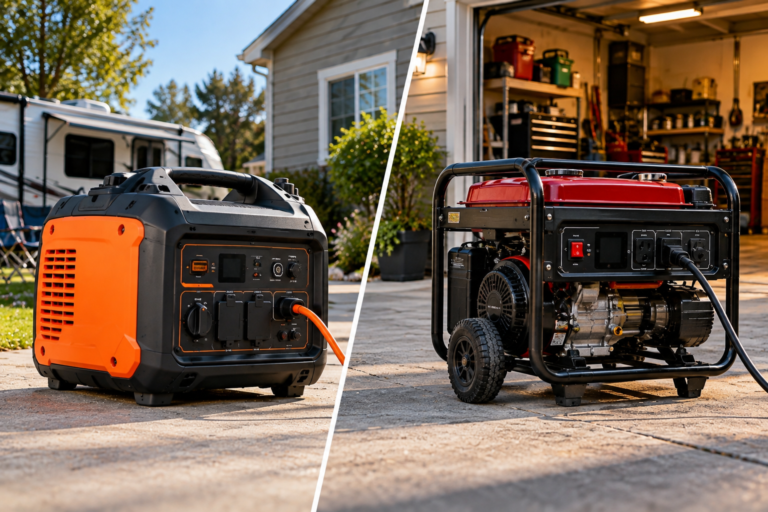
The GP2500i is an inverter generator rather than a conventional open-frame portable generator. Generac calls its electrical system TruePower Technology and describes it as providing clean, stable power suitable for sensitive electronics, tools and appliances.
That matters because portable power is no longer confined to incandescent work lights and basic power tools. Phones, computers, televisions, networking equipment, battery chargers and electronically controlled appliances are now common generator loads.
The enclosed inverter format also permits variable engine operation. Rather than maintaining one high engine speed under every workload, Economy Mode can respond to changing electrical demand.
There is a practical irony here. A generator can produce thousands of watts, yet some of its most common jobs may involve equipment drawing only a few dozen watts. Running a small electronic load should not require treating the engine as though the generator were continuously supplying its maximum output.
That flexibility is part of the appeal of inverter designs.
Generac also provides USB ports for charging mobile devices, covered outlets and LED status indicators for low oil, overload and ready-to-use conditions.
These are modest details individually, but together they make the control interface better suited to recreational and emergency electronics than a bare-bones generator panel.
Parallel Capability Provides an Expansion Route
The GP2500i is parallel ready. Generac states that two GP2500i units can be connected to increase available power, while the company’s specification identifies the parallel kit as a separately sold accessory.
The accessory provides L5-30R twist-lock and TT-30R RV receptacles, according to Generac’s specification.
Parallel capability is useful, but it deserves realistic interpretation.
Buying a second generator is not a cost-free upgrade. It means storing two machines, servicing two engines and transporting two fuel-burning devices. For an owner who only occasionally needs additional capacity, that flexibility can be attractive. For someone who knows from the beginning that substantially more than 2,200 running watts will routinely be required, a larger single generator may be operationally simpler.
Parallel readiness is therefore best regarded as insurance against changing requirements rather than a reason to deliberately undersize the initial purchase.
The GP2500i Is Gasoline-Only
Fuel flexibility is one area where the GP2500i remains straightforward: it is a gasoline generator.
Generac’s specification identifies a one-gallon fuel tank and unleaded fuel, with no propane operating mode.
That simplicity has advantages. There is no fuel-selector system or propane hose to manage. But buyers who prefer propane for long-duration storage or who want two fuel options during emergency conditions will need a different model.
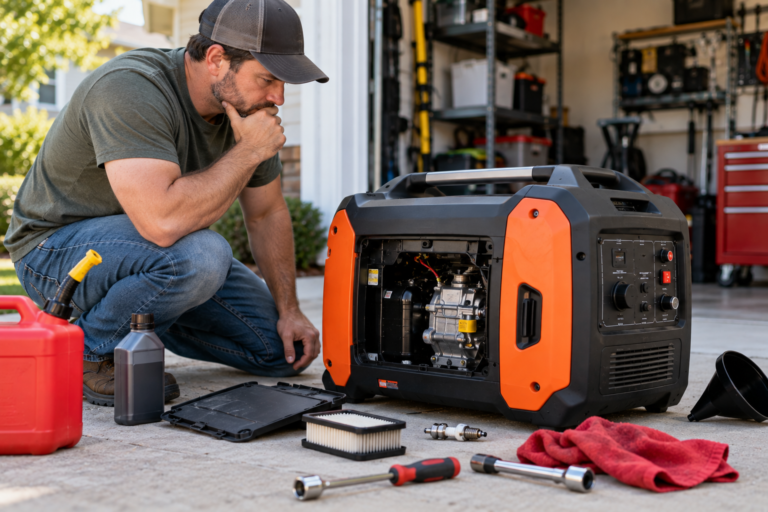
Gasoline itself requires planning. A generator purchased for outage preparedness can spend months without running, and fuel-system condition matters when the machine is finally needed. Storage procedures in the owner’s manual should therefore be treated as part of ownership rather than optional maintenance.
The GP2500i uses 10W-30 recommended oil and has an oil capacity of approximately 0.36 quart, or 0.35 liter. It also incorporates low-oil shutdown.
Low-oil protection helps protect the engine from damage, but it does not replace routine oil checks and scheduled maintenance.
Environmental Conditions Can Reduce Available Power
One easily overlooked section of Generac’s owner’s manual concerns environmental derating.
The manual states that maximum power decreases by approximately 3.5% for every 1,000 feet above sea level. It also says maximum power decreases approximately 1% for every 10°F above 60°F ambient temperature.
Those figures have real consequences.
A generator used at a high-elevation campsite cannot automatically be assumed to deliver the same maximum output as one operating near sea level. Hot weather introduces another reduction.
Consider a user who calculates appliance demand almost exactly against the generator’s nominal maximum capacity and then takes the machine to a mountain campsite. The arithmetic that appeared adequate at home may no longer provide sufficient margin.
This is why load planning should include headroom. Manufacturer ratings describe the machine under defined conditions; the environment can change what the engine can deliver.
For camping and outdoor use—two applications Generac explicitly associates with the GP2500i—altitude is not an obscure engineering detail.
Carbon-Monoxide Protection Is a Serious Feature
Generac equips the GP2500i with COsense Technology, a system intended to stop the generator when hazardous carbon-monoxide conditions are detected.
The significance becomes clearer when set against federal safety data.
The U.S. Consumer Product Safety Commission’s carbon-monoxide information states that more than 100 U.S. deaths each year are linked to portable generators. The agency also says one portable generator can produce as much carbon monoxide as hundreds of cars.
Those numbers make automatic CO detection much more than an accessory.
Yet COsense must not be interpreted as permission to place the generator wherever convenient. In its 2026 generator-safety guidance, the Consumer Product Safety Commission instructs users to operate generators outdoors at least 20 feet from homes and buildings, with exhaust directed away from windows, doors and vents. It explicitly warns against operation inside homes, garages, basements, crawlspaces, sheds and other enclosed areas, even when doors or windows are open.
The distinction is fundamental. COsense is an additional safety mechanism. Correct placement is the primary operating requirement.
The same logic applies to indoor carbon-monoxide alarms. Generator safety works through multiple layers rather than reliance on one sensor.
Starting Is Simple but Entirely Manual
The GP2500i uses recoil pull starting rather than an electric starter. Generac combines the Off, Run and Choke settings into a control-panel knob intended to simplify the startup sequence.
For this weight class, recoil starting is a reasonable engineering choice.
A battery and electric starter would add weight, cost and another component requiring maintenance during long storage periods. Batteries can discharge while a generator sits unused, which can undermine the convenience of electric starting precisely when emergency power is required.
Manual starting avoids that issue.
It does, however, create an accessibility consideration. Buyers who have difficulty operating recoil starters should not assume that compact size automatically means effortless startup. Electric-start models exist for a reason, particularly for users with mobility or strength constraints.
The GP2500i’s starting arrangement therefore fits its minimalist portable design, but it will not suit every owner equally well.
Where 2,200 Running Watts Are Enough
The GP2500i becomes easiest to understand when actual workload rather than abstract wattage drives the assessment.
At 2,200 running watts, it can address a useful collection of modest electrical loads. Emergency refrigeration, lights, communications equipment, charging devices and selected small appliances can fall within its capabilities when starting requirements and simultaneous demand are managed carefully.
The difficulty begins when “emergency power” is interpreted as “everything normally connected to the house.”
Electric water heating, large resistance heaters, central HVAC equipment, electric ranges and other high-demand devices belong to a very different electrical category. Even smaller appliances can create problems when several operate simultaneously.
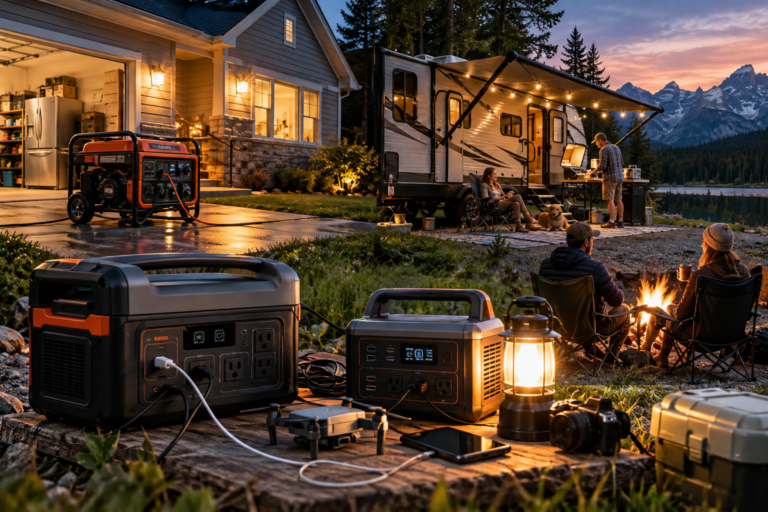
The same applies to recreational use. A campsite full of electronics and small devices presents a different load profile from an RV air conditioner with a substantial compressor startup requirement.
There is no substitute for checking actual equipment ratings.
This discipline also prevents unnecessary overspending. A household that needs only several hundred watts for communications and lighting does not automatically benefit from a huge generator. Conversely, a household requiring several kilowatts continuously will not make the GP2500i more capable by wishing away its 2,200-watt rating.
Good generator selection begins with the load, not the machine.
What the Scores Say About the Generac GP2500i
Our 7.86/10 overall score places the Generac GP2500i in solid territory while leaving room for meaningful reservations.
The 8.61 Buyer Confidence rating is the strongest of our four figures. Generac documents the GP2500i’s core specifications clearly: 2,200 running watts, 2,500 starting watts, a 98cc OHV engine, one-gallon fuel capacity, 48-pound weight, recoil starting and defined runtime figures. The product also carries a three-year limited residential warranty and one-year limited commercial warranty.
That documentation makes buyer fit easier to assess. The boundaries are visible before purchase.
Customer Sentiment at 7.62 is lower. That gap prevents the review from treating a well-specified machine as automatically satisfying every owner. Portable generators are unusually sensitive to expectations. A buyer seeking compact inverter power may see the GP2500i very differently from one expecting broad household backup.
Our 7.79 Value rating sits close to the overall score. The feature package is meaningful: inverter power, Economy Mode, COsense, USB charging, parallel capability, status lights and a manageable 48-pound chassis. Yet the generator remains gasoline-only, recoil-started and capped at 2,200 running watts.
The value proposition therefore depends on buying the correct size rather than extracting the maximum wattage per dollar.
Strengths and Limitations in Practical Terms
The GP2500i’s principal strengths are unusually easy to identify:
- 2,500 starting watts and 2,200 running watts.
- 98cc OHV gasoline engine.
- 48-pound published weight.
- One-gallon fuel capacity.
- Up to eight hours of runtime at 25% load.
- 4.5 hours at 50% load in the current specification.
- Economy Mode with variable engine speed.
- TruePower inverter technology for clean, stable output.
- COsense carbon-monoxide detection.
- USB charging capability.
- Parallel-ready architecture.
- LED low-oil, overload and ready indicators.
- Automatic low-oil shutdown.
- Covered outlets.
- Three-year limited residential warranty.
The limitations are equally concrete. It uses gasoline only. Starting is manual. Its 2,200-watt sustained output requires load management in home-backup scenarios. The one-gallon tank favors compactness over very long intervals between refueling. At 48 pounds, it is portable but not effortless for every user to carry.
Altitude and high ambient temperature can also reduce maximum available power, an issue that deserves more attention from buyers planning mountain or hot-weather use.
None of these limitations invalidate the design. They define the conditions under which it makes sense.
Final Considerations
The Generac GP2500i is best judged as a compact 2,200-running-watt inverter generator, not as a generic “2,500-watt” source of emergency electricity. That distinction immediately clarifies its strengths and boundaries.
Its 48-pound weight, 98cc engine, one-gallon fuel tank, inverter architecture and Economy Mode create a useful balance between electrical capacity and physical portability. Eight-hour runtime at 25% load gives light-load users meaningful endurance, while the published 4.5-hour figure at 50% load provides a more realistic reference for moderately demanding operation.
Safety equipment strengthens the package. COsense addresses a documented portable-generator hazard, and low-oil shutdown adds engine protection. Neither removes the owner’s responsibility to operate the machine correctly. Federal guidance remains explicit: gasoline generators belong outdoors, at least 20 feet from buildings, with exhaust directed away from openings.
Our 7.86/10 rating reflects those realities. Buyer Confidence at 8.61 is the strongest figure because the GP2500i is a clearly defined product with detailed manufacturer documentation. Value at 7.79 indicates a respectable relationship between capability and limitations. Customer Sentiment at 7.62 tempers the picture enough to reinforce the central lesson of generator shopping: satisfaction depends heavily on whether the machine was correctly sized in the first place.
The GP2500i is not a substitute for a large home-backup generator, nor does its 2,500-watt starting figure make it one. It is a portable inverter generator for selective loads, outdoor recreation and carefully managed emergency electricity.
That narrower identity is not a weakness. It is the reason the machine can remain under 50 pounds while delivering more than two kilowatts continuously. For buyers whose calculated electrical demand fits comfortably below 2,200 running watts—and who value portability, inverter output and automatic CO detection—the Generac GP2500i presents a disciplined balance of power and restraint.
The deciding calculation should happen before the generator is purchased: list the equipment, verify running and startup demand, account for environmental derating where relevant, and leave operating margin. Once those numbers are known, the GP2500i becomes much easier to judge. Its specifications do not promise unlimited backup power. They describe something more useful: exactly where this compact generator belongs.