A portable generator can be judged poorly in two opposite directions. The first mistake is assuming that the largest wattage number describes continuous output. The second is focusing so heavily on raw wattage that electrical quality, runtime, weight, noise, connections, safety systems and fuel logistics disappear from the calculation.
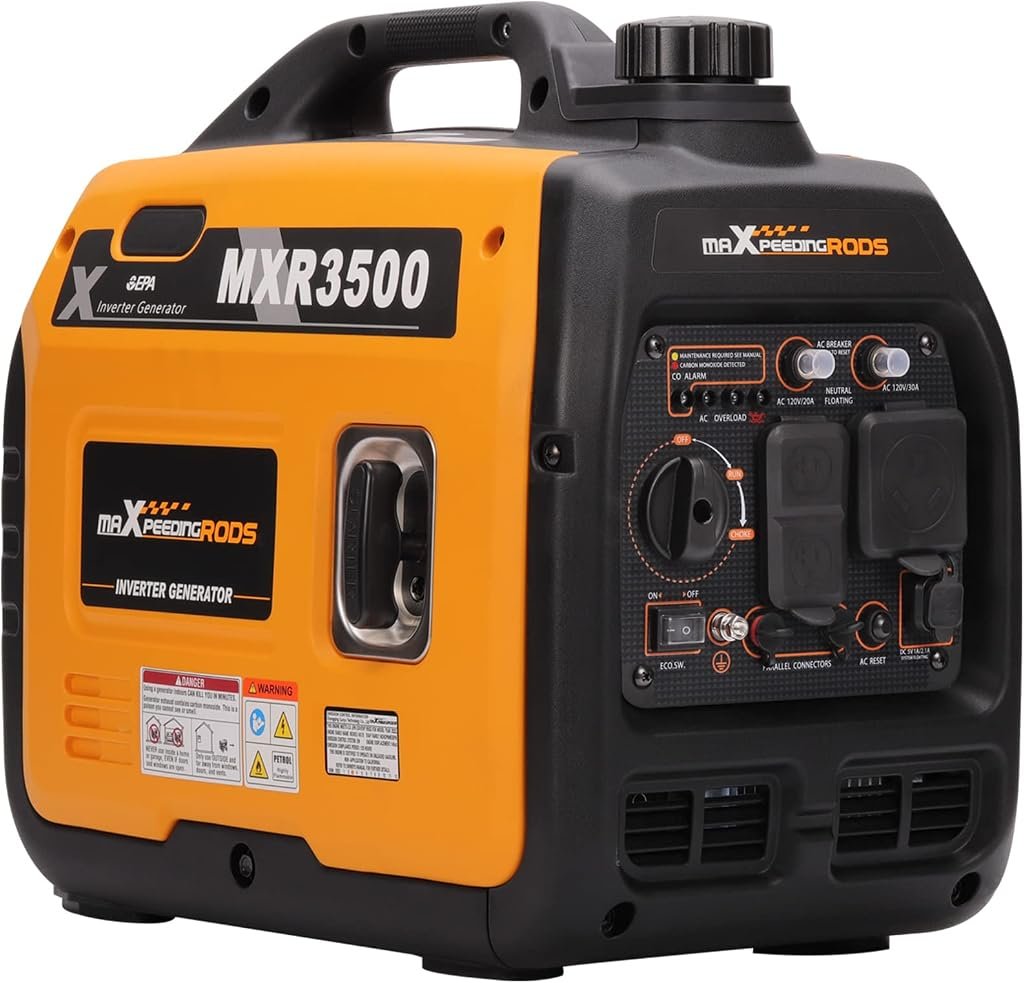
The maXpeedingrods 3500W Gas Inverter Generator illustrates why both approaches fail. Its headline rating is 3,500 starting watts, while sustained output is 3,000 watts. It produces 120V, 60Hz AC power from a 145cc four-stroke gasoline engine and uses inverter technology to supply a pure sine-wave output with total harmonic distortion rated at 3 percent or less. The manufacturer lists a 4-liter fuel tank, recoil starting, Eco mode, parallel capability, carbon-monoxide shutdown and several AC and USB connections.
At an evaluated price of $399.99, our score is 7.95/10. Customer Sentiment stands at 7.4, Buyer Confidence reaches 9.8, and Value is 7.67.
The unusual part of that scoring pattern is the gap between Buyer Confidence and the other measures. The generator’s specifications make its intended job relatively easy to define, supporting a high confidence rating. The overall score and Value rating are more restrained because this remains a gasoline-only, recoil-start, 120V generator with a finite 3,000-watt continuous ceiling. Customer Sentiment at 7.4 is lower still, reinforcing the need to judge the machine by fit rather than by its 3,500-watt headline.
The 3,500W Label Needs Immediate Translation
The first number that matters for ordinary operation is 3,000 watts.
The manufacturer’s current 3,500W gasoline inverter specifications list 3,500 peak watts and 3,000 running watts, along with 25 running amps and 29.2 peak amps at 120V.
That leaves a 500-watt difference between rated continuous and peak output.
The distinction exists because many electrical devices draw extra power during startup. Refrigerators, pumps, air conditioners and power tools containing motors can impose a brief surge before settling into their ordinary operating demand.
Peak output accommodates those short events. It is not an extra 500 watts available indefinitely.
A load plan approaching 3,000 watts continuously therefore leaves little room for another appliance to start. A refrigerator compressor cycling on while other equipment already consumes most of the generator’s running capacity can push the system toward overload.
This is why a credible portable generator buying guide begins with running watts and startup demand rather than the largest number printed on a product page.
The maXpeedingrods is fundamentally a 3,000-watt continuous generator with additional short-duration starting capacity.
The 145cc Engine Establishes the Mechanical Character
maXpeedingrods specifies a 145cc, air-cooled, four-stroke OHV gasoline engine.
The engine uses SAE 10W-30 oil, with a listed oil capacity of 450 milliliters. Starting is manual through a recoil system.
Those specifications establish a fairly conventional ownership routine despite the inverter electronics surrounding the engine.
Oil must be checked and changed. The air filter and spark plug require periodic attention. Fuel condition matters. Long storage requires more thought than placing the machine on a shelf and waiting for the next outage.
Recoil starting is also an important distinction at this price and output level.
There is no need to maintain a starter battery, which removes one storage concern. The trade-off is physical effort. Every cold start depends on the operator, the recoil mechanism and the engine being correctly prepared.
For occasional camping, that may be a minor issue. During an extended outage requiring repeated starts, electric starting can become more attractive.
The maXpeedingrods takes the simpler mechanical route.
Inverter Output Is a Major Part of the Proposition
The generator’s inverter architecture deserves more attention than its enclosure.
maXpeedingrods specifies pure sine-wave output with total harmonic distortion of 3 percent or less. That makes the electrical design relevant for modern electronics, including laptops, phones, tablets and other devices containing sensitive electronic power supplies.
Conventional portable generators and inverter generators can produce the same nominal 120V electricity while regulating that output differently.
An inverter model generates electricity, processes it electronically and supplies controlled AC output. It can also vary engine behavior as load changes rather than requiring the engine to operate in the same manner under every electrical condition.
That architecture is especially logical in a 3,000-running-watt generator because its likely workloads extend beyond pumps and power tools.
Camping equipment, RV electronics, computers, communications hardware, televisions and chargers all fit naturally into this output class.
The inverter is therefore not a decorative technical label. It helps define what kind of equipment the generator is intended to support.
Eco Mode Connects Noise, Load and Fuel Consumption
Eco mode allows engine operation to respond to electrical demand.
That matters because generators rarely experience perfectly constant loads.
A refrigerator compressor cycles. Battery chargers alter their demand. A television consumes far less electricity than a microwave. Power tools may run for seconds or minutes and then sit idle.
Operating the engine as though maximum output were required throughout that changing workload would waste fuel and generate unnecessary noise.
Eco mode addresses that mismatch.
Its usefulness is most apparent at lower loads, where the generator has substantial unused capacity. As demand rises, the engine must respond accordingly.
This also explains why noise and runtime claims need their operating conditions attached. A lightly loaded inverter generator in Eco mode is not acoustically or mechanically equivalent to the same generator delivering close to its full 3,000-watt running output.
The machine changes as the load changes.
Runtime Falls Sharply as Load Increases
The manufacturer lists up to 8.3 hours of runtime at quarter load and approximately 4.5 hours at 50 percent load.
Those percentages translate into useful numbers.
Twenty-five percent of the 3,000-watt running rating is 750 watts. Fifty percent is 1,500 watts.
The 8.3-hour figure therefore describes a generator supplying roughly 750 watts, not one delivering 3,000 watts.
That distinction matters during emergency planning.
A refrigerator, modem, several lights and device chargers may create a relatively modest average load. Add cooking equipment, a portable air conditioner or power tools, and fuel consumption changes substantially.
The 4-liter tank holds about 1.06 U.S. gallons. At quarter load, the published 8.3-hour figure works out to roughly 7.8 hours of rated runtime per gallon of tank capacity. That is only an arithmetic description of the manufacturer’s quarter-load specification, not a promise about operation at other loads.
At half load, the published runtime falls by almost half.
Fuel planning should therefore begin with the expected load rather than tank size alone.
A Four-Liter Tank Encourages Deliberate Fuel Planning
A small gasoline tank has two opposing effects.
It keeps the generator relatively compact and limits the amount of fuel carried inside the machine. It also means prolonged operation requires an external fuel supply and periodic refueling.
For camping, that may be perfectly manageable.
For a multiday outage, the fuel plan becomes more demanding.
An owner should think beyond how long one tank lasts. The more useful question is how much gasoline the expected daily workload will require and how that fuel will be stored safely.
High electrical demand compounds the issue. A generator operated near half load consumes its tank materially faster than the quarter-load runtime headline suggests.
The 4-liter capacity therefore fits the machine’s portable character, but it does not create long-duration independence.
Gasoline remains both the generator’s energy source and one of its logistical constraints.
Fifty-Eight Decibels Needs Context
maXpeedingrods lists a noise level of 58 dB measured at 23 feet.
That number helps position the generator within the broader portable-generator category, but acoustic figures should never be detached from operating conditions.
Engine load affects noise. So do distance, terrain, nearby walls and the orientation of the machine. A generator on an open campsite behaves acoustically differently from the same machine placed beside a hard wall that reflects sound.
The manufacturer associates the 58 dB figure with the generator’s quieter inverter-oriented operation. It should not be interpreted as a fixed sound level under every load.
Distance also matters greatly.
Sound measured 23 feet away is not the sound experienced by someone standing beside the enclosure.
For campground use, local operating-hour rules remain relevant regardless of a generator’s published noise specification. A relatively quiet combustion generator is still a combustion generator, and neighboring campers may hear it.
At Roughly 47 Pounds, Portability Is Credible
The manufacturer lists net weight at 21 kilograms, approximately 46.3 pounds, and describes the generator at about 47 pounds in its feature material.
Its dimensions are 48 by 29 by 44 centimeters, roughly 18.9 by 11.4 by 17.3 inches.
That gives the maXpeedingrods a practical advantage over larger open-frame generators weighing 100 pounds or more.
A roughly 47-pound machine can realistically be carried by many adults over short distances. It can be loaded into a vehicle without the wheel-and-handle systems that become almost mandatory on heavier generators.
That does not make 47 pounds trivial.
Repeated lifting into a pickup bed, RV compartment or storage shelf can still be awkward, particularly because a generator is a bulky object rather than a balanced gym weight.
Gasoline adds further operating weight.
Even so, portability here is more than a marketing description. The combination of an enclosed suitcase-style form and sub-50-pound net weight supports actual transport between storage, vehicle and campsite.
The Outlet Configuration Fits RV and General 120V Use
The control panel provides two 120V 20A outlets, one 120V 30A outlet and two USB connections.
That combination gives the generator a useful range of connection options.
The 20A outlets suit common 120V equipment. The 30A connection broadens its relevance for RV-oriented use and other compatible loads. USB outputs allow smaller electronics to connect without consuming a household-style receptacle.
The electrical budget remains 3,000 running watts across the generator.
A 30A receptacle does not mean the generator can somehow exceed its rated continuous power. Outlet capacity and generator capacity are separate constraints.
This becomes especially important in RV use.
Air conditioning can impose substantial startup demand. A microwave or other high-wattage appliance operating at the same time can consume a large share of the generator’s available output.
Connection convenience should never be mistaken for unlimited simultaneous operation.
The 120V Architecture Creates a Firm Boundary
This generator is rated for 120V, 60Hz output.
That makes it suitable for many recreational, job-site and emergency loads but excludes equipment requiring 240V.
The distinction is easy to overlook when shopping primarily by wattage.
A 3,000-watt 120V generator cannot operate a 240V appliance merely because that appliance consumes fewer than 3,000 watts. Voltage compatibility comes first.
For home backup, that means the maXpeedingrods is best understood as a selected-load generator.
Refrigerators, freezers, lights, electronics, communications equipment and compatible 120V appliances can form a realistic emergency plan. Large central household systems may require a different electrical architecture.
This is one reason Buyer Confidence can remain high even though the overall score is lower.
The limitation is clear.
A buyer who checks appliance voltage before purchase can quickly establish whether this machine fits the intended workload.
Parallel Capability Creates an Expansion Route
The generator is parallel ready.
maXpeedingrods sells a compatible parallel kit for the MXR3500 and several related models, allowing two compatible generators to be linked for greater available output.
Parallel capability can be useful for owners whose power requirements vary sharply.
One generator can handle lighter trips or smaller emergency loads. A second compatible unit can increase available capacity when needed.
There is an obvious economic counterweight.
Two generators mean two engines, two maintenance schedules, more storage space and more fuel management. The parallel hardware also becomes part of the system.
If a buyer already knows that 3,000 running watts will be inadequate almost every time the generator is used, purchasing one small unit with plans to add another may be less efficient than selecting a larger machine initially.
Parallel capability works best as optional expansion rather than compensation for poor sizing.
The CO Shutdown System Is Backup Protection
The maXpeedingrods includes automatic carbon-monoxide shutdown.
That is a meaningful safety feature because gasoline combustion produces carbon monoxide, an odorless and colorless toxic gas.
The sensor does not make garages, sheds or other enclosed operating areas acceptable.
Current CDC generator safety guidance says generators should be kept outside at least 20 feet from doors, windows and vents. The agency also recommends functioning carbon-monoxide detection inside the home.
The distance requirement has practical consequences.
An owner needs a safe outdoor operating location, appropriately rated extension cables and a plan for keeping electrical connections safe from weather without trapping exhaust.
That should be established before an emergency.
Waiting until a nighttime outage to discover that the only convenient generator location sits beside an open window is poor preparation.
Carbon Monoxide Risk Is Not Abstract
The U.S. Consumer Product Safety Commission provides unusually stark context for portable-generator exhaust.
Its carbon-monoxide safety information reports that more than 200 people in the United States die each year from accidental non-fire carbon-monoxide poisoning associated with consumer products, with more than 100 deaths linked to portable generators.
The agency also states that one portable generator can produce the same amount of carbon monoxide as hundreds of cars.
That comparison should reshape how owners think about an enclosed inverter generator.
A tidy plastic enclosure and relatively quiet operation can make a small generator feel less industrial than a large open-frame machine. The exhaust chemistry does not care about appearance.
Carbon-monoxide shutdown is valuable precisely because dangerous conditions can arise. Correct outdoor placement remains the primary operating discipline.
Recoil Start Keeps the Design Simple
The MXR3500 uses recoil starting.
There is a certain mechanical honesty to that arrangement.
There is no starter battery waiting to discharge during months of storage, no remote fob to misplace and no electric-start system adding weight and complexity.
The owner pulls the starter cord.
The disadvantage is equally obvious.
Cold starts, repeated starts and users with limited upper-body strength may find an electric-start generator more convenient. A machine stored for emergency use should also be started periodically so the owner is familiar with the procedure before power fails.
Recoil starting is neither inherently good nor bad. It is a design choice that trades convenience for simplicity.
At roughly 47 pounds and 3,000 running watts, that trade fits the generator’s stripped-down portable identity.
Maintenance Cannot Be Treated as Optional
Inverter electronics do not eliminate combustion-engine maintenance.
The generator still contains oil, a spark plug, an air filter, a fuel system and an engine exposed to heat and combustion deposits.
The owner should follow the manufacturer’s maintenance intervals and storage procedures.
Gasoline deserves particular attention during extended storage. Fuel condition can deteriorate, and residual gasoline in small-engine fuel systems can create starting problems after long periods of inactivity.
Emergency equipment creates an unusual ownership problem: inactivity can be normal right until reliability becomes urgent.
A generator purchased for outages should therefore be exercised and inspected during ordinary conditions.
Oil level, fuel condition and basic operation are much easier to address on a calm weekend than during a storm.
Buyer Confidence at 9.8 Reflects Specification Clarity
Our Buyer Confidence score is 9.8, substantially higher than the overall 7.95/10 rating.
That difference is deliberate.
The generator’s intended operating envelope is relatively easy to map.
It provides 3,000 running watts and 3,500 starting watts. It is gasoline powered. Output is 120V at 60Hz. The engine displacement is 145cc. Tank capacity is 4 liters. Published runtime is 8.3 hours at quarter load and 4.5 hours at half load. Noise is listed at 58 dB at 23 feet. Net weight is about 21 kilograms. Pure sine-wave inverter output is rated at no more than 3 percent THD.
Those figures allow meaningful pre-purchase calculations.
A buyer can inspect appliance labels, add running loads, account for startup demand and check voltage compatibility.
High Buyer Confidence does not mean the generator suits every buyer. It means its boundaries can be identified with relatively little ambiguity.
Customer Sentiment at 7.4 Creates a More Restrained Picture
Customer Sentiment is 7.4, the lowest of our four ratings.
That score tempers the technical clarity represented by Buyer Confidence.
A generator can have a coherent specification sheet without producing equally high satisfaction across every ownership scenario. Portable gasoline equipment introduces variables that battery products do not: starting behavior, fuel storage, oil maintenance, exhaust, vibration and mechanical wear.
The maXpeedingrods also operates in a crowded output class.
Buyers can find alternatives offering electric start, dual-fuel capability, larger tanks or different outlet arrangements. Those features may matter more than small differences in headline wattage.
Our 7.4 Customer Sentiment rating therefore reinforces a simple editorial point: this generator should be selected for its specific combination of weight, inverter output and price rather than because 3,500 watts sounds universally sufficient.
Value at 7.67 Reflects Real Trade-Offs
Our Value score is 7.67 at an evaluated price of $399.99.
The machine provides meaningful hardware for that expenditure: a 145cc engine, 3,000 running watts, inverter output, Eco mode, CO shutdown, parallel capability, multiple 120V outlets and USB connections in a roughly 47-pound package.
Yet price cannot erase feature omissions.
The generator is gasoline only. Starting is manual. Output is 120V. The fuel tank is relatively compact. Buyers seeking propane flexibility, electric starting or 240V capability must look elsewhere.
That is why Value sits below the overall score.
The machine can be economically rational for a buyer whose needs line up closely with its design. Paying for features that are not present would obviously be impossible; paying less because those features are unnecessary can be sensible.
The mistake would be treating a lower purchase price as compensation for missing functionality that the owner actually needs.
Who Is Most Likely to Benefit?
The maXpeedingrods 3500W Gas Inverter Generator is most naturally aligned with:
- Campers who need more output than a small 2,000-watt-class inverter can provide.
- RV users whose electrical loads fit within the 120V, 3,000-running-watt envelope.
- Households seeking selective emergency backup for compatible 120V appliances.
- Users who value pure sine-wave inverter output for electronics.
- Buyers who can work comfortably with recoil starting.
- Owners who prefer a roughly 47-pound generator over heavier open-frame designs.
- Users who see parallel capability as a plausible future expansion path.
- Buyers prepared to store and maintain gasoline safely.
It is less suitable for buyers who require 240V output, propane capability, remote or electric starting, extremely long single-tank runtime or sustained electrical demand close to or above 3,000 watts.
A Pre-Purchase Load Audit Is Essential
Before purchase, the buyer should build an operating plan rather than relying on the 3,500W label:
- List every appliance expected to run.
- Record each appliance’s normal operating wattage.
- Identify startup demand for refrigerators, pumps, air conditioners and power tools.
- Keep sustained combined demand beneath 3,000 watts.
- Leave practical headroom for loads that cycle automatically.
- Confirm that every intended AC appliance operates at 120V.
- Estimate fuel needs using the expected load rather than the quarter-load runtime alone.
- Decide whether recoil starting is appropriate for every likely operator.
- Identify an outdoor operating location at least 20 feet from doors, windows and vents.
- Use properly rated outdoor extension cables.
- Maintain functioning carbon-monoxide detectors inside occupied buildings.
- Plan gasoline storage before a prolonged outage.
- Account for oil changes, air-filter care and spark-plug maintenance.
- Decide whether parallel operation is genuinely likely before assigning much economic value to that feature.
That exercise is more useful than comparing peak-watt labels between generators.
Final Considerations
The maXpeedingrods 3500W Gas Inverter Generator earns our 7.95/10 score by offering a coherent mixture of usable output, inverter power quality, manageable weight and relatively simple mechanical design.
Its 3,500-watt headline needs immediate translation into the figure that governs sustained operation: 3,000 watts.
That capacity is meaningful. It can support a carefully planned collection of camping, RV or emergency loads, particularly when those loads are 120V and their combined startup behavior has been calculated before operation.
The inverter system strengthens the proposition. Pure sine-wave output with rated THD of 3 percent or less makes the generator more naturally suited to electronics than raw wattage alone would suggest. Eco mode gives the engine a way to respond to changing loads, while parallel capability creates a route to greater output if a compatible second generator is added later.
The physical design also deserves credit. At roughly 47 pounds, this machine belongs to a very different portability class from 100-pound home-backup generators. A 4-liter tank and compact enclosure make transport easier, although the smaller fuel supply also means runtime must be considered carefully during extended operation.
The published 8.3-hour runtime figure deserves the same discipline as the 3,500-watt headline. It applies at quarter load, roughly 750 watts. At 50 percent load, or about 1,500 watts, the published figure falls to 4.5 hours. Runtime and electrical demand are inseparable.
Buyer Confidence at 9.8 is the strongest rating because the machine’s operating boundaries are relatively clear. Customer Sentiment at 7.4 introduces more caution, while Value at 7.67 reflects the compromises of gasoline-only operation, recoil starting and 120V output.
Those scores are not contradictory.
They describe a generator that is easy to understand but more selective in its ideal buyer.
For someone needing dual fuel, 240V output or push-button starting, the maXpeedingrods is the wrong architecture regardless of price. For a buyer seeking approximately 3,000 watts of continuous 120V inverter power in a sub-50-pound gasoline generator, its design is far more coherent.
Safety remains non-negotiable. The CO shutdown system is useful secondary protection, but a gasoline generator still belongs outdoors, at least 20 feet from doors, windows and vents, with exhaust directed away from occupied structures. The generator’s relatively quiet enclosed design does not change the chemistry of combustion.
The final judgment therefore rests less on 3,500 watts than on a series of smaller numbers: 3,000 running watts, 120 volts, 145cc, 4 liters, 8.3 hours at quarter load, 4.5 hours at half load, roughly 47 pounds and THD at or below 3 percent.
Together, those figures describe the generator more accurately than its name ever could.