Portable power stations have inherited some of the vocabulary of gasoline generators while behaving according to a very different set of rules. There is no engine displacement, fuel tank or exhaust system to evaluate. Instead, the central numbers are battery capacity, inverter output, surge capability, charging rate, battery chemistry and cycle life.
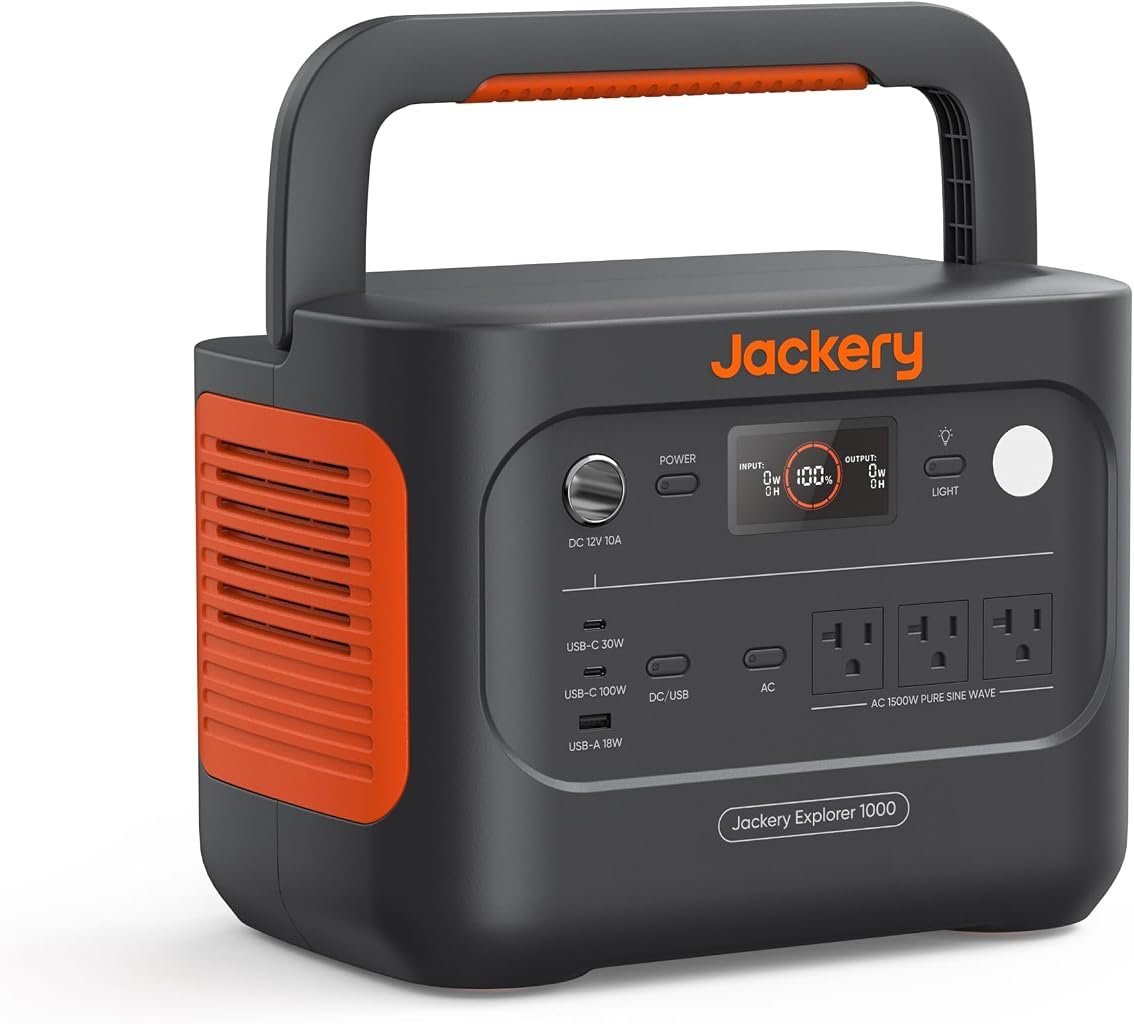
The Jackery Explorer 1000 v2 makes those distinctions unusually important. It combines a 1,070Wh lithium iron phosphate battery with 1,500W of rated AC output and a 3,000W surge rating. Jackery specifies three 120V AC outlets, two USB-C ports, one USB-A port and a 12V automotive output. Its battery is rated for 4,000 cycles while retaining at least 70 percent capacity.
Those numbers define a machine intended to sit between small device-charging batteries and much larger home-backup systems. It can operate equipment that tiny battery packs cannot realistically support, yet 1,070Wh of stored energy imposes an unavoidable limit on how long high-power appliances can run.
At the evaluated price of $499, our score is 9.01/10. Customer Sentiment stands at 8.94, Buyer Confidence reaches 9.8, and Value is 8.52. That pattern describes a product whose electrical identity is unusually easy to understand. The lower Value rating reflects a harder reality: battery power stations provide silence, indoor usability and minimal routine maintenance, but stored electrical energy remains finite.
Watts and Watt-Hours Answer Different Questions
The Explorer 1000 v2 becomes much easier to evaluate once two specifications are separated: 1,500W and 1,070Wh.
Watts describe power. Watt-hours describe stored energy.
Jackery rates the unit for 1,500W of continuous AC output and 3,000W of surge output. Its battery capacity is 1,070Wh.
Those figures answer different questions.
The 1,500W rating helps determine whether an appliance can operate at all. A device requiring more continuous power than the inverter can supply falls outside the normal operating envelope.
The 1,070Wh figure helps determine how long compatible equipment can operate before the battery requires recharging.
A hypothetical 100W load consuming exactly 100 watts continuously would mathematically use 1,000Wh in ten hours. Real AC runtime will differ because inverter conversion, internal electronics, temperature and other losses consume part of the stored energy.
The same arithmetic becomes less forgiving as appliance power rises.
A 1,000W appliance could theoretically consume nearly the entire nominal battery capacity in little more than an hour before conversion losses are considered. A 50W device belongs to an entirely different endurance category.
Any portable generator buying guide that includes battery power stations should therefore treat watts and watt-hours separately. Combining them into a vague idea of “power” obscures the most important purchasing calculation.
The 1,500W Inverter Creates a Broad but Finite Appliance Range
A 1,500W inverter gives the Explorer 1000 v2 enough output for far more than phones and laptops.
Jackery specifies three AC outlets supplying 120V at 60Hz, with total rated AC output of 1,500W and surge capacity of 3,000W.
That makes many ordinary appliances plausible loads provided their actual requirements remain within the inverter’s limits.
The distinction between continuous and surge output resembles the running-versus-starting-watt calculation used with combustion generators. Appliances containing motors and compressors may briefly demand additional power when starting.
The 3,000W surge figure provides short-duration headroom for those events.
It does not turn the unit into a 3,000W continuous power station.
That boundary matters because a buyer can easily mistake a surge specification for usable sustained capacity. The normal AC budget remains 1,500W.
For refrigerators, communications equipment, lighting, computers, televisions and many portable appliances, that is substantial. High-demand electric heating and cooking equipment can consume the available inverter capacity much more aggressively.
A 1,070Wh Battery Rewards Load Discipline
The Explorer’s output rating attracts attention, but its energy capacity determines endurance.
A 1,070Wh battery contains a little over one kilowatt-hour of nominal stored energy.
That can be generous or restrictive depending on the load.
Low-power electronics barely resemble high-wattage appliances from the battery’s perspective. A laptop drawing tens of watts can operate or recharge repeatedly. Lighting can consume comparatively little. A refrigerator cycles rather than necessarily drawing its rated operating power continuously.
Electric heating is another matter.
Anything converting electricity directly into substantial heat can drain a roughly 1kWh battery rapidly. Space heaters, electric kettles, hot plates and similar equipment can impose loads approaching the inverter’s continuous limit.
This produces one of the Explorer 1000 v2’s central trade-offs: the inverter can run some demanding appliances that the battery cannot run for very long.
Capability and endurance are separate.
That distinction should shape emergency planning. The power station is much better suited to preserving critical lower-demand equipment over time than casually supplying high-wattage loads simply because the inverter can start them.
LiFePO4 Chemistry Changes the Longevity Proposition
Jackery uses lithium iron phosphate, commonly abbreviated LiFePO4 or LFP, battery cells in the Explorer 1000 v2.
The manufacturer rates the battery for 4,000 cycles to at least 70 percent remaining capacity and characterizes that as more than ten years of use under its stated assumptions.
The 4,000-cycle figure matters more than a vague claim about long battery life.
Rechargeable batteries age. Their usable capacity declines over time and cycling. A cycle-life specification gives prospective owners a reference point for how the manufacturer expects the battery to age.
Seventy percent capacity after 4,000 cycles does not mean the battery abruptly stops working on cycle 4,001. It identifies the manufacturer’s stated retention threshold.
For equipment purchased partly as emergency backup, long cycle life has another benefit: the owner does not have to treat every discharge as precious.
A power station that can be used routinely for camping, travel or mobile work while still retaining a long theoretical cycling horizon is easier to integrate into ordinary life than equipment preserved exclusively for outages.
Fast AC Charging Changes How 1,070Wh Feels in Practice
Battery capacity tells only half of the energy story. The other half is how quickly that energy can be replaced.
Jackery lists a standard AC charging time of approximately 1.58 hours. It also offers an Emergency Super Charge mode, activated through the app, that the company says can charge the Explorer 1000 v2 from zero to 100 percent in one hour.
That speed materially changes the usefulness of a roughly 1kWh battery.
A slowly rechargeable battery can become dead weight after one deep discharge. A unit capable of rapidly absorbing energy during a brief period of grid availability, generator operation or access to another AC source can return to service much sooner.
The emergency charging mode should still be understood as a specific operating feature rather than the default charging specification. Jackery separately publishes the 1.58-hour standard AC figure.
For emergency preparation, either figure is comparatively short.
That makes the Explorer useful in intermittent-outage scenarios where electricity returns briefly before failing again. The owner has a realistic opportunity to replenish a large portion of the battery during the available window.
Solar Charging Adds Independence but Not Unlimited Energy
The Explorer 1000 v2 supports up to 400W of DC solar input through its two DC input ports. Jackery also markets the unit with compatible SolarSaga panels, although solar panels are not included with the basic power-station configuration.
Solar input changes the machine from a fixed reservoir into a rechargeable energy system.
The distinction matters outdoors and during long outages.
A battery without an energy source eventually reaches zero. Solar panels can replace part or all of the electricity consumed, depending on panel capacity, sunlight, weather, orientation, temperature and load.
The phrase “solar generator” can sometimes create unrealistic expectations. A battery power station does not manufacture electricity by itself. Solar panels collect energy, the charging electronics process it, the battery stores it, and the inverter supplies compatible AC loads.
Daily energy balance is therefore the useful calculation.
If a campsite consumes 500Wh per day and the solar arrangement reliably returns more than that amount, operation can potentially be sustained. If daily consumption exceeds daily generation, the battery will eventually decline regardless of its starting charge.
Solar power does not abolish the energy budget. It adds income to the budget.
Car Charging Is Useful but Slow
Jackery specifies approximately 12 hours for charging through a 12V vehicle adapter.
That figure illustrates why multiple charging methods matter.
Vehicle charging can be valuable during road travel because energy can be added while moving between locations. It is far slower than AC charging, however.
A 12-hour recharge period makes vehicle input better suited to opportunistic replenishment than rapid recovery from a deeply discharged battery.
The contrast is instructive.
AC charging can restore the unit in roughly 1.58 hours under the standard published specification. Emergency charging can reduce that further. Vehicle charging takes many times longer.
The energy source therefore changes the operating rhythm of the same battery.
USB-C Makes the Station More Efficient for Modern Electronics
The Explorer 1000 v2 provides two USB-C outputs: one rated to 100W and another to 30W. It also includes an 18W USB-A output and a 12V/10A automotive port.
The 100W USB-C port is particularly useful for modern laptops and other compatible devices.
Direct DC charging can avoid the unnecessarily elaborate path of converting battery DC to AC through the inverter only for a laptop charger to convert that AC back into DC.
The practical gain varies with equipment, but the connection architecture is sensible.
It also reduces clutter. Phones, tablets and compatible computers can connect without consuming one of the three AC receptacles.
For camping or mobile work, the variety of outputs may matter almost as much as the 1,500W inverter rating because several low-power devices can be charged simultaneously without turning every connection into an AC problem.
Portability Is One of the Stronger Physical Arguments
The Explorer 1000 v2 weighs approximately 23.8 pounds according to Jackery’s U.S. specification.
That figure separates it sharply from combustion generators with similar headline output capability.
A roughly 24-pound power station can realistically be carried between a house, vehicle and campsite by many adults without wheels or a two-person lift.
There is no gasoline tank adding weight after the published dry specification. There is also no engine oil, propane cylinder or fuel can to transport as part of the basic system.
Solar panels change the total equipment burden if off-grid recharging is required, but the central power station remains manageable.
This is where battery storage can have an advantage that cannot be captured through wattage alone.
A 1,500W inverter generator and a 1,500W battery power station may share a power number while presenting completely different transportation experiences.
Silence Is a Functional Feature
The Explorer 1000 v2 does not contain a combustion engine.
That removes engine exhaust and dramatically changes its acoustic behavior compared with a gasoline or propane generator.
Jackery’s European documentation specifies operation at 22 dB or less under its stated conditions.
The larger point is more important than the exact sound figure.
There is no engine cycling up as electrical demand rises. There is no exhaust note traveling across a campsite. Cooling fans may operate, but the acoustic experience belongs to a different category from an internal-combustion generator.
That makes the unit better suited to tents, bedrooms, offices and other environments where engine noise would be disruptive.
It also removes one of the recurring social problems surrounding campground generators: operating-hour restrictions driven by noise.
Indoor Operation Fundamentally Changes Emergency Use
A battery power station does not produce carbon monoxide because it does not burn fuel.
That creates a major operational difference from portable combustion generators.
The Centers for Disease Control and Prevention warns that fuel-burning generators must remain outdoors, more than 20 feet from windows, doors and vents. The Explorer 1000 v2 does not require that exhaust-management arrangement because there is no combustion exhaust.
That makes indoor emergency power much simpler.
A refrigerator, modem, lamp or medical-support device within the unit’s electrical capability can be powered without routing long extension cords from a generator positioned outside.
The distinction should not be stretched into a claim that batteries have no safety requirements. Lithium battery systems still require proper use, charging and storage. They simply remove carbon monoxide from the operating equation.
For many households, that difference may matter more than another few hundred watts of output.
UPS Functionality Expands Its Role
Jackery specifies uninterruptible-power-supply switching at 20 milliseconds or less for the Explorer 1000 v2 in markets where that functionality is supported.
That allows the station to sit between utility power and compatible equipment, then transition to battery supply when incoming electricity fails.
Twenty milliseconds is 0.02 seconds.
The feature broadens the machine’s identity beyond camping and emergency storage. Networking equipment, desktop computing setups and other compatible loads can benefit from automatic transition rather than waiting for someone to notice an outage and connect cables manually.
The 1,070Wh capacity still determines how long backup lasts.
UPS behavior solves the interruption problem. It does not create additional stored energy.
App Control Adds Management Rather Than Capacity
The Explorer 1000 v2 supports app-based control.
That gives users access to settings and operating information without physically interacting with every control on the unit. Emergency Super Charge is one feature tied to the app.
Software does not change the 1,500W inverter or 1,070Wh battery.
Its value lies in visibility and control.
Battery percentage, charging behavior and operating modes become easier to manage when the user can inspect the system remotely within the supported connection environment.
This matters because battery power stations are energy-management devices as much as they are power sources.
A fuel generator can keep operating as long as fuel is supplied. A battery station begins every unplugged session with a finite energy inventory. Knowing how quickly that inventory is declining is central to sensible use.
The Main Limitation Is Energy, Not Power
The Explorer 1000 v2’s 1,500W inverter is capable enough to distract from the more restrictive number: 1,070Wh.
For short high-power tasks, that combination can be effective.
For prolonged high-power operation, capacity becomes the bottleneck.
This distinction explains why battery stations and combustion generators are not interchangeable even when their output ratings overlap.
A gasoline generator can continue operating as fuel is added. A battery power station must eventually recharge.
During a prolonged grid failure with poor solar conditions, that difference can become decisive.
Conversely, the battery station can operate indoors, silently and without routine refueling. It can be recharged from the grid rapidly when electricity returns. It requires far less routine mechanical maintenance.
Neither architecture wins every scenario. They solve different energy problems.
Buyer Confidence at 9.8 Reflects an Exceptionally Clear Electrical Identity
Our Buyer Confidence rating is 9.8.
The reason is specification clarity.
The battery contains 1,070Wh. AC output is rated at 1,500W. Surge capacity is 3,000W. The chemistry is LiFePO4. Jackery rates the battery to 4,000 cycles at 70 percent or greater remaining capacity. There are three AC outlets, two USB-C connections, USB-A and 12V output. Standard AC charging is listed at approximately 1.58 hours.
Those numbers allow a buyer to perform a meaningful fit calculation before spending money.
The device is not unlimited, but its limits are unusually measurable.
A buyer can list the intended appliances, record their wattage, estimate daily watt-hour consumption and compare that demand with both the inverter rating and battery capacity.
That process eliminates much of the ambiguity surrounding portable power.
Customer Sentiment at 8.94 Closely Tracks the Overall Rating
Customer Sentiment stands at 8.94, close to our overall 9.01/10 score.
That alignment reflects a product with a coherent use case.
Its strongest attributes reinforce one another: useful inverter output, manageable weight, fast AC charging, long-cycle LFP chemistry, several output types and optional solar charging.
The limitations are equally identifiable.
There is only 1,070Wh of nominal stored energy. High-power appliances can drain that reserve quickly. Solar charging requires separate panel hardware unless purchased as part of a bundle. The inverter remains limited to 1,500W continuous AC output.
These are not hidden compromises. They are the physics of the category.
Value at 8.52 Requires Looking at the Whole System
Our Value rating is 8.52 at the evaluated price of $499.
That score reflects more than battery capacity per dollar.
The Explorer combines a 1,070Wh LFP battery, 1,500W inverter, rapid AC charging, 100W USB-C, multiple AC outlets, app management and a portable physical design.
Yet solar capability can increase total ownership cost if panels are required.
The same applies to energy expansion. Buyers needing several kilowatt-hours of overnight backup should not assume that a roughly 1kWh station becomes a large home battery merely because it can momentarily operate relatively demanding appliances.
Value is strongest when the intended workload matches the capacity.
A household needing communications, lighting, refrigeration support and device charging during shorter outages presents a stronger fit than one attempting to operate sustained electric heating.
Who Is Most Likely to Benefit?
The Explorer 1000 v2 is particularly well suited to:
- Campers who need quiet AC and USB power without transporting fuel.
- Households seeking indoor backup for selected electronics and appliances.
- Remote workers who need laptops, networking equipment and communications gear powered during outages.
- Buyers who value fast grid recharging.
- Users who want LiFePO4 chemistry and a long published cycle-life specification.
- Travelers who can make use of vehicle charging between destinations.
- Owners planning optional solar recharging for off-grid use.
- Users who need meaningful output while keeping system weight around 24 pounds.
It is less suitable for sustained high-wattage heating, very long outages without a reliable recharging source, loads exceeding 1,500W continuously or households seeking several kilowatt-hours of stored energy.
A Practical Pre-Purchase Energy Audit
Before purchasing, the buyer should:
- List every device expected to operate from the station.
- Record its running wattage.
- Check startup demand for appliances containing compressors or motors.
- Keep simultaneous continuous AC demand within 1,500W.
- Calculate daily energy consumption in watt-hours, not just watts.
- Compare that total with the 1,070Wh nominal battery capacity.
- Allow for conversion and system losses rather than assuming every nominal watt-hour reaches an AC appliance.
- Decide how the station will be recharged during a prolonged outage.
- Include solar-panel cost and storage space if solar charging is part of the plan.
- Identify devices that can use USB-C directly instead of AC adapters.
- Determine whether one battery cycle covers the desired overnight or emergency period.
- Verify that any critical equipment is electrically compatible before relying on the station for emergency use.
That audit can reveal whether 1,070Wh is generous, barely adequate or fundamentally insufficient for the intended workload.
Final Considerations
The Jackery Explorer 1000 v2 earns our 9.01/10 score because its capabilities are unusually well balanced around a recognizable purpose.
It stores 1,070Wh, delivers 1,500W of continuous AC output and provides 3,000W of surge capacity. Its LiFePO4 battery is rated for 4,000 cycles to at least 70 percent remaining capacity. Standard AC charging takes approximately 1.58 hours, while an app-controlled emergency mode can reduce a full recharge to about one hour under Jackery’s stated conditions.
At roughly 23.8 pounds, it also delivers that capability in a package that remains genuinely portable for many users.
Buyer Confidence at 9.8 is the strongest rating because the product’s electrical boundaries are unusually clear. Customer Sentiment at 8.94 closely follows our overall assessment. Value at 8.52 is more restrained because a 1,070Wh battery remains a finite energy reservoir, and adding meaningful solar capability can increase the system cost.
The central buying decision comes down to energy arithmetic.
The 1,500W inverter answers whether an appliance can run. The 1,070Wh battery answers how long it can run. Those questions should never be confused.
For low- and moderate-power loads, the Explorer can stretch its stored energy across communications, lighting, electronics, refrigeration support and mobile work. High-wattage appliances compress the same battery into a much shorter operating window.
That is not a weakness unique to Jackery. It is the defining physics of portable battery storage.
The Explorer 1000 v2 handles that physics intelligently. It pairs useful inverter capacity with fast charging, long-cycle battery chemistry, multiple output formats and a weight that does not require wheels or an engine-driven chassis.
For buyers whose actual energy requirements fit within roughly one kilowatt-hour between recharges, the architecture is highly coherent. For those who need several kilowatt-hours overnight or sustained operation of high-demand equipment, the correct response is not optimism about the 1,500W label. It is a larger energy-storage system.
The arithmetic remains the most reliable buying tool.