Large portable generators invite a particular kind of misunderstanding. A five-digit wattage figure can make a machine look like a substitute for the electric grid, yet the number printed most prominently on the box usually describes a brief peak rather than the sustained electrical budget available hour after hour.
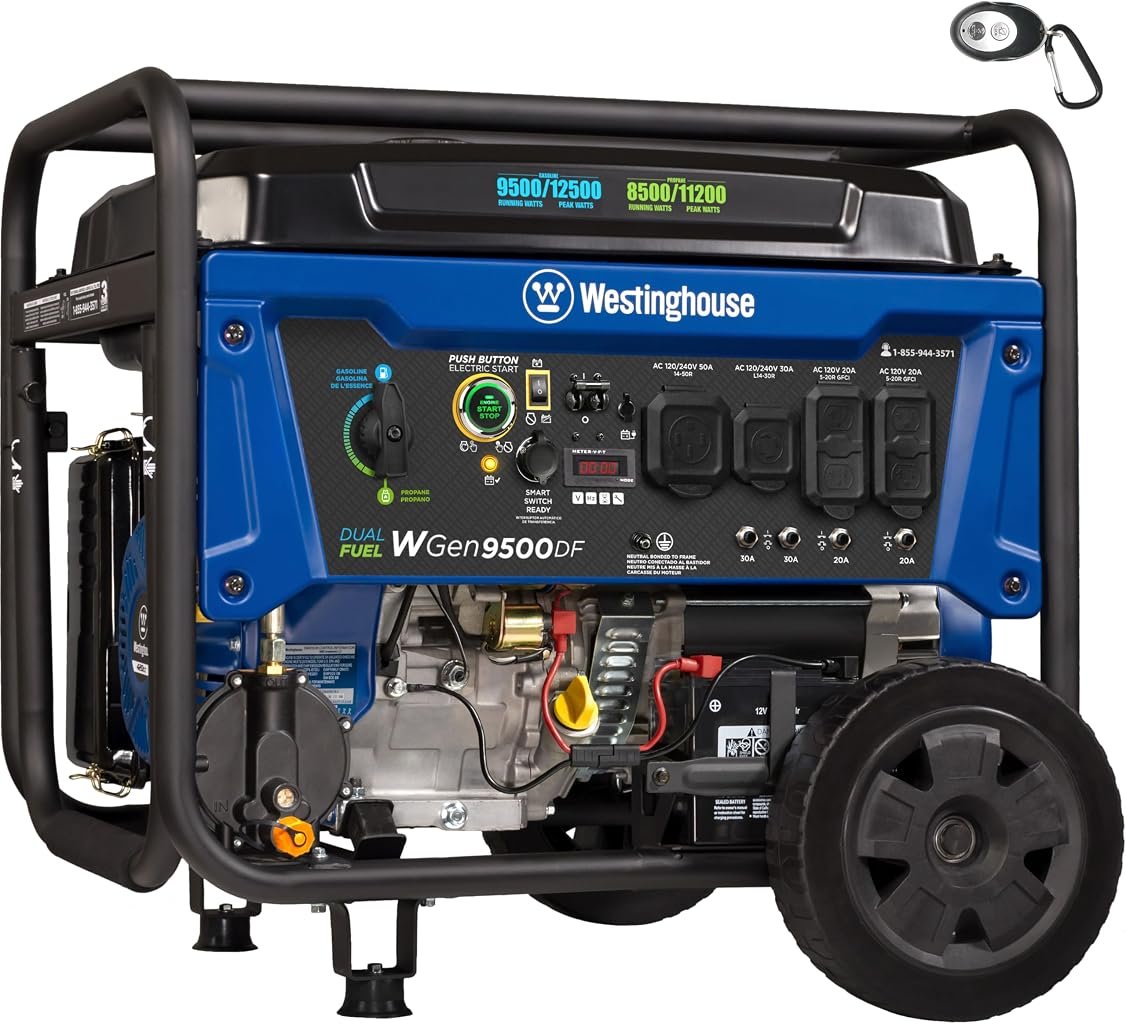
The Westinghouse WGen9500DF demonstrates why that distinction matters. Its gasoline rating reaches 12,500 peak watts, but continuous output is 9,500 watts. Propane changes the equation again, reducing output to 11,200 peak watts and 8,500 running watts. Those are still substantial figures, but they describe two different operating profiles rather than one universal 12,500-watt generator.
Westinghouse builds the machine around a 457cc four-stroke OHV engine and a 6.6-gallon gasoline tank. It supplies both 120V and 240V power, incorporates transfer-switch-oriented connections, provides electric, remote and recoil starting, and weighs 211 pounds. This is portable primarily because it has wheels and a handle, not because anyone should expect to carry it casually.
At the evaluated price of $999, our score is 9.01/10. Customer Sentiment stands at 8.94, Buyer Confidence reaches 9.8, and Value is 8.52.
Those ratings reflect a generator with a particularly well-defined home-backup role. Its output, voltage architecture, dual-fuel capability and connection options are materially broader than those of small recreational inverter generators. Its disadvantages are equally physical: weight, fuel consumption, engine noise, maintenance and the safety obligations attached to running a large combustion engine near a home.
Twelve Thousand Five Hundred Watts Is Not the Continuous Output
The first calculation should discard the temptation to treat 12,500 watts as the normal electrical budget.
According to the official Westinghouse WGen9500DF specifications, gasoline operation provides 12,500 peak watts and 9,500 running watts. Propane provides 11,200 peak watts and 8,500 running watts.
On gasoline, the difference between peak and continuous output is 3,000 watts.
On propane, it is 2,700 watts.
That reserve exists primarily because motors and compressors can demand substantially more electricity during startup than during steady operation. Refrigerators, air conditioners, pumps and other motor-driven equipment can create brief electrical surges.
The generator needs enough capacity to survive those moments without overload.
Once the equipment settles into normal operation, the running rating becomes the governing number.
This distinction is fundamental to any credible portable generator buying guide. A household load plan should be built around 9,500 running watts on gasoline or 8,500 on propane, with adequate room left for startup events.
A system already consuming nearly 9,500 watts continuously has little practical breathing room simply because the enclosure says 12,500 watts.
Dual Fuel Creates Two Different Generators in One Frame
Dual-fuel capability is often described as convenience. In an emergency generator of this size, it is better understood as energy-source flexibility.
Gasoline gives the WGen9500DF its maximum output: 9,500 running watts and 12,500 peak watts.
Propane reduces those figures to 8,500 and 11,200 watts.
That means switching from gasoline to propane costs 1,000 watts of sustained capacity, a reduction of roughly 10.5 percent.
For lightly loaded operation, the difference may have little practical effect. For a home already drawing 8,000 watts while several motor-driven appliances cycle, losing 1,000 watts of continuous headroom becomes much more consequential.
The advantage of propane lies elsewhere.
A household can maintain access to two fuel systems instead of depending exclusively on gasoline. During severe weather, fuel availability can become part of the emergency itself. Gas stations may lose power, roads can become difficult to travel, and regional demand can increase quickly.
Propane also creates a different storage strategy from gasoline.
Dual fuel therefore adds resilience, but it does not eliminate the need for separate electrical calculations. A household should have one load plan for gasoline and another for propane.
The 457cc Engine Explains the Generator’s Scale
Westinghouse uses a 457cc four-stroke OHV engine with a cast-iron sleeve.
That displacement immediately separates the WGen9500DF from compact camping generators.
A machine producing 9,500 continuous watts needs an engine, alternator, frame and fuel system proportionate to that workload. The resulting generator weighs 211 pounds before fuel is added.
Engine oil capacity is approximately 1.1 liters, and Westinghouse specifies SAE 10W-30 oil. Automatic low-oil shutdown provides protection if lubrication falls below an acceptable level.
The mechanical architecture also brings routine ownership obligations.
Oil needs attention. The air filter requires inspection. The spark plug has a maintenance schedule. Gasoline condition matters during storage. The battery supporting electric and remote starting needs to remain charged.
A generator stored untouched for years is not automatically an emergency plan.
Large portable generators are mechanical equipment, and readiness depends on periodic maintenance long before an outage begins.
The 6.6-Gallon Tank Supports Long Runs at Modest Loads
Westinghouse rates gasoline runtime at up to 12 hours at 25 percent load and eight hours at 50 percent load.
Those percentages should always be translated into watts.
Twenty-five percent of the 9,500-watt gasoline running rating is 2,375 watts.
Half load is 4,750 watts.
The advertised 12-hour gasoline runtime therefore describes operation around 2.4kW, not a household continuously consuming 9.5kW.
At half load, the published figure falls to eight hours.
That is still substantial endurance from a portable machine, but it demonstrates how quickly runtime changes with demand.
A household running refrigeration, communications equipment, selected lighting and a few intermittent loads may remain comparatively efficient. Add central cooling, pumps, cooking appliances and other high-demand equipment, and fuel use rises.
The generator’s 6.6-gallon tank should therefore be viewed as one part of the fuel calculation rather than as a promise of overnight endurance under every workload.
Propane Runtime Has Its Own Arithmetic
Westinghouse lists up to seven hours of propane runtime at 50 percent load using a 20-pound propane cylinder.
Half of the 8,500-watt propane running rating is 4,250 watts.
Again, the operating condition matters.
A seven-hour figure does not describe full-load operation. Nor does every propane cylinder necessarily behave identically under every environmental condition.
Propane vaporization can be affected by ambient temperature and demand. Large engines drawing fuel aggressively can expose limitations that are less obvious with small appliances.
The larger lesson is straightforward: propane is not merely gasoline delivered through a different hose.
It changes output, runtime calculations, storage arrangements and refueling logistics.
For emergency planning, those differences should be mapped before the first cylinder is connected.
The 120/240V Architecture Is Central to Home Backup
The WGen9500DF supplies 120/240V AC power at 60Hz.
That is one of the largest functional differences between this generator and smaller 120V-only portable units.
Many household appliances use 120V, but major residential equipment can require 240V. Pumps, central cooling equipment and other large loads may fall into that category depending on the installation.
A generator lacking 240V output cannot solve that problem regardless of its wattage.
The Westinghouse can supply both voltages, which makes it much more naturally aligned with structured home backup.
That does not mean every household appliance can run simultaneously.
Voltage compatibility answers whether a connection is electrically possible. Wattage determines how much equipment can operate at once.
Both calculations are necessary.
Transfer-Switch Readiness Changes the Backup Strategy
Westinghouse equips the generator with a transfer-switch-ready L14-30R 120/240V receptacle and a larger 14-50R 120/240V connection. The panel also includes two duplex 120V 5-20R GFCI household outlets.
That connection architecture is far more consequential than adding another ordinary extension-cord receptacle.
A properly configured home-backup installation can allow selected household circuits to receive generator power through approved transfer equipment rather than running separate extension cords through the building.
Electrical installation is not a place for improvisation.
A transfer arrangement should match the generator, electrical panel, grounding configuration, applicable codes and installation requirements. A qualified electrician is the appropriate resource when household wiring is involved.
The generator uses a bonded-neutral grounding system, another specification that matters when planning connection equipment.
The WGen9500DF’s transfer-switch readiness therefore strengthens its home-backup credentials, but the hardware on the control panel is only one part of a safe installation.
The 14-50R Connection Adds Capacity but Not Unlimited Power
The presence of a 14-50R receptacle can create another misunderstanding.
A receptacle’s physical current rating does not increase generator output.
The WGen9500DF still provides 9,500 running watts on gasoline and 8,500 on propane.
At 240V, Westinghouse lists gasoline running current at approximately 39.5 amps. The arithmetic is consistent: 240 volts multiplied by 39.5 amps is approximately 9,480 watts.
The 14-50R outlet therefore gives the generator a robust connection format, but it does not magically transform a 9.5kW source into a continuous 12kW or 50-amp power supply.
This is precisely why connection type, voltage and generator capacity need to be evaluated separately.
The plug tells the owner how equipment connects. The generator’s running rating determines how much electrical work it can sustain.
Electric, Remote and Recoil Starting Provide Three Paths to Operation
The WGen9500DF offers push-button electric start, wireless remote start and recoil backup.
For a 211-pound generator, that combination is appropriate.
Electric starting removes much of the physical effort associated with turning over a 457cc engine. Remote starting can be convenient when the generator is already correctly positioned and prepared for operation.
Recoil provides a mechanical fallback.
The electric system depends on a battery, which creates its own maintenance requirement. A discharged starter battery discovered during an outage can erase much of the convenience electric starting is meant to provide.
Westinghouse includes a battery float charger among the accessories.
That detail deserves attention during long storage periods. Generator readiness is partly battery readiness when electric and remote starting are expected to work immediately.
Two Hundred Eleven Pounds Redefines Portable
The WGen9500DF has a dry weight of 211 pounds.
Its published dimensions are approximately 27.2 inches long, 26.1 inches wide and 26.5 inches high.
No reasonable assessment should treat this like a suitcase generator.
Westinghouse includes heavy-duty wheels, a handle and a lift bracket because the chassis requires mechanical assistance to move conveniently.
On level pavement, wheels can make a 211-pound machine manageable.
Stairs are another matter. Mud, gravel, steep ground and vehicle loading create different problems.
Adding 6.6 gallons of gasoline increases operating weight further. Gasoline weighs roughly six pounds per U.S. gallon, so a full tank adds around 40 pounds before accessories are considered.
The result can approach a quarter of a thousand pounds in operating condition.
For home backup, that may be acceptable because the machine can remain stored near its intended operating area. For frequent travel, transport logistics deserve far more attention.
Seventy-Four Decibels Places Noise in Perspective
Westinghouse publishes an operating noise figure as low as 74 dBA.
That is materially different from the low-load sound claims associated with enclosed recreational inverter generators.
The WGen9500DF is an open-frame generator powered by a 457cc engine. Its design priorities center on output, fuel flexibility and home-backup connections rather than acoustic isolation.
Noise also changes with distance, load and surroundings.
Hard walls can reflect sound. Increased electrical demand can alter engine behavior. A measurement taken under one set of conditions cannot predict exactly what a neighbor or homeowner will hear in another environment.
The published figure nevertheless communicates something useful: this is a large combustion generator, and buyers should plan accordingly.
Generator placement should be driven first by carbon-monoxide safety, not by an attempt to hide the machine somewhere quieter.
Carbon Monoxide Safety Overrides Convenience
Gasoline and propane both produce carbon monoxide when burned.
The fact that propane can seem cleaner in ordinary handling does not make a propane-powered generator safe indoors.
Current CDC carbon-monoxide guidance states that generators should operate outdoors more than 20 feet from windows, doors and vents. The agency also says never to use a generator inside a home or garage, even when doors and windows are open, and recommends battery-powered or battery-backup CO detection inside the home.
That 20-foot distance can complicate home backup.
A generator may need to be farther from the electrical connection point than expected. Weather protection must not create an enclosed exhaust space. Cables need appropriate ratings and routing.
These are not details to solve after the grid fails.
The safest backup plan is designed while utility power is still available and the weather is uneventful.
The Original WGen9500DF and CO-Sensor Variants Should Not Be Confused
Westinghouse has produced closely related models within this output family, including versions carrying a “c” designation with an integrated carbon-monoxide sensor.
The WGen9500DF specification should not automatically be treated as identical to every WGen9500DFc configuration.
That distinction matters when comparing listings, manuals and replacement parts.
A buyer should verify the exact model designation on the generator and documentation rather than assuming every 12,500-watt Westinghouse dual-fuel unit contains identical safety hardware.
Regardless of sensor configuration, outdoor placement rules remain unchanged.
A CO shutdown sensor is secondary protection. It does not grant permission to operate a combustion generator in a garage, basement, shed or other enclosed location.
The VFT Meter Makes Maintenance More Manageable
The control panel includes Westinghouse’s VFT Data Center.
It displays voltage output, frequency and lifetime operating hours.
Those three measurements have different uses.
Voltage and frequency help the operator observe generator output. Lifetime hours provide a reference for maintenance scheduling.
That last function is particularly practical on equipment that may operate intensively during an emergency and then remain unused for months.
Maintenance based on vague recollection is unreliable.
An hour meter gives the owner an objective record of engine use. When an outage runs for several days, accumulated operating hours can increase faster than expected.
The meter does not reduce maintenance. It makes maintenance easier to schedule intelligently.
Automatic Low-Oil Shutdown and Overload Protection Address Different Risks
Westinghouse includes automatic low-oil shutdown and overload protection.
These systems protect different parts of the generator.
Low-oil shutdown addresses the engine. Insufficient lubrication can damage moving components, particularly under sustained load and high temperature.
Overload protection addresses excessive electrical demand.
Neither system should be treated as a substitute for correct operation.
A generator repeatedly pushed into overload is poorly sized for the workload even if protection prevents immediate damage. Similarly, relying on low-oil shutdown instead of checking lubricant levels is not sound maintenance.
Protective systems work best as backups to disciplined operation rather than routine control mechanisms.
Buyer Confidence at 9.8 Reflects an Unusually Clear Use Case
Our Buyer Confidence rating is 9.8.
That high figure reflects how clearly the WGen9500DF can be matched to a household power plan.
Gasoline provides 9,500 running watts and 12,500 peak watts. Propane supplies 8,500 running and 11,200 peak watts. Output is 120/240V. The engine is 457cc. Gasoline capacity is 6.6 gallons. The generator includes transfer-switch-oriented connections and three starting methods.
Its limitations are equally measurable.
The machine weighs 211 pounds. It produces combustion exhaust. Published noise reaches 74 dBA under the manufacturer’s stated conditions. Fuel consumption rises with electrical demand.
Those boundaries are not subtle.
A household can inventory its required circuits and appliances, calculate running and startup demand, determine whether 240V equipment is involved and compare the result with the generator’s gasoline and propane ratings.
That is the foundation of high buyer confidence: not perfection, but clarity.
Customer Sentiment at 8.94 Tracks the Overall Score Closely
Customer Sentiment stands at 8.94, close to our overall score of 9.01/10.
The alignment fits the generator’s design.
Its strengths are practical rather than decorative. It provides substantial sustained output, two fuel choices, 120/240V operation, transfer-switch-oriented connections, multiple starting systems, a large gasoline tank and useful operating instrumentation.
Its compromises are equally tangible.
At 211 pounds dry, mobility is limited. A 457cc open-frame engine is not a quiet indoor-adjacent power source. Fuel must be stored and replenished. Routine maintenance remains unavoidable.
The generator therefore rewards buyers who genuinely need its output.
Someone requiring only a refrigerator, router and several lights may be carrying far more engine, fuel capacity and electrical capability than necessary.
Value at 8.52 Depends on Using the Capacity
Our Value rating is 8.52 at the evaluated price of $999.
That rating sits below the overall score because value depends heavily on whether the buyer can use the generator’s defining features.
The WGen9500DF provides substantial hardware for the money: a 457cc engine, 9,500 gasoline running watts, 8,500 propane running watts, 120/240V output, remote and electric starting, transfer-switch readiness, a 14-50R receptacle and a 6.6-gallon fuel tank.
But unused capacity has little economic value.
A household that needs only 2,000 watts during an outage may be better served by a smaller, quieter and lighter generator. Conversely, a home with pumps, refrigeration, central cooling or several high-demand circuits can make much greater use of this machine’s electrical architecture.
The $999 price therefore cannot be judged independently from the load plan.
The generator becomes economically coherent when its 120/240V capability and high running output solve problems a smaller machine cannot.
Who Is Most Likely to Benefit?
The Westinghouse WGen9500DF is most naturally suited to:
- Homeowners planning substantial selected-circuit backup through compatible transfer equipment.
- Properties with both 120V and 240V emergency loads.
- Households that benefit from having gasoline and propane fuel options.
- Users who need more than 8,000 running watts even when operating on propane.
- Owners who value electric and remote starting with recoil backup.
- Buyers with a practical outdoor operating location more than 20 feet from doors, windows and vents.
- Users who can store and move a 211-pound generator safely.
- Households prepared for regular engine, fuel and battery maintenance.
It is less naturally suited to apartment living, very light emergency loads, frequent manual transport, environments where engine noise is unacceptable or situations without a safe outdoor operating area.
A Pre-Purchase Home-Backup Audit
Before purchasing, a household should:
- List every circuit or appliance expected to receive backup power.
- Record continuous wattage for each load.
- Identify startup demand for compressors, pumps and motors.
- Create separate 9,500-watt gasoline and 8,500-watt propane operating plans.
- Determine which loads require 120V and which require 240V.
- Leave adequate capacity for equipment that starts automatically.
- Discuss transfer equipment and household wiring with a qualified electrician.
- Verify the exact generator model before assuming a CO sensor is included.
- Identify a safe outdoor operating location more than 20 feet from windows, doors and vents.
- Plan cable routing before an outage.
- Calculate gasoline storage around realistic load rather than the 12-hour quarter-load figure alone.
- Determine how many propane cylinders would be required for the intended emergency duration.
- Account for the generator’s 211-pound dry weight when planning storage and movement.
- Maintain the starting battery during storage.
- Keep engine oil, maintenance supplies and the correct tools accessible.
- Test carbon-monoxide detectors regularly.
This exercise can reveal that the WGen9500DF is too large, too small or appropriately sized before money is spent and before severe weather makes the answer urgent.
Final Considerations
The Westinghouse 12500W Dual Fuel Portable Generator earns our 9.01/10 score because its capabilities form a coherent home-backup system rather than a collection of unrelated specifications.
Its true electrical identity begins with 9,500 running watts on gasoline and 8,500 on propane. The 12,500- and 11,200-watt figures describe peak capacity, not continuous operation.
That distinction should guide every load calculation.
The 457cc engine and 6.6-gallon gasoline tank give the machine enough mechanical scale to support substantial household loads. Dual-fuel operation adds another energy source, while 120/240V output makes the generator compatible with a broader range of home equipment than 120V-only recreational models.
Transfer-switch readiness, the L14-30R and 14-50R connections, electric starting, remote starting, recoil backup and the VFT meter strengthen its home-emergency identity.
Those strengths come with equally serious obligations.
At 211 pounds dry, this is portable by wheels rather than casual lifting. The open-frame engine produces substantial noise. Gasoline and propane require safe handling. Oil, filters, spark plugs and the starter battery need maintenance. Exhaust demands disciplined outdoor placement regardless of weather.
The runtime figures also require context. Twelve hours on gasoline applies at 25 percent load, roughly 2,375 watts. At half load, approximately 4,750 watts, the published gasoline runtime falls to eight hours. Propane is rated for seven hours at 50 percent load, approximately 4,250 watts, using a 20-pound cylinder.
Buyer Confidence at 9.8 is the strongest rating because the generator’s operating boundaries are unusually measurable. Customer Sentiment at 8.94 sits close to our 9.01 overall score. Value at 8.52 is lower because the economic case weakens rapidly when a household does not need this much output or 120/240V capability.
For a home that genuinely needs substantial selected-circuit backup, the WGen9500DF presents a logical architecture. For a household interested mainly in keeping a refrigerator, several lights and communications equipment alive, a smaller generator can be easier to move, quieter and less demanding of fuel.
The defining question is therefore not whether 12,500 watts sounds impressive.
It is whether the home’s actual running loads, startup demands, voltage requirements, fuel strategy and connection plan fit within 9,500 watts on gasoline or 8,500 watts on propane.
When those numbers align, the Westinghouse becomes a serious emergency-power tool. When they do not, no headline wattage figure can repair the mismatch.