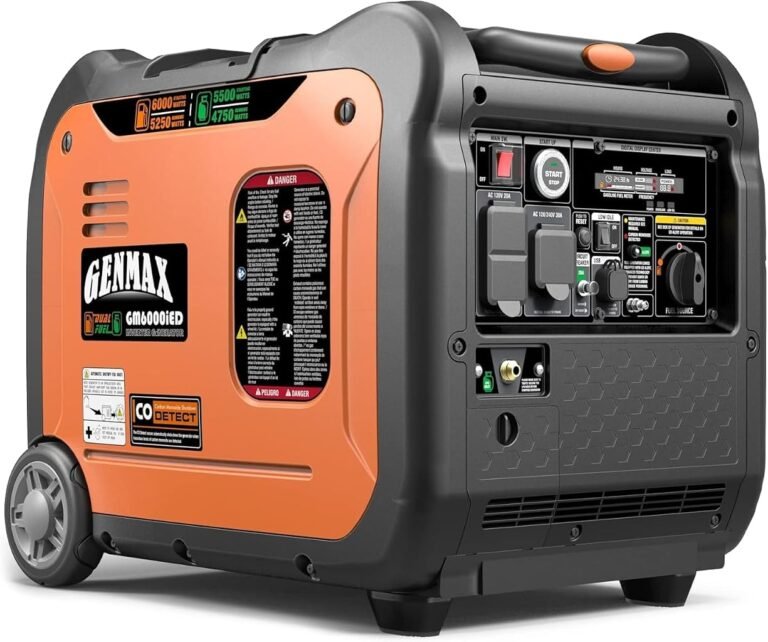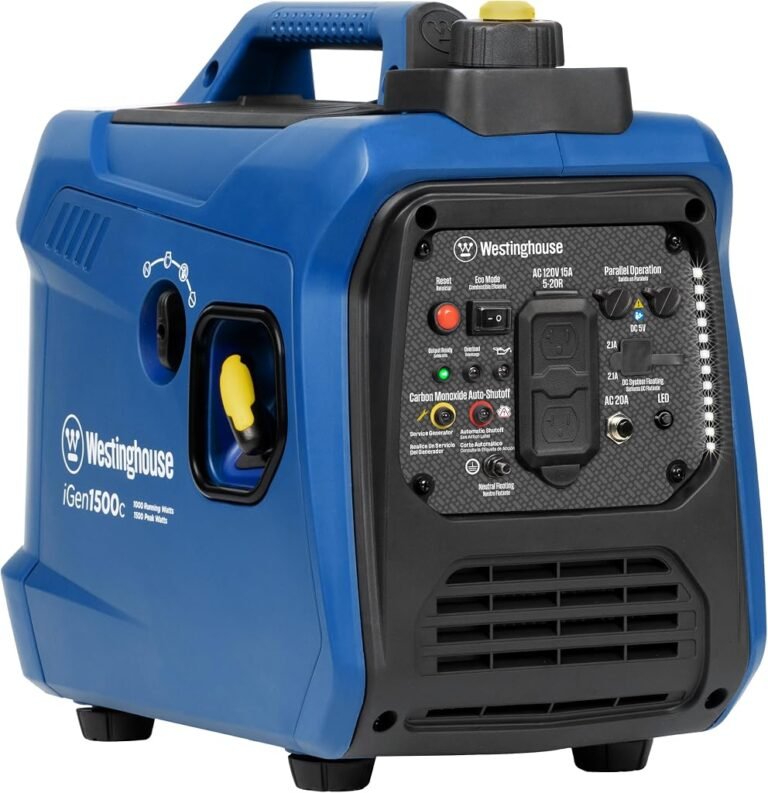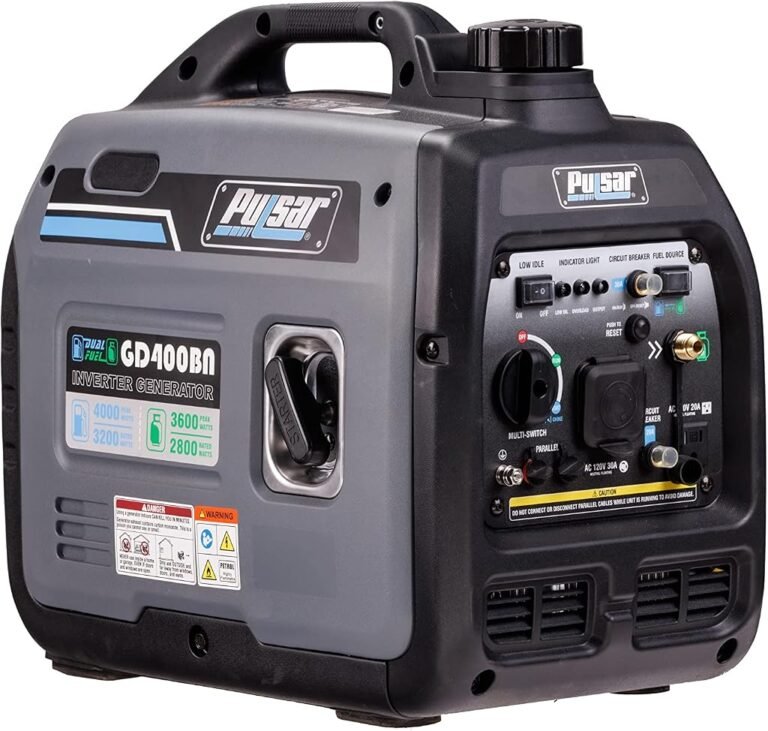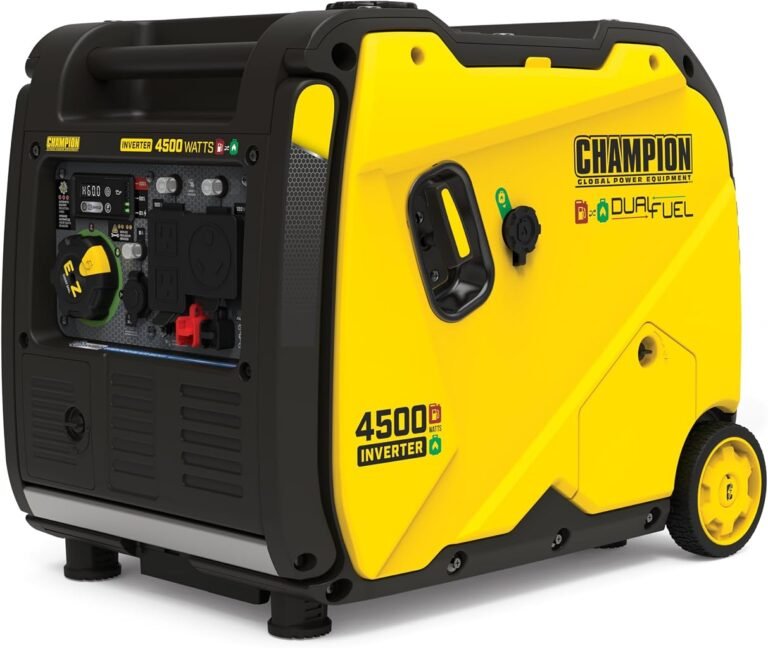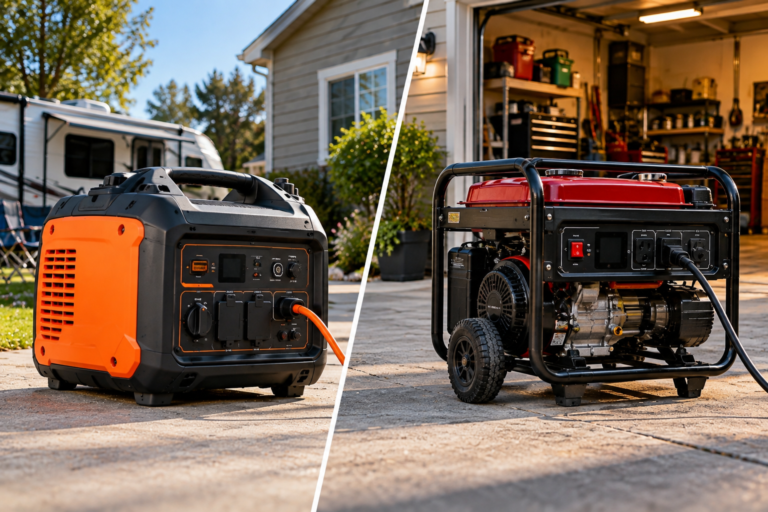
Small inverter generators live or die by compromise. A machine light enough to carry with one hand cannot provide the sustained electrical output of a 200-pound home-backup generator. A small fuel tank aids portability but limits the amount of gasoline available. Acoustic insulation adds weight. Safety hardware adds cost. The engineering challenge is not eliminating those tensions; it is balancing them intelligently.
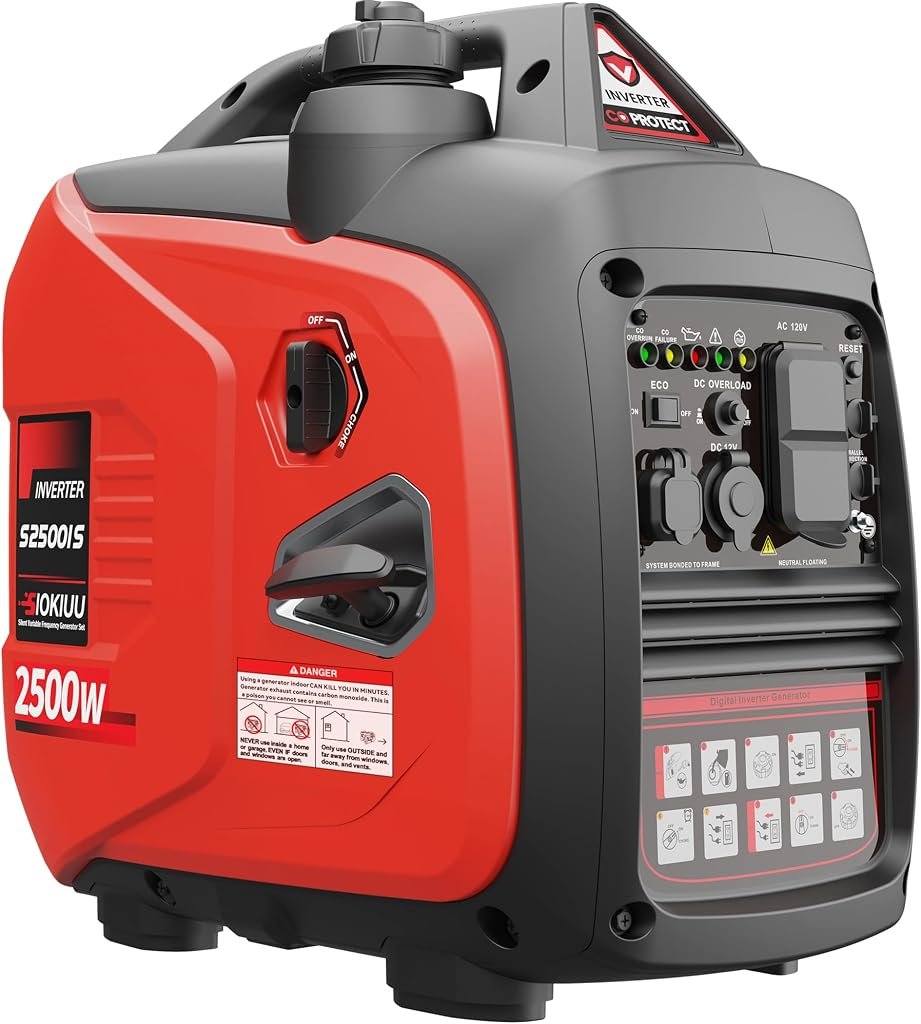
The SIOKIUU SIO-PG 2500W Portable Inverter Generator approaches that balance with 2,500 peak watts, 1,900 running watts, an 80cc four-stroke gasoline engine, a 1.06-gallon fuel tank, inverter output rated below 3% total harmonic distortion, ECO mode, parallel capability and carbon-monoxide shutdown. Published specifications put net weight at approximately 39.46 pounds and operating sound below 59 dBA at 23 feet.
Our score is 7.99/10. Customer Sentiment stands at 7.84, Buyer Confidence at 8.49 and Value at 7.91. Those ratings describe a compact generator with an appealing technical formula but a less established product identity than major-brand alternatives. The machine itself addresses the fundamentals well: usable inverter power, modest weight, extended low-load runtime and a CO sensor. Buyer Confidence is the highest score because the basic specifications form a coherent package, while Customer Sentiment and Value are more restrained.
At the $312.99 reference price, this is fundamentally a generator for selective electricity: refrigeration, lights, communications equipment, electronics, modest tools and recreational loads. It is not a substitute for a high-output home-backup generator.
That distinction should govern the entire purchase.
The Real Rating Is 1,900 Running Watts
The large number is 2,500W. The useful planning number is 1,900W.
Published documentation for the SIO-PG identifies 2,500 peak watts and 1,900 running watts. The difference is not cosmetic.
Peak capacity gives the generator temporary headroom when a connected device demands additional power during startup. Motors and compressors can create these brief surges. Running wattage describes what the generator is designed to supply continuously.
A buyer connecting 2,100W of sustained loads has therefore exceeded the normal rating even though 2,100 is lower than the number printed most prominently in the product name.
That arithmetic belongs near the beginning of any portable generator buying guide.
At 1,900 running watts, the generator can support meaningful emergency equipment, but prioritization is unavoidable. A refrigerator, several LED lights, networking hardware, television and device chargers can present a realistic workload depending on their actual ratings and startup demands. A large electric heater, high-powered cooking appliance or substantial air conditioner can consume most or all of the available output by itself.
The 2,500W designation should therefore be read as startup capability, not permission to construct a continuous 2.5kW load.
Inverter Architecture Is a Significant Advantage at This Size
The SIO-PG is an inverter generator rather than a basic conventional portable generator.
That matters because inverter electronics regulate the electrical output differently. Published specifications claim total harmonic distortion below 3%.
Low THD is relevant when powering electronics.
Computers, televisions, chargers, communications equipment and other electronically controlled devices benefit from a stable AC supply. Conventional portable generators can produce higher distortion, particularly as operating conditions change. An inverter design is generally better suited to the mixed electronic loads common in camping, mobile work and small-scale household backup.
The architecture also enables variable engine operation under lighter loads.
Instead of requiring the engine to behave as though maximum electrical output is constantly needed, ECO mode can reduce engine speed when demand is lower. That can decrease fuel consumption and acoustic output.
There is a practical qualification.
When equipment with a large startup surge is connected, maximum responsiveness may matter more than minimum engine speed. The operating manual should govern ECO-mode use with demanding loads, particularly equipment containing motors or compressors.
The feature is useful precisely because it can be switched according to the workload.
An 80cc Engine Defines the Generator’s Character
The generator uses an 80cc four-stroke gasoline engine with recoil starting.
That engine displacement fits the machine’s purpose. It is large enough to produce 1,900W continuously while remaining small enough to fit inside a compact enclosure.
Recoil starting is mechanically simple but less convenient than electric start.
There is no starter battery to maintain, which reduces one ownership burden. The trade is physical: starting requires pulling a cord. For healthy users operating a small engine, that may be entirely acceptable. For buyers with limited strength or mobility, the absence of electric starting deserves more attention.
The four-stroke design also means engine oil remains part of ownership.
Fuel-powered generators are mechanical equipment. Oil level, spark-plug condition, air filtration, fuel quality and storage procedure influence whether a generator starts months after its previous use.
That matters because emergency generators often spend far more time waiting than operating.
A machine purchased for outage protection should be started and maintained according to its manual rather than forgotten in a shed until the electricity fails.
At Roughly 39.5 Pounds, Portable Actually Means Portable
Weight is one of the SIO-PG’s strongest specifications.
Published documentation places net weight at approximately 39.46 pounds, with dimensions around 18.9 × 11.22 × 18.11 inches.
That is a different proposition from large open-frame generators weighing 100, 150 or 200 pounds.
A roughly 40-pound generator can realistically be lifted into a vehicle, carried between storage and an outdoor operating location or moved around a campsite by one capable adult. The integrated carrying format matters because wheels are less necessary at this mass.
That portability expands the generator’s usefulness.
A large home-backup generator can provide far more power, but it is inconvenient for camping. A tiny generator can be easier to transport but may struggle with refrigeration startup or multiple simultaneous loads.
The SIO-PG sits between those extremes.
Its 1,900W sustained rating is enough to perform serious work, while its physical mass remains manageable.
The compromise appears deliberate rather than accidental.
A 1.06-Gallon Tank Produces Surprisingly Long Low-Load Runtime
The fuel tank holds 1.06 gallons of gasoline. Published product information states up to 17 hours of operation at 25% load and 8.6 hours at 50% load.
Those figures require context.
One-quarter of the 1,900W running rating is 475W. Half load is 950W.
Seventeen hours therefore describes operation under a relatively modest electrical demand, not a generator delivering close to 1,900W continuously. Runtime falls as electrical load and fuel consumption increase.
Still, the numbers illustrate one advantage of a small inverter engine.
At light loads, a little more than one gallon of fuel can potentially cover an extended period. That is attractive during camping and overnight outages, when power demand may consist primarily of refrigeration, lighting and electronics rather than continuous high-wattage appliances.
ECO mode is particularly relevant in this scenario because engine operation can respond to lower demand.
Fuel efficiency also reduces storage pressure. A generator that can perform useful work from a small tank requires less gasoline on hand than a large machine burning several gallons over the same period.
That does not eliminate fuel-management obligations.
Gasoline needs safe storage, and aged fuel can create starting and carburetor problems. Owners should follow the manufacturer’s storage and maintenance procedures rather than assuming a full tank can sit indefinitely.
The CO Sensor Addresses a Hazard That Cannot Be Engineered Away Completely
The generator incorporates a carbon-monoxide sensor designed to shut the engine down when elevated CO concentrations are detected around the machine. Its controls include separate indications for excessive CO and sensor failure.
That is a worthwhile safety system.
It is not permission to operate the generator indoors.
The U.S. Consumer Product Safety Commission’s carbon-monoxide guidance states that more than 100 U.S. deaths each year are linked to portable-generator CO exposure. CPSC advises operating portable generators outdoors only, at least 20 feet from homes, with exhaust directed away from the building.
The scale of the hazard is difficult to overstate. CPSC says one portable generator can produce as much carbon monoxide as hundreds of cars.
A garage with its door open is not an acceptable operating location. Neither is a basement, shed, crawlspace or enclosed porch. Opening windows does not make indoor generator operation safe.
The CO sensor should be treated as a secondary defense if dangerous exhaust concentrations develop around the generator.
CPSC specifically recommends looking for portable generators with automatic CO shutoff, but its placement guidance remains unchanged: outside, away from buildings and with exhaust directed away from openings.
The safety feature reduces risk. It does not repeal combustion chemistry.
Noise Below 59 dBA Needs the Measurement Distance
The published sound specification is below 59 dBA at 23 feet.
The distance matters.
Noise ratings without measurement conditions can be misleading because sound level changes substantially as distance from the source increases. A generator measured from 23 feet cannot be compared fairly with another machine measured much closer without accounting for the different test conditions.
Still, below 59 dBA at that stated distance fits the expectations for a compact enclosed inverter generator.
It should be considerably more suitable to noise-sensitive recreational use than a large open-frame home-backup machine. ECO operation under light demand can further reduce unnecessary engine speed.
“Super quiet,” however, is a marketing description rather than a physical state.
This remains an internal-combustion engine. It produces mechanical and exhaust noise, and nearby users will hear it. Campsites can also have explicit generator-hour or sound rules independent of a manufacturer’s rating.
For residential outages, placement at the CPSC-recommended distance helps separate the generator from living spaces acoustically as well as physically.
Parallel Capability Creates an Upgrade Path
The generator includes parallel connection ports, allowing compatible units to be paired using appropriate equipment.
That changes the ownership proposition.
A buyer may need only 1,900 running watts for most trips or short outages. Purchasing a much larger generator would increase weight and fuel consumption every time the machine is transported.
Parallel capability offers another approach: use one compact generator when demand is modest and pair compatible units when greater capacity is needed.
The economics depend on the cost of a second generator and parallel hardware, so this is not automatically cheaper than purchasing one larger machine.
The advantage is modularity.
Two small generators can also be moved separately, which may be easier than handling one large unit. If the application frequently requires more than 1,900W, however, buying a higher-output machine from the beginning may be more rational.
Parallel capability is best viewed as flexibility rather than free power.
The Outlet Selection Fits Recreational and Emergency Use
The control system includes 120V AC receptacles, a 12V DC connection, USB outputs and parallel ports. The manual also identifies overload, low-oil and operating indicators.
That arrangement covers the basic equipment likely to accompany a generator in this class.
AC outlets support conventional appliances and tools. USB connections reduce the need for separate wall adapters when charging compatible electronics. The 12V output provides another route for suitable DC equipment.
Overload protection matters because a 1,900W generator can reach its limit quickly.
If connected demand exceeds the inverter’s capability, the system can interrupt AC output rather than attempting to supply an impossible load indefinitely. That does not eliminate the need for load calculation; it provides protection when the calculation goes wrong.
A generator should not be routinely operated against its overload protection.
EPA Language Deserves More Precision Than a Badge
The product is marketed as EPA compliant.
That phrase is often treated as a generic environmental endorsement, but the regulatory framework is more specific. The U.S. Environmental Protection Agency’s rules for small spark-ignition equipment establish exhaust and evaporative-emission requirements for small engines, including controls addressing fuel-system permeation and venting.
EPA compliance does not mean zero emissions.
This generator burns gasoline. Combustion produces exhaust, which is why outdoor placement remains mandatory regardless of emissions certification.
Nor does EPA compliance tell a buyer how quiet the generator is, how clean its electrical waveform is or how durable the engine will prove after years of use.
Those are separate questions.
Regulatory compliance should be read for what it is: conformity with applicable emissions requirements, not a universal quality certificate.
Home Backup Is Useful but Selective
Calling a 1,900-running-watt generator “home backup” is defensible only when the phrase is interpreted narrowly.
It can preserve selected household functions.
A refrigerator or freezer may be a priority. So may a router, modem, lights, phones, television or small medical equipment where manufacturer requirements are compatible with generator use. Some furnace blowers or pumps may fit electrically, while others may not.
The calculation has to be performed appliance by appliance.
Large electric water heaters, central air conditioners, clothes dryers, electric ranges and substantial resistance-heating equipment generally inhabit a very different power category.
The SIO-PG does not provide 240V whole-home backup capacity.
Its purpose is triage.
During an outage, 1,900W can be extremely useful when directed toward refrigeration, communications and other carefully chosen loads. Trying to reproduce normal household consumption defeats the point of a compact generator.
Our Score: 7.99/10
Our 7.99/10 score reflects a machine with a sound technical configuration and several practical limitations.
The strengths are easy to identify: 1,900W continuous inverter output, 2,500W peak capacity, sub-3% stated THD, approximately 39.5-pound weight, a small fuel tank with lengthy low-load runtime, ECO operation, parallel capability and automatic CO shutdown.
That is a persuasive collection of functions for a generator near the $312.99 reference price.
The restraints are equally tangible.
Output is modest for household backup. Starting is recoil-only. The generator burns gasoline rather than offering dual-fuel flexibility. The brand has less established market presence than longstanding generator manufacturers, making documentation, parts availability and long-range service support more consequential considerations.
The overall rating therefore lands just below 8/10: capable, portable and sensibly configured, but not without ownership questions.
Customer Sentiment: 7.84
Customer Sentiment is 7.84, slightly below our overall score.
That difference reflects the expectations attached to inexpensive portable generators.
At this size, a machine can feel impressively capable when powering lights, electronics and refrigeration yet suddenly constrained when a high-wattage appliance enters the equation. A 2,500W peak label can intensify that mismatch if the buyer overlooks the 1,900W sustained rating.
Recoil starting creates another dividing line. Some owners prefer its simplicity. Others expect push-button convenience.
The generator is likely to make the most sense when expectations begin with the actual running output and physical size rather than the largest number on the listing.
Buyer Confidence: 8.49
Buyer Confidence is our highest rating at 8.49.
The product’s core specifications fit together logically. An 80cc engine producing 1,900 running watts in a roughly 40-pound enclosed inverter chassis is a credible architecture. The 1.06-gallon tank, ECO mode and published partial-load runtimes also form a coherent relationship.
Safety equipment adds confidence.
The CO sensor, low-oil protection and overload system address three different failure or hazard categories. The inverter architecture and stated sub-3% THD further clarify the generator’s suitability for mixed electronic loads.
Confidence stops short of the level associated with manufacturers that have extensive dealer networks and decades of readily accessible model-specific documentation.
For a lesser-known brand, post-purchase support matters almost as much as initial specifications.
Value: 7.91
Our Value rating is 7.91.
At $312.99, the combination of inverter output, CO shutdown, ECO mode, parallel capability and roughly 40-pound portability is attractive.
Yet purchase price alone does not define generator value.
Owners need engine oil, gasoline storage, maintenance materials and suitable extension cords. Recreational users may need parallel hardware later. Emergency users should have functioning residential CO alarms in addition to the generator’s onboard sensor.
Longevity also affects value.
A generator that operates reliably for many years is economically different from one requiring difficult-to-source components after limited use. With less-established brands, that uncertainty deserves some weight even when the specification sheet is competitive.
The 7.91 rating recognizes a strong feature-to-price relationship without assuming long-range ownership performance that has not been established here.
Who Should Buy It?
The 2500W Portable Inverter Generator with CO Sensor is best aligned with:
- Campers and recreational users needing compact gasoline power.
- Households seeking selective backup for refrigeration, lights and communications.
- Users who prioritize sub-40-pound portability over high sustained wattage.
- Buyers powering laptops, televisions and other electronics that benefit from low-distortion inverter output.
- Owners who value automatic CO shutdown as an additional safety mechanism.
- Users who may eventually benefit from pairing compatible generators.
It is less suitable for households seeking whole-home backup, 240V loads or sustained operation of several high-wattage appliances.
Buyers who cannot comfortably use recoil starting should also factor that limitation into the decision.
What Buyers Should Calculate Before Ordering
Start with running watts.
Add the sustained consumption of every appliance expected to operate simultaneously. Keep the total below 1,900W and account separately for startup surges.
Then calculate runtime expectations.
The 17-hour claim corresponds to 25% load, or approximately 475W. The 8.6-hour figure corresponds to about 950W. A generator working close to maximum output should not be expected to reproduce those runtimes.
Next, plan fuel.
A 1.06-gallon tank is compact, which helps portability, but extended outages require additional gasoline stored safely in approved containers.
Then plan placement.
The CPSC recommends at least 20 feet from the home, with exhaust facing away. That distance influences extension-cord length and gauge. Voltage drop becomes more relevant as cords become longer and loads become heavier.
Finally, consider the actual reason for buying a generator.
If the objective is keeping a refrigerator cold, maintaining internet access and running several lights during an outage, 1,900W can be highly effective. If the objective is powering an electrically intensive home almost normally, this is the wrong generator class.
Final Considerations
The 2500W Portable Inverter Generator with CO Sensor earns its 7.99/10 score by combining useful electrical output with genuine one-person portability.
Its 2,500W peak figure provides startup headroom, but the 1,900W running rating is the specification that should shape every load plan. The 80cc four-stroke engine, 1.06-gallon tank and ECO mode create a credible low-load efficiency package, with published runtime reaching 17 hours at 25% load and 8.6 hours at half load.
The inverter architecture and stated sub-3% THD make the generator better suited to modern electronics than a basic high-distortion power source. At roughly 39.5 pounds, it also remains meaningfully portable rather than merely movable.
The CO sensor is another substantial addition, but its purpose needs to be understood correctly. Automatic shutdown is an extra defense against dangerous carbon-monoxide accumulation. It never makes indoor generator operation acceptable. CPSC’s outdoor-placement guidance still governs safe use.
Customer Sentiment at 7.84 reflects a product whose usefulness depends heavily on realistic expectations around 1,900W of sustained power. Buyer Confidence at 8.49 recognizes a coherent specification set and multiple protection systems. Value at 7.91 acknowledges an appealing $312.99 reference price while leaving room for uncertainty around long-range support from a lesser-known manufacturer.
This is not a miniature whole-house generator.
It is a compact electrical triage tool: light enough to carry, powerful enough to preserve selected necessities and efficient enough to stretch a small gasoline supply under modest demand.
For camping, mobile work and carefully planned emergency backup, that narrower mission is exactly where a 2,500W inverter generator makes sense.