A portable generator is easy to misunderstand because its most visible specification is rarely its most useful one. “4500W” sounds definitive. In practice, a generator purchase is governed by a less dramatic collection of numbers: continuous output, starting capacity, voltage, fuel capacity, runtime, harmonic distortion, receptacles, weight, noise, and the electrical demands of whatever must remain powered when utility electricity disappears.
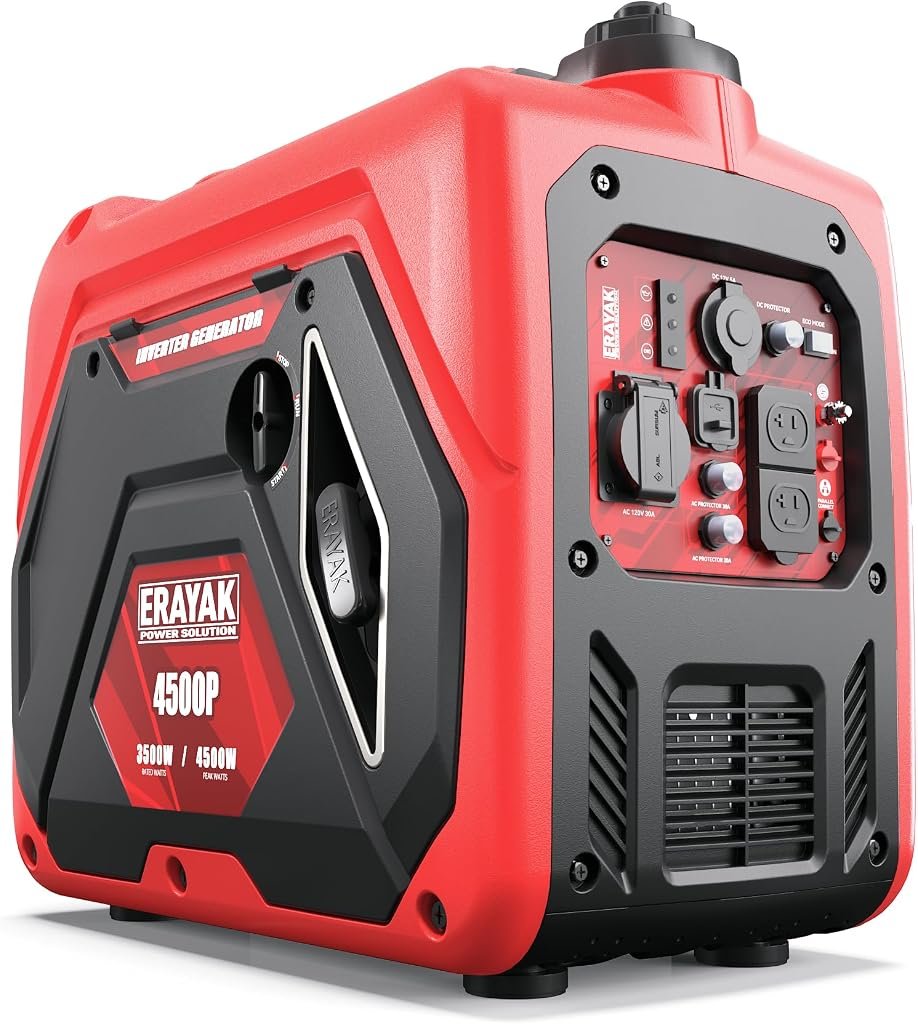
The ERAYAK 4500P portable inverter generator illustrates that distinction unusually well. It produces 4,500 watts of peak power but 3,500 watts of continuous output. ERAYAK specifies 120-volt, 60-Hz operation, a gasoline-only fuel system, manual recoil starting, a 2.25-gallon tank, and a 55-pound portable design. The company also states total harmonic distortion below 1.2 percent for its inverter output.
At an evaluated price of $499, this is neither a miniature generator intended mainly for charging electronics nor a large whole-house machine. It sits between those categories, where careful load management can make a moderate amount of generating capacity surprisingly useful.
Our Score is 8.28/10. Customer Sentiment stands at 8.06, Buyer Confidence at 9.22, and Value at 8.03. Those numbers describe a product with a fairly convincing specification package and clear applications, but also boundaries that buyers should understand before interpreting 4,500 watts as permission to connect everything within reach.
The 4,500-Watt Label Requires Translation
The first number to examine is 3,500 watts, not 4,500.
ERAYAK identifies 4,500 watts as peak output and 3,500 watts as running output. The difference exists because electric motors and compressors can briefly demand substantially more power during startup than they consume after reaching operating speed.
That leaves 1,000 watts between continuous and peak capacity.
A refrigerator provides an intuitive example. Its compressor does not necessarily draw the same amount of electricity every second. Starting the compressor creates a different demand from keeping it running. Air conditioners, pumps and some power tools exhibit similar behavior.
This makes generator sizing a problem of sequencing as much as addition.
Consider a hypothetical 2,400-watt continuous load. On paper, that leaves approximately 1,100 watts beneath the ERAYAK’s 3,500-watt continuous rating. Yet another appliance cannot automatically be added merely because its normal consumption is below 1,100 watts. Its startup requirement also has to fit within the generator’s available capacity at the moment it starts.
A responsible portable generator buying guide therefore begins with two columns: running watts and starting watts. Appliance nameplates and manufacturer manuals should supply the figures. The running loads expected simultaneously are added first; startup requirements are then examined for equipment containing motors or compressors.
That exercise is far more informative than shopping by headline wattage.
Inverter Power Changes the Character of the Machine
The ERAYAK 4500P is an inverter generator, which separates it from basic open-frame conventional generators.
ERAYAK describes the generator as producing pure sine-wave inverter output with total harmonic distortion below 1.2 percent. The manufacturer specifically positions that output for electronic equipment while listing two 120V/20A household receptacles, a 30A L5-30R connection and USB connectivity on the official ERAYAK 4500P product page.
Low harmonic distortion matters because modern electrical loads increasingly contain sensitive electronics rather than simple resistive components. Laptops, televisions, chargers and electronically controlled appliances are not the same loads as an incandescent bulb or basic heating element.
The distinction also makes the ERAYAK more logical for RV and camping duty, where the generator may be asked to power a mixed collection of appliances and electronics from one relatively compact source.
The machine includes Eco operation as well. Rather than requiring the engine to behave as though maximum electrical output is needed continuously, load-based engine-speed management is intended to reduce unnecessary engine activity when demand falls.
This is particularly relevant because real generator loads fluctuate. A refrigerator cycles. An air conditioner compressor starts and stops. Battery chargers taper their consumption. Lights are switched on and off. A generator capable of responding to those changing demands has a different operating character from a machine running at a fixed high engine speed regardless of load.
3,500 Running Watts Can Do Serious Work, Within Limits
The ERAYAK’s 3,500-watt running capacity places it in useful territory for selected-load backup.
It does not make the machine a whole-house generator.
A household attempting to preserve refrigeration, communications, lighting and selected electronics during an outage presents a manageable problem compared with simultaneously operating electric space heating, electric water heating, cooking equipment, large central air conditioning and every ordinary household circuit.
The difference is not semantic. Electric resistance appliances can consume substantial portions of a 3,500-watt budget individually.
The best use of a generator in this class is therefore deliberate prioritization. Refrigeration might remain continuously available while higher-demand appliances are operated selectively. Communications equipment and lighting generally leave more electrical headroom than major heating loads.
RV operation creates a similar calculation. An air conditioner may fit within the available capacity, but the compressor’s startup demand and every simultaneous RV load still matter. A microwave, water heater, converter, refrigerator and air conditioner do not cease consuming electricity merely because they share one recreational vehicle.
The generator should be sized around the actual equipment rather than a generic promise about what “a 4,500-watt generator” can operate.
Runtime Looks Better When the Test Load Is Understood
ERAYAK lists a 2.25-gallon gasoline tank and states up to eight hours of runtime, with runtime varying by load.
That qualification is central to interpreting the specification.
Generator runtime is not a fixed characteristic comparable to physical dimensions. Fuel consumption changes as electrical demand changes. A generator supplying a modest fraction of its rated capacity should not be expected to consume gasoline at the same rate as one working near its continuous limit.
An eight-hour claim therefore does not mean every owner will refill the machine at precisely eight-hour intervals.
This distinction matters during prolonged outages. A generator that operates for several days converts fuel storage into a planning issue. Fuel availability, safe storage, refueling intervals and anticipated electrical demand all become part of emergency preparation.
The gasoline-only design simplifies one aspect of operation while restricting another. There is no propane system to manage on the 4500P, but there is also no alternative fuel source when gasoline is unavailable or inconvenient.
ERAYAK sells other 4500-series configurations with dual-fuel capability, but the 4500P evaluated here is the simpler gasoline model. Buyers specifically seeking propane capability should treat fuel type as a model-selection requirement, not an accessory that can be assumed from the shared 4500 designation.
Portability Is Credible, Not Effortless
At approximately 55 pounds, the ERAYAK lands in a useful middle ground.
It is light enough to remain genuinely transportable for many owners while being substantial enough that repeated lifting should be considered before purchase. Loading roughly 55 pounds into a vehicle is one task. Carrying it over uneven ground or repeatedly moving it between storage and operating locations is another.
The manufacturer’s published dimensions are approximately 19.88 by 16.93 by 20.25 inches for the 4500P specification set.
Those dimensions matter to RV owners more than they might initially appear to. Storage bays, pickup beds and cargo areas impose physical constraints unrelated to wattage. Buyers should measure the intended storage location rather than assuming that any “portable” generator will fit.
Operating location is a separate matter.
A generator fitting neatly inside a garage or RV storage compartment does not make either location suitable for operation. Combustion equipment produces carbon monoxide, and portability cannot be allowed to blur the distinction between convenient storage and safe operation.
Noise Claims Need Their Measurement Conditions
ERAYAK describes the 4500P as operating at approximately 60.5 dB under its stated measurement conditions.
A decibel figure without context can easily become more precise than reality warrants.
Generator noise changes with engine load, distance, surface reflections, surrounding structures and measurement location. A lightly loaded enclosed inverter generator in an open area is not acoustically identical to the same machine operating under substantial load beside a wall.
For that reason, a manufacturer’s decibel figure is best used comparatively and with its conditions attached.
The enclosed inverter format still offers an obvious practical advantage over a bare open-frame layout for environments where sound matters. Camping and residential backup are both situations where a generator may operate for hours in proximity to other people.
“Quiet,” however, should never be interpreted as silent.
A combustion engine remains audible equipment. Anyone purchasing a generator for a noise-sensitive campground or dense residential environment should examine applicable local or campground restrictions rather than assuming that an advertised sound figure guarantees acceptance.
Connections Make the 4500P More Flexible
A generator’s output capacity is only useful when equipment can connect to it appropriately.
The ERAYAK provides two 120V/20A household receptacles and an L5-30R 30A connection. The manufacturer’s current 4500P configuration also identifies an L5-30P-to-TT-30R adapter for compatible RV connections and USB-A plus USB-C output.
That arrangement gives the machine a useful mix of conventional household, RV-oriented and low-voltage charging options.
The 30A connection deserves particular attention because “RV ready” can conceal connector differences. Owners should inspect the actual shore-power plug on the RV and verify the adapter arrangement rather than assuming that any receptacle carrying a 30A description is physically interchangeable.
The generator is also parallel capable. That provides a route to additional generating capacity using compatible equipment.
Parallel capability should not influence the initial load calculation, however. A single generator still has the output of a single generator. Extra capacity exists only after purchasing and correctly connecting the additional compatible equipment.
Clean Power Is One of Its Better Technical Arguments
ERAYAK’s stated THD below 1.2 percent is a meaningful specification for buyers intending to run electronics.
Total harmonic distortion describes deviation in the electrical waveform. Lower distortion is generally preferable for sensitive electronic loads.
That does not mean every electronic device is automatically compatible simply because the generator uses inverter technology. Voltage, frequency, power demand, grounding and manufacturer requirements still apply.
Yet inverter output gives the 4500P a broader practical identity than a generator purchased solely for motors, pumps or basic construction equipment. Phones, computers, entertainment equipment and electronically controlled appliances are plausible parts of its workload when their combined demand stays within capacity.
That flexibility helps explain why our Buyer Confidence rating reaches 9.22.
The machine’s basic operating envelope is relatively easy to define. There is a known continuous rating, a known surge ceiling, 120V output, documented receptacles, a defined fuel system and a manageable physical footprint. Buyers willing to calculate their loads can make a reasonably informed fit assessment before purchase.
Carbon Monoxide Safety Is Not a Footnote
Any gasoline generator review that treats exhaust safety as secondary gives too much attention to convenience and too little to physics.
The Centers for Disease Control and Prevention’s carbon monoxide guidance says generators should be operated outdoors more than 20 feet from windows, doors and vents. It also says never to use a generator inside a home or garage even when doors and windows are open, and recommends a battery-powered or battery-backup carbon monoxide detector in the home.
That 20-foot requirement changes practical ownership.
A prospective buyer should identify the safe operating position before buying the generator. The location must allow exhaust to remain away from openings while also keeping the equipment appropriately protected from weather according to applicable safety guidance.
It also affects extension-cord planning.
A generator located safely away from the building requires cables capable of reaching the intended equipment without becoming an electrical weak point. The CDC’s winter-weather safety guidance advises using individual heavy-duty, outdoor-rated extension cords for appliances connected to a generator.
A $499 generator can therefore require additional spending on appropriate cords, carbon monoxide detection and, where household circuits are involved, correctly installed electrical equipment.
Those are ownership costs, not optional embellishments.
Backfeeding Is a Dangerous Shortcut
Home-backup buyers face another distinction: powering an appliance directly is not the same as powering a home’s installed wiring.
Connecting a generator to household wiring through an improvised male-to-male cord can energize wiring in ways that expose occupants, utility personnel and others to severe hazards.
Male-to-male extension cords used for generator backfeeding can create electrocution and fire risks and should never be used for that purpose.
A household connection should instead use suitable transfer equipment installed in accordance with applicable requirements.
For many owners, direct appliance connection through correctly rated outdoor cords will be simpler. Anyone wanting the generator to supply selected fixed household circuits should budget for the electrical infrastructure required to do that safely.
The generator itself is only one component of a backup-power system.
What the Editorial Scores Reveal
Our Score of 8.28/10 reflects a product that combines useful output with manageable physical size and inverter architecture without escaping the compromises of its class.
Customer Sentiment is 8.06. That figure is positive, but it sits below Buyer Confidence at 9.22. The difference is revealing.
Generators are unusually sensitive to expectations. A buyer who needs 2,000 to 3,000 watts of carefully managed continuous power may view this machine very differently from someone who assumed “4500W” represented an unrestricted continuous electrical supply.
Buyer Confidence benefits from specificity. The machine’s 4,500-watt peak and 3,500-watt running ratings make the basic load envelope understandable. Gasoline-only operation removes ambiguity about fuel. Manual recoil starting is similarly straightforward: there is no reason to purchase the machine expecting electric-start convenience.
Value receives an 8.03 rating.
At $499, the value argument rests on the combination of 3,500 running watts, inverter output, relatively low stated harmonic distortion, useful receptacles, Eco operation, parallel capability and roughly 55-pound portability.
The rating stops short of treating price as the decisive feature. Buyers who require propane, electric starting, 240V output or substantially greater continuous capacity should spend according to those requirements rather than forcing this machine into a role it was not built to fill.
The Main Drawbacks Are Easy to Define
The ERAYAK 4500P’s limitations are not obscure.
First, it produces 3,500 continuous watts, not 4,500. That distinction should govern every load plan.
Second, it is gasoline-only. Fuel simplicity benefits some users but removes the flexibility available from dual-fuel designs.
Third, starting is manual recoil. Users who prioritize push-button or remote starting should regard that as a meaningful usability difference.
Fourth, output is centered on 120V applications. Buyers requiring 240V equipment need a generator designed for that electrical requirement.
Fifth, 55 pounds is portable without being trivial. Anyone with mobility limitations or frequent loading requirements should consider the physical handling demands.
Finally, an inverter generator does not remove routine engine ownership. Oil checks, fuel management, periodic maintenance and proper storage remain part of the experience.
These drawbacks do not undermine the machine’s purpose. They define who should buy it.
Who Is Most Likely to Benefit?
The ERAYAK 4500P fits several buyer profiles particularly well.
- RV owners needing substantial 120V portable power who have verified their air-conditioner startup demand and other simultaneous loads.
- Campers who need more capacity than a small 2,000-watt-class generator but still expect to transport the machine regularly.
- Homeowners building a selected-load outage plan around refrigeration, lighting, communications and other prioritized equipment.
- Users powering electronics who value inverter output and the manufacturer’s low-THD specification.
- Buyers who prefer the simplicity of gasoline-only operation and do not require electric starting.
- Owners who expect future expansion and see parallel capability as useful.
It is less suitable for buyers seeking whole-house coverage, 240V operation, propane capability or very high continuous output.
That distinction is central to sensible generator purchasing. The best machine is not the one with the largest number on its enclosure; it is the one whose continuous capacity, connection options and operating requirements match a defined load plan.
A Practical Pre-Purchase Checklist
Before committing to the 4500P, the buyer should perform a basic electrical and logistical audit:
- List every appliance expected to operate during an outage or trip.
- Record each appliance’s running wattage.
- Record startup requirements for compressor- and motor-driven equipment.
- Add the loads expected to run simultaneously.
- Leave sensible operating headroom beneath the 3,500-watt continuous rating.
- Verify every plug, receptacle and adapter required.
- Confirm that all intended equipment operates on compatible 120V power.
- Identify an outdoor generator position more than 20 feet from windows, doors and vents.
- Purchase correctly rated outdoor extension cords of sufficient length.
- Install suitable carbon monoxide detection.
- Plan gasoline storage and refueling around realistic outage duration.
- Determine whether roughly 55 pounds can be moved safely in the intended environment.
- Budget separately for professional transfer equipment if selected household circuits will be supplied.
The exercise may reveal that the ERAYAK is larger than necessary. It may equally reveal that 3,500 running watts is insufficient. Either discovery is useful before purchase.
Final Considerations
The ERAYAK 4500P makes the strongest case when its 4,500-watt nameplate is immediately translated into what the machine actually represents: a 3,500-running-watt, 120V gasoline inverter generator built around portable and selected-load applications.
That is a useful amount of electricity.
It can support a carefully planned collection of household essentials, provide meaningful RV capability, handle camping loads considerably beyond basic device charging and supply inverter power for electronics. Its roughly 55-pound weight keeps transportation realistic for many owners, while the 2.25-gallon fuel tank and Eco operation address extended portable use.
Our 8.28/10 score reflects that balance.
The 9.22 Buyer Confidence rating is particularly significant because the product’s identity is unusually straightforward once the headline wattage is interpreted correctly. There is little mystery about its intended use: 3,500 watts of continuous 120V inverter output, gasoline fuel, manual starting and portable dimensions.
Customer Sentiment at 8.06 and Value at 8.03 sit somewhat lower because specifications cannot eliminate trade-offs. Gasoline-only operation will rule it out for some buyers. Manual recoil starting will do the same for others. A household requiring 240V service or substantially more continuous power should move into another generator class.
At $499, however, the ERAYAK 4500P presents a coherent package for buyers whose needs fit inside its electrical envelope. Its value is not that 4,500 watts sounds large. Its value lies in the 3,500 watts that can actually be planned around continuously, the inverter architecture behind that output, and a physical format that can still reasonably travel.
The deciding calculation should happen before the generator is purchased. If the intended simultaneous loads fit comfortably beneath 3,500 running watts, startup surges remain within available capacity, 120V satisfies the equipment involved, and gasoline plus recoil starting suit the owner, the ERAYAK 4500P is a well-defined candidate.
If the arithmetic says otherwise, the arithmetic should win.