Portable-generator specifications have a habit of making simple machines look simpler than they are. A large wattage number dominates the name, while the numbers that determine day-to-day usefulness-running output, startup capacity, fuel consumption, voltage, engine displacement, receptacles, weight and runtime-sit farther down the page.
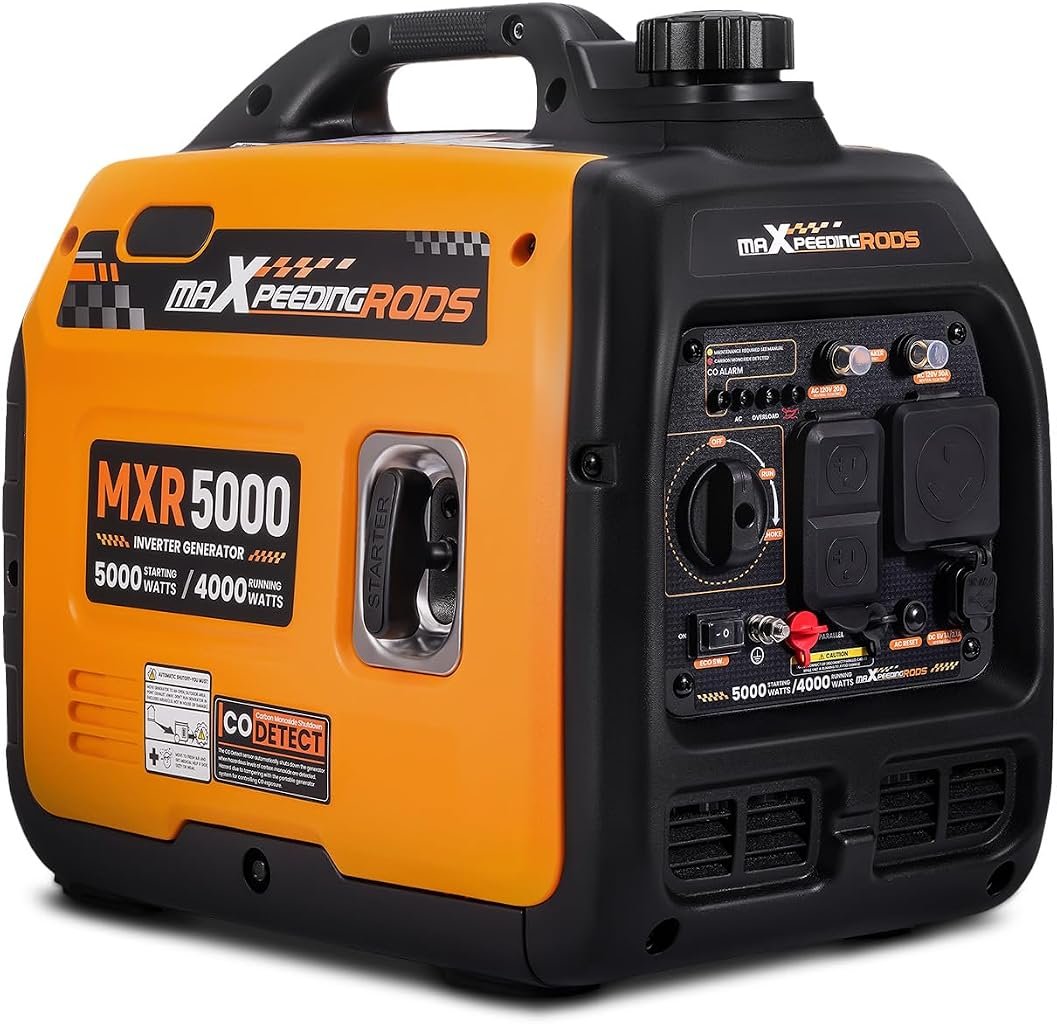
The maXpeedingrods 5KW Portable Inverter Generator is a good example of why those secondary numbers deserve more attention. In its U.S. 120V configuration, the manufacturer specifies 5,000 peak watts and 3,800 running watts from a 174.2cc four-stroke OHV gasoline engine. It offers recoil, electric and remote starting, a 1.85-gallon fuel tank, Eco mode, parallel capability and a digital meter. The manufacturer lists runtime at 9.5 hours at quarter load and 5.8 hours at 50 percent load.
Those specifications place the machine in a useful middle category. It has considerably more capacity than the small inverter generators commonly used primarily for electronics and light camping duties, yet it remains a selective-power machine rather than a substitute for a permanently installed whole-house system.
At the evaluated price of $549.97, our score is 7.95/10. Customer Sentiment stands at 7.4, Buyer Confidence reaches 9.8, and Value is 7.67. The unusually large separation between Buyer Confidence and Customer Sentiment deserves attention. The generator has a clearly defined technical identity, but knowing exactly what a product does is not the same thing as declaring it ideal for every buyer.
The 5KW Name Needs Immediate Context
The first calculation is straightforward: 5,000 peak watts does not mean 5,000 watts of continuous output.
The manufacturer’s specification page lists 3,800 running watts and 5,000 peak watts. Peak capacity exists to accommodate short-duration demands, particularly when motor-driven equipment starts. Continuous loads must be planned around the 3,800-watt figure.
That distinction creates a 1,200-watt gap between running and peak capacity.
For generator sizing, the gap is useful rather than suspicious. Refrigerators, pumps, air conditioners and some power tools can demand considerably more electricity during startup than after their motors reach operating speed.
This means a generator load cannot be calculated merely by adding the normal wattage printed on several appliances.
Suppose a group of devices consumes 2,600 watts continuously. That leaves approximately 1,200 watts beneath the generator’s rated running capacity. A motor-driven appliance consuming another 700 watts while operating might appear to fit comfortably. If that appliance needs substantially more during startup, however, the calculation changes.
A disciplined portable generator buying guide therefore separates running demand from starting demand before evaluating any generator.
That approach also makes the 5KW label less confusing. The machine has meaningful surge capacity, but its working electrical budget is 3,800 watts.
The 174.2cc Engine Is Doing Substantial Work
The generator uses a 174.2cc air-cooled four-stroke OHV gasoline engine. The manufacturer recommends SAE 10W-30 oil and lists a 0.1-gallon oil capacity.
Engine displacement is not a direct measurement of electrical performance, but it helps establish the mechanical scale of the machine. This is not a tiny suitcase generator built around a minimal engine. Nor is it a large-displacement home-backup generator intended to support very high sustained household loads.
The gasoline-only design also keeps the operating arrangement straightforward. There is one fuel system to understand and maintain.
That simplicity has a cost.
A dual-fuel generator gives owners another energy source when gasoline availability becomes difficult during an extended outage. Propane also creates a different storage proposition. The maXpeedingrods model evaluated here does not offer that flexibility.
Fuel choice should therefore be settled before purchase rather than treated as a minor specification. Buyers specifically building a long-duration emergency system may assign considerably more value to fuel diversity than someone purchasing primarily for RV travel or occasional outdoor use.
Three Starting Methods Improve Everyday Usability
One of the generator’s more practical characteristics is its starting arrangement.
The manufacturer lists recoil, electric and remote starting. A remote controller is also included with the generator.
That combination addresses one of the less glamorous realities of portable-generator ownership: starting an engine repeatedly is part of using it.
Recoil starting is mechanically useful as a basic method, but electric starting reduces physical effort. Remote starting adds convenience when the generator is correctly positioned outdoors and the user does not need to stand immediately beside the machine to initiate operation.
There is a maintenance trade-off.
The electric and remote systems depend on the battery. The manufacturer specifically instructs owners to disconnect the battery connection during storage exceeding one month and warns that leaving the generator’s main switch on while the machine is unused can discharge the battery.
That is not a trivial detail for an emergency generator.
Backup equipment may sit untouched for months. A remote-start feature offers little benefit if neglect leaves the starting battery discharged when an outage occurs. Periodic inspection and battery management belong on the same preparedness checklist as gasoline and engine oil.
Runtime Figures Become Useful Only When Load Is Included
The 1.85-gallon fuel tank is paired with two manufacturer runtime figures: approximately 9.5 hours at 25 percent load and 5.8 hours at 50 percent load.
Those two numbers demonstrate why runtime should never be quoted without electrical load.
At quarter load, the generator is producing roughly 950 watts if the percentage is applied to its 3,800-watt running rating. At half load, the corresponding output is approximately 1,900 watts.
The published runtime falls by 3.7 hours between those two stated operating points.
That does not make the generator inefficient; it illustrates a basic characteristic of combustion-powered generation. More electrical output requires more mechanical work and therefore more fuel.
Eco mode is intended to help under changing loads by allowing engine operation to respond to demand. This can be particularly relevant during camping and emergency use, where connected equipment rarely consumes its maximum power continuously.
A refrigerator cycles. Battery charging changes over time. Lighting demand rises and falls. Some appliances operate only briefly.
Owners planning for an extended outage should therefore calculate fuel requirements around their expected workload rather than simply multiplying the maximum 9.5-hour figure across several days.
The Outlet Layout Covers Common 120V Uses
The generator provides two 120V 20A outlets, one 120V 30A outlet and two USB outlets.
That configuration reflects its intended identity as a U.S.-market portable generator for household, recreational and RV-related loads.
The 30A output broadens its usefulness for higher-demand compatible equipment and recreational vehicles, while ordinary 20A receptacles support familiar extension-cord connections. USB outputs provide direct low-voltage charging for smaller electronics.
An RV30 plug is listed among the included accessories.
Still, receptacle presence should not replace compatibility checking. An RV owner needs to inspect the vehicle’s shore-power connection, determine the correct adapter arrangement and calculate simultaneous loads. “30A” describes electrical capability; it does not guarantee that every connector bearing a similar current designation is physically interchangeable.
The generator’s specification is centered on 120V output. Anyone requiring 240V equipment should treat that as a decisive limitation rather than trying to engineer around it.
Inverter Architecture Broadens the Workload
The manufacturer describes the generator as producing pure sine-wave inverter power intended for sensitive electronics.
That matters because portable generators increasingly support loads containing electronic control systems: laptops, chargers, televisions, communications equipment and electronically managed appliances.
An inverter generator approaches those tasks differently from a basic conventional generator. The practical attraction is not simply “better electricity” as a vague marketing phrase; it is the ability to combine meaningful portable output with power intended for electronic equipment.
The digital display contributes to that more controlled operating experience.
According to maXpeedingrods, the meter displays voltage, frequency and running time. Low-oil, overload and output-ready LED indicators are also specified.
These functions do not increase generating capacity, but they give the operator information that can support better decisions. Runtime tracking assists maintenance. Overload indication helps diagnose excessive demand. Voltage and frequency monitoring give more operational context than a generator with only a power switch and receptacles.
Portability Is More Complicated Than the Marketing Language Suggests
The manufacturer’s specification lists a net weight of 27 kilograms, approximately 59.5 pounds, with dimensions of 52.5 by 33 by 50.7 centimeters.
That is portable, but not casually so.
Sixty pounds can be manageable for a healthy adult over a short distance. Repeatedly lifting the machine into a pickup bed, carrying it across a campsite or moving it over stairs presents a different physical task.
The distinction matters because portable generators are often bought online, where dimensions appear abstract until the box arrives.
Storage space should be measured before purchase, particularly in an RV. The generator’s operating location should then be planned separately from its storage location.
A cargo compartment may be ideal for transportation and entirely unsuitable for operation.
That separation becomes critical because a gasoline engine produces carbon monoxide.
Noise Is Moderate Rather Than Invisible
maXpeedingrods lists a no-load sound level of 65 dB measured at 23 feet.
The measurement conditions matter.
“No load” is not the same as operating while delivering 1,900 or 3,000 watts. Sound also changes with distance, surrounding structures, ground surfaces and orientation. A generator beside a reflective wall may be perceived differently from the same generator in an open field.
The 65 dB specification should therefore be treated as a defined manufacturer measurement rather than a promise that every operating situation will sound identical.
This matters particularly for campgrounds.
A generator can be mechanically suitable for RV use while still conflicting with campground quiet hours or local noise rules. Owners should check those restrictions independently.
The enclosed inverter format is nevertheless more aligned with recreational and residential use than an exposed industrial-style frame. The machine is intended to coexist with environments where noise matters, even though it cannot make a combustion engine acoustically disappear.
Parallel Capability Creates an Expansion Path
The generator is parallel ready, allowing compatible generators to be connected for greater combined capacity.
That can be useful for owners whose electrical requirements grow.
It also creates a purchasing strategy different from buying one substantially larger generator immediately. A user can operate a single machine when 3,800 running watts is adequate and employ compatible parallel equipment when additional capacity is required.
The limitation is financial and logistical.
Parallel capability is not free power. A second generator requires another purchase, additional fuel, more storage space and more maintenance. The appropriate connection equipment is also required.
For most buyers, the correct question remains whether 3,800 running watts is enough today.
If it is not, parallel capability should not be used to rationalize an undersized initial purchase unless owning two machines is genuinely part of the plan.
The Safety Arithmetic Is More Important Than the Wattage Arithmetic
Gasoline generators introduce a hazard that no electrical specification can offset: carbon monoxide.
The Centers for Disease Control and Prevention says generators should be operated outside, more than 20 feet from windows, doors and vents. The CDC also says generators should never be operated inside a home or garage even when doors and windows are open, and recommends battery-powered or battery-backup carbon monoxide detection inside the home.
The distance requirement has practical consequences.
A homeowner cannot simply place the generator immediately outside an open door and run an extension cord inside. A safe operating plan requires sufficient distance, appropriate cable length and exhaust orientation away from occupied areas.
The U.S. Consumer Product Safety Commission gives the danger additional scale. Its carbon monoxide information center reports that more than 100 U.S. deaths each year from accidental non-fire consumer-product-related CO poisoning are linked to portable generators. The agency also states that one portable generator can produce the same amount of carbon monoxide as hundreds of cars.
That makes generator placement a primary operating requirement, not a cautionary footnote.
Extension Cords and Household Wiring Need Planning Too
Once the generator is positioned safely away from the home, electricity still has to reach the appliances.
The CDC advises connecting appliances with individual heavy-duty, outdoor-rated extension cords and warns against using generators or appliances when wet. Its winter-storm guidance also says gasoline should not be stored indoors where fumes could ignite.
Cord selection requires attention to current, length and conductor size. An extension cord is part of the electrical system, not merely a convenient piece of wire.
Supplying fixed household circuits presents another category of problem.
A portable generator should not be improvised into household wiring through unsafe backfeeding arrangements. Buyers wanting to energize selected installed circuits should budget for appropriate transfer equipment and qualified installation according to applicable electrical requirements.
This often changes the real cost of emergency backup.
The generator may cost $549.97, but a safe household system can also require outdoor-rated cords, carbon monoxide detectors, fuel storage equipment and professionally installed transfer hardware.
Environmental Conditions Affect Real Output
The manufacturer includes two operating limitations that deserve more attention than they usually receive.
Its documentation states that use above 5,000 feet can affect stability and power. It also identifies an optimum working ambient temperature of 77°F and a normal operating range from 23°F to 104°F, warning that cold conditions can impair starting and high temperatures can reduce output.
Those caveats illustrate why generator specifications are not laboratory constants in every environment.
A machine used at elevation in the mountains faces different combustion conditions from one operating near sea level. A generator started during a severe winter outage faces a different mechanical environment from the same machine at moderate temperature.
For camping buyers, altitude deserves particular attention because mountain travel and portable-generator use frequently overlap.
The load plan should therefore contain some margin rather than assuming the generator will always deliver its published capability under every environmental condition.
Why Buyer Confidence Scores 9.8
Buyer Confidence is the strongest element of our assessment at 9.8.
That rating does not mean the generator suits nearly everyone. It reflects how clearly the machine’s capabilities can be mapped to a buyer’s requirements.
The important specifications are unusually explicit: 5,000 peak watts, 3,800 running watts, 120V output, a 174.2cc gasoline engine, 1.85-gallon tank, three starting methods, defined quarter- and half-load runtimes, digital monitoring, Eco mode and parallel capability.
That gives a disciplined buyer enough information to answer the central question: does this generator fit the intended workload?
The answer becomes much less subjective after a load audit.
A household requiring 2,500 running watts with manageable startup surges sits comfortably inside a different category from one needing 5,000 continuous watts. An RV requiring 120V power presents a different case from equipment requiring 240V.
High Buyer Confidence therefore reflects definitional clarity rather than universal suitability.
Why Customer Sentiment and Value Sit Lower
Customer Sentiment is 7.4, substantially below Buyer Confidence.
The gap reflects a broader reality of generator ownership: specifications can be clear while lived suitability remains more demanding.
A gasoline engine requires maintenance. Electric and remote starting add battery management. Approximately 60 pounds still has to be moved. A 1.85-gallon tank still has to be refilled. The generator still makes noise. Its 3,800-watt running limit still requires load management.
Value scores 7.67.
At $549.97, the generator offers a substantial feature package: inverter architecture, three starting methods, a digital display, multiple outlets, Eco mode, parallel capability and nearly 4,000 watts of running power.
Yet value is inseparable from requirements.
A buyer needing dual-fuel operation receives no benefit from a lower purchase price if gasoline-only operation is unacceptable. Someone requiring 240V cannot solve that mismatch through enthusiasm for remote starting. Conversely, a camper who needs only 1,500 watts may be paying for capacity that spends most of its life unused.
That is why the overall score settles at 7.95/10 rather than tracking the much higher Buyer Confidence figure.
Who Fits This Generator Best?
The maXpeedingrods 5KW model makes the most sense for buyers with a defined 120V workload below its 3,800-watt continuous ceiling.
Suitable use cases include:
- RV owners who have calculated their air-conditioner startup demand and simultaneous appliance loads.
- Homeowners seeking selective emergency power for refrigeration, communications, lighting and other prioritized equipment.
- Campers who need considerably more output than a small inverter generator can provide.
- Users who value electric and remote starting but still want recoil backup.
- Buyers powering a mixture of conventional appliances and sensitive electronics.
- Owners who see parallel operation as a realistic future requirement rather than an unused specification.
It makes less sense for buyers requiring 240V equipment, dual-fuel capability, whole-house capacity or genuinely lightweight portability.
A Pre-Purchase Audit Is Worth the Time
Before purchasing, a buyer should:
- Record the running wattage of every appliance expected to operate simultaneously.
- Record startup requirements for refrigerators, pumps, air conditioners and other motor-driven loads.
- Keep sustained demand within the 3,800-watt running rating.
- Verify 120V compatibility for all intended equipment.
- Check receptacle and RV-adapter requirements.
- Measure the intended transport and storage spaces.
- Decide whether roughly 60 pounds can be handled safely.
- Plan an outdoor operating location more than 20 feet from doors, windows and vents.
- Obtain correctly rated outdoor extension cords.
- Install and test carbon monoxide detectors.
- Estimate gasoline requirements using realistic electrical loads rather than the maximum published runtime.
- Include battery maintenance in the storage schedule.
- Account for altitude and temperature where relevant.
- Arrange suitable transfer equipment if fixed household circuits will receive generator power.
This audit is not bureaucracy. It is the difference between buying a generator by nameplate and buying one by function.
Final Considerations
The maXpeedingrods 5KW Portable Inverter Generator becomes easier to assess once its headline number is stripped of ambiguity. It is fundamentally a 3,800-running-watt, 120V gasoline inverter generator with 5,000 watts of peak capacity.
Within that definition, it offers a thoughtful collection of features.
The 174.2cc four-stroke engine, three starting methods, 1.85-gallon fuel tank, digital display, Eco mode, parallel capability, 30A output and USB connectivity create a machine suitable for RV travel, camping and selected-load residential backup. Its published 9.5-hour quarter-load runtime also gives users a meaningful reference point for lower-demand operation.
Our score of 7.95/10 reflects a generator that is technically well specified without being universally compelling.
Buyer Confidence at 9.8 is the standout figure. Buyers can identify with unusual precision what this machine is capable of doing and where its boundaries lie. Customer Sentiment at 7.4 and Value at 7.67 temper that confidence because ownership includes more than electrical specifications. Gasoline dependence, battery maintenance, nearly 60 pounds of mass, 120V-only operation and a 3,800-watt sustained ceiling all affect fit.
At $549.97, the proposition is strongest for someone who will actually use the features being purchased. Remote starting has value when convenience matters. Parallel capability has value when expansion is plausible. Inverter output has value when electronics form part of the workload. None of those features compensates for a mismatch in voltage, fuel preference or required continuous power.
The final decision therefore comes down to arithmetic and logistics.
If the planned continuous load remains comfortably below 3,800 watts, startup surges fit within available peak capacity, 120V covers the intended equipment, gasoline is an acceptable fuel, and a roughly 60-pound generator is genuinely portable for the owner, the maXpeedingrods 5KW has a coherent place in the market.
If those conditions are not satisfied, its long feature list should not override the mismatch. A generator is emergency equipment, travel equipment and an internal-combustion machine all at once. Buying the right one requires more discipline than reading the largest number printed on the casing.