Portable generators invite a deceptively simple purchasing question: how much electrical power can a buyer obtain for the money? A more useful review asks harder questions. Can the machine’s capabilities be verified? Does its design fit the intended load? Is there enough documentation to support safe ownership? And does the purchase still make sense after cords, fuel, maintenance, storage and electrical connection requirements enter the calculation?
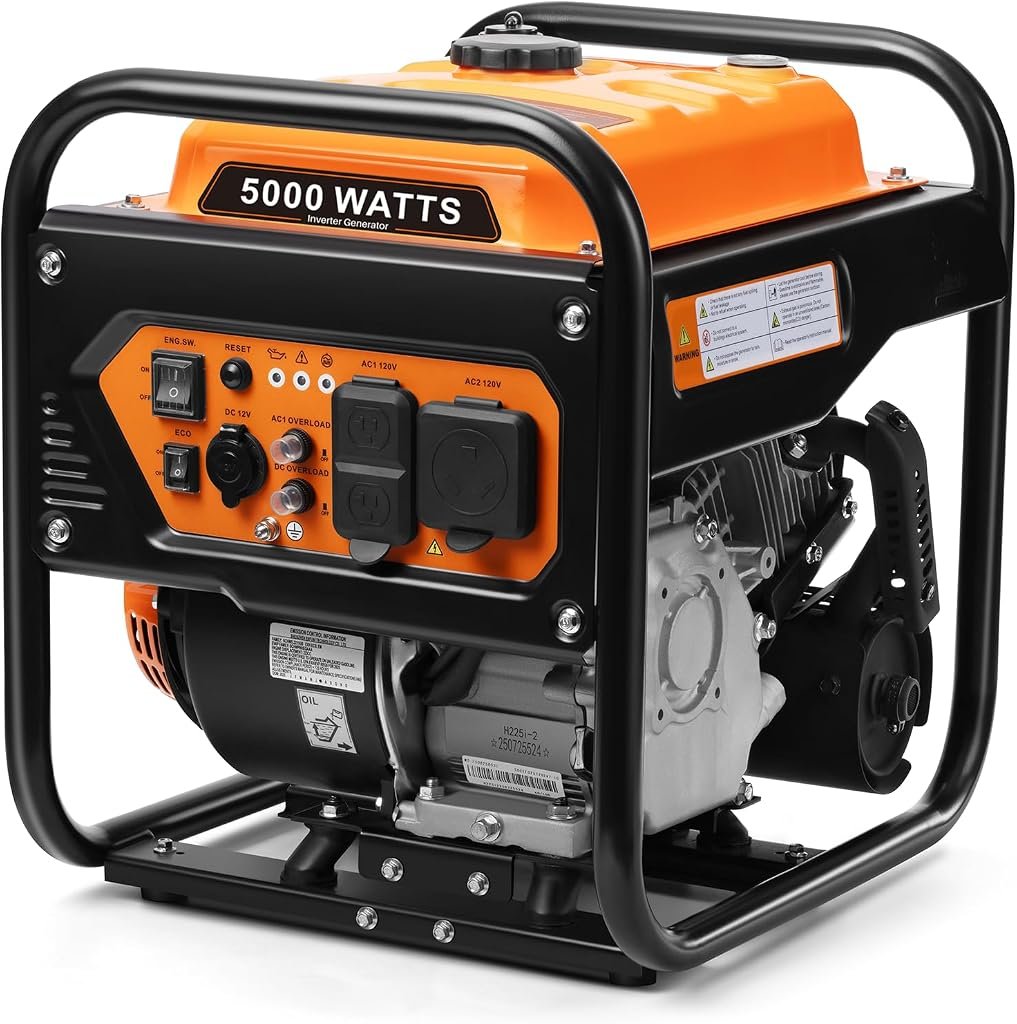
The Oxseryn 5000W Portable Inverter Generator enters that discussion with an overall editorial score of 8.22/10. Customer Sentiment stands at 8.06, Buyer Confidence reaches 8.91, and Value is rated 8.03. Those numbers produce a broadly favorable assessment, but they also reveal something more interesting than a single aggregate score: confidence is substantially stronger than the value and sentiment measures.
That difference deserves attention.
A generator is emergency equipment in many households. It can sit unused for weeks or months and then be expected to work during a blackout, storm or remote trip. Reliability, understandable controls, appropriate electrical capacity and safe operating procedures therefore matter more than an impressive number printed prominently in a product name.
This Oxseryn 5000W Portable Inverter Generator review consequently treats the machine as part of a larger backup-power system rather than as an isolated appliance.
Our Assessment: 8.22/10
Our score of 8.22/10 places the Oxseryn in favorable territory. It indicates a product with meaningful appeal but not one that should be purchased solely because “5000W” sounds substantial.
The strongest editorial signal is Buyer Confidence at 8.91. Customer Sentiment, at 8.06, is positive but lower. Value, at 8.03, follows a similar pattern. In practical terms, the ratings suggest greater confidence in the purchase proposition than enthusiasm about price-to-capability alone.
That distinction is healthy in generator evaluation.
Generators are unusually poor candidates for shopping by headline specifications. Peak or starting wattage, continuous wattage, voltage, outlet configuration, fuel system, total harmonic distortion, noise, runtime and physical weight can all change whether a model suits a particular job. A machine suitable for campsite electronics can be wrong for a well pump. A generator capable of running an RV air conditioner may still be inappropriate for feeding household circuits without suitable electrical equipment.
For that reason, the Oxseryn’s 8.22 score should be read as an editorial endorsement of its overall buying proposition, not as permission to skip load calculations.
Why a 5,000W Label Needs Context
Generator naming conventions can obscure the difference between starting capacity and sustained output.
Electric motors and compressors can demand more power during startup than during normal operation. Refrigerators, freezers, pumps and air conditioners are familiar examples. A generator therefore needs enough continuous capacity for simultaneous operating loads and enough short-duration capability for relevant startup events.
A portable generator buying guide should always separate those calculations.
Suppose a household wants backup power for refrigeration, lighting, communications equipment and several outlets. The correct process is to inspect appliance labels or documentation, record running consumption and identify equipment with elevated starting demand. The buyer can then decide which devices actually need to operate simultaneously.
This matters because adding every appliance in a house produces an unrealistic number if most will never run together. Going too far in the other direction creates overload risk.
OSHA explicitly advises users not to overload generators because overheating can create a fire hazard. Its generator guidance also says electrical equipment should be connected using grounded cords rated for the anticipated load.
The “5000W” designation in the Oxseryn name should therefore trigger a specification check rather than end one. Buyers should verify the exact continuous and starting ratings for the unit they are purchasing before building a load plan around it.
Buyer Confidence Is the Standout Score
The 8.91 Buyer Confidence rating is the strongest of the four editorial measures.
That matters because backup equipment is purchased under a peculiar set of circumstances. The buyer often hopes not to need it. When it finally is needed, failure can mean spoiled food, no furnace blower, no well pump, no communications equipment or an RV electrical system that cannot support the expected load.
Confidence consequently extends beyond whether an engine starts on delivery day.
It includes whether the owner can identify the correct operating procedure, understand overload limits, connect loads safely, perform required maintenance and obtain the necessary documentation. A generator should not require improvisation during an emergency.
The gap between the 8.91 Buyer Confidence figure and the 8.03 Value score also prevents the review from becoming promotional. The editorial position is favorable, but value is not treated as synonymous with low purchase price.
Generator ownership has secondary costs. Fuel containers, engine oil, suitable extension cords, weather protection, storage arrangements and maintenance supplies can add to the real expenditure. Home-backup installations can add considerably more if an inlet, interlock or transfer equipment requires professional installation.
The sticker price is therefore only the opening number.
Value Scores 8.03
Our Value rating of 8.03 indicates a favorable price-to-purchase proposition without suggesting that every buyer receives equal utility from the machine.
A generator earns value by matching a load profile.
A homeowner who needs only a refrigerator, router, several lights and phone charging may derive little benefit from unused generating capacity if a smaller machine would cover the same requirements with easier transportation and potentially lower fuel consumption.
An RV owner faces another calculation. Air-conditioning startup, microwave use, battery charging and other loads can make additional capacity useful, but weight and noise become more consequential when equipment is transported frequently.
Emergency home backup introduces another variable: outage duration. Fuel availability may matter more than several hundred watts of extra capacity during a multiday interruption.
The 8.03 Value rating should therefore be interpreted as an assessment of the overall proposition rather than a universal declaration that this is the right expenditure for every household.
A buyer gets the strongest value when the generator’s verified operating specifications align closely with actual demand.
Customer Sentiment at 8.06
Customer Sentiment receives an 8.06 editorial rating, slightly below the overall 8.22 score and meaningfully below Buyer Confidence.
That is still a favorable result. More importantly, it keeps the product assessment grounded. Ownership satisfaction and purchasing confidence are related, but they are not identical.
Generators create more opportunities for user-product friction than many household appliances. Starting procedure, storage conditions, fuel quality, maintenance, ambient temperature, altitude, extension-cord sizing and load behavior can all affect the ownership experience.
That complexity is why customer sentiment should never replace technical suitability.
A generator can be broadly liked and still be wrong for a specific 240V appliance. It can offer ample wattage and still be unnecessarily cumbersome for occasional camping. It can appear inexpensive yet become costly if the buyer later discovers that the intended home connection requires additional electrical work.
The 8.06 rating is therefore best read alongside the other measures. Taken together, the four scores describe a favorable product proposition with enough separation between confidence, sentiment and value to preserve meaningful trade-offs.
Inverter Architecture and the Buying Decision
The phrase “inverter generator” has become shorthand for a particular category of portable power, but buyers should resist treating the label itself as proof of every desirable characteristic.
An inverter generator electronically conditions its electrical output rather than relying solely on the direct alternator arrangement associated with conventional portable generators. Many inverter designs can also vary engine behavior with electrical demand.
That architecture can be attractive for RVs, camping and household electronics. Yet the actual purchasing questions remain specific: What is the continuous output? Which receptacles are installed? What voltage is available? What harmonic-distortion specification does the manufacturer publish? How is overload handled? What are the stated acoustic measurements, and under what test conditions?
Those questions prevent category labels from becoming substitutes for specifications.
For the Oxseryn, the editorial position is straightforward: buyers should verify the exact technical documentation associated with the unit being purchased and size their loads from those figures. Unsupported assumptions about noise, runtime, electrical quality, fuel capacity or outlet configuration have no place in a serious buying decision.
Home Backup: Start With Loads, Not Generator Size
Home backup is where generator purchasing most often becomes distorted by the pursuit of larger wattage.
A house does not have one fixed emergency-power requirement. It has a collection of loads, some essential and some discretionary.
Refrigeration may be essential. Internet access may matter for work or emergency communication. A gas furnace can still require electricity for its blower and controls. A well system can introduce substantial pump demand. Electric resistance heating, central air conditioning, water heating and cooking can push requirements much higher.
The buyer should create two columns: equipment that must operate during an outage and equipment that can remain off.
Next comes simultaneous demand.
If a refrigerator, freezer, furnace blower and lighting are operating together when a pump starts, the generator must accommodate that event. If high-draw appliances can be manually staggered, the required generator size may fall substantially.
This is more useful than simply buying the largest machine within budget because excess capacity has physical costs. Larger engines and frames can mean greater weight, more storage space and different fuel requirements.
A correctly sized generator is not necessarily the biggest generator. It is the one whose verified output accommodates the planned load with reasonable operating margin.
RV and Camping Use Demand a Different Standard
The same generator can look very different when evaluated beside an RV instead of a house.
Portability rises in importance. So do noise, physical dimensions, outlet compatibility and the ability to move the unit repeatedly.
An RV owner should first identify the RV’s electrical service and major loads. Air conditioning is often a major consideration because compressor startup can create a short-duration demand above normal running consumption.
Load management can solve some problems more economically than buying additional generating capacity. Running an air conditioner and microwave simultaneously, for example, imposes a different requirement than operating them separately.
Camping introduces still more restraint.
If the electrical requirement consists primarily of phones, laptops, lights and small rechargeable equipment, a combustion generator may provide far more output than the trip requires. Battery power stations can be attractive for those modest loads because they operate without combustion exhaust during discharge.
Where longer runtime or repeated high-energy loads make a generator more appropriate, campsite regulations and neighboring users still matter. Generator hours may be restricted, and noise travels.
The Oxseryn’s favorable editorial scores make it worthy of consideration, but intended use should determine whether its class of machine is sensible in the first place.
Carbon Monoxide Safety Cannot Be Reduced to a Feature List
Portable-generator safety deserves its own purchasing criterion because misuse can be fatal.
The Centers for Disease Control and Prevention states that a generator should be operated outdoors more than 20 feet from windows, doors and vents. The agency also says: “Never use a generator inside your home or garage, even if doors and windows are open.”
That instruction is unusually direct because carbon monoxide is colorless and odorless. A garage with an open door is not an acceptable generator room. Neither is a basement or other enclosed area.
The CDC also recommends a battery-powered or battery-backup carbon-monoxide detector in the home when a generator is operating.
Weather creates a related problem. Generators need protection from wet conditions without being enclosed in a manner that traps exhaust or prevents cooling. OSHA advises keeping generators dry and allowing adequate clearance for ventilation.
Any generator purchase should therefore include a placement plan before the machine arrives.
Connecting a Generator to a House Requires Discipline
A portable generator should never be improvised into a home’s wiring system.
The Occupational Safety and Health Administration warns: “Never attach a generator directly to the electrical system of a structure” unless a qualified electrician has properly installed it with a transfer switch.
The reason is backfeed.
An improperly connected generator can energize wiring outside the house and expose utility personnel or other people to electrocution hazards. The risk exists beyond the owner’s property, which makes improvised backfeeding particularly serious.
For individual portable loads, appropriately rated extension cords provide a simpler arrangement. Cords should be grounded where required, undamaged and rated for the anticipated electrical load.
Anyone planning circuit-level home backup should establish the connection architecture before choosing a generator. Voltage, receptacle configuration and transfer equipment must agree with one another. Generator wattage alone cannot solve an incompatible electrical design.
Maintenance Determines Whether Backup Power Is Actually Available
Portable generators spend much of their lives doing nothing.
That inactivity can create a false sense of preparedness. A machine stored in a garage is not useful emergency infrastructure if old fuel, a discharged starting battery or neglected maintenance prevents it from operating when required.
The exact owner’s manual should govern maintenance intervals and storage procedure. Broadly, the owner should pay attention to engine oil, air filtration, fuel condition, hoses, electrical cords, fasteners and starting batteries where fitted.
Gasoline storage deserves particular care. Long periods of inactivity can create fuel-system problems, especially when fuel remains in carburetor passages.
Emergency preparation should also include periodic procedural checks. The owner should know where the generator will operate, how loads will reach it, where fuel is stored safely and which appliances receive priority.
A blackout is a poor time to discover that the extension cord is underrated or that the intended connection does not fit the generator.
Who Should Consider the Oxseryn?
The Oxseryn’s 8.22 overall score makes the strongest case for buyers who already understand their electrical requirements and are comparing portable inverter-generator options on overall fit rather than headline wattage alone.
Its 8.91 Buyer Confidence score is the defining editorial signal. The 8.06 Customer Sentiment and 8.03 Value ratings support the broader assessment while leaving room for practical trade-offs.
It is less compelling as an impulse purchase for someone who has not calculated loads, identified the required outlets or developed a safe operating location.
That distinction matters because generators solve specific electrical problems. They do not create generic “backup power” merely by existing.
A household requiring selected emergency loads, an RV owner managing several substantial appliances and a camper running modest electronics can all encounter the same generator listing while having radically different requirements.
The purchase should follow the requirement, not reverse it.
Final Considerations
The Oxseryn 5000W Portable Inverter Generator earns our 8.22/10 overall score, supported by Customer Sentiment of 8.06, Buyer Confidence of 8.91 and Value of 8.03.
Buyer Confidence is the standout measure. Value and sentiment remain favorable without erasing the compromises inherent in portable combustion power.
The central buying discipline is specification verification. The 5000W designation should not substitute for checking continuous output, starting capacity, voltage, receptacles, operating requirements and the manufacturer’s documentation for the exact unit. Those details determine what a generator can safely and realistically power.
For home backup, buyers should calculate simultaneous loads and motor-starting demand before choosing capacity. For RV use, electrical service, air-conditioning startup and outlet compatibility deserve priority. For camping, weight, acoustic impact and actual energy demand can matter more than maximum output.
Safety sits above all of those calculations. A combustion generator belongs outdoors and away from openings; the CDC specifies more than 20 feet from windows, doors and vents. Household wiring requires a properly designed connection rather than improvised backfeeding. Cords and connected loads must stay within their electrical ratings.
Seen through that wider lens, the Oxseryn’s favorable scores are most meaningful for a buyer who approaches portable power as a system: generator, loads, connection, operating location, maintenance and fuel planning working together.
That is a less dramatic way to shop than chasing the largest wattage printed on a box. It is also the method more likely to produce backup power that actually works when the lights go out.