Portable generators tend to expose the difference between a large number printed on a specification sheet and genuinely useful electrical capacity. An “8000W” badge sounds straightforward. In practice, buyers must account for starting watts, sustained output, fuel choice, noise, power quality, weight, outlet configuration, runtime, safety systems and the surge demands of whatever equipment will be connected.
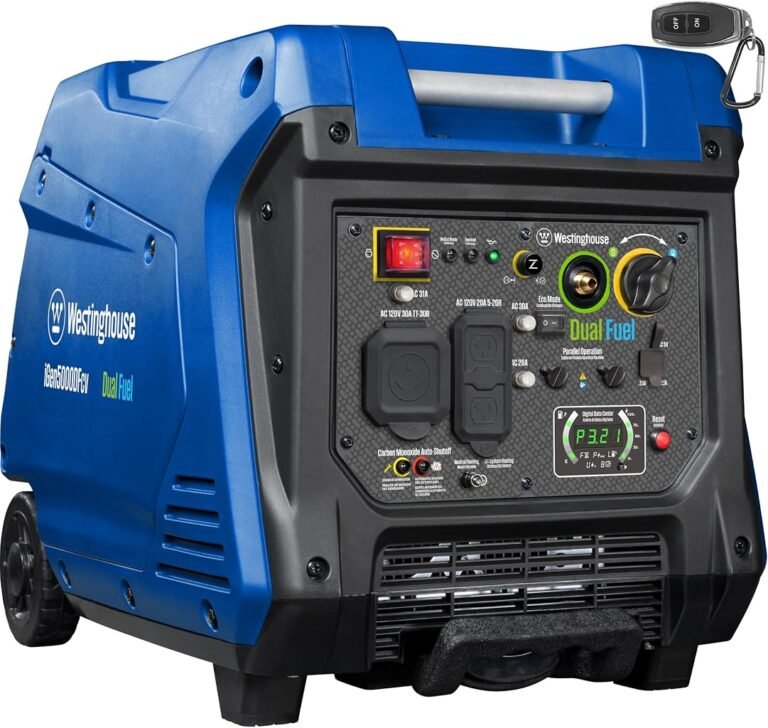
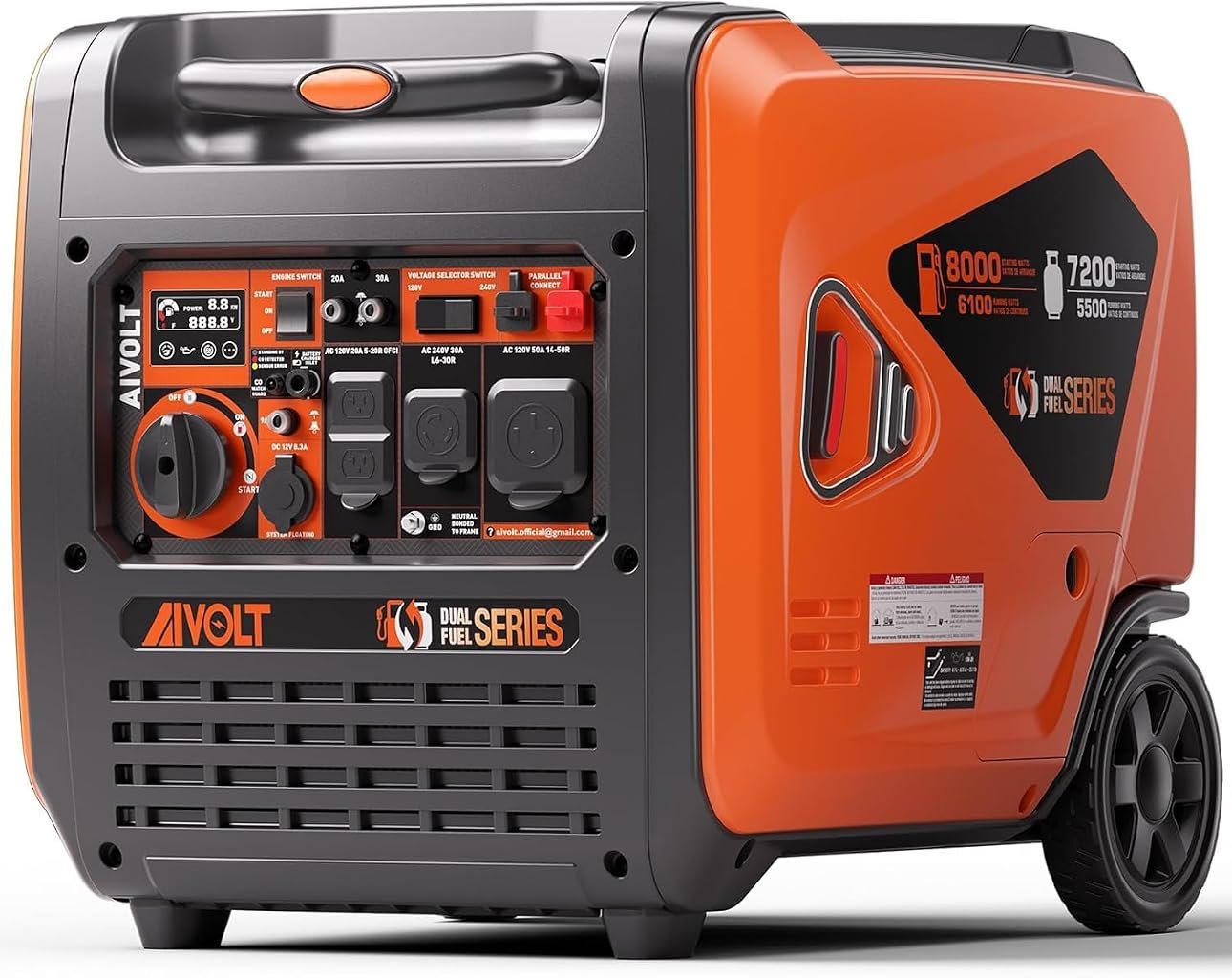
The AIVOLT 8000W Dual Fuel Inverter Generator approaches that problem with an unusually broad set of capabilities. According to AIVOLT’s official specifications, the generator produces 8,000 starting watts and 6,100 running watts on gasoline. The company’s comparison data puts propane output at 7,200 starting watts and 5,500 running watts. It combines those figures with inverter power, gasoline and LPG compatibility, electric starting, an enclosed chassis, automatic fuel switching and carbon-monoxide monitoring.
Our score is 8.1/10. Customer Sentiment stands at 7.62, Buyer Confidence at 9.8 and Value at 7.79. Those figures describe a generator with a persuasive technical package and unusually high confidence as a buying proposition, while also acknowledging that its roughly $1,433.52 review price and substantial physical mass put it well beyond casual camping-generator territory.
This is better understood as movable backup equipment than something a person casually carries around.
What 8,000 Watts Actually Means
The first task in evaluating the AIVOLT is separating peak capacity from continuous capacity.
On gasoline, its 8,000-watt figure represents surge or starting output. Sustained output is 6,100 watts. On propane, the corresponding ratings are 7,200 starting watts and 5,500 running watts.
That distinction matters because electric motors and compressors can briefly require substantially more power while starting than while running. Refrigerators, air conditioners, pumps and certain power tools therefore cannot be evaluated simply by adding their ordinary running wattages.
The 6,100-watt gasoline rating is the more useful figure for planning sustained loads. It gives the AIVOLT enough capacity to sit in a different class from small suitcase-style inverter generators intended mainly for electronics, lighting and modest appliances.
It does not, however, turn the machine into an unlimited whole-house power plant.
A household attempting to run several large loads simultaneously still needs load management. Electric water heating, central air conditioning, electric cooking equipment, well pumps and other high-demand devices can consume capacity rapidly, particularly when motors start. Buyers should identify both running and starting requirements before deciding which circuits or appliances matter during an outage.
That calculation belongs near the beginning of any responsible portable generator buying guide. Generator sizing should start with actual loads, not the wattage printed most prominently on the generator.
Dual Fuel Is More Than a Convenience Feature
Dual-fuel capability is one of the AIVOLT’s strongest practical attributes.
Gasoline provides the higher rated output: 6,100 running watts compared with 5,500 on LPG. Propane therefore involves an approximately 9.8% reduction in continuous rated output, calculated from AIVOLT’s published figures. The trade is additional flexibility.
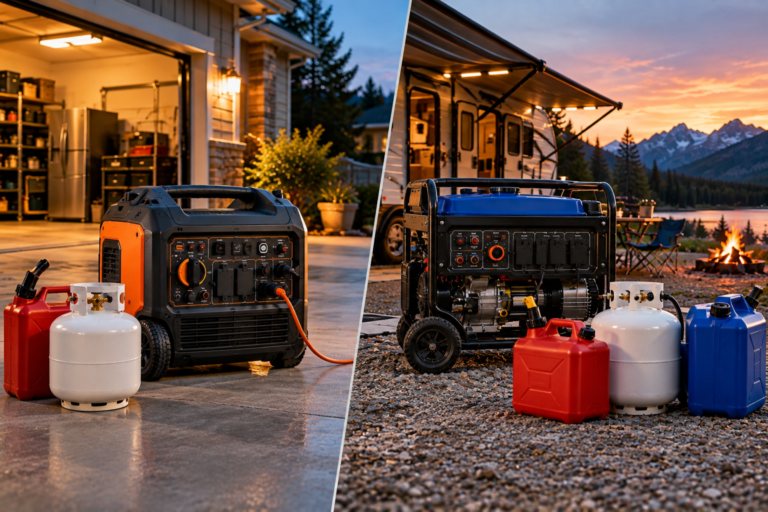
A household preparing for outages does not necessarily know which fuel will be easiest to obtain when the grid fails. Gasoline is widely available and gives the AIVOLT its maximum rated capacity. Propane can be stored separately in cylinders and removes the need to keep gasoline in the generator’s tank between every use.
The more interesting feature is AIVOLT’s automatic fuel-switching system. The manufacturer states that the generator can move between gasoline and LPG without requiring manual adjustments.
That is not merely a specification-sheet flourish. Fuel management becomes more consequential during an extended outage, when runtime and replenishment matter more than peak output. A generator that accepts two fuels gives its owner another logistical option when one fuel becomes inconvenient or scarce.
There is still no free energy in the arrangement. Propane’s lower rated wattage needs to be incorporated into load planning. Someone sizing the machine around the full 6,100-watt gasoline rating cannot assume an identical load margin after switching fuels.
Inverter Power Changes the Character of the Machine
The AIVOLT’s inverter architecture is arguably as significant as its dual-fuel engine.
Traditional portable generators and inverter generators ultimately perform the same broad job-turning engine power into electricity-but inverter electronics allow the output to be electronically conditioned. AIVOLT specifies pure-sine-wave output with total harmonic distortion of no more than 3%.
That specification gives the machine greater relevance in a house or RV containing computers, chargers and other electronic equipment than raw wattage alone would suggest.
It also helps explain the product’s positioning. There are cheaper ways to purchase several thousand watts of portable generation if the only requirement is brute electrical capacity. The AIVOLT is attempting to combine relatively high output with the behavior buyers associate with enclosed inverter generators.
Eco Mode is part of the same strategy. AIVOLT states a runtime exceeding 10 hours at 25% load and lists a 3.6-gallon gasoline tank in its official comparison material.
That runtime figure needs to be read exactly as stated: it is associated with a quarter load. It should not be treated as a promise of ten-plus hours while continuously delivering 6,100 watts. As electrical demand rises, fuel consumption rises with it.
For outage planning, runtime at a defined load is far more informative than a runtime number presented without its operating conditions.
Noise Is Impressive on Paper, but Context Matters
AIVOLT rates the generator at 62 dBA measured from 23 feet.
That is a notable specification for equipment capable of producing 6.1 kW continuously on gasoline. Yet generator noise numbers require careful reading because distance, load, measurement conditions and surroundings affect what a user actually hears.
A generator at light load in an open outdoor area does not create the same acoustic experience as one carrying a demanding load beside reflective walls.
The more defensible observation is therefore narrower: the published 62-dBA-at-23-feet figure is consistent with AIVOLT’s effort to build a relatively high-output generator around an enclosed inverter design rather than a conventional exposed-frame architecture.
Noise also intersects with safety. Moving a generator close to a building simply to reduce what neighbors or occupants hear is a dangerous solution.
The Centers for Disease Control and Prevention’s generator guidance states that a generator should be kept outdoors and at least 20 feet from doors, windows and vents.
That 20-foot rule deserves priority over acoustic convenience.
Portability Has a 130-Pound Reality Check
Calling the AIVOLT portable is technically fair, but the adjective requires context.
AIVOLT lists the generator at approximately 130.7 pounds, with dimensions of 25.2 by 19.7 by 21.4 inches. Its mobility system includes a telescoping handle and two seven-inch never-flat wheels.
The wheels and handle matter because this is not luggage-weight equipment. At roughly 130 pounds before accounting for gasoline, repeatedly lifting it into a truck, onto a high RV platform or across stairs can become a two-person task.
On relatively firm, level ground, the wheel-and-handle arrangement makes the mass considerably more manageable. Mud, gravel, steps and rough job-site terrain are a different proposition.
That distinction helps define the ideal buyer. The AIVOLT makes considerably more sense for a household, RV owner or work site where the generator is rolled into position than for someone who expects to lift and relocate a generator frequently.
Power density has consequences. Six thousand-plus running watts, a 322cc engine, fuel hardware, an inverter system, enclosure, battery and sound-control measures inevitably create mass.
The Specification Sheet Contains a Detail Buyers Should Verify
There is an unusual inconsistency in AIVOLT’s own current material.
Its product description and comparison page identify a 322cc four-stroke OHV engine, while a product-information table farther down the official product page lists engine displacement as 208cc. The company’s dedicated comparison page independently gives the 8000W model a 322cc displacement.
The repeated 322cc specification across AIVOLT’s descriptive and comparison material makes that figure the more consistently documented one, but a prospective buyer should verify the model plate and current manual before purchase if engine displacement affects the decision.
This type of discrepancy matters more on expensive equipment than it does on disposable consumer goods. A generator is a mechanical system expected to operate during circumstances when reliability has immediate consequences. Accurate documentation is part of the ownership experience.
Controls and Connectivity Are Well Considered
The AIVOLT includes a five-in-one LCD information center intended to display operating information including voltage, runtime and fuel-related data. The control arrangement also includes four outlets, a 12V DC cigarette-style outlet and a dual USB adapter.
Electric start reduces the physical effort required during ordinary startup, while recoil starting provides a mechanical fallback.
The machine is also parallel-ready. AIVOLT says a second compatible generator can be connected through a separately sold parallel kit, with support for 240V output in that configuration.
That capability is potentially useful but should not be confused with the standard single-generator output arrangement. Anyone buying specifically for a 240V load should verify the exact required configuration, receptacle arrangement and parallel hardware before committing.
Electrical compatibility deserves more attention than marketing wattage. Voltage, receptacle type, continuous current capacity and startup demand all determine whether a generator can operate a particular appliance.
Carbon Monoxide Safety Cannot Be Reduced to a Sensor
AIVOLT incorporates a CO Alert system that is designed to shut the generator down when unsafe carbon-monoxide conditions are detected around the unit. It also lists overload protection and low-fuel shutdown among its protection systems.
The CO system is useful, but no automatic shutdown device changes where a combustion generator belongs.
The U.S. Consumer Product Safety Commission says portable generators should be operated outdoors, at least 20 feet from a home, with exhaust directed away from buildings. Its current safety guidance also recommends looking for generators equipped with CO shutoff technology.
The scale of the hazard is not theoretical. In January 2026, the U.S. Consumer Product Safety Commission reported an estimated 750 deaths from carbon-monoxide poisoning associated with generators from 2012 through 2022. The agency also warns that gasoline-powered generators can produce as much carbon monoxide as hundreds of cars.
A garage with its main door open is not an acceptable generator location. Neither is a basement, shed, crawlspace or porch close to the building.
CO alarms inside the home remain another layer of protection.
Connecting It to a House Requires the Right Hardware
A generator with 6,100 running watts naturally invites home-backup use, but there is an enormous difference between powering individual appliances with properly rated cords and connecting portable generation to residential wiring.
A generator should never be connected to household wiring by plugging it into an ordinary wall receptacle.
CPSC’s electrical-safety guidance describes this practice-commonly called backfeeding-as extremely dangerous because it can expose utility workers and neighboring properties to electrocution hazards while bypassing household protection devices.
A properly designed transfer arrangement isolates generator power from utility power. Homeowners intending to energize selected household circuits should therefore have the installation designed and completed according to applicable electrical requirements rather than improvising a connection during an outage.
This issue deserves as much attention as choosing the generator itself. A sophisticated inverter and CO sensor cannot compensate for unsafe household wiring.
Where the AIVOLT Makes the Most Sense
The AIVOLT occupies a useful middle ground between small recreational inverter generators and large fixed standby systems.
Its strongest applications are situations where several characteristics are required simultaneously:
- Substantial continuous output without moving to a permanently installed standby generator.
- Gasoline and propane operation.
- Inverter-quality output for mixed loads that include electronics.
- Electric starting and a wheeled enclosed chassis.
- Lower published noise than buyers generally associate with large open-frame generators.
- Enough capacity for carefully managed household backup, larger RV applications or demanding mobile work.
- Carbon-monoxide monitoring as an additional safety layer.
The machine is less compelling for buyers who need only a refrigerator, lights, internet equipment and a few chargers during an outage. Those loads can often be served by substantially smaller equipment.
Nor is this an ideal minimalist camping generator. A roughly 130-pound machine capable of 8,000 starting watts is excessive if the actual job consists of charging phones and running a coffee maker.
Sizing close to genuine demand usually produces a better ownership experience than buying the largest wattage the budget permits.
Understanding Our 8.1/10 Score
Our 8.1/10 rating reflects the breadth of the AIVOLT’s capabilities without treating every feature as equally relevant to every buyer.
Customer Sentiment at 7.62 is positive but more restrained than the overall score. That fits a product category where ownership involves unavoidable compromises: engine maintenance, fuel storage, significant weight, noise and the procedural discipline required to operate combustion equipment safely.
Buyer Confidence, at 9.8, is the strongest of our ratings. The core proposition is unusually easy to understand. There is substantial rated output, two fuel choices, inverter architecture, a defined noise specification, electric starting, mobility hardware and multiple protection systems. The product also carries a two-year warranty, while AIVOLT advertises lifetime technical support.
Value lands at 7.79. At approximately $1,433.52 for the reviewed configuration, this is a major equipment purchase. The price is easier to defend when the buyer genuinely needs the combination of high inverter output and dual-fuel capability. It becomes harder to justify when actual electrical demand is modest.
That difference explains why the 8.1 overall score should not be interpreted as a universal buying recommendation. A generator can be technically capable and still be badly matched to a particular household.
The Drawbacks That Matter
The AIVOLT’s disadvantages are mostly consequences of what it is trying to accomplish.
Weight is the obvious one. Roughly 130 pounds is mobile with wheels, but not effortlessly portable.
Cost is another. Buyers focused exclusively on watts per dollar can find simpler generator architectures without paying for the same mixture of inverter electronics, enclosure and dual-fuel hardware.
Propane also reduces available output to 5,500 running watts. That remains substantial capacity, but buyers planning around propane should size their loads against the propane rating rather than the larger gasoline number.
The published runtime likewise requires context. More than ten hours at 25% load is useful information, but an outage plan involving heavy sustained loads will produce a different fuel-consumption pattern.
Finally, the inconsistency in AIVOLT’s published engine-displacement information should be cleaned up. Buyers of four-figure mechanical equipment should not have to reconcile contradictory specifications on the manufacturer’s own product page.
None of these issues erases the generator’s strengths. They define its boundaries.
Final Considerations
The AIVOLT 8000W Dual Fuel Inverter Generator is most coherent when viewed as serious portable backup equipment rather than an oversized camping accessory.
Its 8,000 starting and 6,100 running watts on gasoline give it enough capacity for demanding mixed loads, while 7,200 starting and 5,500 running watts on propane preserve considerable capability when the second fuel is used. Inverter output rated at no more than 3% THD, automatic fuel switching, electric start, Eco Mode, a digital information display, CO monitoring and parallel capability create a feature set that goes considerably beyond raw engine-and-alternator simplicity.
Our 8.1/10 score reflects that balance. Buyer Confidence of 9.8 captures how well the fundamental design answers the needs of a high-output portable-power buyer. Value at 7.79 recognizes that the roughly $1,433.52 cost only makes sense when those capabilities will actually be used. Customer Sentiment at 7.62 leaves appropriate room for the physical and operational compromises inherent in owning a large combustion generator.
The purchasing decision should therefore begin with arithmetic rather than the 8,000-watt badge. Buyers should list essential loads, identify both running and starting demand, decide whether propane’s lower output remains sufficient, determine how the 130-pound machine will be moved and establish a safe outdoor operating location before an outage occurs.
When those requirements align, the AIVOLT presents a well-developed combination of output, fuel flexibility and inverter technology. When they do not, a smaller generator may be the more rational piece of equipment.
And regardless of generator size, the safety rules do not shrink with the load: operate combustion generators outdoors, maintain substantial separation from occupied buildings, use working CO alarms, protect the equipment from unsafe wet-weather operation and never improvise a connection to household wiring. In portable power, disciplined installation and operation matter every bit as much as the wattage on the casing.