
Buying a microwave used to mean choosing a box, checking whether it fit the counter, and deciding how many buttons seemed tolerable. The modern kitchen makes the decision considerably more consequential.
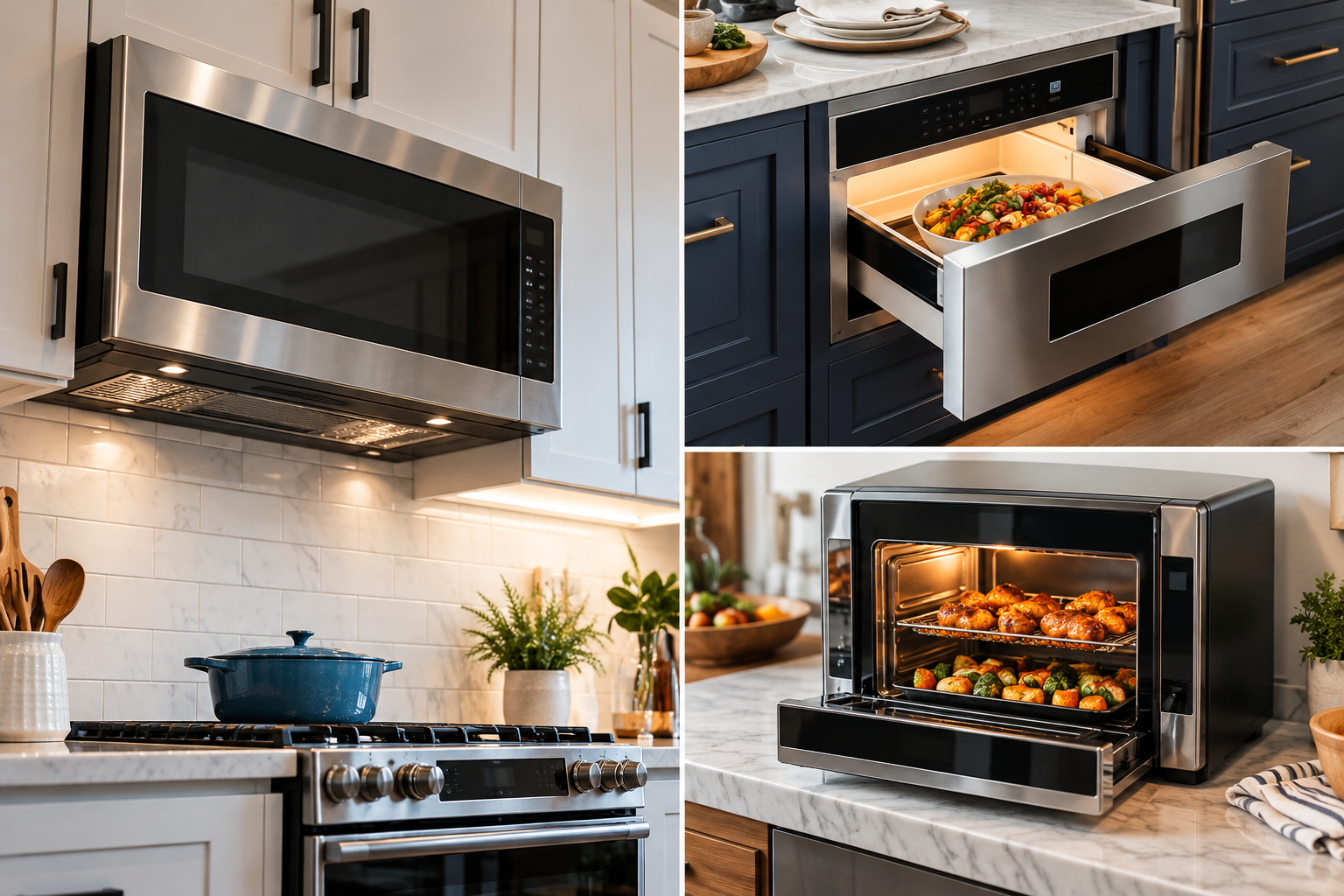
An over-the-range microwave can replace part of a ventilation system. A drawer microwave changes cabinetry and workflow. An air fryer microwave combo tries to consolidate several cooking appliances into one enclosure. Capacity, wattage, exhaust airflow, installation geometry, filter maintenance and door clearance can matter more over a decade of ownership than the number of presets printed on the control panel.
That is why microwave shopping should begin with architecture rather than features.
A household replacing an existing 30-inch over-the-range unit has a fundamentally different problem from a household designing an island around a microwave drawer. A small kitchen attempting to eliminate a countertop air fryer has yet another problem. Price comparisons without accounting for those differences can make an inexpensive microwave costly to install-or make a seemingly expensive appliance rational because it eliminates cabinetry changes or another countertop appliance.
The useful question is therefore not simply which microwave scores highest. It is which configuration solves the kitchen’s actual constraints with the fewest compromises.
The Three Microwave Categories Solve Different Problems
The first decision separates over-the-range, drawer and multifunction air-fryer models.
An over-the-range microwave combines microwave cooking with cooktop lighting and a ventilation fan. It preserves counter space and often fits an established 30-inch kitchen layout. Its weakness is equally structural: placing a microwave above a cooktop means the appliance must perform two jobs from one location.
A microwave drawer moves the cooking cavity below the counter. Food is lowered into a horizontal drawer rather than lifted into a side-hinged appliance. That arrangement can be attractive in islands and built-in kitchens, particularly where keeping appliances away from the visual line of upper cabinetry matters. It does not replace a range hood.
An air-fryer microwave combines microwave energy with another cooking system intended to circulate heated air. Some designs are countertop appliances; others are over-the-range units. The category is appealing because it can consolidate appliances, but buyers need to distinguish microwave output from convection or air-frying capability.
These are not interchangeable formats wearing different doors.
Microwave Drawer vs Over the Range: Start With Kitchen Geometry
The microwave drawer vs over the range decision is fundamentally about placement.
An over-the-range appliance uses space that would otherwise accommodate a hood or upper cabinetry. A drawer uses base cabinetry that might otherwise store cookware, food or utensils.
That trade can be surprisingly significant.
A conventional over-the-range design puts the control panel and cooking cavity roughly around eye or chest level for many adults. A drawer keeps hot containers below the countertop, reducing the need to lift a bowl toward the face when removing it. Conversely, bending and reaching downward can be less convenient for some users. Ergonomics therefore cannot be reduced to a universal claim that one design is easier.
Installation geometry also differs sharply.
A current Sharp 24-inch microwave drawer installation guide, for example, specifies a 24-inch minimum cabinet, a 23½-inch minimum depth and a floor capable of supporting 100 pounds for that particular installation. Those figures should not be generalized to every drawer, but they illustrate why cabinet drawings need to be checked before purchase. Sharp’s microwave drawer installation documentation
Drawer installations also require anti-tip provisions and electrical planning. Sharp explicitly states in another installation manual that installation and service should be performed by a qualified installer and that the appliance must be properly installed and grounded. Sharp’s drawer installation manual
An over-the-range replacement can be simpler when the kitchen already has the correct opening, outlet, mounting structure and duct arrangement. Yet “30-inch microwave” should never be interpreted as “automatic fit.”
How to Measure for Over the Range Microwave Installation
Anyone trying to measure for over the range microwave installation should document the opening before shopping rather than after delivery.
At minimum, measure:
- The width between adjacent cabinets.
- The height from the cooking surface to the cabinet above.
- The depth of the upper cabinet.
- The available vertical space for the microwave body.
- The distance to walls that could obstruct a side-hinged door.
- The location of the electrical outlet.
- Existing duct dimensions and direction, if the appliance vents outdoors.
- The backsplash height and any trim projecting into the installation area.
Manufacturer instructions take precedence because clearance rules vary by model and by the cooking appliance below it.
For perspective, a Whirlpool installation guide for one conventional over-the-range configuration specifies a minimum 30-inch cabinet opening and shows the bottom edge of the cabinet at least 30 inches above the cooking surface. It also calls for a separate 15- to 20-amp circuit and a grounded outlet in the cabinet above the microwave. Those are model-specific instructions, not universal dimensions. Whirlpool’s installation guide
Whirlpool’s broader buying guidance says capacities in its over-the-range category typically run from roughly 0.8 to 2.1 cubic feet and describes conventional models as around 17 inches tall, with low-profile versions nearer 10.5 inches. It also advises checking open-door clearance rather than measuring only the closed appliance. Whirlpool’s over-the-range microwave buying guidance
That last measurement is easy to miss. A microwave can fit perfectly between cabinets and still become irritating if its door collides with a perpendicular wall or cabinet handle.
Microwave Capacity Guide: Cubic Feet Can Mislead
A microwave capacity guide needs one warning near the beginning: cubic feet describe volume, not necessarily usable geometry.
A 1.9-cu.-ft. microwave sounds meaningfully larger than a 1.7-cu.-ft. model, and mathematically it is. Yet a household rarely fills a microwave cavity like a shipping carton. What matters is whether the actual dishes used every week fit inside.
Turntable diameter, interior width, cavity height and usable depth can matter more than the headline volume.
The practical capacity hierarchy looks roughly like this:
- Around 1.0 to 1.3 cu. ft. can work well where compact dimensions have priority.
- Around 1.5 to 1.7 cu. ft. offers a useful middle ground for many everyday kitchens.
- Around 1.8 to 1.9 cu. ft. gives more room for larger dishes and can be attractive for households regularly reheating family-size cookware.
Those ranges are buying categories rather than guarantees. Whirlpool, for example, says households of two to four people may find at least 1.0 cu. ft. adequate, while larger households may prefer 1.7 cu. ft. or more.
A tape measure remains more informative than a capacity badge. Measure the widest dinner plate, tallest covered container and largest casserole dish likely to enter the microwave.
The same logic explains why the Haven Coll 1.2 cu. ft. Built-in Microwave Drawer review belongs in a different conversation from a 1.9-cu.-ft. over-the-range model. The smaller nominal capacity is part of an entirely different installation strategy.
What a 1000 Watt Microwave Actually Tells the Buyer
A 1000 watt microwave sits in a familiar performance class for full-size household models. Cooking wattage describes microwave output, not the total electrical draw of the appliance and not ventilation performance.
Those distinctions matter.
A manufacturer may separately specify cooking output, electrical input and exhaust-fan airflow. Comparing a 1000-watt microwave with a 900-watt model says something about available microwave cooking power, but nothing by itself about cavity size, heating uniformity, sensor programming, air-frying performance or hood effectiveness.
One current Whirlpool 1.7-cu.-ft. over-the-range model, for example, specifies 1,000 watts of cooking power and a 300-CFM two-speed ventilation system. Another Whirlpool air-fry over-the-range design lists 900 watts of microwave cooking power and a 400-CFM three-speed motor class. Whirlpool’s 1.7-cu.-ft. over-the-range specifications Whirlpool’s air-fry over-the-range specifications
That comparison demonstrates why wattage and CFM should stay in separate columns on a shopping worksheet.
Microwave CFM Explained
Microwave CFM explained without jargon is straightforward: CFM means cubic feet per minute, an airflow measurement used to describe how much air a ventilation system can move under stated conditions.
More CFM indicates greater nominal airflow capacity. It does not guarantee better real-world capture.
Duct diameter, duct length, elbows, restrictions, installation quality, filter condition and the relationship between the hood intake and the cooking surface all affect ventilation performance. Even Whirlpool’s product descriptions qualify stated CFM figures by noting that performance varies with installation.
The distinction between ducted and recirculating installations is even more consequential.
A ducted system sends exhaust outside. A recirculating configuration filters air and returns it to the room. Recirculation can help address grease and odors, but it does not become outdoor exhaust merely because the fan has a large CFM number.
For buyers comparing 300- and 400-CFM over-the-range models, the question should therefore be twofold: how much airflow is available, and where does that air go?
GASLAND 1.9 cu. ft. Over-the-Range Microwave Review
The GASLAND 1.9 cu. ft. Over-the-Range Microwave review begins with a combination that makes sense on paper for a conventional full-size installation: 1.9 cu. ft., 1,000 watts and a stated 400-CFM two-speed ventilation system.
Those specifications are independently reflected on the manufacturer’s current product page. GASLAND also lists a 13.5-inch glass turntable and time/weight defrost functions for its 30-inch 1.9-cu.-ft. model. GASLAND’s 1.9-cu.-ft. model specifications
Our score is 8.19/10, with Customer Sentiment at 7.84, Buyer Confidence at 9.49 and Value at 7.91.
At the referenced price of $369.99, the attraction is easy to identify: large nominal capacity paired with 400-CFM ventilation and 1,000-watt microwave output.
The GASLAND 1.7 cu. ft. Over-the-Range Microwave review changes the value equation slightly. Its referenced price is $329.99, so buyers with no need for the larger cavity can keep the brand and format while spending less. Its editorial signals are the same here-8.19 overall, 7.84 Customer Sentiment, 9.49 Buyer Confidence and 7.91 Value.
The distinction should therefore be made by fit and capacity rather than pretending the smaller unit is automatically inferior.
ThermoMate 1.7 cu. ft. Over-the-Range Microwave Review
The ThermoMate 1.7 cu. ft. Over-the-Range Microwave review produces one of the stronger editorial score profiles in this group.
Our score is 8.52/10. Customer Sentiment is 8.50, Buyer Confidence 8.88 and Value 8.28. The referenced price is $369.99.
ThermoMate’s current manufacturer page identifies its 30-inch 1.7-cu.-ft. OTR7702S as a 1,000-watt model with a 300-CFM ventilation system. ThermoMate’s 1.7-cu.-ft. model page
The resulting proposition is balanced rather than extreme: 1.7 cu. ft. is substantial without chasing the largest cavity, while 1,000 watts puts microwave output in a familiar full-size range.
For buyers researching GASLAND vs ThermoMate microwave options, the editorial scores favor the ThermoMate 1.7-cu.-ft. entry on overall score, Customer Sentiment and Value, while GASLAND carries the higher Buyer Confidence figure in this comparison. The GASLAND 1.9-cu.-ft. model also has the larger stated capacity and a manufacturer-listed 400-CFM system versus the ThermoMate 1.7-cu.-ft. model’s stated 300 CFM.
That does not create a universal winner. It creates a decision: prioritize GASLAND’s larger cavity and higher stated airflow, or ThermoMate’s stronger overall editorial score profile.
The ThermoMate 1.9 cu. ft. Over-the-Range Microwave review carries an 8.31/10 score, Customer Sentiment of 8.28, Buyer Confidence of 8.59 and Value of 8.15 at a referenced $399.99. Buyers specifically seeking 1.9 cu. ft. can therefore compare it more directly with GASLAND’s larger model rather than assuming brand-level scores apply equally across capacities.
Kenmore vs ThermoMate Microwave
The Kenmore vs ThermoMate microwave comparison illustrates why buying guides should separate model identity from brand familiarity.
The referenced Kenmore 1.7 cu. ft. Over-the-Range Microwave review has an editorial score of 8.13/10, Customer Sentiment of 8.06, Buyer Confidence of 8.45 and Value of 8.03 at $399.99.
The ThermoMate 1.7-cu.-ft. entry is rated 8.52 overall, with 8.50 Customer Sentiment, 8.88 Buyer Confidence and 8.28 Value at a referenced $369.99.
On those editorial measures and referenced prices, ThermoMate presents the stronger value profile. That assessment does not extend to unverified feature differences. A buyer should still verify exact model numbers, installation dimensions, duct arrangements and warranty conditions before ordering.
That caution matters particularly for replacement installations, where a difference of an inch can carry more financial consequence than several tenths of a point in an editorial score.
Frigidaire, Midea, Stellar Coll and the Middle of the Field
The Frigidaire 1.8 cu. ft. Over-the-Range Microwave review is notable for the relationship between price and our scoring.
At a referenced $309, it receives 8.51/10 overall, 8.28 for Customer Sentiment, 9.59 for Buyer Confidence and 8.15 for Value. Within this comparison set, that creates a compelling numerical profile for buyers who want a conventional OTR format without moving toward the $400-plus group.
The Frigidaire FFMV1846VB Over-the-Range Microwave review is slightly different. At a referenced $319, our score is 8.12, with Customer Sentiment of 7.84, Buyer Confidence of 9.16 and Value of 7.91. Similar price and brand do not imply identical editorial standing.
The Midea 1.2 cu. ft. Over-the-Range Microwave review sits at $480.99 in the referenced pricing, with an 8.33 overall score, 8.28 Customer Sentiment, 8.69 Buyer Confidence and 8.15 Value. Its smaller 1.2-cu.-ft. designation makes it a space-driven choice rather than a straightforward competitor to 1.7- or 1.9-cu.-ft. units.
The Stellar Coll 1.3 cu. ft. Over-the-Range Microwave review earns 8.49 overall, 8.28 Customer Sentiment, 9.48 Buyer Confidence and 8.15 Value at $339.99. Again, a 1.3-cu.-ft. appliance should be selected because its physical format suits the kitchen, not because a smaller capacity sounds efficient in isolation.
A generic 1.80 cu. ft. Microwave review in this comparison set scores 8.28 overall, but the absence of a sufficiently precise normalized identity makes detailed feature claims inappropriate. A score can help sort candidates; it cannot replace a model number.
KoolMore KM-MOT-OP1SS Over-the-Range Microwave Review
The KoolMore KM-MOT-OP1SS Over-the-Range Microwave review is unusually useful because the manufacturer’s published specifications clarify exactly what kind of installation it targets.
KoolMore identifies the KM-MOT-OP1SS as a 1.3-cu.-ft. over-the-range microwave with 1,000 watts of microwave cooking output, 11 power levels, three vent speeds and a maximum exhaust rating of 300 CFM. Its listed width is 23.86 inches rather than the roughly 30-inch format associated with many full-size OTR installations. KoolMore’s KM-MOT-OP1SS specifications
Our score is 8.14/10, with Customer Sentiment of 7.84, Buyer Confidence of 9.27 and Value of 7.91. The referenced price is $358.60.
The narrower body is the meaningful distinction. A buyer with a 24-inch installation problem should not treat a 30-inch model with a marginally higher score as a substitute. Kitchen architecture wins that argument before scoring begins.
Haven Coll 1.2 cu. ft. Built-in Microwave Drawer Review
The Haven Coll 1.2 cu. ft. Built-in Microwave Drawer review occupies the premium end of this comparison at a referenced $1,249.99.
Our score is 8.58/10, Customer Sentiment is 8.72, Buyer Confidence is 8.43 and Value is 8.40.
The price gap versus conventional over-the-range models is substantial. The reason to contemplate it is not that food somehow deserves a more expensive microwave field. The value lies in layout.
A drawer can keep the microwave out of upper cabinetry, support an island-centered workflow and avoid positioning hot containers overhead. It also leaves ventilation to a dedicated hood or another system.
That final point can justify part of the cost in a kitchen where ventilation performance has higher priority than appliance consolidation. An OTR microwave is always negotiating for space above the range with the hood function. A drawer does not participate in that compromise.
The correct comparison therefore includes cabinetry and ventilation costs, not merely microwave sticker prices.
Air Fryer Microwave Comparison: Two Cooking Systems in One Box
An air fryer microwave comparison becomes confusing when every heating mode is treated as though it were the same process.
Microwave cooking uses electromagnetic energy that is absorbed by food and converted to heat. The FDA explains that microwave energy causes water molecules in food to vibrate and that thick foods are heated internally partly through conduction from hotter outer layers. FDA guidance on how microwave ovens cook food
Air frying relies on heated moving air and surface browning. A combination appliance therefore needs hardware and programming beyond the magnetron used for ordinary microwave cooking.
That changes what shoppers should examine.
For microwave reheating, cooking wattage and sensor behavior matter. For air frying, cavity geometry, airflow, heating elements, racks or crisper accessories and cleaning burden matter. A machine can be a good microwave and an unremarkable air fryer, or vice versa.
A useful air fryer microwave comparison should therefore ask whether the household genuinely needs both functions in the same cavity.
If the main goal is reheating leftovers and boiling or steaming microwave-friendly foods, extra dry-heat hardware may add complexity without much daily benefit. If the household routinely uses a separate countertop air fryer and wants that counter space back, the hybrid format has a clearer purpose.
BLACK+DECKER 1.5 cu. ft. Air Fryer Over-the-Range Microwave Review
The BLACK+DECKER 1.5 cu. ft. Air Fryer Over-the-Range Microwave review represents an especially interesting format because it combines the space-saving logic of an OTR microwave with the consolidation logic of an air-fryer combination.
Its referenced price is $455.99. Our score is 8.25/10, Customer Sentiment is 7.84, Buyer Confidence is 9.80 and Value is 7.91.
That Buyer Confidence score is the strongest among the listed editorial signals in this group.
Yet the purchase logic should still begin with usage. A household that already owns and enjoys a dedicated air fryer may not gain much by reproducing the function above the range unless counter-space recovery is the objective. A household starting from scratch may find appliance consolidation more attractive.
The 1.5-cu.-ft. capacity also places it below many conventional 1.7- to 1.9-cu.-ft. OTR models. Multifunctionality therefore comes with a capacity trade that should be checked against actual cookware.
TOSHIBA OptiChef PRO MAX Air Fryer Combo Microwave Oven Review
The TOSHIBA OptiChef PRO MAX Air Fryer Combo Microwave Oven review belongs in a different installation category from most of the OTR models discussed above.
At a referenced $409.97, it carries an 8.12/10 overall score, 7.84 Customer Sentiment, 9.13 Buyer Confidence and 7.91 Value.
Its relevance is strongest for buyers whose priority is multifunction cooking rather than integrated cooktop ventilation.
That distinction should prevent a common comparison error. A countertop-style air fryer microwave combo and an over-the-range microwave do not compete for the same kitchen location. One consumes counter or dedicated shelf space; the other consumes the hood position over the cooktop.
The buyer therefore needs to price the space each appliance uses, not merely the appliance itself.
Why Ventilation Can Matter More Than Microwave Presets
Preset menus are easy to advertise because they are visible. Ventilation is harder to assess because its performance is partly hidden inside ductwork.
Yet for an over-the-range appliance, the fan is used whenever cooking below creates smoke, steam, grease or odors. A weak or poorly installed ventilation path can affect the kitchen every day even when the microwave itself works perfectly.
CFM should be considered alongside:
- Whether the installation exhausts outdoors or recirculates.
- The number and sharpness of duct bends.
- Duct length.
- Filter condition.
- Whether the damper opens correctly.
- Whether the fan intake adequately overlaps the cooking area.
- How often high-smoke cooking occurs.
This explains why GASLAND’s stated 400 CFM is meaningful in a GASLAND vs ThermoMate microwave comparison, but not decisive by itself. ThermoMate’s 1.7-cu.-ft. model states 300 CFM. If one appliance is connected to a short, correctly sized outdoor duct and another is poorly installed or recirculating, the CFM label alone cannot describe actual kitchen performance.
How to Clean Microwave Vent Filter Components
Anyone buying an OTR model should know how to clean microwave vent filter components before grease has had several years to accumulate.
Grease filters and charcoal filters perform different jobs.
Whirlpool recommends cleaning its applicable grease filters monthly or when the filter indicator requests it, using mild soap and water. It says many grease filters can be washed in a dishwasher, though the individual owner’s manual should be checked first. Whirlpool’s microwave filter maintenance instructions
For manual cleaning, Whirlpool describes soaking the grease filter in hot soapy water, gently scrubbing it, rinsing it and allowing it to dry before reinstalling it. Whirlpool’s step-by-step filter cleaning guidance
Charcoal filters are different. Whirlpool says its applicable charcoal filters cannot be cleaned and recommends replacement at roughly six-month intervals or when indicated by the appliance. GE likewise says charcoal filters are required on its applicable OTR models when the appliance is not vented outdoors and identifies grease saturation and trapped odors as signs that replacement may be due. GE Appliances’ charcoal-filter guidance
Owners should follow their own model manual rather than treating those intervals as universal rules.
Microwave Vent Fan Not Working: Diagnose the Simple Causes First
A microwave vent fan not working does not automatically mean the motor has failed.
The initial checks are basic: confirm the correct fan control has been selected, verify power, check the circuit breaker and consult the model’s control instructions. Some OTR microwaves have automatic fan behavior linked to heat from the cooking surface.
Whirlpool’s troubleshooting guidance states that some of its models can automatically activate the fan when temperatures from the range become high. Its recommended reset procedure for a fan that does not turn on includes switching the appliance circuit off for one minute, restoring power and checking operation. It also warns against repeatedly operating the appliance if the breaker or fuse opens again. Whirlpool’s vent-fan troubleshooting guidance
If airflow exists but odors or vapor are not being removed effectively, the investigation changes. Whirlpool advises checking filters, external venting and the wall-cap damper on applicable installations. Whirlpool’s ventilation-performance troubleshooting guidance
Persistent electrical, blower or control failures call for qualified service rather than improvised internal repair.
Microwave Safety Is More Regulated Than Many Buyers Realize
Microwave radiation tends to attract disproportionate anxiety compared with mundane kitchen hazards such as burns, steam and hot containers.
The FDA has regulated microwave oven manufacturing since 1971 and states that appliances meeting its standard and used according to manufacturer instructions are considered safe under current knowledge. The federal performance standard limits microwave leakage throughout an oven’s lifetime to 5 milliwatts per square centimeter measured at approximately two inches from the oven surface.
The FDA also requires independent interlock systems that stop microwave production when the door is opened. Its guidance says most microwave-related injuries are heat-related rather than radiation injuries.
The practical safety concerns are consequently familiar kitchen concerns: damaged doors, unsuitable containers, superheated liquids and burns.
The agency advises against using a microwave with a door that does not close firmly or is bent, warped or otherwise damaged. It also recommends following the manufacturer’s cookware instructions rather than assuming every plastic, metal or composite container is suitable.
That matters even more with air-fryer combinations because cookware that is appropriate in one operating mode may not be appropriate in another. The model manual should govern.
Comparing the Editorial Scores
The score spread among the listed products is narrower than the range of prices and formats.
That is revealing.
The Haven Coll 1.2-cu.-ft. drawer has the highest overall editorial score here at 8.58, closely followed by the ThermoMate 1.7-cu.-ft. OTR at 8.52 and Frigidaire 1.8-cu.-ft. OTR at 8.51. Stellar Coll follows at 8.49.
Those numbers should not be interpreted as a universal ranking across installation types. A microwave drawer cannot replace the ventilation function of an OTR microwave. A 24-inch KoolMore cannot be dismissed because a 30-inch appliance scores several tenths higher when only the smaller appliance fits.
The scores work best as decision signals after the kitchen has already filtered out incompatible categories.
For a conventional 30-inch OTR installation, ThermoMate’s 1.7-cu.-ft. model combines an 8.52 overall score with an 8.28 Value score and referenced $369.99 price. Frigidaire’s 1.8-cu.-ft. entry has an 8.51 overall score at the lower referenced price of $309. GASLAND’s 1.9-cu.-ft. model scores 8.19 but brings manufacturer-confirmed 1.9-cu.-ft. capacity, 1,000-watt output and 400-CFM ventilation.
Those are three different arguments, not one leaderboard.
Total Cost of Ownership Changes the Comparison
Microwave prices become less informative as installation complexity increases.
A conventional over-the-range replacement may be relatively economical when the existing opening, electrical supply, mounting surface and ductwork are already compatible. Change any of those conditions and the project can expand to include cabinet modification, electrical work, duct transitions, wall repair or professional installation.
A drawer creates a different cost structure. The appliance itself is generally more expensive, but the larger financial question is whether the kitchen is already designed to accept it. In a new island or cabinet run, the opening can be planned from the beginning. Retrofitting a drawer into existing cabinetry may require sacrificing storage and rebuilding part of the cabinet.
Combination air-fryer microwaves complicate the calculation in another direction. A higher appliance price can still make economic sense if the machine genuinely replaces a separate air fryer or convection appliance that would otherwise consume money and counter space. That argument weakens if the secondary cooking mode is rarely used.
The useful comparison is therefore installed cost plus the value of the space and functions gained, not the microwave’s purchase price in isolation.
Replacement Planning Deserves Attention Before Installation
Integrated appliances eventually fail, become obsolete or are replaced during another renovation. The original installation should anticipate that event.
For over-the-range models, retain the installation manual and document the opening width, cabinet height, mounting arrangement, outlet location and duct configuration. Replacement brackets and screw locations may differ even when two appliances share the same nominal width.
For drawers, keep the exact cutout dimensions and support requirements with the household records. A future model may fit the same nominal cabinet class without matching the existing opening precisely.
Service access matters as well. A clean built-in appearance should not require destructive cabinet work simply to remove an appliance for diagnosis or replacement. The more specialized the installation, the more valuable accurate documentation becomes.
A Better Order for Making the Purchase Decision
The products in this comparison become easier to evaluate when the buying process follows the physical logic of the kitchen.
- Choose the installation category: over-the-range, drawer, countertop multifunction or another format.
- Measure the actual opening, clearances, door movement, electrical location and, where applicable, ventilation path.
- Eliminate every model that does not satisfy the manufacturer’s installation requirements.
- Check usable cooking space against the household’s real plates, bowls and cookware rather than relying only on cubic feet.
- For over-the-range models, evaluate ventilation separately from microwave wattage.
- For air-fryer combinations, decide whether the secondary cooking system will replace an appliance or merely duplicate one.
- Compare price, editorial scores, controls, finish and convenience features only after those functional requirements have been satisfied.
This order prevents small score differences from overwhelming larger practical differences. It also makes the editorial metrics more useful because products are being compared only after the kitchen has established which ones are realistic candidates.
Final Considerations
The central lesson from this comparison is that microwave format matters more than a narrow ranking of specifications.
An over-the-range microwave can be an efficient use of space when the kitchen already supports the installation and its ventilation performance is appropriate for the household’s cooking habits. Within that category, capacity, microwave wattage and CFM are useful comparison points, but none should be read without the installation details behind them. A larger cavity is useful only if the cookware fits more comfortably. Higher stated airflow matters only in the context of the duct or recirculating arrangement through which that airflow must operate.
A microwave drawer solves a different problem. Its premium is principally an architectural and ergonomic purchase: below-counter placement, island integration and separation of microwave duties from range ventilation. Buyers should judge that premium against cabinetry cost, storage sacrificed and the long-term replacement constraints created by the cutout.
Air-fryer microwave combinations add another dimension. Their value depends less on the presence of an air-fry button than on whether the dry-heat system performs a job the household would otherwise assign to another appliance. Buyers should evaluate microwave cooking and air-frying as separate capabilities even though they occupy the same enclosure.
The editorial scores in this article are consequently most useful after installation type, dimensions, ventilation and cooking needs have narrowed the field. Differences of a few tenths of a point should not override a better-fitting cabinet dimension, a more suitable ventilation arrangement, more useful cavity geometry or a substantially lower installed cost.
For most buyers, the strongest purchase process is therefore straightforward: measure first, decide the appliance format second, verify the manufacturer’s installation requirements third, and compare features and scores last. That sequence turns microwave shopping from a contest between specification sheets into a practical decision about how an appliance will fit, ventilate, cook, clean, service and eventually be replaced in the kitchen that actually has to live with it.