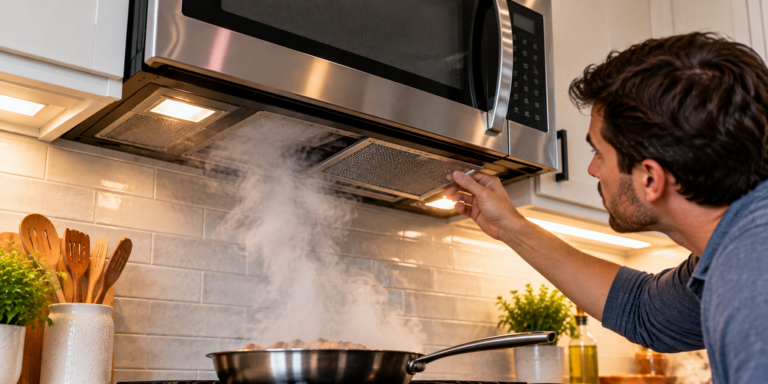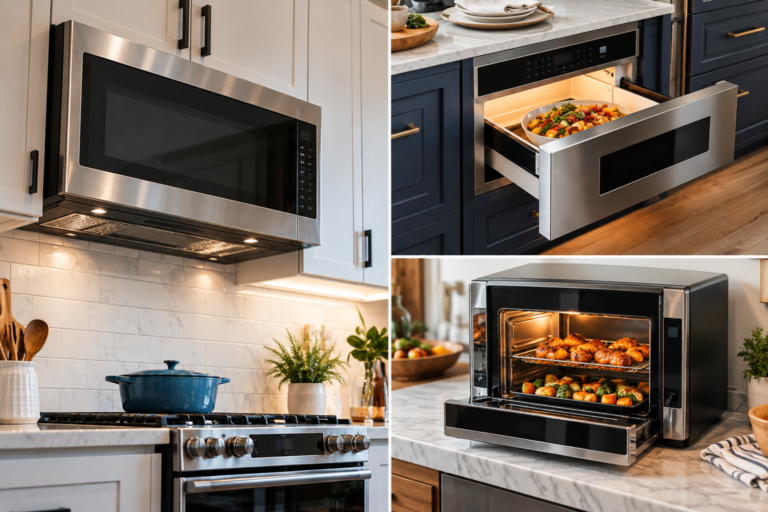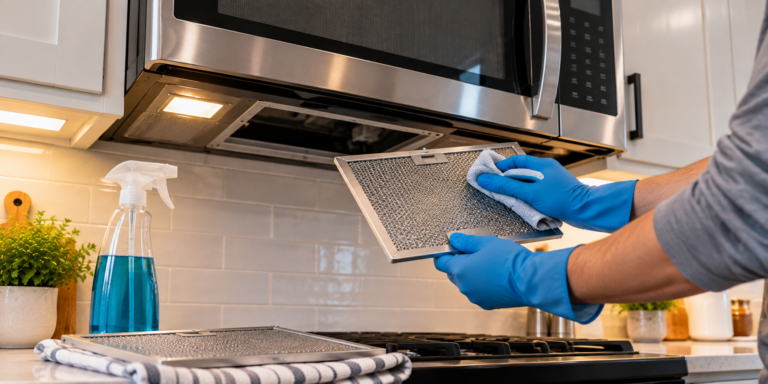
An air fryer microwave combo is an unusual piece of kitchen engineering because the two cooking methods inside it are trying to accomplish almost opposite things.
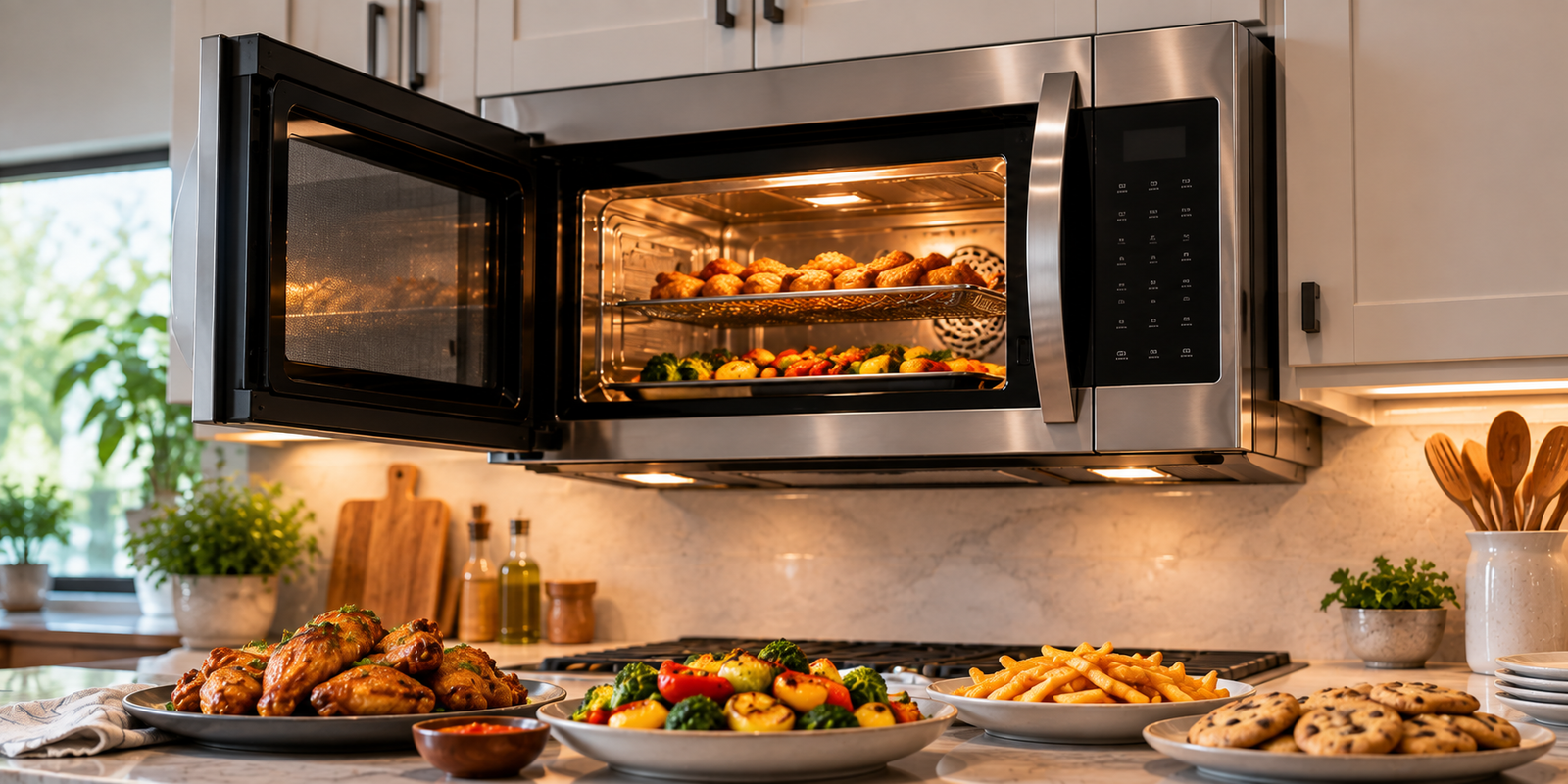
Microwave cooking is built around speed. Electromagnetic energy is absorbed by food and converted into heat. Air frying is built around dry, circulating heat and surface exposure. Its purpose is not merely to make food hot, but to encourage browning, dehydration and crisping.
Put both systems in one cavity and the result is not simply a microwave with an extra button. It is a compact multi-mode oven whose behavior changes considerably according to the selected cycle.
That distinction explains both the attraction and the limitations of the category.
For a household crowded by a microwave, countertop air fryer and perhaps a toaster oven, consolidation can reclaim meaningful workspace. For someone who air fries large batches several times a week, however, replacing a purpose-built basket appliance with a microwave combination model may exchange dedicated cooking geometry for versatility.
The correct question is therefore not whether air fryer microwave combos “work.” They use established microwave, heating-element and convection-fan technologies. The more useful investigation asks what each mode does, how the cavity accommodates those competing methods, and whether the resulting compromises suit the way a particular household cooks.
Microwave Mode and Air Fry Mode Use Different Physics
The easiest way to understand a combination appliance is to stop thinking of it as one cooking system.
It contains several.
The U.S. Food and Drug Administration explains that a conventional microwave uses a magnetron to generate microwave energy. That energy reflects around the metal cavity and is absorbed by food, causing water molecules to vibrate and generate heat. The FDA’s explanation of microwave cooking also stresses that microwave energy becomes heat when absorbed and does not make food radioactive.
Air-fry operation takes another route.
Whirlpool describes its microwave Air Fry Mode as activating a heating element while a fan circulates hot air around the food. Perforated baskets are commonly used so that heated air can reach more of the food surface.
The difference can be summarized simply:
| Cooking Method | Primary Mechanism | Main Strength |
|---|---|---|
| Microwave | Electromagnetic energy absorbed by food | Rapid heating and reheating |
| Air fry | Heated air circulated by a fan | Surface browning and crisping |
| Convection | Heated circulating air | Baking, roasting and more even dry heating |
| Combination mode | Two methods used together or sequentially | Balancing heating speed with surface finishing |
The appliance changes personality according to the mode selected.
That is why cookware that is correct for one cycle may be incorrect for another.
Why Ordinary Microwaves Struggle With Crispness
A microwave can make food extremely hot while leaving its exterior disappointingly soft.
This is not a defect in microwave technology. It follows from how the cooking method works.
Microwave energy is absorbed by food, with water-rich foods responding particularly readily. The FDA notes that thick foods are not cooked from the inside outward; outer areas receive microwave heating while heat reaches deeper areas substantially through conduction.
Crisping requires another condition: the surface needs to lose enough moisture and reach temperatures that encourage browning.
A wet surface resists that process.
This is why reheated pizza can emerge from a conventional microwave with hot cheese but a soft base, and why breaded foods can become warm without recovering the dry exterior associated with frying or baking.
An air-fry system introduces moving hot air and a heating element to attack that specific weakness.
It is less about making food hotter than changing what happens at the surface.
Air Frying Is Essentially Concentrated Convection
The phrase “air fryer” can make the technology sound entirely separate from convection cooking.
Mechanically, the relationship is close.
Both rely on heated moving air. Air-fry configurations generally emphasize relatively strong circulation around food and use a basket or elevated rack to expose more surface area.
Whirlpool’s current air-fry OTR microwaves illustrate the design. The manufacturer uses accessory tracks to elevate racks and baskets so hot air can circulate around food, while its Roast Mode uses convection airflow for browning and cooking.
A perforated basket matters because the underside of a french fry or chicken wing cannot receive circulating air effectively if it is pressed against a solid surface.
Geometry therefore matters almost as much as temperature.
A deep pile of food restricts airflow. A loose single layer exposes more surface.
This principle explains why the stated cubic-foot capacity of an air fryer microwave can be misleading when judging its air-fry capacity.
The cavity may be large enough to hold a tall bowl, yet the useful air-frying area is largely determined by the dimensions of the basket or rack.
Combination Modes Are Where the Design Becomes More Interesting
Some air fryer microwave combos can do more than switch independently between microwave and air-fry operation.
They may also provide convection, grilling, roasting or programmed combination cooking.
Panasonic’s current NN-CD88, for example, combines a 1,000-watt inverter microwave with air fry, convection and a 1,300-watt quartz grill. Panasonic specifies convection from 100°C to 220°C, air frying from 180°C to 220°C, five combination-cooking options and a 34-liter cavity.
Those specifications illustrate what the category is attempting to accomplish.
Microwave energy can handle rapid internal heating. Dry heat can address the exterior. A grill element can apply intense radiant heat from another direction.
The appliance can therefore approach a food problem with more than one heating mechanism.
That flexibility is the category’s main engineering advantage.
It is also why operating instructions matter more than they do with a simple microwave.
The Accessory Basket Is Part of the Cooking System
An air-fry basket should not be treated as incidental packaging.
It is part of the airflow design.
Whirlpool sells stainless-steel air-fry baskets for compatible microwave models and specifies that heating elements and a fan circulate hot air around the basket to brown and crisp food. One current rectangular basket measures approximately 17¼ by 10½ inches, demonstrating why usable air-fry area needs to be considered separately from cavity volume.
Another Whirlpool basket design allows air to flow around food and measures 12 inches in diameter.
These dimensions translate directly into batch size.
A 1.5-cu.-ft. microwave may sound generous, but french fries still need enough exposed basket area to avoid becoming a thick pile. The same applies to wings, vegetables and breaded foods.
This creates one of the most useful rules in a microwave buying guide:
For air-frying capacity, examine the basket before the cubic-foot figure.
A Combo Can Save a Meaningful Amount of Counter Space
The clearest case for an air fryer microwave combo is spatial consolidation.
A conventional microwave and a dedicated basket air fryer can each consume a substantial portion of countertop area. Add a toaster oven and the appliance collection can dominate a small kitchen.
Combining several functions into one housing changes that equation.
The advantage becomes especially pronounced with an over-the-range air fryer microwave because the appliance uses the space above the cooktop rather than the counter.
Whirlpool explicitly positions Air Fry Mode in current OTR models as a way to combine microwave and air-fryer functions while freeing counter space.
That benefit is measurable in physical terms even without assigning a dollar value to countertop area.
One appliance footprint replaces two or potentially three.
The trade is that every function now depends on one machine.
Consolidation Also Creates a Single Point of Failure
Multi-function appliances have an unavoidable structural weakness: several cooking jobs share the same hardware platform.
If a separate air fryer fails, the microwave still works.
If a standalone microwave fails, the air fryer still works.
If the combination appliance requires repair, several cooking functions can disappear from the kitchen simultaneously.
This does not make integration a poor design choice. It changes the risk profile.
The same principle appears throughout kitchens. A range combines oven and cooktop functions. An OTR microwave combines microwave cooking and ventilation. Integration reduces appliance count while increasing dependence on each appliance.
Buyers attracted to air fryer microwave combos primarily because they reduce clutter should consider that exchange deliberately.
Air-Fry Batch Size Is Often the Critical Limitation
Dedicated basket air fryers are designed around airflow.
Their cooking chambers can be relatively compact, and the basket places food directly within a concentrated hot-air environment.
A microwave combo must do more.
Its cavity needs to accept dinner plates, microwave-safe containers and sometimes convection accessories. The interior geometry is therefore not optimized exclusively around air frying.
This matters most for households cooking large batches.
A couple reheating two slices of pizza or air frying a modest serving of vegetables may find a combination cavity entirely practical.
A family attempting to produce several portions of fries or wings may need multiple batches depending on basket size.
That is not a failure of the technology. It is a geometry problem.
Food that needs exposed surface area cannot be stacked indefinitely simply because empty cubic volume remains above it.
Air Frying and Microwaving Demand Different Cookware Rules
This is one of the most consequential operational differences.
Traditional microwave guidance generally warns against metal cookware during microwave operation because microwave energy reflects from metal and inappropriate use can cause uneven cooking, arcing or appliance damage.
The FDA advises following the oven manufacturer’s cookware instructions and notes that metal pans and aluminum foil generally should not be used during ordinary microwave cooking.
Yet air-fry and convection modes may deliberately use metal accessories.
Whirlpool’s instructions for combination microwave ovens state that metal bakeware may be used during convection-only cycles, while ovenproof microwave-safe cookware is required for other convection and combination cycles. Its air-fry basket is itself a metal accessory.
Whirlpool separately warns that accessory racks or metal ovenproof bakeware intended for air fry, toast, bake, roast or similar oven functions can cause arcing if incorrectly used with microwave operation.
The practical rule is uncompromising:
The cooking mode determines the cookware.
A pan being safe during Air Fry Mode does not make it safe during Microwave Mode.
Presets Should Not Replace Food Judgment
Combination appliances often include programmed air-fry settings for foods such as fries, chicken pieces or vegetables.
Presets can simplify operation, but they cannot measure every variable in the food.
Starting temperature, portion size, thickness, moisture content and basket loading all affect cooking.
Frozen fries spread loosely across a basket do not behave like a crowded layer of fresh potatoes. Two chicken wings do not behave like twelve.
Food safety adds another requirement.
The USDA Food Safety and Inspection Service states that all poultry should reach a minimum internal temperature of 165°F, or 73.9°C, as measured with a food thermometer. It also states that a thermometer is the reliable method for determining whether food has reached a temperature high enough to destroy foodborne bacteria.
A preset is therefore a cooking instruction.
A thermometer is a verification instrument.
They do different jobs.
Reheating Is Where Hybrid Cooking Can Make Particular Sense
Leftovers expose the weaknesses of single-method cooking very clearly.
Microwave reheating is fast but can soften fried or baked surfaces. Air frying can restore surface texture but may take longer to heat the center of a thick portion.
A combination appliance places both methods within the same cavity.
That creates useful possibilities for pizza, breaded foods, roasted vegetables and other leftovers where both internal temperature and exterior texture matter.
The USDA advises reheating leftovers to 165°F throughout and recommends checking reheated food in several locations with a food thermometer. For microwave reheating specifically, it advises covering and rotating or stirring food during cooking.
Texture does not establish safety.
A crisp exterior can coexist with a center that has not reached the desired reheating temperature.
This is particularly relevant when switching between microwave and air-fry cycles.
Air Frying Introduces More Grease Into the Microwave Cavity
A simple reheating microwave mostly deals with steam, splatter and spilled food.
An air fryer microwave has another maintenance burden.
Air frying fatty foods can release grease and cooking residue into the cavity. The basket itself collects browned particles, oils and crumbs.
This means a combination microwave that is heavily used for wings, bacon-like foods or other fatty ingredients can require more frequent cleaning than one used mainly for reheating soup.
Whirlpool’s cleaning guidance states that its applicable air-fry basket is dishwasher safe, while also warning that the cavity, door, basket and glass tray can remain hot after cooking.
Dishwasher-safe accessories reduce part of the work.
They do not clean the ceiling, walls, heating-element area or door.
Anyone considering an air fryer microwave because it eliminates a separate appliance should therefore compare cleaning routines as well as countertop footprints.
Preheating and Cooking Time Deserve Attention
Microwave cooking built its reputation on immediacy.
Air frying operates differently.
Dry-heat cooking may involve preheating, and food generally needs enough exposure time for moisture to leave the surface and browning to develop.
This means the air-fry function should not be judged by microwave expectations.
A microwave can reheat a plate in minutes because electromagnetic energy interacts directly with the food. Air frying depends on hot air transferring heat at the surface and then through the food.
The user who expects every air-fry cycle to preserve microwave speed is asking one cooking method to behave like another.
Combination modes may reduce some of that tension by applying more than one heat source, but exact behavior is model-specific.
Air Fryer Microwave Combos Do Not Automatically Use Less Energy
Energy claims deserve restraint.
Microwave cooking can be efficient for reheating because it heats food rapidly without heating a large conventional oven cavity. The FDA notes that microwave cooking can use energy efficiently because food cooks quickly and energy heats the food rather than the entire oven compartment.
That observation does not justify claiming that every air-fry microwave cycle consumes less electricity than every dedicated air fryer or conventional oven cycle.
Air-fry operation activates heating elements and a fan. Convection operation does the same. Combination cycles may use several systems.
Actual energy consumption depends on appliance wattage, cycle duration, food quantity, preheating and operating mode.
A household buying primarily to reduce energy consumption should therefore examine rated input power and expected cooking time for the exact appliance rather than assuming that the word “microwave” applies the efficiency characteristics of microwave heating to every mode.
Countertop and Over-the-Range Combos Solve Different Problems
Air fryer microwave combos come in more than one architectural format.
A countertop combination unit can replace several countertop appliances but still consumes a substantial working surface.
An OTR air fryer microwave removes those cooking functions from the counter entirely and may also provide cooktop ventilation.
That sounds like an obvious spatial advantage, but installation changes the equation.
The OTR appliance becomes part of the kitchen infrastructure. It must fit the cabinet opening, mount securely and work with the kitchen’s ventilation configuration.
The countertop unit is easier to relocate but claims permanent counter or appliance-shelf area.
The choice is therefore partly about cooking and partly about real estate.
Who Is Well Suited to an Air Fryer Microwave Combo?
The strongest candidates are households that genuinely use multiple cooking modes but do not need dedicated appliances running simultaneously.
A combo is particularly coherent for:
- Small kitchens where countertop space is scarce.
- Apartments where several large countertop appliances create clutter.
- Households that microwave frequently and air fry occasionally or moderately.
- Buyers who reheat foods where restored surface crispness is desirable.
- Kitchens where a convection or roasting function would receive regular use.
- Households comfortable changing accessories and cookware according to cooking mode.
- OTR installations where replacing a conventional microwave with a multi-mode model adds functionality without consuming more counter area.
- Secondary kitchens, compact homes or other spaces where appliance consolidation has unusually high value.
For these users, versatility can matter more than maximum single-purpose capacity.
Who May Be Better Served by Separate Appliances?
A combination design becomes less convincing when the household’s air-fry requirements are demanding enough to justify dedicated equipment.
Separate appliances may make more sense for:
- Households air frying large quantities several times a week.
- Users who need the microwave and air fryer operating simultaneously.
- Buyers who prefer a removable basket with simple access and cleaning.
- Kitchens with ample countertop or storage space.
- Households already satisfied with a dedicated air fryer.
- Users who do not want to change racks, baskets or cookware between cooking modes.
- Buyers who prioritize specialized air-fry geometry over appliance consolidation.
The simultaneous-use issue is easily overlooked.
A household cannot microwave one dish while air frying another inside the same cavity.
Two functions on the control panel do not create two cooking chambers.
Capacity Should Be Evaluated Twice
Air fryer microwave capacity needs two separate assessments.
First is microwave capacity: will plates, bowls and casserole dishes fit?
Second is air-fry capacity: how much food can be arranged across the basket with adequate airflow?
These are not the same measurement.
A 1.5-cu.-ft. cavity may be excellent for large dinner plates while the included air-fry basket accommodates only a moderate layer of fries.
Conversely, a relatively compact cavity with an efficiently shaped basket may satisfy a household that mostly cooks smaller portions.
This is why cubic feet should never be the only size specification considered.
Measure the plate.
Then measure the basket.
Safety Standards Do Not Disappear Because the Appliance Has More Modes
The microwave portion of a combination appliance remains subject to microwave safety requirements.
The FDA has regulated microwave oven manufacturing since 1971. Federal standards limit microwave leakage throughout the oven’s lifetime to 5 milliwatts per square centimeter at approximately two inches from the oven surface. The standard also requires two independent safety interlocks that stop microwave production when the door is opened.
The FDA considers compliant microwave ovens used according to manufacturer instructions safe under current knowledge.
Combination appliances add another safety issue: heat.
The cavity, basket, racks, glass tray and cookware can become extremely hot during convection and air-fry operation. A surface that feels familiar from years of ordinary microwave use may behave more like an oven surface after a dry-heat cycle.
Oven mitts belong beside these appliances.
So does the owner’s manual.
The Buying Checklist Should Focus on the Hybrid Parts
A conventional microwave buying guide can concentrate on capacity, wattage, dimensions and controls.
A combo requires additional questions.
Before buying, examine:
- Microwave output wattage.
- Air-fry basket dimensions.
- Overall cavity capacity.
- Convection temperature range.
- Whether preheating is required for common air-fry cycles.
- Included racks, trays and baskets.
- Whether accessories are dishwasher safe.
- Which accessories are permitted during each mode.
- Whether combination microwave-and-convection cycles are available.
- External dimensions and required clearances.
- OTR ventilation specifications where applicable.
- Electrical requirements.
- Replacement cost of specialized baskets or racks.
- Whether the household needs microwave and air-fry functions at the same time.
- Whether the expected air-fry batch size fits comfortably in one layer.
These questions expose the difference between a feature that looks attractive on a control panel and one that will actually change daily cooking.
Final Considerations
Air fryer microwave combos are not ordinary microwaves with decorative cooking presets.
They combine genuinely different heating systems.
Microwave mode uses electromagnetic energy absorbed by food to generate heat rapidly. Air-fry and convection modes activate heating elements and circulate hot air around food to encourage drying, browning and crisping. Some models add grilling or combination cycles that use several cooking methods within the same appliance.
That versatility can be highly practical.
A household can reheat soup at lunch, air fry vegetables at dinner and use convection heat for another dish without dedicating separate counter space to three machines.
The compromise appears in specialization.
A dedicated air fryer can devote its entire cooking chamber to concentrated airflow and basket geometry. A combination microwave has to accommodate plates, bowls, microwave-safe containers, racks and dry-heat accessories in the same cavity.
Batch size is therefore one of the most consequential buying criteria. Cubic-foot capacity describes the microwave cavity, but basket dimensions describe how much food can realistically be air fried with adequate exposure to circulating air.
Cookware rules require equal attention. Metal accessories that are appropriate during convection or air-fry operation can be unsuitable during microwave operation. The owner’s manual should determine which basket, rack or pan belongs in each mode.
Cleaning also changes. Air frying introduces grease, crumbs and browned residue into a cavity that might otherwise have dealt mainly with microwave splatter and steam. Dishwasher-safe baskets help, but the cavity still needs regular cleaning.
For small kitchens, apartments and households that use air frying moderately, the consolidation argument is substantial. An OTR air fryer microwave can be particularly efficient with kitchen space because it can combine microwave cooking, dry-heat functions and cooktop ventilation above the range without consuming countertop area.
For households air frying large batches frequently, separate appliances can remain more practical. They allow simultaneous cooking and preserve the specialized basket geometry of a dedicated air fryer.
The most useful decision test is therefore surprisingly concrete.
List the appliances the combo is expected to replace. Measure how much counter space they consume. Measure the quantity of food normally air fried at once. Check the combo’s basket dimensions rather than relying solely on cubic feet. Determine whether microwave and air-fry functions are often needed simultaneously. Then examine the cleaning and accessory routine.
If one cavity can realistically handle those jobs, consolidation has a purpose.
If the household regularly needs two cooking chambers, large air-fry batches or the simplest possible basket workflow, combining everything into one appliance solves a space problem by creating a scheduling problem.
That is the defining trade of the air fryer microwave combo: more cooking methods in less physical space, but only one cavity in which to use them.