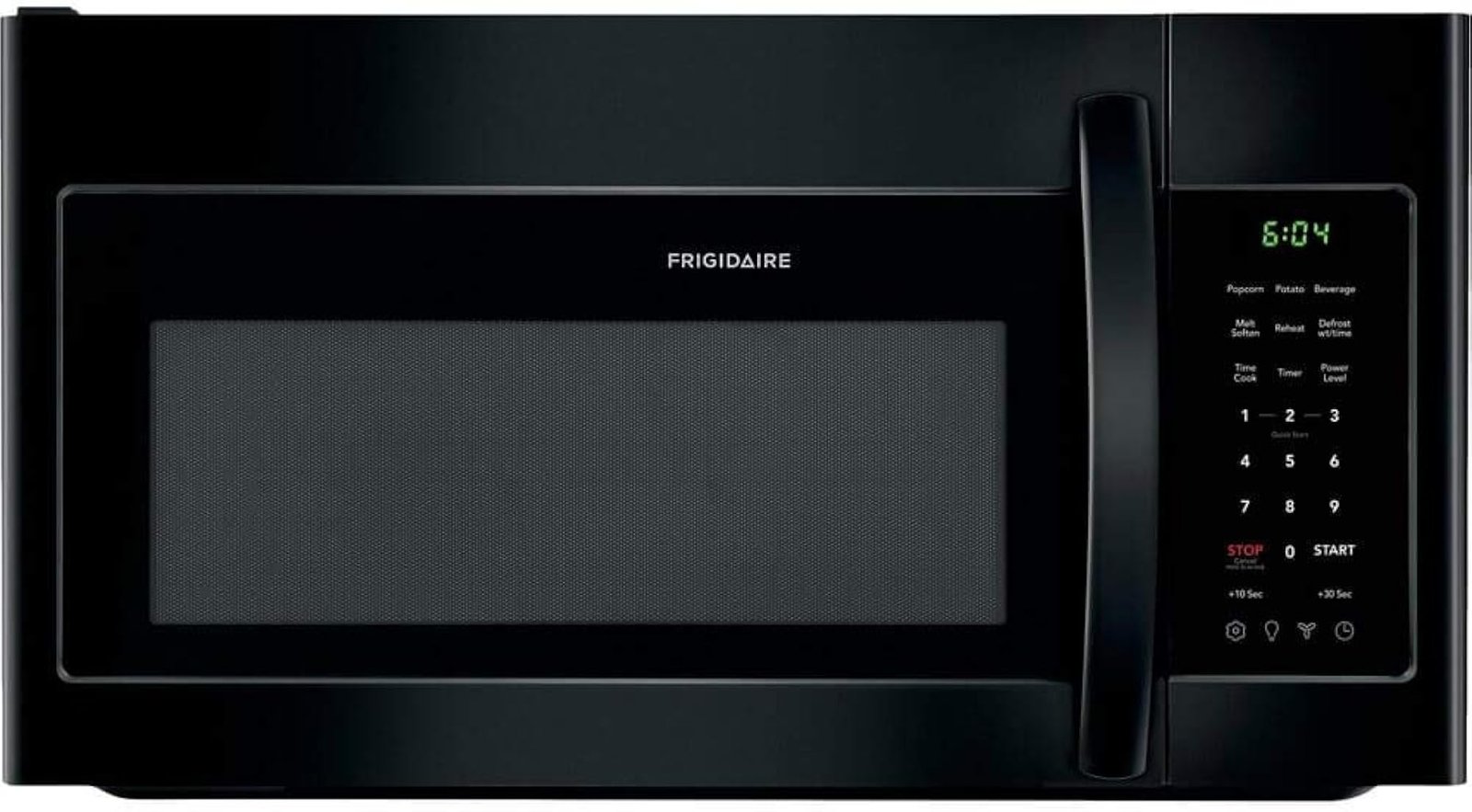
The Frigidaire FFMV1846VB occupies one of the most established positions in the microwave market: the conventional 30-inch over-the-range appliance. There is nothing experimental about the basic proposition. A microwave moves off the countertop, a ventilation system takes the place of a separate range hood, and both functions are compressed into a cabinet-width appliance mounted above the cooking surface.
That familiarity can make the category deceptively simple. An OTR microwave is not merely a countertop model attached to a wall. It is a 50-plus-pound installed appliance that must heat food, illuminate the cooktop, manage cooking exhaust, fit existing cabinetry, connect safely to household power, and remain usable at an elevated mounting position.
The black FFMV1846VB approaches those responsibilities with a deliberately conventional specification. Frigidaire’s official specification sheet documents 1.8 cubic feet of capacity, 1,000 watts of cooking power, 10 power levels, a 12.41-inch turntable, two exhaust-fan speeds, LED cooktop lighting, and exterior dimensions of 29 7/8 inches wide, 16 3/8 inches high, and 15 3/4 inches deep.
At a reference price of $319, our score is 8.12/10. Customer Sentiment stands at 7.84, Buyer Confidence at 9.16, and Value at 7.91. Those ratings describe a microwave whose strongest quality is not novelty but predictability. Its dimensions, cooking output, capacity, electrical requirements, ventilation configuration, and installation framework are well documented. The lower sentiment and value scores reflect a more demanding question: whether a straightforward 1.8-cu.-ft. OTR microwave at this price offers enough beyond competent execution.
That distinction defines the FFMV1846VB.
A Familiar 30-Inch Footprint Has Real Advantages
Width is the first measurement that matters with an installed microwave.
The FFMV1846VB measures 29 7/8 inches across. Frigidaire’s installation diagram calls for a 30-inch minimum width in the mounting area and specifies that the microwave must attach to both the upper cabinet and the wall.
This places the model squarely within the familiar 30-inch OTR format.
That conventional footprint can be more useful than it sounds. Replacement appliances often create expensive problems when mounting dimensions drift away from established kitchen layouts. A microwave that conforms to a common cabinet width gives owners a clearer starting point, although it never eliminates the need to measure the actual opening.
A microwave buying guide that discusses OTR products primarily through wattage and capacity misses this architectural reality. Cabinet width, mounting height, wall structure, depth, electrical access, and ventilation configuration can determine suitability before cooking features become relevant.
The Frigidaire measures 16 3/8 inches high and 15 3/4 inches deep. It is therefore a conventional-height OTR microwave rather than a low-profile design.
That means buyers looking specifically to increase vertical clearance above a range should distinguish this model from shorter OTR machines. The Frigidaire instead uses its conventional chassis to provide a relatively generous 1.8-cu.-ft. interior.
Neither approach is inherently preferable. They solve different kitchen problems.
The 1.8-Cubic-Foot Interior Is Genuinely Useful
Capacity is one of the FFMV1846VB’s more practical specifications.
Frigidaire documents an interior measuring approximately 21.09 inches wide, 10 9/16 inches high, and 14 9/16 inches deep. Total stated capacity is 1.8 cubic feet.
Those dimensions place the microwave comfortably above compact models in usable volume.
The turntable diameter is 12.41 inches. That number deserves attention because turntable diameter can tell a buyer more about everyday compatibility than total cubic capacity. Plates, bowls, storage containers, and cookware need to rotate without repeatedly contacting the cavity walls.
Retail documentation for the model states that its cooking space can accommodate larger cookware, including a 13-by-9-inch baking dish. That does not mean every large rectangular dish can rotate freely; container geometry and placement still matter. It does indicate that Frigidaire designed the cavity around more than small plates and mugs.
This is where the conventional-height chassis earns some of its space.
A household replacing a similarly sized 30-inch OTR microwave is unlikely to regard 1.8 cubic feet as unusually restrictive. Someone moving from a small countertop model may find the interior substantially more accommodating.
The absence of a cooking rack also keeps the cavity fundamentally single-level. Buyers wanting multi-level microwave cooking or oven-style functionality will need a different feature set.
For ordinary reheating, defrosting, vegetables, beverages, popcorn, potatoes, and larger plates, the 1.8-cu.-ft. format is easier to defend.
1,000 Watts Is a Sensible Cooking Specification
Frigidaire rates microwave cooking power at 1,000 watts and provides 10 power levels.
That combination is familiar for good reason.
Maximum wattage provides a rough indication of how much microwave energy the appliance can deliver, but it is not a complete measurement of cooking performance. Food density, moisture content, geometry, initial temperature, placement, container material, and resting time all influence results.
A bowl of soup and a dense frozen entrée can receive the same nominal wattage while heating very differently.
The ten power levels therefore matter.
Reduced power can be useful when maximum output would overheat edges before the center reaches the desired temperature. Defrosting is an obvious example. Melting and softening are others.
Frigidaire specifically includes Melt/Soften among its documented cooking functions, alongside Beverage, Popcorn, Potato, and Veggies.
The control system also provides +10 Seconds and +30 Seconds functions. Those shortcuts are mundane compared with connected-home features, but microwave design often benefits from mundane efficiency. A large percentage of daily interactions with a microwave involve adding a short burst of heat rather than programming an elaborate cooking sequence.
The FFMV1846VB appears designed around that reality.
One-Touch Controls Favor Routine Cooking
The control philosophy is straightforward.
Frigidaire provides one-touch options for familiar microwave tasks rather than attempting to turn the appliance into a second smart screen in the kitchen.
That restraint has practical value.
A microwave is often used while another cooking task is already underway. The person operating it may be stirring a pan, preparing ingredients, carrying a plate, or trying to heat something quickly before returning to another job.
Every unnecessary control step creates friction.
Dedicated functions for popcorn, potatoes, vegetables, beverages, melting and softening therefore have more practical relevance than their simplicity suggests. The same is true of the short-duration addition buttons.
The trade-off is equally clear. This is not an appliance purchased for elaborate automation, app integration, or a broad collection of advanced cooking modes.
Its feature set belongs to a traditional microwave.
That is neither an automatic strength nor a defect. Buyers should decide whether simplicity is desirable before paying for features they may never use elsewhere.
Ventilation Is the Other Half of the Appliance
An over-the-range microwave removes the location normally given to a range hood. Its ventilation performance therefore deserves independent scrutiny.
The FFMV1846VB uses a two-speed exhaust fan, with retail specifications identifying maximum airflow at 300 CFM.
CFM means cubic feet per minute. It describes airflow volume rather than guaranteed capture of every contaminant produced during cooking.
That distinction matters because kitchen ventilation is affected by considerably more than blower capacity.
Duct length, duct diameter, bends, filters, installation quality, hood geometry, fan speed, burner position, and cooking method can all alter real performance.
The U.S. Environmental Protection Agency’s guidance on cooking-generated particulate matter states that cooking itself can increase indoor particulate matter and advises using a range hood whenever cooking. The agency prefers outdoor-vented hoods where possible and recommends leaving the hood running for 10 to 20 minutes after cooking.
That guidance changes how the Frigidaire’s 300 CFM rating should be interpreted.
The number is meaningful, but airflow should not be treated as an isolated performance guarantee.
Is 300 CFM Enough?
The answer is better framed through cooking requirements than through a universal threshold.
EPA remodeling guidance reports that ASHRAE and the Home Ventilation Institute recommend 100 CFM for a typical kitchen range. The agency also cautions that larger exhaust fans can require makeup air to avoid excessive depressurization and possible backdrafting of combustion equipment.
Against that reference, a 300 CFM maximum specification is substantial for ordinary residential cooking.
Yet maximum rated airflow is not necessarily the airflow achieved after installation. Duct resistance matters. A long exhaust path with several bends can impose substantially different conditions from a short, direct duct to an exterior wall.
Capture geometry matters too.
Cooking emissions rise from pans in plumes. A fan must not merely move air; the hood assembly needs to capture those plumes before they escape into the room.
The EPA’s current cooking-air-quality guidance also recommends using back burners when possible because doing so improves capture by the hood.
That advice is particularly relevant to OTR microwaves, whose hood geometry is constrained by the microwave body above.
The FFMV1846VB’s 300 CFM ventilation system is therefore credible for routine use, but households that frequently perform heavy frying, high-temperature searing, or other smoke-intensive cooking should evaluate ventilation needs separately from microwave capacity.
Outdoor Exhaust Deserves Preference Where Practical
Recirculating ventilation and outdoor exhaust should not be treated as equivalent merely because both involve a fan.
A recirculating system filters air and returns it to the kitchen. An outdoor-vented system physically removes cooking air from the building.
That is especially relevant in homes using gas cooking, where combustion products join particles and moisture generated by the food itself.
For buyers replacing an existing OTR microwave, the sensible approach is to inspect the current ventilation arrangement before ordering the Frigidaire. The presence of an old microwave above a stove does not prove that its exhaust was correctly ducted outdoors.
Some installations simply recirculate.
Others may contain poorly configured ducts, excessive bends, blocked exterior dampers, or accumulated grease.
The microwave can only work with the ventilation path available to it.
LED Lighting Is More Useful Than Its Specification Suggests
Frigidaire uses LED lighting for the cooktop and also provides an interior microwave light. The specification sheet documents one LED surface light.
This sounds minor until the appliance is installed.
An OTR microwave sits directly above the primary cooking surface, placing its underside in one of the most useful locations for task lighting. Ceiling fixtures often illuminate the room rather than the contents of a dark pan. Worse, the cook’s body can cast a shadow directly over the work area.
Integrated cooktop lighting reduces that problem.
LED technology also avoids turning a basic lighting function into a significant additional heat source beneath the appliance.
The interior light addresses a different need: observing food during operation without repeatedly opening the door.
Neither function justifies buying the microwave by itself. Both contribute to the daily usefulness of an appliance expected to remain installed for years.
The 90-Degree Door Is a Small but Intelligent Detail
One of the more interesting features of the FFMV1846VB has little to do with cooking.
Frigidaire states that the door can open to 90 degrees without contacting an adjacent wall.
That matters in kitchens where the microwave sits at the end of a cabinet run.
Appliance specifications often assume generous surrounding space. Real kitchens are less accommodating. Walls, tall cabinets, refrigerator panels, trim, and uneven cabinet layouts can interfere with wide-swinging doors.
A 90-degree usable opening reduces one potential source of installation frustration.
This does not remove the need to verify clearances. Handles, trim, surrounding construction, and the precise mounting position still matter.
It does show attention to a problem that tends to appear only after a large appliance has been mounted.
Installation Is Part of the Cost
The FFMV1846VB requires a 120-volt electrical supply. Frigidaire’s planning diagram specifies a grounded 120V/60Hz outlet inside the upper cabinet and states that the microwave must be mounted to both an upper cabinet and a wall. The diagram also identifies a 30-inch minimum width and a 66-inch minimum measurement from the floor to the top of the microwave.
These requirements should influence the purchase before checkout.
An OTR microwave is not a plug-in countertop appliance that can be relocated if the first position proves inconvenient.
Before ordering, buyers should verify:
- The actual width of the cabinet opening.
- Available height above the cooking surface.
- Cabinet depth and surrounding trim.
- Wall construction and mounting points.
- The position and condition of the electrical outlet.
- Existing ventilation direction and duct dimensions.
- Whether exhaust reaches outdoors or recirculates.
- Clearance for the door.
- Whether commonly used dishes fit the 12.41-inch turntable.
- Whether professional removal and installation will add materially to the project cost.
The appliance price is only the visible portion of the installation equation.
Cabinet modification, electrical correction, new ductwork, wall repair, disposal of an old microwave, and labor can alter the economics quickly.
Grease Filters Require Actual Maintenance
Frigidaire documents a removable grease filter as part of the ventilation system.
That component should not disappear from attention once the microwave is installed.
Grease filters collect material carried upward from cooking. As residue accumulates, airflow can be restricted and the filter itself becomes increasingly dirty.
The EPA specifically recommends routinely cleaning a range hood’s grease filter as part of its current guidance for improving indoor air quality while cooking.
Cleaning frequency should reflect cooking behavior rather than an arbitrary calendar rule.
A kitchen where food is frequently fried or sautéed at high temperatures will expose the filter to more airborne grease than a kitchen where the cooktop is mainly used for boiling and gentle heating.
The microwave cavity requires the more obvious maintenance: wiping spills, cleaning the turntable, and preventing food residue from repeatedly baking onto interior surfaces.
An OTR appliance simply adds another maintenance zone underneath.
Safety Is Mostly About Ordinary Behavior
Microwave ovens sometimes attract disproportionate concern about radiation while much more ordinary hazards receive less attention.
Hot containers, steam, overheated liquids, and uneven food temperatures are immediate kitchen risks. So are damaged doors and improper installation.
The FFMV1846VB is UL listed, according to Frigidaire’s specifications.
Correct installation remains part of safe operation. A heavy appliance mounted above a hot cooking surface should be treated as structural equipment, not simply consumer electronics.
Ventilation safety also deserves attention.
The EPA warns that sufficiently powerful exhaust systems can create depressurization in some homes, potentially causing combustion appliances to backdraft. A 300 CFM microwave hood does not automatically create such a problem, but the broader principle matters in tightly sealed homes with fuel-burning equipment.
This is another reason installation conditions matter more than the fan number alone.
Reading Our Four Editorial Scores
Our overall score is 8.12/10.
That places the Frigidaire FFMV1846VB in very-good territory without disguising its conventional character. The appliance offers a coherent package: 1.8 cubic feet, 1,000 watts, 10 power levels, a 12.41-inch turntable, two-speed 300 CFM ventilation, LED lighting, direct cooking controls, and a standard 30-inch installation format.
Customer Sentiment is 7.84, the lowest of the four editorial ratings.
That more restrained figure reflects the reality that competent basics do not erase trade-offs. The ventilation specification is moderate rather than aimed at demanding high-heat cooking. The microwave lacks the specialized appeal of low-profile models and does not attempt to add convection or a broad connected-home feature set.
Buyer Confidence reaches 9.16.
This is where the Frigidaire performs especially well editorially. Its principal specifications are documented by the manufacturer, its dimensions conform to a familiar appliance format, and its intended use is easy to understand before installation.
High Buyer Confidence should not be mistaken for universal suitability. It means the decision can be made with relatively concrete information.
Value stands at 7.91.
At $319, the FFMV1846VB is easier to justify when it drops into an existing 30-inch OTR installation without major modification. The economics weaken when new ductwork, cabinet alterations, electrical changes, or extensive installation labor are required.
The spread between Buyer Confidence at 9.16 and Value at 7.91 tells the story neatly. This is easier to understand than it is to declare an automatic bargain.
Where the FFMV1846VB Fits Best
The Frigidaire makes the most sense for a household seeking a conventional 30-inch OTR replacement with substantial cavity space and uncomplicated controls.
Its strengths are concentrated in familiar areas:
- 1.8 cubic feet of interior capacity.
- 1,000 watts of cooking power.
- Ten power levels.
- A 12.41-inch rotating turntable.
- One-touch cooking functions.
- +10-second and +30-second controls.
- Two-speed ventilation reaching 300 CFM.
- Removable grease filtration.
- LED cooktop lighting.
- Interior lighting during operation.
- A 90-degree door opening designed to accommodate adjacent-wall installations.
- Familiar 30-inch installation geometry.
The weaker fit is equally identifiable.
Households requiring very high ventilation capacity may be better served by a dedicated hood. Buyers seeking extra clearance above the cooktop should investigate low-profile microwaves. Those wanting convection or other oven-like cooking capabilities will need a different class of appliance.
The FFMV1846VB does not disguise those boundaries with an inflated feature count.
Final Considerations
The Frigidaire FFMV1846VB is a conventional appliance in a category where conventional can be useful.
Its 29 7/8-inch width aligns with the familiar 30-inch OTR format. The 1.8-cu.-ft. cavity provides meaningful cooking space, while the 12.41-inch turntable gives buyers a concrete measurement for everyday dish compatibility. A 1,000-watt output and 10 power levels establish a practical cooking foundation without pretending that wattage alone determines food quality.
The ventilation system deserves more nuanced treatment. A two-speed, 300 CFM fan is a credible specification for ordinary residential cooking, but real capture depends on installation geometry, duct resistance, burner location, filter maintenance, and whether exhaust actually reaches outdoors. EPA guidance favoring outdoor exhaust reinforces why the duct behind the microwave can matter as much as the blower inside it.
LED cooktop lighting, a removable grease filter, straightforward one-touch cooking, short-duration addition controls, and the 90-degree door opening round out a feature set focused more on everyday utility than technological novelty.
Our score of 8.12/10 reflects that balance.
Customer Sentiment at 7.84 keeps expectations measured. Buyer Confidence at 9.16 reflects the unusually concrete nature of the product’s specifications and installation framework. Value at 7.91 recognizes that the $319 price makes the most sense when the appliance can use existing cabinetry, power, and ventilation without turning replacement into a remodeling project.
The most appropriate buyer is therefore not someone chasing the longest feature list. It is someone with a conventional 30-inch OTR opening who wants 1.8 cubic feet of microwave capacity, 1,000-watt cooking, moderate integrated ventilation, straightforward controls, and familiar installation geometry.
Before purchase, the decisive work should happen with the microwave still outside the kitchen. Measure the cabinet opening. Verify the mounting height. Check the outlet. Inspect the duct. Determine whether the existing ventilation exhausts outdoors. Measure frequently used cookware against the turntable. Account for installation labor.
Those steps are less exciting than comparing cooking presets, but they reveal whether the FFMV1846VB actually belongs in a particular kitchen.
Once those physical questions are resolved, the Frigidaire becomes easy to read. It is not trying to transform the role of the microwave. It is trying to perform the established OTR formula with enough capacity, power, lighting, ventilation, and control simplicity to make replacement predictable.
For many kitchens, predictability is not a minor virtue. An installed appliance that fits the cabinet, accepts normal cookware, handles routine reheating without unnecessary control complexity, illuminates the stove, and moves cooking air through an existing exhaust path solves a collection of ordinary problems at once.
The FFMV1846VB’s strongest argument is that those ordinary problems are exactly the ones an over-the-range microwave is supposed to solve.