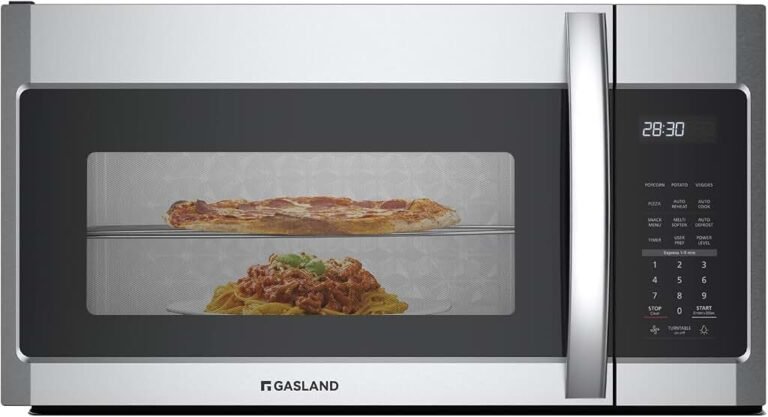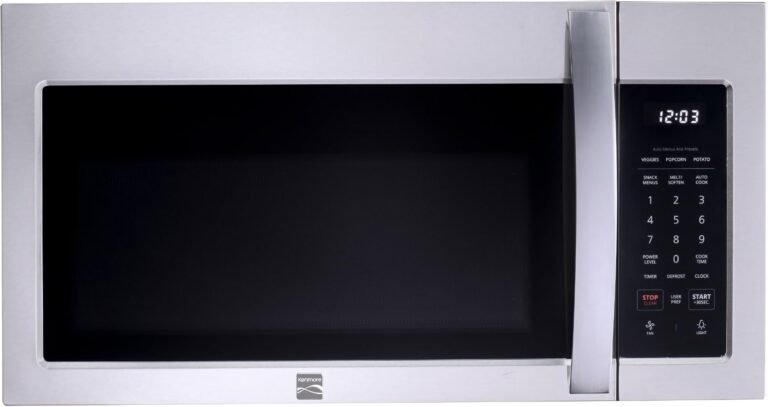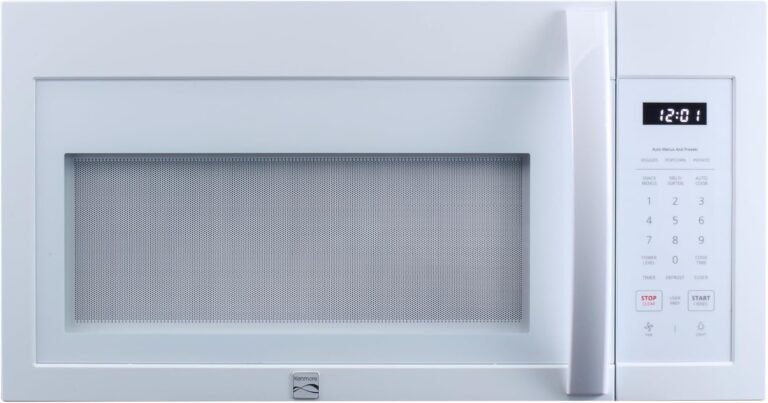
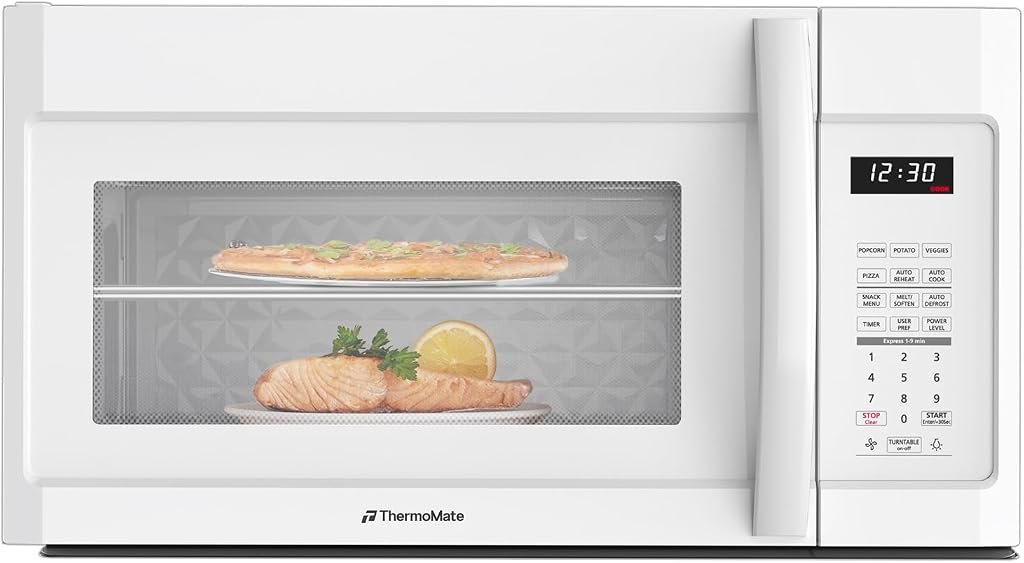
An over-the-range microwave is asked to perform two jobs in one of the kitchen’s least forgiving locations. It must heat food predictably while also handling steam, odors and airborne residue rising from the cooktop beneath it. That combination sounds straightforward until dimensions, ventilation, cooking power and installation geometry begin competing for attention.
The ThermoMate listing considered here corresponds to the KoolMore KM-MOT-OP1SS, and that identification produces an immediate correction buyers should know before measuring cabinetry. Despite the 1.9 cu. ft. description associated with the review name, KoolMore identifies the KM-MOT-OP1SS as a 24-inch model with 1.3 cu. ft. of capacity. The manufacturer’s current specification page confirms the model number, 1.3 cu. ft. capacity, 300 CFM maximum exhaust rating and other dimensions.
That discrepancy is not trivial. Microwave capacity and exterior width determine whether an appliance fits the intended kitchen and whether its cavity accommodates the dishes a household actually uses.
Judged by the verified appliance rather than the inaccurate capacity description, this is an unusually compact over-the-range proposition. At $399.99, it combines 1,000 watts of microwave output, 11 power levels, six automatic cooking options and 300 CFM ventilation in a roughly 24-inch-wide format.
Our score is 8.31/10. Customer Sentiment stands at 8.28, Buyer Confidence at 8.59 and Value at 8.15. Those numbers describe a competent appliance with a particularly convincing specification identity once the capacity issue is corrected, but also one whose compact cavity and moderate ventilation capacity establish firm boundaries around buyer fit.
First, the Capacity Discrepancy Needs to Be Settled
Appliance shopping becomes unnecessarily difficult when merchandising descriptions conflict with manufacturer specifications. In this instance, the model number resolves the matter.
KoolMore identifies KM-MOT-OP1SS as having 1.3 cu. ft. of net interior capacity. The manufacturer lists exterior measurements of 23.86 inches by 16.18 inches by 17.01 inches and cutout dimensions of 24 by 13 by 16.5 inches. The unit weighs 57.32 pounds.
Accordingly, buyers should plan around 1.3 cu. ft., not 1.9 cu. ft.
This changes the character of the appliance. A 1.9 cu. ft. microwave would belong to the larger end of common household microwave capacities. A 1.3 cu. ft. over-the-range unit is much more compact, and its approximately 24-inch exterior width distinguishes it from the numerous 30-inch machines encountered in American kitchens.
That narrower footprint can be an advantage where cabinetry demands it. It can also become a limitation for households expecting the interior space implied by the review name.
The distinction demonstrates why a microwave buying guide should never treat cubic footage, wattage and exterior width as interchangeable shorthand for size. They answer separate questions.
The 24-Inch Width Is the Product’s Defining Feature
Most discussions of microwave performance begin with wattage. For this model, physical width deserves to come first.
KoolMore specifies a cutout width of 24 inches. The appliance itself measures 23.86 inches across its relevant exterior dimension. That makes the KM-MOT-OP1SS especially relevant to smaller kitchens, apartments and cabinet arrangements where a conventional 30-inch over-the-range unit is unsuitable.
This is not merely a cosmetic distinction.
An over-the-range microwave consumes space that would otherwise be available to a conventional range hood and upper cabinetry. Its dimensions therefore affect the entire cooking zone. A narrower unit can solve a difficult spatial problem, but installation must still respect the requirements of the microwave, cabinetry and cooking appliance below it.
Over-the-range appliances also differ fundamentally from countertop machines because installation geometry affects two functions at once. The microwave needs safe support and electrical service; the ventilation system needs an appropriate path for moving air.
That makes pre-purchase measurement less glamorous than feature comparison and considerably more consequential.
1.3 cu. ft. Is Compact but Not Automatically Restrictive
The verified 1.3 cu. ft. capacity deserves interpretation rather than dismissal.
KoolMore lists interior dimensions of 15.39 inches in length, 15.28 inches in depth and 10.71 inches in height. The distance from the turntable to the top is listed at 9.74 inches.
Those figures matter more than an abstract cubic-foot number when determining whether familiar cookware will fit.
A household that mainly reheats dinner plates, bowls, beverages and packaged foods may find the capacity entirely workable. A household accustomed to using unusually wide casserole dishes or oversized containers should measure those items rather than assume compatibility.
This is where compact over-the-range design exposes an unavoidable engineering trade. The appliance saves horizontal kitchen space partly because it is physically smaller. The lost width does not vanish; some of it necessarily appears as reduced interior room.
The result is not a defect. It is a design choice with a specific audience.
1,000 Watts and 11 Power Levels Form a Sensible Cooking Core
The microwave delivers 1,000 watts of output and provides 11 power levels, according to KoolMore’s published specifications. The manufacturer also identifies six pre-programmed automatic cooking options and a 30-second express function.
That is a credible cooking foundation.
Wattage is one of the more useful microwave specifications because it affects how rapidly energy can be delivered to food. Yet raw wattage does not describe every cooking task. Defrosting, reheating dense foods and softening ingredients often require reduced power or cycling rather than continuous maximum output.
Eleven power levels provide room for that control.
The KM-MOT-OP1SS also includes sensor operation, sensor reheating, defrosting, a kitchen timer, turntable on/off control, light control and clock functions. KoolMore lists six sensor-control pads.
That collection is appropriately restrained. Microwave control panels can accumulate features whose usefulness is difficult to distinguish from marketing decoration. Here, the emphasis stays relatively close to everyday microwave behavior: reheating, defrosting, popcorn, timed cooking and sensor-assisted operation.
The Vent Hood Function Is More Than a Bonus
The second half of the product is its ventilation system.
KoolMore rates maximum exhaust airflow at 300 CFM and lists three vent speeds. Exhaust can be configured through the back, top or front, while two charcoal filters are specified.
CFM means cubic feet per minute and describes airflow volume. A larger number generally represents greater potential airflow, although installation resistance matters greatly in actual operation.
For perspective, Whirlpool says its own over-the-range microwave line commonly spans 280 to 400 CFM motor-class ratings. That does not define the entire market, but it places 300 CFM within a recognizable range for this appliance category.
The number should nevertheless be interpreted carefully.
A 300 CFM microwave hood is not equivalent to every dedicated 300 CFM range hood under every installation condition. Duct length, elbows, transitions, filters and vent configuration can affect delivered airflow. Even Whirlpool’s technical documentation warns that duct size, transitions and back pressure influence ventilation performance.
For relatively routine stovetop cooking, the KoolMore’s ventilation specification is reasonable for the category. Kitchens regularly producing substantial smoke, heavy grease or intense high-heat cooking should assess ventilation needs separately rather than assume that any over-the-range microwave automatically replaces a more capable dedicated hood.
That distinction is central to sensible purchasing.
Recirculation and Exterior Venting Are Not the Same Thing
Over-the-range microwave ventilation is often discussed as though every installation removes air from the kitchen. Many do not.
As Whirlpool explains in its over-the-range microwave buying guide, these appliances can be configured to exhaust through ductwork or, depending on the model and installation, recirculate filtered air back into the kitchen.
The distinction affects what the ventilation system can accomplish.
An externally ducted installation physically moves cooking air outside. A recirculating arrangement filters air and returns it to the room. Charcoal filtration can address odors, but recirculation does not become exterior exhaust merely because a fan is running.
The KM-MOT-OP1SS lists exhaust ventilation through back, top or front positions and uses two charcoal filters. The correct configuration therefore deserves attention during installation rather than after the microwave is already mounted.
For buyers replacing an existing over-the-range unit, the current duct arrangement should be inspected before ordering. For a new installation, ventilation planning belongs alongside cabinet and electrical planning.
Installation Is Part of the Purchase
At 57.32 pounds, the KoolMore is not something that should be treated like a countertop microwave with a wall bracket added as an afterthought.
Over-the-range installation requires support, alignment, electrical access and ventilation preparation. The surrounding cabinet dimensions and the clearances specified for both microwave and cooking appliance must be respected.
General manufacturer guidance illustrates the workload. Whirlpool’s installation overview recommends two people for handling an over-the-range microwave and estimates roughly two hours for installation when the space already has suitable electrical and ventilation arrangements. It also advises professional assistance when outlets or ductwork need to be added.
Those figures are not installation instructions for the KoolMore and should not replace its manual. They illustrate why installation costs cannot be separated casually from purchase costs.
A $399.99 appliance installed into an already compatible opening is one proposition. A $399.99 appliance requiring cabinetry alteration, new ductwork and electrical changes is financially different.
The installation plan should therefore be established before price comparisons become decisive.
Counter Space Is Where the Format Earns Its Keep
The enduring logic of an over-the-range microwave is spatial efficiency.
A countertop microwave requires a horizontal landing zone. In a small kitchen, that surface may already be contested by food preparation, a coffee machine, toaster, dish rack and other equipment.
Moving the microwave above the cooking surface releases that counter area while combining microwave cooking with hood ventilation.
This dual use of space explains why the category persists despite compromises. An over-the-range microwave is rarely the purest microwave design or the purest ventilation design. Its appeal lies in consolidation.
The compact KoolMore pushes that logic further by fitting the microwave and hood functions into a 24-inch format.
For a narrow kitchen, that can be genuinely useful. For a spacious kitchen with room for a dedicated hood and separate microwave location, the argument becomes less compelling.
Safety Deserves a More Grounded Discussion
Microwave safety discussions often drift toward radiation anxiety while overlooking ordinary risks such as overheated liquids, hot containers and damaged doors.
The U.S. Food and Drug Administration’s microwave guidance states that it has regulated microwave oven manufacturing since 1971. Manufacturers must certify their products against federal safety-performance standards, and the agency says that ovens meeting those standards and used according to manufacturer instructions are safe.
The FDA also describes microwaves as non-ionizing radiation and explains that microwave energy absorbed by food is converted to heat rather than making food radioactive.
More immediate concerns arise from use and condition.
The agency warns that a microwave with damaged hinges, latches or seals may present a leakage risk and advises contacting the manufacturer when those parts are damaged.
With an over-the-range machine, mounting height introduces another everyday consideration: users remove hot containers from above the cooking surface. Household height, reach and physical mobility therefore matter when deciding whether this format is comfortable.
Controls Favor Function Over Connected Features
The KoolMore uses a front-mounted membrane touch panel rather than an elaborate connected interface. Manufacturer specifications list sensor operation, popcorn, sensor reheat, power-level adjustment, timer, defrost, turntable control, lighting, ventilation and clock functions.
That approach suits the appliance.
A microwave is frequently used in interactions lasting only a few seconds: add 30 seconds, reheat a plate, start a defrost cycle or switch on the cooktop fan. Requiring a phone or layered software interface would add friction to jobs already solved efficiently at the control panel.
The absence of a large smart-home feature set will matter to some buyers. It is less consequential for households that primarily value immediate controls and straightforward operation.
The membrane interface also aligns with the product’s broader character. This is not positioned as an elaborate culinary command center. It is a compact microwave-and-ventilation combination designed to conserve kitchen space.
Where the Editorial Scores Land
Our score of 8.31/10 places the appliance firmly in favorable territory without ignoring its limitations.
Buyer Confidence is the highest component at 8.59. There is a practical reason for that. Once the misleading 1.9 cu. ft. description is set aside, KoolMore publishes unusually specific information for KM-MOT-OP1SS: capacity, dimensions, electrical characteristics, interior measurements, ventilation rating, filter configuration, weight and warranty are all identifiable.
That specificity reduces uncertainty before installation.
Customer Sentiment stands at 8.28. The figure sits close to the overall score, reflecting a product whose appeal is closely connected to fit. Someone specifically seeking a 24-inch over-the-range microwave has fewer dimensional options than someone shopping for the conventional 30-inch format.
Value is 8.15, the lowest of our four ratings. At $399.99, the appliance offers two functions in one chassis, but its 1.3 cu. ft. cavity and 300 CFM ventilation establish practical limits. The price is easier to defend when the 24-inch width solves a genuine kitchen-layout problem.
These score differences tell a coherent story: confidence in what the appliance is exceeds enthusiasm about how broadly it fits different households.
Strengths That Matter in Daily Use
The KoolMore’s advantages are functional rather than theatrical:
- The approximately 24-inch format can fit kitchens where a standard 30-inch over-the-range appliance is impractical.
- The 1,000-watt microwave output is paired with 11 selectable power levels.
- Six automatic cooking programs reduce repetitive input for common tasks.
- Sensor and sensor-reheat functions add automated cooking control.
- A 30-second express function handles one of the most common microwave interactions quickly.
- The 300 CFM ventilation system offers three fan speeds.
- Turntable on/off control adds flexibility when container shape makes rotation inconvenient.
- Integrated lighting supports visibility over the cooking surface.
- The over-the-range installation releases countertop area.
- KoolMore publishes detailed physical and electrical specifications for installation planning.
The strongest advantage is the combination of compact width and dual functionality. Many kitchens do not need more appliance; they need better use of limited space.
Drawbacks That Should Not Be Minimized
The first drawback is the capacity discrepancy attached to the product’s review name. Buyers should use the verified 1.3 cu. ft. specification for KM-MOT-OP1SS, not 1.9 cu. ft.
Second, 1.3 cu. ft. is a deliberate compromise. Households routinely heating large dishes should check actual interior dimensions before ordering.
Third, 300 CFM is moderate ventilation rather than an unlimited substitute for a dedicated high-capacity hood. Cooking style matters.
Fourth, installation is inherently more involved than placing a countertop microwave on a shelf. A roughly 57-pound appliance must be mounted correctly while accommodating electrical and ventilation requirements.
Fifth, the manufacturer lists a one-year parts-and-labor warranty. Buyers expecting unusually long factory coverage will not find it here.
There is also an inconsistency in KoolMore’s current product information concerning the safety lock. The descriptive text refers to a child safety lockout, while the detailed specification table lists “Safety Lock: No.” That conflict is enough reason not to treat the lock as a confirmed feature without checking current documentation directly with the manufacturer.
That kind of discrepancy matters more than decorative feature language because it affects household use.
Who Is the Best Fit?
The strongest buyer profile is unusually specific: someone who needs an over-the-range microwave, has approximately 24 inches of available width and values reclaimed countertop space more than maximum microwave capacity.
Small kitchens are the obvious setting, but not the only one. Secondary kitchens, compact apartments, guest spaces and remodels constrained by existing cabinetry may also benefit from the narrower format.
The product makes less sense when a 30-inch opening is readily available and larger capacity is a priority. In that situation, the compact dimensions cease to be an advantage and become a restriction.
Likewise, households whose cooking produces substantial smoke or grease should evaluate whether 300 CFM ventilation matches their needs rather than treating the microwave hood as automatically sufficient.
The buying decision is therefore less about whether 1,000 watts is “good” and more about whether the entire geometry of the appliance matches the kitchen.
A Better Way to Use a Microwave Buying Guide
A useful microwave buying guide should start with constraints rather than feature counts.
For an over-the-range appliance, buyers should establish cabinet width, mounting clearance, electrical availability, duct configuration and desired ventilation capacity before comparing automatic menus.
After that, cavity dimensions matter. A nominal cubic-foot figure is useful, but measuring frequently used plates and cookware against interior dimensions is better.
Cooking power comes next. The KoolMore’s 1,000-watt output and 11 power levels are well aligned with routine microwave work, while its sensor and express functions address common convenience needs.
Ventilation then deserves its own assessment. CFM should be evaluated in relation to cooking habits and installation, not merely compared as a larger-is-better number.
Finally comes price.
This order prevents a common appliance-shopping mistake: choosing a machine because its feature list appears impressive and discovering later that the cabinet, cookware or ventilation arrangement does not suit it.
Final Considerations
The ThermoMate 1.9 cu. ft. Over-the-Range Microwave review ultimately leads to a different appliance than the name suggests. The identifiable KoolMore KM-MOT-OP1SS is a 1.3 cu. ft., approximately 24-inch-wide over-the-range microwave with 1,000 watts of output, 11 power levels, six automatic cooking options and maximum exhaust ventilation of 300 CFM.
That correction does not diminish the appliance. It clarifies its purpose.
This is a compact kitchen tool built around spatial efficiency. It combines microwave cooking, cooktop lighting and ventilation while releasing countertop space, and its narrower width can solve installation problems that conventional 30-inch models cannot.
Our 8.31/10 score reflects that focused usefulness. Customer Sentiment at 8.28 remains closely aligned with the overall assessment. Buyer Confidence rises to 8.59 because the manufacturer publishes detailed specifications that allow careful pre-installation planning. Value at 8.15 recognizes a fair but conditional proposition at $399.99: the compact architecture has greater economic meaning when it solves a real dimensional constraint.
Its limitations are equally concrete. The cavity is 1.3 cu. ft., not 1.9. The 300 CFM ventilation system should be evaluated against actual cooking habits. Installation demands considerably more planning than a countertop appliance. The current manufacturer page also contains conflicting statements about the presence of a safety lock, which should be verified before that feature influences a purchase.
There is something refreshingly rational about the product once the inaccurate capacity description is stripped away. It does not need to be enormous. It does not need dozens of cooking modes or a phone application. Its reason for existing is narrower: fit above a range where space is constrained, heat food with familiar microwave controls and provide integrated ventilation without surrendering another section of countertop.
For the kitchen that presents exactly that problem, the KM-MOT-OP1SS is a credible answer. For buyers seeking 1.9 cu. ft. of capacity, heavy-duty ventilation or maximum interior space, it is the wrong specification wearing a misleading description.
That distinction is ultimately what careful appliance shopping is supposed to uncover.