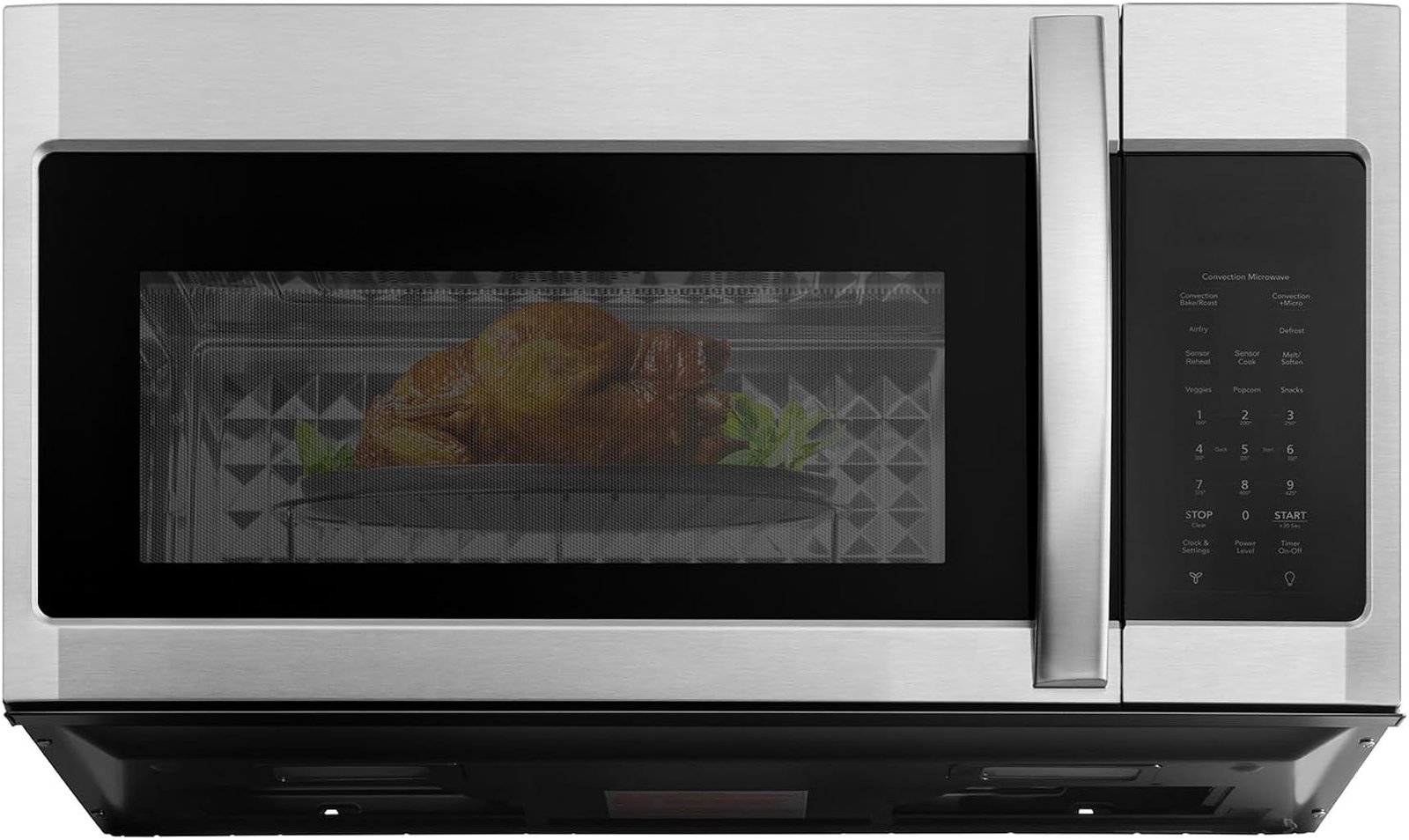
The traditional over-the-range microwave has always been an appliance of consolidation. It moves microwave cooking off the counter, places ventilation above the stove and adds cooktop lighting to the same chassis. The BLACK+DECKER 1.5 cu. ft. Air Fryer Over-the-Range Microwave pushes that logic further by adding air frying, convection, baking, roasting and combination grilling to a space already expected to handle several kitchen jobs.
That ambition makes model EC942K6CE-SS considerably more interesting than its 1.5 cu. ft. capacity might suggest.
The appliance is identified as a 1.5 cu. ft., 900-watt over-the-range microwave with six cooking functions: microwave, air fryer, convection, combination grill, bake and roast. Current product information also identifies a 13.6-inch turntable, sensor reheating, a 300 CFM ventilation fan with two speeds and an integrated cooking light. A current product listing for model EC942K6CE-SS confirms the model identity, 1.5 cu. ft. capacity, 900-watt microwave output and multifunction cooking configuration.
At $455.99, however, multifunctionality has to earn its keep. A household that merely wants to reheat leftovers can find simpler machines. The economic argument for this BLACK+DECKER rests on whether its additional cooking methods can reduce reliance on another appliance, particularly a countertop air fryer or compact convection oven.
Our score is 8.25/10. Customer Sentiment stands at 7.84, Buyer Confidence reaches a notably higher 9.8, and Value is 7.91. The separation among those figures defines the review. This is an unusually easy product to understand on paper, supporting high confidence in what it is and what functions it contains. The harder questions concern whether every household needs that versatility and whether $455.99 represents a sensible use of the appliance budget.
Six Cooking Functions Fundamentally Change the Proposition
A conventional microwave has one primary source of cooking energy: microwaves. The BLACK+DECKER adds methods intended to address jobs for which ordinary microwave heating is poorly suited.
Its six identified modes are microwave, air fry, convection, combination grill, bake and roast.
That matters because microwave energy and circulating hot air produce different effects.
Microwave cooking is exceptionally efficient at heating foods containing water. The FDA explains microwave heating as a process in which microwaves produced by a magnetron are absorbed by food and cause water molecules to vibrate, generating heat. The agency also classifies microwaves as non-ionizing radiation.
What microwave energy does not naturally reproduce well is the dry, browned exterior associated with roasting, baking and frying.
That is where hot-air cooking changes the appliance’s character. Air-fryer and convection functions move heated air around food, allowing surface moisture to evaporate while promoting browning. The microwave can therefore address rapid internal heating while the hot-air system tackles texture.
The result is not simply a microwave with a longer menu. It is an appliance containing multiple cooking approaches.
The 1.5 cu. ft. Capacity Reflects the Multifunction Trade-Off
Capacity is 1.5 cu. ft., with a reported 13.6-inch turntable. Current listings place the exterior around 29.9 inches wide, 16.4 inches high and roughly 13.9 inches deep.
That cavity is smaller than the 1.7 and 1.9 cu. ft. interiors found in many conventional full-size over-the-range microwaves, but the comparison requires context.
Whirlpool’s current over-the-range microwave buying guide places the category broadly between about 0.8 and 2.1 cu. ft. and describes 1.7 cu. ft. or more as potentially useful for larger households.
The BLACK+DECKER’s 1.5 cu. ft. capacity therefore lands below the larger end of mainstream OTR designs without entering compact-microwave territory.
Its 13.6-inch turntable is more informative for daily use. Plates and cookware need physical clearance, not merely theoretical volume. A large rectangular dish can encounter the cavity wall while rotating even when its total volume is nowhere near 1.5 cu. ft.
Multifunction cooking introduces another spatial issue. Air frying, roasting and convection cooking may involve racks or other accessories, and food benefits from enough surrounding space for heated air to circulate.
Anyone buying this machine partly to replace a countertop air fryer should therefore measure the cookware and portions normally used in that appliance. Capacity should be evaluated against real food rather than the cubic-foot number alone.
The 900-Watt Microwave Output Is a Genuine Compromise
The BLACK+DECKER’s microwave output is 900 watts.
That is sufficient for conventional household microwave cooking, but it sits below the 1,000-watt output common among full-size over-the-range competitors.
Whirlpool says microwave power commonly spans roughly 600 to 1,700 watts and that many recipes are geared toward approximately 1,000 watts. Its current comparison chart also shows multiple over-the-range configurations at 1,000 watts, although some multifunction models use 900 watts.
The BLACK+DECKER therefore does not have unusually weak microwave power, but neither should its 900-watt specification be dismissed as numerically irrelevant.
Wattage affects heating rate. Instructions written around a 1,000-watt microwave may require modest timing adjustments in a 900-watt appliance, particularly for dense foods or larger quantities.
The important editorial distinction is that the lower microwave output accompanies a much broader cooking system.
A buyer comparing this model with a basic 1,000-watt OTR microwave is not choosing between two otherwise identical machines. One prioritizes conventional microwave output; the BLACK+DECKER distributes its engineering across microwave, convection and air-frying duties.
Whether that exchange makes sense depends on how often those secondary modes will actually be used.
Air Frying Is the Feature Most Likely to Change Kitchen Behavior
Air frying is more consequential here than another preset or decorative interface option because it can potentially replace a separate countertop appliance.
That possibility deserves scrutiny.
Counter space is finite. A conventional over-the-range microwave already saves work surface by moving the microwave above the stove. Adding air-fryer functionality could remove another appliance from the counter or cabinet.
Whirlpool makes the same general case for multifunction OTR designs, describing air cooking, grilling and roasting as ways of adding cooking capability without adding another appliance.
The physical attraction is obvious.
A kitchen containing a microwave, toaster oven and air fryer can become a collection of electrical boxes competing for outlets and preparation space. Consolidation reduces that clutter.
But combination appliances rarely erase every compromise associated with dedicated machines.
A basket-style countertop air fryer is engineered around concentrated airflow in a relatively small cooking chamber. An over-the-range combination microwave has to preserve enough cavity geometry for plates, microwave rotation and other cooking modes.
The BLACK+DECKER’s air-fryer mode should therefore be understood as an expansion of the microwave’s capabilities rather than an automatic guarantee that every dedicated air fryer becomes redundant.
Portion size, accessory arrangement and preferred foods determine whether replacement is realistic.
Convection, Bake and Roast Add More Than Menu Variety
Convection cooking uses moving hot air to distribute heat around food. In practical kitchen use, that makes baking and roasting possible without relying solely on microwave energy.
The BLACK+DECKER’s inclusion of convection, bake and roast functions gives it a second identity as a compact oven positioned above the range.
That can be useful in several scenarios.
A small batch of food may not justify heating a full-size oven. A second cooking cavity can also help when the main oven is already in use. Smaller households may find that modest portions align naturally with a 1.5 cu. ft. appliance.
Yet the same capacity that makes the unit relatively compact also sets boundaries.
This is not a replacement for a full-size oven when large sheet pans, multiple racks or large roasting vessels are involved. The cooking chamber remains physically constrained.
The more accurate way to evaluate convection is as supplementary oven capacity.
That can be surprisingly useful. It simply needs to be separated from the unrealistic idea that one appliance can reproduce every strength of every machine whose function appears on its control panel.
Sensor Reheat Is a More Subtle Form of Automation
The BLACK+DECKER also identifies Sensor Reheat as a feature.
Sensor cooking is less visually dramatic than air frying, yet it addresses one of microwave cooking’s oldest irritations: estimating time.
A fixed reheating cycle knows nothing about the actual condition of the food. It runs for the entered duration whether the plate contains a small serving of vegetables or a dense portion of refrigerated pasta.
Sensor systems add feedback to the process, commonly using humidity released from food to inform cooking behavior.
The benefit is not that the microwave suddenly understands dinner. It is that the control system has more information than a countdown timer alone.
That makes sensor reheating particularly relevant to leftovers, where quantity, moisture content and starting temperature vary.
For a product already carrying a premium over basic OTR microwaves, features such as sensor reheating matter because they improve the microwave side of the appliance rather than relying entirely on the headline air-fryer mode.
The 300 CFM Vent Fan Is Conventional Rather Than Aggressive
The BLACK+DECKER includes a 300 CFM ventilation system with two fan speeds and integrated lighting.
Three hundred CFM is a familiar rating among mainstream over-the-range microwaves.
Whirlpool’s current comparison material shows OTR models ranging from roughly 280 to 400 CFM motor-class ratings across much of its range, with higher-output configurations available. The company also explicitly warns that ventilation performance varies with installation.
That last qualification matters.
A fan does not operate independently of the duct system attached to it. Duct size, length, turns, transitions and restrictions influence airflow. A headline CFM figure is therefore not a promise that every installed kitchen will achieve identical extraction.
For moderate everyday cooking, 300 CFM belongs to a well-established OTR specification class. For frequent high-temperature searing or cooking that produces large quantities of smoke and grease, a dedicated range hood may be the more appropriate engineering solution.
Two speeds also provide relatively coarse control.
The BLACK+DECKER’s ventilation is functional infrastructure, but ventilation is not the feature for which its $455.99 price makes the strongest argument.
Multifunction Cooking Makes Ventilation More Interesting
There is a curious interaction between the product’s two identities.
Because the BLACK+DECKER sits above the stove, its ventilation system primarily addresses cooking taking place below it. Meanwhile, the appliance itself can air fry, roast and bake inside its own cavity.
That arrangement concentrates considerable cooking activity in one vertical zone.
For smaller kitchens, this consolidation can be useful. Microwave heating, hot-air cooking, cooktop lighting and range ventilation all live within roughly the same footprint.
For another household, the same arrangement may create too many compromises in one location. Someone who prioritizes high-capacity ventilation might prefer a dedicated hood and place the microwave elsewhere.
This is why OTR design cannot be judged only by cooking features.
An appliance installed above a stove becomes part of the kitchen’s architecture. Replacing it is not as casual as replacing a countertop air fryer.
Installation Should Be Treated as Part of the Purchase
The model is approximately 29.9 inches wide, placing it in the conventional 30-inch OTR installation class.
That does not make installation universal.
Cabinet opening, mounting hardware, electrical supply, backsplash position, door clearance and ventilation routing all need attention. Existing holes from another microwave may not align with the new mounting system.
The correct process begins with measurement.
A household replacing an older 30-inch OTR microwave should not assume that another appliance described as 30 inches wide will attach to precisely the same points. Nominal width identifies a product class, not a universal mounting template.
Ventilation adds another decision.
Whirlpool’s general OTR guidance explains that these appliances can use external ducting or, depending on design, filtered recirculation back into the kitchen. Model-specific instructions should determine how the BLACK+DECKER is configured.
Installation costs also belong in the value calculation.
A $455.99 appliance that fits an existing location with minimal modification presents one economic case. The same appliance requiring new ductwork, electrical changes or cabinet alteration presents another.
Microwave Safety Is Better Framed Through Federal Standards
The BLACK+DECKER’s air-fryer and convection functions add hot surfaces and hot-air cooking to the normal risks of microwave use, but microwave radiation itself is governed by federal safety requirements.
The FDA has regulated microwave oven manufacturing since 1971 and requires manufacturers to certify compliance with applicable safety-performance standards.
Federal rules limit microwave leakage throughout an oven’s lifetime to 5 milliwatts per square centimeter measured at approximately two inches from the surface. The FDA describes that limit as “far below the level known to harm people.”
The same standard requires two independent interlock systems that stop microwave production when the door latch is released or the door opens.
The more ordinary hazards deserve at least as much attention.
The FDA reports that most microwave injuries involve heat-related burns from hot containers, overheated foods or liquids rather than radiation.
A multifunction microwave adds another behavioral adjustment. Air-fryer, bake and roast modes can heat racks, cookware and cavity surfaces differently from a brief microwave reheating cycle.
Users therefore need to distinguish between cooking modes rather than treating every cycle as ordinary microwave operation.
Buyer Confidence at 9.8 Is the Strongest Part of the Score Profile
Our Buyer Confidence score is 9.8, substantially higher than the overall 8.25/10 rating.
That difference is deliberate.
The product’s identity is unusually specific. Model EC942K6CE-SS is consistently associated with 1.5 cu. ft. capacity, 900-watt microwave output and a six-function design incorporating microwave, air fry, convection, combination grill, bake and roast. Current listings also identify Sensor Reheat and a 300 CFM two-speed vent.
The buyer therefore has a relatively clear picture of the architecture before installation.
High confidence in product identity does not mean every household should buy it. It means the major trade-offs are visible enough to make an informed decision.
That distinction explains why Buyer Confidence can reach 9.8 while Value remains 7.91.
Value at 7.91 Reflects a Demanding Price
At $455.99, the BLACK+DECKER needs its multifunction capability to matter.
Someone seeking only a microwave and basic ventilation can find simpler OTR configurations built around approximately 1,000 watts of microwave output. The BLACK+DECKER instead asks the buyer to accept 900 watts and a 1.5 cu. ft. cavity in exchange for a broader cooking system.
That exchange can make economic sense if air frying and convection cooking replace another planned appliance.
Suppose the household already intends to dedicate money and counter space to an air fryer. Folding that function into the OTR microwave changes the comparison. The relevant question becomes the combined cost and space demands of two appliances rather than the microwave price alone.
Conversely, a household that rarely air fries or bakes small portions gains little from paying for those functions.
Our 7.91 Value rating reflects precisely that conditional economics.
The feature list is extensive. The usefulness of the feature list is personal.
Customer Sentiment at 7.84 Signals More Friction
Customer Sentiment is the lowest component at 7.84.
That score does not overturn the product’s technical appeal. It places more emphasis on the reality that multifunction appliances ask more from users.
A simple microwave has a short learning curve. Enter time, choose power if necessary and press start.
A six-mode appliance requires users to understand when microwave energy is appropriate, when hot-air cooking is preferable, how combination modes differ, which accessories belong in which cycles and how cooking time changes between methods.
That complexity is not inherently bad. It is the cost of flexibility.
The score also fits the broader physical compromises of the design. Capacity is 1.5 cu. ft. rather than the 1.7 cu. ft. found in many full-size OTR models, while microwave output is 900 watts rather than the familiar 1,000-watt level.
The product gains functions while giving up some simplicity.
Our 8.25/10 Score Rewards Integration Rather Than Excess
The overall 8.25/10 assessment sits between the exceptionally high Buyer Confidence figure and the more restrained Customer Sentiment and Value ratings.
That balance captures the product accurately.
The BLACK+DECKER is not compelling because any single specification dominates its category. Nine hundred watts is ordinary. A 1.5 cu. ft. cavity is useful but not unusually large. A 300 CFM fan is conventional.
The attraction comes from putting microwave cooking, air frying, convection, baking, roasting, grilling and range ventilation into one installed appliance.
Integration is the product.
That makes the review less about isolated numbers and more about whether consolidation solves a real kitchen problem.
Strengths That Carry Practical Weight
The BLACK+DECKER’s most meaningful strengths are interconnected:
- Six cooking functions expand the appliance far beyond microwave reheating.
- Air-fryer capability can reduce reliance on a separate countertop appliance.
- Convection, bake and roast modes provide supplementary oven functionality.
- The 1.5 cu. ft. cavity offers useful household capacity while remaining within a conventional OTR footprint.
- A 13.6-inch turntable accommodates many standard dinner plates and cooking vessels.
- Sensor Reheat introduces feedback into a job often handled by guesswork.
- The 300 CFM vent system performs the secondary role expected from an OTR microwave.
- Two fan speeds allow basic ventilation adjustment.
- Integrated lighting addresses the cooktop zone below.
- The roughly 30-inch width aligns with the dominant full-size OTR installation class.
- Multifunction design can reduce countertop appliance clutter.
The strongest case emerges in kitchens where several of those benefits matter simultaneously.
Drawbacks That Should Influence the Decision
The 900-watt microwave output is the first compromise. It sits below the 1,000-watt level around which many microwave recipes are designed.
The 1.5 cu. ft. cavity is also smaller than many 1.7 cu. ft. mainstream OTR machines. Buyers with large cookware should measure rather than assume compatibility.
The 300 CFM fan is suitable for many routine kitchens but should not be confused with a high-output dedicated range hood.
Two fan speeds provide limited airflow adjustment.
The six-mode cooking system inevitably creates more operational complexity than a basic microwave.
The $455.99 price demands that the additional cooking functions receive regular use. Paying for air frying and convection only to use the machine as a reheating appliance weakens its economic case substantially.
Installation can add expense beyond the appliance price, particularly when ducting or electrical work needs modification.
Finally, multifunction design cannot remove physical constraints. A 1.5 cu. ft. cavity does not become a full-size oven merely because it has a bake button.
Who Is Most Likely to Appreciate It?
The strongest buyer fit is a household that wants an over-the-range microwave and is simultaneously considering an air fryer or compact convection oven.
Smaller kitchens present an especially logical use case. Moving microwave and air-fryer functions into the same installed chassis can release meaningful counter space.
The appliance can also suit households that frequently prepare smaller portions and do not want to heat a full-size oven for every baked or roasted dish.
It becomes less attractive when conventional microwave speed is the overriding priority. A simpler 1,000-watt model may make more sense there.
It is also a weaker fit where ventilation dominates the buying decision. Heavy stovetop cooking can justify preserving the above-range location for a dedicated hood.
Large households using oversized cookware should scrutinize the 1.5 cu. ft. cavity carefully.
The BLACK+DECKER works best when consolidation itself is valuable.
What a Microwave Buying Guide Should Ask Before Purchase
The product demonstrates why comparing multifunction microwaves requires a different sequence from comparing basic models.
First, establish installation compatibility. Measure the cabinet opening, height above the cooking surface, depth, door clearance and available ventilation path.
Second, measure cookware. The 1.5 cu. ft. capacity and 13.6-inch turntable need to accommodate the dishes actually used.
Third, decide whether 900 watts is sufficient for the household’s microwave habits.
Fourth, identify which secondary cooking modes will genuinely be used. Air frying, convection, baking and roasting add value only when they replace or supplement existing cooking routines.
Fifth, evaluate ventilation separately. Three hundred CFM should be compared with the cooktop’s demands rather than with the appliance’s cooking-mode count.
Sixth, consider the learning curve. A multifunction appliance rewards users willing to understand different heat sources and cooking methods.
Seventh, calculate installed cost rather than appliance price alone.
Finally, compare the $455.99 price with the cost and physical footprint of the appliances it might replace.
That is the microwave buying guide logic most appropriate to this machine: judge the system rather than counting buttons.
Final Considerations
The BLACK+DECKER 1.5 cu. ft. Air Fryer Over-the-Range Microwave is a more ambitious appliance than its ordinary 900-watt microwave specification initially suggests.
Model EC942K6CE-SS combines a 1.5 cu. ft. cavity, 13.6-inch turntable and 900-watt microwave system with air frying, convection, combination grilling, baking and roasting. Sensor Reheat expands its automatic microwave functionality, while the 300 CFM two-speed fan and integrated lighting address its responsibilities above the cooktop.
Our score is 8.25/10.
Buyer Confidence is the standout at 9.8 because the appliance’s identity and major functions are clearly established. Customer Sentiment at 7.84 is more restrained, reflecting the compromises and operational demands that accompany multifunction design. Value at 7.91 recognizes a capable appliance whose $455.99 price becomes easier to defend when its secondary cooking modes replace equipment the household would otherwise buy and store separately.
Its weaknesses are not hidden behind its versatility.
Nine hundred watts trails the familiar 1,000-watt benchmark used by many full-size OTR microwaves. The 1.5 cu. ft. cavity gives up some interior volume relative to larger competitors. Three hundred CFM is mainstream ventilation rather than an answer to every high-output cooking environment. Six cooking modes require more learning than a simple microwave interface.
Yet those compromises accompany a coherent idea.
A conventional OTR microwave already exists because kitchens benefit from combining microwave cooking, lighting and ventilation in one space. BLACK+DECKER extends the same logic to hot-air cooking.
For a household that regularly air fries, bakes smaller portions, reheats food and needs an over-the-range microwave anyway, that consolidation can materially change how much equipment sits on the counter.
For a household that wants little more than fast microwave heating and strong range ventilation, much of the BLACK+DECKER’s engineering becomes unnecessary expense.
That distinction explains the score profile better than any individual feature. This is not a basic microwave made universally better by adding more modes. It is a multifunction cooking appliance whose value rises or falls according to how many of those modes become part of ordinary kitchen behavior.
When that behavior matches the design, the 8.25/10 assessment is supported by genuine functional breadth and unusually high buyer clarity. When air frying, convection and baking are unlikely to leave the control panel, a simpler over-the-range microwave will use both money and complexity more efficiently.