A microwave drawer asks a rather expensive question: how much is better placement worth?
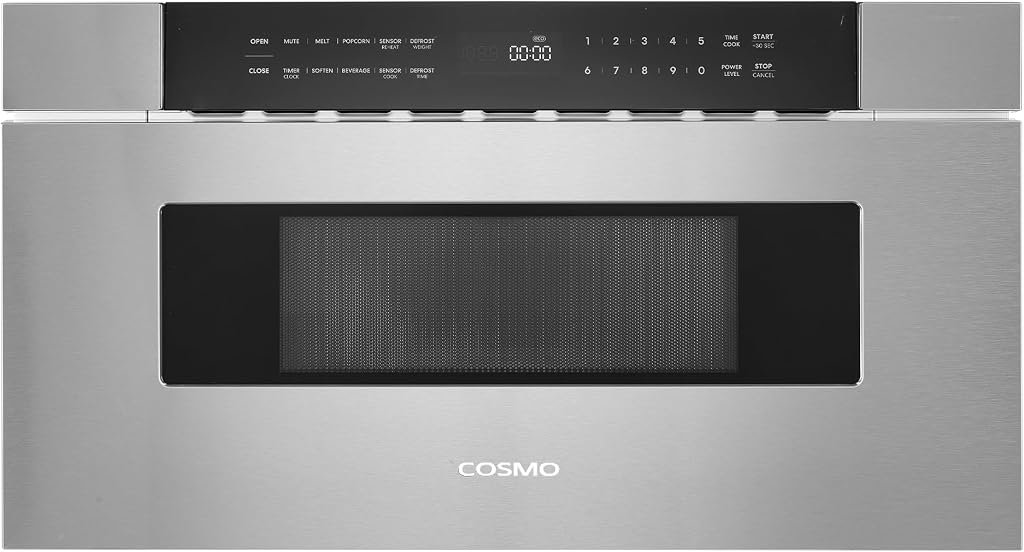
The Haven Coll 1.2 cu. ft. Built-in Microwave Drawer, model COS-MWD3012NHSS from Cosmo, approaches that question with a 30-inch built-in format, 1,000 watts of microwave output, 10 power levels, automatic presets, sensor functions, touch-operated opening and closing, and a stainless-steel exterior. At $1,249.99, this is plainly not a substitute for an inexpensive countertop microwave. It belongs to another category entirely-one in which cabinet integration, kitchen workflow, accessibility, and visual restraint carry substantial weight.
Our score is 8.58/10. Customer Sentiment stands at 8.72, Buyer Confidence at 8.43, and Value at 8.4. The relationship among those numbers is revealing. People attracted to this appliance format have good reasons to like what the Haven does, while its price and installation requirements prevent the value equation from becoming effortless.
The result is a microwave that makes considerably more sense during a kitchen remodel or new build than as an impulse appliance replacement.
What the Haven Coll Actually Is
The product name can cause some confusion because “Haven Coll” is a shortened rendering of Cosmo’s Haven Collection. The appliance itself is the COS-MWD3012NHSS, which Cosmo identifies as a 30-inch built-in microwave drawer.
According to the official Cosmo product specification, the microwave has a 1.2 cu. ft. cavity, stainless-steel finish, 120V/60Hz electrical specification, 1,000-watt output, 1,500-watt input and a net weight of 74.1 pounds. Its controls provide 10 power levels along with melt, soften, popcorn and beverage presets. Weight- and time-based defrosting are supported, and a dedicated defrosting rack is included.
That establishes a useful baseline. This is not simply a conventional microwave turned sideways and fitted with decorative trim. Its entire interaction model changes.
Instead of opening a hinged door and reaching horizontally into a cavity, the user opens a drawer and places the food into it from above. Instead of consuming countertop space or hanging above a range, the appliance becomes part of the cabinetry.
That distinction is the foundation of its appeal.
The Drawer Format Changes Kitchen Workflow
Conventional microwave placement has always involved compromise. A countertop machine consumes preparation space. An over-the-range microwave places hot food relatively high and combines two functions-microwave and ventilation-in one crowded location. A wall-mounted built-in can solve the countertop problem, although its usefulness depends heavily on installation height.
A drawer shifts the appliance downward.
KitchenAid’s explanation of microwave drawer design identifies the central architectural advantage: drawers are commonly installed in lower cabinetry or an island and open outward rather than through a swinging door. That arrangement releases countertop area and changes how dishes enter and leave the cavity.
The Haven follows that logic closely. Its 30-inch width particularly suits a kitchen where the microwave is meant to read as part of a broad bank of cabinetry rather than as a small appliance inserted wherever room happened to remain.
There is also a less obvious advantage. A conventional hinged microwave door temporarily claims space in front of the machine when opened. A drawer still projects into the working aisle, but its movement is predictable and contained at a lower level. For an island installation, that can produce a cleaner work surface and eliminate a visually dominant appliance from the countertop.
None of this makes the drawer universally more ergonomic.
Lower placement reduces overhead lifting, but it can require users to look downward or bend. Kitchen-design guidance on microwave drawers similarly recognizes that trade-off: loading from above can be easier than reaching into a high microwave, while seeing into a low cavity may require bending.
The practical lesson is simple. Installation height matters almost as much as appliance selection.
Capacity Is Moderate; Width Is the Bigger Story
At 1.2 cu. ft., the Haven’s capacity is neither unusually small for a drawer microwave nor unusually generous. The 30-inch exterior width should not be mistaken for a 30-inch-wide cooking chamber.
That distinction deserves attention because appliance dimensions and usable cavity volume are different measurements. Buyers working from cabinet drawings can easily focus on the impressive exterior width while assuming that it translates directly into substantially greater food capacity.
The 1.2 cu. ft. figure places the Haven in familiar microwave-drawer territory. For context rather than direct equivalence, Sharp currently sells a 24-inch drawer with the same 1.2 cu. ft. nominal capacity, while ZLINE also markets a 24-inch built-in drawer at 1.2 cu. ft.
That makes the Haven’s 30-inch format primarily an installation and design decision rather than evidence of an unusually cavernous interior.
This is precisely the kind of distinction a useful microwave buying guide should make. Cubic footage describes cavity volume. Exterior width determines how the appliance relates to cabinetry. Wattage describes rated microwave output. None of those figures substitutes for the others.
1,000 Watts Is a Sensible Output Level
The Haven is rated at 1,000 watts of cooking output and offers 10 power levels.
That combination is more meaningful than an oversized collection of specialized cooking buttons. Microwave cooking often requires power modulation rather than maximum output. Melting, softening and defrosting are obvious examples: the goal is controlled energy delivery, not simply reaching a target temperature as quickly as possible.
The four dedicated automatic options-melt, soften, popcorn and beverage-cover tasks that people realistically assign to microwaves. The control panel also includes sensor cook and sensor reheat functions, according to the model’s user manual.
There is a useful restraint here. The Haven does not need to pretend to be an entire connected cooking platform.
In fact, retailer specifications identify the COS-MWD3012NHSS as lacking Wi-Fi and smart-platform compatibility. That will disappoint buyers seeking app control, but it also keeps the product focused on a task for which connectivity can feel peripheral. Opening a microwave app to accomplish a job that usually takes seconds at the appliance itself is not automatically progress.
The Haven instead spends its complexity on drawer operation, cooking controls and cabinetry integration.
Controls Are Better Suited to the Format Than a Conventional Keypad
The control system is particularly relevant because a drawer microwave changes the user’s viewing angle.
The Haven provides dedicated OPEN and CLOSE controls, along with mute, timer/clock, melt, soften, popcorn, beverage, sensor reheat, sensor cook, defrost-by-weight, defrost-by-time, numeric input, time cook, power level, start/+30 seconds and stop/cancel functions. These are documented in the product manual.
That is a reasonably coherent interface rather than a sprawling catalog of recipes.
The mute function deserves more credit than its technical simplicity suggests. Audible appliance alerts can become irritating in open-plan kitchens, especially when several electronic appliances compete for attention. Giving the user control over that sound is a small but practical design choice.
Touch-controlled opening and closing also distinguishes the Haven from a basic pull-out compartment. Cosmo states that the drawer can be opened and closed at the touch of a button.
The long-run durability of a powered drawer mechanism naturally matters more than it would on a cheap countertop microwave with a manual door. That mechanical complexity is part of the trade: the design gains elegance and accessibility while adding components that a conventional hinged-door machine does not require.
Installation Is Not a Footnote
This is where the Haven separates casual shoppers from suitable buyers.
A 74.1-pound built-in appliance should be treated as cabinetry equipment, not as a machine that merely needs an electrical outlet. Cosmo’s installation instructions specify a solid, level contact surface and state that the floor of the opening should be plywood strong enough to support about 100 pounds.
The installation manual also requires an anti-tip block. Its purpose is not cosmetic: the block helps prevent the appliance from tipping when the drawer is extended, reducing the danger associated with spilled hot liquids.
Electrical planning is equally specific. The documented requirement is 120V, 60Hz AC with a protected 15-amp-or-greater supply, with a separate circuit recommended for the appliance. The installation instructions call for a grounded three-prong outlet and prohibit an adapter or extension cord.
These requirements materially affect the real purchase price.
A $1,249.99 microwave that slides into an already compatible cabinet is one financial proposition. The same microwave purchased during a retrofit involving cabinet alteration, electrical work and professional labor is another.
That is why installation should be priced before the appliance is ordered. The correct sequence is to verify model dimensions, opening dimensions, support requirements, electrical placement and adjacent cabinetry first-and only then treat the appliance price as meaningful.
Safety Is More Engineered Than Microwave Myths Suggest
Microwave ovens still attract persistent anxiety about radiation, much of it detached from how modern appliances are regulated.
The U.S. Food and Drug Administration’s microwave safety guidance states that manufacturers must certify microwave ovens to federal safety requirements. The federal standard limits leakage over an oven’s lifetime to 5 milliwatts per square centimeter measured approximately two inches from the oven surface. The FDA further explains that this limit is “far below the level known to harm people.”
The same standard requires two independent interlock systems that stop microwave production when the latch is released or the door is opened.
For the Haven specifically, the more immediate household issue is physical rather than exotic: hot food, hot liquids and a moving drawer positioned below the counter.
Cosmo equips the unit with a child lock, while the installation design calls for the anti-tip block already discussed.
Families with small children should think carefully about placement precisely because a drawer is lower and therefore physically easier for a child to approach. A child lock is useful, but it does not replace supervision around hot containers.
The Price Makes Sense Only in the Right Project
At $1,249.99, the Haven’s cost is substantial in ordinary microwave terms.
The more relevant comparison, however, is with other built-in drawers rather than $100 countertop ovens. Current manufacturer pricing illustrates how different that market is. Sharp lists a 24-inch, 1.2 cu. ft., 950-watt stainless drawer at $1,499.99, while ZLINE lists a 24-inch, 1.2 cu. ft. stainless built-in drawer at $1,159.99.
Those examples do not establish a universal market average, and prices can change. They do show that four-figure pricing is not unusual within the built-in drawer category.
That context helps explain our Value rating of 8.4.
The Haven is not inexpensive, but its price is not detached from its product class. The value argument is strongest when the buyer already wants a 30-inch drawer, already has suitable cabinetry planned and places genuine value on recovering countertop space.
Value deteriorates quickly when substantial cabinet reconstruction is necessary or when a conventional microwave would perform the household’s actual heating tasks equally well.
The appliance therefore rewards deliberate kitchen planning more than bargain hunting.
Where the Scores Land
Our 8.58/10 overall score reflects a product with a well-defined purpose and a feature set aligned with that purpose.
Customer Sentiment is higher at 8.72. That fits the nature of microwave drawers: buyers who deliberately choose this format tend to be selecting for specific qualities-integrated appearance, lower placement, clear countertops and drawer access-rather than stumbling into the category by accident.
Buyer Confidence is 8.43, slightly below the overall figure. That gap is reasonable for a built-in appliance. Purchasing involves more than deciding whether its cooking specifications look appealing. Cabinet compatibility, installation quality, electrical preparation and service considerations all influence ownership.
Value, at 8.4, is the lowest of the four figures, though still strong. The explanation is price discipline. A drawer microwave can solve a spatial problem elegantly, but it cannot make the cost difference between itself and a basic microwave disappear.
Those distinctions matter. A product can be highly satisfactory for its intended buyer while still demanding careful financial and installation planning.
Meaningful Strengths
Several advantages stand out after separating functional benefits from showroom appeal:
- The 30-inch built-in format removes the microwave from the countertop and suits wide base cabinetry or an island.
- A 1,000-watt output and 10 power levels provide a credible foundation for everyday reheating, cooking and lower-power tasks.
- Sensor cook and sensor reheat expand the control set beyond simple timed operation.
- Melt, soften, popcorn and beverage presets focus on common microwave jobs rather than obscure programmed recipes.
- Weight- and time-based defrost modes give users two approaches to thawing.
- Touch-operated opening and closing suit the drawer architecture.
- The mute function gives households control over appliance sounds.
- The child lock addresses the accessibility of a low-mounted appliance.
- Stainless steel and a handle-free front support visually restrained cabinet integration.
The strongest attribute is not any single button. It is coherence. Most of the Haven’s design decisions support the same objective: making the microwave part of the kitchen architecture instead of leaving it sitting on the architecture.
Drawbacks That Should Affect the Buying Decision
The drawbacks are equally concrete.
First, $1,249.99 remains a large expenditure for microwave cooking. A buyer primarily interested in reheating leftovers gains little culinary benefit merely because the appliance lives inside cabinetry.
Second, installation creates dependency on cabinet dimensions and structural preparation. The appliance weighs more than 74 pounds, the opening must support it correctly, and an anti-tip installation is required.
Third, a lower drawer is not automatically ideal for every body. People who dislike bending or who have difficulty looking downward may prefer a conventional built-in located closer to counter or chest height.
Fourth, the 30-inch exterior does not translate into unusually large nominal capacity. The cavity remains 1.2 cu. ft.
Fifth, buyers seeking connected controls will not find Wi-Fi or smart compatibility here.
Finally, powered drawer operation introduces mechanical complexity that a simple manual microwave door avoids. That does not establish a reliability problem with this model, but it is a legitimate structural difference to recognize when choosing an appliance intended to remain built into cabinetry for years.
Who Is Most Likely to Appreciate It?
The Haven makes its strongest argument in a kitchen renovation where appliance placement is being designed rather than inherited.
It fits especially well when countertop space is scarce, an island already has a suitable appliance bay, an over-the-range microwave would compromise the desired ventilation arrangement, or the visual objective is to keep upper cabinetry relatively quiet.
It can also suit households that prefer loading dishes from above rather than lifting them into a high microwave. The accessibility benefit should still be assessed against the user’s height and mobility because lower placement trades overhead reaching for downward viewing.
Conversely, renters, budget-led shoppers and households replacing a failed countertop microwave are unlikely to extract enough benefit from the built-in format to justify the project cost.
A good microwave buying guide should ultimately separate cooking needs from architectural preferences. If the requirement is simply “heat food efficiently,” many cheaper appliances satisfy it. If the requirement is “heat food while preserving counters, integrating into a 30-inch cabinet plan and avoiding an elevated microwave,” the Haven addresses a much narrower problem-and its price becomes easier to understand.
Final Considerations
The Haven Coll 1.2 cu. ft. Built-in Microwave Drawer is best understood as a kitchen-design appliance that happens to perform microwave cooking, rather than as an ordinary microwave dressed in stainless steel.
Its 1,000-watt output, 10 power levels, sensor functions, four automatic presets, dual defrost methods, mute control, child lock and powered drawer give it a practical feature set. The 30-inch built-in architecture is the defining element, freeing counter area and allowing the microwave to disappear into lower cabinetry.
Our score of 8.58/10 reflects that focused execution. Customer Sentiment at 8.72 suggests particularly good alignment between the appliance and the people drawn to this category. Buyer Confidence at 8.43 reflects the additional planning inherent in a built-in machine, while the 8.4 Value score recognizes both the useful design and the unavoidable fact that $1,249.99 buys an expensive method of generating microwave energy.
That last point should not be treated dismissively. Kitchen design is partly the management of repeated small actions. Where a plate is lifted, where a door opens, where a hot bowl can be set down and how much work surface remains available may each seem minor in isolation. Repeated thousands of times, those decisions define whether a kitchen feels orderly or awkward.
The Haven’s appeal lies there. It does not fundamentally reinvent microwave cooking. It relocates it, integrates it and makes its physical interaction more deliberate.
For a kitchen already being designed around a 30-inch drawer, that distinction can justify the premium. For a household that merely needs a machine to reheat dinner, the architecture is likely to cost more than the underlying need warrants.
That is the dividing line buyers should settle before ordering-not whether a drawer microwave looks cleaner in photographs, but whether its placement solves a recurring problem in the kitchen they actually use.