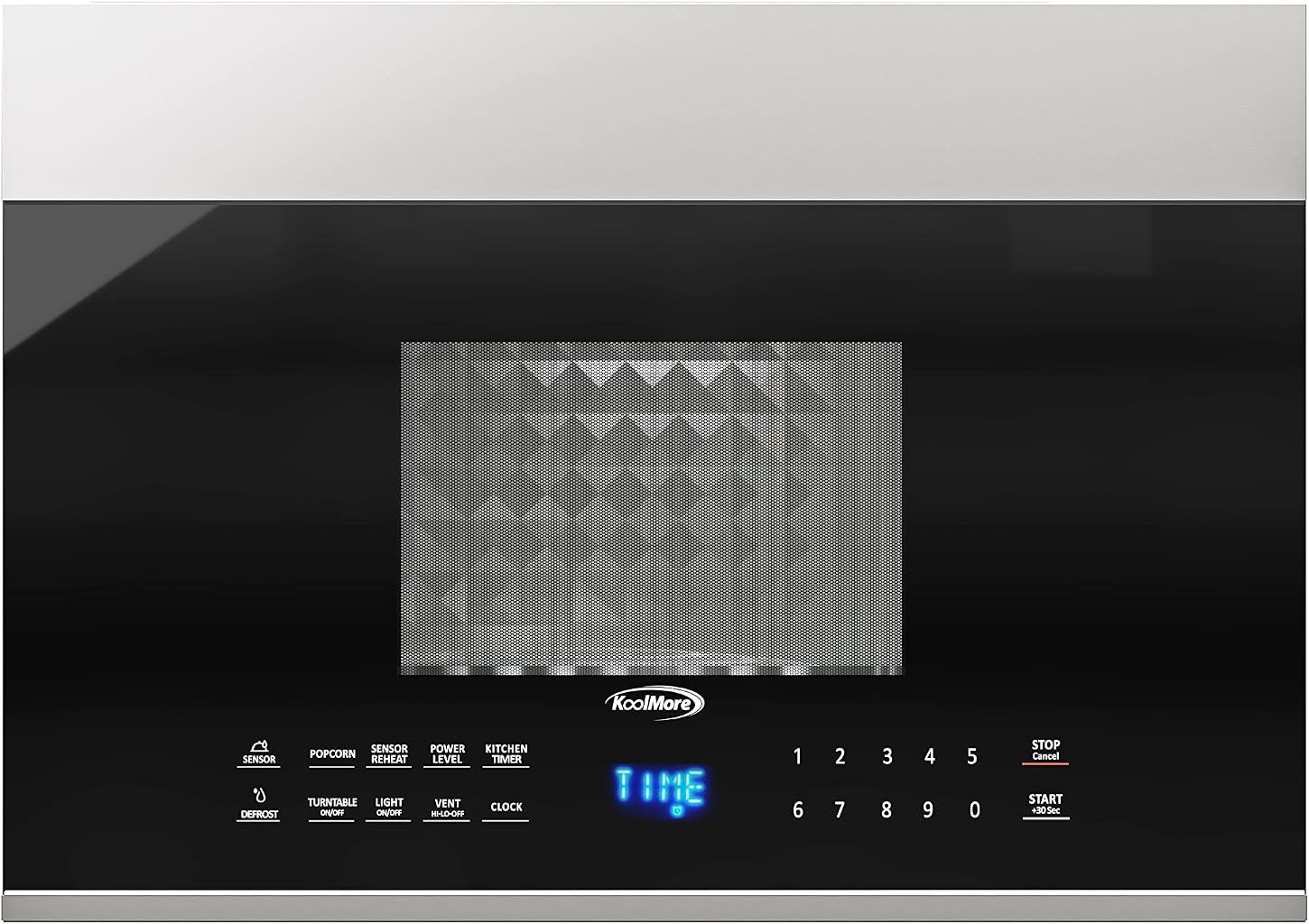
The KoolMore KM-MOT-OP1SS addresses a kitchen problem that mainstream appliance catalogs often treat as an afterthought: what happens when there simply is not room for a conventional 30-inch over-the-range microwave?
At 23.86 inches across, this KoolMore belongs to the comparatively narrow class of 24-inch OTR microwaves. That measurement defines the product more convincingly than almost any preset button on its control panel. The appliance combines a 1.3-cu.-ft. microwave cavity with 1,000 watts of advertised cooking output, sensor functions, three ventilation speeds, and a 300 CFM maximum exhaust rating in a chassis intended for a 24-inch opening. KoolMore’s official KM-MOT-OP1SS specifications put the exterior at 23.86 inches across, 16.18 inches deep, and 17.01 inches high, with a weight of 57.32 pounds.
At a reference price of $358.60, our score is 8.14/10. Customer Sentiment stands at 7.84, Buyer Confidence at 9.27, and Value at 7.91.
That unusually high Buyer Confidence rating is central to understanding the KoolMore. This is not an appliance whose appeal rests on vague lifestyle claims. Its purpose is unusually specific. A kitchen either benefits from a roughly 24-inch OTR microwave or it does not.
The lower Value and Customer Sentiment scores introduce the necessary restraint. A 1.3-cu.-ft. cavity is smaller than those found in many 30-inch OTR models, and buyers are paying partly for the unusual width rather than maximum capacity per dollar. The KM-MOT-OP1SS makes its strongest case when dimensional compatibility is the problem that needs solving.
The 24-Inch Width Is the Defining Specification
Microwave capacity attracts attention because cubic feet are easy to compare. Installation width is less glamorous, but for an OTR appliance it can end the buying process before capacity even enters the discussion.
KoolMore specifies a 24-by-13-by-16.5-inch cutout for the KM-MOT-OP1SS. The appliance itself measures 23.86 inches across its narrow exterior dimension.
That makes it fundamentally different from a conventional 30-inch OTR microwave.
A household with a standard 30-inch opening has a broad field of competing appliances. A kitchen with roughly 24 inches available has far fewer realistic options. Older cabinetry, compact apartments, secondary kitchens, accessory dwelling units, and space-constrained renovations can all produce this narrower requirement.
This is where a serious microwave buying guide should begin: with the kitchen rather than the control panel.
A microwave that offers more capacity but cannot fit between the cabinets has no practical advantage.
The KoolMore’s 17.01-inch height also deserves attention. Its narrow width should not be confused with a low-profile design. Space is saved laterally, not primarily vertically.
Someone seeking more clearance between the cooktop and microwave therefore needs to examine height independently from width.
The 1.3-Cubic-Foot Cavity Is the Main Compromise
A narrower chassis inevitably places pressure on interior volume.
KoolMore specifies 1.3 cubic feet of net capacity. Its interior measurements are approximately 15.39 inches across, 15.28 inches deep, and 10.71 inches high. The manufacturer also lists 9.74 inches from the turntable to the top of the cavity.
Those numbers deserve more attention than the 1.3-cu.-ft. headline alone.
Interior geometry determines what cookware can actually be used. A microwave can have respectable total volume yet still reject a particular rectangular dish because the dish cannot rotate.
The KoolMore’s smaller cavity is therefore most naturally suited to ordinary plates, bowls, mugs, storage containers, frozen meals, and similarly sized cookware rather than oversized casserole dishes.
That limitation is not surprising. It is the cost of compressing an OTR appliance into a 24-inch installation.
The proper comparison is not simply 1.3 cubic feet versus 1.8 cubic feet. It is 1.3 cubic feet that fits versus a larger microwave that may require cabinet reconstruction.
For the correct kitchen, those are entirely different propositions.
1,000-Watt Cooking Output Keeps the Narrow Body From Feeling Underpowered on Paper
Retail documentation identifies the KM-MOT-OP1SS as a 1,000-watt microwave, while KoolMore’s electrical specifications list 1,550 watts for appliance wattage. A current Lowe’s listing identifies the model as a 1,000-watt cooking appliance, consistent with the model’s marketed cooking output.
These numbers describe different things.
Microwave cooking output represents energy delivered for cooking, while electrical input includes the power the appliance draws to operate its microwave-generation and supporting systems. Buyers comparing appliances should avoid treating input wattage as cooking output.
The 1,000-watt cooking figure is the more useful number for everyday comparison.
KoolMore also documents 11 power levels.
That is useful because maximum wattage tells only part of the cooking story.
Food composition, water content, thickness, initial temperature, container material, placement, and resting time all affect microwave heating. Dense foods can remain cool internally while thinner sections become hot.
Reduced power can moderate that process during defrosting, reheating, and other tasks where full output is unnecessarily aggressive.
The narrow chassis therefore does not impose an obvious cooking-power penalty.
Sensor Functions Give the Controls More Substance
The KM-MOT-OP1SS includes six sensor-control pads, according to KoolMore’s specifications. The documented functions include Sensor, Sensor Reheat, Popcorn, Defrost, Power Level, Kitchen Timer, Turntable On/Off, Light On/Off, ventilation control, and a clock.
KoolMore also lists six pre-programmed automatic cooking options and 30-second express cooking.
Sensor operation is one of the more useful additions because microwave cooking frequently involves estimation.
A conventional timed cycle follows the selected duration regardless of what is happening to the food. Sensor programs attempt to adjust the process in response to conditions during heating.
That does not guarantee uniform results.
A mixed plate containing rice, vegetables, and meat still presents multiple densities and moisture levels. Thick frozen food can still require repositioning or additional time. Containers still matter.
Yet sensor reheating can reduce the amount of manual guessing involved in routine leftovers.
The turntable on/off function also deserves attention. Large or awkwardly shaped containers sometimes benefit from remaining stationary, although stopping rotation can increase the importance of repositioning food manually.
The control package is therefore more developed than the appliance’s compact dimensions might suggest.
Three Fan Speeds Improve Ventilation Control
KoolMore specifies three ventilation speeds and maximum airflow of 300 CFM. Exhaust can be configured through the back, top, or front, while the appliance includes two charcoal filters.
The three-speed arrangement is useful because kitchen ventilation does not always require maximum airflow.
Boiling water produces a different plume from frying food. A lower fan setting can handle lighter moisture and odor loads while a higher setting provides more airflow when cooking generates greater emissions.
Still, CFM deserves careful interpretation.
Cubic feet per minute measures airflow volume. It does not directly measure how effectively a hood captures every particle, droplet, odor, or cooking plume.
A 300 CFM blower attached to poor ductwork can perform differently from the same blower attached to a short, properly sized exterior duct.
Likewise, cooking on a front burner can place the emission source farther from the hood’s capture area.
The fan rating establishes potential airflow, not guaranteed kitchen conditions.
Cooking Produces More Than Smells
The ventilation function deserves attention because cooking can materially affect indoor particulate levels.
The U.S. Environmental Protection Agency identifies cooking as a source of indoor particulate matter and states that the food, cooking method, and type of cooking fat can all affect particle production. The agency advises using a range hood whenever cooking and prefers one vented outdoors where possible.
The EPA also recommends leaving the hood operating for 10 to 20 minutes after cooking and using back burners when practical because this improves capture.
That guidance changes the way the KoolMore’s 300 CFM system should be viewed.
The fan is not merely an odor-control accessory attached to a microwave. It is part of the kitchen’s air-management system.
This distinction becomes especially relevant because an OTR microwave physically replaces the space where a dedicated range hood might otherwise be installed.
A buyer choosing the KoolMore is therefore selecting both a microwave and a ventilation strategy.
Ducted and Recirculating Ventilation Are Not Equivalent
KoolMore documents back, top, and front exhaust options for the KM-MOT-OP1SS and includes two charcoal filters.
Those configurations should not be treated as producing identical outcomes.
A properly ducted outdoor system removes cooking air from the kitchen. A recirculating system passes air through filtration and returns it indoors.
Charcoal filtration can address odors, while grease filtration can capture some material carried by the air. Neither process makes recirculation identical to outdoor exhaust.
The EPA’s current cooking guidance explicitly states that the preferred range hood is one that vents outdoors.
For buyers replacing an existing OTR microwave, the existing ventilation path should therefore be inspected before purchase.
An old microwave with a fan button does not prove that the kitchen has an exterior duct.
Some OTR installations recirculate by design. Others may have ductwork that is poorly routed, obstructed, undersized, or no longer connected correctly.
The KoolMore can only work within the installation around it.
The Installation Manual Deserves to Be Read Before Purchase
KoolMore’s installation documentation states plainly that installation requires basic mechanical and electrical skills and that proper installation is the installer’s responsibility.
That warning deserves more attention than it usually receives.
The microwave weighs 57.32 pounds. It is not simply placed on a shelf. It must be mounted securely above a cooking appliance while accommodating electrical service and ventilation.
The manufacturer’s electrical specifications call for 120 volts, 60 Hz, 13 amps, single-phase service, and a NEMA 5-15P plug. The power cord measures approximately 39.37 inches.
These are not decorative specifications.
Outlet position can determine whether the cord reaches without modification. Cabinet construction affects mounting. Duct direction determines blower configuration. Wall studs influence structural support.
Before ordering, buyers should verify:
- The actual cabinet opening width.
- Available vertical clearance above the cooking surface.
- Cabinet depth.
- Wall construction and mounting points.
- Outlet position and electrical condition.
- Exhaust direction and duct dimensions.
- Whether ventilation reaches outdoors or recirculates.
- Door-swing clearance.
- Compatibility of frequently used cookware with the 1.3-cu.-ft. cavity.
- Whether two people or professional installers will be available to handle a 57.32-pound appliance.
A compact microwave can still produce a large installation problem when those details are ignored.
The Door Requires More Space Than the Chassis Suggests
KoolMore documents a depth of 38.5 inches with the door open to 90 degrees.
That figure illustrates why appliance depth cannot be evaluated solely with the door closed.
The microwave itself is approximately 16.18 inches deep, but normal operation requires space for the door to swing outward.
Nearby walls, tall cabinets, refrigerator panels, decorative trim, and other obstacles can interfere.
This is particularly relevant in small kitchens-the very environments most likely to benefit from a 24-inch microwave.
Compact kitchens often have tighter corners and shorter cabinet runs. Saving six inches of appliance width does not automatically create unlimited door clearance.
The installation should therefore be evaluated as a moving object rather than a static rectangle.
Lighting Matters Because the Microwave Replaces a Hood
The KM-MOT-OP1SS includes an LED interior light with a documented brightness of approximately 44 to 55 lumens, along with a light on/off control associated with the OTR installation.
Lighting beneath an OTR microwave can appear incidental until the appliance replaces a dedicated hood.
The underside becomes a task-lighting position directly above the cooktop.
Ceiling lighting can leave shadows across pans because the cook stands between the fixture and the range. Integrated lighting reduces that problem and makes boiling, browning, spills, and burner conditions easier to see.
Inside the microwave, illumination allows food to be observed without interrupting the cycle.
Neither function determines cooking power, but both affect how pleasant the appliance is to use every day.
Small conveniences accumulate quickly in an appliance positioned at the center of routine kitchen work.
The Finish Is More Complicated Than the Model Name Suggests
The product is widely described as stainless steel, but KoolMore’s current detailed specification table lists the color finish as black while describing the exterior material as metal. The product photography and retail descriptions present a stainless-steel-forward exterior treatment.
For buyers matching an existing appliance suite, photographs alone are not enough.
Stainless finishes can differ in reflectivity, grain, darkness, surrounding black trim, handle treatment, and resistance to fingerprints.
KoolMore describes the unit as using stainless steel intended to resist fingerprints and smudges.
That is useful as a stated finish characteristic, but color matching remains a visual issue rather than a specification-sheet exercise.
Anyone placing the microwave beside appliances from another manufacturer should expect possible differences in tone.
Maintenance Includes the Ventilation System
The microwave cavity is only half of the cleaning job.
An OTR appliance sits directly above frying, boiling, sautéing, and other cooking activity. Air moving through the hood carries grease and particles toward its filtration system.
KoolMore specifies two charcoal filters.
Filter maintenance should therefore be treated as part of normal ownership rather than an optional service task.
The EPA recommends routinely cleaning a range hood’s grease filter as part of its guidance for improving indoor air quality while cooking.
Inside the microwave, spills should be removed before repeated heating hardens them onto surfaces. The turntable and its support area need regular cleaning as well.
The door, hinges, latching area, and seals deserve inspection for another reason: microwave safety depends on correct closure.
Maintenance on this appliance therefore divides naturally into two zones-the food cavity and the ventilation equipment underneath.
Ignoring either one eventually affects usability.
Microwave Safety Is Better Understood Through Regulation Than Folklore
Microwave ovens remain associated with persistent anxiety about radiation, but federal safety requirements are highly specific.
The U.S. Food and Drug Administration explains that it has regulated microwave-oven manufacturing since 1971. The agency states that manufacturers must certify compliance with federal safety-performance standards.
The federal standard limits microwave leakage throughout an oven’s useful life to 5 milliwatts per square centimeter measured at approximately two inches from the oven surface. It also requires two independent interlock systems that stop microwave production when the door is opened.
The FDA’s practical advice is equally relevant: a microwave with damaged hinges, latches, seals, or a door that does not close properly should not simply remain in service.
For everyday owners, heat-related hazards are often more immediate.
The FDA notes that most microwave-related injuries involve hot containers, overheated foods, or liquids rather than radiation exposure.
That is a useful corrective to the usual safety conversation.
Buyer Confidence at 9.27 Is the Standout Score
Buyer Confidence is our highest rating for the KoolMore at 9.27.
The reason is specificity.
KoolMore publishes unusually detailed product measurements: exterior size, cutout dimensions, interior dimensions, weight, electrical requirements, cord length, ventilation routes, fan speeds, maximum airflow, filter count, control type, lighting specification, and door-open depth.
The manufacturer also documents the KM-MOT-OP1SS as a 24-inch, 1.3-cu.-ft. household OTR microwave.
That amount of dimensional information matters greatly for an installed appliance.
Buyer Confidence does not mean every household should buy the KoolMore. It means prospective owners have enough concrete information to determine whether the machine fits their kitchen and requirements.
For a product built around an uncommon width, that distinction is particularly important.
Why Value Stops at 7.91
Value is 7.91, below the overall 8.14 rating and considerably below Buyer Confidence.
At $358.60, the KoolMore is not competing solely on cavity volume.
A conventional 30-inch OTR microwave can offer substantially more than 1.3 cubic feet. Buyers who have room for a larger appliance therefore have a broader market to examine.
The KoolMore’s economics improve when the 24-inch width is genuinely required.
In that setting, comparing cavity volume per dollar becomes less useful. The alternative may involve cabinet modification, giving up the OTR configuration entirely, or choosing among a much smaller group of narrow models.
The 1,000-watt cooking output, sensor controls, 11 power levels, three fan speeds, and 300 CFM ventilation help prevent the smaller chassis from becoming functionally sparse.
Still, $358.60 is enough money that installation costs deserve attention.
If cabinetry, ducting, or electrical work is required, the final project price can rise well beyond the appliance price.
Reading Customer Sentiment at 7.84
Customer Sentiment is our most restrained score at 7.84.
That figure fits the compromises visible in the specification sheet.
The 1.3-cu.-ft. cavity is inherently smaller than mainstream full-width alternatives. A 300 CFM ventilation system is useful but should not be confused with a high-capacity dedicated range hood. The model is specialized around width, which means households without that dimensional constraint may see less reason to accept the smaller cavity.
None of those limitations makes the microwave poorly conceived.
They simply narrow its ideal audience.
That is precisely why Customer Sentiment can sit below Buyer Confidence. A product can be easy to understand before purchase while still asking its owner to accept meaningful compromises.
The two measurements answer different questions.
Who Should Consider the KM-MOT-OP1SS
The strongest buyer fit is a kitchen that genuinely needs an approximately 24-inch OTR microwave.
Its principal attributes are straightforward:
- 1.3 cubic feet of capacity.
- Approximately 23.86-inch exterior width.
- 1,000-watt advertised microwave cooking output.
- 11 power levels.
- Six sensor-control pads.
- Sensor reheating.
- Defrost function.
- 30-second express cooking.
- Turntable on/off control.
- Three ventilation speeds.
- 300 CFM maximum exhaust.
- Back, top, and front ventilation configurations.
- Two charcoal filters.
- LED interior lighting.
- 120-volt plug-in electrical configuration.
- 57.32-pound installed-appliance weight.
- One-year parts and labor warranty.
The weaker fit is a household with a standard 30-inch opening that prioritizes maximum cavity size, a kitchen requiring substantially stronger smoke capture, or a buyer seeking convection and oven-like cooking capabilities.
The KoolMore’s purpose is narrower than that.
That narrow purpose is also what makes it interesting.
Final Considerations
The KoolMore KM-MOT-OP1SS is best understood as a dimensional solution first and a microwave second.
Its 23.86-inch width is the specification around which everything else is organized. The 1.3-cu.-ft. cavity, 57.32-pound weight, 24-inch cutout requirement, and compact interior all follow from an appliance designed to fit where conventional 30-inch OTR microwaves cannot.
KoolMore has not paired that narrower chassis with unusually weak cooking specifications. The model is marketed with 1,000 watts of microwave cooking output and provides 11 power levels, sensor functions, sensor reheating, defrosting, express cooking, a kitchen timer, and turntable control.
The ventilation system is similarly practical rather than extravagant. Three fan speeds and a maximum 300 CFM rating provide meaningful airflow capability, while back, top, and front exhaust configurations create installation flexibility. Real capture performance will still depend heavily on ductwork, mounting position, burner choice, filter condition, and whether cooking air actually reaches outdoors.
That last point deserves emphasis because the microwave replaces the physical location of a conventional hood. EPA guidance identifies cooking as a source of indoor particulate matter and favors outdoor-vented range hoods where practical. A buyer evaluating this KoolMore should therefore inspect the ventilation path with the same care given to cabinet dimensions.
Our overall score of 8.14/10 reflects a product whose usefulness is concentrated rather than universal.
Customer Sentiment at 7.84 recognizes the compromises of the smaller cavity and moderate ventilation capacity. Value at 7.91 acknowledges that $358.60 is easier to justify when a 24-inch appliance is actually required. Buyer Confidence at 9.27 stands distinctly higher because KoolMore documents the dimensions, electrical requirements, ventilation specifications, interior measurements, installation cutout, controls, and warranty with unusual precision.
That spread between scores tells the product’s story.
The KM-MOT-OP1SS is not the obvious choice for every kitchen. It is unusually easy to assess for the kitchens it was built to fit.
Before ordering, the buyer should measure the cabinet opening, confirm vertical clearance, inspect the outlet, identify the exhaust route, measure frequently used cookware, account for the 38.5-inch door-open depth, and decide whether outdoor ventilation is available. Installation labor should be included in the budget rather than treated as an afterthought.
Once those questions are answered, the decision becomes considerably simpler.
A kitchen with 30 inches of available width has many alternatives, including models with larger cavities. A kitchen limited to roughly 24 inches faces a much narrower field. In that setting, the KoolMore’s combination of 1,000-watt cooking output, sensor functions, 11 power levels, three-speed 300 CFM ventilation, and detailed installation documentation becomes much more consequential.
Its strongest quality is therefore not raw capacity, an enormous preset catalog, or technological novelty.
It is the ability to place a fully functioning over-the-range microwave and ventilation appliance into a space where the dominant 30-inch format simply does not belong.