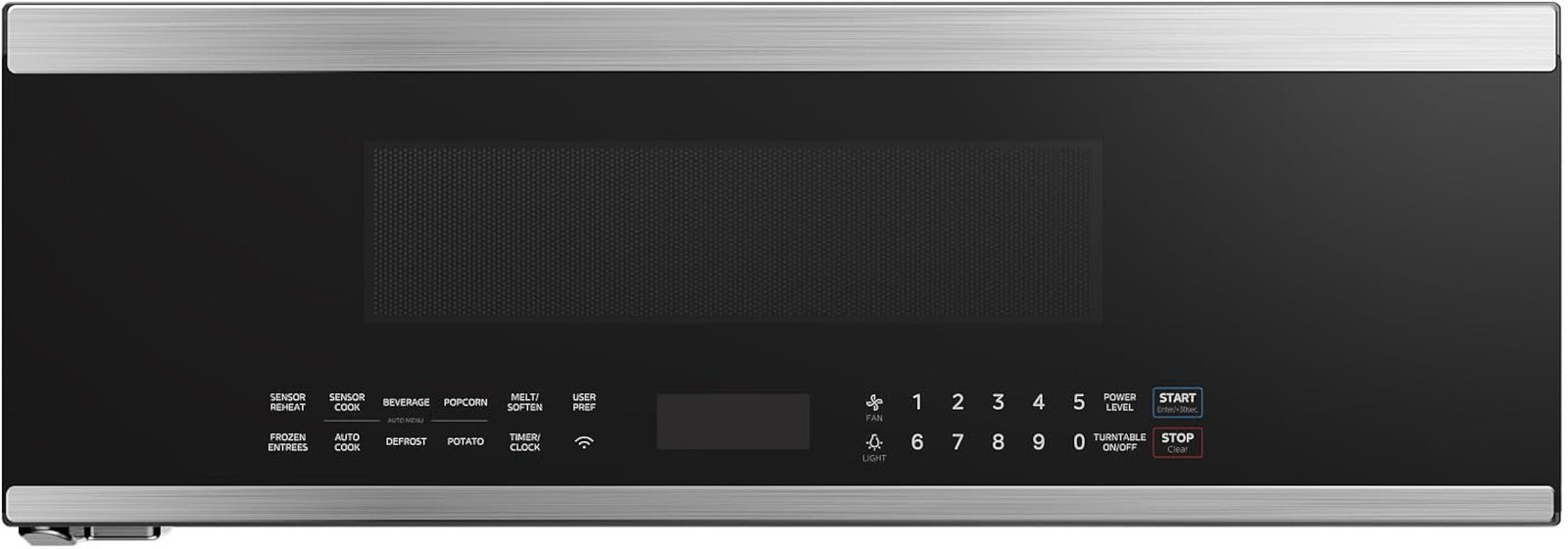
Over-the-range microwaves are appliances of compromise. They have to heat food efficiently, replace or supplement a range hood, fit into a tightly prescribed section of cabinetry, remain accessible above a cooktop, and justify giving up the larger cavity that a countertop machine can often provide for less money. The Midea MMO12S3ASTZ approaches that problem by making one decision unusually clear: vertical space matters.
This is a 1.2-cu.-ft., 1,000-watt over-the-range microwave built around a low-profile stainless-steel chassis. Verified specifications put its exterior dimensions at approximately 29.88 inches wide, 10.31 inches high, and 18.58 inches deep. Its turntable measures about 12.4 inches across, and the machine combines sensor cooking with connected controls and a ventilation system rated at 400 CFM.
That 10.31-inch height is the defining number. Many buyers are not looking for the largest microwave that can be attached to a wall. They are trying to recover sightlines and working clearance above a range without abandoning the convenience of an integrated microwave. Midea’s answer is unusually focused on that problem.
Our score is 8.33/10. Customer Sentiment stands at 8.28, Buyer Confidence at 8.69, and Value at 8.15. Those figures describe a product with a coherent purpose and a strong specification set, but also one whose $480.99 reference price demands more scrutiny than a basic OTR microwave. The central question is not whether the Midea can microwave food. It is whether its combination of slim construction, ventilation, sensor automation, and connected features justifies paying for a more specialized design.
A Low-Profile Design With a Practical Purpose
The standard appliance discussion tends to treat capacity as though more cubic feet automatically means a better microwave. In an over-the-range installation, that logic is incomplete.
A microwave mounted above a cooktop consumes space that affects how a kitchen feels and functions. A tall appliance can bring its bottom edge closer to cookware, reduce the visual openness around the cooking surface, and complicate replacement projects where cabinetry was designed around a conventional range hood.
The Midea’s 1.2-cu.-ft. cavity deliberately trades internal volume for a body only about 10.3 inches high. Its nearly 30-inch width, meanwhile, follows the familiar footprint expected of many OTR installations. The manufacturer’s installation material also specifies a 30-inch minimum width in the rear-wall template.
That makes the design easier to understand. This is not a miniature microwave in every dimension. It is predominantly a vertically compressed one.
For buyers using a microwave buying guide to compare models, cubic capacity should therefore be read alongside external height. A 1.7- or 1.9-cu.-ft. machine can offer substantially more internal volume, but that advantage becomes irrelevant if its taller body creates an undesirable installation above the cooktop.
The smaller cavity still imposes boundaries. Large vessels and bulky cookware demand more attention than they would in a full-height OTR model. The 12.4-inch turntable gives a more useful indication of everyday compatibility: standard plates and common microwave-safe containers belong within the intended use pattern, while oversized serving dishes deserve measurement before purchase.
That trade is defensible because Midea has not merely reduced the size and stopped there. The machine retains 1,000 watts of rated heating power.
What 1,000 Watts Actually Means
Microwave wattage is often used as a shorthand for performance, sometimes too casually. Power output does not establish heating uniformity, sensor accuracy, long-term reliability, or the quality of a particular cooking program. It does, however, establish useful context.
At 1,000 watts, this Midea sits in familiar territory for a household microwave rather than accepting a large power sacrifice in exchange for the slim chassis. Retail specifications associated with model MMO12S3ASTZ list nine power levels, allowing output to be reduced for foods that should not simply receive maximum energy until the timer expires.
The underlying physics is straightforward. The U.S. Food and Drug Administration explains how microwave ovens heat food: microwaves generated inside an oven are absorbed by food and cause water molecules to vibrate, producing heat. The agency also corrects a persistent misconception: microwave ovens do not cook food literally “from the inside out.” In thicker foods, interior cooking also depends heavily on heat conduction from warmer outer layers.
That detail matters when assessing any 1,000-watt appliance. A higher number on a specification sheet cannot eliminate the need to stir, rotate, rest, or otherwise manage foods whose geometry creates uneven heating.
The Midea’s sensor functions are therefore more interesting than wattage alone.
Sensor Cook and Sensor Reheat Address a Familiar Weakness
Timed microwave cooking asks the user to predict an outcome from imperfect variables: food quantity, starting temperature, moisture, container shape, density, and desired final temperature.
Midea equips this model with Sensor Cook and Sensor Reheat. Product descriptions for the MMO12S3ASTZ describe steam sensing that adjusts cooking time and power, while an automatic cooking menu handles predefined tasks.
The distinction is useful. A preset is essentially an instruction. A sensor has information from the cooking process itself.
That does not mean sensor cooking should be treated as an infallible substitute for observation. Food composition varies, and microwave results remain sensitive to portion geometry and placement. But sensor automation has a rational purpose: it can reduce the amount of manual timing required for foods whose moisture release provides a usable signal.
For routine reheating, that is arguably more relevant than an extensive menu of novelty cooking modes. Most households ask a microwave to repeat a relatively narrow group of jobs-warming leftovers, heating beverages, cooking packaged foods, defrosting, softening ingredients, and preparing simple vegetables. A machine that reduces friction in those repeated tasks has more practical utility than one carrying an impressive feature list that rarely gets used.
The 400 CFM Vent Fan Changes the Evaluation
An OTR microwave is not merely a microwave mounted somewhere convenient. It also sits where a range hood would otherwise go.
That second job deserves more scrutiny than it often receives.
The MMO12S3ASTZ is specified with a 400 CFM ventilation fan. CFM-cubic feet per minute-is an airflow rating rather than proof of capture effectiveness in every kitchen. Duct configuration, installation quality, filter condition, mounting height, cooking intensity, and whether air is actually exhausted outdoors all affect real performance.
Even so, 400 CFM is meaningful specification headroom for a slim appliance. The design is not asking buyers to accept obviously weak nominal airflow simply to obtain a shorter body.
There is a broader lesson here for anyone comparing OTR microwaves: ventilation should not be judged by CFM in isolation. A high airflow number attached to poor ducting can disappoint. Recirculating configurations also behave differently from systems that discharge cooking contaminants outdoors. Before purchase, the existing duct path should be inspected rather than assuming that replacing one OTR microwave with another guarantees equivalent ventilation behavior.
Midea’s installation documents reinforce how installation-specific this category is. The template provides for an exterior exhaust opening and requires careful positioning against the rear wall and upper cabinet.
The buyer is purchasing an installed appliance, not a freestanding box. That difference affects both cost and risk.
SmartHome Controls: Useful, but Secondary
Connected kitchen appliances tend to divide buyers into two camps: those who genuinely integrate remote functions into daily routines and those who stop opening the app shortly after installation.
The Midea supports the SmartHome app, remote control and notifications, with retail descriptions also advertising voice control. The connected system can handle cooking and ventilation controls and alert the user when a cycle finishes.
There are plausible use cases. A completion notification can prevent reheated food from being forgotten while someone is elsewhere in the house. Hands-free commands can also have utility when the user’s hands are occupied during food preparation.
Yet these features should remain secondary in the purchase decision. A microwave’s useful life can extend beyond the lifespan of a particular app experience, mobile operating system implementation, cloud integration, or smart-home habit. Physical fit, heating capability, ventilation, controls, and serviceability have more durable importance.
The connected functions are therefore best viewed as additional convenience rather than the foundation of the Midea’s value. The low-profile body is the lasting feature. Wi-Fi is an accessory to it.
Installation Deserves More Attention Than the Feature List
The 29.88-inch width may look reassuringly conventional, but no OTR microwave should be purchased on width alone.
Midea’s installation documentation for the MMO12S3ASTZ calls for a 30-inch minimum-width installation area and uses templates for locating cabinet mounting holes, the power-cord opening, and the exterior exhaust cutout. Recessed cabinet bottoms can require filler blocks so that the unit mounts level.
Those details have financial consequences.
A nominal $480.99 appliance can become a more expensive kitchen project if electrical work, duct modification, cabinetry changes, wall repair, or professional installation is required. Conversely, a low-profile machine that fits an existing configuration cleanly may prevent more disruptive remodeling.
Before ordering, a buyer should verify:
- Cabinet opening width and the full installation clearances required by the manual.
- Distance between the intended microwave position and the cooking surface.
- Existing exhaust direction and duct dimensions.
- Availability and position of the electrical connection.
- Cabinet-bottom construction, particularly recessed or framed designs.
- Whether the door and controls will remain comfortably accessible at the intended mounting height.
- The diameter of plates and containers used most often.
This is where careful measurement produces more value than another hour comparing cooking presets.
Safety Is Less Mysterious Than Microwave Myths Suggest
Microwave radiation attracts disproportionate anxiety compared with many mundane kitchen hazards. The regulatory history is useful context.
The FDA has regulated microwave-oven manufacturing since 1971 and states that ovens meeting its standard and used according to manufacturer instructions are considered safe under current knowledge. The federal performance standard limits microwave leakage throughout an oven’s useful life and requires independent safety interlocks that stop microwave production when the door latch is released or the door opens.
The FDA states that the lifetime leakage limit is 5 milliwatts per square centimeter measured at approximately two inches from the oven surface, a level the agency describes as far below that known to harm people.
The more ordinary hazards deserve attention instead. The agency reports that most microwave injuries are heat-related burns involving hot containers, overheated foods, or liquids rather than radiation. It specifically warns about superheated water, which can erupt after being heated beyond its boiling temperature without visibly boiling.
For this Midea, the sensible safety priorities are therefore familiar ones: maintain the door and seals, use microwave-safe containers, follow heating instructions, keep ventilation paths unobstructed, and discontinue operation if the door becomes damaged or the appliance behaves abnormally.
Reading the Four Editorial Scores
Our overall score of 8.33/10 places the Midea firmly in the very-good range. The rating reflects a product whose central design choice makes sense: sacrificing some cavity volume to produce a low-profile OTR microwave without dropping to weak nominal cooking power or minimal ventilation.
Customer Sentiment is 8.28. That is positive without suggesting that every buyer will find the format ideal. The most obvious dividing line is capacity. Someone routinely reheating large serving dishes has a different requirement from a household primarily warming plates, bowls, beverages, and smaller containers.
Buyer Confidence is the strongest of the four figures at 8.69. The core specifications are coherent rather than contradictory. A 1,000-watt output, 400 CFM fan, sensor functions, established 30-inch installation format, and documented installation materials give buyers concrete criteria to verify before committing.
Value receives 8.15, the lowest of the four ratings, though still a healthy result. The reason is straightforward: $480.99 is enough money that the low-profile format needs to solve an actual problem. Buyers who have ample vertical clearance and no interest in smart controls can reasonably compare larger conventional OTR microwaves. Paying for compact height makes more sense when compact height materially improves the kitchen.
The gap between the 8.69 Buyer Confidence score and 8.15 Value score tells much of the story. This is easier to trust as a well-defined product than to recommend indiscriminately as a bargain.
Where the Midea Makes the Most Sense
The strongest buyer fit is a kitchen where a conventional tall OTR microwave would consume more vertical space than desired.
That can include smaller kitchens, remodels replacing an under-cabinet hood, and installations where maintaining a more open area above the range matters more than maximizing microwave cavity volume. The 1.2-cu.-ft. interior becomes a rational trade rather than an arbitrary limitation in those settings.
It also suits households that value sensor reheating and already use connected-home controls. The 400 CFM fan strengthens the case for buyers who actually expect the appliance to perform ventilation duty rather than treating the fan as an occasional steam remover.
The fit becomes weaker for households that regularly microwave oversized cookware, want maximum cavity volume for the money, or have no spatial reason to pay for a low-profile body. A conventional OTR model may deliver more interior space at a comparable or lower cost.
There is no contradiction in those judgments. Specialized appliances create value by solving specific constraints. Outside those constraints, their compromises become easier to see.
Strengths and Drawbacks
The Midea’s strengths are unusually easy to identify because they reinforce the same design objective.
- The roughly 10.3-inch-high chassis preserves more vertical space than a traditional full-height OTR format.
- The 1,000-watt output avoids turning compact dimensions into an obvious power compromise.
- A 400 CFM ventilation specification gives the hood function credible nominal airflow.
- Sensor Cook and Sensor Reheat reduce reliance on manually estimated cooking times.
- The approximately 12.4-inch turntable accommodates common plates despite the reduced 1.2-cu.-ft. cavity.
- SmartHome controls, notifications, and voice functionality add convenience for households that will actually use connected features.
- Stainless-steel construction gives the appliance a conventional visual language that can integrate with many existing kitchen packages.
The drawbacks follow directly from those same decisions.
- A 1.2-cu.-ft. cavity cannot offer the flexibility of larger 1.7- or 1.9-cu.-ft. OTR machines.
- The $480.99 price places pressure on the low-profile design and smart functions to deliver meaningful household utility.
- Installation can add cost and complexity, especially when ducting, electrical placement, or cabinet geometry does not match the mounting requirements.
- Connected functions add software dependence without replacing the need for good physical controls and sound basic microwave operation.
- A 400 CFM specification describes airflow capacity, not guaranteed real-world contaminant capture in every duct and kitchen configuration.
Those are substantive trade-offs rather than minor cosmetic complaints.
Final Considerations
The Midea 1.2 cu. ft. Over-the-Range Microwave is best understood as a space-management appliance that also happens to carry a capable microwave specification.
Its 1,000-watt output is conventional enough to avoid making the slim design feel underpowered on paper. The 400 CFM ventilation rating gives the range-hood side of the appliance more credibility than a low-profile chassis might initially suggest. Sensor Cook and Sensor Reheat target everyday usability, while SmartHome connectivity and notifications extend control beyond the front panel. Most significantly, the roughly 10.3-inch height changes the geometry of the installation in a way that a longer list of presets cannot.
Our 8.33/10 score reflects that balance. Customer Sentiment at 8.28 supports the overall assessment, while Buyer Confidence at 8.69 is the strongest rating because the machine’s purpose and principal specifications align cleanly. Value at 8.15 is slightly more restrained: at $480.99, this is not a purchase that should be justified merely by needing a microwave.
The buyer who benefits most is the one who can point to a physical problem the Midea solves-limited vertical clearance, an undesirable full-height OTR footprint, or a need to combine microwave cooking and credible ventilation in a low-profile package. In that kitchen, the smaller cavity is the price paid for space where space is more useful.
For a kitchen with abundant clearance and frequent use of large microwave cookware, the calculation changes. More cavity volume may matter more than a shorter chassis, and the connected functions may not compensate for that difference.
That is the useful distinction. The Midea MMO12S3ASTZ does not need to be the right microwave for every kitchen. Its design is more disciplined than that. It takes one of the persistent problems with over-the-range microwaves-the amount of vertical space they consume-and builds the rest of the appliance around reducing it without surrendering 1,000-watt heating, sensor functions, or a 400 CFM ventilation specification.
For buyers whose kitchens present exactly that constraint, the design has a clear rationale. The final decision should begin with a tape measure, the installation manual, the household’s largest regularly used microwave dish, and an inspection of the existing exhaust arrangement. Those four checks reveal more about whether this Midea belongs above a particular range than almost any feature comparison can.