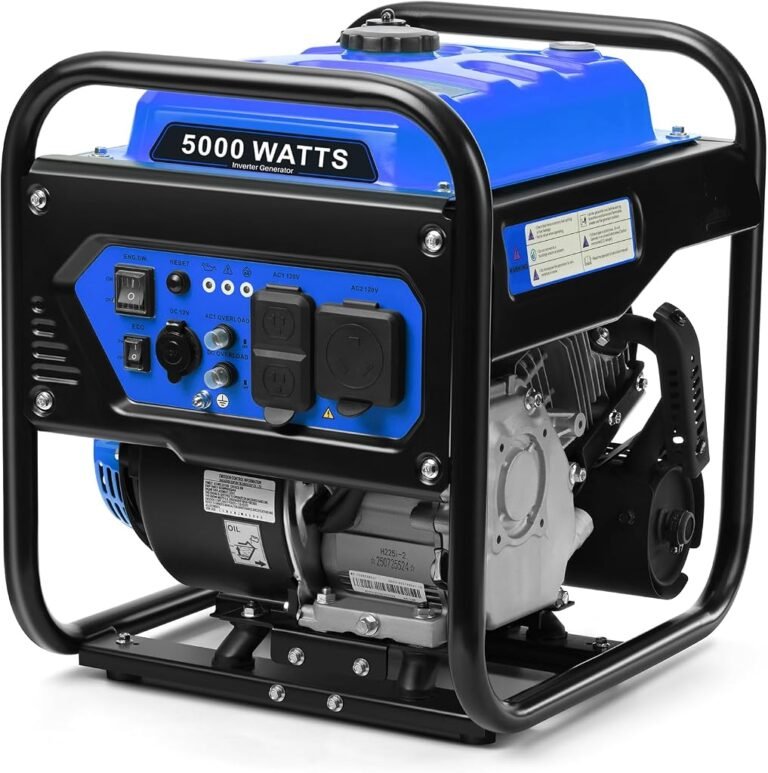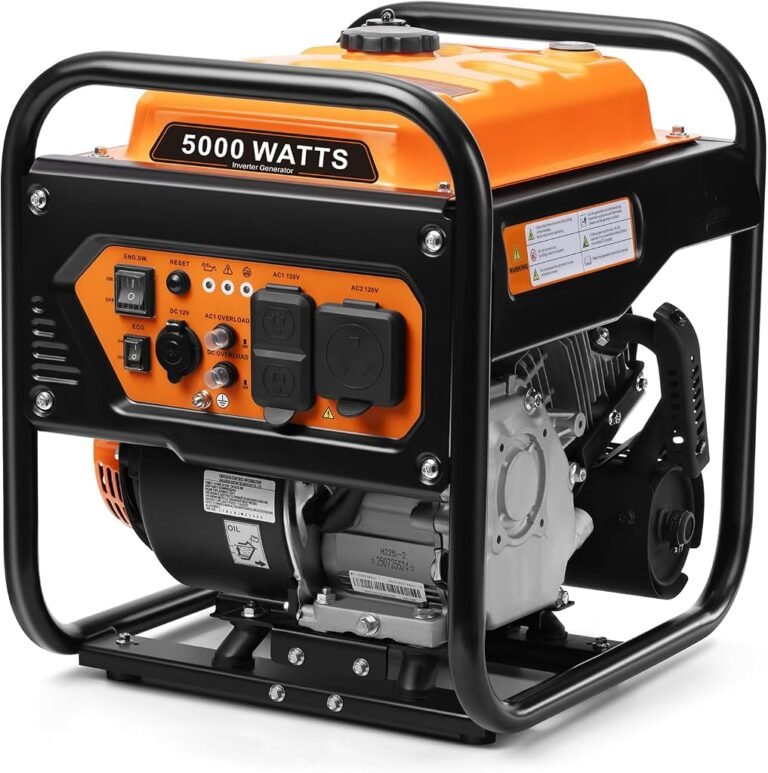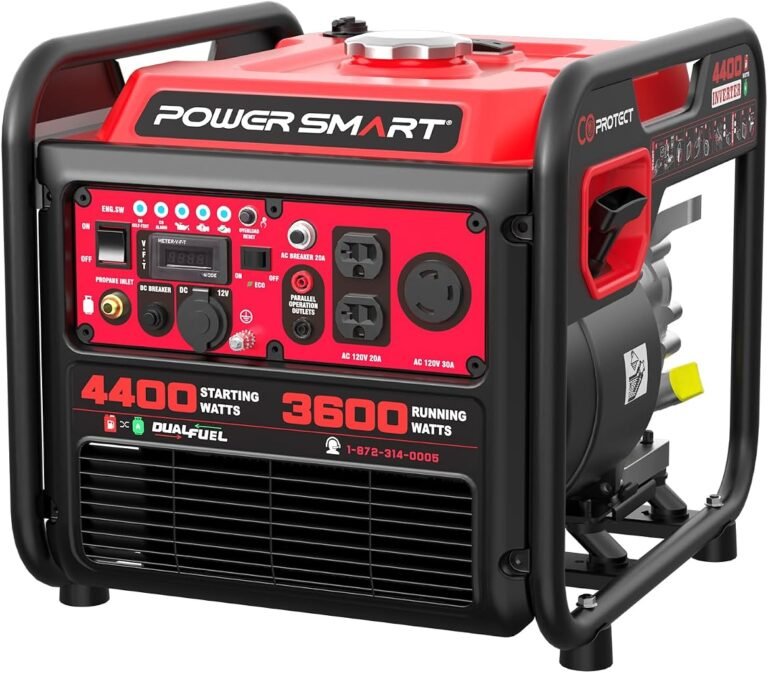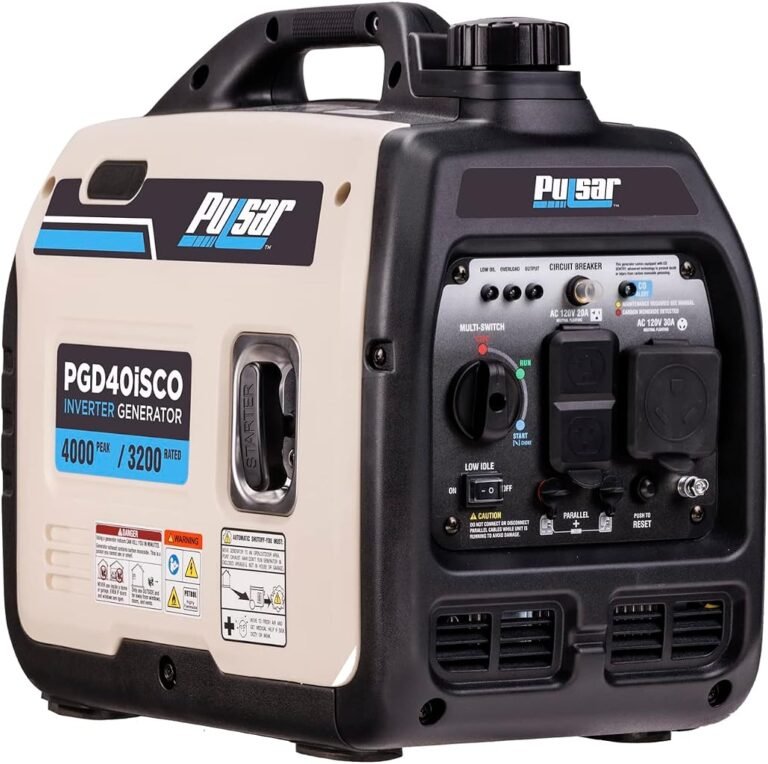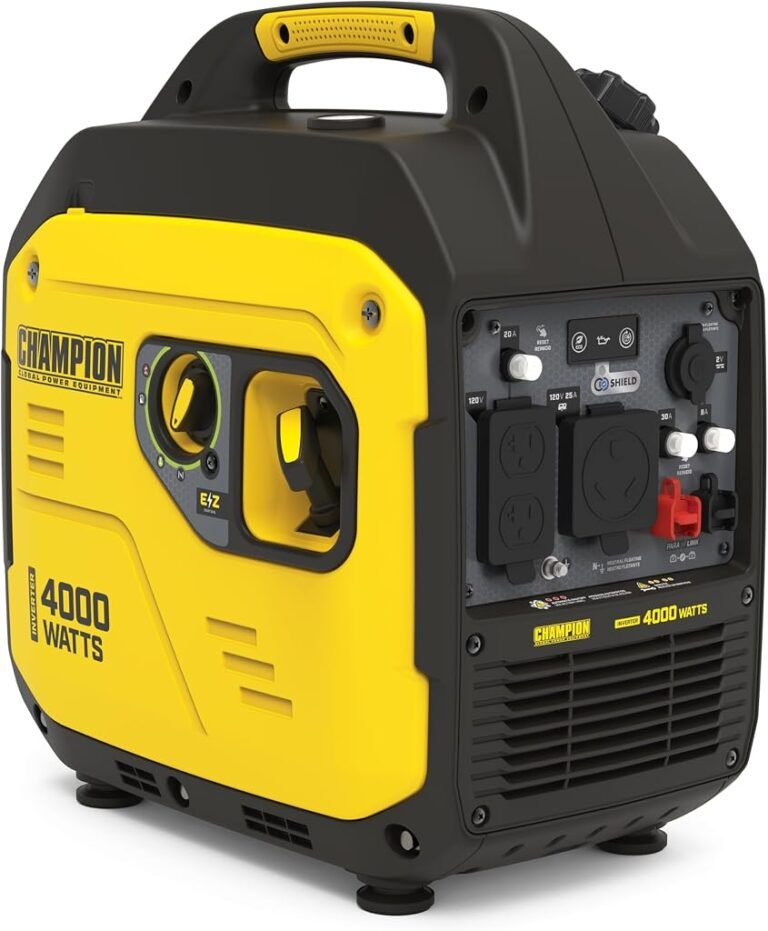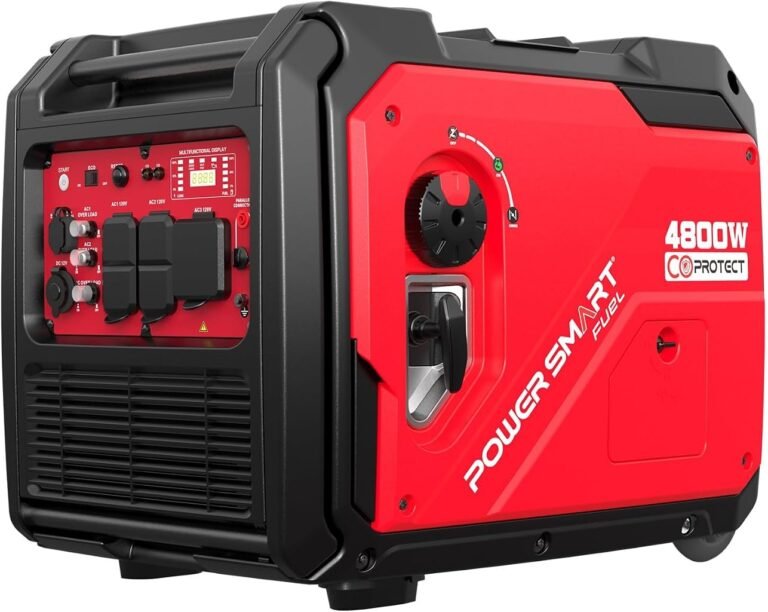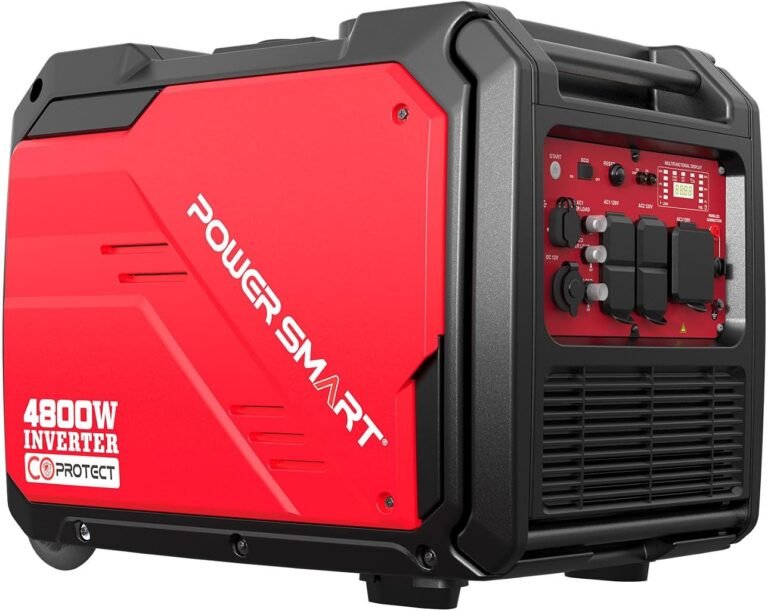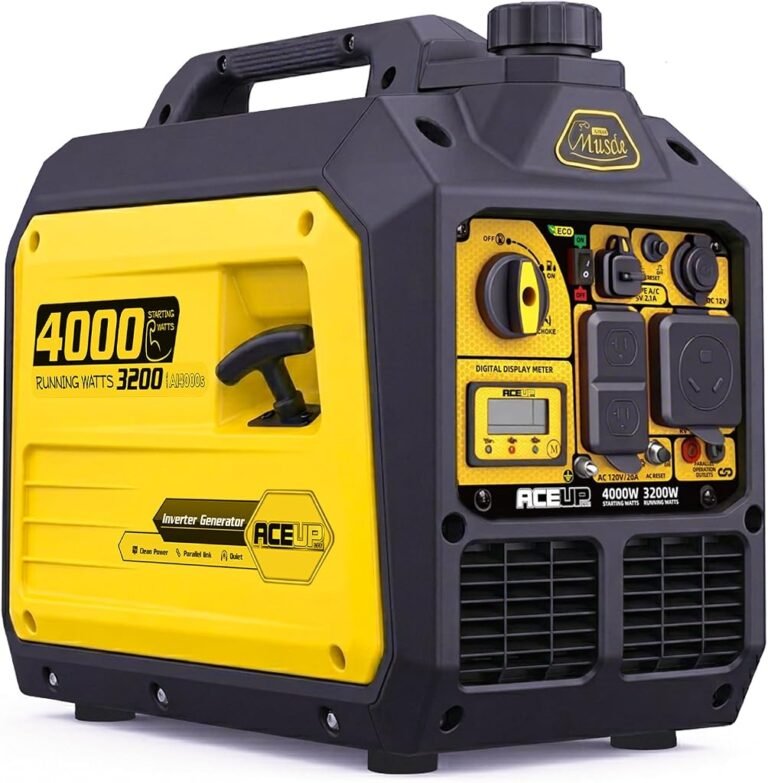
A 4,000-watt generator is large enough to matter during a power failure but still small enough to expose the limits of casual wattage shopping. It can keep selected household equipment running, support an RV, operate tools, or provide electricity at a campsite, yet it cannot imitate an unrestricted utility connection. The difference between those outcomes rests on a number that receives less attention than it deserves: running wattage.
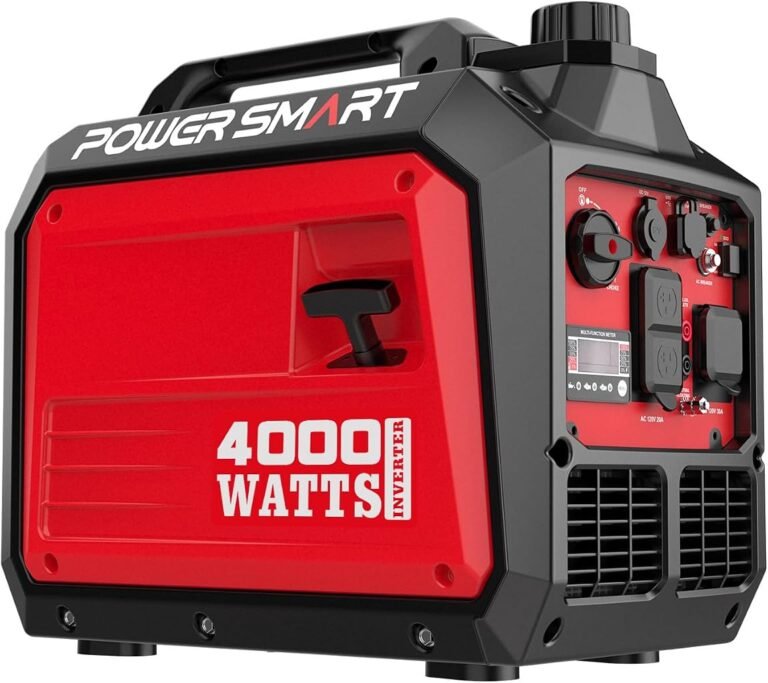
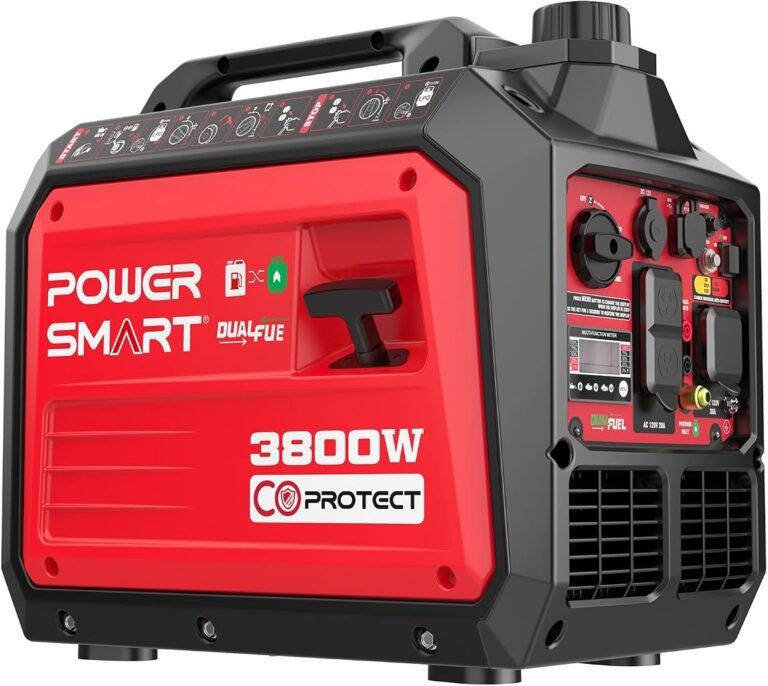
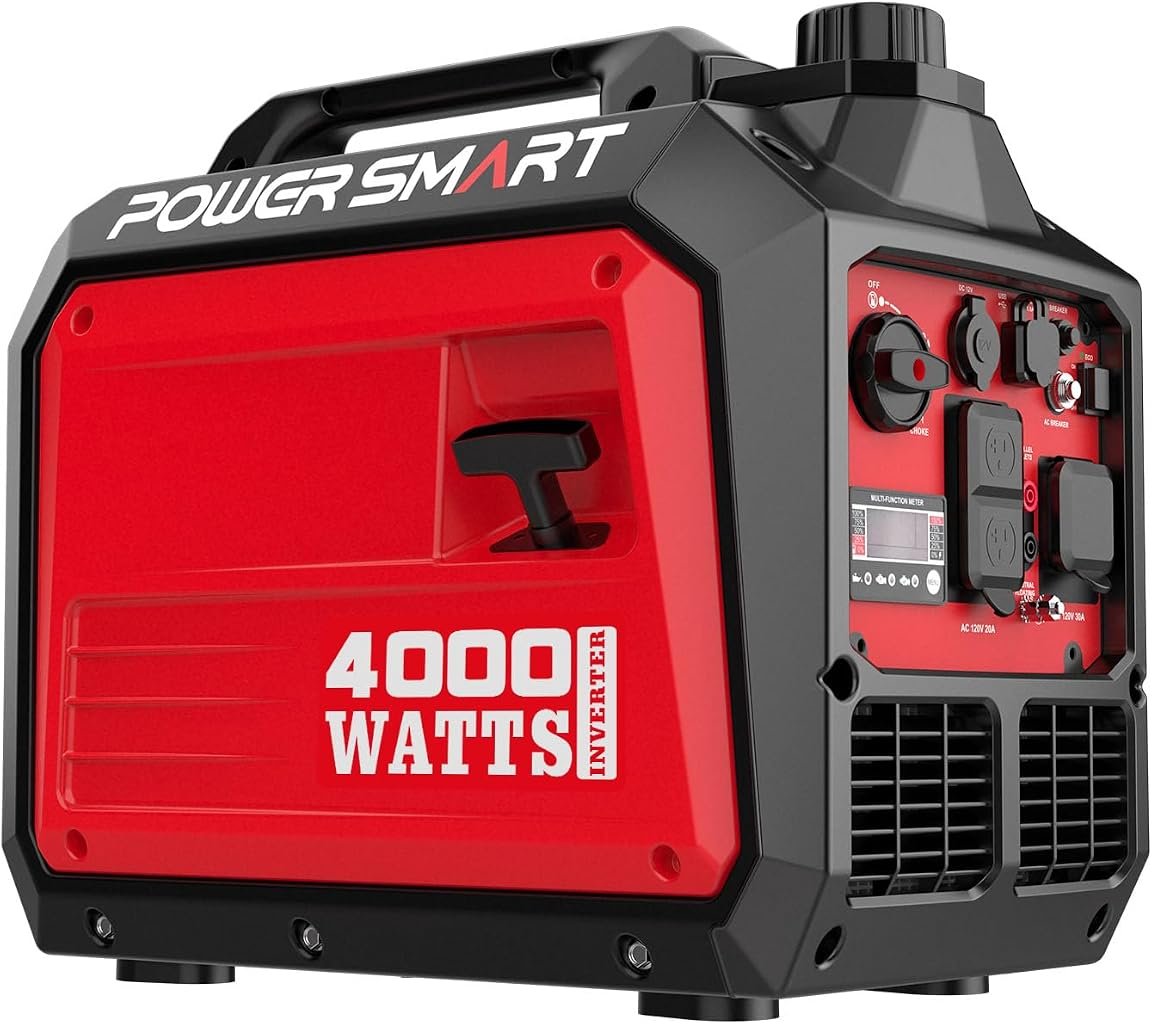
The PowerSmart DB5035 is rated at 4,000 starting watts and 3,200 running watts. Power comes from a 149cc four-stroke gasoline engine, with a 1.3-gallon fuel tank, recoil starting, Eco Control, parallel capability, 120V AC connections, 12V DC output, USB connectivity, a multifunction meter, low-oil shutdown, and overload protection. PowerSmart currently identifies the DB5035 as its 4,000W inverter gasoline generator, specifying up to eight hours of runtime at 25% load and 4.5 hours at 50% load.
Our score is 8.71/10. Customer Sentiment is 8.5, Buyer Confidence reaches 9.8, and Value stands at 8.28. Those figures describe a generator with an unusually coherent specification package for moderate portable power, while leaving room for criticism around gasoline-only operation, recoil starting, a small fuel tank, 120V-only output, and a published 70 dBA noise level.
At a reference price of $399.99, the DB5035 sits in a competitive part of the inverter-generator market. Its case depends less on the 4,000-watt headline than on whether 3,200 sustained watts, RV-ready 30A connectivity, and compact gasoline operation match the buyer’s actual electrical needs.
The Real Generator Is Rated at 3,200 Watts
Peak output dominates generator naming conventions because the larger number is easier to market. Electrical planning needs the smaller one.
The DB5035 provides 4,000 starting watts and 3,200 running watts.
Starting capacity exists to absorb temporary demand when motors and compressors switch on. Refrigerators, freezers, pumps, air conditioners, and certain tools can draw considerably more power during startup than during steady operation.
Once the startup event passes, the generator must carry the sustained load.
That makes 3,200 watts the practical electrical budget.
A carefully managed 3.2kW supply can keep meaningful household equipment operating. Refrigeration, lights, networking equipment, televisions, laptops, chargers, a furnace blower, and selected kitchen appliances can fit within that budget depending on their individual ratings and which devices operate simultaneously.
The limitations appear quickly with resistance heating and large appliances.
A 1,500-watt portable heater can consume almost half the generator’s running capacity by itself. Add a microwave, refrigerator compressor, and several smaller loads, and the available margin narrows sharply.
This is why a generator should be sized from an appliance list rather than a product name.
The DB5035 is not a 4kW continuous generator. Treating it as one invites overloads and disappointment.
A 149cc Engine Keeps the Generator Relatively Compact
The DB5035 uses a 149cc four-stroke gasoline engine. PowerSmart specifies SAE 5W-30 oil and a 16.2-fluid-ounce oil capacity.
That displacement makes sense for the output class.
Large home-backup generators commonly use engines several times larger because they must support far greater continuous loads. A 149cc engine allows the PowerSmart to remain closer to recreational-generator scale while still supplying more than 3kW continuously.
The smaller engine does not eliminate maintenance.
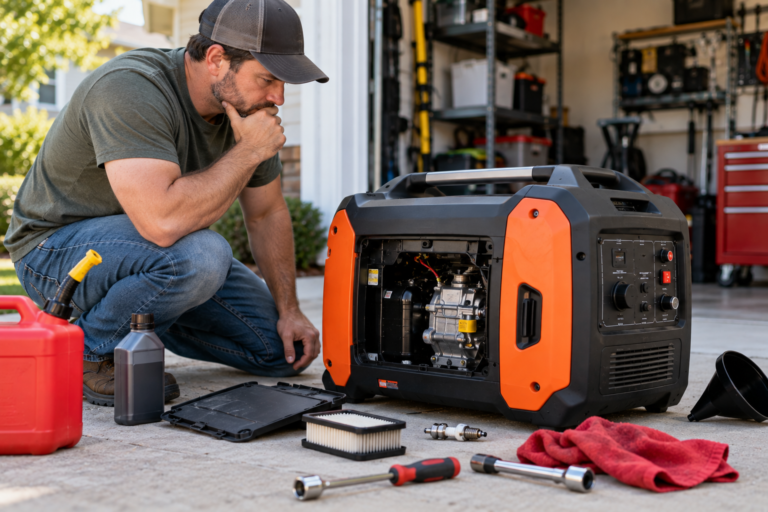
This remains a gasoline combustion machine. Oil needs checking and changing according to the manufacturer’s schedule. The air intake and spark plug require attention. Fuel condition matters during storage. A generator that spends months waiting for an outage still needs preparation before the outage arrives.
That distinction matters when comparing the DB5035 with a portable battery station.
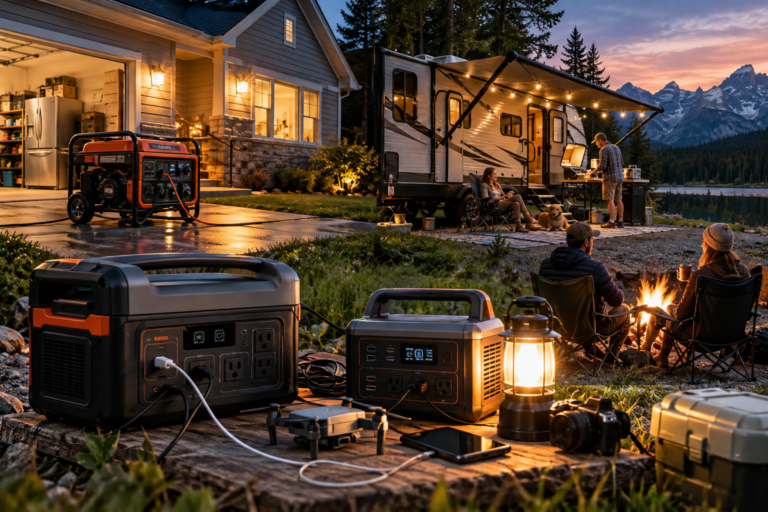
Battery systems avoid gasoline, engine oil, exhaust, carburetors, and combustion maintenance. Fuel generators trade that simplicity for rapid energy replenishment. A gasoline container can restore hours of operating capability in minutes, whereas a discharged battery needs a charging source and time.
The PowerSmart belongs firmly on the combustion side of that exchange.
The 1.3-Gallon Tank Rewards Moderate Loads
Fuel capacity is 1.3 gallons. PowerSmart publishes up to eight hours of runtime at 25% load and 4.5 hours at 50% load.
Half of the generator’s 3,200-watt running capacity is 1,600 watts.
At that level, the manufacturer’s 4.5-hour figure describes a useful but not enormous operating window. Quarter load is 800 watts, where the published runtime extends to eight hours.
The contrast illustrates how strongly load affects generator endurance.
A refrigerator cycling periodically, a router, several lights, and charging electronics create a very different fuel demand from a space heater, microwave, coffee maker, and other high-wattage appliances running frequently.
This is where Eco Control earns its place.
PowerSmart says the system adjusts output according to power demand. Inverter architecture allows the generator to respond more intelligently to lighter loads than a basic fixed-speed design.
The practical benefit is not magical fuel creation. It is avoiding unnecessary engine activity when electrical demand is low.
A 1.3-gallon tank still creates a logistical limitation during prolonged outages. A household expecting several days without utility power needs a safe gasoline-storage and refueling strategy.
For shorter interruptions, RV use, or intermittent operation, the smaller tank helps preserve a more manageable physical package.
Inverter Architecture Is Central to the Product’s Appeal
The DB5035 is an inverter generator rather than a conventional open-frame alternator design.
That distinction affects how it produces AC electricity and how the engine can respond to changing loads.
Inverter generators generate electrical power, convert it through electronic circuitry, and reconstruct AC output. This architecture permits more flexible engine-speed management than traditional designs tied directly to output frequency.
For buyers powering modern household electronics, that design is attractive.
Homes now contain routers, laptops, televisions, appliance control boards, battery chargers, game systems, communications equipment, and other electronically controlled devices. Emergency electricity is no longer primarily about incandescent lamps and simple motors.
PowerSmart positions the DB5035 for household, RV, and outdoor equipment, and its combination of inverter architecture and Eco Control fits that purpose.
There is still a distinction between saying a generator uses inverter technology and claiming a specific waveform or harmonic-distortion performance that has not been published for this model. The editorial case does not need an invented number. The architecture itself is documented.
120V Output Defines the Electrical Boundary
The DB5035 provides one 120V 20A AC outlet and one 120V 30A outlet, along with a 12V DC connection and USB capability. It is also parallel-ready.
The 30A connection makes the generator particularly relevant to compatible RV applications.
The absence of 240V output matters just as much.
A household can have enough generator wattage in theory and still be unable to operate equipment requiring a voltage the generator does not provide. Certain pumps, HVAC equipment, workshop machinery, electric dryers, water heaters, and other appliances may require 240V.
The DB5035 is fundamentally a 120V machine.
That makes it well suited to individual household appliances, recreational equipment, and selected backup loads. It makes it unsuitable for buyers whose emergency plan depends on 240V circuits.
Voltage should therefore appear near the beginning of any portable generator buying guide.
Peak wattage tells only part of the story. Voltage determines whether some loads are electrically compatible in the first place.
Parallel Capability Creates an Expansion Path
PowerSmart makes the DB5035 parallel-ready. A compatible second generator can be connected using the appropriate parallel equipment to increase available output.
That creates an interesting alternative to buying one much larger generator.
A buyer whose ordinary requirements fit comfortably within 3,200 running watts can retain the smaller machine’s portability for most uses while preserving an expansion path for higher-demand situations.
Parallel operation also introduces cost and complexity.
Two generators mean two engines, two fuel systems, additional maintenance, more storage space, and appropriate connection hardware. Parallel capability should therefore be viewed as flexibility rather than an automatic reason to buy two units.
For users whose needs permanently exceed the DB5035’s output, purchasing a correctly sized larger generator from the beginning may be simpler.
For buyers whose demand changes between camping, RV use, and occasional backup, modular capacity can be useful.
Recoil Starting Trades Convenience for Simplicity
The DB5035 uses recoil starting.
There is no starter battery to keep charged, replace, or diagnose after months in storage.
That simplicity has merit.
Emergency generators can spend long periods unused. Small starting batteries gradually discharge, and an electric-start generator with a neglected battery can surprise its owner when the utility fails.
Recoil starting removes that particular failure point.
It replaces it with physical effort.
A 149cc engine is far smaller than the 400cc- or 500cc-class engines found in high-output generators, but pull starting still requires movement and strength. Buyers with mobility limitations, shoulder problems, or reduced grip strength should treat the starting method as a serious usability consideration.
A generator’s electrical specifications matter little if the intended operator cannot start it comfortably.
The DB5035’s recoil system therefore fits buyers who prefer mechanical simplicity and accept manual starting. Those prioritizing push-button convenience should compare electric-start alternatives.
70 dBA Keeps the Noise Claim Grounded
PowerSmart specifies 70 dBA at 23 feet.
That figure deserves more attention than vague descriptions of an inverter generator as “quiet.”
Seventy decibels is not silence.
Actual perceived noise depends on load, distance, terrain, reflective surfaces, enclosure design, and the acoustic environment. Eco Control can reduce unnecessary engine activity during lighter demand, but the generator remains a gasoline engine producing mechanical and exhaust noise.
This distinction matters especially for camping.
An inverter architecture can improve operating behavior without turning every generator into an ultra-quiet suitcase unit. Buyers using the DB5035 near neighboring campsites or residential properties should consider placement and expected load rather than relying on the word “inverter” as an acoustic guarantee.
For emergency home backup, 70 dBA may be an acceptable exchange for 3,200 running watts.
For buyers whose first priority is very low noise, models with lower published sound specifications deserve comparison.
The Multifunction Meter Makes Energy Management Easier
PowerSmart includes a multifunction meter on the DB5035 control panel, alongside the Eco switch, DC breaker, and primary controls.
Instrumentation matters because generators are often operated by approximation.
Without useful feedback, an owner may know that several appliances are connected without understanding how close the system is to its operating limits or how long the machine has accumulated service hours.
A meter makes the generator less opaque.
That does not eliminate the need to know appliance wattages. It does make routine monitoring more practical, particularly when the generator moves between recreational and emergency uses.
For maintenance, operating-hour awareness is especially useful. Engine service schedules are linked to use, not merely calendar age.
Low-Oil Shutdown and Overload Protection Address Predictable Failures
PowerSmart specifies low-oil shutdown and overload protection for the DB5035.
Both systems address common risks.
Low oil can damage an engine rapidly. Automatic shutdown provides a layer of protection if the oil level falls below the machine’s operating threshold.
Overload protection addresses the electrical side.
A 3,200-running-watt generator invites load stacking because individual household appliances often appear modest in isolation. A refrigerator, microwave, coffee maker, heater, television, and lighting can collectively push the machine beyond its intended continuous capacity.
Protection circuitry is useful, but disciplined load management remains preferable to repeatedly testing the protection system.
A circuit breaker or shutdown feature is a safety mechanism, not a wattage-expansion device.
Carbon Monoxide Is the Generator’s Most Serious Limitation
The DB5035 burns gasoline. That fact imposes a safety boundary no inverter circuitry can change.
The U.S. Consumer Product Safety Commission says more than 100 U.S. deaths each year are linked to portable generators through carbon-monoxide exposure and states that one portable generator can produce the same amount of CO as hundreds of cars.
CPSC’s guidance is direct: portable generators should be operated outdoors only, at least 20 feet from homes, with exhaust facing away. It specifically warns against operation inside homes or garages even when doors and windows are open.
The historical toll gives that guidance context. CPSC estimated that about 750 people died from generator-associated CO poisoning from 2012 through 2022.
That risk fundamentally separates the DB5035 from battery power stations.
The PowerSmart cannot be brought into a living room because rain is falling outside. It cannot safely operate in a garage because the garage door is open. It cannot be moved into a shed simply to reduce noise.
Safe placement is part of ownership.
A household operating a combustion generator should also maintain functioning carbon-monoxide alarms. The generator should be shut down and allowed to cool before refueling, and gasoline should be stored in approved containers away from ignition sources.
Household Connections Need Electrical Discipline
At 3,200 running watts and 120V, the DB5035 is more naturally suited to individual appliance connections and compatible RV use than to broad whole-house integration.
The electrical safety principles remain the same.
The Electrical Safety Foundation International warns against connecting a generator directly to household wiring without an appropriate transfer switch. Such connections can backfeed electricity onto power lines and expose utility workers to electrocution hazards. ESFI also recommends properly rated three-prong extension cords and qualified electrical installation for home generator systems.
For many DB5035 owners, heavy-duty outdoor-rated extension cords connected directly to selected appliances will be the simpler arrangement.
Cord capacity still matters.
A generator may produce adequate wattage while an undersized extension cord overheats under the electrical load. Length also affects voltage drop. The cable needs to be rated for the current it carries and for outdoor use.
The weakest component in an emergency electrical system can define the safety of the entire arrangement.
Gasoline-Only Operation Narrows Fuel Flexibility
The DB5035 runs on gasoline.
That simplicity avoids the regulators, hoses, selectors, and fuel-specific output figures associated with dual-fuel machines.
It also creates dependence on one fuel.
Gasoline requires storage management. It ages, needs approved containers, and must be kept away from ignition sources. During widespread outages, filling stations can face shortages, long queues, or their own electrical problems.
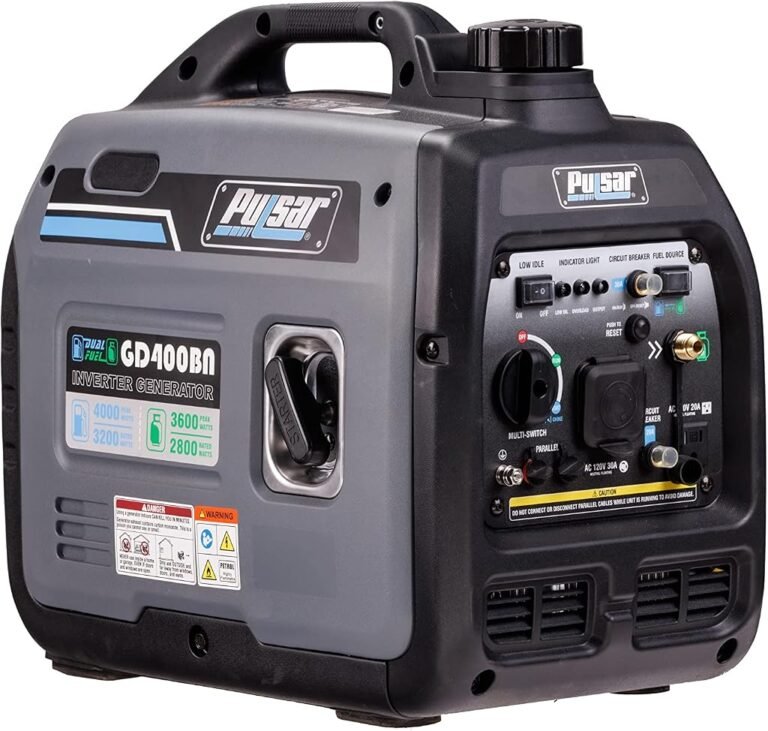
Propane-capable generators give owners another stored-energy option.
The DB5035 does not.
Whether that matters depends on the emergency plan. For occasional recreational use or brief outages, gasoline-only operation may be perfectly reasonable. For households planning around extended storm-related failures, fuel diversity can carry greater value.
That limitation helps explain why our Value rating does not rise as high as Buyer Confidence.
What the Editorial Scores Mean
Our overall score is 8.71/10.
The DB5035 earns that rating through a balanced combination of 3,200 running watts, inverter architecture, RV-ready 30A output, Eco Control, parallel capability, useful monitoring, manageable engine displacement, and established safety systems.
Buyer Confidence is 9.8, the strongest score. PowerSmart publishes a detailed specification set for the model, including engine displacement, peak and running output, runtime, fuel capacity, noise, outlets, oil requirements, starting method, safety systems, and certification. The company’s current generator catalog also identifies the DB5035 as its 4,000W inverter offering.
Customer Sentiment is 8.5. The ownership proposition is less effortless than the technical package. Recoil starting, gasoline storage, engine maintenance, 70 dBA published noise, a 1.3-gallon tank, and outdoor-only operation all impose practical compromises.
Value is 8.28. At $399.99, the DB5035 combines meaningful inverter output with RV connectivity and parallel capability, but buyers in this price range can also compare dual-fuel machines, electric-start alternatives, and lower-noise models. The value is strongest when its particular mix of output and portability matches the intended load.
The gap between 9.8 Buyer Confidence and 8.28 Value is therefore logical. The generator itself presents a convincing technical package. The purchasing equation becomes more selective once fuel flexibility, noise, starting method, and voltage enter the comparison.
Who the DB5035 Fits
The PowerSmart DB5035 is most coherent for users whose electrical requirements fit comfortably inside 3,200 sustained watts.
Likely applications include:
- refrigerator and freezer backup;
- lights, routers, televisions, computers, and charging equipment;
- selected kitchen appliances with disciplined load management;
- compatible RV electrical systems;
- camping where a 70 dBA published noise figure is acceptable;
- temporary tool use within startup and running limits;
- households wanting inverter generation without moving to a substantially larger machine;
- users who value parallel expansion capability.
The weaker fit is equally identifiable.
Homes requiring 240V equipment need another generator. Buyers wanting propane flexibility need a dual-fuel model. Users with physical limitations may prefer electric starting. Households needing indoor electricity should choose battery storage rather than combustion generation.
A property requiring several large appliances simultaneously needs more than 3,200 running watts.
The DB5035 works best when buyers resist the temptation to make it perform a job belonging to a larger generator.
A Portable Generator Buying Guide for the 4,000W Class
A useful portable generator buying guide should translate the product name into operational limits.
For the PowerSmart DB5035, buyers should examine:
- Running output: 3,200 watts determines sustained capacity.
- Starting output: 4,000 watts provides temporary surge headroom.
- Engine: the 149cc four-stroke gasoline engine requires normal engine maintenance.
- Fuel: gasoline-only operation simplifies the fuel system while eliminating propane flexibility.
- Tank capacity: 1.3 gallons keeps the package relatively compact but limits extended high-load operation.
- Runtime: PowerSmart publishes 4.5 hours at 50% load and up to eight hours at 25%.
- Voltage: 120V output means the generator is not suitable for 240V equipment.
- Connections: one 120V 20A outlet, one 120V 30A outlet, 12V DC, and USB cover several recreational and backup uses.
- Starting: recoil operation avoids starter-battery maintenance but requires physical effort.
- Noise: PowerSmart publishes 70 dBA at 23 feet.
- Eco Control: engine behavior can respond to changing demand.
- Parallel capability: compatible equipment can expand available generator capacity.
- Monitoring: the multifunction meter assists with operating oversight.
- Protection: low-oil shutdown and overload protection are included.
- Certification: PowerSmart lists EPA certification.
- Warranty: the current product listing provides a two-year warranty.
That list demonstrates why the 4,000-watt badge alone cannot determine suitability.
The better question is whether 3,200 continuous watts at 120V, supplied by gasoline through a recoil-start inverter generator, match the actual job.
Final Considerations
The PowerSmart 4000W Portable Inverter Generator earns our 8.71/10 rating by putting a useful amount of sustained electricity into a relatively straightforward gasoline inverter platform.
Its meaningful specification is 3,200 running watts rather than the 4,000-watt starting figure. A 149cc four-stroke engine, 1.3-gallon tank, Eco Control, RV-ready 30A output, 120V household connection, 12V DC, USB, parallel capability, multifunction monitoring, overload protection, and low-oil shutdown create a capable package for moderate backup and recreational power.
Its limits are equally concrete.
Gasoline is the only fuel. Recoil starting requires physical effort. The generator does not provide 240V output. PowerSmart’s 70 dBA specification means buyers should not equate inverter architecture with silence. At 50% load, the published 4.5-hour runtime also means prolonged outages require deliberate fuel planning.
Carbon monoxide imposes the strictest operating boundary. CPSC’s guidance places combustion generators outdoors only and at least 20 feet from homes, with exhaust directed away. That requirement remains unchanged by weather, convenience, noise concerns, or the modest physical scale of the machine.
Those trade-offs explain the scoring. Buyer Confidence at 9.8 reflects a well-defined specification package and a clear use case. Customer Sentiment at 8.5 acknowledges that gasoline-generator ownership brings maintenance, noise, storage, and safety obligations. Value at 8.28 reflects a competitive but not universally dominant proposition at $399.99.
The DB5035 makes the most sense when the buyer already knows that 3,200 running watts are sufficient. In that setting, its combination of inverter architecture, 30A RV connectivity, Eco Control, and parallel capability gives the generator a useful degree of flexibility without moving into the weight and fuel consumption of high-output home-backup machines.
It makes less sense when purchased as an abstract insurance policy against every possible electrical demand. A 120V generator cannot power 240V equipment simply because spare wattage remains. A 3.2kW running ceiling cannot support unlimited simultaneous appliances. A 1.3-gallon tank cannot provide high-load electricity indefinitely.
Those are not obscure deficiencies. They define the machine.
The PowerSmart DB5035 succeeds when treated as a moderate-output inverter generator rather than a miniature utility grid. For refrigeration, communications, selected appliances, RV use, tools, and carefully managed emergency loads, 3,200 running watts can accomplish a surprising amount of useful work.
That is where the 8.71/10 assessment ultimately lands: a technically coherent 4,000-starting-watt generator whose strongest qualities emerge when the owner plans around the 3,200-watt reality underneath the label.