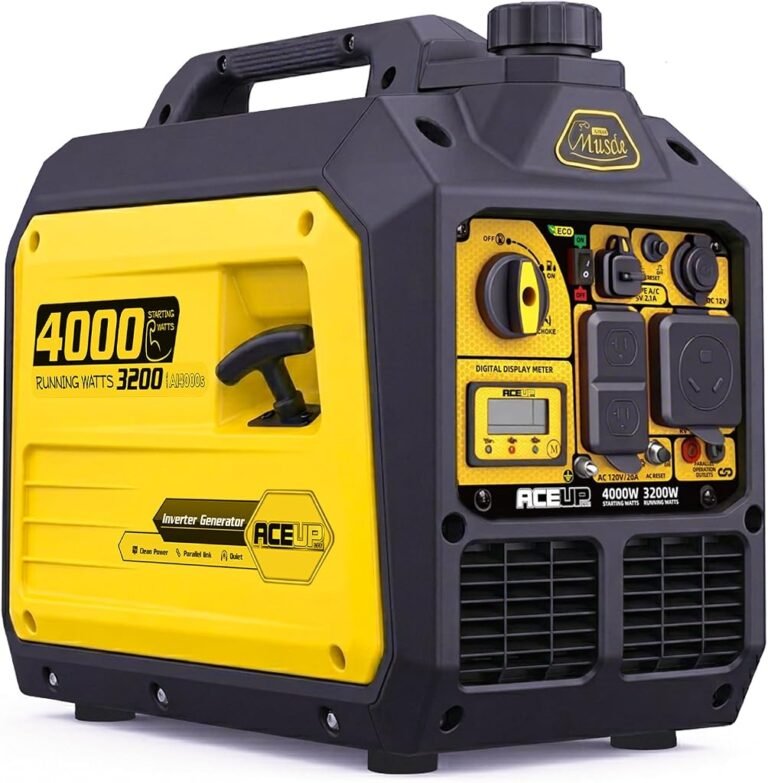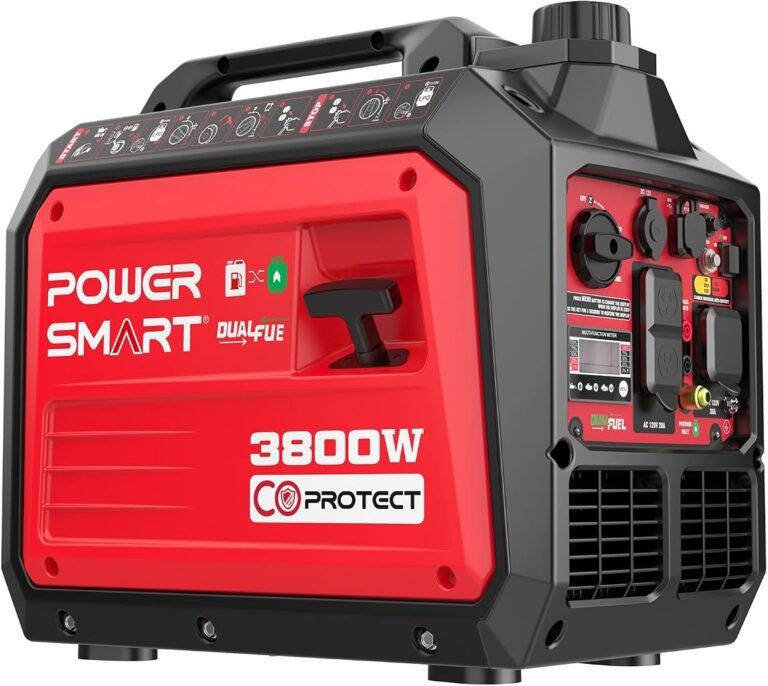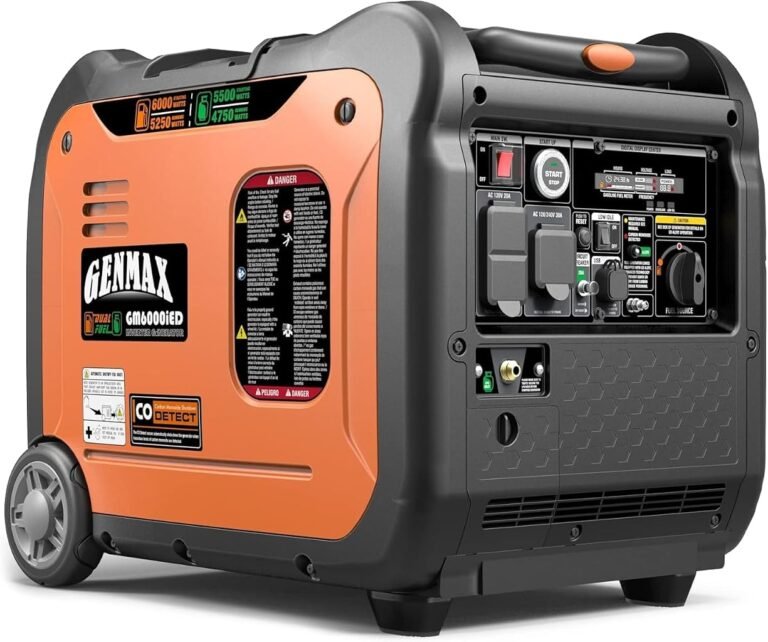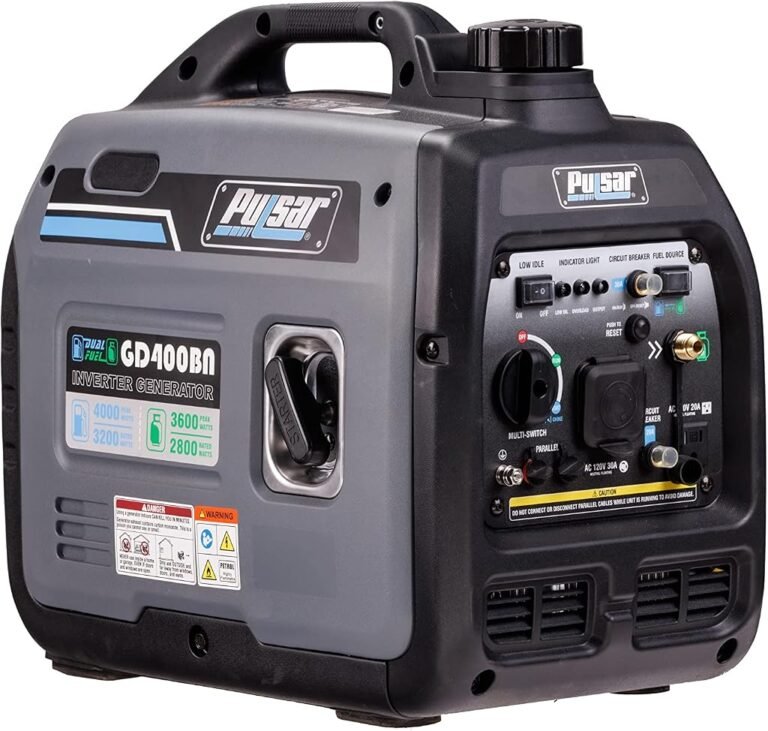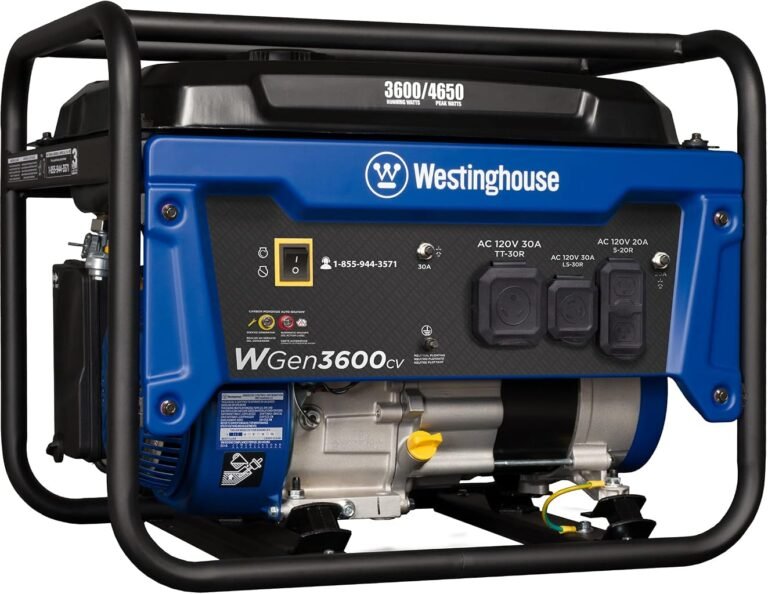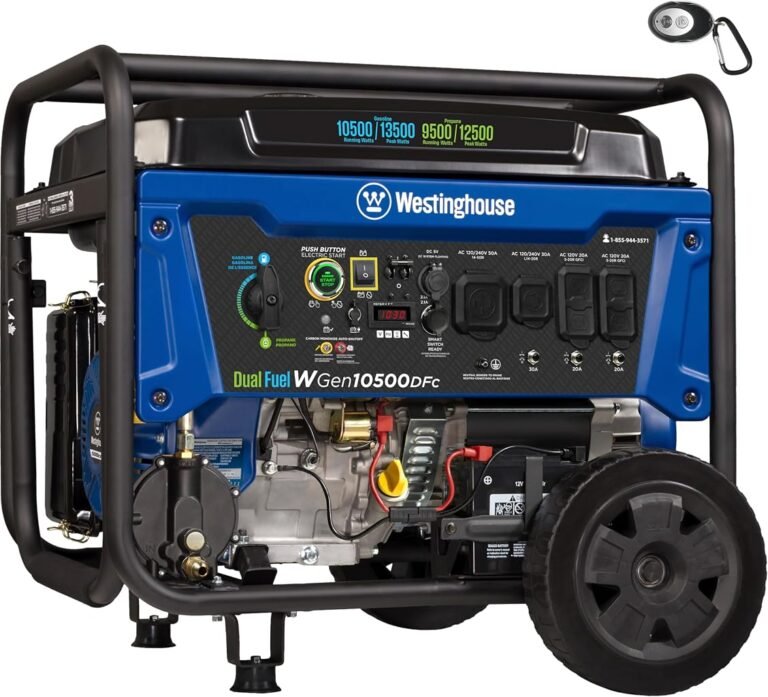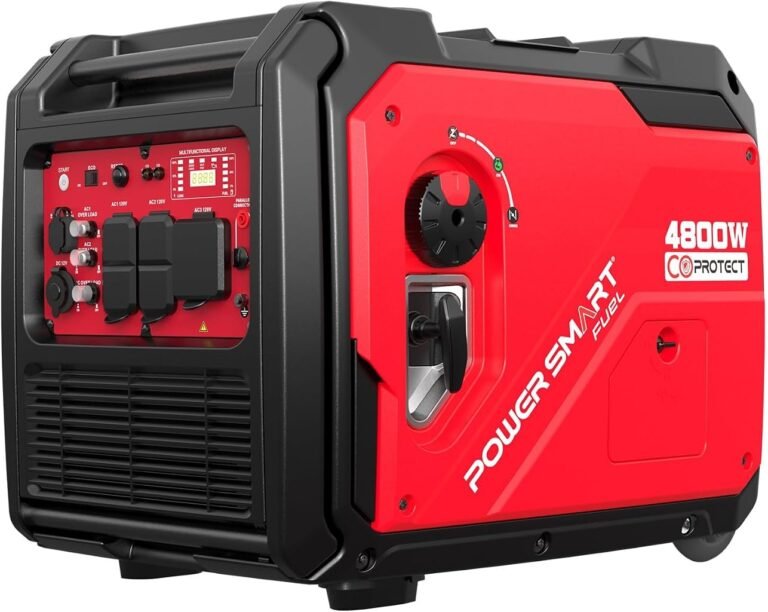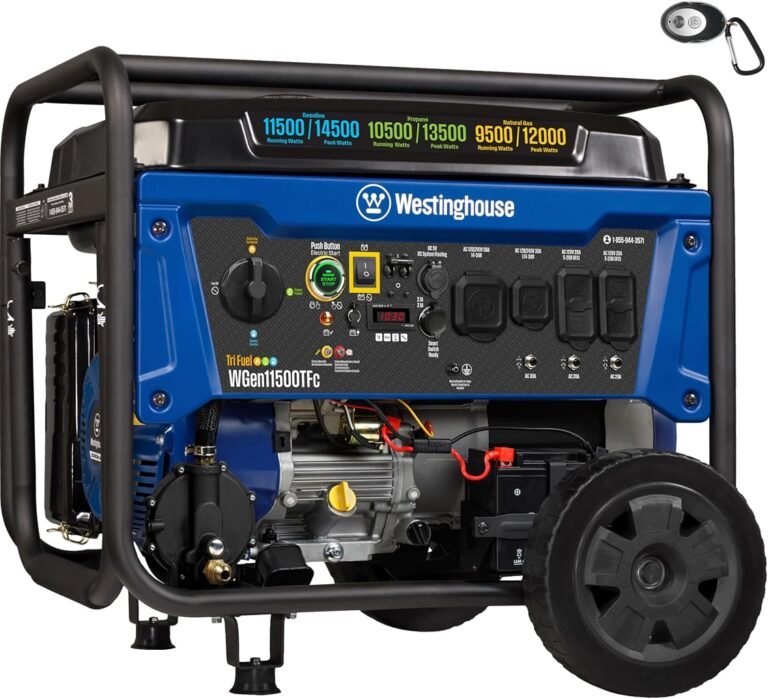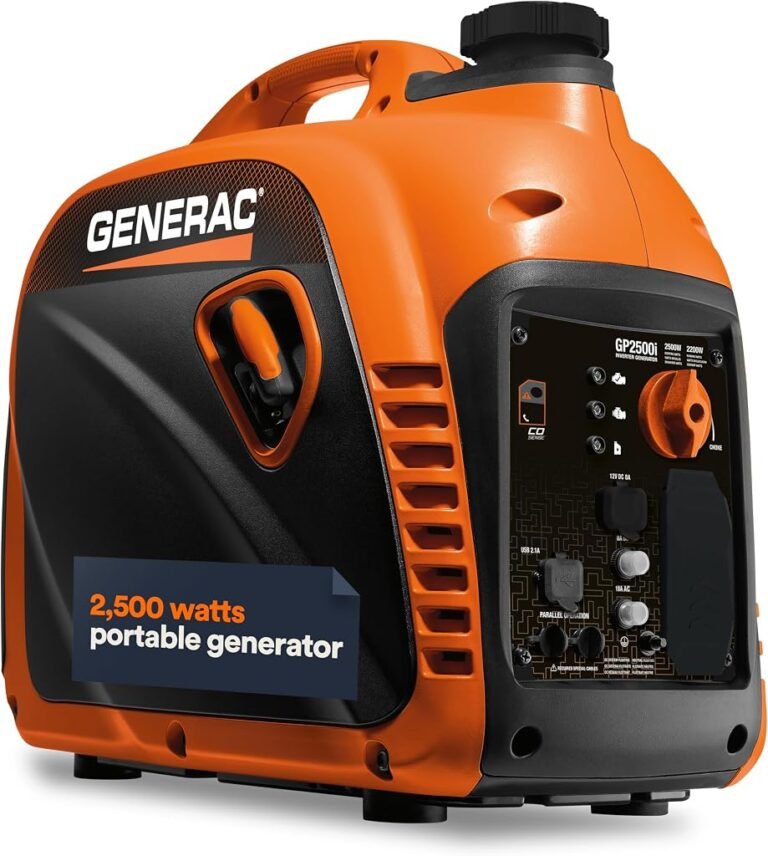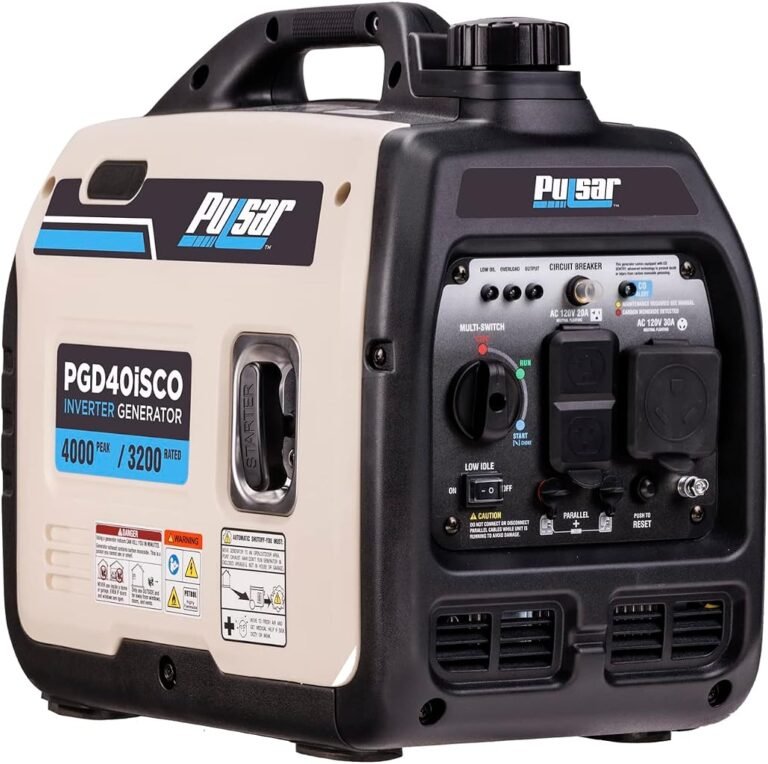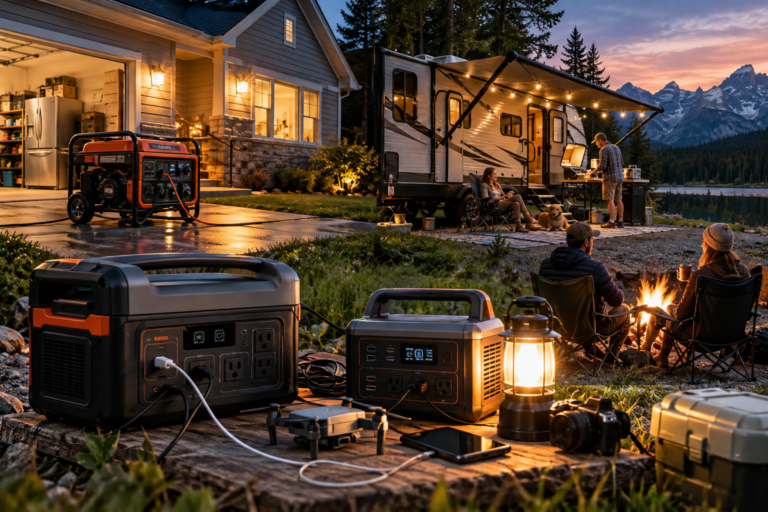
Portable generators are frequently judged by the largest number printed on the housing. That approach is convenient, memorable and incomplete. Peak wattage describes only a brief part of a generator’s capability. Sustained output, fuel consumption, electrical quality, noise, weight, receptacle selection and safety systems determine whether the machine actually fits an RV, campsite or emergency-power plan.
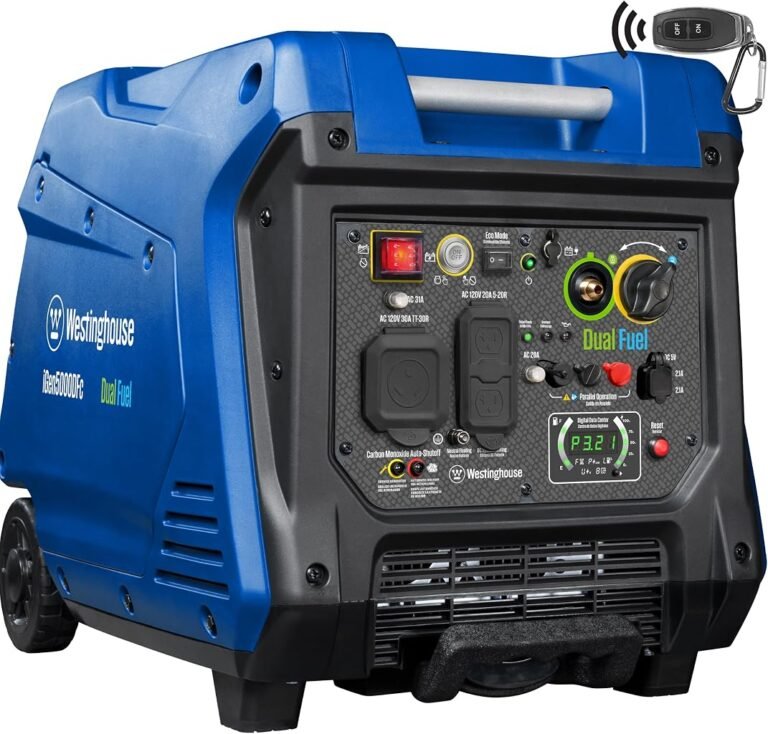
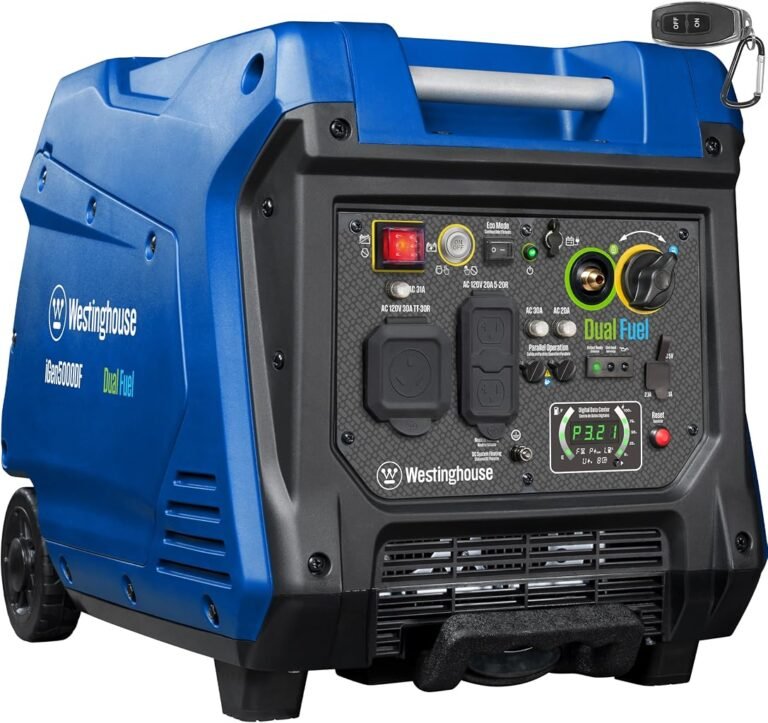
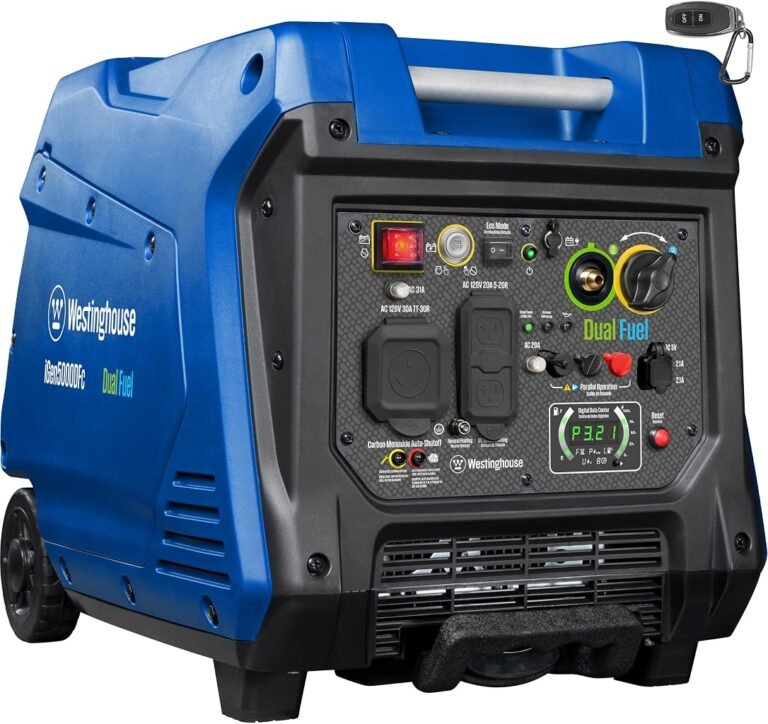
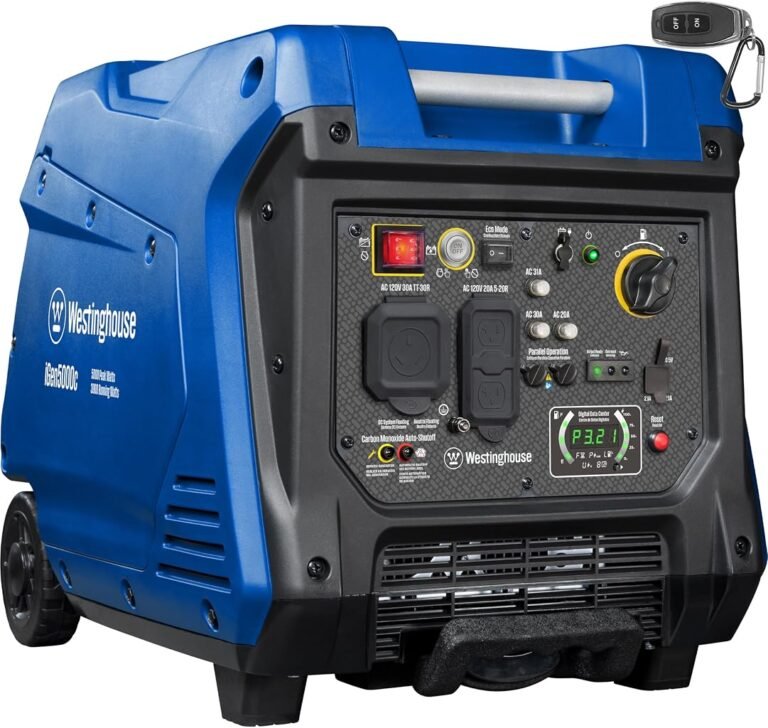
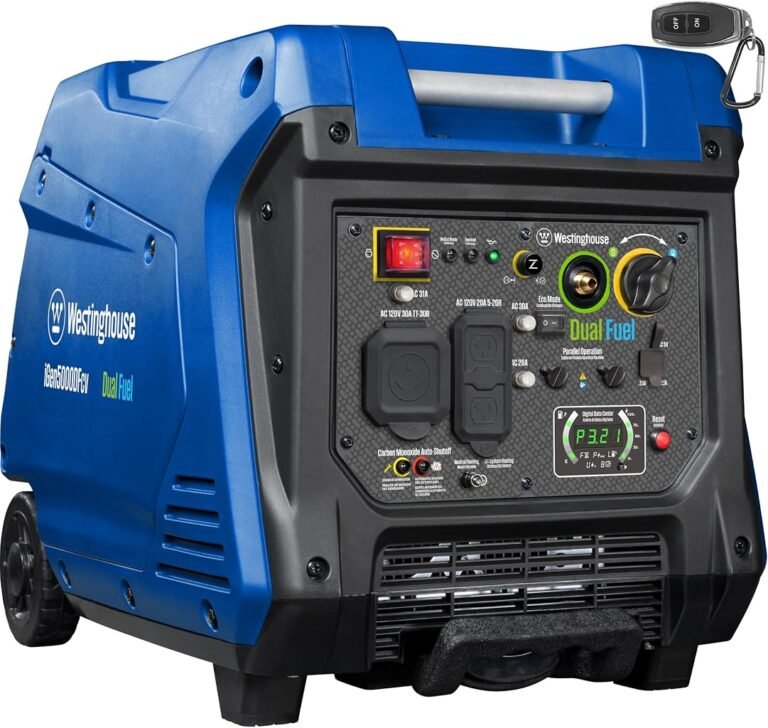
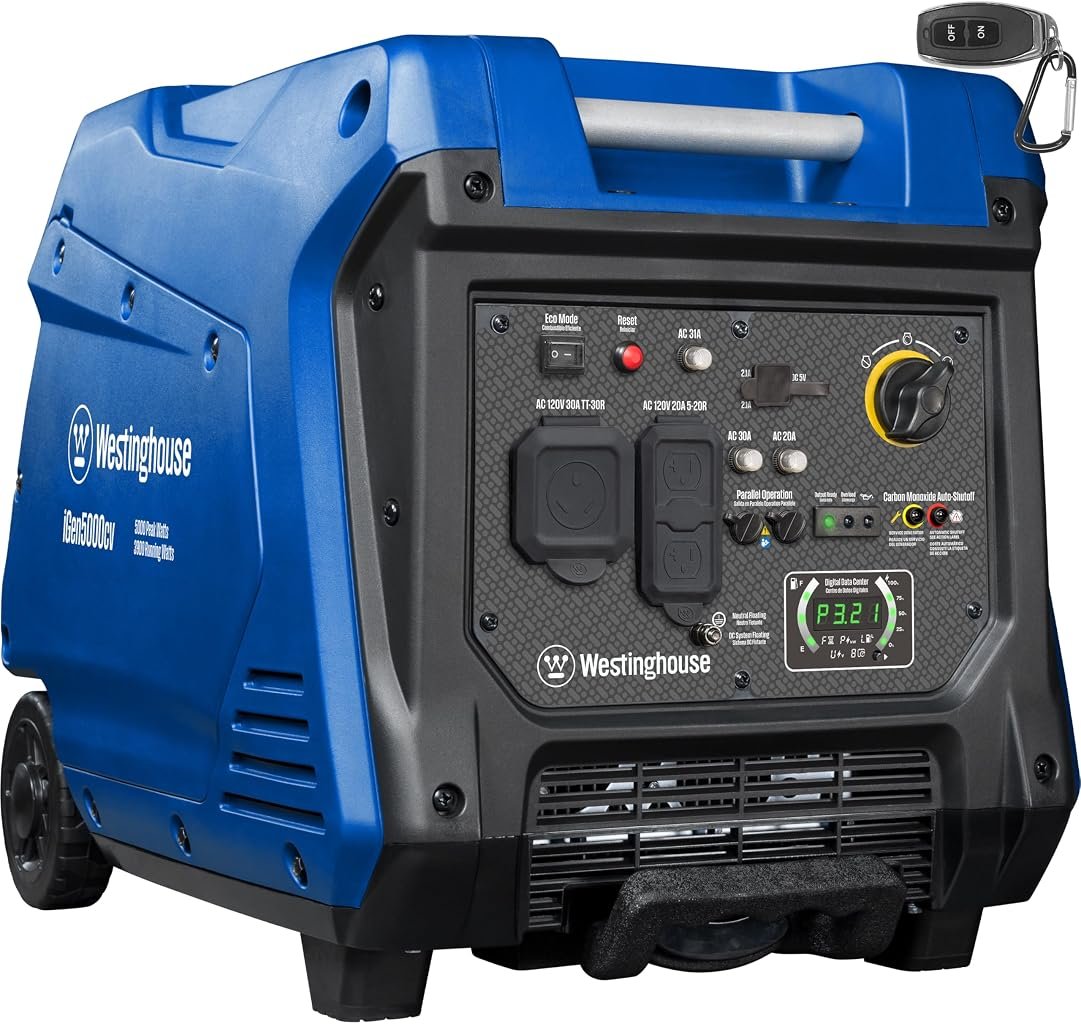
The Westinghouse 5000 Peak Watt Gas Inverter Generator examined here is the iGen5000cv, a gasoline-powered inverter model built around a 224cc four-stroke engine. According to Westinghouse’s iGen5000cv specifications, it produces 5,000 peak watts and 3,900 running watts at 120 volts, carries 3.4 gallons of gasoline, can run for up to 18 hours at 25% load and produces less than 3% total harmonic distortion. The generator also incorporates a TT-30R RV outlet, two 20A household outlets, USB connections, wheels, an extendable handle and automatic carbon-monoxide shutdown.
Those specifications describe a machine positioned between compact camping generators and larger conventional backup units. Its 3,900-watt sustained rating gives it noticeably more electrical breathing room than common 3,000-to-3,200-running-watt inverter generators, yet the design remains focused on 120V applications rather than large 240V household equipment.
Our score is 8.62/10. Customer Sentiment stands at 8.72, Buyer Confidence is 8.62 and Value reaches 8.4. At the approximately $799 review price, the Westinghouse makes its strongest argument through its combination of sustained output, long published runtime, RV connectivity and inverter-quality electricity.
It is not without compromises. At 104.7 pounds, this is portable largely because Westinghouse gives it wheels and a telescoping handle. Recoil starting is less convenient than electric or remote starting. Gasoline-only operation lacks the fuel redundancy of dual-fuel models. And despite the 5,000-watt headline, 3,900 watts remain the number that should govern serious load planning.
Five Thousand Watts Is the Beginning of the Calculation
The difference between peak and running output deserves immediate attention.
Westinghouse rates the iGen5000cv for 5,000 starting watts and 3,900 running watts. Its owner’s manual specifies 120V, 60Hz, single-phase output and total harmonic distortion of no more than 3%.
Peak watts provide temporary capacity for startup demand. Running watts describe sustained rated output.
The distinction matters because appliances containing compressors and motors can require additional electricity during startup. Refrigerators, freezers, air conditioners, pumps and many tools may briefly draw considerably more than their normal operating consumption.
That means a buyer cannot simply add ordinary running wattages until the total reaches 3,900.
Starting requirements must also be considered.
A useful portable generator buying guide should therefore encourage buyers to create a load inventory before comparing machines. Each intended appliance needs a running-watt figure, and motor-driven equipment needs an appropriate starting-demand allowance. The largest likely simultaneous surge should then be compared with the generator’s available headroom.
The Westinghouse offers 1,100 watts between its rated and peak figures. That provides meaningful temporary capacity, but it does not eliminate the need for sequencing heavy loads.
The 224cc Engine Supports a Substantial 120V Power Budget
Westinghouse uses a 224cc engine in the iGen5000cv. The manufacturer’s documentation specifies gasoline with an octane rating of 87 to 93 and ethanol content no higher than 10%. The manual specifically excludes E15 and E85.
That engine supports 3,900 watts of rated output, equivalent to 32.5 amps at 120 volts by simple division.
This is a useful level of capacity for an inverter generator aimed at recreational and selective backup applications.
It gives an RV owner more margin than a 3,000-watt unit. It can also support a meaningful collection of household essentials during an outage, assuming the loads are selected carefully.
Yet 120V remains an important boundary.
Equipment requiring native 240V power falls outside this generator’s normal operating architecture. Large well pumps, certain central air-conditioning systems, electric ranges, clothes dryers and other 240V equipment cannot simply be treated as smaller versions of ordinary 120V appliances.
The Westinghouse is therefore better understood as a high-capacity 120V portable source than as a scaled-down whole-house generator.
That distinction keeps expectations realistic.
A 3.4-Gallon Tank Produces an Unusually Long Published Runtime
Fuel capacity is one of the iGen5000cv’s more notable characteristics.
Westinghouse specifies a 3.4-gallon gasoline tank and up to 18 hours of runtime at 25% load.
Twenty-five percent of the 3,900-watt rated output is approximately 975 watts.
That operating condition matters. Eighteen hours should not be interpreted as the expected runtime at 3,900 watts, nor should it be treated as a fixed refueling interval regardless of load.
Electrical demand and fuel consumption are connected.
A generator supplying refrigeration, lights and modest electronics can experience a very different fuel-consumption pattern from the same machine operating an RV air conditioner, microwave and other substantial loads.
Westinghouse uses variable engine speed to match engine operation more closely to demand. The company says this architecture can improve fuel efficiency compared with a traditional generator operating under comparable conditions.
The broader advantage is straightforward: a relatively large fuel tank and load-responsive inverter system reduce the frequency with which an owner must approach a running generator with a fuel can.
That matters for convenience, but it also matters for safety. Generators should be shut down and allowed to cool before refueling.
The 30A RV Outlet Is Useful, but It Does Not Rewrite the Electrical Limits
The TT-30R receptacle is one of the Westinghouse’s defining connections.
A TT-30R outlet provides a familiar interface for many recreational vehicles. The generator also supplies two conventional 120V 20A household receptacles and built-in USB ports.
The arrangement gives the iGen5000cv a broad recreational focus.
An RV can connect through the dedicated receptacle while conventional equipment can use the household outlets. USB connections add convenience for smaller electronics without requiring a separate AC charging adapter.
There is, however, an electrical nuance behind the RV-ready label.
A TT-30R receptacle is associated with 30A RV systems, while the generator’s total rated output is 3,900 watts. At 120V, that is more than 30 amps of theoretical rated current, giving the generator enough capacity to make meaningful use of the RV connection.
That does not mean every appliance inside a 30A RV should operate simultaneously without thought.
Air conditioners, microwaves, coffee makers, electric water heaters and hair dryers can consume large portions of the available supply. Motor-starting demand can add short spikes.
Load management remains relevant even when the connector itself is convenient.
Less Than 3% THD Is a Significant Electrical Specification
The iGen5000cv is not merely an engine connected to a conventional alternator.
Westinghouse specifies total harmonic distortion at no more than 3%.
THD measures distortion in the AC waveform relative to an ideal sine wave. Lower distortion is desirable when a generator is expected to supply electronics, chargers and devices using electronic controls.
Modern RVs make this particularly relevant.
Portable computers, televisions, mobile devices, communications equipment and electronically controlled appliances often share the electrical system with compressors, motors and heating elements.
Westinghouse explicitly identifies laptops, mobile phones and similar electronics among suitable loads for the inverter’s stable output.
The practical benefit is versatility.
A generator with enough wattage to start an air conditioner but poorly suited to electronic loads would force users to think about more than capacity every time equipment was connected. The inverter architecture makes the iGen5000cv more appropriate for the mixed electrical environment typical of contemporary RV and emergency use.
Fifty-Two Decibels Needs Context
Westinghouse publishes a noise figure as low as 52 dBA for the iGen5000cv. The company attributes its acoustic behavior to features including an insulated enclosure, cooling design and low-tone muffling.
The words “as low as” matter.
A generator’s sound output is not necessarily constant across every operating condition. Electrical demand changes engine behavior. Physical surroundings can reflect sound. Measurement distance and test methodology also affect numerical results.
A lightly loaded inverter generator in open surroundings can therefore create a different acoustic experience from the same machine working harder beside a wall or RV.
The 52-dBA figure is nonetheless relevant because noise is not merely an abstract specification for recreational users.
A generator may operate for hours beside a campsite. Campgrounds can impose generator-hour restrictions. Neighboring RVs may sit relatively close together. Noise that seems insignificant during a brief daytime demonstration can become far more noticeable during prolonged operation.
Safe placement still takes priority over acoustic convenience.
A generator cannot be moved into a garage, enclosed trailer, RV storage compartment or other unsafe location merely to reduce audible noise.
Portability Depends on the Wheel Kit
At 104.7 pounds, the iGen5000cv sits in a different physical category from compact 40-to-50-pound inverter generators.
Westinghouse addresses that mass with never-flat wheels and an extendable suitcase-style handle.
Those features are not decorative.
A 104.7-pound generator can be rolled reasonably well across suitable surfaces, but lifting it into a pickup bed, storage compartment or vehicle remains a different task from moving a generator weighing half as much.
The distinction matters for buyers who use the word “portable” to mean “easily carried by one person.”
The iGen5000cv is transportable. It is not especially light.
That weight comes with benefits. The machine contains a 224cc engine and a 3.4-gallon fuel tank while delivering 3,900 rated watts. The larger chassis also accommodates the wheel system, telescoping handle, multiple outlets and acoustic enclosure.
Buyers therefore face a straightforward exchange: more sustained output and longer runtime for more mass.
RV owners who unload the generator frequently should think carefully about that exchange. Owners who roll it from a garage to a prepared outdoor operating position may find the weight much less consequential.
The LED Data Center Makes Runtime Less Abstract
Westinghouse equips the iGen5000cv with an LED Data Center displaying output, fuel level, estimated remaining runtime and lifetime operating hours.
This is one of the more practical electronic features on the generator.
Fuel gauges are useful, but estimated runtime adds another dimension because fuel quantity alone does not describe how quickly the tank is being depleted.
Lifetime hours are also relevant to maintenance.
Small engines require scheduled attention, and operating time provides a better basis for service than memory or calendar guesses. An owner who knows the machine has accumulated a certain number of hours can plan maintenance more methodically.
The display does not remove the need to inspect oil, fuel and mechanical condition. It makes operating information easier to see.
For emergency equipment that may alternate between long periods of storage and intensive use, that visibility is useful.
Carbon Monoxide Protection Addresses a Serious Hazard
The iGen5000cv includes automatic carbon-monoxide shutdown in addition to automatic low-oil shutdown and overload protection.
The CO system is meaningful because portable-generator exhaust can become lethal rapidly.
The U.S. Consumer Product Safety Commission’s carbon-monoxide guidance states that one portable generator can produce as much carbon monoxide as hundreds of cars. The agency reports that more than 100 U.S. deaths each year are linked to portable generators.
CPSC’s operating guidance is explicit: portable generators should be used outdoors only, at least 20 feet from a home, with exhaust directed away.
An open garage is not an acceptable substitute for outdoor placement. Neither is a basement, shed, crawlspace, porch or carport.
The automatic CO shutdown should therefore be treated as another protective layer rather than permission to reduce operating distance.
Correct placement comes first.
Working carbon-monoxide alarms inside occupied buildings provide another layer, particularly during outages when fuel-burning equipment may be operating nearby.
The Mortality Numbers Explain the Strict Safety Guidance
The warnings surrounding generators are unusually direct because the historical consequences are measurable.
In January 2026, the CPSC reported an estimated 750 deaths from generator-associated carbon-monoxide poisoning from 2012 through 2022. The agency again advised operating portable generators outdoors at least 20 feet from homes, with exhaust pointed away from nearby buildings.
The risk is intensified by the conditions under which generators are most likely to be used.
Storms create outages. Outages create urgency. Rain, snow or high winds make outdoor generator placement inconvenient precisely when people are most eager to restore electricity.
That combination can encourage dangerous improvisation.
A generator is moved into a garage to keep it dry. An extension cord is shortened by moving the machine toward a door. Exhaust is allowed to face a window because the chosen location is easier to reach.
Each decision may seem small. Carbon monoxide does not care about convenience.
Current CPSC guidance also warns that poisoning can happen quickly enough that exposed people may lose consciousness before recognizing symptoms such as dizziness, nausea or weakness.
A safe operating position should therefore be planned before an emergency.
Weather Protection Requires Planning
Outdoor operation creates another problem: electricity and water are an unsafe combination.
A generator cannot be brought indoors to escape rain, yet electrical equipment must be protected according to the manufacturer’s instructions.
CPSC advises owners to follow generator-specific guidance for shock hazards during rain or snow. Depending on the equipment and conditions, that guidance may involve appropriate noncombustible generator protection or waiting for precipitation to pass.
The correct solution is not an improvised enclosure that traps exhaust or restricts cooling.
This is why emergency preparation involves more than storing gasoline.
The owner needs an outdoor location, a plan for cable routing, suitable weather protection where permitted, working CO alarms and an understanding of which loads will receive power.
Those arrangements are much easier to solve on a clear afternoon than during a storm at night.
Home Backup Is Useful but Selective
With 3,900 running watts, the Westinghouse can supply meaningful household loads during an outage.
Refrigeration, lights, communications equipment, chargers and selected appliances can form a practical backup strategy when their combined requirements remain within the generator’s electrical envelope.
The additional capacity over a 3,000-watt generator provides more room for simultaneous loads.
It still does not create ordinary residential electrical service.
Electric water heaters, resistance heaters, electric ranges and dryers can consume substantial power. Central HVAC equipment and pumps may present both high running consumption and significant startup demand. Native 240V equipment falls outside the iGen5000cv’s 120V architecture.
The better strategy is prioritization.
Emergency electricity can be highly effective without powering everything. Refrigerated food can be protected. Communication can remain available. Lighting and selected appliances can operate. Certain medical or work-related equipment may be supported when its requirements fit the generator.
That is a more realistic interpretation of 3,900 running watts than treating the machine as a substitute for the utility grid.
Household Wiring Requires Proper Isolation
Powering individual appliances from a portable generator is different from energizing circuits inside a home.
When household circuits are involved, generator power must be properly isolated from utility power through appropriate equipment.
Improvised backfeeding can endanger occupants, damage equipment and place utility workers at risk because electricity can appear on lines assumed to be de-energized.
A correctly installed transfer arrangement prevents the utility supply and generator from energizing the system in an unsafe manner.
Anyone buying the iGen5000cv primarily for residential backup should therefore consider the electrical connection strategy before the first outage.
Appropriately rated extension cords may be suitable for individual appliances when used according to manufacturer instructions. Supplying a building’s wiring is a different task and calls for purpose-built equipment and qualified installation.
Parallel Capability Adds Expansion Flexibility
Westinghouse identifies the iGen5000 platform as parallel-capable, allowing compatible inverter generators to be paired through appropriate parallel equipment.
The concept is attractive because it separates ordinary power needs from occasional larger demands.
One generator can handle routine camping, RV or backup work. A second compatible unit can increase available capacity when circumstances require it.
The price of that flexibility is duplication.
Two generators mean two engines, additional fuel handling, another maintenance schedule and more storage space. Parallel equipment also adds cost.
The feature therefore makes the most sense for buyers who genuinely expect their needs to vary.
If 3,900 running watts are routinely insufficient, purchasing a larger generator from the start can be simpler. If additional capacity is required only occasionally, parallel operation can preserve the advantages of a smaller primary unit.
Maintenance Matters More Than Emergency Advertising
Portable generators often spend months doing nothing.
That makes maintenance particularly easy to neglect.
Westinghouse specifies SAE 10W-30 oil, an oil capacity of 0.63 quart and gasoline containing no more than 10% ethanol for the iGen5000cv.
Fuel management is especially significant because gasoline changes during storage. Owners should follow the manual’s storage procedures rather than leaving fuel unattended for long periods and assuming the engine will start normally during the next outage.
Periodic operation also gives the owner a chance to identify problems while utility power is still available.
A generator’s rated output means little if a neglected fuel system prevents the engine from starting.
Maintenance should therefore be considered part of emergency readiness rather than an unrelated mechanical chore.
Westinghouse backs the iGen5000cv with a three-year limited warranty and lifetime technical support. Those provisions contribute to confidence in the ownership structure, though they do not replace routine service.
Understanding Our 8.62/10 Score
Our score of 8.62/10 reflects a generator with substantial 120V output and a well-defined recreational and selective-backup mission.
Customer Sentiment reaches 8.72, slightly above our overall score. The machine’s proposition is easy to appreciate: 3,900 running watts, long published quarter-load runtime, inverter output, an RV-ready connection, useful operating data and a wheel-and-handle system that makes a heavy generator manageable on the ground.
Buyer Confidence stands at 8.62.
Westinghouse publishes detailed first-party specifications covering output, engine displacement, fuel capacity, THD, runtime, receptacles, safety systems and maintenance requirements. The three-year limited warranty and lifetime technical support also strengthen the ownership proposition.
Value scores 8.4 at the approximately $799 review price.
That is a favorable assessment with a qualification rooted in buyer fit. The iGen5000cv provides a substantial package, but buyers who need far less than 3,900 running watts may be carrying and paying for unnecessary capacity. Buyers who need 240V or substantially greater sustained output will still need another class of generator.
The Value score therefore sits below Customer Sentiment and our overall score because economic merit depends heavily on whether the buyer needs this particular combination of power, runtime and RV functionality.
Who Is Most Likely to Benefit?
The Westinghouse has a clearly identifiable audience:
- RV owners who need a TT-30R connection and want more sustained output than smaller inverter generators commonly provide.
- Campers who value long quarter-load runtime and can accommodate a 104.7-pound machine.
- Households seeking selective 120V emergency backup.
- Users powering electronics who value less than 3% THD.
- Owners who prefer a large fuel tank to frequent refueling.
- Buyers who want wheels and a telescoping handle rather than repeatedly carrying the generator.
- Users who value automatic CO shutdown as an additional safety measure.
- Buyers who may later make use of compatible parallel operation.
The poor fits are equally apparent.
Anyone needing native 240V output should choose different equipment. Users who frequently lift a generator into vehicles may prefer a lighter machine. Buyers prioritizing propane or another alternate fuel should consider dual-fuel equipment. Those who want push-button or remote starting should examine Westinghouse models equipped with those systems.
Matching the machine to the task matters more than maximizing one specification.
The Main Drawbacks Follow Directly From the Design
The iGen5000cv’s compromises are not difficult to identify.
Weight comes first. At 104.7 pounds, the generator depends heavily on its wheels and extendable handle for practical mobility.
Recoil starting is mechanically straightforward but less convenient than electric starting, particularly for users with limited upper-body strength.
Gasoline-only operation reduces fuel flexibility.
The 120V architecture limits compatibility with equipment requiring 240V.
The 3.4-gallon tank supports long runtime but adds mass when full. Gasoline weighs several pounds per gallon, so a fueled generator is materially heavier than its dry specification suggests.
Finally, 3,900 running watts still require prioritization during demanding RV or residential use. The 5,000-watt peak figure should never become an excuse to plan around 5,000 watts of sustained demand.
These compromises are the cost of the product’s chosen balance rather than hidden defects. The relevant question is whether they align with the intended application.
Final Considerations
The Westinghouse 5000 Peak Watt Gas Inverter Generator with Wheel Kit and 30A Outlet is best understood as a 3,900-running-watt, 120V inverter generator with substantial fuel capacity and RV-oriented connectivity.
Its 224cc four-stroke engine, 3.4-gallon tank, up-to-18-hour quarter-load runtime, ≤3% THD output, TT-30R receptacle, household outlets, USB connections, LED Data Center, CO shutdown, wheels and telescoping handle create a package aimed at users who need more than lightweight camping power without moving into large conventional generator territory.
Our 8.62/10 score reflects that balance.
Customer Sentiment at 8.72 recognizes a feature combination with broad recreational and backup utility. Buyer Confidence at 8.62 reflects detailed manufacturer documentation, established safety equipment and meaningful support coverage. Value at 8.4 acknowledges that the approximately $799 review price makes the most sense when the buyer will actually use the generator’s higher sustained output, large tank and RV connection.
The 5,000-watt headline should not make the buying decision.
Three thousand nine hundred running watts should.
Prospective owners should calculate their simultaneous electrical loads, identify the largest startup demand and determine whether 120V output meets every critical requirement. They should also decide whether a 104.7-pound generator is realistically portable for their circumstances and whether gasoline-only operation fits their emergency fuel plan.
Safety belongs in the same calculation.
CPSC’s 2026 hurricane-season generator guidance directs users to operate portable generators outdoors at least 20 feet from homes and buildings, with exhaust pointed away from doors, windows and vents. Automatic CO shutdown adds protection; it does not replace that separation.
The Westinghouse ultimately trades lightness for output and runtime. A 104.7-pound chassis is harder to lift than a compact inverter generator, but it carries a 3.4-gallon tank and produces 3,900 rated watts. The wheel kit and telescoping handle make that mass manageable across suitable surfaces, while the inverter system broadens the types of equipment the generator can sensibly supply.
For an RV, campsite or selective household backup plan that genuinely needs close to 4,000 watts of sustained 120V power, those compromises form a coherent package. For lighter loads, the machine may be more generator than necessary. For 240V equipment or much heavier residential demand, it is not enough.
The disciplined buyer therefore starts not with the largest number printed on the generator, but with the loads that must remain powered when the grid, campsite pedestal or ordinary outlet is unavailable.