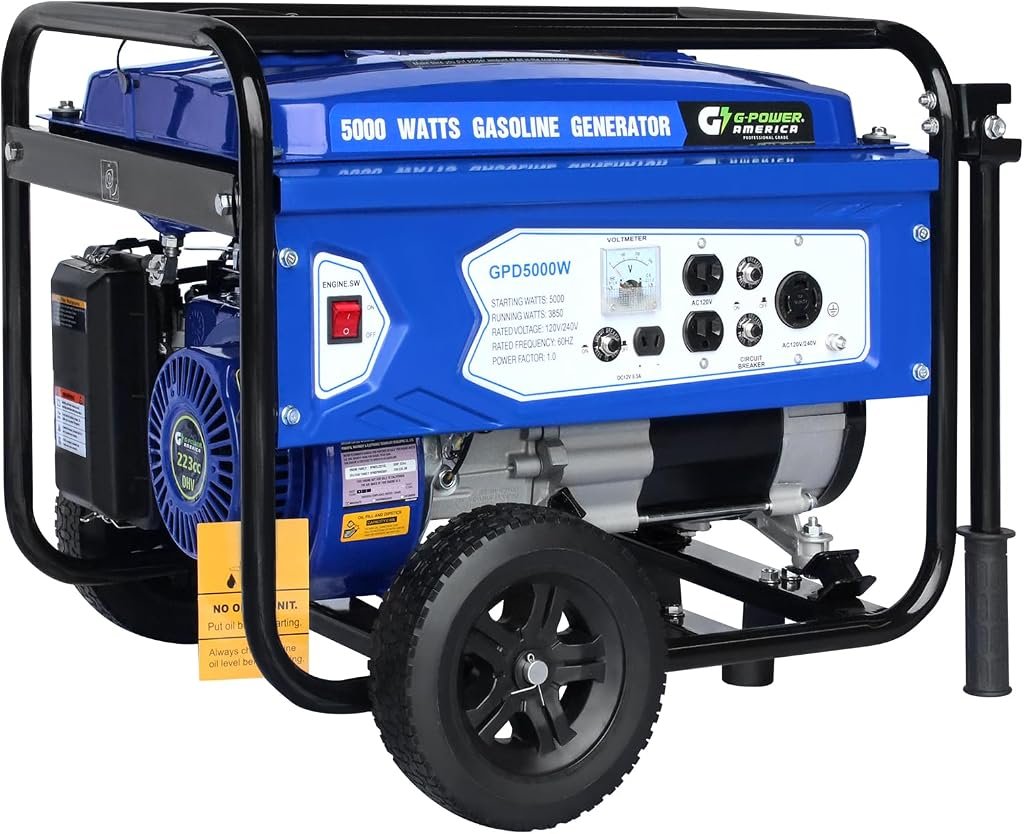
Portable generators invite a particular kind of numerical optimism. A large wattage number sits prominently in the product name, while the figure governing sustained operation receives less visual attention. The Green-Power America GPD5000W is a useful example. Its 5,000-watt identity describes starting capacity. Current listings specify 3,850 watts of continuous output from a 223cc gasoline engine. That 1,150-watt difference is not fine print. It defines what the machine can realistically be asked to do.
The GPD5000W is a conventional gasoline generator rather than an inverter-based or dual-fuel design. Current specifications identify a four-gallon gasoline tank, recoil starting, automatic voltage regulation, low-oil shutdown, 8-inch solid wheels and approximately 11 hours of runtime at half load. The electrical panel includes 120V AC connections and 12V DC output.
Our score is 8.51/10. Customer Sentiment receives 8.5, Buyer Confidence stands at 8.83 and Value receives 8.28.
Those ratings place the GPD5000W in a favorable but clearly defined position. It offers substantial conventional generator capacity without pretending to be a substitute for every form of backup power. The strongest fit is for buyers who understand gasoline storage, can work within its output and voltage architecture, and need several thousand watts of portable electricity rather than a small recreational power source.
Its limitations are just as relevant. It requires manual starting. Gasoline is the only fuel. Current specifications do not identify a carbon-monoxide shutdown sensor. At roughly 100 pounds or more depending on the listing, wheels are less an accessory than a practical necessity.
That combination makes the GPD5000W less technologically elaborate than many newer portable generators. Simplicity, however, can have its own logic.
Our Assessment: 8.51/10
An 8.51/10 overall score reflects a generator with useful output, relatively straightforward controls and enough capacity for meaningful backup work.
Current product information specifies 5,000 starting watts and 3,850 running watts. The engine is a 223cc, 7.5-horsepower, four-stroke overhead-valve design using gasoline and manual recoil starting. A four-gallon tank is associated with up to 11 hours of operation at half load.
Those figures place the GPD5000W well above the small-generator category without moving it into whole-house territory.
That distinction matters.
A 3,850W continuous supply can support a substantial group of selected household loads. Refrigeration, lighting, communications equipment and some pumps or heating-system components can fit into that budget when their actual requirements are calculated carefully.
What 3,850 watts cannot do is erase the need for prioritization.
Electric water heating, resistance space heating, large air conditioners, cooking appliances and other high-demand equipment can consume large portions of the generator’s capacity individually. Several operating together can exceed it quickly.
The GPD5000W therefore rewards planning more than ambition.
Buyer Confidence at 8.83 Reflects a Straightforward Design
Buyer Confidence is our highest component score at 8.83.
The generator’s relatively simple architecture contributes to that result.
There is one fuel system. Starting is manual. The engine is naturally aspirated and air cooled. Output is conventional AC rather than an inverter architecture built around a more elaborate electronic power stage. Low-oil shutdown protects the engine when lubricant falls below an acceptable level, while automatic voltage regulation is listed among the machine’s features.
The control panel is also direct. A documented parts list identifies two 120V 20A NEMA 5-20 receptacles, one 120V 30A NEMA L5-30 receptacle and a 12V DC output, along with circuit protection and an earth terminal.
That is a practical connection set for conventional portable-generator work.
The 5-20 outlets address ordinary 120V appliances and tools. The L5-30 connection provides a higher-current 120V option for compatible equipment or an appropriately designed electrical arrangement. The DC connection adds another form of output without altering the machine’s primary identity as an AC generator.
The architecture is not unusually sophisticated. That is partly why it is easy to understand.
The 5,000W Name Can Mislead Load Planning
A portable generator buying guide should treat starting watts and running watts as separate quantities.
The GPD5000W illustrates why.
Its 5,000W figure represents starting capacity, while current listings place continuous output at 3,850 watts. That means the sustained rating is 77% of the headline starting figure.
The distinction exists because electric motors can draw substantially more power during startup than during steady operation.
A refrigerator compressor is one familiar example. Pumps, air conditioners, freezers and other motor-driven equipment can exhibit the same basic pattern. Their normal operating wattage tells only part of the electrical story.
A generator load plan therefore needs at least two calculations:
- the combined running demand of equipment expected to operate simultaneously;
- the largest realistic startup event occurring while those other loads are already active.
Imagine that essential equipment is consuming 3,000 watts continuously. That leaves 850 watts before reaching the GPD5000W’s current 3,850W running specification. A motor requiring a substantial additional startup allowance could push the generator beyond its available capacity even though every appliance appears individually compatible.
The reverse mistake is equally common. Treating 5,000 watts as continuously available can encourage a load plan that exceeds the machine’s actual sustained rating.
The correct number for everyday capacity planning is therefore 3,850 watts.
Value Scores 8.28
Our Value rating is 8.28, lower than both the overall score and Buyer Confidence.
That difference reflects the economics of specialization.
The GPD5000W provides conventional gasoline generation without the fuel flexibility of a dual-fuel machine or the electrical characteristics associated with modern inverter generators. Buyers are paying primarily for engine-driven AC capacity, runtime and portability rather than a large collection of electronic features.
That can be economically rational.
Someone who needs several thousand watts for occasional outage protection or outdoor work may have little reason to pay for functionality that will never be used. A mechanically straightforward gasoline generator can meet that requirement directly.
The calculation changes for buyers prioritizing propane storage, highly variable low-load operation or a lighter recreational format.
Value is therefore closely tied to the job.
The GPD5000W makes more sense when its 3,850 running watts will actually be used. Purchasing it primarily to charge phones, LED lanterns and a laptop would leave most of its engine capacity unused while retaining the fuel, noise and maintenance obligations of a gasoline generator.
Sizing works in both directions. Too little capacity creates overload problems. Too much capacity can create unnecessary ownership burden.
Customer Sentiment at 8.5
Customer Sentiment receives our 8.5 rating, almost identical to the overall 8.51 score.
That close relationship fits the machine’s character.
The GPD5000W does not disguise the realities of conventional generator ownership. It burns gasoline. It uses manual recoil starting. It needs engine oil. It has to operate outdoors. It needs storage space, fuel management and periodic attention.
Those characteristics create work, but they are predictable forms of work.
The integral mobility equipment helps. Current listings identify 8-inch solid wheels and folding handles, reducing the effort involved in moving a machine whose published weight varies across listings but remains substantial.
Solid wheels also avoid the tire-pressure maintenance associated with pneumatic designs.
Still, “portable” should not be confused with “light.”
A generator of this size is equipment that can be moved, not an object most owners will casually carry. Storage thresholds, steps, soft ground and vehicle loading can change the experience considerably.
The wheels solve one part of mobility. They do not solve every part.
Eleven Hours at Half Load Changes the Fuel Discussion
Current GPD5000W listings specify a four-gallon gasoline tank and up to 11 hours of runtime at 50% load.
Half of the 3,850W running specification is approximately 1,925 watts.
That makes the runtime figure useful for emergency planning because 1,925 watts is not a trivial load. A carefully managed group of essential appliances can fall near that range.
Runtime figures still need disciplined interpretation.
Eleven hours at half load does not mean eleven hours under every operating condition. Increasing electrical demand generally increases fuel consumption. Ambient conditions, engine condition and maintenance can also affect real operation.
Yet the figure provides a planning baseline.
A household expecting overnight use can estimate how often the machine may require refueling. That, in turn, determines how much gasoline needs to be stored safely before an outage.
Long runtime is only useful when fuel is available.
A four-gallon tank also means refueling involves a meaningful volume of gasoline. Fuel logistics therefore belong in the purchasing decision rather than being postponed until severe weather arrives.
Gasoline-Only Operation Is Both Simpler and Less Flexible
Single-fuel architecture eliminates the decisions associated with switching between gasoline and propane.
There is one carburetion system to understand and one primary fuel to maintain.
The cost of that simplicity is resilience.
A dual-fuel generator can provide another energy source when gasoline becomes difficult to obtain. The GPD5000W does not have that option.
Gasoline can also deteriorate during storage, making fuel rotation and appropriate storage practices part of long-term ownership.
The generator is therefore best viewed as one component of a backup system. The other component is a realistic fuel plan.
How much gasoline can be stored safely? Where will it be stored? How frequently will stored fuel be rotated? How long will the available supply last at the expected electrical load?
Those questions are less exciting than wattage figures. During a prolonged outage, they become far more consequential.
Recoil Start Keeps the Machine Mechanically Simple
The GPD5000W uses manual recoil starting rather than electric start.
That is simultaneously a limitation and a simplification.
Electric start reduces physical effort, which can matter for repeated operation or users with limited strength. Recoil starting asks the operator to pull the starter manually.
The alternative perspective is that a recoil-only generator does not depend on a starting battery being charged after months in storage.
A generator can spend long periods unused before an outage. Starting batteries do not become maintenance-free merely because the machine is stationary.
Manual starting avoids that particular failure point.
Whether that trade is favorable depends heavily on the operator. A physically capable owner may consider recoil starting acceptable. Someone who would struggle to pull-start a 223cc engine should treat the absence of electric start as a meaningful drawback rather than a minor inconvenience.
Backup equipment needs to be operable by the people expected to use it.
The Outlet Configuration Favors Conventional 120V Work
The documented GPD5000W parts list identifies two NEMA 5-20 receptacles, one NEMA L5-30 receptacle and a 12V DC output.
That architecture is oriented toward conventional 120V use.
For household backup through extension cords, the standard outlets can supply compatible appliances within the generator’s electrical limits. The twist-lock connection supports higher-current compatible equipment or properly configured backup arrangements.
The 12V DC connection expands utility for suitable DC applications.
What matters is matching the connection to the intended load rather than assuming that wattage alone determines compatibility.
Voltage, amperage, plug type and conductor rating all matter.
An appliance that cannot be connected correctly is not made compatible merely because its wattage falls below the generator’s output.
That point becomes particularly serious when household wiring enters the discussion.
Home Backup Requires More Than an Extension Cord and Confidence
A portable generator should never be improvised into a home’s electrical system.
The Occupational Safety and Health Administration warns that a generator should not be attached directly to a structure’s electrical system unless a qualified electrician has installed the generator with a transfer switch. Improper connection can energize utility wiring and expose workers and other people to electrocution.
That hazard is commonly associated with backfeeding.
For direct appliance operation, OSHA advises using grounded extension cords that are intact and appropriately rated for the anticipated load. The agency also warns against overloading a generator because overheating can create a fire hazard.
Those requirements change the meaning of “home backup.”
The GPD5000W can supply household equipment. That does not mean it should be connected to household circuits without the correct electrical infrastructure.
A safe backup plan establishes the connection method before the outage.
Carbon Monoxide Is the Non-Negotiable Constraint
The GPD5000W’s gasoline engine produces combustion exhaust, making carbon-monoxide safety central to operation.
Current retail specifications do not identify an onboard carbon-monoxide sensor.
That makes placement discipline especially important, although a CO sensor on any generator would not make unsafe placement acceptable.
The Centers for Disease Control and Prevention says generators should operate outdoors more than 20 feet from windows, doors and vents. The CDC also says generators should never be used inside a home or garage, even when doors and windows are open, and recommends a battery-powered or battery-backup CO detector inside the home.
The 20-foot guidance has practical consequences.
An owner needs an outdoor location far enough from building openings, a way to route appropriately rated cords, and a strategy for keeping the generator dry without enclosing it.
A garage with the door open is not that strategy.
Neither is a basement, enclosed porch or other partially enclosed space.
Generator safety begins with geography.
Rain Creates a Second Placement Problem
Moving a generator outdoors addresses exhaust but creates exposure to weather.
OSHA advises keeping portable generators dry, protecting them from wet conditions and maintaining three to four feet of clear space on all sides and above for adequate ventilation and cooling. The agency also advises shutting the generator down and allowing it to cool before refueling.
Those instructions can seem contradictory during a storm: keep the generator outside, but keep it dry.
The answer is not an enclosed shed or garage. Weather protection needs to prevent direct exposure while preserving the ventilation and clearance required for safe engine operation.
This is another reason generator planning should happen before a blackout.
Trying to invent a safe rain shelter in darkness while household power is already unavailable is a poor preparedness strategy.
Noise Is Part of the Conventional-Generator Trade
Current listings place GPD5000W operating sound around 74 dB, although measurement conditions are not always described consistently.
That missing test context limits comparisons.
Sound measurements depend on distance, load and surrounding conditions. A decibel figure measured under one procedure cannot be treated as directly equivalent to a competitor’s figure obtained under another.
What can be said more confidently is architectural.
The GPD5000W is a conventional open-frame gasoline generator rather than a compact enclosed inverter. Buyers should set acoustic expectations accordingly.
For emergency household operation, noise may be secondary to refrigeration or pumping.
For camping, dense residential environments or prolonged overnight operation, it can become much more prominent.
The same generator can therefore feel entirely appropriate in one setting and conspicuous in another.
Low-Oil Shutdown Provides Useful Engine Protection
Low-oil shutdown is listed among the GPD5000W’s features.
Its purpose is straightforward: protect the engine when oil level becomes insufficient.
That is particularly relevant during extended outages, when a generator may accumulate operating hours far faster than during normal recreational use.
The feature does not eliminate oil checks or scheduled maintenance.
Automatic protection should be viewed as a fallback, not as a substitute for inspection.
Owners still need to follow the applicable maintenance schedule, monitor oil and inspect the generator before demanding prolonged operation.
A generator purchased for emergency reliability has to be maintained during periods when no emergency exists.
That paradox defines much of portable-generator ownership.
Who Is the GPD5000W Best Suited To?
The strongest buyer fit is someone seeking conventional gasoline power in the roughly 4,000-running-watt class.
Selected-load household backup is one logical application. Refrigeration, lighting, communications equipment and compatible pumps or heating-system components can form a practical outage plan when their combined running and starting requirements remain within the generator’s capacity.
Outdoor work is another reasonable fit. The standard 120V outlets and L5-30 connection support conventional electrical loads within their respective ratings.
The machine also makes sense for buyers who prefer mechanical simplicity over features such as electric start, dual-fuel operation or inverter electronics.
It is less convincing for several other groups.
Someone needing 240V household equipment should verify the electrical architecture carefully rather than assuming the 5,000W name guarantees compatibility.
A user prioritizing propane storage should choose a generator built for that fuel.
Someone seeking quiet recreational electricity for a few electronics may find a smaller inverter generator or battery power station more proportionate.
And an operator unable to use a recoil starter comfortably should not dismiss the physical requirement merely because manual starting simplifies the machine.
Final Considerations
The Green-Power America GPD5000W earns our 8.51/10 overall score, with Customer Sentiment at 8.5, Buyer Confidence at 8.83 and Value at 8.28.
Buyer Confidence leads because the machine’s proposition is relatively easy to understand.
Current specifications center on a 223cc four-stroke gasoline engine producing 5,000 starting watts and 3,850 running watts. A four-gallon fuel tank provides a stated runtime of up to 11 hours at half load. Manual recoil starting, low-oil shutdown, automatic voltage regulation, solid wheels and conventional 120V connections reinforce the machine’s straightforward character.
The limitations are equally direct.
This is a gasoline-only generator. Manual starting requires physical effort. It lacks the fuel flexibility of a dual-fuel machine. Current listings do not identify a CO shutdown sensor. Its open-frame conventional architecture also carries different expectations for noise and operation than an enclosed inverter generator.
Those compromises explain the 8.28 Value rating. The GPD5000W becomes economically more coherent when the owner genuinely needs several thousand watts of conventional AC power. For much smaller loads, the engine, fuel supply and physical footprint can become unnecessary overhead.
Its 5,000W name should not determine the buying decision.
The figure that deserves more attention is 3,850 watts: the current continuous-output specification around which an actual load plan should be built.
From there, the calculation becomes disciplined rather than aspirational. Add simultaneous running loads. Account for motor startup. Verify outlet and voltage compatibility. Establish safe outdoor placement. Plan fuel storage. Determine how equipment will connect without unsafe backfeeding.
If those pieces align, the GPD5000W presents a coherent form of portable backup: mechanically straightforward, substantial enough for meaningful selected loads and uncomplicated by features that some owners may never need.
Its value lies less in the promise of “5,000 watts” than in understanding exactly what 3,850 continuous watts can accomplish when electricity is treated as a finite resource rather than an unlimited utility.