Portable generators are often marketed through their largest number. In the WEN GN5600’s case, that number is 5,600 watts. Yet the figure that matters for sustained operation is smaller: WEN specifies 4,500 running watts, with the larger 5,600W figure reserved for starting demand. That difference establishes the first rule for evaluating this machine. It should be judged by what it can sustain, not by the largest number on the specification sheet.
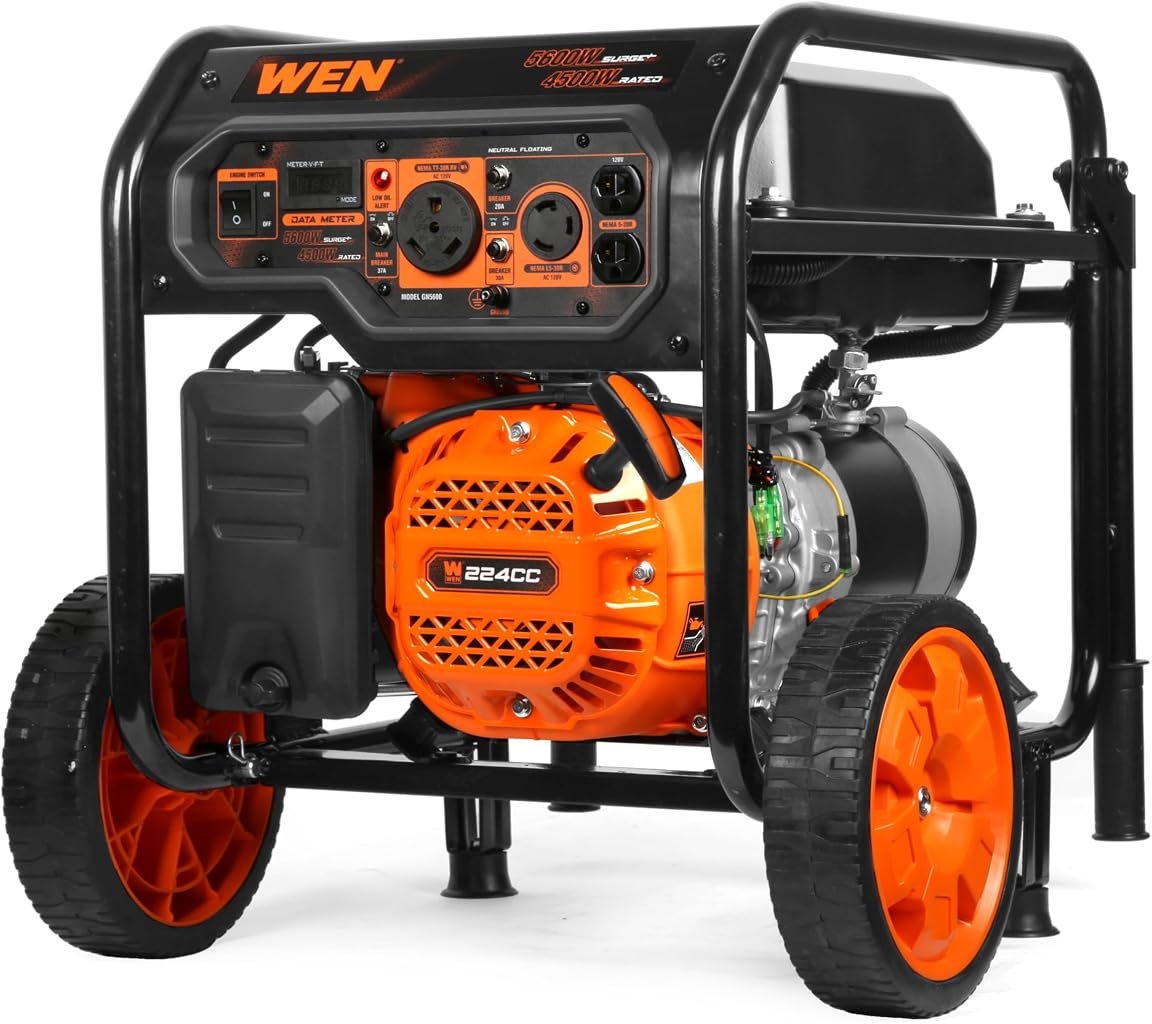
The GN5600 takes a relatively traditional approach to portable power. A 224cc gasoline engine drives a generator intended for household backup, RV use and other situations requiring conventional 120V electricity. WEN specifies a 4.3-gallon fuel tank, up to 12.5 hours of runtime at half load, two standard 120V 5-20R outlets, an RV-ready TT-30R receptacle and a transfer-switch-ready L5-30R connection. A wheel-and-handle kit addresses transportation, while an onboard digital meter displays operating information.
Our score is 8.58/10. Buyer Confidence leads at 9.15, Customer Sentiment stands at 8.5, and Value receives 8.28.
Those scores describe a generator whose strongest argument is clarity rather than novelty. Its electrical architecture is easy to understand, its output is substantial enough for meaningful selected-load backup, and its long stated half-load runtime is relevant during extended interruptions. At the same time, it remains a gasoline-only conventional portable generator. That brings fuel storage, engine maintenance, outdoor placement and load management into the ownership equation.
Our Assessment: 8.58/10
The 8.58/10 overall score reflects a favorable assessment of the GN5600 as a straightforward mid-capacity portable generator.
The manufacturer specifies 5,600 starting watts and 4,500 running watts, generated by a 224cc engine. Its 4.3-gallon gasoline tank is rated for up to 12.5 hours at half load. The connection panel includes two conventional 120V 20A 5-20R receptacles, one 120V 30A TT-30R RV outlet and one 120V 30A L5-30R twist-lock receptacle intended for transfer-switch applications.
That combination defines the machine more accurately than “5600W.”
This is a 120V generator with 4,500 watts of sustained rated output. It is not presented as a dual-fuel machine, and it does not provide the 120/240V architecture associated with some larger backup generators. Buyers whose electrical plan requires 240V loads need a different configuration.
For users whose requirements fit within 120V, however, the GN5600 covers a useful range between small recreational generators and much larger machines.
Buyer Confidence at 9.15 Is the Standout Score
Buyer Confidence receives our highest rating at 9.15.
The reason is not difficult to identify. The GN5600’s capabilities are unusually straightforward.
There is one fuel to manage: gasoline. There are two principal output figures: 5,600 starting watts and 4,500 running watts. There is a defined 4.3-gallon tank and a stated half-load runtime. The outlet panel clearly addresses ordinary extension-cord loads, 30A RV use and properly configured transfer-switch applications.
That clarity reduces one of the persistent problems in generator shopping: purchasing features without knowing whether they solve the intended electrical problem.
WEN also lists a three-year limited warranty and describes support through its service-technician network.
For emergency equipment, confidence is partly a function of predictability. A generator sitting unused for months may eventually be called upon during a storm, grid failure or other disruption. The owner needs to know what fuel it requires, what loads it can sustain, how appliances will connect and how long a tank might last under a representative load.
The GN5600 answers those questions with relatively little ambiguity.
The 5,600W Number Requires Context
Starting watts and running watts are not interchangeable.
The GN5600’s 5,600W rating describes starting capacity. Its continuous rated output is 4,500 watts.
That 1,100W difference matters because many household devices do not draw electricity uniformly.
Motor-driven equipment can require additional power while starting. Refrigerators, freezers, sump pumps, furnace blowers and some air conditioners are familiar examples. Once the motor reaches operating speed, demand generally falls toward its running requirement.
A generator therefore needs enough sustained capacity for everything operating simultaneously and enough short-duration capacity to absorb relevant startup events.
Suppose several essential loads total 3,500 running watts. A pump then requires a substantial additional starting allowance. Looking only at the 4,500W continuous rating could miss the short startup event; looking only at the 5,600W starting figure could overstate how much equipment can remain connected indefinitely.
A portable generator buying guide should consequently begin with two columns: running watts and starting watts.
That exercise is far more useful than choosing a generator because its model number appears larger than the expected household load.
The GN5600 Is Fundamentally a 120V Generator
Voltage deserves as much attention as wattage.
The GN5600 provides standard 120V receptacles, a 120V TT-30R RV connection and a 120V L5-30R twist-lock receptacle.
That makes it suitable for a wide range of ordinary 120V equipment.
It does not make the generator a universal household electrical source.
Homes can contain 240V loads including some well pumps, water heaters, electric ranges, dryers, central air-conditioning equipment and other large appliances. A buyer expecting to operate such equipment needs to verify voltage requirements before considering wattage.
This is an area where the GN5600’s simplicity creates both strength and limitation.
For selected 120V emergency loads, the architecture is direct. For a backup plan built around 240V equipment, it is the wrong electrical format regardless of whether 4,500 running watts would otherwise appear adequate.
The outlet panel should therefore be examined before the wattage calculation, not after it.
Home Backup Is About Priorities
A 4,500W generator can be useful during a household outage without attempting to imitate normal grid service.
That distinction changes the planning exercise.
Instead of asking whether the GN5600 can “power a house,” the better question is which equipment should remain operating when utility power disappears.
Refrigeration may rank high. A sump pump can become urgent during severe weather. A furnace may burn natural gas yet still require electricity for its blower and controls. Internet equipment and phone charging can preserve communication. Several LED lights may require relatively little power compared with electric heating or cooking.
The household can then identify which loads need to operate simultaneously.
This is where load sequencing becomes useful.
A microwave may be used for several minutes and then switched off before another high-demand device operates. A pump may cycle intermittently. Some appliances can remain disconnected until needed.
Load management effectively stretches generator capacity without changing the generator.
That is one reason the GN5600’s 4,500 running watts can be more useful than the number initially suggests, provided the household treats backup electricity as a limited resource rather than attempting to reproduce normal consumption.
The 12.5-Hour Runtime Is a Meaningful Specification
WEN specifies up to 12.5 hours of runtime at half load from the 4.3-gallon gasoline tank.
That is one of the GN5600’s more consequential specifications.
Half load on a 4,500W running rating corresponds to roughly 2,250 watts. The manufacturer’s runtime figure therefore describes a meaningful operating level rather than a near-idle demonstration.
It should still be interpreted correctly.
“Up to” does not mean every user will receive 12.5 hours from every tank. Electrical load, environmental conditions, maintenance state and operating circumstances can affect fuel consumption.
Yet the figure gives buyers a useful planning reference.
During a long outage, runtime translates directly into fuel logistics. A generator consuming one tank every operating cycle requires the household to maintain an appropriate gasoline supply and a safe refueling routine.
The larger 4.3-gallon tank can reduce refueling frequency relative to smaller machines, but it also means more gasoline is involved in the preparedness plan.
Runtime is therefore both an advantage and a responsibility.
Value at 8.28 Reflects a More Focused Proposition
Our Value score of 8.28 is the lowest component rating, although it remains favorable.
The GN5600 earns value through functional simplicity rather than a long feature list.
A buyer gets 4,500 running watts, 5,600 starting watts, a 4.3-gallon tank, RV connectivity, a transfer-switch-ready receptacle, transportation hardware and an onboard data meter.
What the buyer does not get is equally relevant.
There is no dual-fuel flexibility in the GN5600 specification. There is no 240V output. It is not positioned as an inverter generator with the electrical architecture and load-responsive engine behavior associated with that category.
Whether those omissions matter depends on the job.
A household already committed to gasoline storage and selected 120V backup loads may have little reason to pay for propane capability or 240V output it will never use.
A buyer seeking broader fuel resilience or 240V home-backup capability will place a different value on those missing features.
The 8.28 rating captures that narrower focus. The GN5600 can be economically sensible when its architecture matches the requirement, but it is not trying to solve every portable-power problem.
Customer Sentiment Scores 8.5
Customer Sentiment receives an 8.5 editorial score.
That sits close to the 8.58 overall assessment, suggesting a relatively balanced ownership proposition.
The GN5600 does not remove the familiar obligations of gasoline-generator ownership.
Fuel quality matters. Oil service matters. The machine needs a dry, ventilated outdoor operating location. Extension cords must be sized appropriately. Long storage periods require preparation. A generator that has been ignored for a year cannot automatically be assumed ready because the lights have gone out.
The wheel-and-handle kit makes transportation easier, but movement is only one component of portability. The owner still needs a suitable storage location and a safe outdoor operating area.
These demands explain why the 9.15 Buyer Confidence score exceeds Customer Sentiment.
The product itself is straightforward to evaluate. Owning a combustion generator remains work.
The RV Connection Has a Clear Electrical Ceiling
The GN5600 includes a 120V 30A TT-30R receptacle for RV use.
The arithmetic is simple:
120 volts × 30 amps = 3,600 watts
That represents the theoretical power ceiling of a 30A, 120V RV service.
The generator’s 4,500W running capacity therefore exceeds the arithmetic maximum of that single 30A RV connection. The RV and its connection remain limited by their own electrical design, regardless of the generator having additional capacity.
This provides useful margin for generator operation but does not permit the RV to ignore its 30A service limit.
Air conditioning deserves particular attention because compressor startup can impose additional short-duration demand. Microwave ovens, electric water heating and other large loads can also consume a substantial share of a 30A electrical budget.
RV owners can often improve the situation through sequencing.
Operating an air conditioner and a microwave simultaneously creates a different demand profile than using them separately. The generator may have adequate capacity while the RV’s own service remains the tighter constraint.
That distinction prevents unnecessary generator oversizing.
Transfer-Switch Ready Does Not Mean Plugging Directly Into House Wiring
The GN5600 includes a 120V 30A NEMA L5-30R twist-lock receptacle described by WEN as transfer-switch ready.
That is useful for a properly designed backup installation.
It is not permission to improvise a connection to household wiring.
OSHA’s generator guidance warns against attaching a generator directly to a structure’s electrical system unless a qualified electrician has installed a transfer switch. Without isolation, generator power can energize utility wiring and create an electrocution risk for utility workers and other people.
OSHA also advises plugging equipment directly into a generator using manufacturer-supplied cords or grounded extension cords rated for the anticipated load. The agency warns that overloading can cause overheating and create a fire hazard.
Those instructions turn the L5-30R receptacle into part of a larger electrical system rather than a shortcut around one.
Anyone planning circuit-level household backup should settle the transfer arrangement before an outage occurs.
Carbon Monoxide Safety Determines Where the Generator Can Operate
The GN5600 burns gasoline. That makes carbon-monoxide safety inseparable from ownership.
The CDC states that portable generators should operate outdoors more than 20 feet from windows, doors and vents. Its guidance also says: “Never use a generator inside your home or garage, even if doors and windows are open.”
That instruction deserves literal interpretation.
An open garage door does not transform a garage into a safe generator location. A covered porch can still place exhaust too close to a building opening. A basement is never an acceptable operating space for a portable gasoline generator.
The CDC also recommends using a battery-powered or battery-backup carbon-monoxide detector in the home while a generator is operating.
Weather complicates placement because the machine also needs to remain dry.
OSHA advises protecting generators from wet conditions while maintaining adequate ventilation and cooling. Its guidance specifies three to four feet of clear space on all sides and above the generator.
The correct operating location therefore needs distance, ventilation and weather protection simultaneously.
That site should be identified before the generator is needed.
Gasoline Storage Is Part of the Real Ownership Cost
The GN5600’s gasoline-only architecture simplifies fuel selection while concentrating the preparedness burden on one fuel.
Gasoline is energy-dense and widely available under normal conditions. During regional outages, however, filling stations can lose electricity or face heavy demand.
Storage introduces another concern.
Gasoline needs to be kept in approved containers and handled away from ignition sources. Refueling a hot generator is unsafe. OSHA specifically advises shutting down the generator and allowing it to cool before refueling.
The 12.5-hour half-load runtime can reduce the frequency of refueling, but prolonged outages can still require a substantial fuel plan.
A household should decide in advance how much gasoline it can safely store, where it will be kept and how older fuel will be managed.
The generator itself is only half of a gasoline backup system. Stored fuel is the other half.
The Data Meter Is More Useful Than It Sounds
The GN5600 incorporates an onboard digital meter displaying voltage, frequency, total runtime and session runtime.
This is a modest feature with practical value.
Session runtime can help an owner estimate when refueling or inspection may be approaching. Total runtime creates a reference for maintenance scheduling. Voltage and frequency provide immediate operating information rather than leaving the user entirely dependent on guesswork.
Maintenance records become particularly important for emergency equipment because use can be irregular.
A generator may accumulate several hours during one outage, sit unused for months, then run extensively during another. Calendar time alone does not describe engine use accurately.
An hour meter creates a more useful maintenance history.
That is the kind of feature that rarely dominates a product listing but can improve ownership over several years.
High-Altitude Operation Requires Additional Planning
Altitude affects combustion engines because air density decreases as elevation rises.
WEN sells dedicated GN5600 high-altitude kits for operation from 3,000 to 6,000 feet and another for 6,000 to 8,000 feet.
That is relevant for buyers in mountainous regions or those intending to travel with the generator.
A carbureted engine calibrated for lower elevations can run improperly as altitude changes significantly. The appropriate manufacturer guidance and high-altitude configuration should therefore be followed rather than assuming sea-level settings remain suitable everywhere.
For RV users in particular, geographic mobility can turn altitude from an abstract specification into a practical operating issue.
A generator that spends one month near sea level and another in mountain country may face conditions a stationary household unit never encounters.
Who Should Consider the GN5600?
The GN5600 makes the strongest case for buyers who want substantial 120V gasoline-powered backup without paying for capabilities they do not intend to use.
Selected-load home backup is an obvious application.
Its 4,500 running watts can support a carefully managed collection of refrigeration, lighting, communications equipment, pumps, furnace equipment and other compatible 120V loads, subject to actual appliance requirements.
The TT-30R outlet gives 30A RV owners a direct use case.
The L5-30R receptacle supports properly configured transfer-switch applications.
The 4.3-gallon tank and stated 12.5-hour half-load runtime make the generator particularly interesting where extended operation matters more than compact dimensions.
It becomes less compelling when the requirement shifts.
Buyers needing 240V output should look elsewhere. Those seeking propane flexibility need a dual-fuel machine. Users primarily charging small electronics may find a smaller generator or battery power station more proportionate.
The GN5600 is strongest when its simplicity is treated as intentional rather than deficient.
Final Considerations
The WEN GN5600 earns our score of 8.58/10, supported by Customer Sentiment of 8.5, Buyer Confidence of 9.15 and Value of 8.28.
Buyer Confidence is the defining measure because the generator’s capabilities are unusually easy to map against real electrical requirements.
The 224cc engine produces 5,600 starting watts and 4,500 running watts. A 4.3-gallon gasoline tank is rated for up to 12.5 hours at half load. Two standard 120V outlets, a TT-30R RV receptacle and an L5-30R transfer-switch-ready connection give the machine a focused 120V electrical architecture.
Its strengths are equally focused: substantial selected-load capacity, long stated half-load runtime, RV compatibility, transfer-switch readiness, onboard operating data and a transportation kit.
Its limitations are not hidden behind those strengths.
The GN5600 is gasoline-only. It does not provide 240V output. It requires routine small-engine maintenance, safe fuel storage and an outdoor operating location. The 5,600W headline represents starting capacity, while 4,500 watts is the figure that should govern sustained-load planning.
Those compromises explain why Value at 8.28 trails Buyer Confidence at 9.15.
A buyer who needs exactly what the GN5600 provides can make productive use of most of its capability. A buyer requiring 240V equipment, alternative fuels or only a few hundred watts of emergency electricity would be paying for the wrong architecture.
That is the central lesson of this generator.
Its appeal does not rest on pretending that 5,600 watts can replace normal household utility service. It rests on the more disciplined proposition that 4,500 running watts, allocated carefully among selected 120V loads, can preserve refrigeration, communications, pumping, heating support and other priorities when the grid is unavailable.
For a portable generator, that is the more useful measure of preparedness.