Portable-generator shopping has a recurring problem: the number in a product name can become more influential than the electrical system behind it. A buyer sees “5000W,” imagines a large reserve of power, and begins matching appliances to that number. That shortcut can produce the wrong generator.
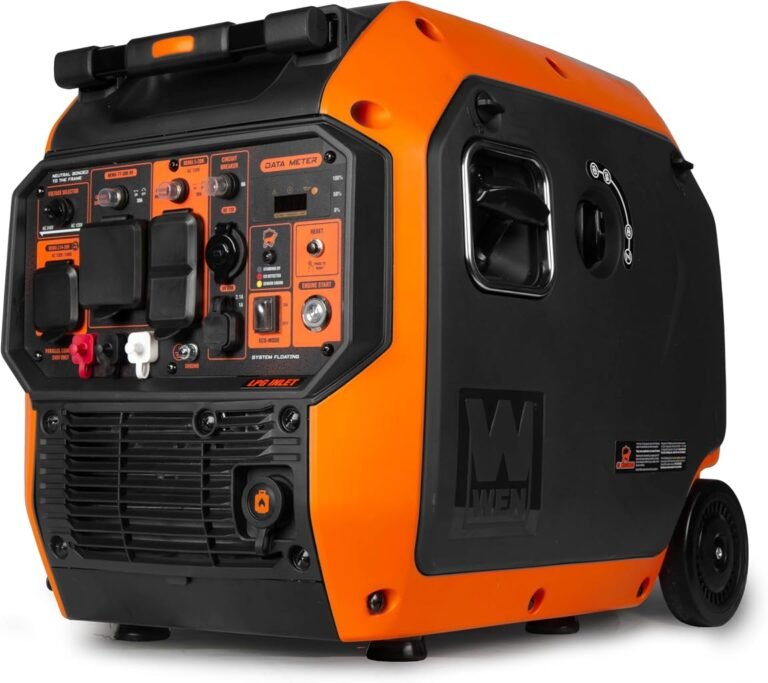
The more revealing specifications here point to the WEN DF680iX platform, a dual-fuel portable inverter generator built around a 224cc engine. On gasoline, the manufacturer specifies 6,800 surge watts and 5,100 rated watts. Propane changes those figures to 6,000 surge watts and 4,500 rated watts. It provides 120/240V capability, an RV receptacle, electric start, CO shutdown, fuel shutoff, wheels and a telescoping handle.
Those specifications give this Oxseryn 5000W Open Frame Inverter Generator review considerably more substance than its headline wattage suggests.
Our overall score is 8.78/10. Buyer Confidence is the standout figure at 9.4, followed by Customer Sentiment at 8.72 and Value at 8.4. That scoring pattern tells a coherent story: this is an unusually well-defined generator proposition, with a broad connection panel and meaningful fuel flexibility, while the value judgment remains more restrained than the confidence assessment.
The distinction matters. A generator can be technically convincing without being the right economic choice for every household, RV or campsite.
Our Assessment: 8.78/10
An 8.78/10 overall score reflects a favorable editorial judgment grounded in the machine’s practical versatility.
The generator’s strongest attribute is not simply its output. It is the combination of dual-fuel operation, 120/240V capability, inverter architecture and a connection panel capable of addressing several different use cases.
The manufacturer specifies gasoline output at 6,800 surge watts and 5,100 rated watts. Propane operation produces 6,000 surge watts and 4,500 rated watts. That fuel-dependent difference is exactly why buyers should avoid treating a single wattage figure as the generator’s universal capability.
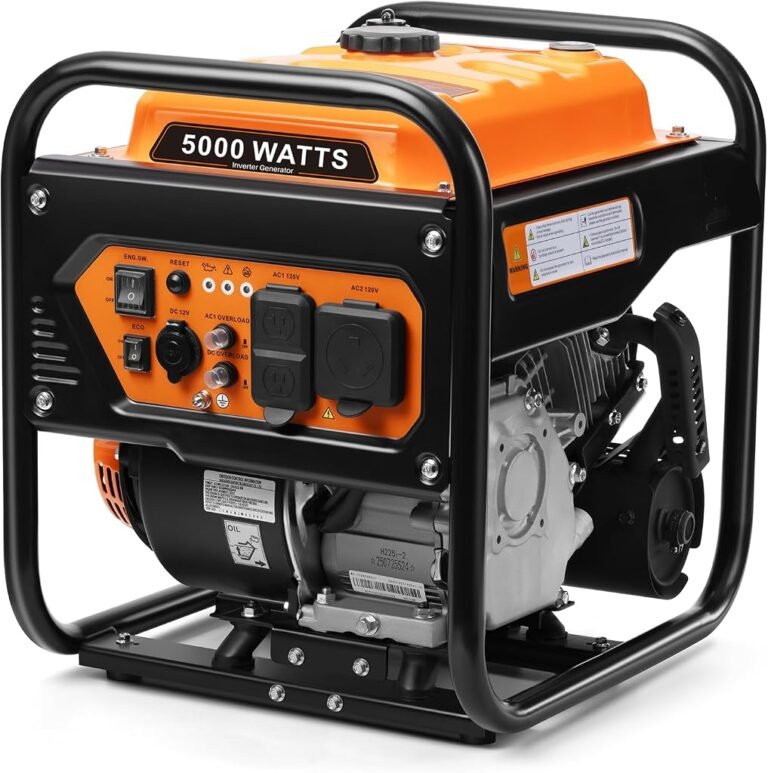
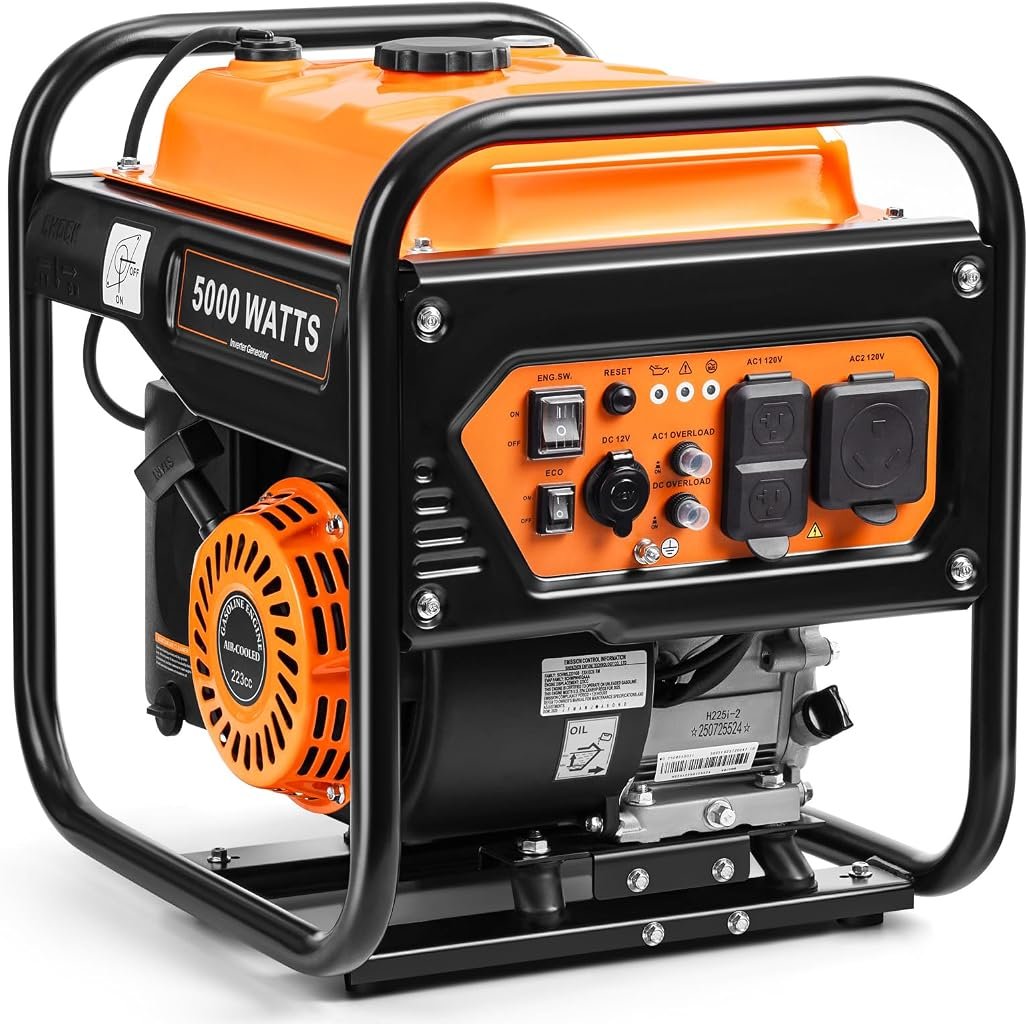
A TT-30R RV receptacle makes the machine relevant to recreational vehicles. An L14-30R 120/240V receptacle broadens its usefulness for properly configured backup applications. Two 120V receptacles, a 12V DC connection and two 5V USB ports round out the panel. The generator also incorporates a voltage selector switch.
This is not a minimalist generator.
That breadth helps explain the 9.4 Buyer Confidence rating. Buyers can identify concrete applications for the machine rather than relying on vague promises about “backup power.”
The Real Wattage Story Is Better Than the Name Suggests
The generator’s electrical ratings deserve to be unpacked carefully.
On gasoline, 5,100 watts is the rated continuous figure. The 6,800W specification describes surge capacity. On propane, rated output drops to 4,500 watts, with 6,000 surge watts available according to the manufacturer.
This difference is normal in dual-fuel generator design, but it can materially affect sizing.
A household running 4,700 watts of continuous load might fall within the gasoline rating while exceeding the propane rating. A buyer intending to use propane as the primary emergency fuel should therefore calculate the load against 4,500 rated watts rather than against the larger gasoline or surge figure.
Starting demand adds another layer.
Compressors and motors can draw additional power during startup. Refrigerators, pumps and air conditioners are familiar examples. A generator that appears comfortably oversized according to normal operating consumption can face a much heavier momentary demand when a motor starts.
A serious portable generator buying guide should therefore separate three numbers:
- total simultaneous running demand;
- the largest realistic motor-starting event;
- the generator’s continuous and surge ratings on the fuel actually being used.
That method produces a more defensible answer than selecting a generator from its model name.
Buyer Confidence at 9.4 Is the Defining Score
Our Buyer Confidence rating of 9.4 is substantially higher than the 8.78 overall score.
There are practical reasons for that confidence.
The DF680iX specification is unusually explicit about output on both fuels, connection types, electrical configuration and protection features. The manufacturer also backs the generator with a three-year limited warranty and states that service is supported through a nationwide technician network.
Clear documentation has real value in emergency equipment.
Generators often spend long periods stored before being expected to work during a blackout. The owner may need to switch fuels, connect an RV, supply selected household equipment or diagnose why a machine has failed to start. A well-documented electrical panel and operating procedure reduce uncertainty at exactly the moment uncertainty becomes expensive.
The 9.4 score does not mean the machine is appropriate for every buyer. Rather, it reflects confidence in evaluating what the generator is designed to do.
That is a meaningful distinction.
Customer Sentiment Scores 8.72
Customer Sentiment receives an 8.72 editorial rating, slightly below the overall score.
The figure remains favorable, but it prevents the assessment from becoming an exercise in specification-sheet enthusiasm.
Portable generators demand participation from their owners. Fuel has to be stored and managed. Oil requires attention. Starting batteries on electric-start equipment need care. The machine has to be moved to a safe operating position. Extension cords or transfer equipment have to match the application.
Dual-fuel capability introduces another decision rather than eliminating one.
Gasoline delivers the higher rated output here. Propane offers a different storage and handling proposition while reducing continuous output to 4,500 watts. A buyer choosing between them must decide whether maximum electrical capacity or fuel-management convenience carries greater weight.
That tension is not a flaw. It is part of owning a dual-fuel generator.
Value at 8.4
Value is our lowest component score at 8.4, though that remains a favorable assessment.
The reason is straightforward: generator value should be measured against usable capability, not peak wattage alone.
A household that needs only 1,500 watts of emergency power could purchase more generator than necessary here. Larger capacity can mean carrying, storing and fueling equipment that spends most of its operating life well below its capability.
At the other end, a household expecting whole-home operation may discover that 5,100 rated gasoline watts is not enough for simultaneous high-demand loads.
The generator finds its more persuasive economic position between those extremes.
It offers enough continuous output for substantial selected-load backup, meaningful RV capability and a 120/240V connection architecture without moving into the much larger class of 10kW-plus portable machines.
Value therefore depends on load matching.
A generator used near the center of its practical capability generally makes more sense than one purchased primarily for psychological reassurance.
Inverter Output Is More Than a Marketing Label
The inverter architecture is another meaningful part of the machine.
WEN specifies total harmonic distortion below 0.3% at no load and below 1.2% at full load. The company explicitly positions that electrical output for devices such as laptops, phones, monitors and tablets.
That specification is more informative than simply calling the generator “clean power.”
Total harmonic distortion describes deviation in the AC waveform. Sensitive electronics can benefit from a well-controlled supply, making a published THD specification useful when comparing an inverter generator with conventional open-frame alternatives.
The generator also includes an eco-mode that adjusts engine behavior as connected demand changes. According to the manufacturer, the objective is to reduce unnecessary gasoline consumption when electrical demand falls.
That makes inverter architecture relevant not only to waveform quality but also to operation under variable loads.
A household backup load rarely remains fixed. A refrigerator cycles. A furnace blower starts and stops. Lights are switched on and off. Electronics charge and then reduce consumption.
Variable-load operation is therefore normal rather than exceptional.
Runtime Depends Heavily on Fuel Choice
Fuel flexibility is one of the generator’s strongest practical arguments.
The gasoline tank holds 2.9 gallons, and the manufacturer specifies up to 6.1 hours of runtime at half load. With a 20-pound propane tank, the stated half-load runtime rises to nine hours.
Those figures should not be treated as guaranteed outage duration because electrical load affects consumption. Half-load runtime is a standardized comparison point, not a promise that every household will reproduce the figure.
Still, the difference illustrates why dual-fuel capability matters.
Gasoline provides higher rated output. Propane provides a stated longer half-load runtime with the referenced 20-pound cylinder configuration. Buyers can therefore select fuel according to the immediate job.
Fuel availability during a regional emergency is another consideration. Gas stations can be affected by power outages, while propane supply depends on what has been stored or remains available locally.
The useful preparedness strategy is established before the outage: decide which fuel will be primary, how much can be stored safely and how the generator will be switched between fuels.
The 120/240V Architecture Broadens Home-Backup Use
A generator’s wattage is only one part of household compatibility.
Voltage matters.
The DF680iX provides an L14-30R 120/240V receptacle along with a voltage selector. WEN also describes the generator’s 240V arrangement as a bonded-neutral configuration and positions the L14-30R connection for transfer-switch or supported electric-vehicle applications.
That gives the machine a broader electrical role than a 120V-only recreational generator.
It does not mean the generator should simply be plugged into household wiring.
OSHA’s portable-generator guidance states that a generator should never be connected directly to a structure’s electrical system unless a qualified electrician has properly installed the generator with a transfer switch. Improper connection can energize utility wiring and expose workers and other people to electrocution.
For direct appliance use, OSHA advises grounded extension cords rated for the anticipated load and warns against overloading a generator.
A home-backup purchase therefore needs an electrical connection plan as much as it needs a wattage calculation.
RV Owners Get a Dedicated Connection
The TT-30R receptacle makes the generator particularly relevant to 30A RV users.
A nominal 30A, 120V RV electrical service has a theoretical ceiling of 3,600 watts:
120 volts × 30 amps = 3,600 watts
That arithmetic helps explain why generator sizing for an RV is not simply a contest to obtain the largest output available.
Air-conditioning startup can be a major demand. Microwave ovens, electric heating elements and other high-power appliances can add substantial load. An RV owner may therefore need to sequence equipment rather than run every large appliance simultaneously.
The generator’s 5,100 rated gasoline watts provide capacity beyond the theoretical 30A shore-power ceiling itself, but the actual connection and generator operating limits still govern use.
Propane operation reduces generator rated output to 4,500 watts, which remains above that 3,600W arithmetic ceiling for a single 30A, 120V service.
For RV use, the more relevant questions become portability, noise, runtime and whether the owner actually needs this much generator.
Noise Is Quantified, With an Important Condition
Noise specifications deserve skepticism unless the test condition is disclosed.
WEN states 64 decibels at quarter load for this generator.
The phrase “at quarter load” matters.
A generator working harder can behave differently acoustically, and decibel comparisons between competing models become misleading when manufacturers use different distances or load conditions.
The 64 dB figure is therefore useful as a manufacturer specification but should not be interpreted as the generator’s noise output under every workload.
Open-frame construction also changes buyer expectations.
An open-frame inverter generator can combine inverter electronics with a chassis closer to conventional portable-generator design. Buyers seeking campsite use should evaluate that architecture differently from a compact, heavily enclosed recreational inverter.
The machine’s wheels and telescoping handle help with movement, but portability encompasses more than whether equipment can roll. Storage space, loading height and the surfaces across which it will be moved also matter.
Fuel Shutoff Is a Practical Maintenance Feature
The generator includes a fuel-shutoff function that allows gasoline remaining in the carburetor to be consumed before the engine stops. WEN presents the feature as a way to reduce stagnant-fuel buildup inside the carburetor.
That is a practical addition for equipment that may spend long intervals in storage.
Portable generators often fail preparedness plans not because they lack output, but because neglected fuel systems or starting batteries prevent operation when needed.
Fuel shutoff does not remove the need for storage maintenance. Oil, air filtration, fuel condition, electrical connections and the starting system still require attention according to the manual.
It does, however, address a familiar gasoline-storage concern in a relatively direct way.
A generator should be prepared before severe weather arrives rather than treated as maintenance-free equipment waiting indefinitely for an emergency.
CO Watchdog Adds Protection but Does Not Change Placement Rules
The generator includes WEN’s Watchdog CO Shutdown Sensor, which is designed to shut the generator down when dangerous carbon-monoxide levels are detected.
That feature adds a safety layer. It does not make indoor operation acceptable.
The Centers for Disease Control and Prevention’s current carbon-monoxide guidance says generators should be operated outdoors more than 20 feet from windows, doors and vents. It also advises using a battery-powered or battery-backup CO detector inside the home.
The agency is explicit that a generator should never operate inside a home or garage, even when doors and windows are open.
A CO sensor should therefore be treated as backup protection against dangerous conditions, not permission to move the generator into a garage, porch or other enclosed area.
Placement planning belongs in the buying process.
If a property does not have a practical outdoor operating location more than 20 feet from openings, that problem needs solving before a combustion generator becomes the backup strategy.
Electric Start and Recoil Backup Reduce Starting Friction
The DF680iX uses keyless electric start and includes a recoil starter as backup.
That pairing makes sense in emergency equipment.
Electric start reduces the physical effort required during normal operation. Recoil backup creates another starting route if the electric-start system cannot perform.
The arrangement does not eliminate battery maintenance. Any starting battery still needs to be kept in appropriate condition according to the manual.
But redundant starting methods are preferable to relying on a single mechanism in equipment expected to sit idle between emergencies.
Starting convenience also matters for RV users who may operate the generator repeatedly during a trip rather than only during rare household outages.
Who Is This Generator Best Suited To?
The generator’s scoring and verified specifications point toward three especially logical applications.
The first is selected-load home backup. At 5,100 rated gasoline watts or 4,500 rated propane watts, it can support a meaningful emergency load plan when the household calculates requirements carefully.
The second is RV use. The TT-30R connection, dual-fuel capability and inverter architecture give it an electrical profile that fits substantial recreational loads.
The third is buyers who need 120/240V capability without moving into a much larger generator class.
It is less compelling for minimalist camping where phones, lights and small electronics dominate demand. In that setting, the output capability may come with more machine than the electrical job requires.
It is also not a substitute for a much larger whole-home generator where simultaneous central air conditioning, electric water heating, cooking, pumps and other heavy loads create requirements well beyond its rated output.
The machine makes the most sense in the middle: serious portable backup without crossing into the scale of the largest portable generators.
Final Considerations
The Oxseryn 5000W Open Frame Inverter Generator earns our 8.78/10 overall score, with Customer Sentiment at 8.72, Buyer Confidence at 9.4 and Value at 8.4.
Buyer Confidence is the defining result, and the verified specifications explain why.
The underlying DF680iX platform supplies 6,800 surge and 5,100 rated watts on gasoline, falling to 6,000 surge and 4,500 rated watts on propane. It combines dual-fuel operation with 120/240V capability, a TT-30R RV receptacle, an L14-30R connection, electric start, recoil backup, CO shutdown, fuel shutoff, USB and DC connections, wheels and a telescoping handle.
The generator’s inverter architecture also comes with published harmonic-distortion figures: below 0.3% with no load and below 1.2% at full load according to the manufacturer. Its gasoline tank is rated for up to 6.1 hours at half load, while a 20-pound propane tank is rated for up to nine hours at half load.
Those specifications make this more than a headline-wattage proposition.
Its limitations are equally concrete. Propane reduces available output. Half-load runtime should not be mistaken for universal runtime. The 64 dB noise specification applies at quarter load. Home connection requires suitable electrical equipment, and the CO sensor does not alter the requirement for outdoor operation.
The 8.4 Value score captures that balance. This is a generator with a broad capability set, but buyers obtain the strongest value only when they genuinely need that versatility.
For selected home circuits, substantial RV loads and users who value dual-fuel flexibility with 120/240V output, the electrical architecture is persuasive. For light camping loads or very small emergency requirements, a smaller machine may be more proportionate. For heavy whole-home demand, a larger backup strategy may be required.
The buying decision ultimately returns to a less glamorous number than peak watts: simultaneous rated load.
Once that number is calculated honestly-and calculated for the fuel actually being used-the generator’s place becomes much easier to judge.