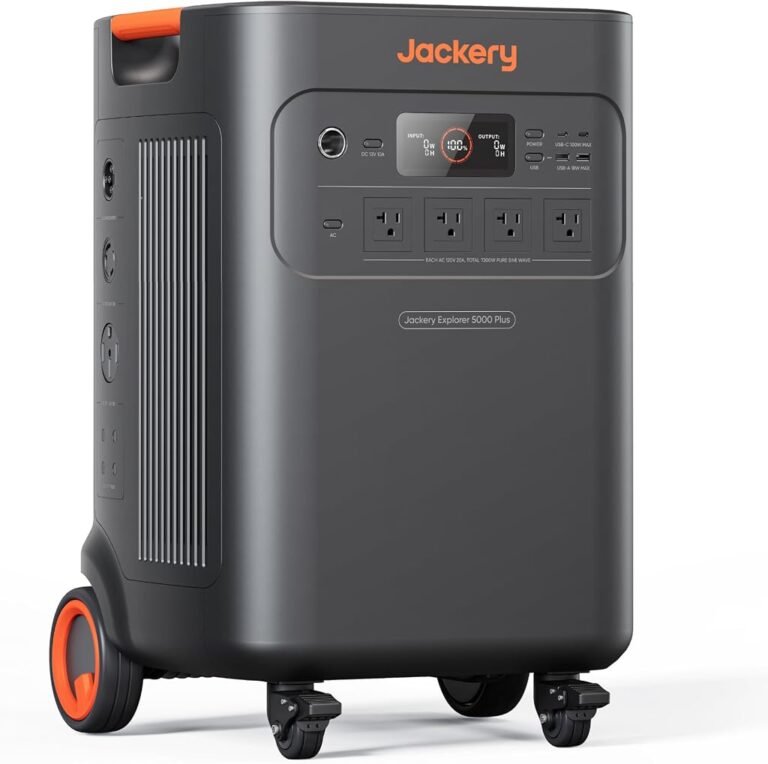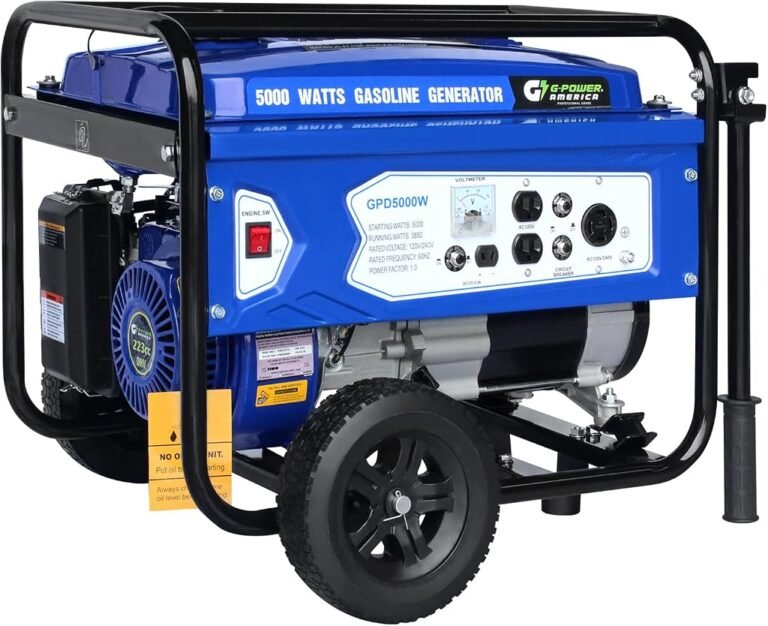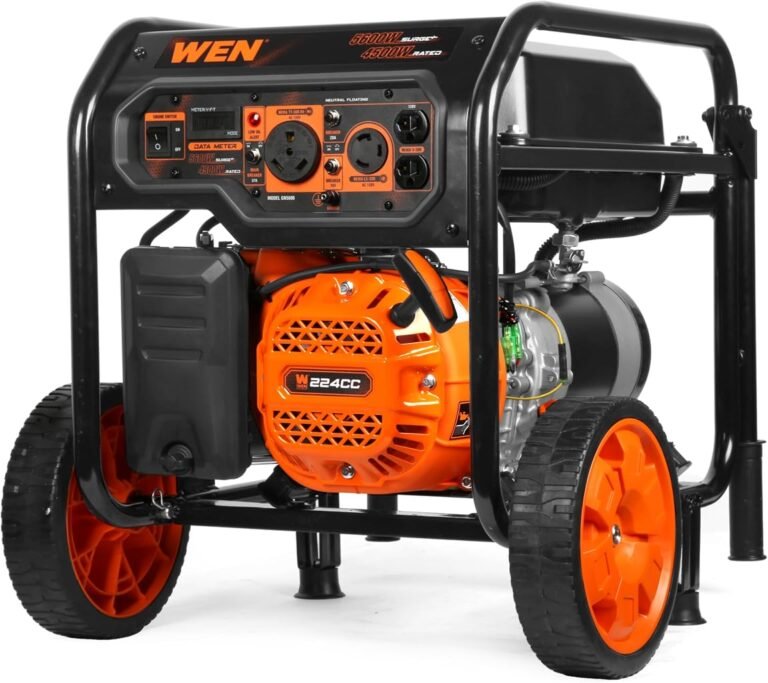
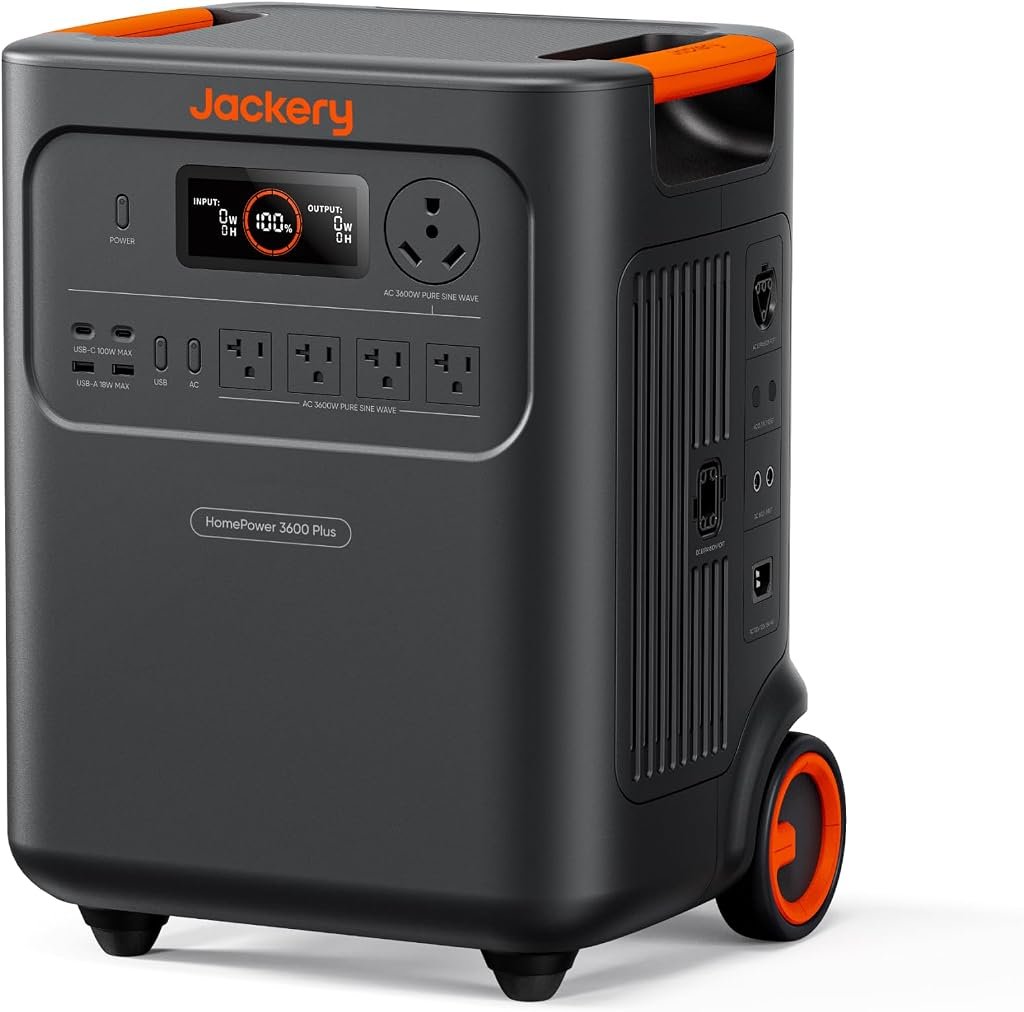
The Jackery HomePower 3600 Plus belongs to a category that increasingly blurs the boundary between portable battery and residential backup system. Its 3,584Wh battery is large enough to make household outage planning realistic, while its 3,600W continuous AC output moves beyond the modest appliance loads associated with smaller portable power stations. Yet it remains a movable unit rather than permanently installed home storage.
That distinction shapes this review.
The HomePower 3600 Plus stores electricity rather than generating it from fuel. It produces no combustion exhaust during discharge, requires no gasoline storage and can operate indoors within Jackery’s specified environmental limits. The trade is finite stored energy. Once 3,584Wh has been consumed, the battery must be recharged from AC power, solar input, a vehicle connection or another supported charging source.
Jackery’s current specifications identify a 3,584Wh LiFePO4 battery, 3,600W rated AC output, 7,200W surge capability, five AC outlets, four USB ports and a 30A 120V AC connection. The battery is rated for 6,000 cycles before remaining capacity falls to 70% or more. The unit weighs about 77.16 pounds and incorporates wheels and a retractable handle.
Our score is 8.7/10. Customer Sentiment receives 8.72, Buyer Confidence stands at 9.02 and Value receives 8.4.
The distribution is revealing. Confidence is the strongest element because the HomePower 3600 Plus has clearly documented electrical limits and an unusually expandable architecture. Value trails because meaningful home backup at this scale remains an expensive proposition, especially when additional battery capacity, solar equipment or household transfer hardware enters the plan.
Our Assessment: 8.7/10
The HomePower 3600 Plus earns its 8.7/10 rating by combining substantial battery capacity with an inverter powerful enough to operate more than electronics and low-demand appliances.
The distinction between energy and power is central.
Battery capacity is 3,584Wh. AC output is rated at 3,600W, with 7,200W available as surge capacity.
Those numbers describe two different constraints.
Watts determine how much electrical demand the inverter can support at a particular moment. Watt-hours describe the amount of stored energy available over time.
A 3,000W appliance can therefore fall comfortably below the inverter’s 3,600W continuous ceiling while exhausting the battery comparatively quickly. A 100W device asks very little from the inverter but could theoretically operate much longer.
Real AC runtime is lower than simple battery-capacity division would imply because conversion losses and system consumption intervene. Still, the arithmetic provides a useful starting point.
That difference between watts and watt-hours is one of the most consequential concepts in any portable generator buying guide that includes battery power stations alongside combustion generators.
Buyer Confidence Leads at 9.02
Buyer Confidence is our highest component rating at 9.02.
The HomePower 3600 Plus earns that confidence through specificity.
Jackery identifies the battery as LiFePO4 with 80Ah capacity at 44.8V DC, producing 3,584Wh of stored energy. The company rates the battery for 6,000 cycles while retaining at least 70% capacity. AC output is specified at 3,600W continuous and 7,200W surge.
The output panel is similarly well defined.
Four conventional AC outlets provide 120V at 60Hz, with each group subject to its stated limits and 3,600W total system output. A separate 120V 30A outlet can provide up to 3,600W. Two USB-C ports are rated at up to 100W each, while two USB-A ports provide up to 18W each.
That level of specification reduces ambiguity during load planning.
The buyer can establish appliance wattage, identify startup requirements and compare them directly with the power station’s continuous and surge limits.
Confidence does not mean unlimited capability. It means the limits are relatively easy to identify before an outage.
A 3,584Wh Battery Needs to Be Understood as an Energy Budget
The HomePower 3600 Plus has 3,584Wh of nominal battery capacity.
That figure becomes more useful when translated into load-duration relationships.
At a theoretical 100% conversion efficiency, a constant 100W load would consume 2,400Wh over 24 hours. A constant 500W load would consume the entire nominal 3,584Wh capacity in just over seven hours. A continuous 1,000W load would do so in roughly 3.6 hours.
Actual AC operation will be shorter because an inverter cannot deliver every stored watt-hour to an AC appliance without losses.
This exposes the central discipline of battery backup: high power capability does not equal long runtime.
The HomePower 3600 Plus can support a 3,000W appliance from a power perspective. That does not mean operating a 3,000W appliance continuously is an efficient outage strategy.
Refrigerators illustrate why average consumption matters.
A refrigerator compressor cycles rather than drawing its rated running power every minute of the day. Communications equipment may draw relatively little. LED lighting is modest compared with electric resistance heating.
An intelligent battery-backup plan therefore asks not merely whether an appliance can start, but how frequently and how long it will operate.
The 3,600W Inverter Is a Serious Step Above Small Power Stations
A 3,600W continuous AC rating materially broadens the range of equipment that can be considered.
Jackery specifies a 7,200W surge peak, providing temporary headroom for equipment with elevated startup demand.
That is relevant for compressor and motor loads.
Refrigerators, pumps and some air-conditioning equipment can require considerably more power at startup than during steady operation. A surge specification allows the inverter to tolerate a short demand above its normal continuous ceiling, provided the actual load remains within the system’s limits.
Surge capacity should not be mistaken for another continuous rating.
The HomePower 3600 Plus is still a 3,600W continuous system.
If connected equipment settles at 4,000W after startup, the 7,200W surge figure does not transform that load into an acceptable continuous demand.
This is the same conceptual trap encountered with gasoline generators, only expressed through inverter electronics rather than engine output.
Value at 8.4 Reflects the Cost of Battery Backup
Our Value score is 8.4, the lowest of the four editorial ratings.
The reason is structural rather than a criticism of one specification.
Battery backup requires purchasing energy storage upfront.
A gasoline generator stores comparatively little energy inside the machine itself; most of its usable energy arrives later as fuel. A power station reverses that model. The battery cells, inverter, charging hardware and control electronics are already contained in the purchase.
The HomePower 3600 Plus therefore carries substantial stored capacity before a single appliance is connected.
That investment buys meaningful advantages: no exhaust during battery discharge, no gasoline handling, low operating noise and immediate electrical output without starting an engine.
But stored energy remains finite.
Buyers seeking multi-day autonomy can add battery packs, which increases both capacity and cost. Jackery states that the platform can expand from 3,584Wh to approximately 21.4kWh using five additional 3,584Wh battery packs.
Expansion is technically appealing. Economically, it changes the project from purchasing a portable power station to building a modular home-energy system.
That distinction explains why Value sits below Buyer Confidence.
Customer Sentiment at 8.72
Customer Sentiment receives our 8.72 rating, essentially tracking the 8.7 overall score.
The product’s ownership model has obvious attractions.
There is no carburetor to prepare for storage. No engine oil requires changing. There is no recoil starter, spark plug or gasoline tank. Routine operation is substantially removed from the maintenance patterns associated with combustion generators.
Indoor battery operation is another major distinction.
Because the power station itself does not burn fuel while discharging, it avoids the carbon-monoxide problem inherent to portable gasoline generators. That does not make every charging arrangement suitable for indoor use; any separate combustion generator used to recharge it remains subject to generator safety rules.
The primary ownership burdens shift elsewhere.
Battery state of charge has to be managed. Stored capacity must match expected outage duration. The 77.16-pound unit still requires physical movement, despite its wheels and retractable handle.
And a battery sitting at a low state of charge when the grid fails cannot instantly create energy.
Preparedness becomes an exercise in stored electricity rather than stored fuel.
The 77-Pound Weight Changes the Meaning of Portable
Jackery lists the HomePower 3600 Plus at about 77.16 pounds, or 35 kilograms. Its dimensions are approximately 15.2 by 12.2 by 19.3 inches.
That is movable equipment, but not lightweight equipment.
The built-in wheels and retractable handle therefore matter.
A 77-pound rectangular battery is very different from a small power bank that can be carried casually between rooms. Stairs, vehicle loading and uneven outdoor terrain remain physical considerations.
At the same time, the integrated mobility hardware changes how that mass is experienced on level surfaces.
For home backup, the distinction may be largely academic if the unit spends most of its life near the appliances or circuits it is intended to support.
For camping or frequent transportation, weight becomes more consequential.
The HomePower 3600 Plus is better understood as a rolling power system than a carry-anywhere battery.
AC Charging Takes About 2.5 Hours
Jackery specifies approximately 2.5 hours for AC charging. Maximum AC input is listed at 1,720W ±50W.
That creates a useful relationship between outage duration and grid availability.
A battery system does not need an uninterrupted grid to regain meaningful utility. If power returns for several hours between outages, the HomePower 3600 Plus can potentially restore substantial charge before another interruption.
Charging time also matters for planned emergency preparation.
A storm warning several hours before expected grid disruption provides a very different preparation window from discovering that a gasoline can is empty after the lights go out.
Battery backup shifts preparedness toward keeping the system charged.
That can be easier operationally, but only if charging actually occurs.
The best battery chemistry and inverter specifications are irrelevant during an outage if the unit begins nearly empty.
Solar Input Creates Independence, With Limits
The HomePower 3600 Plus supports up to 1,000W of DC solar input across its two DC ports. Jackery’s technical documentation lists 16–60V operation at up to 12A per applicable input, with combined input reaching 24A and 1,000W maximum.
Solar charging changes the outage equation because stored energy can potentially be replenished without the grid or combustible fuel.
It does not make energy unlimited.
Panel output depends on solar conditions, orientation, shading, temperature and the electrical limits of the charging system. A nominal panel rating should not be treated as guaranteed all-day production.
Jackery estimates approximately six hours to recharge with two SolarSaga 500 X panels under its stated conditions, while one panel is listed at around 12 hours.
Those figures show why consumption and generation have to be considered together.
If household loads consume more energy each day than the solar array restores, battery state of charge will decline despite daily charging.
Solar backup is therefore an energy budget, not an infinite loop.
LiFePO4 Chemistry Supports Long Cycle Life
The HomePower 3600 Plus uses lithium iron phosphate, commonly abbreviated LiFePO4 or LFP.
Jackery rates its battery for 6,000 cycles before retained capacity falls to at least 70% of the original figure.
Cycle life is more informative than a vague promise of durability because rechargeable batteries gradually lose usable capacity.
A battery does not normally work perfectly for thousands of cycles and then suddenly stop. Instead, available energy decreases over time.
At 70% of the original 3,584Wh nominal capacity, the mathematical equivalent would be about 2,509Wh.
That would still represent substantial storage, but noticeably less than when new.
The 6,000-cycle specification therefore describes the point associated with Jackery’s stated retention threshold, not a binary expiration date.
For buyers expecting frequent cycling, that specification carries more significance than it does for equipment used only during occasional emergencies.
Expansion Changes the Scale of the System
One of the HomePower 3600 Plus platform’s more consequential characteristics is battery expansion.
Jackery’s Battery Pack 3600 adds another 3,584Wh per module. The company states that five additional packs can expand a HomePower 3600 Plus system to approximately 21.4kWh.
That is six times the base unit’s nominal storage.
The practical significance is not simply longer runtime. Expansion allows the system to be sized around a different class of outage.
A 3.584kWh battery encourages prioritization around refrigeration, communications, lighting and carefully selected larger loads.
A system exceeding 20kWh permits a much larger daily energy budget, although actual duration still depends on consumption.
Expansion also introduces a financial question.
A modular system allows capacity to be added after the original purchase rather than requiring the largest configuration immediately. Yet each battery represents additional cost, mass and storage space.
Modularity prevents the initial configuration from becoming a permanent ceiling. It does not make expansion free.
A Single Unit Is Fundamentally a 120V System
One HomePower 3600 Plus provides 120V AC output.
Jackery states that two units can be connected through the appropriate system architecture to provide 240V output, with up to 7,200W output and 14,400W surge through the AC expansion arrangement.
That distinction matters for household backup.
Many ordinary appliances use 120V. Some well pumps, dryers and other large household equipment require 240V.
A single 3,600W unit therefore should not be treated as a universal replacement for a conventional 120/240V residential electrical service.
The two-unit expansion path broadens what the platform can support, but it also doubles the number of base power stations involved.
Buyers should identify voltage before calculating wattage.
A 2,000W appliance requiring 240V cannot be powered correctly from an ordinary 120V outlet simply because the power station has more than 2,000 watts of available output.
Electrical compatibility begins with voltage.
The 30A Outlet Gives the Unit a Different Kind of Utility
The HomePower 3600 Plus includes a 120V, 30A AC output capable of delivering the unit’s 3,600W rated maximum.
The arithmetic aligns exactly:
120 volts × 30 amps = 3,600 watts
That makes the connection relevant for applications built around 30A, 120V service.
It also illustrates why outlet ratings and total inverter capacity need to be considered together.
Four additional 120V AC outlets are present, but connecting devices across several receptacles does not multiply the power station’s 3,600W total continuous output.
The outlets provide connection flexibility. The inverter establishes the system ceiling.
This is another common source of confusion in portable-power shopping. A device with many sockets does not necessarily have more total power than a device with fewer sockets.
Ports determine where electricity can leave. The inverter determines how much can leave at once.
USB-C Makes Low-Power Loads More Efficient to Manage
Two USB-C outputs provide up to 100W each, while two USB-A connections are rated at up to 18W each.
Those ports may look minor beside a 3,600W inverter, but they are logically important.
Laptops, tablets, phones and other compatible electronics can be powered directly without using a separate AC charging brick.
During an outage, avoiding unnecessary conversion stages can simplify the setup and preserve AC receptacles for appliances that genuinely need them.
It also makes the HomePower 3600 Plus useful across very different scales of demand.
The same system can supply a refrigerator through AC while charging communications equipment directly through USB.
That diversity does not increase total stored energy. It improves how that energy can be distributed.
Battery Backup Changes Carbon-Monoxide Risk
A battery power station has a safety advantage that deserves precise wording: it does not create combustion exhaust while supplying stored electrical energy.
That separates it sharply from gasoline, propane and diesel generators.
The Centers for Disease Control and Prevention warns that fuel-burning generators must be operated outdoors more than 20 feet from windows, doors and vents, and that they should never be operated inside a home or garage, even with openings present.
Those restrictions explain why battery stations can be especially practical for apartments and other settings where safe combustion-generator placement is difficult.
The distinction disappears if a gasoline generator is used to recharge the battery. That combustion equipment still belongs outdoors under the applicable safety guidance.
The HomePower 3600 Plus does not make a fuel-burning generator safe indoors. It removes the need for combustion while the battery itself is supplying power.
Temperature Limits Still Matter
Battery systems are not indifferent to their environment.
Jackery specifies both charging and discharging temperatures from -4°F to 113°F, or -20°C to 45°C, for the HomePower 3600 Plus.
Those boundaries are unusually relevant for equipment associated with emergency weather.
A winter outage can occur in an unheated building. A summer outage can expose stored equipment to high temperatures in garages or vehicles.
Battery backup therefore still needs an appropriate storage and operating plan.
The absence of an internal-combustion engine removes several maintenance and exhaust problems. It does not remove environmental limits from the electronics and cells.
Who Should Consider the HomePower 3600 Plus?
The strongest buyer fit is a household seeking substantial indoor-capable battery backup without moving immediately to permanently installed residential storage.
Its 3,600W inverter is large enough for meaningful appliance operation. The 3,584Wh battery creates a credible energy reserve. Solar charging adds an off-grid replenishment route. Battery expansion allows the system to grow substantially beyond its original capacity.
It also suits users who place a high priority on avoiding gasoline storage, engine maintenance and combustion exhaust.
The fit becomes weaker when the requirement centers on inexpensive multi-day energy rather than clean stored electricity.
A conventional generator can continue producing power as long as fuel remains available. A battery must periodically recharge. Adding enough battery capacity for several days of high consumption can become costly.
The base HomePower 3600 Plus is also excessive for modest electronics-only use. Someone powering a phone, router and a few lights does not need a 77-pound, 3.6kWh-class system merely to obtain USB charging.
At the opposite extreme, a household expecting unrestricted operation of multiple large 240V appliances needs to consider the expanded two-unit architecture or a different backup system.
The HomePower 3600 Plus makes the most sense in the substantial middle ground: more capability than a recreational battery, without immediately requiring permanent whole-home storage.
Final Considerations
The Jackery HomePower 3600 Plus earns our overall score of 8.7/10, with Customer Sentiment at 8.72, Buyer Confidence at 9.02 and Value at 8.4.
Buyer Confidence leads because the electrical proposition is clearly defined.
The base unit stores 3,584Wh, supplies 3,600W of continuous AC power and supports a 7,200W surge. Its LiFePO4 battery is rated for 6,000 cycles to at least 70% remaining capacity. Five AC outlets, two 100W USB-C ports, two USB-A connections and a 120V 30A output provide substantial connection flexibility.
The platform can also grow.
Additional 3,584Wh battery modules can increase storage to approximately 21.4kWh, while a two-unit arrangement can enable 240V operation and substantially greater combined AC output.
Those capabilities explain the high confidence score.
The 8.4 Value rating reflects the other side of the equation. Battery capacity is expensive energy stored in advance. Long outages with heavy loads can consume 3,584Wh quickly, and extending runtime through additional batteries requires further investment.
Its 77-pound weight also places limits on the word “portable.” Wheels and a retractable handle help, but this is better understood as movable household energy equipment than as a lightweight camping battery.
The HomePower 3600 Plus is therefore most persuasive when evaluated as an energy-management system rather than as a silent imitation of a gasoline generator.
Its central limitation is finite stored energy. Its central advantage is what disappears with the engine: exhaust, gasoline handling, recoil starting, oil changes and the need to operate the power source outdoors while it discharges.
For outage planning, the arithmetic should begin with watt-hours per day rather than the number of appliances a 3,600W inverter can start. Refrigeration, communications, lighting, pumps and climate equipment should be assigned realistic operating durations. Solar replenishment can then be estimated against expected consumption, with expansion batteries added only when the energy budget demonstrates a need.
That discipline reveals what the HomePower 3600 Plus actually offers: not unlimited electricity, but a large, expandable reserve that can move household backup away from fuel logistics and toward deliberate management of stored energy.