The Jackery Explorer 5000 Plus sits in an increasingly consequential space between portable battery and residential backup system. Calling it merely a portable power station understates its electrical capability. Calling it a whole-home battery oversimplifies the installation, capacity, and runtime questions that determine whether it can actually perform that job.
The numbers establish the scale quickly. Jackery rates the Explorer 5000 Plus at 5,040Wh of battery capacity, 7,200W of total AC output, and 14,400W of surge output. It supports both 120V and 240V loads, uses lithium iron phosphate battery chemistry, and can integrate with transfer equipment for home circuits. Yet it weighs approximately 134.5 pounds.
That combination makes the Explorer 5000 Plus less like a battery someone casually carries to a campsite and more like a movable energy appliance.
Our score is 8.28/10, with Customer Sentiment at 8.28, Buyer Confidence at 8.46, and Value at 8.15. The tight clustering of those ratings tells an interesting story. There is no single spectacular number compensating for a glaring deficiency. Instead, Jackery has assembled a capable, expensive system whose appeal depends heavily on whether the buyer can exploit its high output, 240V capability, solar charging architecture, and potential for expansion.
5,040Wh Is the Number That Defines Runtime
Power stations invite confusion between watts and watt-hours. The distinction is fundamental.
The Explorer 5000 Plus can deliver considerable instantaneous power, but its battery stores 5,040 watt-hours of energy. Jackery’s official Explorer 5000 Plus specifications state that the LiFePO4 battery is rated at 45Ah and 112V DC, producing the stated 5,040Wh capacity.
A simple theoretical calculation illustrates what that means. A constant 500-watt load would require 500Wh each hour, suggesting roughly 10 hours from 5,040Wh if every watt-hour were usable without conversion losses. A constant 1,000-watt load mathematically reduces that figure to about five hours. A 2,000-watt load cuts it to approximately two and a half.
Real operation is less tidy. AC conversion consumes energy, loads fluctuate, temperature affects batteries, and the system itself requires power. Runtime calculations therefore should be treated as planning estimates rather than guarantees.
That distinction becomes particularly relevant during an outage. A refrigerator does not draw its rated operating power every minute. A well pump may consume substantial power briefly and then stop. Lighting loads can be small and predictable. Heating equipment varies enormously depending on whether electricity is running electronics and blowers or generating heat directly.
A serious portable generator buying guide should therefore begin with an energy inventory rather than a product’s maximum output number. With a battery system, the buyer needs answers to two separate questions: can the power station start and operate the equipment, and for how many hours can its stored energy support that equipment?
The Explorer 5000 Plus answers the first question impressively. The second demands arithmetic.
The 7,200W Inverter Changes What a Power Station Can Run
Jackery specifies 7,200W maximum total AC output and 14,400W surge capacity, with 120V and 240V support.
That output ceiling moves the Explorer 5000 Plus beyond the smaller power-station category associated mainly with laptops, phones, camping refrigerators, lights, and modest kitchen appliances.
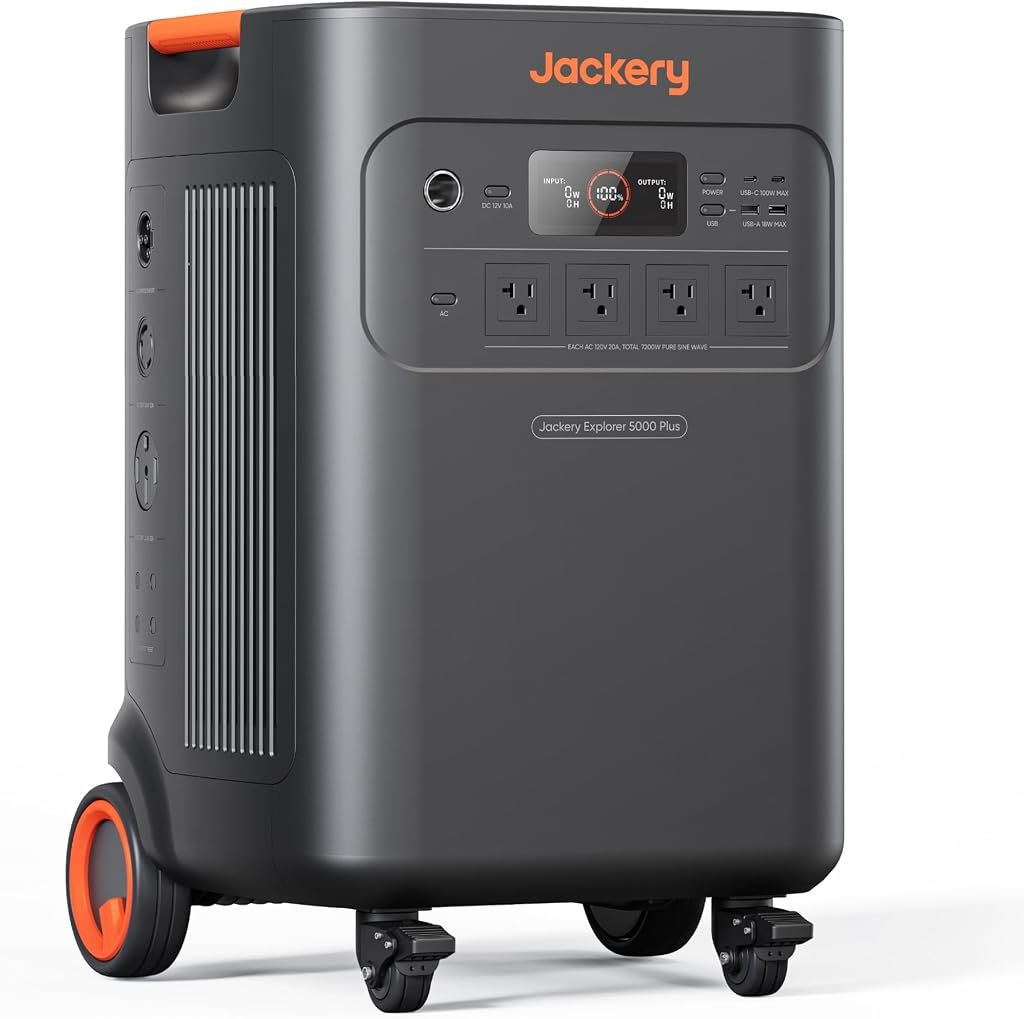
The machine includes four conventional NEMA 5-20 AC outputs as well as NEMA L14-30R and NEMA 14-50 connections for 120V/240V operation. Jackery specifies the 240V outlets at up to 7,200W.
This is consequential because many substantial residential and mobile electrical applications use 240V. Supporting the voltage does not mean every 240V appliance is automatically a sensible load, however.
A 5,040Wh battery can deliver 7,200W, but doing so continuously would exhaust its nominal stored energy rapidly. Dividing 5,040Wh by 7,200W produces only 0.7 hours before accounting for conversion losses and other operating factors.
That calculation exposes the defining tension of the Explorer 5000 Plus: its power capability is considerably larger than its base energy reserve might initially suggest.
This is not a design defect. High inverter output permits large startup surges and enables equipment that smaller stations simply cannot operate. But buyers should distinguish between being able to run an appliance and being able to run it for a long time.
The Explorer 5000 Plus is therefore particularly compelling for mixed loads-equipment that sometimes requires substantial power but does not consume several kilowatts continuously.
LiFePO4 Chemistry Makes Sense at This Scale
Jackery uses lithium iron phosphate, commonly abbreviated LiFePO4 or LFP, for the Explorer 5000 Plus.
The company rates the battery for 4,000 cycles to at least 70% capacity. A cycle-life specification does not mean the battery abruptly fails after its rated cycle count. It describes degradation to a stated remaining capacity under the manufacturer’s rating conditions.
This matters economically because a 5kWh-class battery is not a disposable accessory. Longevity influences the effective cost of ownership, particularly when a power station is used regularly for solar storage, home backup, or mobile applications rather than spending almost its entire life waiting for an emergency.
Battery safety also deserves more attention as stored energy increases.
UL Solutions explains that UL 2743 covers portable power packs intended for circumstances where normal grid power is unavailable, including emergency applications. UL published the first edition of that standard in 2016.
There is also an important boundary between portable equipment and permanently installed residential energy storage. UL Solutions identifies UL 9540 as a standard for energy storage systems and equipment, while UL 2743 applies to portable power packs.
That distinction becomes relevant when products such as the Explorer 5000 Plus are integrated into home electrical systems. A portable battery plugged into appliances is one use case; equipment connected through transfer hardware to residential circuits is another. Local electrical codes, equipment listings, manufacturer instructions, and appropriate installation practices become increasingly consequential as the system moves toward permanent home infrastructure.
Charging Speed Is One of the More Interesting Specifications
Large batteries create an obvious problem: putting the energy back.
Jackery lists approximately 3.5 hours for ordinary AC charging. Its specifications list a maximum standard AC input of 120V, 60Hz, and 15A.
Solar changes the equation considerably.
The Explorer 5000 Plus accepts both high-voltage and low-voltage photovoltaic input. Jackery specifies high-voltage PV input of 135-450V DC at up to 15A. Its low-voltage solar inputs can accept up to 1,200W combined.
Jackery states that the system supports up to 4,000W of solar input and can recharge in about two hours under suitable conditions.
Those figures reveal why discussing “solar charging time” without identifying the solar array is almost meaningless.
A 5kWh battery connected to a few hundred watts of portable panels behaves very differently from the same battery attached to several kilowatts of rooftop photovoltaic capacity. Weather, panel orientation, shading, season, temperature, and available sunlight add further variation.
For an outage strategy, this distinction can determine whether the battery is an energy reservoir that gradually empties or part of a system capable of replenishing meaningful energy every day.
Expansion Changes the Character of the System
The base Explorer 5000 Plus stores 5.04kWh. Jackery also designed the platform around expansion batteries.
The manufacturer’s system configurations can scale far beyond the capacity of a single unit, with Jackery advertising configurations reaching 60kWh.
This modularity addresses the central limitation of the base station: runtime.
Adding capacity does not merely make a specification sheet more impressive. It fundamentally changes what the system can do during an extended outage. Five kilowatt-hours demands active load management in many households. Tens of kilowatt-hours allow a very different backup strategy.
Yet expansion introduces cost and physical scale.
Battery modules are expensive, heavy objects. Once a system accumulates enough batteries, solar panels, switching hardware, and cabling to provide substantial home backup, comparing it only against portable power stations stops making sense. The relevant alternatives begin to include permanently installed residential battery systems and conventional standby generators.
That is where the Explorer 5000 Plus becomes more interesting editorially. It is not simply competing against another large box with AC outlets. Its modular architecture pushes it toward a middle ground between movable power equipment and residential energy infrastructure.
At 134.5 Pounds, “Portable” Needs Interpretation
Jackery lists the Explorer 5000 Plus at approximately 134.5 pounds, or 61 kilograms, with dimensions of roughly 16.5 by 15.5 by 25 inches.
No semantic gymnastics can make 134.5 pounds light.
The product incorporates wheels and a telescoping handle, which changes the practical experience substantially on smooth surfaces. Rolling a 134.5-pound unit across a garage is fundamentally different from lifting it into a vehicle, carrying it upstairs, or dragging it over rough ground.
For many buyers, “portable” should therefore be interpreted as movable rather than easily carried.
This distinction affects buyer fit. Someone seeking a battery for frequent solo camping trips may find the physical scale excessive. Someone seeking an outage battery that normally sits in a garage, utility area, workshop, or RV may find the same weight perfectly acceptable.
The mass is also understandable in engineering terms. A 5,040Wh battery, high-output inverter, cooling system, protection electronics, connections, enclosure, and mobility hardware cannot be made weightless.
The relevant question is not whether 134.5 pounds is heavy. It plainly is. The relevant question is whether the user needs to lift the system frequently.
Home Backup Is Where the Explorer 5000 Plus Becomes More Ambitious
Jackery supports integration with its Smart Transfer Switch, which the company says can manage up to 12 circuits at 120V or six circuits at 240V.
This is a far more consequential capability than the familiar collection of USB ports found on smaller power stations.
Circuit-level backup means selected household loads can be incorporated into a structured outage plan rather than relying exclusively on extension cords. Refrigeration, communications equipment, lighting, selected outlets, pumps, or other circuits can potentially be prioritized according to the installation.
The critical word is “selected.”
A 7,200W inverter does not turn 5,040Wh into an unlimited energy source. Household backup works best when users decide which loads deserve stored energy. Resistance heating, electric water heating, large air-conditioning equipment, cooking appliances, and other high-consumption loads can drain a 5kWh battery rapidly.
The system’s 240V capability widens the range of equipment it can operate, but electrical compatibility should never be confused with energy abundance.
Home integration also deserves professional treatment. High-power transfer equipment and residential circuits are not an appropriate setting for improvised wiring. UL Solutions distinguishes portable power packs from stationary energy-storage installations and discusses UL 9540 and UL 9540A in the context of energy storage systems and fire-safety testing.
The more deeply a portable battery is integrated into a building, the more the installation itself matters.
UPS Capability Adds Another Layer of Utility
Jackery specifies UPS switchover at less than 20 milliseconds, while its online UPS mode is listed at 0 milliseconds.
That functionality broadens the product beyond emergency backup.
A sufficiently fast transition can keep compatible equipment powered when grid electricity disappears, reducing the interruption associated with manually locating a power station and reconnecting devices after an outage has already begun.
The usefulness varies by equipment. Computers, networking hardware, medical equipment, refrigeration controls, and other electronics have different tolerance for interruption. Users with equipment whose operation is safety-critical should follow the equipment manufacturer’s requirements rather than assume that any generic UPS specification guarantees compatibility.
Still, backup that is already connected when the grid fails is qualitatively different from a battery stored in a closet.
That difference explains much of the Explorer 5000 Plus concept. Jackery is not merely offering stored electricity. It is trying to make that electricity available through a system that can function more like infrastructure.
Ports Are Appropriately Serious
The Explorer 5000 Plus includes four 120V NEMA 5-20 AC outlets, two USB-C outputs rated at up to 100W each, two USB-A outputs rated at up to 18W, and a 12V/10A cigarette-lighter output. Higher-power AC connections include NEMA L14-30R and NEMA 14-50 outputs.
The USB ports are useful, but they are almost incidental on a machine of this scale.
A pair of 100W USB-C connections can directly power or charge many laptops and mobile devices without wasting an AC receptacle. Yet the defining connections are the high-current AC outputs and expansion interfaces.
That port selection reinforces the product’s identity. This is not a supersized phone charger. It is an electrical platform intended to bridge portable and household applications.
Battery Power Avoids the Central Combustion-Generator Hazard
One advantage over gasoline or propane generation requires little embellishment: a battery does not burn fuel while producing electricity.
That eliminates engine exhaust during discharge, including the carbon-monoxide hazard created by combustion generators.
This distinction can be particularly meaningful during storms and widespread outages, when portable generators are sometimes operated in unsafe locations. Battery stations can power equipment without a running internal-combustion engine, without storing gasoline for immediate operation, and without generator exhaust.
That does not make large lithium battery systems hazard-free.
Lithium-ion failures can involve thermal runaway, heat, fire, and hazardous gases.
UL Solutions explains that thermal runaway can create extremely high temperatures, smoke, fire, toxic off-gassing, or explosion when lithium-ion batteries malfunction.
The correct comparison is therefore not “dangerous gasoline versus harmless battery.” The technologies present different hazards.
A battery system eliminates combustion exhaust during normal operation. It simultaneously stores a substantial amount of electrochemical energy that requires proper battery management, protection, installation, charging, and handling.
What the Editorial Scores Mean
Our 8.28/10 score reflects a product with substantial technical capability and a clearly identifiable audience.
The 8.46 Buyer Confidence rating is the highest of the four figures. That makes sense. Jackery publishes detailed electrical specifications, charging parameters, battery chemistry, cycle-life figures, operating temperatures, port ratings, dimensions, and weight. The buyer can model the system against actual loads rather than purchasing primarily on vague promises.
Customer Sentiment at 8.28 matches our overall score. The product proposition is attractive but inherently specialized. Its considerable output, 240V support, solar capability, and modularity are meaningful strengths; its weight, system cost, and finite base capacity prevent it from becoming a universal answer.
Value at 8.15 is the lowest rating, though only modestly. That difference is editorially significant.
At the stated reference price of $3,148.99, the buyer is paying roughly $625 per nominal kilowatt-hour of base battery capacity before accounting for the inverter, electronics, enclosure, connectivity, high-power outputs, or other system hardware. That simple calculation is not a fair measure of the entire product’s value, but it illustrates why capacity alone should not justify the purchase.
The value proposition improves for someone who will exploit 240V output, UPS functionality, solar charging, home integration, or expansion. A buyer needing only several AC outlets during occasional blackouts is paying for substantial capability that may sit unused.
Who Is Likely to Benefit Most
The Explorer 5000 Plus fits buyers whose needs are too substantial for small portable stations but who still value a movable, modular battery platform.
Its strongest use cases include:
- backup power for selected household circuits;
- households seeking battery backup without running a combustion generator during discharge;
- properties with suitable solar-generation capacity;
- RV or mobile applications requiring high AC output or 240V capability;
- workshops or remote sites needing substantial temporary electrical power;
- users who expect to expand storage capacity later;
- situations where UPS operation adds meaningful everyday utility.
It is less compelling for buyers whose requirements are dominated by portability. At 134.5 pounds, this is not an appealing companion for frequent lifting.
Nor is the base 5,040Wh configuration automatically sufficient for prolonged whole-house operation. Households expecting days of conventional electrical consumption need to calculate daily energy demand carefully and consider expansion capacity, solar replenishment, or another energy source.
The Main Strengths and Drawbacks
The Explorer 5000 Plus has an unusually broad electrical envelope. The combination of 5,040Wh storage, 7,200W output, 14,400W surge capability, 120V/240V support, high-voltage solar input, LiFePO4 chemistry, and home-transfer compatibility gives it flexibility that smaller power stations cannot match.
Its charging architecture is another major strength. Accepting up to 4,000W from an appropriate high-voltage photovoltaic source makes the system considerably more credible for solar-backed resilience than products limited to a few hundred watts of solar input.
Expansion also gives buyers a route beyond the limitations of the original 5.04kWh battery.
The drawbacks follow directly from those ambitions.
Weight is substantial. Cost is substantial. A sophisticated transfer setup adds further expense. Additional batteries raise both cost and physical scale. Solar performance depends on the actual array and environmental conditions. And despite its 7,200W inverter, the base battery contains only enough nominal energy to sustain a continuous 7,200W load for 42 minutes in a theoretical loss-free calculation.
That final point deserves emphasis because it is the easiest specification relationship to overlook.
The Explorer 5000 Plus has abundant power for its class. Its base configuration has a much more finite quantity of energy.
Understanding that distinction is the difference between buying a capable backup system and buying an expensive specification sheet.
Final Considerations
The Jackery Explorer 5000 Plus earns its 8.28/10 score because it treats portable battery power as serious electrical infrastructure rather than merely a collection of charging ports.
Its 5,040Wh LiFePO4 battery provides meaningful stored energy. The 7,200W inverter and 14,400W surge rating allow unusually demanding loads. Native 120V/240V capability broadens the equipment it can support. High-voltage solar input provides a credible route to fast renewable replenishment under suitable conditions. Expansion batteries and transfer equipment allow the system to grow beyond its original configuration.
The trade-offs are equally real. A 134.5-pound machine stretches ordinary notions of portability. Five kilowatt-hours can disappear quickly under heavy household loads. Building a large multi-battery home-backup installation pushes total spending far beyond the cost of the base station. Integration with household circuits also raises electrical-code and installation questions that should be treated with the seriousness appropriate to high-power residential equipment.
Those tensions explain the scores. Buyer Confidence at 8.46 reflects a well-defined and well-documented technical proposition. Customer Sentiment at 8.28 indicates a favorable overall assessment without ignoring the specialized nature of the product. Value at 8.15 recognizes that the hardware delivers substantial functionality while asking buyers to pay for capabilities they should have a concrete plan to use.
The Explorer 5000 Plus makes the strongest case when purchased around an energy plan: identify critical loads, calculate wattage, estimate daily watt-hours, decide how quickly energy must be replenished, determine whether 240V equipment must be supported, and establish whether future storage expansion is likely.
For that buyer, the machine’s unusually high inverter output is not just an impressive number. It becomes part of a coherent backup architecture.
For someone shopping primarily by capacity, price, or the vague desire to “power the house,” more arithmetic is required. A 7,200W inverter answers how much power the system can deliver at a moment in time. The 5,040Wh battery answers how long that performance can persist. Solar and expansion batteries determine how readily the stored energy can be replaced or enlarged.
That is ultimately the most useful way to read the Explorer 5000 Plus: not as a silent substitute for every generator, and not as an oversized camping battery, but as a modular 5kWh-class energy system whose high output gives it considerably more electrical flexibility than its base capacity alone would suggest.