Portable generators invite a peculiar kind of numerical tunnel vision. A buyer sees “4,800 watts,” compares that figure with another large number, checks the price, and assumes the central question has been answered. In practice, the useful capacity of a generator is governed by a more demanding collection of facts: rated output, surge capacity, fuel choice, electrical quality, outlet configuration, runtime, noise, starting method, and the loads that will actually be connected.
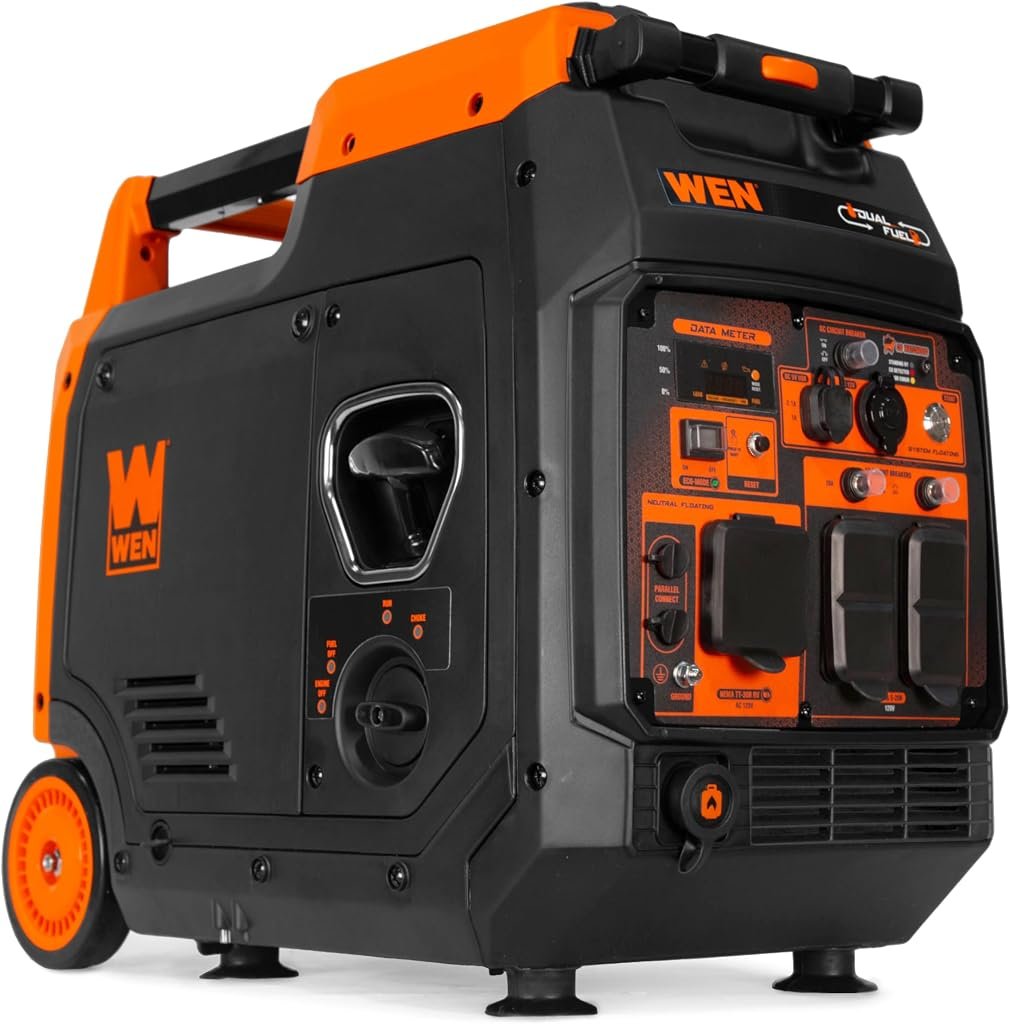
The WEN DF480iX is particularly revealing because its 4,800-watt headline tells only one part of its story. This is a dual-fuel inverter generator with electric start, RV-oriented connectivity, carbon-monoxide shutdown, fuel shutoff, and parallel capability. WEN specifies different power limits for gasoline and propane, meaning even the wattage changes according to what is poured into—or connected to—the machine.
Our score is 8.59/10. Customer Sentiment stands at 8.5, Buyer Confidence at 9.21, and Value at 8.28. The gap between those ratings deserves attention. The DF480iX is a technically well-defined generator whose specifications make buyer fit relatively easy to judge. Its value assessment is more restrained, particularly against a $647 reference price and a market filled with competing inverter generators.
That makes the DF480iX less interesting as a collection of features than as an exercise in matching equipment to real electrical demand.
The 4,800-Watt Figure Needs Context
According to WEN’s official DF480iX specifications, the generator uses a 224cc dual-fuel engine and produces 4,800 surge watts and 4,000 rated watts when operating on gasoline. Propane output drops to 4,320 surge watts and 3,600 rated watts.
Those figures establish the first rule for evaluating the machine: 4,800 watts is not its continuous output.
Surge capacity exists to accommodate temporary increases in electrical demand. Motors and compressors can require considerably more power while starting than after they are running. Refrigerators, pumps, air conditioners, and certain tools illustrate the problem. A generator needs enough temporary headroom to survive those startup events without being overloaded.
Rated watts describe the more useful boundary for sustained operation. On gasoline, that boundary is 4,000 watts. On propane, it is 3,600 watts.
The difference is not trivial. Switching from gasoline to propane reduces rated capacity by 400 watts, or 10%. Surge capacity falls by 480 watts, also 10%. A load plan constructed around the gasoline rating can therefore exceed the generator’s limits after a fuel change.
This distinction belongs near the front of any portable generator buying guide. Generator capacity is not one number. It is a set of limits that must be interpreted against startup demand, continuous demand, and fuel type.
Dual Fuel Is About Resilience as Much as Convenience
The DF480iX’s ability to burn gasoline or propane materially changes its usefulness.
Gasoline provides the higher output. Propane provides an alternative energy source when gasoline is inconvenient to obtain, difficult to store in sufficient quantity, or simply not the preferred fuel for a particular owner.
That flexibility can matter during an extended outage. A generator is only useful while fuel remains available. Two compatible fuels create more options than one.
Yet dual-fuel capability should not be romanticized into unlimited flexibility. The propane power reduction is measurable. Users operating near the machine’s gasoline capacity must recalculate before switching fuels.
This is where appliance-level planning becomes useful. Suppose several loads collectively approach 3,800 running watts. They may fall inside the DF480iX’s 4,000-watt gasoline rating, although startup events still require additional consideration. The same combination exceeds its 3,600-watt propane rating.
Fuel selection, in other words, becomes part of electrical load management.
For buyers who expect relatively modest demand, that 400-watt difference may rarely matter. For an RV owner balancing an air conditioner, microwave, refrigerator, converter, chargers, and other equipment, it can determine which appliances operate simultaneously.
Inverter Architecture Changes the Proposition
The DF480iX is not merely a portable engine connected to an alternator. Its inverter architecture is central to its identity.
WEN describes the generator as producing clean power intended for sensitive electronics such as smartphones, tablets, and laptops.
That matters because modern backup-power requirements look different from those of decades past. A household outage may involve refrigerators and lights, but it may also involve routers, computers, phone chargers, televisions, communications equipment, and electronically controlled appliances.
An inverter generator conditions its electrical output electronically rather than relying solely on a conventional fixed-speed generator arrangement. Inverter designs can also alter engine behavior as electrical demand changes, helping address fuel consumption and acoustic output when the machine is not heavily loaded.
That distinction makes the DF480iX especially relevant to camping, RV operation, and household backup scenarios characterized by fluctuating loads.
A refrigerator cycles. A laptop charger changes demand. A microwave operates briefly. An air conditioner compressor starts and stops. The generator rarely experiences one perfectly constant electrical load.
The DF480iX is designed around that reality rather than merely delivering maximum output whenever its engine is running.
Electric Start Makes Repeated Use Easier
Electric start can sound like a luxury until the circumstances surrounding generator use are considered.
Generators frequently come out during power failures, travel, severe weather, or temporary work away from utility electricity. Starting an engine by repeatedly pulling a recoil cord is hardly impossible, but eliminating unnecessary physical effort has practical merit.
The DF480iX provides electric starting while retaining manual starting capability. That combination is preferable to relying entirely on one mechanism.
There is an important boundary, however. Electric start does not make the DF480iX an automatic standby generator.
It still needs to be positioned safely outdoors, fueled correctly, started deliberately, and connected to appropriate loads. It does not automatically detect a utility outage and energize household circuits in the manner of a permanently installed standby system.
That difference matters for buyers comparing portable and standby generators. The two categories solve related but distinct problems.
The Outlet Panel Reveals Its Intended Audience
The DF480iX includes four three-prong 120V receptacles, a TT-30R RV receptacle, a 12V DC receptacle, and two 5V USB ports. WEN also includes a tool-free LPG quick connector.
The TT-30R connection is particularly revealing.
A 30-amp RV owner can connect compatible equipment through a receptacle designed for that application rather than treating RV operation as an improvised secondary use. Combined with inverter architecture and dual-fuel capability, the outlet gives the DF480iX a coherent camping and travel-trailer identity.
USB connections broaden the low-voltage charging options, while conventional 120V outlets handle ordinary equipment.
Yet an RV-ready outlet does not mean unlimited RV power.
An air conditioner can impose a substantial startup load. A microwave can add a large short-duration demand. Electric heating elements can consume significant capacity. Refrigerators, converters, chargers, televisions, and other devices accumulate additional watts.
The sensible approach is therefore not to ask whether the DF480iX can “power an RV.” The useful question is whether its 4,000 gasoline-rated watts or 3,600 propane-rated watts can support the specific collection of equipment that will operate at the same time.
That calculation produces a much more reliable answer.
Our Score: 8.59/10
Our 8.59/10 rating reflects a generator with a well-integrated feature set and clearly defined operating boundaries.
The DF480iX combines dual-fuel operation, inverter power, electric start, RV connectivity, CO sensing, fuel shutoff, onboard wheels, a telescoping pull handle, USB charging, and a three-year warranty.
None of those features alone determines the rating.
Their value lies in the way they work together. Dual fuel makes sense for emergency preparedness. An RV outlet aligns with camping and travel use. Inverter architecture addresses electronics and variable demand. Wheels and a pull handle respond to the physical reality of moving a generator. CO shutdown adds a secondary safety layer. Fuel shutoff addresses storage and maintenance.
The resulting product is coherent rather than merely feature-heavy.
Customer Sentiment at 8.5 sits slightly below our overall rating. The difference is modest, but it keeps the editorial assessment grounded. The DF480iX has meaningful advantages, yet generator ownership always involves friction: fueling, storage, maintenance, outdoor placement, load calculations, and noise do not disappear because a machine has an electric starter.
Buyer Confidence: 9.21
Buyer Confidence is the strongest component of our assessment at 9.21.
WEN identifies the core engineering facts with useful specificity: a 224cc dual-fuel engine, 4,800/4,000-watt gasoline output, 4,320/3,600-watt propane output, multiple receptacles, CO shutdown, fuel shutoff, wheels, a telescoping handle, LPG connectivity, and warranty coverage.
This level of specification detail gives buyers something generator marketing often obscures: boundaries.
A buyer can establish that 4,800 watts means surge output on gasoline rather than continuous capacity. Propane’s lower rating is explicitly stated. RV connectivity can be verified before purchase. The fuel type and starting architecture are identifiable rather than left to inference.
That does not guarantee the DF480iX is suitable for every application. It makes suitability easier to determine.
The distinction explains why Buyer Confidence at 9.21 exceeds the overall 8.59 score. Product transparency can be high even when value and buyer fit remain more conditional.
Value: 8.28
Our Value score of 8.28 is the lowest of the four ratings, though still favorable.
At a reference price of $647, the DF480iX needs to justify itself through more than peak wattage. The buyer is paying for an integrated combination of dual-fuel capability, inverter architecture, electric starting, RV connectivity, portability equipment, CO shutdown, and fuel-management features.
That package has merit.
Still, generator value is intensely price-sensitive. Buyers comparing machines in this class can encounter conventional generators with greater raw output, inverter generators with different fuel systems, and dual-fuel competitors with varying outlet arrangements and capacities.
The correct comparison therefore depends on priorities.
A buyer concerned principally with the lowest cost per running watt may judge the DF480iX differently from an RV owner who values a TT-30R receptacle, inverter power, propane compatibility, and electric start in one unit.
The 8.28 Value score reflects that distinction. The DF480iX makes more sense when its broader feature combination will actually be used. Paying for capabilities that remain irrelevant to the owner weakens the equation.
CO Watchdog Is a Backup Safety Layer
WEN equips the DF480iX with its Watchdog CO Shutdown Sensor, designed to switch the generator off if dangerous carbon-monoxide levels are detected.
That is a meaningful safety feature. It is not permission to operate the machine indoors, in a garage, or near an occupied building.
The Centers for Disease Control and Prevention’s generator guidance says portable generators should be kept outdoors at least 20 feet from doors, windows, and vents.
CDC describes carbon monoxide as an odorless, colorless gas capable of causing sudden illness and death. Its generator guidance is unequivocal: “Never use a generator inside your home or garage, even if doors and windows are open.”
That warning changes how CO sensors should be understood.
A shutdown system can provide another protective layer if dangerous concentrations develop around the generator. It cannot guarantee that exhaust will not migrate toward a window, door, vent, neighboring structure, or occupied space.
Physical placement remains the primary defense. Indoor battery-powered or battery-backup CO detection adds another layer. The generator’s sensor sits behind those measures, not in place of them.
Household Backup Requires Load Priorities
Four thousand rated watts on gasoline can support meaningful household equipment during an outage. It cannot reproduce unrestricted utility service.
The difference is best understood through prioritization.
Refrigeration, communications equipment, lighting, chargers, televisions, selected pumps, and other moderate loads may fit into a carefully managed power plan. Large electric water heaters, clothes dryers, central air-conditioning systems, electric ranges, and other high-demand equipment can consume substantial portions of a portable generator’s capacity.
Startup demand complicates the arithmetic further.
A refrigerator compressor may draw relatively modest power after it is running but demand considerably more during startup. Pumps and air-conditioning compressors create similar planning issues.
The owner therefore needs two columns: running watts and startup watts.
The sum of continuous loads must remain within the generator’s rated output, while sufficient temporary capacity must remain available for the largest likely startup event. On propane, those calculations need to use the 3,600-watt rated limit rather than the 4,000-watt gasoline figure.
This simple exercise is more useful than relying on generic claims about how many appliances a generator can run.
Household Wiring Is Not an Extension-Cord Experiment
Powering individual appliances through suitable extension cords and powering installed household circuits are different electrical tasks.
The U.S. Consumer Product Safety Commission warns against male-to-male extension cords used for generator backfeeding. CPSC says their exposed prongs can become energized and create electrocution or fire hazards. The agency describes supplying residential electrical systems this way as dangerous backfeeding.
For a generator feeding installed household wiring, proper isolation from utility power is fundamental.
A CPSC technical memorandum on portable-generator connections explains that a suitable means such as a transfer switch is needed to interface generator output safely with installed household wiring. It also observes that portable generators generally have enough capacity for only part of a household’s electrical equipment.
That description fits the DF480iX well.
This generator is suited to selective backup. It is not a reason to bypass safe electrical installation practices.
Fuel Shutoff Addresses Long Storage Periods
One of the less glamorous DF480iX features may prove useful precisely because generators often sit unused.
WEN includes a fuel-shutoff function intended to help limit maintenance.
Gasoline-powered equipment can face storage-related fuel-system problems when left unused for extended periods. Generator ownership therefore involves more than filling the tank when a storm appears in the forecast.
The machine needs a storage routine.
Fuel condition, oil, battery state, ventilation openings, cables, and general mechanical condition all deserve periodic attention according to manufacturer instructions. A generator that exists exclusively for emergencies is still an engine, and engines do not become maintenance-free merely because they spend most of their lives waiting.
Fuel shutoff fits that ownership pattern better than it first appears. It addresses the period between emergencies rather than only the moment electricity is needed.
Portability Has a Physical Meaning
“Portable” can be misleading when attached to engine-driven generators. The category does not imply something that should be carried casually like a toolbox.
WEN equips the DF480iX with onboard wheels and a telescoping pull handle. Those features matter because generator mobility usually means rolling the machine from storage to an operating location, repositioning it around a campsite, or loading it for travel.
The safe operating location may also be farther away than convenience would otherwise dictate.
CDC’s 20-foot separation guidance means household users need enough outdoor space and appropriate heavy-duty outdoor-rated extension equipment to preserve distance from openings. CDC’s emergency-preparedness guidance specifically includes a generator with at least 20 feet of outdoor-rated extension cord among backup-power supplies.
Portability therefore has two dimensions: moving the machine and placing it where combustion exhaust does not endanger occupants.
Who Should Consider the DF480iX?
The DF480iX has a particularly coherent buyer profile:
- RV owners who need a TT-30R connection and can manage loads within the generator’s rated capacity.
- Households seeking selective emergency backup rather than unrestricted whole-house electricity.
- Users who value the ability to choose between gasoline and propane.
- Buyers who expect to power computers, chargers, communications equipment, and other electronics alongside conventional appliances.
- Owners who prefer electric starting but still want a portable generator rather than a permanently installed standby system.
- Users who value integrated wheels, a telescoping handle, CO shutdown, and fuel-management features.
The limitations are equally concrete.
Its 4,800-watt headline represents gasoline surge capacity. Continuous gasoline output is 4,000 watts. Propane reduces rated capacity to 3,600 watts. Dual-fuel capability therefore creates flexibility while simultaneously introducing a second power limit.
The DF480iX also cannot erase the ordinary responsibilities of combustion-generator ownership. Fuel must be stored and handled correctly. The engine requires maintenance. Exhaust dictates outdoor placement. Extension equipment must be suitable for the loads involved. Household electrical integration requires proper hardware and competent installation.
Those constraints are not incidental details. They define the experience of owning the machine.
Final Considerations
The WEN DF480iX earns its 8.59/10 score by combining features that correspond logically to real portable-power use rather than chasing wattage alone.
Its 4,800-watt figure needs translation: that is gasoline surge output. The sustained figure is 4,000 watts on gasoline, dropping to 3,600 watts on propane. Those numbers should drive appliance planning.
Customer Sentiment at 8.5 sits close to our overall assessment. Buyer Confidence rises to 9.21 because WEN publishes enough concrete engineering detail for buyers to establish whether the generator matches their intended workload. Value at 8.28 is more conditional, particularly at a $647 reference price where alternative generators merit comparison.
The DF480iX’s strongest attribute is arguably balance. Dual fuel addresses energy flexibility. Inverter architecture suits mixed loads and electronics. Electric start improves routine operation. TT-30R connectivity directly addresses RV use. CO Watchdog adds a secondary safety mechanism. Wheels and a telescoping handle acknowledge that portable generators still need deliberate movement. Fuel shutoff addresses the long quiet periods between uses.
None of those features eliminates the central discipline of generator ownership.
A buyer still needs to calculate loads, distinguish surge watts from rated watts, account for the lower propane output, place the generator outdoors more than 20 feet from openings, maintain indoor CO detection, and use a proper electrical connection method when feeding household circuits.
That is where the DF480iX ultimately makes sense. It is not an unlimited source of emergency electricity compressed into a movable enclosure. It is a 4,000-rated-watt gasoline and 3,600-rated-watt propane power system with a thoughtfully matched collection of features.
For an RV, campsite, or selectively powered household outage, that combination can be highly practical. The buyer who understands its limits will extract far more usefulness from the DF480iX than one who buys it because “4,800 watts” happens to be the largest number printed beside its name.