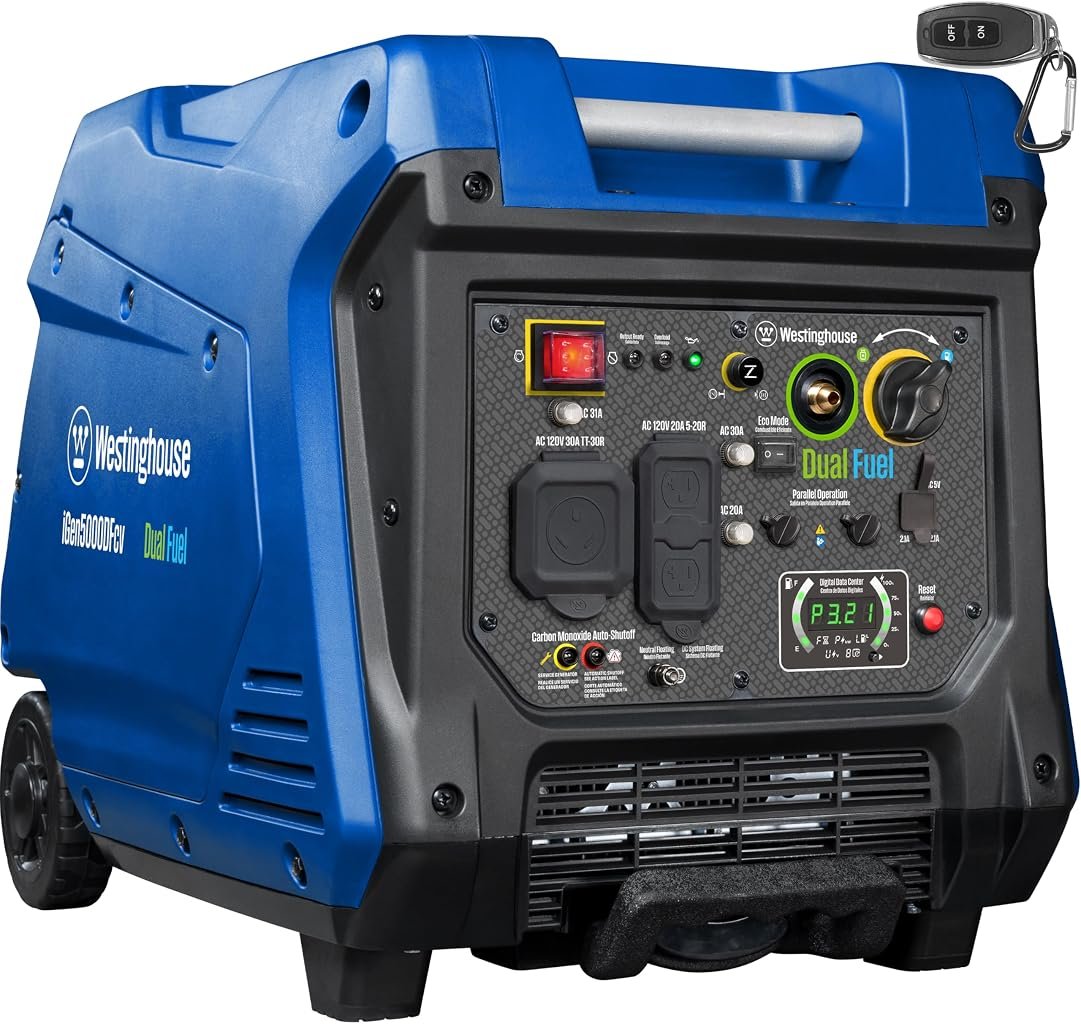
Portable generators become easier to evaluate when the largest number printed on the enclosure is treated as the beginning of the investigation rather than the answer. The Westinghouse iGen5000DFc carries a 5,000-watt peak rating, but its practical identity is defined by a broader set of numbers: 3,900 running watts on gasoline, 3,500 running watts on propane, 120V output, a 224cc four-stroke engine, a 3.4-gallon gasoline tank, inverter architecture, and a dry weight of 105.8 pounds.
That combination places it in an interesting category. It has substantially more output than a small suitcase-style inverter generator, yet it retains features associated with recreational machines: an enclosed body, RV receptacle, USB ports, economy mode, parallel capability, wheels and an extendable handle. Westinghouse also equips it with electric, remote and recoil starting.
The result is a generator that attempts to bridge recreational power and selective emergency backup without becoming a large open-frame home generator.
At the evaluated price of $849, our score is 8.33/10. Customer Sentiment is 8.28, Buyer Confidence reaches 8.71, and Value stands at 8.15. The narrow spread among those ratings tells much of the story. The generator has meaningful strengths without escaping the compromises created by its weight, 120V-only electrical architecture and lower propane output.
Five Thousand Watts Is a Peak Figure, Not a Continuous Budget
The first number a prospective owner should write down is 3,900 watts.
Westinghouse specifies 5,000 peak watts and 3,900 running watts when the generator operates on gasoline. On propane, output falls to 4,500 peak watts and 3,500 running watts. The manufacturer’s iGen5000DFc specifications also identify 120V, 60Hz output and a gasoline running current of 32.5 amps.
The difference between gasoline peak and running capacity is 1,100 watts. On propane, the corresponding difference is 1,000 watts.
Those margins exist because electrical equipment containing motors and compressors can demand additional power during startup. Refrigerators, pumps and air conditioners are familiar examples.
A generator therefore has two electrical limits that matter at different moments.
Running capacity governs the sustained workload. Peak capacity accommodates shorter surges. Confusing the two can produce a load plan that looks acceptable on paper but repeatedly overloads the generator in operation.
A responsible portable generator buying guide should therefore begin with appliance running watts and startup watts rather than generator marketing labels.
For this Westinghouse, the safe planning ceiling starts at 3,900 continuous watts on gasoline or 3,500 on propane, with suitable headroom for changing loads.
Dual Fuel Is More Than a Convenience Feature
Gasoline and propane give the generator two distinct operating profiles.
Gasoline provides maximum output. Propane sacrifices 400 running watts and 500 peak watts. That means propane running capacity is roughly 10 percent lower than gasoline capacity.
The reduction is large enough to matter.
Suppose connected equipment requires 3,300 watts while operating. On gasoline, that leaves approximately 600 watts beneath the rated running output. On propane, only about 200 watts remains.
That smaller margin can become especially relevant when another appliance starts.
The advantage of propane lies elsewhere. It gives the owner an alternative energy source rather than tying every outage or trip to gasoline availability. A generator stored primarily for emergency use may benefit from that flexibility because fuel availability can change during severe weather and prolonged outages.
Propane cylinders also create a different storage arrangement from gasoline.
The correct way to evaluate dual-fuel capability is therefore not to ask which fuel is universally better. Each fuel changes the operating equation. Gasoline produces more electrical capacity; propane offers another route to keeping the generator operating.
A buyer should prepare separate load plans for both.
Runtime Numbers Reveal How Load Changes the Machine
Westinghouse rates gasoline runtime at up to 18 hours at 25 percent load from the 3.4-gallon tank. Propane runtime is listed at up to 22 hours at 25 percent load.
The load condition is essential.
Twenty-five percent of the 3,900-watt gasoline running rating is approximately 975 watts. The published 18-hour figure therefore describes relatively light operation, not a generator supplying nearly 4,000 watts continuously.
The same principle applies to propane.
Runtime is not a fixed characteristic like physical dimensions. Fuel consumption changes as engine workload changes. An owner operating refrigeration, a few lights and communications equipment presents a different demand profile from an RV running air conditioning alongside several other appliances.
That distinction becomes particularly important during a multiday outage.
An 18-hour published runtime cannot simply be multiplied by the number of days and treated as a fuel plan. The actual electrical workload determines how quickly gasoline is consumed.
Westinghouse’s economy mode helps address changing demand by allowing the engine to vary its operation rather than behaving as though full electrical output is required continuously.
The benefit is most relevant when loads cycle rather than remaining constant.
Inverter Architecture Is Central to the Product’s Identity
This is not simply a conventional generator placed inside a plastic enclosure.
The iGen5000DFc is an inverter generator, and Westinghouse specifies total harmonic distortion at 3 percent or less.
That specification is relevant for modern electrical loads containing sensitive electronics. Computers, televisions, chargers and electronically controlled appliances can all form part of a contemporary emergency or recreational power plan.
Inverter architecture also fits the generator’s RV identity.
An RV does not contain only high-demand appliances. It may simultaneously contain charging equipment, entertainment electronics, lighting, control boards and other devices. The ability to provide inverter output while retaining nearly 4,000 gasoline running watts gives the Westinghouse a broader workload than many smaller recreational units.
The generator also includes two USB ports for direct low-voltage charging.
None of this means every electronic device can be connected without calculation. Voltage, current demand and manufacturer requirements still matter. Inverter technology improves the electrical proposition; it does not eliminate the need to understand connected equipment.
The 120V Limitation Defines the Home-Backup Role
The iGen5000DFc supplies 120V AC power.
That specification deserves attention because the 5,000-watt headline can make the machine sound more like a small whole-home generator than it actually is.
It does not provide 240V output.
For extension-cord backup of refrigerators, freezers, lights, electronics and many ordinary appliances, 120V may be entirely appropriate. RV electrical systems can also fit comfortably within this architecture when their load and connection requirements match.
A home containing equipment that requires 240V presents a different problem.
Central air-conditioning systems, electric water heaters, well equipment and other large household loads may use 240V depending on their design. Wattage alone cannot make a 120V generator electrically compatible with a 240V appliance.
This is one of the iGen5000DFc’s most important boundaries.
Its 3,900 gasoline running watts can support a useful selected-load emergency plan, but buyers should not confuse respectable wattage with broad voltage compatibility.
RV Readiness Is More Substantial Than a Label
Westinghouse equips the generator with a 120V TT-30R RV receptacle, a duplex 120V 5-20R household outlet and two USB ports.
The TT-30R connection gives RV owners a direct reason to consider the machine.
Yet an RV owner still needs to perform a load calculation.
A recreational vehicle may combine air conditioning, a microwave, refrigerator, converter, water heater and smaller electrical loads. The air conditioner can impose a substantial startup demand, while other appliances consume power simultaneously.
A 30A receptacle does not create unlimited 30A operation independently of the generator’s actual output.
The generator’s gasoline running rating of 3,900 watts remains the governing electrical budget. Propane lowers that to 3,500 watts.
RV owners should therefore calculate the air conditioner’s startup requirement first, then determine which additional loads can operate simultaneously.
The receptacle simplifies connection. It does not replace arithmetic.
Three Starting Methods Improve Usability
The iGen5000DFc supports electric, wireless remote and recoil starting.
That combination makes sense for a generator weighing more than 100 pounds.
Push-button starting reduces the physical effort required during routine operation. Remote starting can add convenience in recreational or emergency settings, provided the generator is already positioned correctly outdoors. Recoil starting gives the machine a mechanical fallback.
The battery required for electric and remote starting introduces another maintenance item.
A generator can remain unused for long periods, especially when purchased primarily for emergency backup. Battery condition therefore belongs in periodic readiness checks.
A sophisticated starting system is useful only when it works during the outage for which the generator was stored.
The included battery float charger can assist with that maintenance routine. Westinghouse also lists the remote, propane regulator and hose, oil bottle, oil funnel and spark-plug wrench among the included accessories.
The Wheel Kit Is Necessary Because This Is Not a Light Generator
The words “wheel kit” can sound like a secondary convenience until the generator’s weight is examined.
Westinghouse lists the dry weight at 105.8 pounds. Dimensions are approximately 24.5 inches long, 17.5 inches wide and 20 inches high.
That changes the meaning of portability.
At more than 100 pounds before gasoline is added, this is not a generator most owners will want to carry repeatedly. Its wheels and telescoping handle are central to its practical mobility.
On a smooth driveway or campsite, rolling roughly 106 pounds is quite different from lifting it.
Stairs, pickup beds, gravel, mud and uneven terrain expose the distinction.
A buyer planning to transport the generator regularly should consider how it will enter and leave a vehicle. Two-person lifting may be more realistic than treating the integrated handle as evidence that the machine behaves like wheeled luggage in every situation.
Storage dimensions matter as well. RV owners should measure compartments before purchase rather than relying on the broad description of the machine as compact.
Noise Claims Need Measurement Context
Westinghouse publishes a noise figure of 52 dBA for the iGen5000DFc.
A decibel number is useful only when its measurement conditions are understood.
Generator noise changes with electrical load, distance, surrounding surfaces and engine speed. A lightly loaded inverter generator operating in an open area will not necessarily produce the same perceived sound as one supplying an air conditioner beside a reflective wall.
The published figure therefore should not be interpreted as a guaranteed sound level in every operating condition.
Still, the enclosed inverter design and economy mode give this machine a different acoustic character from many large open-frame generators.
That distinction matters in RV parks, campgrounds and residential areas.
Local rules matter too. A generator can be quieter than another model and still violate campground quiet hours. Buyers expecting recreational use should investigate site-specific restrictions independently.
The Digital Data Center Adds Useful Operating Information
The iGen5000DFc includes an LED Data Center.
Westinghouse describes it as providing real-time operating information, complementing the generator’s fuel gauge and other controls.
Instrumentation is easily dismissed as secondary, but it can improve generator management.
An operator benefits from knowing how a machine is behaving rather than treating it as a black box that produces electricity until something trips.
This is particularly relevant when electrical loads change throughout the day.
An RV air conditioner may cycle. A refrigerator compressor starts intermittently. Chargers taper their demand. Cooking equipment may operate for only a few minutes.
Information about generator operation can help an owner recognize patterns and manage the machine more deliberately.
The fuel gauge is similarly mundane until a long outage makes fuel status an operational question rather than an inconvenience.
Parallel Capability Offers Expansion, at a Price
Westinghouse identifies the iGen5000DFc as parallel capable.
That gives owners a route to greater output using compatible parallel equipment and another compatible generator.
The feature is useful, but its economic meaning should remain clear.
Parallel operation requires another generator.
That means another engine, another fuel supply, additional storage space, more maintenance and the necessary connection equipment.
For buyers who occasionally need more power but prefer the flexibility of operating one generator during lighter-demand periods, that arrangement can make sense.
For someone who already knows that 3,900 running watts is inadequate for normal use, buying a single unit on the assumption that a second will eventually solve the problem may be less rational than selecting a larger generator from the beginning.
Parallel capability is an expansion path, not a substitute for correct initial sizing.
The CO Sensor Adds Protection but Does Not Change Placement Rules
Westinghouse equips the generator with automatic carbon-monoxide shutdown.
That is a meaningful safety feature, but it does not convert an unsafe operating location into a safe one.
The Centers for Disease Control and Prevention says portable generators should operate outdoors more than 20 feet from windows, doors and vents. The agency also says generators should never operate inside a home or garage even when doors and windows are open, and recommends a battery-powered or battery-backup carbon-monoxide detector inside the home.
The U.S. Consumer Product Safety Commission gives the hazard a stark numerical scale. Its current carbon-monoxide information center states that more than 200 people in the United States die each year from accidental non-fire consumer-product-related CO poisoning, with more than 100 of those deaths linked to portable generators. The agency also says one portable generator can produce as much carbon monoxide as hundreds of cars.
A CO sensor should therefore be understood as additional protection, not operating permission.
Twenty Feet Changes the Ownership Plan
The 20-foot safety distance is not merely an abstract recommendation.
It affects where the generator can be positioned, how appliances connect to it and how the owner protects the machine from weather without trapping exhaust.
The CDC’s emergency-preparedness guidance specifically includes a generator with at least 20 feet of outdoor-rated extension cord among its recommended backup-power preparations.
That creates a useful pre-purchase exercise.
The buyer should walk outside and identify where the generator would actually run. Windows, doors, vents, neighboring structures and exhaust direction all matter.
Then comes cable planning.
The CDC advises using individual heavy-duty, outdoor-rated extension cords and warns against using generators or appliances when wet. Its winter-weather safety guidance provides further direction for generator use during outages.
The safe operating location therefore needs to be identified before the outage, not improvised during heavy rain or darkness.
Home Backup Requires a Different Mindset From RV Use
The iGen5000DFc can support useful household emergency loads, but its home-backup identity should be kept separate from that of a transfer-switch-oriented 120/240V generator.
Westinghouse explicitly lists the iGen5000DFc as not transfer-switch ready.
That distinction reinforces its natural fit with direct appliance connection and RV use.
A refrigerator, freezer, communications equipment, lighting and selected 120V appliances can form a realistic outage plan within the generator’s capacity.
Trying to treat the machine as a universal household electrical source creates unnecessary problems.
The correct question is not whether 5,000 peak watts sounds large enough for a home. It is whether the specific 120V loads that need emergency power fit beneath the applicable 3,900- or 3,500-watt running limit.
Once framed that way, the generator becomes much easier to judge.
Buyer Confidence at 8.71 Reflects a Well-Defined Product
Our Buyer Confidence rating is 8.71.
The generator’s identity is unusually legible. Its gasoline and propane ratings are separately documented. Voltage is explicit. Receptacles are defined. Runtime is tied to a specific load condition. Weight, tank capacity and engine displacement are published.
That makes fit easier to determine before purchase.
The rating stops below the very highest range because the 5,000-watt label still requires interpretation, and the 120V architecture narrows home-backup compatibility compared with larger 120/240V generators.
The weight also complicates the word “portable.”
Yet these are identifiable boundaries rather than hidden ones.
A buyer who performs a load audit can establish with reasonable precision whether this machine belongs in the intended power plan.
Customer Sentiment and the Overall Score Are Closely Aligned
Customer Sentiment stands at 8.28, only slightly below our overall 8.33/10 score.
That proximity suggests a product whose strengths and compromises are relatively balanced.
The strengths are easy to identify: dual-fuel operation, inverter output, substantial gasoline running capacity, three starting methods, RV connectivity, a digital display, economy mode, parallel capability and integrated mobility hardware.
The drawbacks are equally concrete.
Propane reduces output. The machine weighs more than 100 pounds. It supplies 120V rather than 120/240V. Its size is more substantial than the compact-inverter label may initially suggest. Combustion-engine maintenance remains unavoidable.
None of those limitations makes the generator poorly designed. They determine the buyer profile.
Value at 8.15 Requires Looking Beyond Wattage per Dollar
Our Value rating is 8.15 at an evaluated price of $849.
The generator provides a considerable collection of features for that expenditure, but value should not be reduced to a dollars-per-watt calculation.
A cheaper conventional generator may offer substantial raw wattage without inverter architecture, remote starting, an enclosed body or the same RV-oriented feature set. A smaller inverter generator may cost less while lacking the output required for air-conditioning or broader emergency loads.
The iGen5000DFc therefore derives value from the combination rather than any single specification.
The question is whether the buyer needs that combination.
Someone requiring 240V receives poor functional value regardless of how attractive the other features appear. A buyer who cannot comfortably transport a 105.8-pound machine should similarly reconsider what “portable” means in practice.
An RV owner who needs roughly this output, values propane capability and can make use of the TT-30R connection presents a much stronger fit.
Who Is Most Likely to Benefit?
The iGen5000DFc is particularly well aligned with several use cases:
- RV owners who need a TT-30R connection and have calculated air-conditioner startup demand.
- Campers who require considerably more capacity than small inverter generators provide.
- Homeowners planning selective 120V emergency loads rather than broad household circuit coverage.
- Buyers who value gasoline and propane flexibility.
- Users who prefer electric or remote starting while retaining recoil backup.
- Owners powering electronics who value low-THD inverter output.
- Buyers who can move a roughly 106-pound generator using its wheels and telescoping handle.
- Users who see parallel expansion as a realistic future option.
It is less suitable for buyers requiring 240V equipment, very low weight, whole-home electrical coverage or a machine that can easily be carried by one person.
A Practical Pre-Purchase Audit
Before buying, the owner should establish the complete operating plan:
- Record running wattage for every intended appliance.
- Record startup demand for motor- and compressor-driven equipment.
- Build separate 3,900-watt gasoline and 3,500-watt propane load plans.
- Verify that every intended appliance is compatible with 120V power.
- Confirm RV plug requirements before relying on the TT-30R receptacle.
- Decide whether the 105.8-pound dry weight is manageable in the intended environment.
- Measure vehicle and RV storage spaces.
- Identify a safe outdoor operating position more than 20 feet from windows, doors and vents.
- Obtain correctly rated heavy-duty outdoor extension cords.
- Install and test household carbon-monoxide detectors.
- Plan gasoline and propane storage according to expected operating duration.
- Include battery maintenance in long-term storage routines.
- Check campground noise and generator-hour rules before recreational trips.
- Decide whether parallel operation is genuinely likely before assigning value to that feature.
This exercise can expose an undersized generator, but it can also reveal unnecessary excess. Both discoveries save money and frustration.
Final Considerations
The Westinghouse 5000 Peak Watt Dual Fuel Inverter Generator with Wheel Kit earns its 8.33/10 score by combining meaningful portable output with a feature set that fits RV travel, recreational use and selective 120V emergency backup.
Its true working identity is more specific than the 5,000-watt name suggests.
On gasoline, it provides 3,900 running watts with 5,000 watts available for peak demand. Propane reduces those figures to 3,500 and 4,500 watts. Its 224cc four-stroke engine, 3.4-gallon gasoline tank and published 18-hour quarter-load gasoline runtime place it well above minimalist camping generators in both capability and physical scale.
The inverter system, total harmonic distortion at 3 percent or less, TT-30R RV receptacle, USB connectivity, economy mode and parallel capability broaden its usefulness. Electric, remote and recoil starting add operational flexibility.
Then there is the wheel kit.
At 105.8 pounds dry, wheels and a telescoping handle are not decorative accessories. They are what make the generator realistically movable for many owners. The same weight also explains why prospective buyers should think carefully about vehicle loading, stairs and uneven ground before describing the machine as easily portable.
Buyer Confidence at 8.71 reflects how clearly the generator’s operating envelope can be defined. Customer Sentiment at 8.28 sits close to our 8.33 overall score, while Value at 8.15 reflects a capable $849 package whose worth depends heavily on whether the buyer actually needs dual fuel, inverter output, RV connectivity and this level of capacity.
The largest boundary is voltage. This is a 120V generator. Buyers requiring 240V loads need another class of machine, regardless of the appealing 5,000-watt peak figure.
For the right workload, however, the architecture is coherent. A buyer whose sustained demand remains comfortably beneath 3,900 watts on gasoline or 3,500 watts on propane, whose equipment operates at 120V, and who can manage a machine weighing more than 100 pounds has a clearly defined use case for the iGen5000DFc.
The generator’s strongest argument is therefore not that it promises 5,000 watts. It is that its real capabilities can be mapped with unusual precision to an RV, campsite or selective emergency-power plan. Once that arithmetic is performed before purchase, the headline number becomes much less interesting—and the generator itself becomes much easier to judge.