Large portable generators invite a predictable mistake: reading the biggest number on the machine as though it describes the electricity available continuously. The Westinghouse 14500 Peak Watt Tri-Fuel Portable Generator makes that mistake especially easy because 14,500 watts is a formidable headline figure. Yet its real identity is more nuanced—and considerably more interesting.
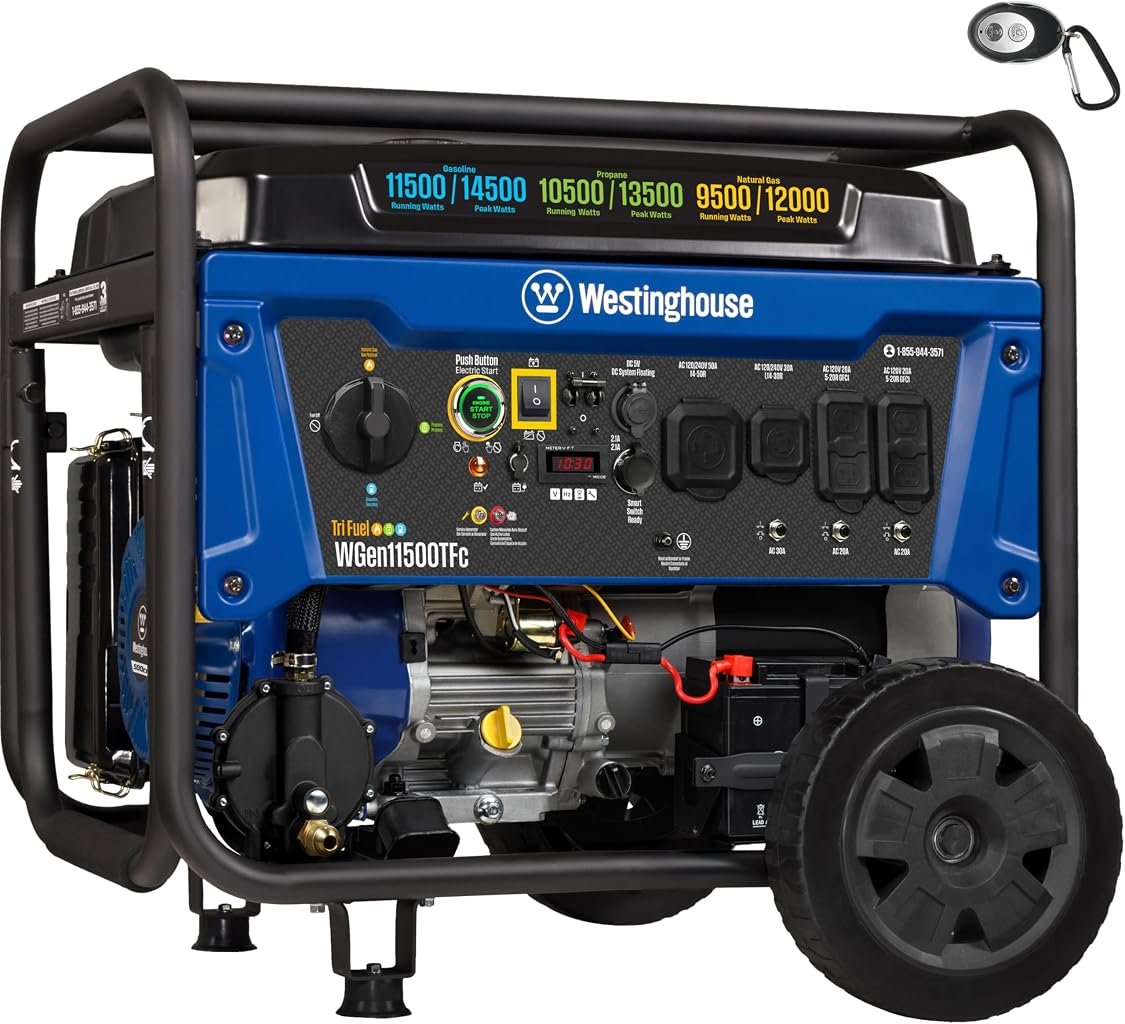
This is a tri-fuel, 120/240-volt generator built for substantial backup loads rather than casual camping duty. On gasoline, it produces 14,500 peak watts and 11,500 running watts. Propane reduces output to 13,500 peak and 10,500 running watts. Natural gas lowers it again, to 12,000 peak and 9,500 running watts. Westinghouse pairs those figures with a 550cc four-stroke OHV engine, a 9.5-gallon gasoline tank, electric and remote starting, transfer-switch-oriented connections and a carbon-monoxide shutdown system.
Those numbers immediately establish the central theme of this review: fuel flexibility is valuable, but flexibility does not mean identical performance on every fuel.
At the evaluated price of $1,499, our score is 9.16/10. Customer Sentiment is 9.16, Buyer Confidence reaches 9.8, and Value stands at 8.64. The scoring pattern is unusually coherent. Buyer Confidence leads because the generator has a clearly defined role and substantial electrical capability. Value sits somewhat lower because a machine of this scale carries costs beyond its purchase price: fuel, storage, maintenance, transfer equipment and the practical burden of moving a large engine-driven generator.
The 14,500-Watt Figure Is Only the Starting Point
The first number that should enter a load calculation is 11,500 watts.
That is the generator’s rated running output on gasoline. The 14,500-watt figure describes peak output, providing temporary capacity for loads that demand additional electricity during startup. Refrigerators, pumps, compressors, air-conditioning equipment and other motor-driven appliances can create those short surges.
The difference is substantial: 3,000 watts separate gasoline running and peak output.
That margin is useful, but it is not another 3,000 watts that can be assigned permanently to appliances. A household drawing 11,000 watts continuously does not have a further 3,500 watts available simply because the model carries a 14,500-watt peak designation.
A disciplined portable generator buying guide therefore starts by separating running watts from starting watts.
This generator’s scale makes that exercise particularly relevant. Smaller portable units force obvious compromises. At 11,500 running watts on gasoline, considerably more equipment can operate simultaneously, which can tempt owners to stop calculating. That would be a mistake. Electric water heaters, well pumps, central air-conditioning equipment, cooking appliances and other major loads can consume large portions of even a five-figure wattage budget.
The Westinghouse provides more room to work. It does not repeal electrical arithmetic.
Tri-Fuel Capability Is the Defining Feature
Gasoline, propane and natural gas fundamentally change how a generator can fit into an emergency plan.
The Westinghouse can operate on all three without requiring the owner to commit permanently to one source. That matters because the strengths and weaknesses of the fuels are different.
Gasoline produces the generator’s highest rated output: 11,500 running watts and 14,500 peak watts. Propane drops those figures to 10,500 and 13,500 watts. Natural gas produces the lowest output at 9,500 running and 12,000 peak watts. Westinghouse documents those fuel-specific ratings in its WGen11500TFc owner documentation.
The practical difference between gasoline and natural gas is 2,000 running watts—roughly 17 percent of the gasoline running rating.
That is large enough to change a household load plan.
A system comfortably operating at 9,000 watts leaves 2,500 watts beneath the gasoline running rating but only 500 watts beneath the natural-gas rating. The same physical generator therefore has three different electrical budgets depending on what enters the engine.
This is not a defect. It is the price of fuel flexibility, and it should be planned explicitly.
Natural Gas Changes the Emergency-Power Equation
Natural gas is arguably the most strategically interesting option here, even though it produces the lowest output.
Gasoline backup requires stored fuel or access to operating filling stations. Propane requires cylinders or a larger storage arrangement. A suitable residential natural-gas connection can remove repeated liquid-fuel handling from the operating cycle.
For a prolonged outage, that can materially alter the owner’s workload.
The trade-off is the 9,500-watt running ceiling. That remains substantial portable-generator output, but the household load calculation must be built around 9,500 watts whenever natural gas is used.
There is another practical distinction. A natural-gas generator arrangement requires an appropriate fuel supply and connection. The fact that the machine can burn natural gas does not mean every home automatically has a suitable connection ready for generator use.
Fuel planning therefore belongs alongside electrical planning.
A buyer attracted primarily by natural gas should calculate the home’s priority loads using 9,500 running watts from the beginning. Treating the gasoline rating as the reference point and discovering the natural-gas reduction during an outage is precisely backward.
Gasoline Delivers Maximum Output but Demands More Management
Gasoline remains the route to the generator’s full rated performance.
The 9.5-gallon tank gives the machine substantial onboard fuel capacity. Westinghouse specifies unleaded gasoline in the 87–93 octane range and warns against E15 and E85.
A large fuel tank reduces refueling frequency, but it creates another question: how much gasoline should realistically be stored for a long outage?
That calculation cannot be answered responsibly with tank capacity alone. Consumption changes with load. A generator supporting a refrigerator, lighting and communications equipment behaves differently from the same machine supplying several major household loads.
Gasoline also introduces storage considerations. Fuel ages, containers require appropriate handling, and emergency demand can disrupt local availability.
This is where tri-fuel architecture earns its keep. Gasoline can be treated as the maximum-output option rather than the only path to electricity.
Propane Sits Between Output and Storage Convenience
Propane reduces rated running output by 1,000 watts compared with gasoline, but it gives the owner another form of stored energy.
At 10,500 running watts, the propane rating remains high enough for substantial selected-load backup.
The advantage is not simply another fuel choice. It is diversification.
Storms and other disruptions can affect fuel supplies unevenly. A generator capable of drawing energy from gasoline, propane or an appropriate natural-gas supply gives the owner alternatives rather than dependence on one chain of supply.
That flexibility partly explains our 9.8 Buyer Confidence rating.
The machine’s capabilities are not difficult to interpret once each fuel is treated separately. There is a gasoline budget, a propane budget and a natural-gas budget. Owners who calculate all three can make rational decisions about which appliances remain available as circumstances change.
120/240V Output Moves It Beyond Small-Generator Territory
Voltage is one of the specifications that separates serious home-backup generators from smaller recreational models.
The Westinghouse supplies 120/240V AC power.
That matters because many residential systems contain 240V loads. A small 120V-only inverter generator may be perfectly adequate for extension-cord operation involving refrigerators, electronics and lights, yet unsuitable for equipment requiring 240V.
The Westinghouse is designed for a broader electrical role.
That does not mean every household appliance should simply be switched on after the generator starts. Load prioritization remains necessary, especially when large 240V appliances are involved.
The presence of 240V capability instead means that a professionally configured backup system has more options. For homeowners intending to power selected household circuits through transfer equipment, this is a fundamentally different proposition from a camping-oriented generator.
Transfer-Switch Readiness Is More Than a Convenience Feature
At this output level, extension cords begin to look less like a complete household strategy and more like a temporary solution for individual appliances.
A transfer switch or other approved transfer equipment allows a generator to supply selected installed circuits while isolating the home appropriately from utility power.
That isolation matters.
Improvised backfeeding can energize wiring in dangerous ways, creating risks for occupants and utility personnel. A high-output generator makes proper connection architecture more—not less—important because the machine is capable of supplying substantial electrical energy.
Professional installation also gives the owner a chance to decide which circuits deserve priority before an outage.
Refrigeration, well equipment, heating-system controls, lighting and communications may rank above electric resistance heating or other high-demand loads. The correct hierarchy differs from one home to another.
A transfer-switch-ready generator is therefore most useful when paired with a preplanned electrical strategy.
Remote Electric Start Fits the Generator’s Intended Role
A machine built for emergency home backup benefits from starting methods that do not depend exclusively on pulling a recoil cord.
Westinghouse equips this generator with electric start and remote-start capability, while recoil starting provides a mechanical fallback.
That combination is practical during outages, particularly when repeated starts are necessary.
Remote start should not be mistaken for permission to operate the generator where its exhaust is unsafe. Convenience and placement are separate questions. The machine still belongs outdoors at a safe distance from occupied structures.
Battery maintenance also becomes part of ownership. Electric-start convenience depends on a functioning starting system. A generator stored for long periods should be maintained according to its manual rather than ignored until severe weather arrives.
Emergency equipment has an inconvenient characteristic: it may be needed most urgently after months of inactivity.
Carbon Monoxide Shutdown Adds Protection, Not Permission
Carbon monoxide deserves more space in a large-generator review than almost any convenience feature.
Westinghouse includes a CO sensor designed to shut the generator down when elevated carbon-monoxide concentrations are detected around the machine. That is a useful additional layer of protection.
It does not make indoor operation acceptable.
The U.S. Consumer Product Safety Commission’s carbon-monoxide guidance says portable generators should be used outdoors only, at least 20 feet from the home, with exhaust directed away. The agency reports that more than 100 U.S. deaths each year from accidental non-fire consumer-product-related carbon-monoxide poisoning are linked to portable generators. It also warns that one portable generator can produce as much carbon monoxide as hundreds of cars.
The statistics put the safety problem into perspective.
A CO sensor is backup protection against dangerous conditions. It is not a substitute for correct placement, functioning household CO alarms or exhaust management.
Garages, basements, crawlspaces and sheds are not appropriate operating locations. An open garage door does not transform a garage into outdoor space.
The 20-Foot Rule Has Practical Consequences
The CPSC’s current generator guidance calls for operation at least 20 feet from homes and buildings, with exhaust directed away from windows, doors and vents.
That distance affects installation planning.
A buyer needs a location that is sufficiently distant from the structure while still allowing safe electrical and fuel connections. The site also has to account for weather exposure without enclosing the generator in a way that creates exhaust or fire hazards.
This is where the physical reality of backup generation collides with marketing imagery.
A generator cannot simply be placed wherever it is easiest to reach. Safe distance may dictate longer cables, a different natural-gas connection strategy and a more deliberate operating area.
For a machine costing $1,499, the generator itself may represent only part of the complete backup-power budget.
Carbon Monoxide Risk Has a Documented Human Cost
Portable-generator exhaust is not a theoretical hazard.
In January 2026, the CPSC reported that about 100 U.S. consumers die each year from carbon-monoxide poisoning associated with portable generators. The agency reiterated that generators should never operate in homes, garages, basements, crawlspaces, sheds or other enclosed spaces and advised placing them at least 20 feet from the house.
The historical record is similarly sobering. CPSC data covering 1999 through 2012 found portable generators associated with more than 85 percent of non-fire carbon-monoxide deaths involving engine-driven tools—800 of 931 deaths during that period.
Those numbers explain why exhaust safety should influence the purchasing process itself.
A property without a workable outdoor operating location has a generator problem before the generator is purchased.
Large Output Also Means Large Responsibility
A generator producing 11,500 running watts on gasoline can support considerably more equipment than a small recreational unit.
That capability can be liberating during a prolonged outage. Refrigeration, water systems, communications, lighting and selected comfort loads can potentially coexist within a carefully constructed power budget.
It also raises the cost of poor load management.
The owner should know which appliances are 120V, which require 240V, which contain motors, and which impose substantial startup demand. High-draw equipment should not be treated as invisible simply because the generator has a five-digit wattage rating.
Load monitoring becomes especially important when changing fuels.
A household configuration acceptable on gasoline may exceed the generator’s natural-gas running rating. Switching fuel therefore should trigger a corresponding review of connected loads.
Tri-fuel capability is operational flexibility, not electrical immunity.
Portability Is Relative at This Scale
The word “portable” needs context when attached to a generator built around a 550cc engine and home-backup output.
This is not luggage.
Large open-frame generators rely on wheels and handles because carrying them in the manner of a small inverter generator would be unrealistic. Portability here means that the machine can be repositioned and transported without permanent installation, not that it is light.
That distinction matters for storage.
The generator needs a secure storage location when not in use and a separate safe outdoor operating location when running. The path between those places should be considered before purchase.
Steps, steep grades, soft ground and narrow gates can turn a wheeled machine into a logistical problem.
The same applies to transportation. A generator of this class is fundamentally different from a compact camping model that one person casually lifts into a vehicle.
The Engine Demands a Maintenance Schedule
A 550cc four-stroke generator engine brings ordinary combustion-engine responsibilities with it.
Oil requires checking and periodic replacement. The air filter, spark plug and other service items need attention according to Westinghouse’s maintenance schedule. Fuel condition matters, particularly when gasoline remains part of the emergency plan.
This is one reason emergency generators should be periodically exercised and inspected rather than treated as dormant insurance policies.
The machine may spend months doing nothing and then be expected to start during a storm, heat wave or grid failure. Reliability under those circumstances is partly a product characteristic and partly an ownership practice.
The tri-fuel design does not eliminate maintenance. It changes the fuel options available while leaving the underlying engine subject to ordinary mechanical care.
Buyer Confidence at 9.8 Reflects a Clearly Defined Mission
Our Buyer Confidence rating of 9.8 is the highest of the four editorial measures.
The reason is clarity.
This generator is not difficult to place conceptually. It offers substantial 120/240V output, three fuel choices, electric and remote starting, home-backup-oriented connections and a large engine suited to demanding temporary-power applications.
Its fuel-specific output ratings are explicit enough to support serious load planning.
A buyer can determine whether 11,500 gasoline running watts, 10,500 propane running watts or 9,500 natural-gas running watts fit the intended electrical plan.
That is far more useful than vague promises about powering “most appliances.”
The generator’s limitations are similarly legible. It is physically large, mechanically demanding, fuel-consuming equipment. It is not intended to disappear into a small RV storage bay or provide whisper-level campsite electricity.
Buyer Confidence benefits when both strengths and restrictions are obvious.
Customer Sentiment at 9.16 Tracks the Overall Score
Customer Sentiment is 9.16, identical to our overall 9.16/10 score.
That alignment reflects the generator’s coherent identity.
People shopping in this output category are generally solving a substantial backup-power problem. They are not choosing between two phone chargers. They may be planning for a well pump, refrigeration, heating equipment, selected kitchen loads, communications and other household systems during an extended outage.
The Westinghouse answers that problem with capacity and fuel choice rather than extreme portability.
The editorial assessment remains grounded in fit. A buyer who needs only 3,000 running watts gains little from storing and maintaining a much larger generator. A homeowner without access to an appropriate natural-gas connection receives less benefit from the third-fuel capability.
High scores do not make excess capacity free.
Why Value Is Lower at 8.64
Value receives an 8.64 rating, below the other three measures.
At $1,499, this is a significant purchase before installation-related expenses enter the picture.
A complete household backup arrangement may involve a transfer switch or interlock solution where permitted, professional electrical work, suitable cables, fuel connections, carbon-monoxide alarms, maintenance supplies and protected storage.
Those costs do not make the generator poor value. They explain why value should be judged at the system level.
The generator delivers substantial output and unusually broad fuel flexibility for its role. Natural gas capability can be particularly useful for homes already positioned to take advantage of it.
Yet a buyer paying for tri-fuel capability should have a realistic reason to use it.
If gasoline alone will always be used, part of the generator’s engineering proposition goes untapped. If natural gas is the primary plan, the buyer should evaluate the machine as a 9,500-running-watt generator rather than mentally retaining the 14,500-watt headline.
Who Should Consider This Generator?
The Westinghouse makes the most sense for buyers whose backup requirements are too substantial for small portable inverter generators but who do not want a permanently installed standby generator.
Strong use cases include:
- Homes requiring substantial selected-load backup at both 120V and 240V.
- Properties where natural gas can provide a practical long-duration fuel source.
- Buyers who want gasoline and propane available as alternative fuels.
- Homes using well pumps or other motor-driven equipment with meaningful startup demand.
- Owners planning a professionally configured transfer-switch connection.
- Users who value electric and remote starting on a large generator.
- Emergency plans where fuel diversification matters more than compact dimensions.
It makes less sense for light camping, minimal emergency loads, apartments, locations without a safe outdoor operating area or buyers who prioritize low weight and very quiet operation.
A Pre-Purchase Audit Should Come Before the Credit Card
A buyer considering this generator should complete a detailed audit before purchase:
- List every load expected to operate during an outage.
- Record running and starting wattage separately.
- Identify all 240V equipment.
- Build separate load plans around 11,500 watts on gasoline, 10,500 watts on propane and 9,500 watts on natural gas.
- Decide which fuel will be primary and which will function as backup.
- Confirm that any natural-gas supply and connection arrangement is appropriate for the generator.
- Plan professional transfer equipment if household circuits will receive generator power.
- Identify an outdoor operating location at least 20 feet from the building.
- Direct exhaust away from doors, windows and vents.
- Install and test carbon-monoxide alarms.
- Plan safe fuel storage.
- Determine how the generator will be moved between storage and operating locations.
- Establish an engine and battery maintenance schedule.
- Test the complete backup arrangement before an emergency rather than discovering connection or load problems during one.
That preparation is where a large portable generator becomes an emergency-power system rather than simply a machine in a garage.
Final Considerations
The Westinghouse 14500 Peak Watt Tri-Fuel Portable Generator earns its 9.16/10 score by combining substantial electrical capacity with an unusually flexible fuel strategy.
Its strongest characteristic is not actually the 14,500-watt headline.
It is the ability to deliver 11,500 running watts on gasoline, 10,500 on propane and 9,500 on natural gas while supporting 120/240V applications. Those three operating profiles allow one generator to adapt to changing fuel circumstances without pretending that all fuels deliver identical performance.
Buyer Confidence at 9.8 reflects that clarity. The machine’s purpose is easy to identify, its output is substantial, and its three-fuel architecture addresses one of the persistent weaknesses of portable backup generation: dependence on a single fuel source.
Customer Sentiment at 9.16 aligns with our overall assessment. Value at 8.64 is somewhat more restrained because $1,499 is only part of the financial picture. Proper transfer equipment, electrical work, fuel arrangements, maintenance and safe operating infrastructure can increase the total cost materially.
The machine also demands respect for its physical and mechanical scale. This is not a lightweight inverter generator that happens to produce extraordinary power. It is a large portable generator with a substantial engine, serious electrical output and the corresponding responsibilities of fuel handling, maintenance, exhaust management and safe household connection.
For a home that genuinely needs several thousand watts of sustained backup power, the architecture makes sense. Gasoline provides maximum output. Propane offers another stored-fuel option. Natural gas sacrifices some electrical capacity in exchange for a potentially convenient long-duration supply.
The buyer’s arithmetic should therefore use three columns, not one.
If 9,500 running watts is sufficient when natural gas is used, 10,500 covers the propane plan, and 11,500 provides adequate gasoline capacity with room for relevant startup surges, the generator’s tri-fuel design is being used as intended. If the household requires more than those limits, the 14,500-watt peak label should not be allowed to disguise the mismatch.
A large generator is most useful when its owner has already decided what will stay powered, what will remain off, where the machine will run, how it will connect and which fuel will carry the load.
The Westinghouse provides unusually broad options for answering those questions. The discipline still belongs to the owner.