Portable generators tend to be judged by a deceptively simple number printed prominently on the enclosure: wattage. Yet the more revealing questions concern the power available after startup, the electrical output, fuel consumption, noise, connections, weight, maintenance demands, and whether the machine actually matches the loads its owner intends to run.
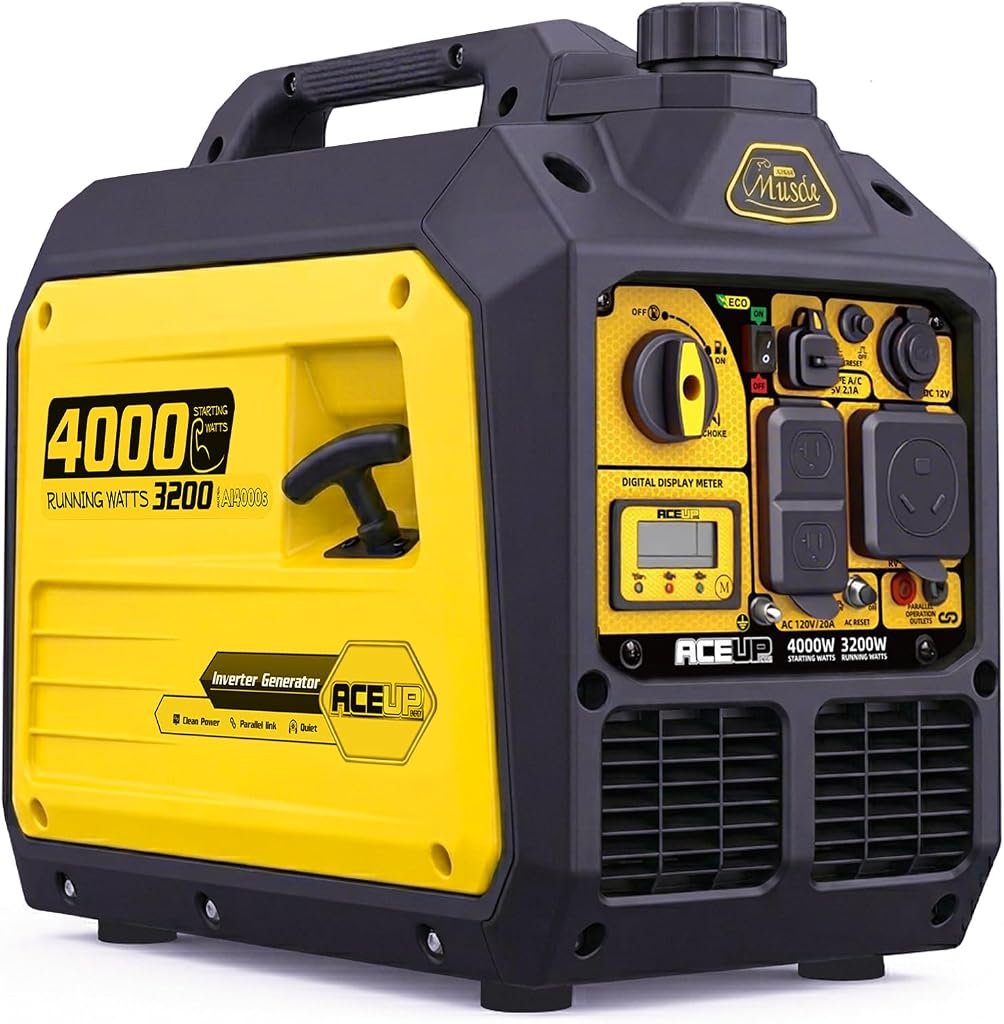
The Aceup Energy AI4000S sits in an interesting part of that market. Its headline figure is 4,000 starting watts, but its rated continuous output is 3,200 watts. The generator uses a 149cc four-stroke OHV gasoline engine, operates at 120 volts and 60 Hz, and starts through a recoil system. The manufacturer specifies a 1.32-gallon fuel capacity and up to eight hours of operation at half load.
Those numbers establish the AI4000S as a medium-output portable inverter generator rather than a substitute for a permanently installed whole-house generator. That distinction matters. A machine in this class makes more sense as a selective-power tool: refrigeration, electronics, lighting, camping equipment, RV loads, and other carefully managed appliances rather than every circuit in a house simultaneously.
At $399.99 in the configuration evaluated here, the proposition is largely about how much usable inverter-generator capability is available for the money. Our Score is 8.31/10, while Customer Sentiment is 8.06, Buyer Confidence reaches 9.33, and Value stands at 8.03. The unusually high Buyer Confidence figure is the revealing number of the four. This is not a generator whose appeal rests solely on low cost. Its specification sheet presents a coherent package for a defined class of user, although there are meaningful limitations.
4,000 Watts Does Not Mean 4,000 Watts All Day
Generator wattage needs translation before it becomes useful.
The AI4000S is rated for 4,000 starting watts and 3,200 running watts, according to the manufacturer’s AI4000S product specifications. Starting wattage represents the short-duration capacity available when equipment such as compressors or motors initially demands more electricity. Running wattage is the more useful figure when calculating what can remain connected once everything is operating.
That leaves 800 watts between rated and starting capacity.
The distinction can prevent an expensive purchasing mistake. Someone who sees “4000W” and constructs a 4,000-watt continuous load plan has already exceeded the generator’s rated continuous output. A more disciplined portable generator buying guide starts with the running loads, then adds the largest relevant startup surge rather than treating the number printed on the generator as an unlimited electrical budget.
A hypothetical load calculation demonstrates the point. Suppose several connected devices collectively consume 2,200 running watts. That leaves roughly 1,000 watts beneath the generator’s 3,200-watt running rating. Whether another motor-driven appliance can be started depends on that appliance’s actual starting requirement and what else is operating at that moment.
The correct numbers come from appliance labels, manuals, or manufacturer specifications. Guessing is poor load management.
This also explains why a 3,200-running-watt generator can feel surprisingly capable in one household and restrictive in another. A refrigerator, lights, router, television, and several chargers create a very different electrical profile from electric resistance heating, a large air conditioner, a water heater, or workshop machinery.
Inverter Architecture Is the More Interesting Feature
Raw wattage is only part of the AI4000S story. It is an inverter generator rather than a conventional open-frame generator.
The manufacturer describes its output as clean power intended for electronics including phones and televisions. The enclosure also distinguishes the machine from basic open-frame designs, with the manufacturer claiming a noise level of 55 dB measured at 23 feet on the official Aceup Energy AI4000S product page.
That 55 dB figure should be read with appropriate discipline. Sound measurements change with distance, operating load, surroundings, measurement method, and orientation. A manufacturer figure does not mean the machine will always produce precisely that sound level during real use.
Still, enclosure and inverter operation make conceptual sense for camping, RV use and residential backup situations where a generator may run for hours rather than minutes.
The economic mode adds another practical element. Instead of treating engine speed as entirely detached from electrical demand, Eco operation is intended to reduce unnecessary fuel use under lighter loads. The machine also incorporates a digital gauge for voltage, frequency, runtime and power output, according to the manufacturer.
For an owner trying to manage a finite 3,200-watt running capacity, that monitoring function is more useful than decorative electronics. Load awareness is one of the central disciplines of small-generator ownership.
Fuel Capacity and Runtime Need Context
The AI4000S uses gasoline exclusively in the configuration reviewed here. Its 149cc four-stroke OHV engine draws from a 1.32-gallon tank, and the manufacturer states up to eight hours of operation at half load.
That claim works out to a simple theoretical average of about 0.165 gallon per hour over the stated eight-hour period. It should not be treated as a universal consumption rate. Generator fuel consumption changes with electrical load, operating conditions and engine behavior.
Runtime claims can be particularly misleading when shoppers compare generators without checking the test load. Eight hours at half load is not equivalent to eight hours at maximum rated output.
There is also an operational issue that specification comparisons often miss: gasoline storage and maintenance. A backup generator can spend far more time sitting than running. The manufacturer advises emptying the fuel system before storage of 30 days or longer to avoid engine problems.
That instruction deserves attention from emergency-preparedness buyers. A generator that ran perfectly after purchase but was then stored improperly for a long period may be a very different machine when the next outage arrives. Periodic inspection, fuel management and scheduled maintenance are part of ownership, not optional housekeeping.
The Outlet Selection Is Sensibly Varied
The AI4000S provides several ways to use its output rather than forcing every application through identical household receptacles.
The manufacturer lists a 120V AC 20A outlet, an L5-30R twist-lock receptacle, a 12V DC 8.3A outlet, and dual 5V USB charging ports through a USB car charger. It is also parallel-ready, allowing two compatible generators to be connected with a separately sold parallel kit.
That selection broadens the machine’s usefulness for camping and temporary power.
The L5-30R connection is particularly relevant to users whose equipment is configured around a locking 30-amp connection, although connector compatibility should always be checked before purchase. “RV-ready” language is less useful than inspecting the exact plug and receptacle required by the RV or adapter arrangement.
Parallel capability is similarly useful but should not be mistaken for additional power already present in the box. Obtaining more output requires a second compatible generator and the necessary connection equipment. For buyers who expect 3,200 running watts to cover their needs, the feature may never matter. For those whose requirements could grow, it provides an expansion path.
Portability Is Relative, but the AI4000S Stays Manageable
The manufacturer lists the AI4000S at 50.7 pounds, with dimensions of 19.68 by 11.8 by 17.7 inches.
Fifty pounds is portable in the literal sense, but it is not effortless cargo. Fuel adds additional mass, and lifting a generator repeatedly into a truck bed, RV storage compartment, or elevated shelf is different from moving it a few feet across level ground.
Yet this weight remains one of the more persuasive parts of the design. The machine delivers 3,200 running watts without moving into the much heavier physical category associated with larger backup generators. For campers and RV users who need a machine to travel with them, physical dimensions can matter nearly as much as rated output.
The narrow 11.8-inch dimension is also useful where storage space is constrained.
Buyers should measure the intended storage compartment rather than relying on a visual impression of compactness. Clearance requirements during operation are an entirely separate issue: a generator cannot safely be run simply because it physically fits into a garage, shed, RV compartment, or covered storage space.
Safety Changes the Entire Ownership Equation
Gasoline generator reviews that spend pages discussing watts and decibels but barely address carbon monoxide miss the highest-stakes part of ownership.
The Centers for Disease Control and Prevention’s carbon monoxide guidance says portable generators should be operated outdoors, more than 20 feet from windows, doors and vents. The agency also advises using a battery-powered or battery-backup carbon monoxide detector inside the home. A garage does not become a safe generator location because its door is open.
The distance requirement has practical consequences. Buyers need suitable outdoor space and sufficiently long, correctly rated cords. The generator’s advertised portability does not relax those requirements.
Electrical connection to a home requires equal care. Male-to-male extension cords used for generator backfeeding can create electrocution and fire risks.
For appliances connected directly to a portable generator, properly rated outdoor extension cords are the appropriate route. Supplying installed household wiring is a different project and calls for suitable transfer equipment and professional electrical installation where required.
This is one area where improvisation can turn a useful backup-power machine into a serious hazard.
What the 8.31/10 Score Actually Says
Our Score of 8.31/10 places the AI4000S in very good territory, but the number makes more sense when separated into the underlying editorial judgments.
Customer Sentiment is 8.06. That is positive without being treated as evidence of universal satisfaction. Generators are unusually dependent on workload, storage practices, maintenance, altitude, ambient conditions and user expectations. A buyer expecting selective backup power is evaluating a different proposition from someone expecting whole-house independence.
Buyer Confidence is substantially higher at 9.33. That is the standout rating. The specification package is straightforward: 4,000 starting watts, 3,200 running watts, a 149cc four-stroke engine, 120V output, recoil starting, digital monitoring, multiple output types and parallel capability. There is enough definition here for a buyer to determine whether the machine matches a planned load profile.
Value scores 8.03. At the evaluated price of $399.99, the attraction comes from the combination of inverter architecture, 3,200 running watts and useful connectivity rather than a single unusual feature.
The gap between Buyer Confidence at 9.33 and Value at 8.03 is informative. The AI4000S is easier to understand than it is to declare an automatic bargain for every generator buyer. Gas-only operation, recoil starting and finite 120V capacity impose boundaries. Someone who needs dual-fuel flexibility, electric starting, much higher sustained output or a different electrical architecture should treat those requirements as purchase filters rather than minor preferences.
Where the AI4000S Makes the Most Sense
The generator’s strongest use cases emerge from the intersection of power, size and inverter design.
For camping, 3,200 running watts creates considerably more flexibility than a very small inverter generator while retaining a roughly 50-pound form factor. For RV applications, the combination of substantial temporary output and an L5-30R receptacle can be useful when the connection arrangement is compatible.
For emergency residential use, its best role is selective backup rather than indiscriminate household power.
A disciplined outage plan might prioritize refrigeration, communications, modest lighting and selected electronics, then rotate higher-demand appliances rather than attempting to run everything simultaneously. Motor-starting surges should be calculated before the outage, not discovered through repeated overloads during one.
It also makes sense for buyers who place value on direct USB charging and a display showing operational information. Neither feature changes the underlying electrical capacity, but both improve day-to-day usability.
The Drawbacks Are Concrete
The AI4000S has several limitations that deserve equal billing with its strengths.
First, 3,200 running watts is the real continuous-power ceiling to plan around. The 4,000-watt figure describes starting capacity. Anyone whose normal loads approach 4,000 watts should move to a larger generator rather than attempting to manage an undersized one at its limits.
Second, this is a gasoline machine. Buyers seeking propane as an alternative fuel will need another configuration or product. Gasoline can be widely accessible, but long-term storage and fuel-system care add ownership work.
Third, recoil starting is mechanically simple but less convenient than electric start. That difference becomes more noticeable for users with limited grip strength or mobility, or during repeated cold starts.
Fourth, approximately 50.7 pounds is manageable but not featherweight. Buyers expecting one-handed portability should reset that expectation before purchase.
Finally, the manufacturer’s stated sound figure of 55 dB at 23 feet should be treated as a defined test claim, not a promise of identical noise in every campsite or backyard. Load and surroundings matter.
None of those limitations makes the machine poorly designed. They define its category.
A Better Way to Decide Before Buying
The most reliable purchase process starts with appliances rather than generators.
Before choosing the AI4000S, a buyer should:
- Record the running wattage of every appliance expected to operate simultaneously.
- Identify startup requirements for refrigerators, pumps, air conditioners and other motor-driven loads.
- Keep the planned sustained load within the generator’s 3,200-watt rating.
- Verify that the generator’s receptacles match the intended cables, adapters and equipment.
- Plan a safe outdoor operating location more than 20 feet from doors, windows and vents.
- Obtain appropriately rated outdoor extension cords for the actual electrical load and required distance.
- Install and maintain carbon monoxide alarms in the residence.
- Decide whether gasoline-only operation fits the intended emergency or travel plan.
- Account for roughly 50 pounds of generator weight before choosing its storage and transport location.
- Establish a fuel-storage and maintenance routine before the generator spends months waiting for its first emergency.
This exercise frequently reveals whether 3,200 running watts is abundant, marginal, or insufficient long before money changes hands.
Final Considerations
The Aceup Energy AI4000S is most coherent when evaluated as a compact 3,200-running-watt inverter generator with 4,000 watts available for startup demands-not as an all-purpose 4,000-watt household power plant.
That framing explains our 8.31/10 score.
Its appeal rests on a practical combination: a 149cc four-stroke engine, inverter output, 120V operation, several connection options, digital monitoring, Eco operation, parallel capability and a package weighing about 50.7 pounds. The $399.99 evaluated price strengthens that equation, reflected in our 8.03 Value rating.
The 9.33 Buyer Confidence score is even more revealing. The AI4000S has a fairly legible identity. It is aimed at buyers who can work within a 3,200-watt continuous-power budget and who prefer a relatively compact gasoline inverter generator over a larger conventional unit. Customer Sentiment at 8.06 supports the broader assessment without erasing the compromises inherent in this power class.
Those compromises should guide the purchase. Recoil starting will not satisfy everyone. Gas-only operation removes the flexibility of propane. The unit cannot erase the need for load calculations, safe outdoor placement, suitable extension cords or proper household transfer equipment. And no noise specification changes the fact that a combustion engine is running nearby.
For the right buyer, however, those are defined boundaries rather than hidden defects. The AI4000S offers enough output to handle meaningful temporary-power duties while remaining small enough to travel and store without the logistical burden of a large backup generator.
The final decision should therefore be made with a calculator rather than an impression of the “4000W” label. If the intended simultaneous running load sits comfortably below 3,200 watts, startup surges fit beneath the available ceiling, 120V output meets the application, and gasoline operation is acceptable, the AI4000S presents a well-balanced case. If those conditions are not met, a larger or differently fueled generator is the more rational direction.
Portable power works best when the generator is selected around a known electrical plan. The AI4000S rewards exactly that kind of buyer.