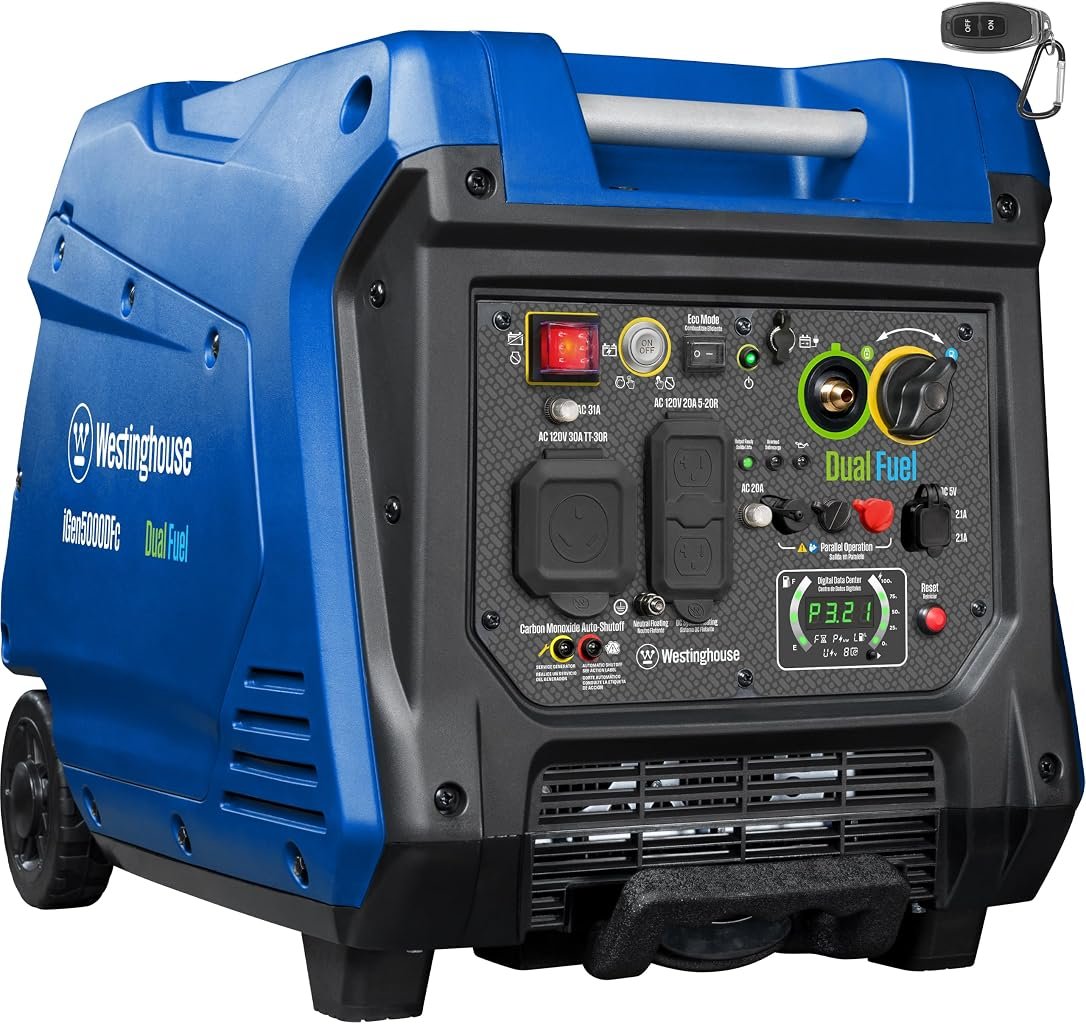
The Westinghouse iGen5000DFc is built around a set of compromises that make more sense when examined together than when reduced to the 5,000-watt number printed on the specification sheet. It is a 120V dual-fuel inverter generator with remote starting, RV connectivity, an enclosed housing, digital monitoring, automatic carbon-monoxide shutdown, and enough sustained output to support selective household backup or demanding recreational loads.
The electrical limits deserve attention first. Westinghouse identifies the iGen5000DFc as producing 5,000 peak watts and 3,900 running watts on gasoline, or 4,500 peak watts and 3,500 running watts on propane. It uses a 224cc engine, operates at 120V, and produces power with total harmonic distortion of 3% or less.
Our score is 8.86/10, accompanied by Customer Sentiment of 8.72, Buyer Confidence of 9.8, and Value of 8.4. Those ratings reflect a machine whose greatest advantage is not maximum output in isolation. Its case rests on the combination of dual-fuel flexibility, inverter-grade electricity, usable surge capacity, remote starting, substantial runtime, an RV-ready outlet, mobility hardware, and several layers of automatic protection.
That combination also explains why the iGen5000DFc should not be judged as a generic 5,000-watt generator. The machine has a much more specific identity.
The 5,000-Watt Number Needs Immediate Qualification
Generator names routinely emphasize peak output because peak wattage is the larger number. Electrical planning has to begin elsewhere.
The iGen5000DFc supplies 3,900 continuous watts on gasoline. Its 5,000-watt gasoline rating represents temporary peak capacity. Propane lowers the corresponding figures to 3,500 running watts and 4,500 peak watts.
The distinction matters whenever motors or compressors are involved.
Refrigerators, pumps, air conditioners, freezers, and power tools can demand considerably more electricity during startup than during steady operation. A generator therefore needs short-duration capacity beyond the ordinary running load.
On gasoline, the Westinghouse has 1,100 watts of peak headroom above its continuous rating. On propane, the difference is 1,000 watts.
That reserve is useful, but it does not transform 5,000 watts into a permanent electrical budget.
A household already consuming close to 3,900 watts continuously leaves little room for another motor-driven appliance to start. The more disciplined approach is to calculate continuous loads first, identify startup requirements separately, and preserve operating margin.
This belongs near the beginning of any serious portable generator buying guide. Peak watts explain what a generator may tolerate briefly. Running watts describe the workload it is designed to carry over time.
Dual Fuel Creates Two Different Electrical Budgets
Dual-fuel capability is sometimes treated as though the only difference is what gets poured or connected to the generator. The iGen5000DFc demonstrates why that interpretation is incomplete.
Gasoline provides 3,900 running watts. Propane provides 3,500.
That is a reduction of 400 continuous watts, or roughly 10% of the gasoline rating.
The difference becomes relevant near the generator’s upper operating range. A combination of appliances consuming 3,700 watts may fit within the gasoline rating while exceeding the propane rating before startup surges are considered.
Owners therefore need two load plans rather than one.
The benefit is resilience.
Gasoline is familiar and energy-dense, but storing it for emergency use requires attention to containers, age, and safe handling. Propane offers a second fuel pathway and can be stored in approved cylinders until needed. During a prolonged outage, access to two fuels can reduce dependence on a single supply chain.
The trade is straightforward: propane expands fuel choice while reducing available electrical output.
For many households, 3,500 watts still covers a carefully selected group of essential loads. The owner simply needs to know which appliances remain within that smaller budget.
The 224cc Engine Supports a Refined Inverter System
Westinghouse pairs the electrical system with a 224cc engine. The manufacturer’s quick-start documentation specifies a 3.4-gallon gasoline tank, 0.6-liter oil capacity, and SAE 10W-30 oil.
Those mechanical details matter because an inverter generator remains an internal-combustion machine.
The inverter electronics affect how electricity is produced and conditioned. They do not eliminate engine oil, fuel management, spark ignition, air filtration, exhaust, cooling, or maintenance.
What inverter architecture changes is the relationship between engine operation and electrical output.
Conventional portable generators typically depend on engine speed being closely tied to AC frequency. Inverter generators can generate electricity, electronically process it, and produce controlled AC output with lower harmonic distortion.
Westinghouse specifies total harmonic distortion at or below 3% for this generator family.
That figure is especially relevant when backup power includes computers, televisions, chargers, networking hardware, electronic appliance controls, and other equipment containing sensitive circuitry.
Low-THD output does not make every electrical decision automatic. Loads still need to fit the generator’s wattage and voltage limits. It does make the iGen5000DFc a materially different proposition from a basic open-frame conventional generator.
Gasoline Runtime Can Reach 18 Hours at Light Load
Westinghouse rates the carbureted iGen5000DFc for up to 18 hours of runtime at 25% load.
The load condition is essential to interpreting that number.
Twenty-five percent of the 3,900-watt gasoline running rating is approximately 975 watts. The maximum runtime therefore describes a relatively modest electrical demand rather than sustained operation near full capacity.
That does not make the figure trivial.
A carefully managed emergency load can spend substantial periods around or below one kilowatt. Refrigeration cycles rather than drawing maximum power continuously. LED lighting has modest demand. Routers, phones, laptops, and communications equipment can add relatively little. Selected appliances can be operated sequentially rather than simultaneously.
Heating appliances change the calculation quickly.
A single high-wattage resistance heater can consume much of a 975-watt target by itself. Electric cooking appliances, pumps, air conditioners, and other demanding equipment also increase fuel consumption and reduce runtime.
The practical lesson is that runtime is partly a load-management problem.
A large tank helps. So does resisting the temptation to energize every available appliance merely because another receptacle remains unused.
Inverter Output Is One of the Product’s Central Advantages
The iGen5000DFc’s inverter architecture affects more than electronic compatibility.
An inverter generator can adjust engine behavior according to demand rather than treating a light load and a heavy load identically. That contributes to the product’s ability to stretch a 3.4-gallon gasoline supply during modest operation.
It also changes the acoustic character of the machine.
An engine working under light demand does not need to behave exactly as it does when output approaches the generator’s continuous ceiling. The result can be lower fuel consumption and less noise during modest use.
That distinction is particularly relevant in RV applications.
Camping loads often fluctuate. An air conditioner may cycle. A refrigerator compressor switches on and off. Lighting demand can be small. Chargers and electronics consume power intermittently.
A generator capable of responding to those changing conditions is better aligned with such a load pattern than a design whose operating behavior changes little regardless of demand.
The TT-30R Outlet Gives It an Obvious RV Role
Westinghouse equips the iGen5000DFc with an RV-ready TT-30R outlet, two 20A household outlets, and USB connections.
That arrangement gives the machine a clear recreational-vehicle application.
The TT-30R receptacle provides a familiar 120V connection for 30A RV electrical systems. Yet the receptacle rating should never be confused with unlimited generator output.
On gasoline, 3,900 watts divided by 120 volts equals 32.5 amps. Westinghouse’s documentation lists the gasoline current rating at 32.5A and the propane figure at 29.2A.
The generator’s output ceiling still governs everything connected to it.
An RV air conditioner can create a substantial startup surge. Add a microwave, coffee maker, electric water heater, refrigerator, converter, and other loads, and the electrical budget can disappear quickly.
The TT-30R outlet simplifies the connection. It does not remove the need to decide which loads should operate together.
Remote and Electric Starting Improve Accessibility
The iGen5000DFc includes push-button electric starting and wireless remote starting.
Those features do nothing to increase the generator’s wattage. They can substantially change everyday usability.
Pull-starting an engine requires physical effort and direct access to the machine. Electric starting removes much of that effort. Remote starting adds another layer of convenience once the generator is correctly positioned and prepared for operation.
This can matter for users with limited grip strength or shoulder mobility. It can also make repeated starts and stops less burdensome during recreational use.
There is a corresponding ownership obligation.
Electric starting depends on a battery. A generator stored for long periods cannot simply be assumed to have a healthy starting system months later. Emergency equipment benefits from periodic inspection because batteries age even while the engine is silent.
The iGen5000DFc still retains the fundamental demands of a gasoline or propane engine. Remote starting changes the interface, not the underlying machinery.
The LED Data Center Reduces Guesswork
The generator also includes an LED data center that provides operating information in real time. Westinghouse describes the digital display as part of the iGen5000DFc’s standard equipment.
Instrumentation matters because generator loading is rarely static.
A refrigerator cycles. A pump starts. An air conditioner compressor engages. Someone plugs in another appliance. The total electrical demand changes even when the number of connected cords remains constant.
Digital operating information helps the user manage that shifting electrical budget with more discipline.
The same logic applies to maintenance. Operating hours are more useful than vague recollection when oil changes and other service tasks depend on accumulated use.
During a multi-day outage, that information becomes increasingly useful. Generator management stops being a single startup event and becomes a repetitive routine involving fuel, loads, operating time, and maintenance awareness.
Enclosed Construction Changes the Portability Equation
The iGen5000DFc uses an enclosed design rather than the exposed steel-frame architecture associated with many conventional portable generators.
That enclosure helps address noise, protects internal components, and gives the machine a more compact physical arrangement.
It does not make the generator weightless.
The design uses wheels and an extendable suitcase-style handle to move the machine. Westinghouse specifically presents those components as part of the generator’s portability strategy.
This distinction matters because generator portability is often discussed too casually.
There is a large practical difference between equipment that can be carried comfortably and equipment that can be rolled effectively. Wheels solve much of the movement problem across pavement, garage floors, campsites, and reasonably firm ground. Stairs, deep gravel, mud, and vehicle loading are different problems.
The correct question is not simply whether a generator is portable. It is whether its mobility system fits the route between storage, transport, and the safe outdoor operating position.
Dual Fuel Does Not Mean Maintenance-Free
The availability of propane can reduce reliance on stored gasoline, but the engine still needs routine care.
Westinghouse’s maintenance documentation identifies oil checks and scheduled service for engine oil, the air filter, spark plug, spark arrestor, fuel filter, and valve clearance. The quick-start guide specifies a 0.6-liter oil capacity and SAE 10W-30.
This matters especially for emergency generators because inactivity creates its own problems.
A machine may sit for months between outages. Fuel condition changes. Batteries discharge and age. Dust accumulates. Owners forget how long the engine ran during the previous event.
Preparedness therefore includes maintenance during periods when the generator is not urgently needed.
The machine’s real emergency capability is not its factory rating alone. It is the combination of that rating and its mechanical condition when the power fails.
The CO Sensor Addresses a Hazard That Electronics Cannot Eliminate
The iGen5000DFc includes automatic carbon-monoxide shutdown, along with low-oil shutdown, voltage regulation, and overload protection.
The CO sensor is meaningful. It is also secondary to correct placement.
The U.S. Consumer Product Safety Commission’s carbon-monoxide guidance states that more than 100 U.S. deaths each year are linked to portable generators. CPSC also says a single portable generator can produce the same amount of carbon monoxide as hundreds of cars.
CPSC instructs consumers to operate portable generators outdoors only, at least 20 feet from the home, with exhaust directed away from buildings. The agency warns against operating them inside homes or garages even when doors and windows are open.
The historical toll adds context. CPSC estimated that about 750 people died from carbon-monoxide poisoning associated with generators from 2012 through 2022. Its 2026 generator-safety guidance reports that figure directly.
Those numbers explain why an automatic CO sensor belongs in the safety discussion.
They also explain why the sensor cannot be treated as permission to run the generator in a garage, shed, basement, crawlspace, porch, or other unsafe location.
Automatic shutdown is a backup defense. Distance and outdoor placement remain the primary controls.
Gasoline and Propane Do Not Change the CO Rule
There can be a false sense of safety around propane because it is often associated with cleaner combustion than gasoline.
Cleaner is not the same as free of carbon monoxide.
Both fuels are burned in an internal-combustion engine. The generator therefore belongs outdoors regardless of which fuel is selected.
That point is particularly relevant to dual-fuel ownership because propane cylinders can make a generator feel more like familiar outdoor cooking equipment. The electrical output may change when the fuel selector moves, but the placement rule does not.
The safest planning occurs before the outage.
The owner needs a location at least 20 feet from the home, with exhaust facing away, suitable protection consistent with manufacturer instructions, and correctly rated electrical connections reaching the intended loads.
Working CO alarms inside occupied buildings add another defensive layer.
What the Editorial Scores Mean
Our 8.86/10 overall score reflects a generator that combines useful output with a relatively refined operating package.
The standout figure is Buyer Confidence at 9.8.
That rating reflects specification transparency and a design whose limits can be identified before purchase. Gasoline and propane ratings are separately stated. Peak and running watts are separately stated. The generator’s 120V architecture, 224cc engine, fuel capacity, low-THD output, outlet configuration, starting methods, safety systems, and maintenance requirements are documented.
That makes load planning considerably easier.
Customer Sentiment at 8.72 sits close to our overall assessment. The generator combines several attributes that work logically together: inverter output, dual fuel, remote starting, RV connectivity, long light-load runtime, digital monitoring, an enclosed housing, and mobility hardware.
Its compromises remain real.
It is still a combustion generator. It produces exhaust. It needs maintenance. Gasoline requires safe storage and handling. Propane reduces available output. The machine is restricted to 120V rather than providing 240V service.
Value at 8.4 is the lowest of the four ratings because much of the iGen5000DFc’s appeal comes from refinement beyond raw wattage.
A simpler open-frame generator may provide similar continuous output with fewer convenience systems. The Westinghouse directs more of its engineering toward inverter power, sound management, remote starting, digital information, fuel flexibility, RV use, and protective electronics.
Those features create value only when the owner benefits from them.
Where the iGen5000DFc Fits Best
The generator makes the most sense where 120V output, dual-fuel flexibility, and refined operation matter simultaneously.
Likely applications include:
- selective household backup for refrigerators, freezers, lighting, communications equipment, and other compatible 120V loads;
- RV use where a TT-30R connection and inverter output are useful;
- emergency planning where gasoline and propane provide two fuel options;
- camping where an enclosed inverter design is preferable to an exposed conventional generator;
- users who value remote and push-button starting;
- households powering electronics alongside ordinary appliances;
- applications where long light-load runtime reduces refueling frequency;
- buyers who prefer a wheeled, suitcase-style mobility system rather than an exposed steel frame.
The iGen5000DFc is less suitable when the electrical plan requires 240V equipment or substantially more than 3,900 watts of sustained output.
A 240V well pump, for example, cannot be made compatible merely because the generator has sufficient theoretical wattage for the motor.
Voltage comes first.
The Strengths and Drawbacks Are Closely Connected
The iGen5000DFc’s strongest features create corresponding limits.
Dual fuel increases resilience but produces different output ceilings. The enclosed inverter architecture improves electrical refinement and sound management but adds hardware beyond a basic generator. Electric and remote starting improve accessibility but introduce a battery that needs attention.
A 3.4-gallon tank supports long light-load operation, yet the maximum runtime depends on operating far below full capacity.
The TT-30R outlet makes RV connection straightforward, but the generator remains bounded by its overall 120V output.
CO shutdown adds meaningful protection, but it does not make unsafe placement acceptable.
This pattern is why the generator’s high editorial rating should not be interpreted as universal suitability. The iGen5000DFc solves a specific group of problems unusually coherently. Buyers whose needs fall outside those boundaries should select a different electrical architecture rather than forcing this one into the wrong job.
Final Considerations
The Westinghouse iGen5000DFc earns its 8.86/10 score by combining 5,000 gasoline peak watts, 3,900 gasoline running watts, 4,500 propane peak watts, and 3,500 propane running watts with inverter electronics, dual-fuel operation, RV connectivity, remote starting, digital monitoring, and automatic carbon-monoxide shutdown.
Its 224cc engine and 3.4-gallon gasoline tank provide the mechanical foundation. Its inverter system keeps total harmonic distortion at or below 3%. The TT-30R outlet gives the machine a defined RV role, while household outlets and USB connections broaden its usefulness.
The 9.8 Buyer Confidence score is the strongest editorial rating because the machine’s capabilities are unusually straightforward to map against a real electrical plan.
Customer Sentiment at 8.72 reflects the balance between refinement and the unavoidable demands of combustion generation. The iGen5000DFc is easier to start and more electronically sophisticated than many conventional generators, but it still needs fuel, oil, maintenance, outdoor placement, and disciplined load management.
Value at 8.4 is more measured because buyers are paying for more than watts. Dual fuel, inverter output, an acoustic enclosure, remote starting, digital information, wheels, an extendable handle, RV connectivity, and safety shutdowns all add functionality without raising the 3,900-watt gasoline running ceiling.
The buying process should begin with arithmetic.
List every appliance that must operate during an outage. Separate running demand from startup demand. Calculate the plan against the 3,900-watt gasoline ceiling and then repeat it against the 3,500-watt propane ceiling. Verify that every required load is compatible with 120V operation.
Then build the fuel strategy.
Decide how gasoline will be stored and rotated. Identify the propane supply that will be available. Account for the 400-watt reduction in running output before switching fuels under pressure during an outage.
Finally, establish the operating location. CPSC guidance calls for outdoor use at least 20 feet from the home with exhaust directed away from buildings. That requirement needs to coexist with correctly rated cords, weather planning, security, and a practical path for moving the generator into position.
Viewed through those requirements, the iGen5000DFc is more accurately described as a 3,900-running-watt gasoline and 3,500-running-watt propane inverter generator with substantial surge capacity, rather than simply a 5,000-watt machine.
That distinction does not diminish the generator. It explains why the product works.
The iGen5000DFc offers enough sustained power for meaningful selective backup and RV use, enough surge capacity for many motor-driven loads, two fuel choices, low-THD inverter output, and an operating interface intended to reduce friction during use.
Its limitations are equally defined: 120V only, lower output on propane, finite fuel capacity, combustion exhaust, mechanical maintenance, and the need for safe outdoor operation.
For a buyer whose electrical plan fits inside those boundaries, the Westinghouse presents a carefully integrated answer to portable backup power. The value is not hidden in one oversized number. It lies in how fuel flexibility, electrical quality, starting convenience, runtime, connectivity, mobility, and safety protection function as a single system.