Portable generators are unusually easy products to misunderstand. A large wattage number dominates the label, runtime appears farther down the specification sheet, and features such as Bluetooth can attract more attention than the less glamorous questions of sustained output, fuel capacity, noise, electrical connections, and carbon-monoxide protection.
The maXpeedingrods MXR4000 is a useful example. The headline figure is 4,000 watts, but the machine is rated for 3,200 watts of continuous output. That difference matters far more than the typography on the casing.
Our score for the maXpeedingrods 4000W Inverter Generator with Bluetooth is 8.23/10. Customer Sentiment stands at 7.84, Buyer Confidence at 9.71, and Value at 7.91. Those numbers describe a generator with a convincing core specification and unusually high confidence as a buying proposition, tempered by the ordinary compromises of a compact gasoline generator and by features whose usefulness varies substantially according to how the machine will be used.
The broader editorial judgment is straightforward: this is better understood as a 3,200-watt portable inverter generator with 4,000 watts of short-duration peak capacity than as a limitless “4,000-watt generator.” Viewed through that more accurate lens, the MXR4000 becomes considerably easier to assess.
The 4,000-Watt Number Needs Context
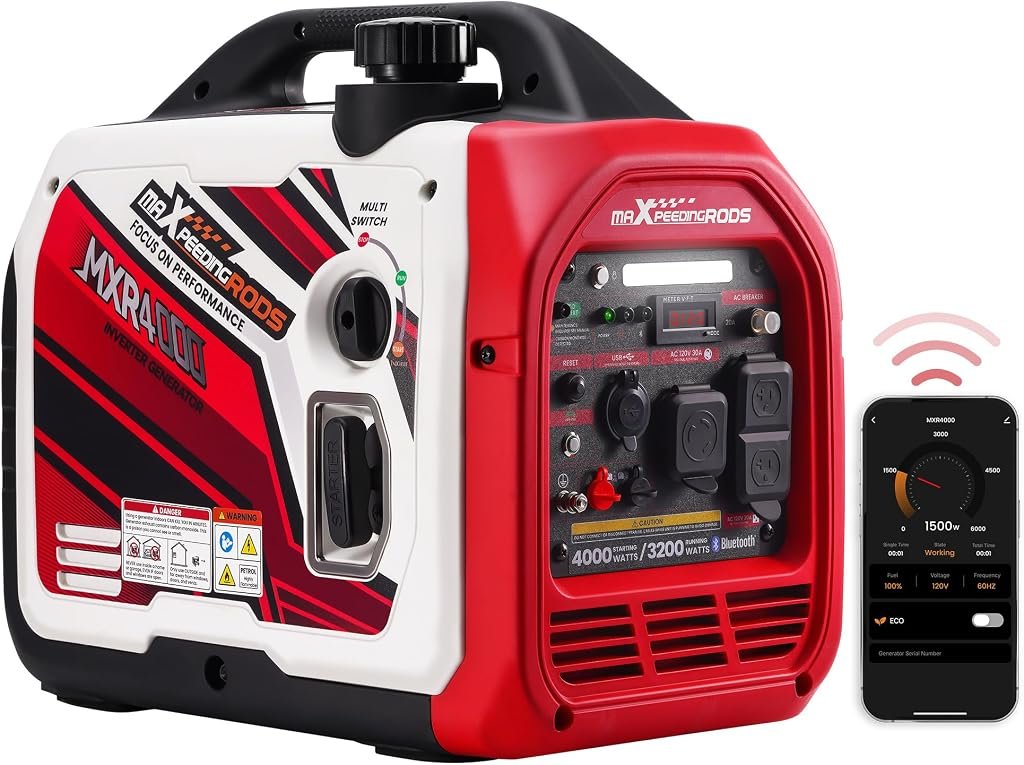
According to the official maXpeedingrods MXR4000 specification, the gasoline generator is rated at 4,000 peak watts and 3,200 running watts. Its engine is a 145 cc, four-stroke, air-cooled OHV unit. The manufacturer specifies 120-volt, 60 Hz AC output for the U.S. model.
That 800-watt gap between peak and running output is not a footnote.
Peak capacity accommodates temporary surges. Electric motors and compressors can demand substantially more power during startup than after they settle into operation. Continuous wattage, by contrast, is the figure that should anchor ordinary load planning.
A buyer looking at refrigerators, lights, chargers, electronics, a television, or selected RV equipment should therefore build the power budget around 3,200 watts, while leaving additional headroom for startup loads. Simply adding appliance nameplate wattages until the total reaches 3,200 watts is an unnecessarily aggressive strategy because simultaneous startup events can create short spikes.
This distinction belongs near the beginning of any serious portable generator buying guide: advertised peak wattage describes one boundary of capability, not the amount of electrical load that should be treated as continuously available.
The MXR4000 provides 26.7 running amps at 120 volts according to the manufacturer. That figure is consistent with the 3,200-watt rating: 3,200 divided by 120 is approximately 26.7 amps. The numbers therefore tell a coherent electrical story rather than asking the buyer to infer usable capacity from a larger marketing figure.
Inverter Architecture Is More Meaningful Than Bluetooth
Bluetooth is the feature that differentiates the MXR4000 at a glance, but inverter architecture is the more consequential engineering characteristic.
The manufacturer describes the output as pure sine-wave power intended for electronics and other sensitive devices. Unlike a basic conventional generator whose engine speed is closely tied to output frequency, an inverter generator electronically conditions its electrical output. The architecture also allows engine behavior to respond more intelligently to load, which is why Eco modes are common in this category.
The MXR4000 includes such an Eco setting.
Its usefulness is practical rather than theatrical. A generator spending much of an evening running modest loads does not face the same demand as one supplying a large appliance near its rated capacity. Allowing engine operation to respond to demand can reduce unnecessary fuel consumption and noise during lighter loading.
That leads to one of the MXR4000’s more attractive combinations: 3,200 running watts from a machine the manufacturer lists at only 50.7 pounds.
Its stated dimensions are 18.9 by 12 by 17.32 inches. “Portable” still deserves context-50.7 pounds is substantial when carried over distance-but this is far removed from the mass and footprint of many higher-output open-frame generators.
The suitcase-style enclosure also makes the machine easier to store than a sprawling tubular-frame design. For RV owners, campers, mobile users, or households with limited storage, physical dimensions can be nearly as consequential as output.
Bluetooth Is Useful, but It Should Not Drive the Purchase
Bluetooth connectivity can easily become the headline feature because conventional generators are fundamentally mechanical appliances. Adding an app gives the MXR4000 a distinctly modern interface.
The manufacturer’s Bluetooth system can display voltage, frequency, real-time load power, remaining fuel information, individual runtime, accumulated runtime, and generator status. It also permits Eco-mode control.
Those functions are more useful than remote connectivity might initially sound.
Real-time load information can help an owner understand how much electrical capacity is actually being consumed instead of estimating from appliance labels. Accumulated runtime can assist with maintenance scheduling. Voltage and frequency monitoring put operating information in a more convenient location.
Yet Bluetooth should remain secondary in the purchasing decision.
A portable generator must remain useful when a phone is unavailable, an application changes, or wireless communication becomes inconvenient. Engine quality, electrical capacity, outlets, safety systems, runtime, parts support, and serviceability have longer useful lives than an app interface.
There is another distinction that deserves attention. maXpeedingrods sells multiple 4 kW-class generator configurations, including models with different starting and fuel arrangements. The gasoline MXR4000 specification reviewed here should not be casually conflated with the company’s dual-fuel Bluetooth/electric-start models. Buyers comparing listings should check the exact model and specification rather than assuming every visually similar 4,000-watt version has identical controls.
Runtime Is Respectable, but Load Changes the Equation
The MXR4000 carries a 1.06-gallon gasoline tank. maXpeedingrods specifies up to seven hours of operation at 25% load and four hours at 50% load.
Those percentages translate to approximately 800 watts at quarter load and 1,600 watts at half of the 3,200-watt running rating.
That context makes the runtime figures more useful.
Seven hours sounds generous when detached from load. Seven hours while producing around 800 watts describes something more specific: an operating pattern suited to modest sustained demand rather than a house drawing several kilowatts continuously.
The four-hour half-load figure likewise suggests that users expecting extended outages should plan fuel storage and refueling intervals rather than treating a single tank as an overnight guarantee under heavier demand.
Fuel consumption also cannot be reduced to one universal figure. Generator loading changes as refrigerators cycle, chargers finish, pumps activate, and appliances are switched on or off. Eco mode adds another variable.
The practical lesson is to treat manufacturer runtime figures as reference points tied to stated load conditions, not promises independent of electrical demand.
Noise Performance Looks Competitive on Paper
maXpeedingrods specifies approximately 58-60 dBA at 23 feet and 25% load.
The test conditions matter.
Sound figures cannot be compared responsibly unless distance and loading are considered. A measurement taken at light load and 23 feet cannot describe what someone standing beside the machine will experience while it is producing close to its maximum continuous output.
Still, 58-60 dBA under the stated conditions is consistent with the basic objective of an enclosed inverter generator: keeping low-load operation substantially more civilized than the stereotypical open-frame generator.
For camping and RV use, this matters for reasons beyond personal comfort. Generator noise travels through campsites, parking areas, and quiet residential streets. Local campground rules may also impose operating-hour or noise restrictions regardless of what the generator itself can achieve.
The MXR4000 therefore has a credible low-load noise specification, but buyers should resist treating a single decibel number as a universal acoustic measurement.
Outlets Make the 3,200 Watts More Accessible
The U.S.-market MXR4000 is listed with two 120V 20A outlets, one 120V 30A outlet, and two USB outlets.
That is a sensible assortment for the machine’s output class.
The 30-amp connection is particularly relevant to RV-oriented use, while conventional 120-volt outlets support common appliances and extension-cord applications. USB outputs reduce the need to consume an AC receptacle merely to charge smaller electronics.
Parallel capability expands the architecture further. The generator can be paired with another compatible unit to increase available output, and maXpeedingrods lists parallel cables among the included accessories for this configuration.
Parallel operation can make sense for someone who needs moderate power most of the time but occasionally requires substantially more. One smaller generator can handle ordinary demand, while a second unit can be added when required.
It is not automatically cheaper or simpler than buying one larger generator, however. Two engines mean two machines to fuel, maintain, transport, and store.
Carbon-Monoxide Protection Is Not Permission to Operate Indoors
The MXR4000 includes a CO alert alongside low-oil and overload protection, with the manufacturer describing automatic shutdown behavior for its protection system. It also states that the model was tested by Intertek to ANSI/PGMA G300-2018.
That deserves context because carbon monoxide remains one of the gravest hazards associated with gasoline generators.
The newer ANSI/PGMA G300-2023 portable-generator standard revised carbon-monoxide shutoff requirements, with the updated edition taking effect for generators claiming compliance and manufactured as completed units on or after January 1, 2025. The standard specifies requirements for CO sensing and, where applicable, remote-start behavior after a CO shutdown event.
No automatic sensor turns a combustion engine into an indoor appliance.
The U.S. Centers for Disease Control and Prevention’s current generator guidance states that generators should be operated outside, more than 20 feet from windows, doors, and vents. The CDC also recommends a battery-powered or battery-backup CO detector inside the home. Its guidance explicitly says not to operate a generator inside a house or garage even with doors and windows open.
The scale of the hazard is measurable. The U.S. Consumer Product Safety Commission reported that nearly 100 U.S. consumers die on average each year from carbon-monoxide poisoning caused by portable generators, citing its latest report on non-fire carbon-monoxide deaths associated with consumer products.
The MXR4000’s CO system is therefore a worthwhile secondary safeguard. It is not a substitute for outdoor placement.
Electrical conditions deserve similar discipline. The CDC recommends heavy-duty, outdoor-rated extension cords and warns against using a generator or connected appliances when wet. Home connection through a transfer arrangement also calls for appropriate electrical equipment and installation rather than improvised backfeeding through household receptacles.
What the Scores Say About the MXR4000
Our 8.23/10 overall score places the MXR4000 firmly in very-good territory without pretending that every buyer needs what it offers.
Its strongest number is Buyer Confidence at 9.71. The reason is not Bluetooth alone. The product has a coherent specification: 3,200 running watts, published load-specific runtime, stated sound conditions, multiple outlets, CO protection, inverter output, parallel capability, and identifiable manufacturer documentation. These are concrete attributes that allow a buyer to judge fit before purchase.
Customer Sentiment is 7.84. That score is positive but less emphatic. Portable generators invite demanding expectations: buyers care about startup behavior, noise, fuel consumption, transport, controls, and reliability simultaneously. A product can make sense technically without every aspect feeling equally refined to every owner.
Value scores 7.91. That reflects a package with meaningful functionality rather than bare-bones generation. Bluetooth monitoring, inverter architecture, parallel capability, CO protection, a digital display, USB connectivity, Eco operation, and a relatively compact enclosure all add utility.
The gap between the 9.71 Buyer Confidence score and the 7.91 Value score is revealing. The MXR4000 is easier to understand and buy with confidence than it is to call an unquestioned bargain. Its appeal rests on the whole package, not merely watts per dollar.
Where the MXR4000 Makes the Most Sense
The strongest use case is selective portable power.
A 3,200-watt continuous ceiling can cover a useful collection of household essentials during an outage when loads are managed deliberately. It can also make sense for camping, RV use, outdoor events, mobile work, and situations where electronics benefit from inverter power.
The machine is particularly well aligned with buyers who value:
- 3,200 watts of sustained output without moving to a much larger generator;
- an enclosed inverter design;
- roughly 50.7-pound transport weight;
- Bluetooth load and operating-data monitoring;
- a 30-amp outlet alongside conventional 120-volt connections;
- CO, low-oil, and overload protection;
- Eco operation for lighter loads;
- parallel capability for later expansion.
The less suitable buyer is someone seeking effortless whole-home backup.
Central air-conditioning, large electric water heaters, electric ranges, clothes dryers, well pumps, and other heavy loads can rapidly consume or exceed a 3,200-watt budget, particularly when motor startup requirements enter the calculation. Homeowners wanting broad automatic backup should evaluate larger generator systems and appropriate transfer equipment rather than asking a compact portable unit to behave like a permanently installed standby system.
The MXR4000 also requires the ordinary commitments of gasoline-engine ownership: fuel handling, oil, periodic maintenance, outdoor operating space, and safe storage. Bluetooth does not remove any of those responsibilities.
The Most Meaningful Strengths and Drawbacks
The MXR4000’s strengths are unusually easy to identify. It combines credible sustained output with a manageable physical package. Its inverter architecture suits electronics, the outlet selection is useful, the published runtime conditions are reasonably transparent, and the monitoring system exposes operating data that would otherwise require repeated trips to the generator.
The safety equipment also matters. CO sensing, low-oil protection, and overload protection address three very different failure or hazard categories.
Its drawbacks are equally concrete.
First, 4,000 watts is peak output, not continuous output. Anyone shopping by the largest printed number can overestimate what the machine should carry.
Second, 50.7 pounds is portable rather than effortless. Moving it from a garage to a driveway is one thing; carrying it across a large campsite is another.
Third, seven-hour runtime applies at 25% load. Greater sustained demand shortens the interval between refueling stops.
Fourth, Bluetooth is fundamentally a convenience layer. Buyers should assign it less weight than engine, inverter, electrical, safety, and service considerations.
Finally, gasoline remains gasoline. It introduces exhaust, storage, maintenance, refueling, and fire considerations that battery power stations do not. Conversely, gasoline can be replenished rapidly and can support extended operation when adequate fuel is available. The correct technology follows the use case rather than fashion.
Final Considerations
The maXpeedingrods MXR4000 earns its 8.23/10 overall score by getting the central engineering proposition largely right: 3,200 watts of continuous inverter output in a roughly 50.7-pound package, backed by a useful collection of outlets, Eco operation, parallel capability, digital monitoring, Bluetooth connectivity, and multiple protection systems.
The Bluetooth feature makes the product more convenient, but it is not the reason the generator merits attention. The more persuasive qualities are less flashy: published continuous output, a relatively compact enclosure, load-specific runtime figures, inverter power, CO protection, and an outlet arrangement suited to genuinely portable applications.
Buyer Confidence at 9.71 is the standout rating because the machine’s intended job is relatively clear. Customer Sentiment at 7.84 and Value at 7.91 are more restrained, reflecting the fact that gasoline-generator ownership still carries noise, refueling, maintenance, transport, and safe-placement obligations regardless of how polished the monitoring interface becomes.
For the right household, RV, campsite, or mobile-power setup, that balance is sensible. For a buyer expecting 4,000 watts continuously or seamless whole-home backup, it is the wrong interpretation of the machine.
The number to remember is therefore not 4,000. It is 3,200 running watts. Start the buying decision there, calculate actual loads and startup demands, examine how long those loads must run, and then decide whether Bluetooth, parallel operation, portability, and the outlet configuration justify the rest of the package.
That approach turns a wattage label into an informed equipment decision-and, with a fuel-burning generator, informed use matters every bit as much as output.